Preserving Your Estate
Chapter 15
How Will This Affect Me?
No, you can‘t take it with you . But there’s a next best thing: A carefully designed estate plan
will allow your loved ones and family to keep as much of your accumulated wealth as possible.
Goal is not to make the students lawyers, but the chapter does include some legal terms that are
important to understand. Included are:
1. Estate planning involves deciding what to distribute to which of your heirs, people
planning and asset planning
2. The difference between probate and gross estate
LEARNING GOALS
15-1 Describe the role of estate planning in personal financial planning and identify the
seven steps involved in the process.
The students need to understand the difference between people planning and asset
15-2 Recognize the importance of preparing a will and other documents to protect you
and your estate.
The sections and content of a will are discussed in the chapter. Let the students read it—
Trusts are useful to all to provide for minors and special needs situations. The 2017 Tax
15-4 Determine whether a gift will be taxable and use planned gifts to reduce estate taxes.
The text does not spend a lot of time on what is or is not a gift. For this course do not
15-5 Calculate federal taxes due on an estate.
15-6 Use effective estate planning techniques to minimize estate taxes.
There is a short list in the chapter. You should discuss each of these. They are:
• Gift giving program
• Use of the Unified Transfer Tax Credit and Portability of credit
Because of these techniques, commentators refer to the transfer tax [estate tax] as an “elective
tax”, that is you elect to pay the tax because you do no estate planning.
Lastly and again, estate planning is not tax planning alone. Estate planning is deciding what to
do with your assets after you are dead.
Financial Facts or Fantasies?
These may be used as “teasers” to get the students on the right page with you. Also, they may be
used as quizzes after you covered the material or as “pre–test questions” to get their attention.
• Due to recent changes in the law, a person no longer has to be mentally competent in order to
draw up a valid will.
Fantasy: A person still must be mentally competent in order to draw up (or have drawn up) a
legally enforceable will.
• Once a will is drawn up, it is relatively simple to make minor changes to it.
Fact: As long as the changes are minor, a simple and convenient way to legally modify an
existing will is a codicil, which is a short, legal document that specifies the changes.

Financial Facts or Fantasies?
These may be used as a quiz or as a pre-test to get the students interested.
1. True False Estate planning is one of the key elements of personal financial
planning.
2. True False The wealthy are the only ones who need to make out wills.
3. True False Due to recent changes in the law, a person no longer has to be
mentally competent in order to draw up a valid will.
4. True False Once a will is drawn up, it is relatively simple to make minor
changes to it.
5. True False In order for a living trust to be legally enforceable, it must be
irrevocable.
6. True False There are no federal estate taxes on estates of up to $11,180,000
for individuals or up to $22,360,000 for married couples.
YOU CAN DO IT NOW
The “You Can Do It Now” cases may be assigned to the students as short cases or problems.
They will help make the topic more real or relevant to the students. In most cases, it will only
take about ten minutes to do, that is, until the student starts looking around at the web site. But
they will learn by doing so. In class, you could ask the students what they found on the sites.
Estate Planning Conversations
Talking about the prospect of each other’s deaths in a family is never comfortable.
But careful estate planning will assure that your intentions are best served in light of
the family’s needs. A useful perspective on how to have such a conversation may be
Financial Impact of Personal Choices
Read and think about the choices being made. Do you agree or not? Ask the students to discuss
the choices being made.
The Unintended Effects of Benjamin’s Beneficiary Designations
Benjamin Garner died suddenly in 2018. He had amassed a significant estate and had an attorney
write a will that would distribute his assets among his wife, Sophia, and two grown daughters,
Violet and Lily. Apart from his will, he had heard that it made sense to name beneficiaries on his
investment accounts so those assets would go directly to his family and bypass the sometimes
long and costly probate process. Benjamin had been previously married to Leah Garner, who
survived him.
So, what was the effect of Benjamin’s beneficiary designations? His wife Sophia received most
of the investment accounts as he intended. However, the $50,000 account that had not been
updated to name Sophia as the beneficiary went to Benjamin’s prior wife, Leah, which is not
Applying Personal Finance
Prepare Your Will!
If you die without a valid will, the laws of your state will determine what happens to your
property. That may be fine with people who have few assets, but it’s not fine for people who
care what happens to their property, and it’s certainly not fine for people with dependents. In this
project, you’ll consider what your current will should contain and what changes you should
make to your will based on your future circumstances.
Solutions to Financial Planning Exercises
1. Estate planning objectives. Generate a list of estate planning objectives that apply to
your personal family situation. Be sure to consider the size of your potential estate as well
as people planning and asset planning. Estate planning is not just about taxes.
The student may not share information about their family, rather just using general family
situations. That should be sufficient for this problem. Estate planning is planning how you will
distribute your property. Regardless of the taxability of your estate, you have to plan what do to
with your property. Asset planning refers to your plan to distribute your assets.
2. Importance of writing a will. Zoe and William Hawkins are in their mid-30s and have
two children, ages 8 and 5. They have combined annual income of $95,000 and own a
house in joint tenancy with a market value of $410,000, on which they have a mortgage of
$300,000. William has $100,000 in group term life insurance and an individual universal
life policy of $150,000. However, the Hawkins haven’t prepared their wills. William plans
to draw one up soon, but they think that Zoe doesn’t need one because the house is jointly
limited right to receive property outright). With a will, she can express her wishes in these
matters as well as specify who should receive any personal property. Both Zoe and William
3. Will and last letter preparation. Prepare a basic will for yourself, using the guidelines
presented in the text; also prepare your brief letter of last instructions.
4. Topics in an ethical will. State the topics you would cover in your ethical will. Would
you consider recording it digitally?
Ethical wills are personal statements of values, blessings, life’s lessons, and hopes and dreams
for the future. They are informal documents that are usually added to formal wills and read at the
5. Qualifications of estate executor. Your best friend has asked you to be executor of his
estate. What qualifications do you need, and would you accept the responsibility?
An executor, sometimes called the decedent’s personal representative, must collect the
decedent’s assets, pay debts or provide for payment of debts that are not currently due, and
distribute any remaining assets to the person entitled to them by will or by the intestate
6. Trusts in estate planning. Elijah Johnson, 48 and a widower, and Mila Turner, 44 and
previously divorced, were married 5 years ago. There are children from their prior
marriages, two children for Elijah and one child for Mila. The couple’s estate is valued at
$1.7 million, including a house valued at $475,000, a vacation home at the beach,
investments, antique furniture that has been in Mila’s family for many years, and jewelry
belonging to Elijah’s first wife. Discuss how they could use trusts as part of their estate
planning and suggest some other ideas for them to consider when preparing their wills and
related documents.
Trusts are very useful to provide professional management of property for the benefit of another.
Elijah and Mila have a small estate. Their primary concern will be taking care of their children
in case of death of one or both. A testamentary trust could be designed to set aside funds for the
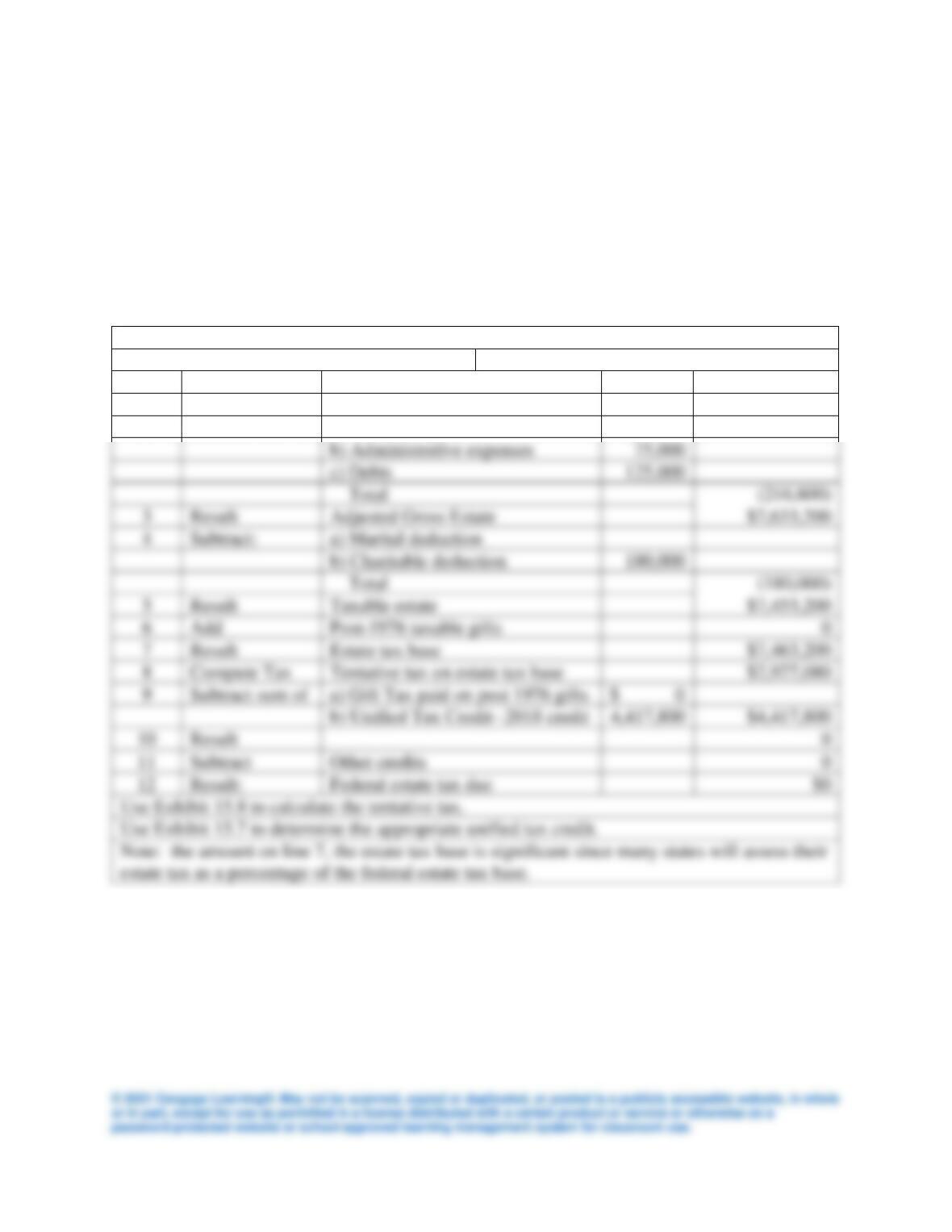
7. Calculation of estate taxes. Use Worksheet 15.1. When Pablo Gonzalez died unmarried
in 2018, he left an estate valued at $7,850,000. His trust directed distribution as follows:
$20,000 to local hospital, $160,000 to his alma mater, and the remainder to his three adult
children. Death-related costs and expenses were $16,800 for funeral expenses, $40,000 paid
to attorneys, $5,000 paid to accountants, and $30,000 paid to the trustee of his living trust.
In addition, there were debts of $125,000. Use Worksheet 15.1 and Exhibits 15.7 and 15.8
to calculate the federal estate tax due on his estate.
Worksheet 15.1 [as a word table] Chapter 15, Exercise 7
Computing Federal Estate Tax Due
Name: Pablo Gonzalez
Date: 2018
Line
Computation
Item
Amount
Total Amount
1
Gross Estate
$7,850,000
2
Subtract sum of
a) Funeral expenses
$16,800
b) Administrative expenses
125,000
Total
3
Result
Adjusted Gross Estate
$7,633,200
4
Subtract:
a) Marital deduction
b) Charitable deduction
180,000
Total
5
Result
Taxable estate
$7,453,200
6
Add
Post-1976 taxable gifts
7
Result
Estate tax base
$7,463,200
8
Compute Tax
Tentative tax on estate tax base
$2,927,080
9
Subtract sum of
a) Gift Tax paid on post 1976 gifts
$ 0
b) Unified Tax Credit—2018 credit
4,417,800
$4,417,800
Subtract
Other credits
Result:
Federal estate tax due
Use Exhibit 15.8 to calculate the tentative tax.
Use Exhibit 15.7 to determine the appropriate unified tax credit.
estate tax as a percentage of the federal estate tax base.
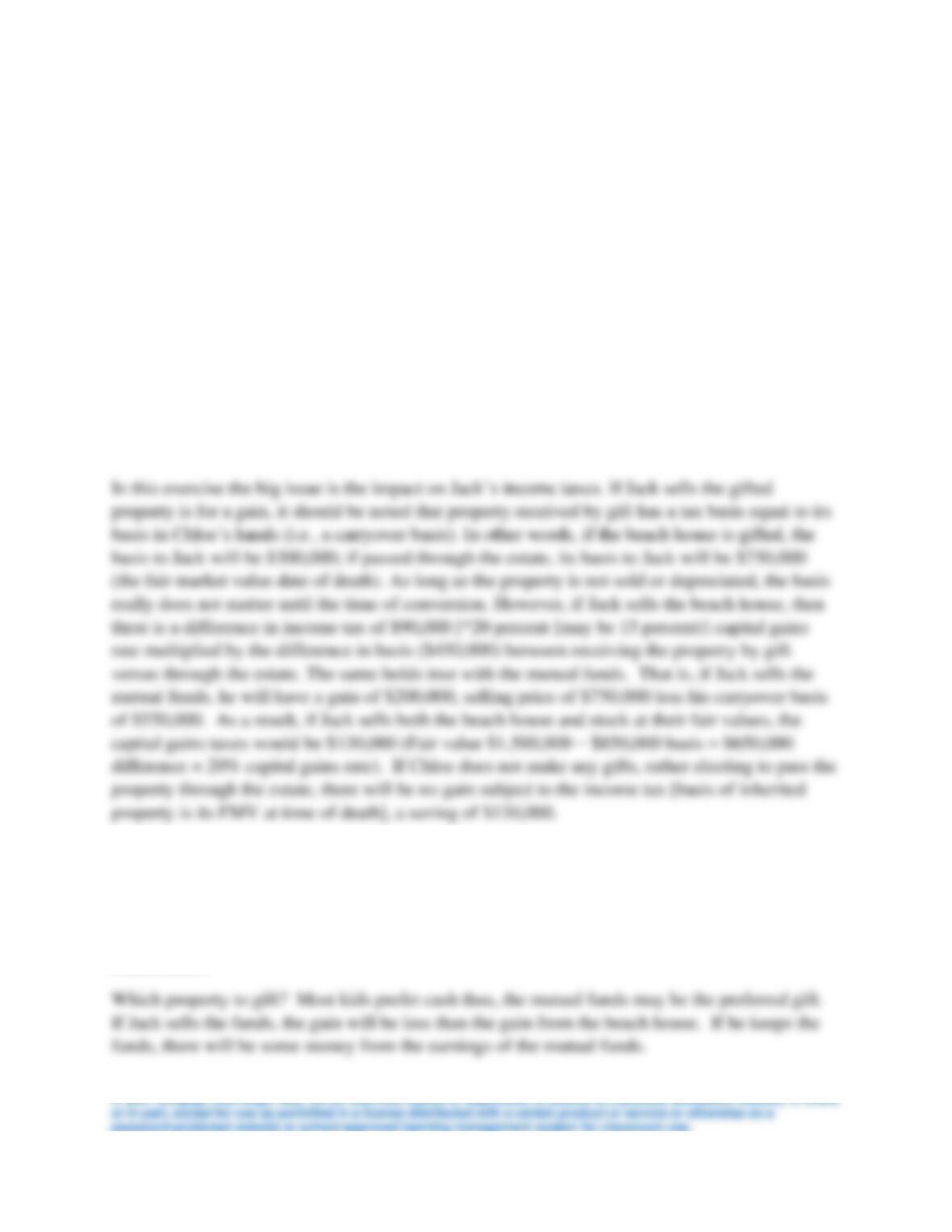
8. Lifetime gifting strategy. Chloe Parker has accumulated substantial wealth and plans
to gift some of her wealth to her son, Jack. She is considering two assets: a beach house,
which cost $300,000 twenty years ago and now has a fair market value of $750,000; and
shares in three mutual funds, which cost her $550,000 several years ago and now have a
fair market value of $750,000.
Prepare a memo advising Chloe which property to give to Jack. In your memo, consider
two scenarios: one where Jack sells the property and one where he does not.
Student memo formats may vary but should include some of the following information regarding
Chloe’s gift to her son Jack and whether he decides to keep the gift or sell it.
Giving gifts reduce the taxable estate in two ways. First, any future appreciation of the gifted
property is excluded from the estate because the decedent does not own the property on the date
of death. Second, if the gift is so large that taxes are due, the money used to pay the tax is also
removed from the estate. (There is an exception for gift taxes paid within 3 years of death.)
If Jack intends to keep the property, for example keep the beach house, then the basis issue is of
little matter. As noted above, basis only matters if the property is to be sold. The other issue is
income. The mutual funds will generate income (dividends and capital gains) that will be
available to Jack and taxable to Jack most likely at the capital gains rate (20 or 15 percent). The
beach house will not generate income, but will have expenses such as taxes, insurance, and
maintenance.
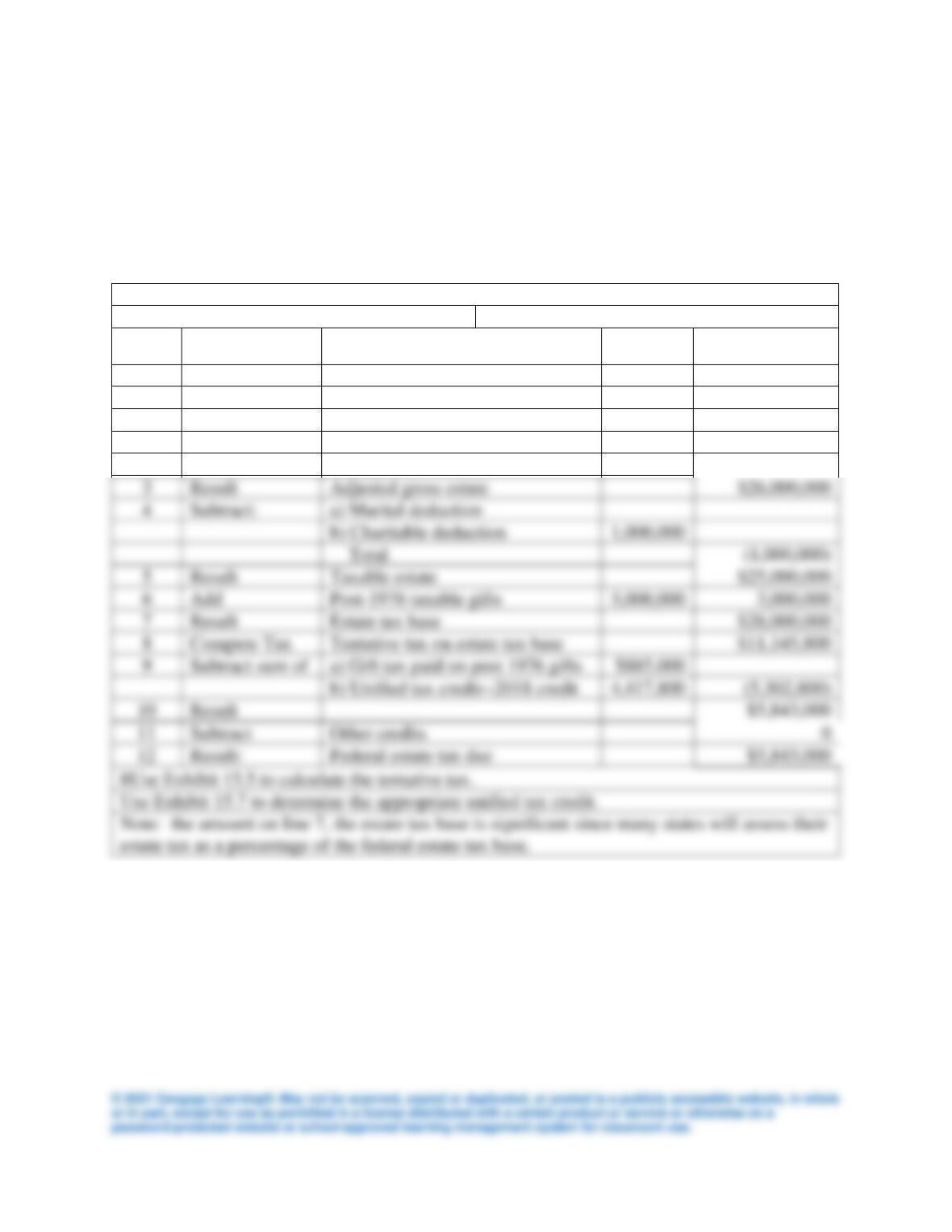
9. Calculating federal transfer tax on estate. Ryan Cook died in 2018, leaving an estate of
$26 million. Ryan’s wife, Isabella, died in 2015. In 2013, Ryan gave his son, Aiden, property
that resulted in a taxable gift of $3 million and upon which Ryan paid $885,000 in transfer
taxes. Ryan had made no other taxable gifts during his life. His will provided a charitable
bequest of $1 million to his church. Determine the federal transfer tax on Ryan’s estate.
Worksheet 15.2 [as a word table] Chapter 15, Exercise 9
Computing Federal Estate Tax Due
Name: Ryan Cook
Date: 2018
Line
Computation
Item
Amount
Total Amount
1
Gross estate
$26,000,000
2
Subtract sum of
a) Funeral expenses
b) Administrative expenses
c) Debts
Total
3
Result
Adjusted gross estate
4
Subtract:
a) Marital deduction
b) Charitable deduction
1,000,000
Total
5
Result
Taxable estate
6
Add
Post-1976 taxable gifts
3,000,000
7
Result
Estate tax base
9
Subtract sum of
a) Gift tax paid on post 1976 gifts
b) Unified tax credit—2018 credit
4,417,800
Subtract
Other credits
Result:
Federal estate tax due
8Use Exhibit 15.5 to calculate the tentative tax.
Use Exhibit 15.7 to determine the appropriate unified tax credit.
estate tax as a percentage of the federal estate tax base.
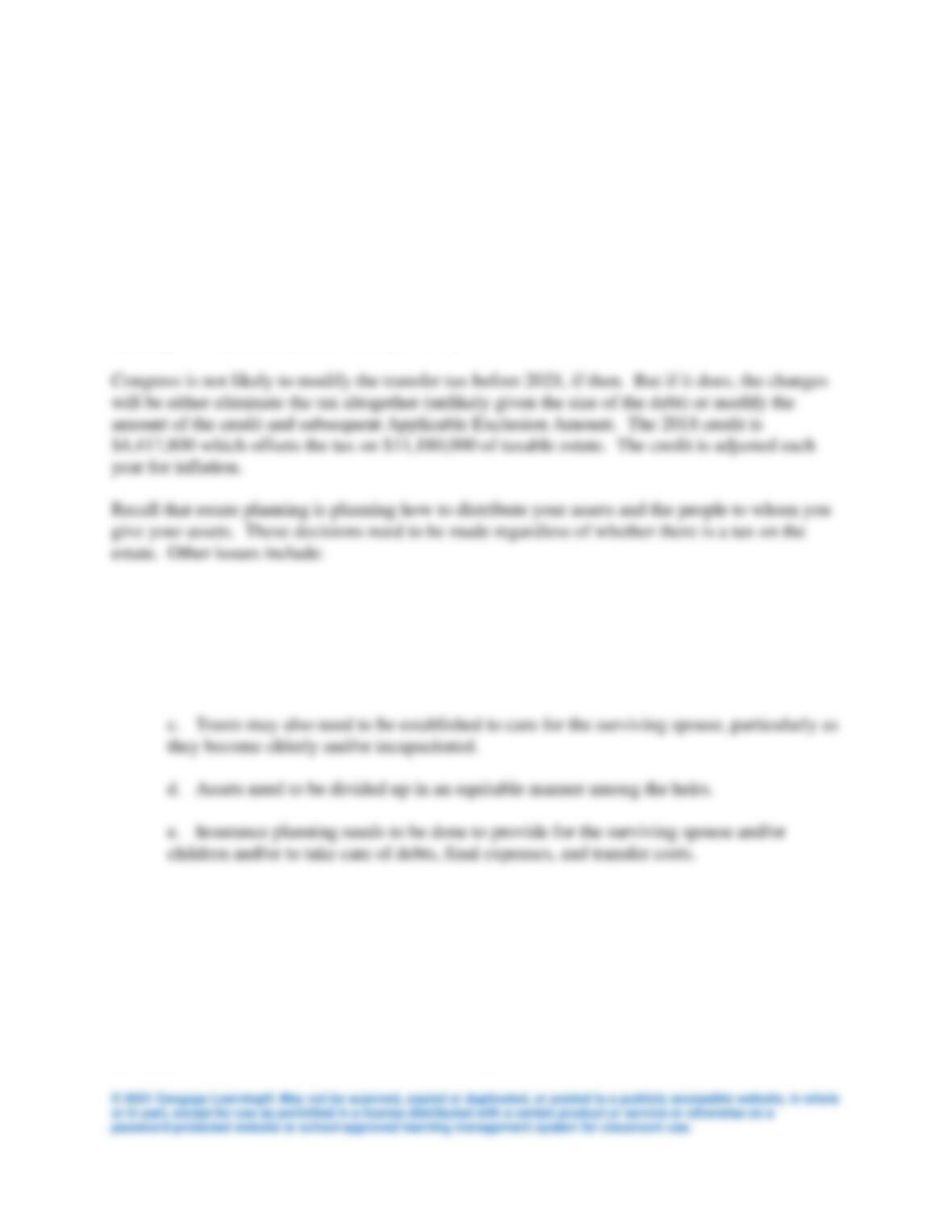
10. Recent estate taxes legislation. Summarize important legislation affecting estate taxes,
and briefly describe the impact on estate planning. Explain why getting rid of the estate
tax doesn’t eliminate the need for estate planning.
The Congress is always discussing changes to the income and transfer tax. In 2017, the U.S.
House of Representatives voted to eliminate the estate tax in 2026 while keeping the gift tax, but
the U.S. Senate did not agree. It is uncertain what will happen by the time 2026 comes around.
The gift tax is seen as necessary to prevent splitting the income among the family in order to
minimize the family’s income tax. Thus, when planning an estate, focus on flexibility so you can
react when or if the law is changed. The tax impact of your estate plan should be reviewed
annually to ensure the outcome is as you intend.
a. When minor children are involved, guardians need to be named in the event that both
parents die. Otherwise, the state will decide the guardian for the children.
b. Trusts need to be established to take care of certain special needs children for the
remainder of their lives.

Critical Thinking Cases
15.1 A Long-Overdue Will for Nathan
Nathan Cooper, a man of many talents and deep foresight, has built a large fleet of
oceangoing oil tankers, now a wealthy man in his 60s, he resides in San Francisco, with his
second wife, Audrey, age 50. They have two sons, one in junior high and one a high-school
freshman. For some time, Nathan has considered preparing a will to ensure that his estate
will be property distributed when he dies. A survey of his estate reveals the following:
Ranch in New Mexico
$1,000,000
Condominium in Denver
800,000
House in San Francisco
Franchise in yogurt stores
Stock in Google
Stock in Apple
Stock in Gold Mines International
Other assets
200,000
Total Assets
The house and the Gold Mines International shares are held in joint tenancy with his wife,
but all other property is in his name alone. He desires that there be a separate fund of $1
million for his sons’ education and that the balance of his estate be divided as follows: 40
percent to his sons; 40 percent to his wife, and 20 percent to given to other relatives, friends
and charitable institutions. He has scheduled an appointment for drafting his will with his
attorney and close friend, Sebastian Rogers. Nathan would like to appoint Sebastian, who
is 70 years old and Nathan’s 40-year old cousin Leo Cooper (a CPA) as co-executors. If one
of them predeceases Nathan, he’d like First National Bank to serve as co-executor.
Critical Thinking Questions
1. Does Nathan really need a will? Explain why or why not? What would happen to his
estate if he were to die without a will?
Yes, Nathan really needs a will. Without a valid will, the statutes of the state of California would
2. Explain to Nathan the common features that need to be incorporated into a will.
His will should contain eight distinct parts:
(1) Introductory Clause—stating his place of residence and nullifying old and forgotten wills
and codicils (legally binding modifications of an existing will).
(2) Direction of Payments—directing his estate with respect to certain payments of expenses.
(3) Disposition of Property—disposing of his personal effects, passing money to specified
parties, or distributing his residual assets after specific gifts have been made.
3. Might the manner in which titles are held thwart his estate planning desires? What
should be done to avoid problems?
The property titled joint with right of survivorship will pass to the survivor regardless of a will
4. Is a living trust an appropriate part of his estate plan? How would a living trust change
the nature of Nathan’s will?
Certainly, either a living will or a durable power for health care should be provided. Nathan
5. How does the age of his children complicate the estate plan? What special provisions
should he consider?
6. What options are available to Nathan if he decides later to change or revoke the will? Is
it more difficult to change a living trust?
Minor changes in the will may be made by a codicil, a short document that reaffirms all existing
7. What duties will Sebastian Rogers and Leo Cooper have to perform as co-executors of
Nathan’s estate? If a trust is created, what should Nathan consider in his selection of a
trustee or co-trustees? Might Sebastian and Leo, serving together, be a good choice?
As co-executors of Nathan’s estate, Sebastian Rogers, his close friend and attorney, and Leo
Cooper, his cousin, will share the duties of estate administration. Upon Nathan’s death, they
must take inventory and value his assets, pay his debts or provide for payment of debts that are