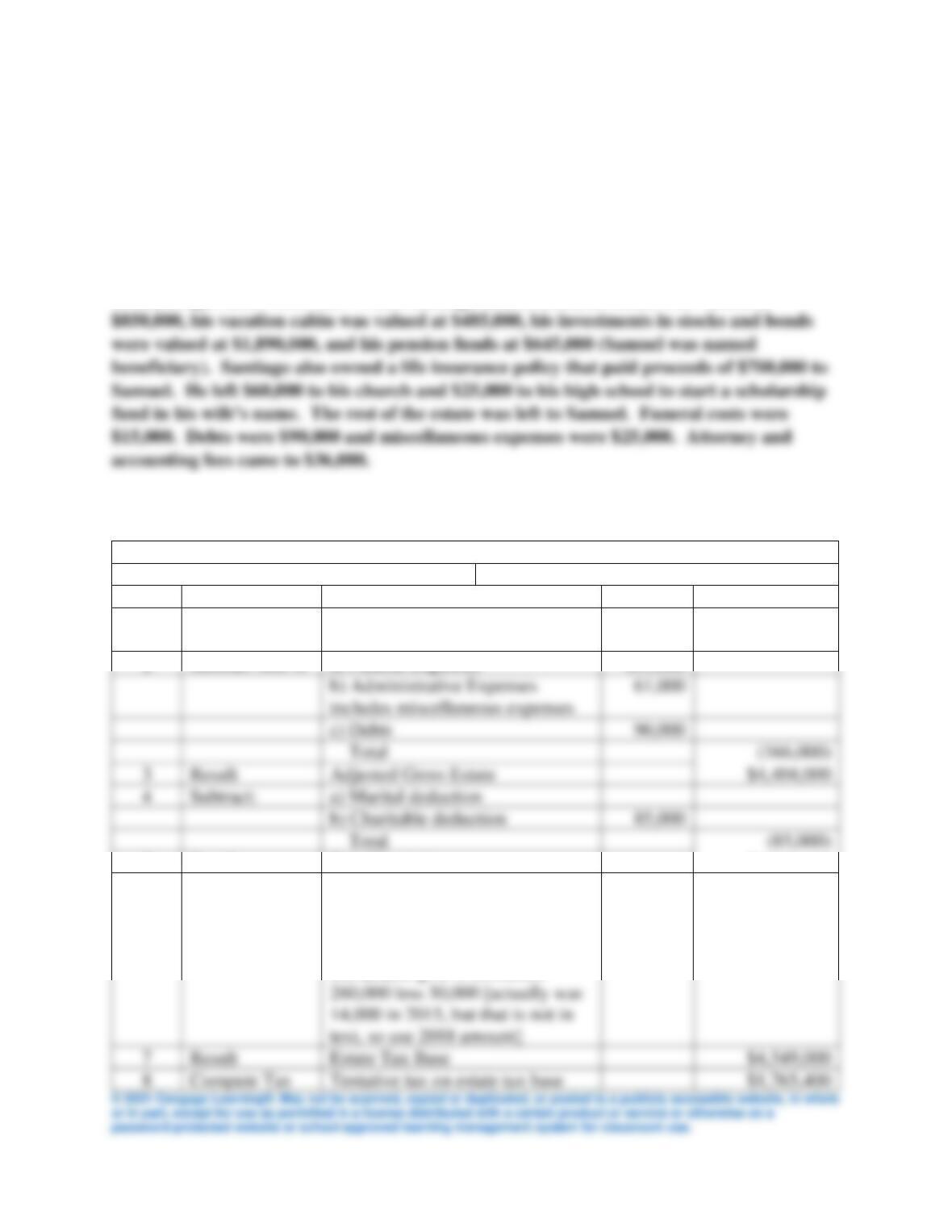
15.2 Estate Taxes on Santiago Hernandez’s Estate
Santiago Hernandez’s was 65 when he retired in 2014. Maria, his wife of 40 years, passed
away the next year. Her will left everything to Santiago. Although Maria’s estate was
valued at $2,250,000, there was no estate tax due because of the 100 percent marital
deduction. Their only child, Samuel, is married to Luna. They have four children, two in
college and two in high school. In 2015, Santiago made a gift of Microsoft stock worth
$260,000 jointly to Samuel and Lina. Because of the two annual exclusions and the unified
credit, no gift taxes were due. When Santiago died in 2018, his home was valued at
Use Worksheet 15.1 to guide your calculations as you complete these exercises.
Worksheet 15.1 is below.
Computing Federal Estate Tax Due
Name: Santiago Hernandez
Date: June 4, 2018
Line
Computation
Item
Amount
Total Amount
1
Gross Estate[850,000 + 485,000 +
1,890,000 + 645,000 + 700,000]
$4,570,000
2
Subtract sum of
a) Funeral Expenses
includes miscellaneous expenses
Total
3
Result
Adjusted Gross Estate
$4,404,000
4
Subtract:
a) Marital deduction
b) Charitable deduction
Total
5
Result
Taxable estate
$4,319,000
6
Add
Post-1976 taxable gifts (Assume
that wife has died at time of gift.
Gift made to both Samuel and
Luna, so two exclusions apply.
230,000
7
Result
Estate Tax Base
$4,549,000
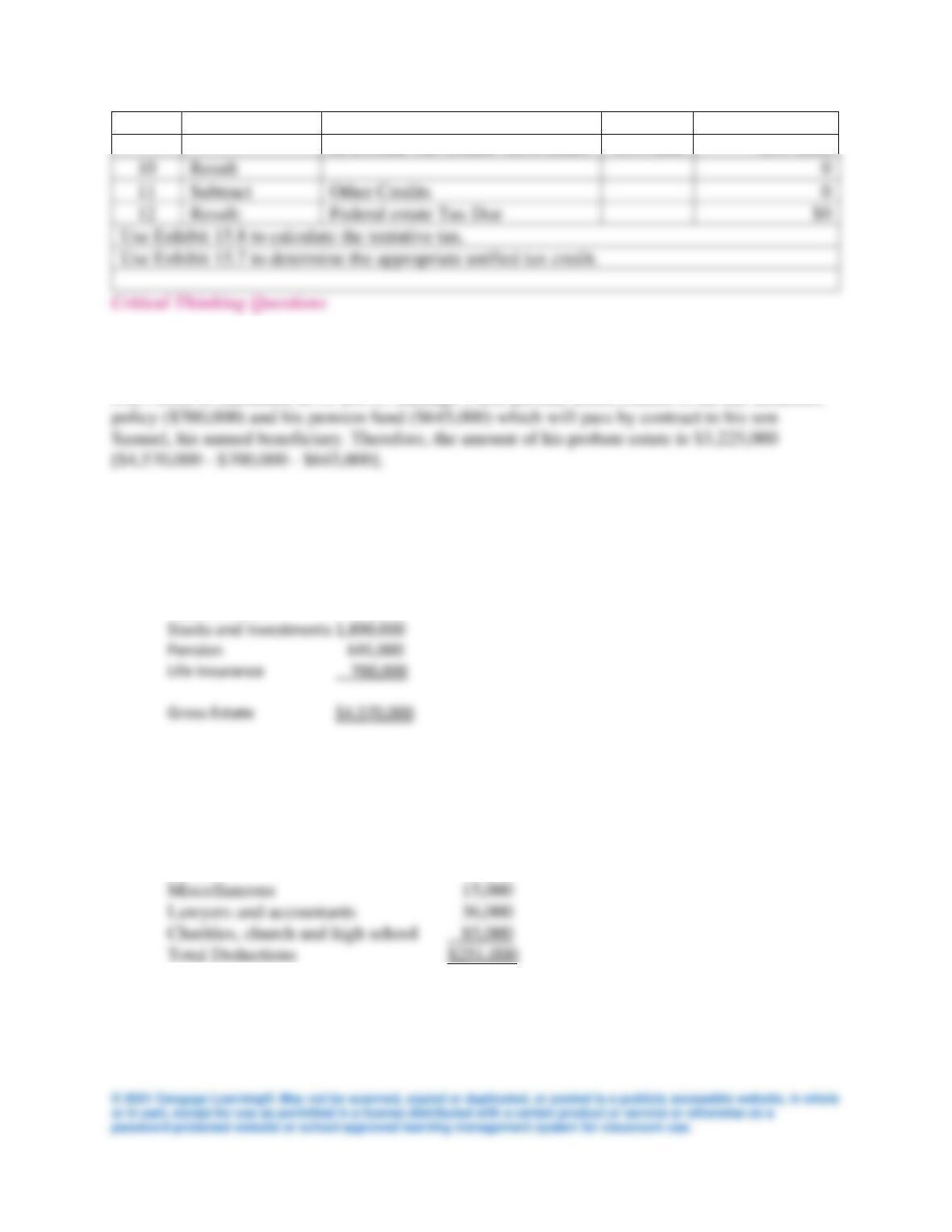
9
Subtract sum of
a) Gift Tax paid on post 1976 gifts
0
1. Compute the value of Santiago’s probate estate.
The probate estate consists of the gross estate less non-probate assets. The gross estate amount of
2. Compute the value of Santiago’s gross estate.
Gross estate is:
Home $850,000
Vacation Cabin 485,000
3. Determine the total allowable deductions.
Deduction are:
Funeral Expenses $ 15,000
Debts 90,000
4. Calculate the estate tax base, taking into account the gifts to Samuel and Luna
(remember that the annual exclusions “adjust” the taxable gifts).
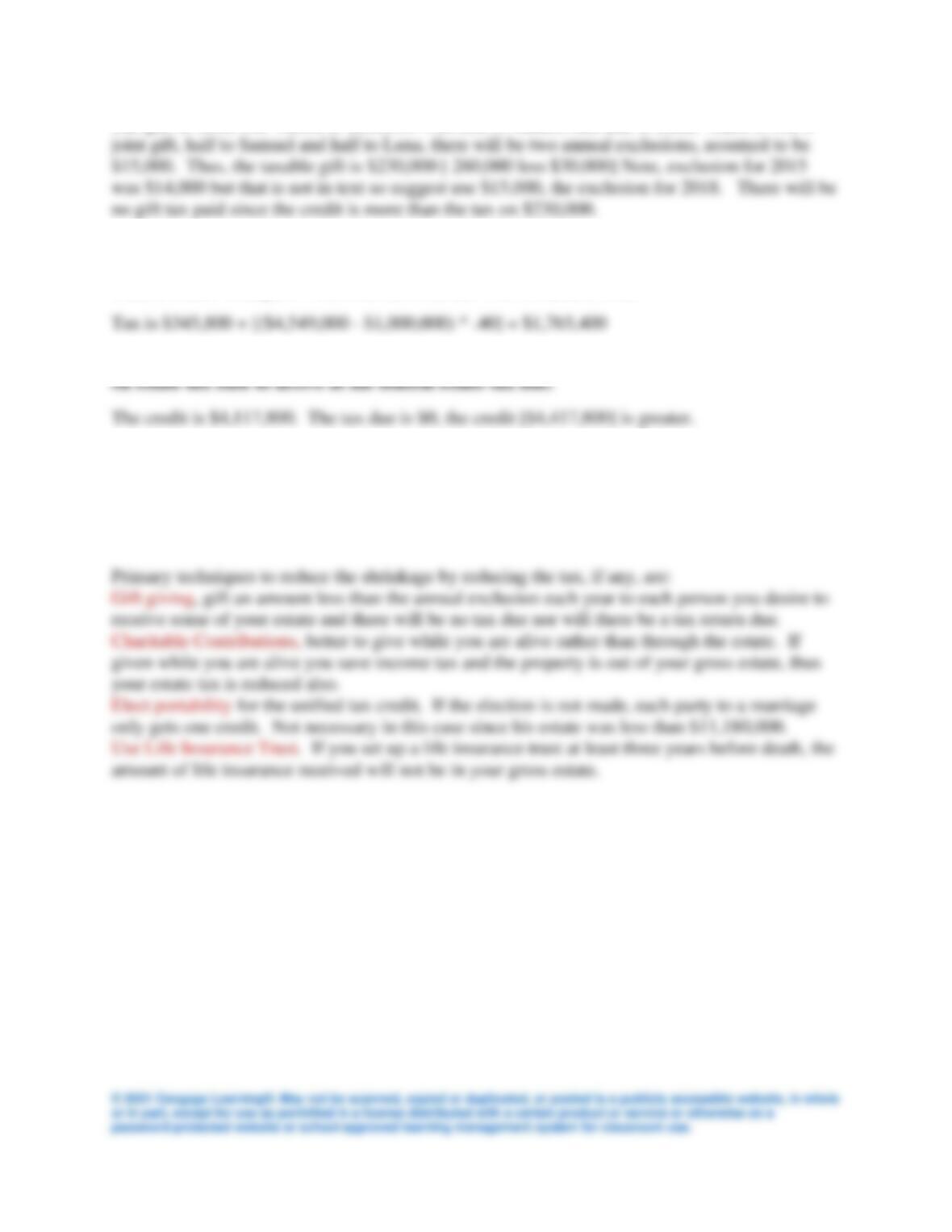
5. Use Exhibit 15.8 to determine the tentative tax on estate tax base.
Taxable estate with gifts = $4,549,000, from line 7 of Worksheet 15.2.
6. Subtract the appropriate unified tax credit (Exhibit 15.7) for 2018 from the tentative tax
7. Comment on the estate shrinkage experienced by Santiago’s estate. What might have
been done to reduce this shrinkage? Explain.
Santiago’s estate did not shrink due to taxes. Investments need to be managed and there may
have been some shrinkage due to not monitoring the investments.
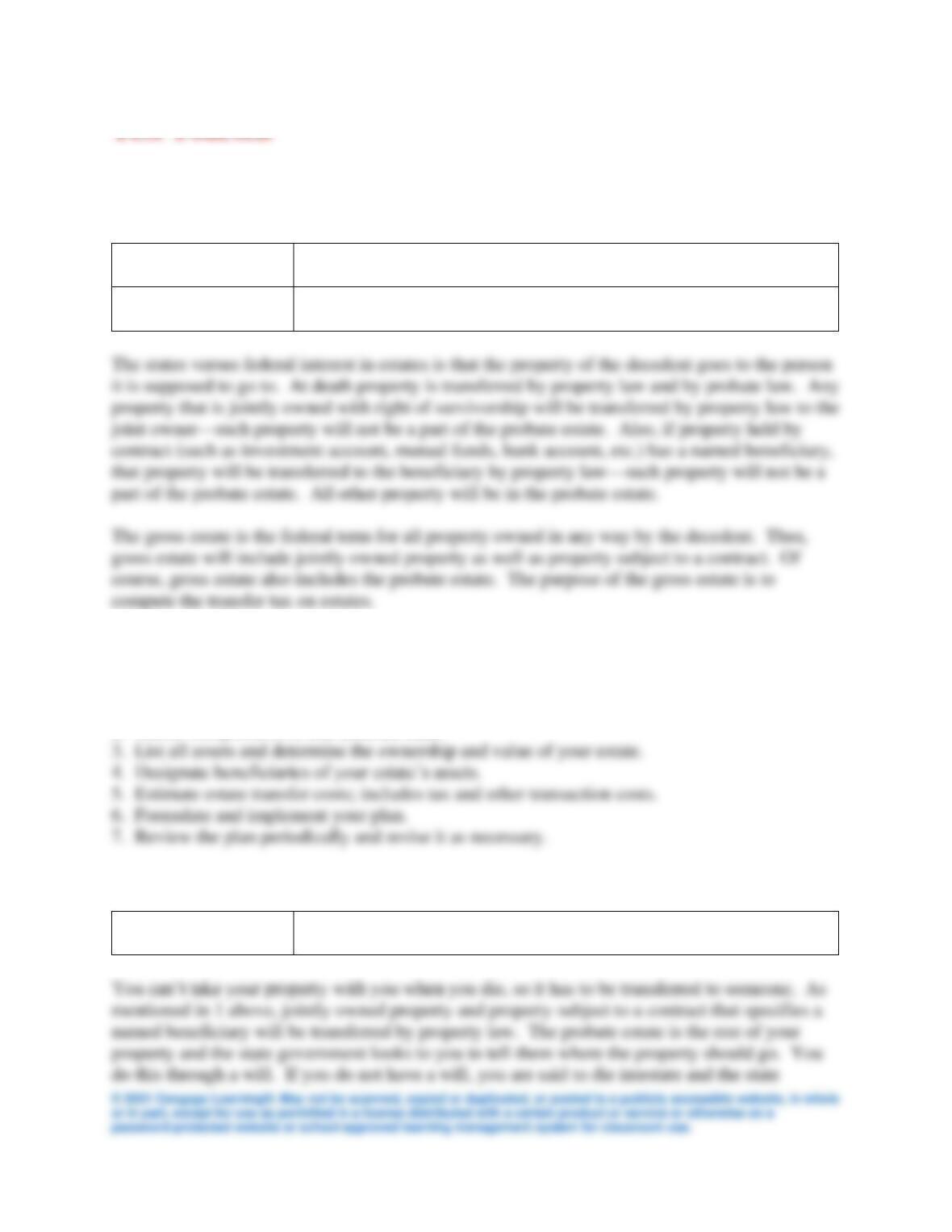
15-1 Discuss the importance and goals of estate planning. Explain why estates often
break up. Distinguish between the probate estate and the gross estate.
probate estate
The real and personal property owned by a person that can be
transferred at death.
gross estate
All property that might be subject to federal estate taxes on a person’s
death.
15-2 Briefly describe the steps involved in the estate planning process.
Exhibit 12.2 list seven steps in the estate planning process. They are:
1. Assess your family situation and set estate planning goals.
2. Gather comprehensive and accurate data.
15-3 What is a will? Why is it important? Describe the consequences of dying intestate.
will
A written and legally enforceable document expressing how a
person’s property should be distributed on his or her death.
15-4 Describe the basic clauses normally included in a will and the requirements
regarding who may make a valid will.
Exhibit 15.5 displays a sample will with eight sections or clauses that are normally found in a
will. Section 15-2c of the chapter discusses the common features of the will. The will must do
three things:
• Provide a plan for distributing the testator’s assets according to his or her wishes,
the beneficiaries’ needs and federal and state dispositive tax laws.
15-5 How can changes in the provisions of a will be made legally? In what four ways can
a will be revoked?
Minor changes in the will may be made by a codicil, a short document that reaffirms all existing
provisions in the will except the one to be changed. The codicil should be executed and
witnessed in the same formal manner as a will.
15-6 Explain these terms: (a) intestacy, (b) testator, (c) codicil, (d) letter of last
instructions.
intestacy
The situation that exists when a person dies without a valid will.
testator
The person who makes a will that provides for the disposition of
property at his or her death.
letter of last
An informal memorandum that is separate from a will and contains
15-7 What is meant by the probate process? Who is an executor, and what is the
executor’s role in estate settlement?
In the probate process, money owed to the decedent is collect, creditors (including tax
15-8 Describe briefly the importance of these documents in estate planning: (a) power of
attorney, (b) living will, (c) durable power of attorney for health care, and (d)
ethical will.
Power of Attorney: Through a power of attorney, you give a person complete control over your
financial affairs. The “attorney” may sell your property, write checks on your accounts, manage
your property in every sense of the word. If you do not wish to give complete control, you may
15-9 Define and differentiate between joint tenancy and tenancy by the entirety. Discuss
the advantages and disadvantages of joint ownership. How does tenancy in common
differ from joint tenancy?
Joint tenancy describes a type of property ownership where there are more than one owner and
that all surviving owners take ownership of all the property at the death of one of the owners.
15-10 What is the right of survivorship? What is community property and how does it
differ from joint tenancy with regard to the right of survivorship?
right of
survivorship
The right of surviving joint owners of property to receive title to the
deceased joint owner’s interest in the property.
community
property
All marital property co-owned equally by both spouses while living is
15-11 Describe the basic trust arrangement, and discuss typical reasons for establishing
trusts. What essential qualities should a trustee possess?
trust
A legal relationship created when one party transfers property to a
The essential qualities for a trustee are to honest and knowledgeable. The text specifies five
qualities:
1. Possess sound business knowledge and judgment.
15-12 What is a living (inter vivos) trust? Distinguish between a revocable living trust and
in irrevocable living trust.
living (inter vivos)
A trust created and funded during the grantor’s lifetime.
15-13 Explain each of these terms: (a) grantor, (b) trustee, (c) beneficiary, (d) pour-over
will, testamentary trust, and (f) irrevocable life insurance trust.
grantor
A person who creates a trust and whose property is transferred into it.
Also called settlor, trustor creator.
trustee
An organization or individual selected by a grantor to manage and
conserve property placed in trust for the benefit of the beneficiaries.
beneficiaries
Those who receive benefits—property or income—from a trust or
from the estate of a decedent. A grantor can be a beneficiary of his
own trust.
insurance trust
death, the life insurance is not included in the gross estate as long as
neither the estate nor decedent is the named beneficiary.
15-14 What is a gift, and when is a gift made? Describe the following terms as they relate
to the federal gift taxes: (a) annual exclusion, (b) gift splitting, (c) charitable
deduction, and (d) marital deduction.
A gift is a transfer for less than full and adequate consideration. The donor must have charitable
or altruistic motives. The gift is made when the ownership of the property is transferred to the
15-15 Discuss the reasons estate planners cite for making lifetime gifts. How can gift
giving be used to reduce estate shrinkage?
The estate tax is assessed on the property owned by the decedent at the time of their death. If the
property was gifted before their death, it is not in the gross estate. Any taxable gift made after
15-16 Explain the general nature of the federal estate tax. How does the unified tax credit
affect the amount of estate tax owed? What is the portability concept?
The unified transfer tax applies to two type of transfers: transfers by gift [referred to as the gift
tax] and transfers through an estate [referred to as the estate tax]. The beginning point for the
estate tax is the gross estate, all property owned, in whole or part, by the decedent on the date of
death. From this amount deductions are taken including expenses relating to the estate,
15-17 Explain the general procedure used to calculate the federal estate tax due.
Compute the gross estate, subtract the total deductions, add taxable gifts since 1976, compute tax
15-18 Describe and discuss each of the techniques used in estate planning.
Primary techniques are:
Gift giving, gift an amount less than the annual exclusion each year to each person you desire to
receive some of your estate and there will be no tax due nor will there be a tax return due.
Key Terms
administrator
The personal representative of the estate appointed by the court if the
decedent dies intestate.
annual exclusion
Under the federal gift tax law, the amount that can be given each year
without being subject to the gift tax—for example, $14,000 in 2015.
This amount is indexed for inflation.
applicable exclusion
amount (AEA)
Credit given to each person that can be applied to the amount of
federal estate tax owed by that person at death. In 2009 the AEA was
$3,500,000. In 2015, the AEA is $5,400,000.
A document that legally modifies a will without revoking it.
community
All marital property co-owned equally by both spouses while living is
durable power of
attorney for
financial affairs and act on this or her behalf.
financial matters
durable power of
attorney for health
care
A written power of attorney authorizing an individual to make health
care decisions on behalf of the principal when the principal is unable
to make such decisions. Also called advanced directive for health
care.
estate planning
The process of developing a plan to administer and distribute your
assets in a manner consistent with your wishes and the needs of your
survivors, while minimizing taxes.
estate tax
A tax levied on the value of property transferred at the owner’s death.
ethical will
A personal statement left for family, friends, and community that
the future. Also called legacy letter.
executor
will.
gift splitting
A method of reducing gift taxes, a gift given by one spouse, with the
consent of the other spouse, can be treated as if each had given one-
half of it.
gift tax
A tax levied on the value of certain gifts made during the giver’s
lifetime.
grantor
A person who creates a trust and whose property is transferred into it.
Also called settlor, trustor creator.
gross estate
All property that might be subject to federal estate taxes on a person’s
death.
intestacy
The situation that exists when a person dies without a valid will.
Irrevocable life
insurance trust
An irrevocable trust in which the major asset is life insurance on the
irrevocable living
trust
A trust in which the grantor gives up the right to revoke or terminate
the trust.
joint tenancy
A type of ownership by two or more parties, with the survivor(s)
continuing to hold all such property on the death of one or more of the
owners.
letter of last
instructions
An informal memorandum that is separate from a will and contains
suggestions or recommendations for carrying out a decedent’s wishes.
living (inter vivos)
trust
A trust created and funded during the grantor’s lifetime.
living will
A document that precisely states the treatments a person wants if he or
she becomes terminally ill.
pour-over will
A provision in a will that provides for the passing of the estate—after
debts, expenses, taxes, and specific bequests—to an existing living
trust.
probate estate
The real and personal property owned by a person that can be
transferred at death.
probate process
The court-supervised disposition of a decedent’s estate.
revocable living
trust
A trust in which the grantor reserves the right to revoke the trust and
regain trust property. The grantor can serve as the initial trustee.
right of
survivorship
The right of surviving joint owners of property to receive title to the
tenancy by the
entirety
A form of ownership by husband and wife, recognized in certain
states, in which property automatically passes to the surviving spouse.
tenancy in common
A form of co-ownership under which there is no right of survivorship
and each co-owner can leave his or her share to whomever he or she
desires.
testamentary trust
process.
testator
The person who makes a will that provides for the disposition of
property at his or her death.
trust
A legal relationship created when one party transfers property to a
second party for the benefit of third parties.
trustee
An organization or individual selected by a grantor to manage and
conserve property placed in trust for the benefit of the beneficiaries.
unified rate
schedule
A graduated table of rates applied to all taxable transfers; used for
both federal gift and estate tax purposes.

unified tax credit
The credit that can be applied against the tentative tax on estate tax
base.
will
A written and legally enforceable document expressing how a
person’s property should be distributed on his or her death.
Preserving Your Estate
Chapter Outline
Learning Goals
I. Principles of Estate Planning
A. Who Needs Estate Planning?
1. People Planning
2. Asset Planning
II. Thy Will Be Done…
A. Absence of a Valid Will: Intestacy
B. Preparing the Will
C. Common Features of the Will
G. Letter of Last Instructions
H. Administration of an Estate
I. Other Important Estate Planning Documents
3. Ethical Wills
J. What about Joint Ownership?
B. Selecting a Trustee
C. Common Types and Characteristics of Trusts
1. Living Trusts
a. Revocable Living Trust
IV. Federal Unified Transfer Taxes
A. Gifts and Taxes
B. Is It Taxable?
C. Reasons for Making Lifetime Gifts
V. Calculating Estate Taxes
A. Computing the Federal Estate Tax
B. Portability
VI. Estate Planning Techniques