CFIN6 – CHAPTER 15
INTEGRATIVE PROBLEMS SOLUTIONS
Integrative Problem 15-1
a. Because cash is a nonearning asset, the goal of cash management is to reduce the amount of cash
held to the minimum necessary to conduct business.
d. Sound working capital management requires an ample supply of cash so:
(1) A firm has sufficient cash to take trade discounts, discounts that suppliers offer customers for
e. A firm can synchronize its cash flows by arranging to bill customers and to pay their own bills on
regular “billing cycles” throughout the month. Synchronized cash flows reduce the cash balances,
decrease required bank loans, lower interest expenses, and boost profits.
f. SSP’s disbursement float is the amount of funds tied up in checks that have been written but are
still in process and have not yet been deducted from the store’s checking account balance by the
bank. SSP’s disbursement float is $50,000 and is calculated as 5 days x $10,000.
g. To speed up collections, a lockbox plan can be used. A firm arranges to have its customers send
payments to post office boxes in local areas. A local bank picks up the checks, has them cleared in
the local area, and then transfers the funds by wire to the company’s concentration bank. This is
not a practical solution for Smith because he only has one shop. To speed up his collections, he
needs to concentrate on recording them as soon as they come in each day and making a bank
deposit daily.
To slow down disbursements, many firms write checks on banks located in distant cities. Another
method would be to use drafts. A draft must be transmitted to the issuer, who approves it and
deposits funds to cover it, and then it can be collected. Again, neither of these methods is effective
for Smith; however, he can wait until the due date to pay his bills.
Some securities that are not suitable to hold as near-cash reserves are: U.S. Treasury notes and
bonds, corporate bonds, state and local government bonds, preferred stocks, common stocks of
other corporations, and the firm’s own common stock.
Integrative Problem 15-2
a. The variables that make up a firm’s credit policy are (1) credit standards, (2) credit terms, (3)
collection policy, and (4) monitoring function.
Credit terms refer to the conditions of the credit sale, including the length of time until payment is
due, whether a cash discount is available for early payment, and so on. If a firm offers a cash
discount for early payment, all else equal, the average balance of accounts receivable will decrease
if some customer take the cash discount—without the cash discount, these customers would wait
until the due date to make payment. If a firm increases the cash discount it offers, generally sales
will increase because the customers of competitors will be attracted to the new credit terms.
find (perhaps too late) that the cash flow pattern associated with collections of credit sales has
changed significantly.
b. ACP and DSO measure the same thing—the average length of time the firm must wait after making
a sale before receiving payment. DSO is the more preferred business nomenclature. Under the
current credit policy, the DSO is approximately 19 days:
c. Of the $3,600,000 in current sales 62.5 percent are affected by the discount. So,
DiscountsOld = 0.02 x $3,600,000 x 0.625 = $45,000
d. Analysis of the change:
Current Proposal
Annual amounts:
Sales $ 3,600,000 $ 4,000,000
Operating expenses (75%) $(2,700,000) $(3,000,000)
Cash discount $( 45,000) $( 87,000)
Required return, r 10% 10%
Daily amounts:
Current Policy:
(7,500) 6,125* 3,200** 550***
0
30
0.0278%
10
60
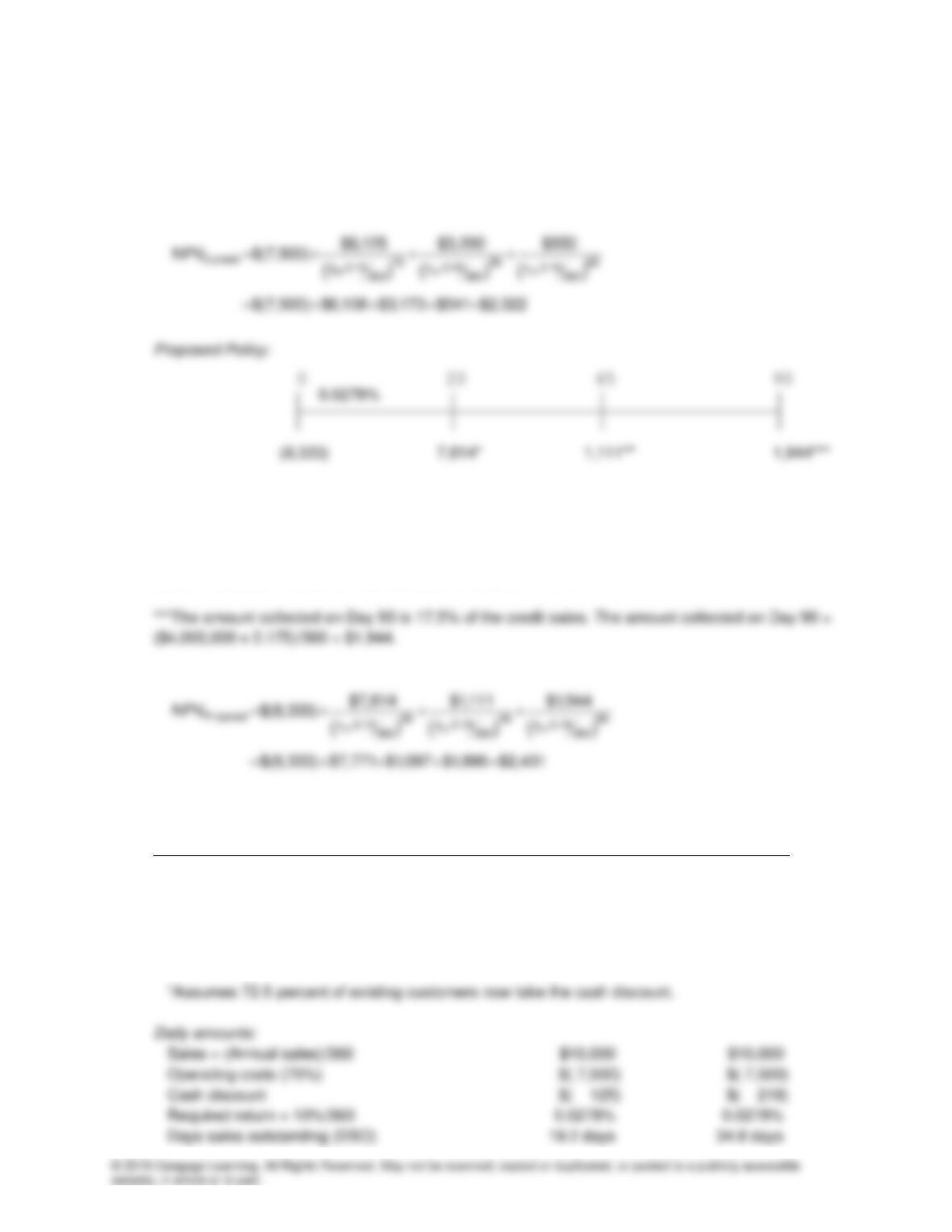
**The amount collected on Day 30 is 32% of the credit sales. Because bad debts are negligible, the
amount collected on Day 30 = [($3,600,000)(0.32)]/360 = ($10,000)0.32 = $3,200.
*** The amount collected on Day 60 is 5.5% of the credit sales. The amount collected on Day 60 =
[($3,600,000)(0.055)]/360 = ($10,000)0.055 = $550.
*72.5% of the customers take the 3% cash discount; thus, the amount paid by these customers on
Day 10 = [($4,000,000 x 0.97)(0.725)]/360 = $7,814.
**The amount collected on Day 45 is 10% of the credit sales. Because bad debts are negligible, the
amount collected on Day 45 = ($4,000,000 x 0.10)/360 = $1,111.
SSP should change the credit terms because NPV would be increased with the propose terms.
e. Current Proposal
Annual amounts:
Sales $ 3,600,000 $ 3,600,000
Operating expenses (75%) $(2,700,000) $(2,700,000)
Cash discount $( 45,000) $( 78,300)*
Required return, r 10% 10%
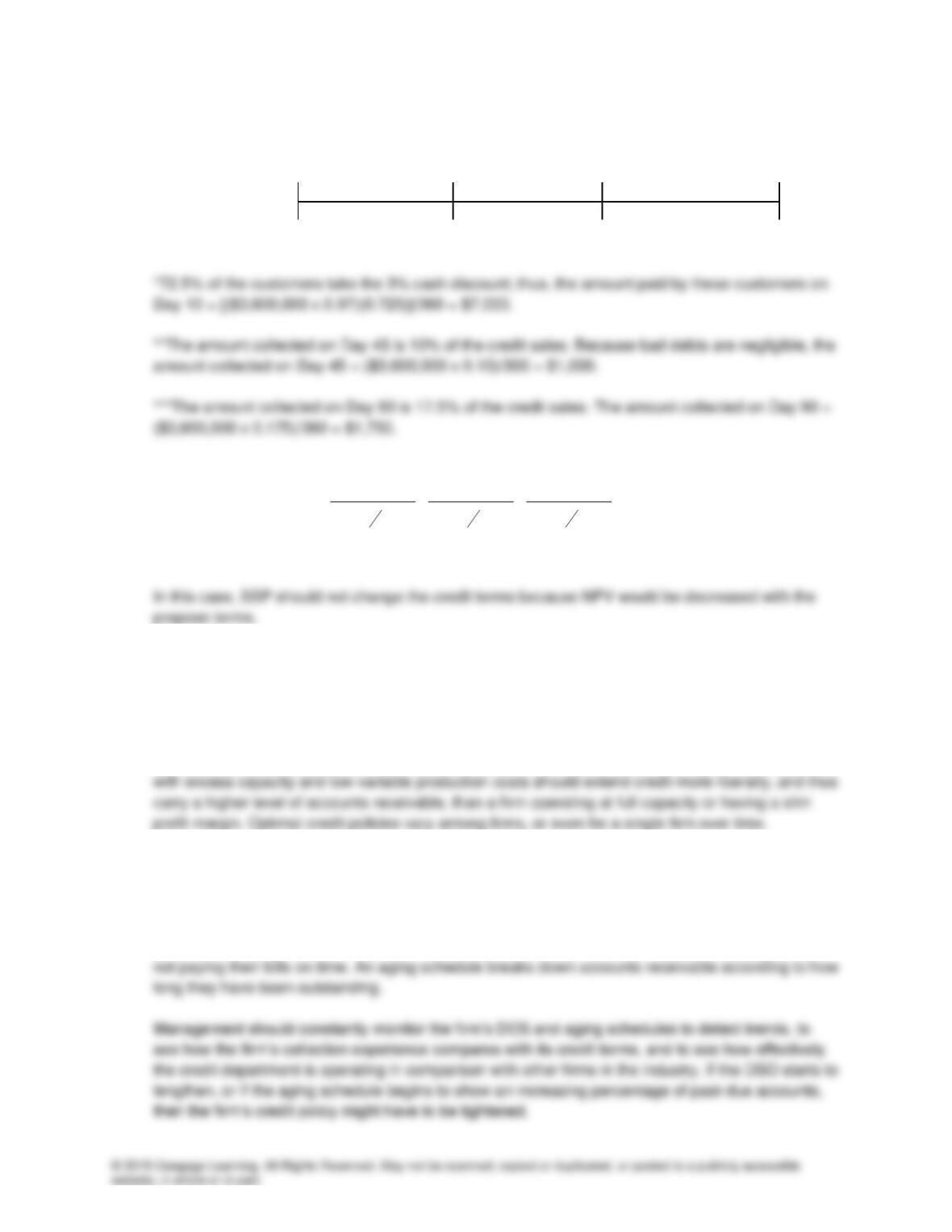
Proposed Policy:
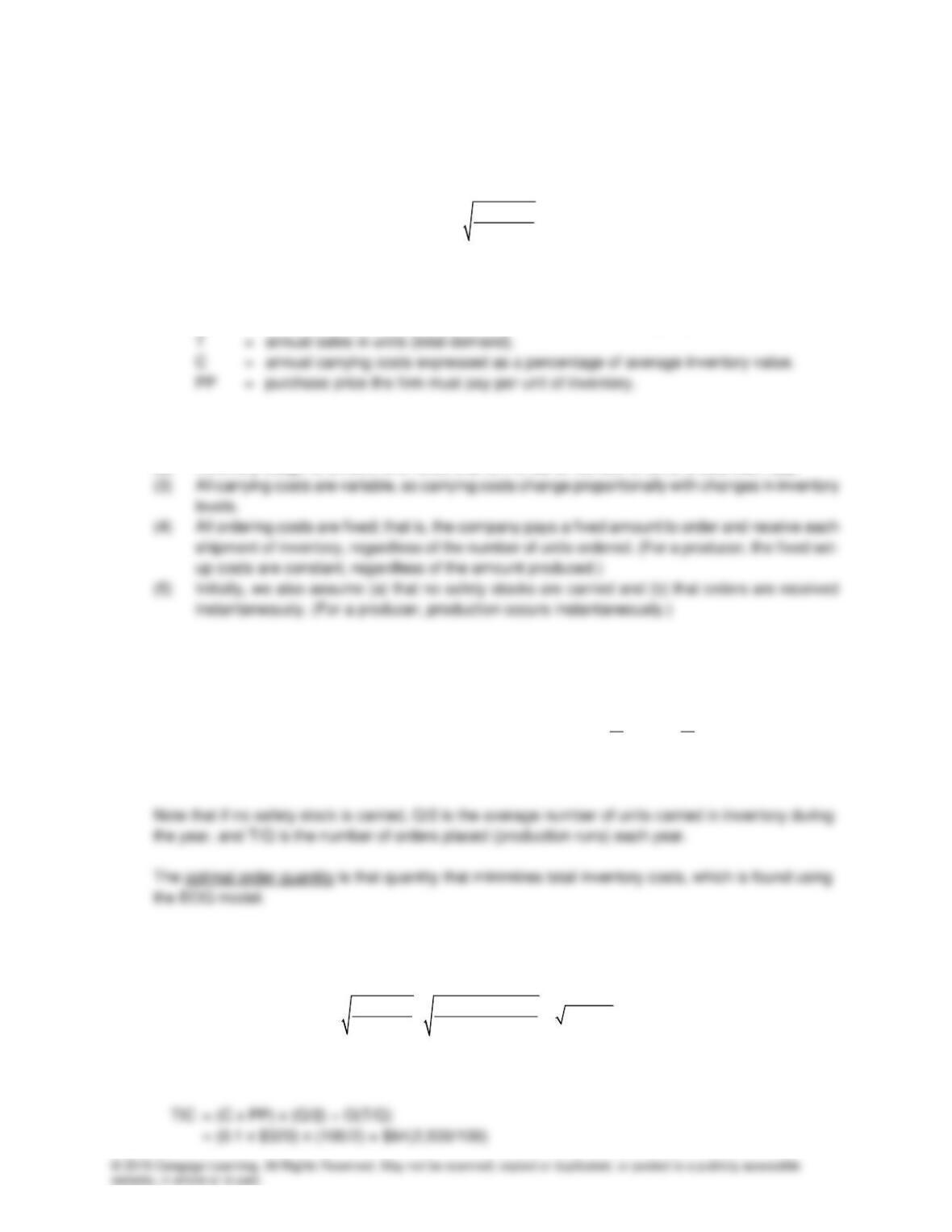
(7,500) 7,033* 1,000** 1,750***
( ) ( ) ( )
Pr oposal 20 45 90
0.10 0.10 0.10
360 360 360
$7,033 $1,000 $1,750
NPV $(7,500) 1 1 1
$(7,500) $6,994 $988 $1,707 $2,289
= + + +
+ + +
= + + + =
g(1). To monitor a firm’s accounts receivable means to analyze the effectiveness of its credit policy in an
aggregate sense.
g(2). A firm would want to monitor its receivables because the optimal credit policy, and hence the
optimal level of accounts receivable, depends on the firm’s own unique operating conditions. A firm
g(3). The DSO and aging schedule can be used to monitor a firm’s accounts receivable. If the firm’s DSO
is higher than the industry average it means that the firm might have an excessive investment in
receivables (unless of course it is a case of excess capacity and low variable production costs, as
discussed earlier). Also, the firm’s DOS should be compared with the firm’s own credit policy. If the
firm’s DSO is longer than the maximum credit period, then the firm’s customers, on average, are
0
45
0.0278%
20
90
Integrative Problem 15-3
a. The EOQ model is written:
2 O T
EOQ = C PP
Where
EOQ = economic ordering quantity, or the optimum quantity to be ordered each time an order
is placed.
O = fixed costs of placing and receiving an order (set up cost per production run).
The standard form of the EOQ model requires the following assumptions:
(1) All values (a) are known with certainty and (b) are constant over time.
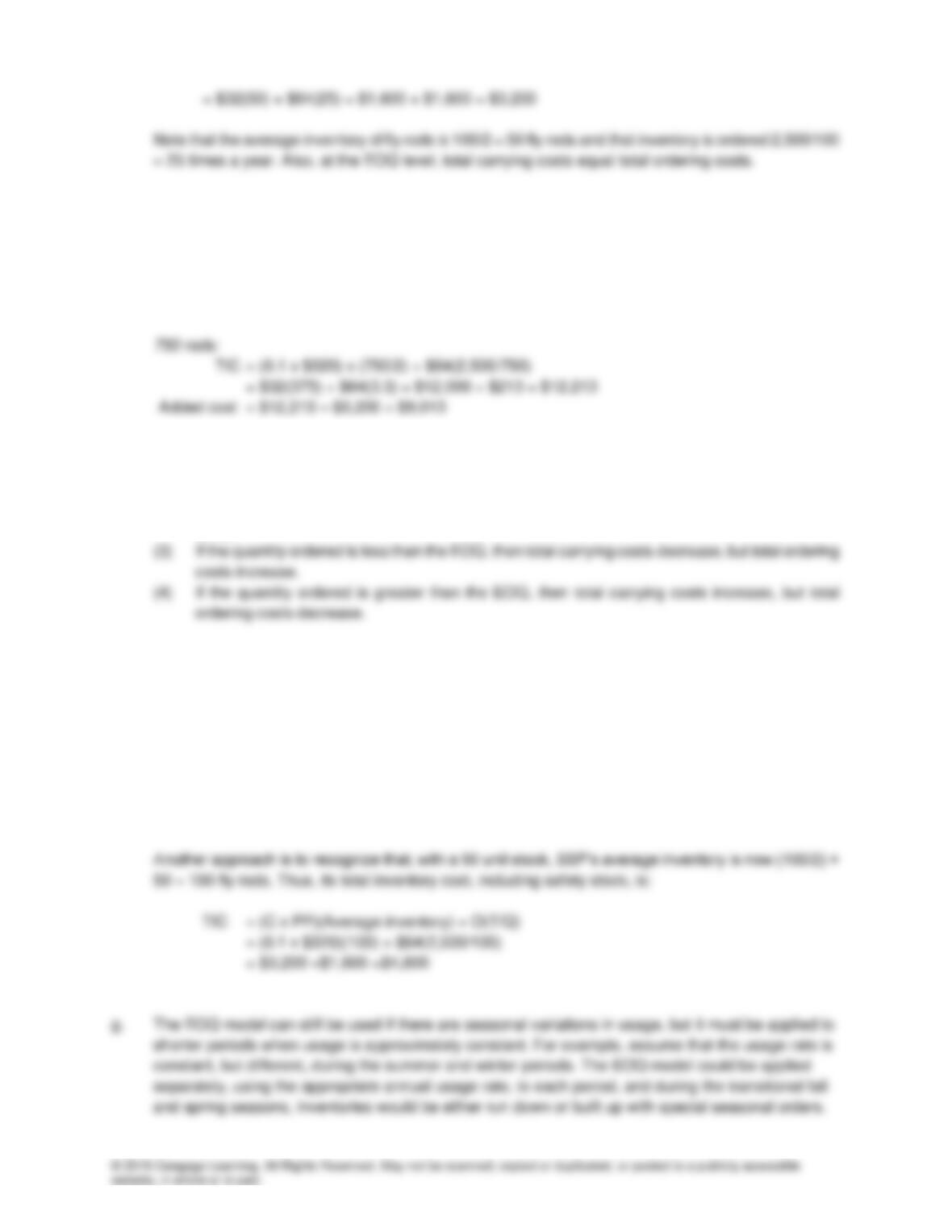
b. Under the assumptions listed above, total inventory costs (TIC) can be expressed as follows:
Total Total Total QT
Inventory = TIC = carrying + ordering = C PP + O
2Q
Costs costs costs
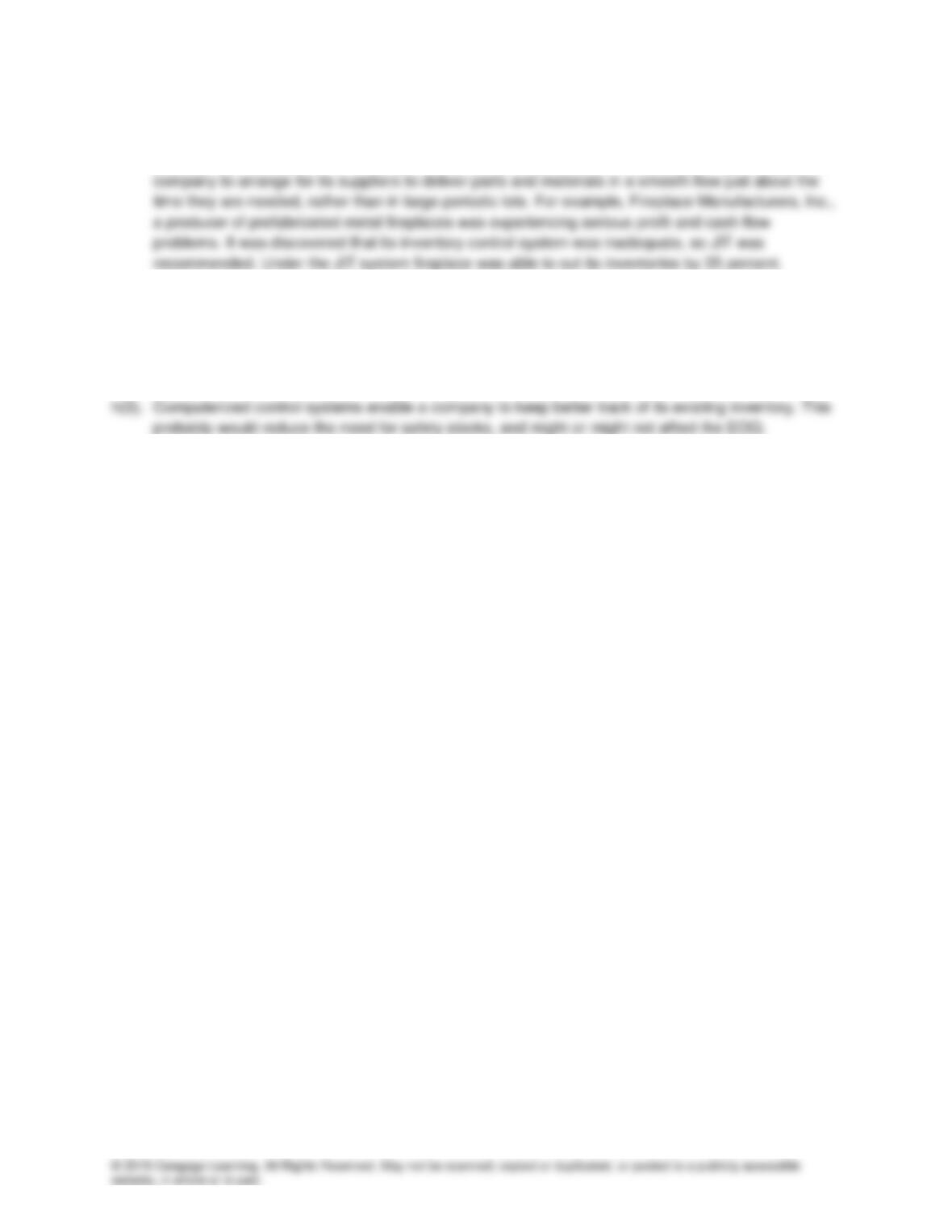
c. The EOQ and total inventory costs for the fly rods are:
2 O T 2 $64 2,500
EOQ = 10,000 = 100
C PP 0.1 $320
==
When 100 fly rods are ordered each time inventory is needed, total inventory costs equal:
d. 500 rods:
TIC = (C x PP) x (Q/2) + O(T/Q)
= (0.1 x $320) x (500/2) + $64(2,500/500)
= $32(250) + $64(5) = $8,000 + $320 = $8,320
Added cost = $8,320 – $3,200 = $5,120
Note the following points:
(1) At any order quantity other than EOQ = 100 units, total inventory costs are higher than they need
be.
(2) The added cost of not ordering the EOQ amount is not large if the quantity ordered is close to the
EOQ.
e. With an annual usage of 2,500 rods, SSP’s daily usage rate is 2,500/360 = 6.94 rods. If it takes three
days to receive an order, then SSP must order when its inventory of rods reaches 21 ≈ 6.94 x 3 days.
f. There are two ways to view the impact of safety stocks on total inventory costs. SSP’s total cost of
carrying the operating inventory is $3,200(see part c). Now the cost of carrying an additional 50 fly rods
is (C x PP)(Safety stock) = 0.1($320)(50) = $1,600. Thus, total inventory costs are increased by $1,600,
for a total of $3,200 + $1,600 = $4,800.
h(1). Just-In-Time (JIT) procedures are designed specifically to reduce inventories. If a JIT system were
put in place, it probably would obviate the need for using the EOQ model. The JIT system allows a
h(2). Air freight presumably would shorten delivery times and reduce the need for safety stocks. It might
or might not affect the EOQ.