1
2
3
4
5
6
7
8
14
15
16
17
18
19
20
21
22
23
24
25
26
27
28
29
30
31
32
33
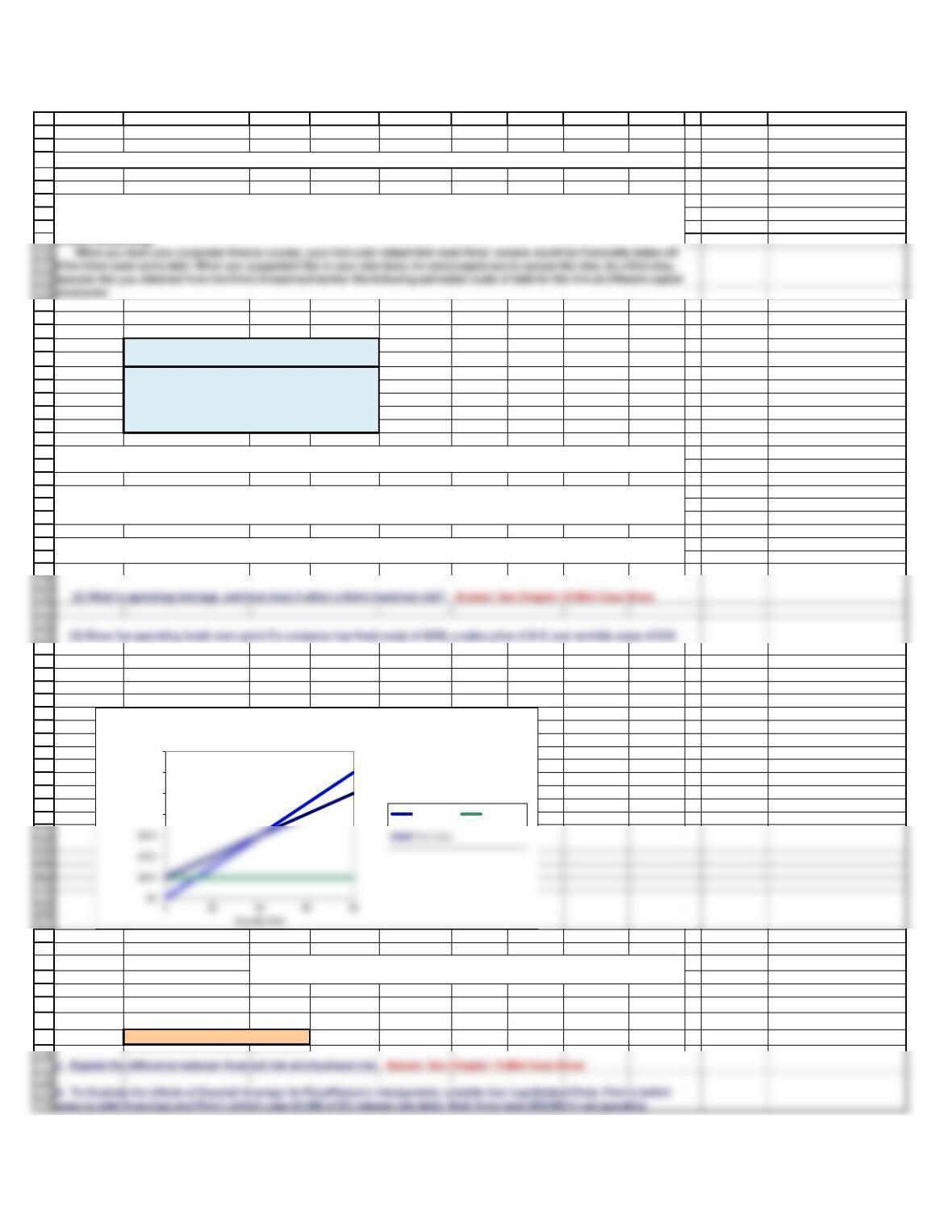
(3) Show the operating break even point if a company has fixed costs of $200, a sales price of $15, and variable costs of $10.
40
41
42
43
44
45
46
47
48
49
50
51
52
53
62
63
64
65
66
67
68
69
A B C D E F G H I J K L
11/21/2018
Situation
Input Data
Percent Financed
with debt, wdrd
0% 0.0%
20% 8.0%
30% 8.5%
40% 10.0%
50% 12.0%
F = $200 QRevenues
Fixed Costs
Total Costs
P = $15 0$0 $200 $200
V = $10 80 $1,200 $200 $1,000
Q BE = FC / (P – VC)
Q BE = F÷(P –VC)
Q BE = $200 ÷$15.00 – $10.00
Q BE = 40 Units.
Chapter 15. Mini Case
If the company were to recapitalize, debt would be issued, and the funds received would be used to repurchase stock.
a. Using the free cash flow valuation model, show the only avenues by which capital structure can affect value.. Answer: See
Chapter 15 Mini Case Show
b. (1) What is business risk? What factors influence a firm’s business risk? Answer: See Chapter 15 Mini Case Show
In words, the quantity at which a firm breaks even is found as the difference between
Price and Variable costs divided by Fixed costs.
Assume you have just been hired as a business manager of PizzaPalace, a regional pizza restaurant chain. The company’s EBIT
was $120 million last year and is not expected to grow. Pizza Palace is in the 25% state-plus-federal tax bracket, the risk-free
rate is 6 percent, and the market risk premium is 6 percent. The firm is currently financed with all equity and it has 10 million
capital, a 25% tax rate, and an expected EBIT of $2,400.
$800
$1,000
$1,200
$1,400
Operating Leverage
Revenues Fixed Costs
75
76
77
78
79
80
86
87
88
89
90
91
92
NI $1,800 $1,560
97
98
99
100
101
102
103
104
105
106
107
108
109
110
111
112
113
114
115
116
117
127
128
129
130
131
132
133
134
135
136
137
138
A B C D E F G H I J K L
Two Hypothetical Firms
Firm U Firm L
Capital $20,000 $20,000
Impact of Leverage
Firm U Firm L Distribution to Investors
EBIT $2,400 $2,400
(2) Calculate NOPAT, ROIC, and ROE for both firms.
xFirm U Firm L
EBIT = $2,400 $2,400
NOPAT = EBIT(1 – T) = $1,800 $1,800
Operating capital = $20,000 $20,000
ROIC = NOPAT/Op. Cap. = 9.0% 9.0%
Equity = $20,000 $16,000
Net income = $1,800 $1,560
ROE = NI/Equity = 9.0% 9.8%
(4) Why did leverage increase ROE in this example?
More total dollars paid to L’s investors:
U: NI = $1,800
L: NI + Int = $1,880
If EBIT = $1,200: Firm U Firm L
EBIT $1,600 $1,600
Interest $0 $320
EBT $1,600 $1,280
Taxes $400 $320
NI $1,200 $960
ROIC 6.0% 6.0%
ROE 6.0% 6.0%
e. What happens to ROE for Firm U and Firm L if EBIT falls to $1,600? What happens if EBIT falls to $1,200? What is the after-
tax cost of debt? What does this imply about the impact of leverage on risk and return?
d. To illustrate the effects of financial leverage for PizzaPalace’s management, consider two hypothetical firms: Firm U (which
uses no debt financing) and Firm L (which uses $4,000 of 8% interest rate debt). Both firms have $20,000 in net operating
capital, a 25% tax rate, and an expected EBIT of $2,400.
(1) Construct partial income statements, which start with EBIT, for the two firms.
(3) What does this example illustrate about the impact of financial leverage on ROE? Answer: See Chapter 15 Mini Case
Show
149
150
151
152
153
154
155
156
157
166
167
168
169
170
171
172
173
174
175
address the MM models. Answer: See Chapter 15 Mini Case Show
h. With the above points in mind, now consider the optimal capital structure for PizzaPalace.
184
185
186
187
188
189
190
191
192
193
194
195
196
197
198
199
207
208
209
210
211
212
213
214
215
rs12.00% 13.13% 13.93% 15.00% 16.50%
A B C D E F G H I J K L
Leverage only adds value if ROIC is greater than the after-tax cost of debt.
EBIT EBIT EBIT
$2,400 $1,600 $1,200
ROIC 9.0% 6.0% 4.5%
rd(1-T) 6.0% 6.0% 6.0%
ROE 9.8% 6.0% 4.1%
Data for Recapitalization
EBIT =
$120 million
gL = 0%
Tax rate (T) =
25%
# of shares, n0 = 10.00 million
WACC = rs= rRF + b(RPM) = 12.00% WACC = rs because there is not debt
EBIT = $120.0
T = 25%
NOPAT = $90.0
gL = $0.0
Investment in operating capital = $0.0 Zero investment because growth is zero.
Expected FCF = NOPAT = $90.0 FCF = NOPAT because there is no growth, hence not investments in operating capital
Shares outstanding, n = $10.0
Current Valuation
Vop = [FCF(1+gL)]/(WACC-gL)
Vop = $750.00
P $75.00
wd0% 20% 30% 40% 50%
rd0.0% 8.0% 8.5% 10.0% 12.0%
ws100% 80% 70% 60% 50%
(1) For each capital structure under consideration, calculate the levered beta, the cost of equity, and the WACC.
Investment bankers provided estimates of the cost of debt for different capital structures, as shown below. Other rows are
explained below the table.
222
223
224
225
226
232
233
234
235
236
237
238
239
240
241
242
243
244
245
WACC = wd(1-T)rd + wsrs = 11.70%
250
251
252
253
254
255
256
257
258
259
260
265
266
267
268
269
270
271
272
273
274
275
276
277
286
287
288
289
290
291
A B C D E F G H I J K L
n10.0 8.0 7.0 6.0 5.0
P$75.00 $76.92 $77.17 $75.00 $70.59
Estimating the Cost of Equity for Different Capital Structures
b = bU [1 + (1-T)(wd/ws)]
For example:
wd = 20%
ws = 80%
b = 1.19
The betas, cost of equity, and WACC at each debt level are shown in the table above.
Corporate Value for wd = 20%
Vop = [FCF(1+g)]/(WACC-g)
Vop = $769.23
Consider a recap to 30% debt.
Before
Debt Issue
After Debt
Issue, But
Before
Repurchase
After
Repurchase
(1) (2) (3)
Vop $750.00 $769.23 $769.23
+ ST investments
0 $153.85 0
VTotal $750.00 $923.08 $769.23
Shortcuts for finding results after the repurchase:
S =(1- wd) (VopNew)
For wd = 20%: S = $615.38
(2) Now calculate the corporate value, the value of the debt that will be issued, and the resulting market value of equity.
i. Describe the recapitalization process and apply it to PizzaPalace. Calculate the resulting the value of the debt that will be
issued, the resulting market value of equity, the price per share, the number of shares repurchased, and the remaining shares.
Considering only the capital structures under analysis, what is PizzaPalace’s optimal capital structure?
Here b is the leveraged beta, bU is the beta that the firm would have if it used no debt, T is the marginal tax rate, wd is the
percentage of the firm financed by debt (based on market values), and ws is the percentage of the firm financed by equity
(based on market values).