15-
1
CHAPTER 15
FORWARD AND FUTURES CONTRACTS
Answers to Questions
1. There are many different reasons some futures contracts succeed and some fail, but the
most important is demand. If people need a particular contract to expose themselves to or
hedge a price risk, then the contract will succeed. Most people use Treasury bond futures
to gain exposure to or hedge general long-term interest rate risk. The only additional
2. Before entering into a futures or forward contract, hedgers have exposure to price
changes in the underlying asset. To hedge this risk, hedgers enter into contracts that most
closely offset this price risk. The problem is that for most hedgers there is not a contract
3(a). To hedge price risk, you could enter into a long position in 100,000 gallons worth of
gasoline futures.
3(b). In this case, by using futures you will not be able to match the quantity or time of
delivery in the forward contract you sold. This gives rise to two types of risk. Because
term contract, so again relative near-term and longer-term price differentials will lead to
basis risk.
4. There are two types of basis risk that this hedge is exposed to. The first is from changes
in the shape of the yield curve. Because the company wishes to hedge a seven-year
issue’s cost with a ten-year contract, the hedge is exposed to changes in the relative level
5.
5(a). The hedging strategy using the 10-year Treasury note futures contract that would provide
the best protection against this possible decline in yields is purchasing, or “going long,”
5(b). Effect of Higher Interest Rates
If rates increase in six months, the price of these futures contracts will decline and there
will be a loss in the long futures position. The loss will show up in the mark-to-market
position over time and will require the posting of additional margin money.
The return from the hedged position will be lower than the return if not hedged. Because
of the futures contract’s loss, the higher yield earned when the purchase of a now lower
6. It is most likely that a single position in an index futures market would be the best hedge.
There are several reasons for this. The most important is cost. Because there are no
exchange traded futures for individual stocks, entering 50 different positions would have
to be done through an over-the-counter derivative dealer. This typically would mean the
15-
3
7. The fourth factor affecting the price of a stock index futures contract is the risk-free
interest rate, which is usually measured by the Treasury bill rate. Futures prices increase
with increases in the risk-free interest rate. Investors can create portfolios having
identical levels of risk by either investing directly in a diversified equity portfolio or
8.
8(a). If the pension fund invests in bonds, they can use the current spot rate to calculate how
many bonds they will receive today for $900 million. We can assume pension fund is
8(b). Short futures positions will incur losses as the exchange rate rises and gains as the
exchange rate falls. The dollar value of the bonds will change in the opposite direction. A
15-
4
Undesirable Characteristics:
Even a perfect fixed futures hedge does not preserve the entire $900 million. The futures
settlement rate for six months hence is almost surely less favorable than the exchange rate
today. The pension fund can hedge but probably will lock in a loss, even without
9. Because the funds from one country could be converted to another currency and then
through the use of forward contracts converted back to the original currency at the same
10.
l0(a). An interest rate swap is a customized risk-management vehicle. It is represented by an
agreement between two parties to exchange a series of interest money cash flows for a
certain period of time (term) based on a stated (notional) amount of principal. For
15-
5
l0(b). Strategies using interest rate swaps to affect duration or improve return in a domestic
fixed-income portfolio can be divided into two categories:
Duration modification. Swapping floating- for fixed-rate interest payments increases
portfolio duration (and vice versa, decreases duration when the portfolio is the
11. An interest rate swap is an agreement to exchange a series of cash flows based on the
difference between a fixed interest rate and a floating interest rate on some notional
amount. A fixed rate receiver would get the difference between a fixed rate and a floating
rate if the fixed rate was above the floating rate and pay the difference if floating was
above fixed. The fixed rate is set so that no cash changes hands upon initiation of the
deal. This can be thought of as:
i. A series of forward contracts on the floating rate because forward contracts also have
no initial cash flow and will net the difference between the floating rate and the
15-
6
iii. A pair of options, namely caps and floors. A cap is a series of cash settlement interest
rate options typically based on LIBOR. The cap seller, in return for the option
premium, is obligated to pay the difference between LIBOR and the exercise, or cap,
rate (times the fraction of the year, times the notational principal) whenever the
difference is positive. The seller of a floor agreement makes payments only when
CHAPTER 15
Answers to Problems
1(a).
Price Adjustment Margin Maintenance
March 9 $173.00 0 3000 0
1(b). Futures (Forwards) unwind without (with) discounting net differential, so
Short Futures Long Forward Net
2(a). You buy the coffee at 58.56 cents per pound. This will cost 75,000 x ($.5856) = $43,920.
Your futures profit will be 75,000 x ($ .592 – $ .5595) = $2,437.50. This reduces the
2(b). There are a couple of types of basis risk. First, the anticipated amount is not exactly
hedgable because of the contract size. This means you will either have to over-hedge or
15-
8
3.
3(a). Futures are an efficient, low-cost tool that can be used to alter the risk and return
characteristics of an entire portfolio with less disruption than using conventional
methods. There may also be both institutional constraints and unfavorable tax
consequences that prevent a portfolio manager such as Klein from liquidating the entire
3(b). The value of the futures contract is 94-05 (i.e., 94 5/32% of $100,000), which translates
Using the information given, there are at least two ways, modified duration (MD) or basis
point value (BPV), to calculate the number of contracts.
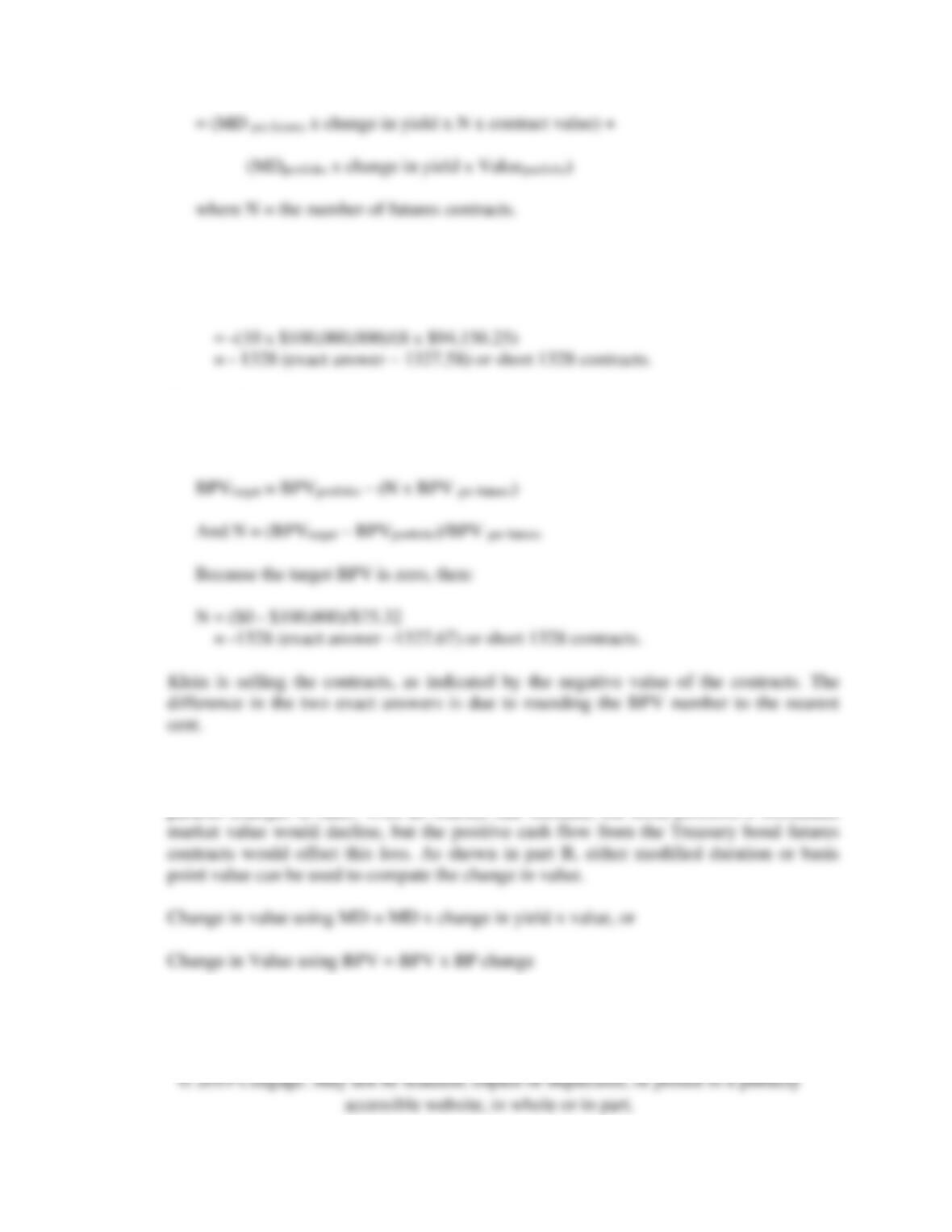
Using modified duration,
Target Change in Value using MD
15-
9
Because the target MD is zero, then:
N = -(MDportfolio x Valueportfolio)/(MD per futures x contract value)
Using basis point value,
BPVtarget = BPVportfolio – BPVhedge
3(c). Because the newly modified portfolio has approximately a zero modified duration and
basis point value, the value of this portfolio would remain relatively constant for small
parallel changes in rates. With an interest rate increase, the bond portfolio’s immediate
15-
10
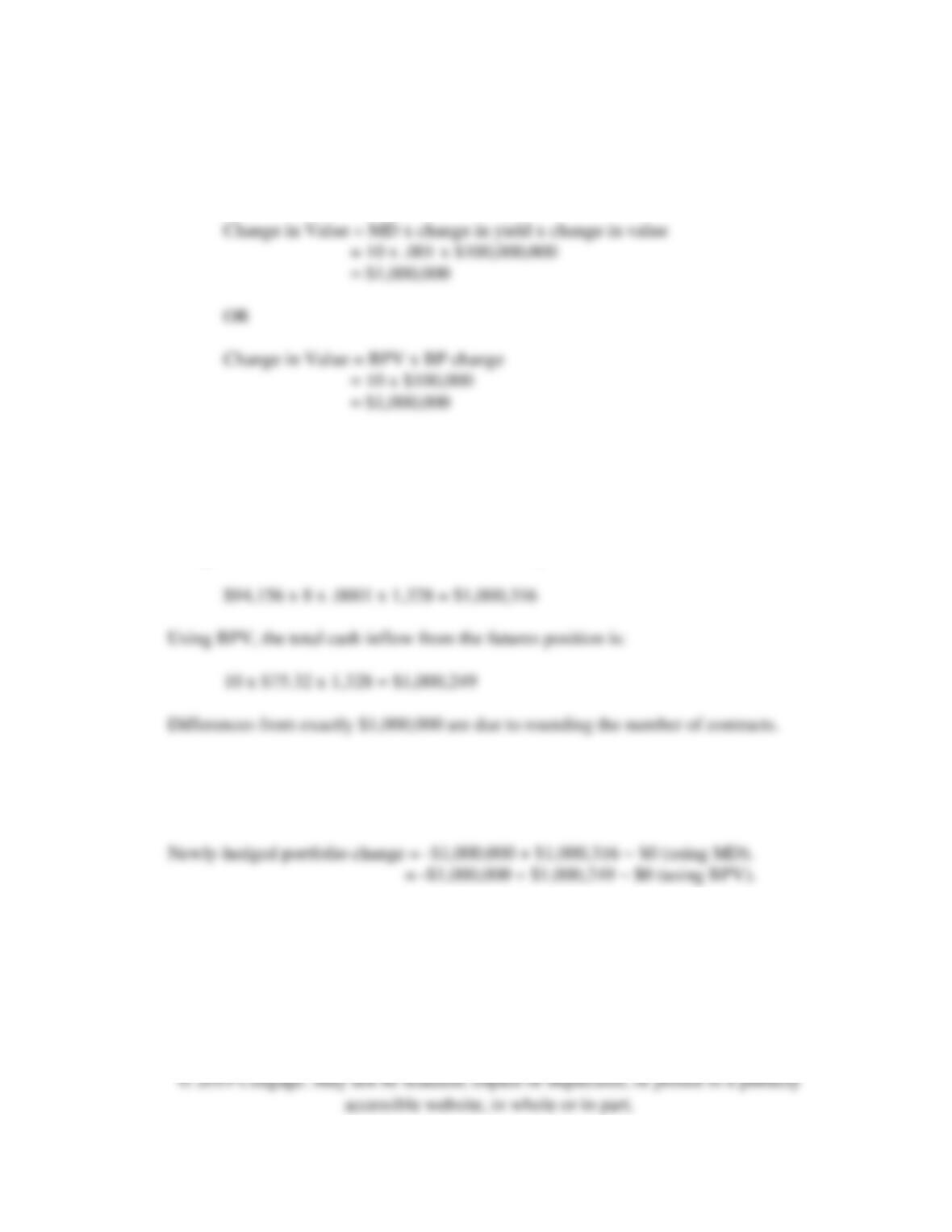
3(c)i. The $100,000 BPV for the portfolio means that the portfolio value will decrease
(increase) by $100,000 for each basis point increase (decrease). A 10-basis point increase
in interest rates would mean a $1,000,000 decline (or loss in the market value of the
original portfolio.
3(c)ii. A $75.32 BPV for the futures contract represents a $75.32 change in value per basis point
per contract. When rates increase by 1 basis point, each futures contract will decrease by
$75.32. However, because Klein is short contracts, she will receive a cash flow of $75.32
from each short contract for each basis point increase.
Using MD, the total cash inflow from the futures position is:
3(c)iii. The change in the value of the hedged portfolio is the sum of the change in value of the
original portfolio and the cash flow from the hedge (futures) position, or:
3(d). Klein’s hedging strategy may not fully protect the portfolio against interest rate risk for
several reasons. First, immunization risk would remain even after execution of the
strategy because of the possibility of non-parallel shifts in the yield curve. If the yield
curve shifts in a non-parallel fashion, the modified portfolio is not immunized against
interest rate risk because the original bond portfolio and T-bond futures exist at different
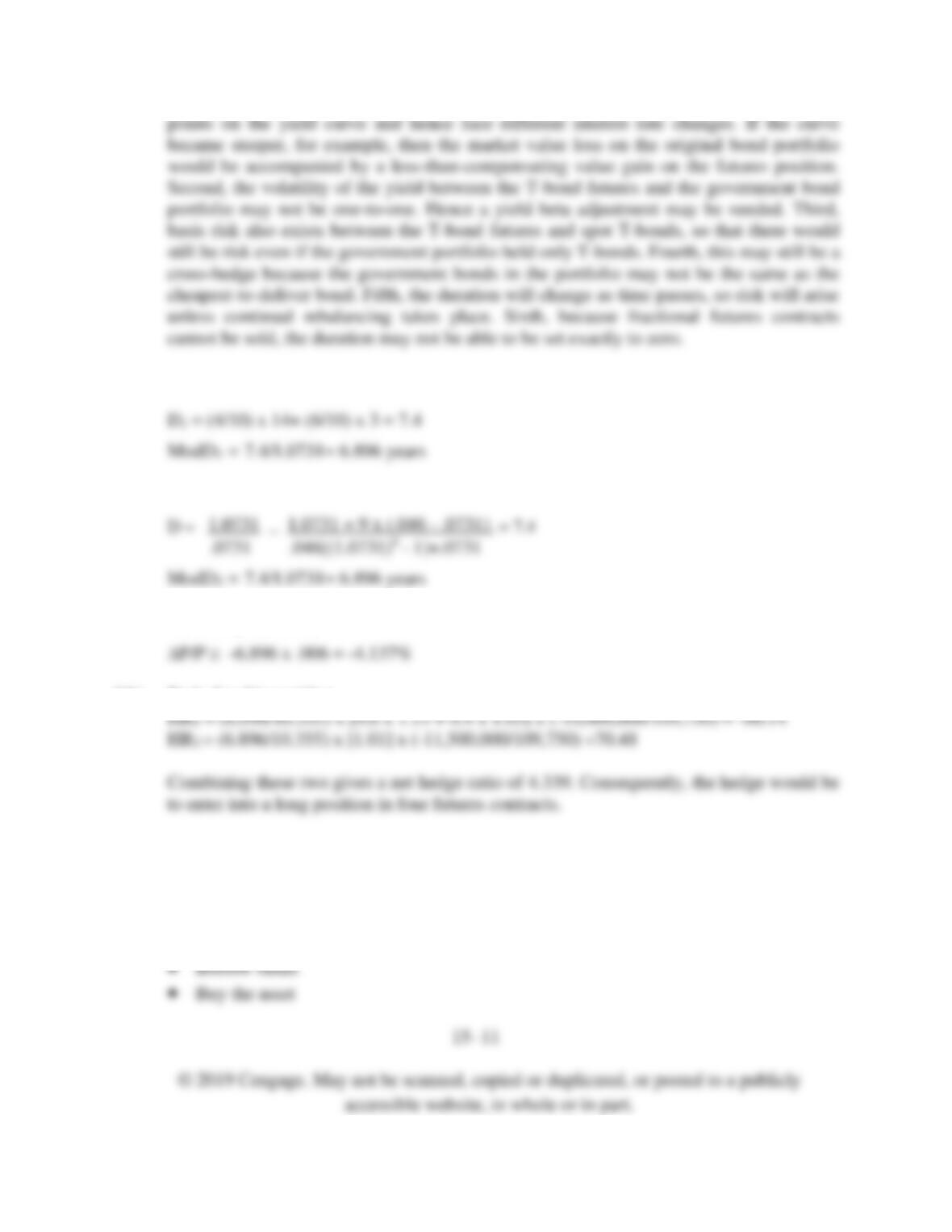
points on the yield curve and hence face different interest rate changes. If the curve
became steeper, for example, then the market value loss on the original bond portfolio
would be accompanied by a less-than-compensating value gain on the futures position.
Second, the volatility of the yield between the T-bond futures and the government bond
portfolio may not be one-to-one. Hence a yield beta adjustment may be needed. Third,
basis risk also exists between the T-bond futures and spot T-bonds, so that there would
still be risk even if the government portfolio held only T-bonds. Fourth, this may still be a
cross-hedge because the government bonds in the portfolio may not be the same as the
cheapest-to-deliver bond. Fifth, the duration will change as time passes, so risk will arise
unless continual rebalancing takes place. Sixth, because fractional futures contracts
cannot be sold, the duration may not be able to be set exactly to zero.
4(a). Both bonds in portfolio 1 are zero coupon bonds, so:
For both portfolios:
4(b). To hedge this position
5. a) Arbitrage transactions. In a cash-and-carry strategy, which is what this transaction is,
the arbitrageur borrows funds at a short-term rate, buys the asset, and sells the futures
contract. On the expiration date, the arbitrageur delivers the asset against the futures,
repays the loan with interest, and earns a low-risk profit.
List of transactions:
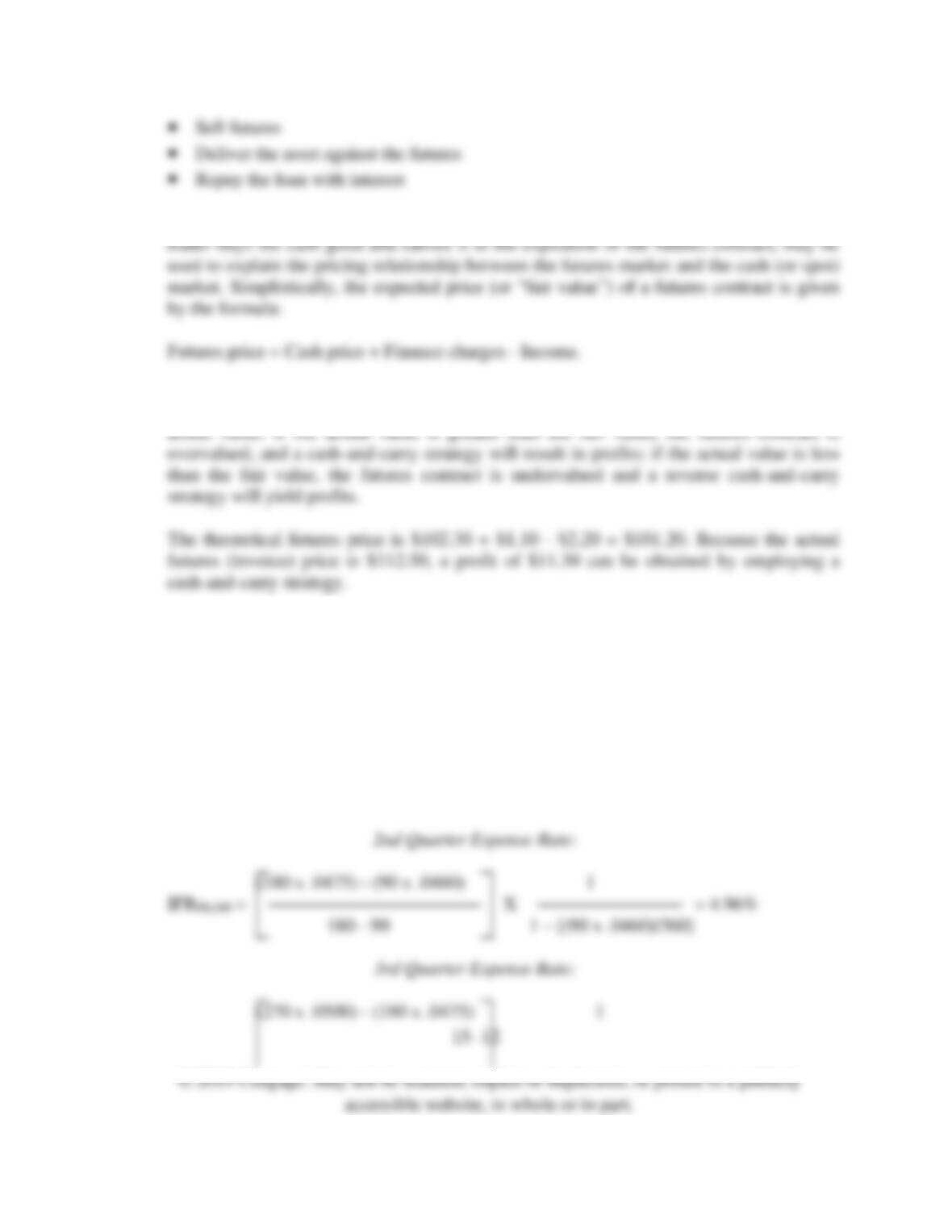
• Sell futures
• Deliver the asset against the futures
• Repay the loan with interest
b) Calculation of arbitrage profits. The cash-and-carry model, so called because the
First, determine whether the futures is overpriced or underpriced relative to cash.
Calculate the fair value of the futures contract and compare this value to the contract’s
c) Bond price at maturity. Per the equation used in part b), the actual price of the
underlying bond at the futures contract maturity does not affect the arbitrage profit.
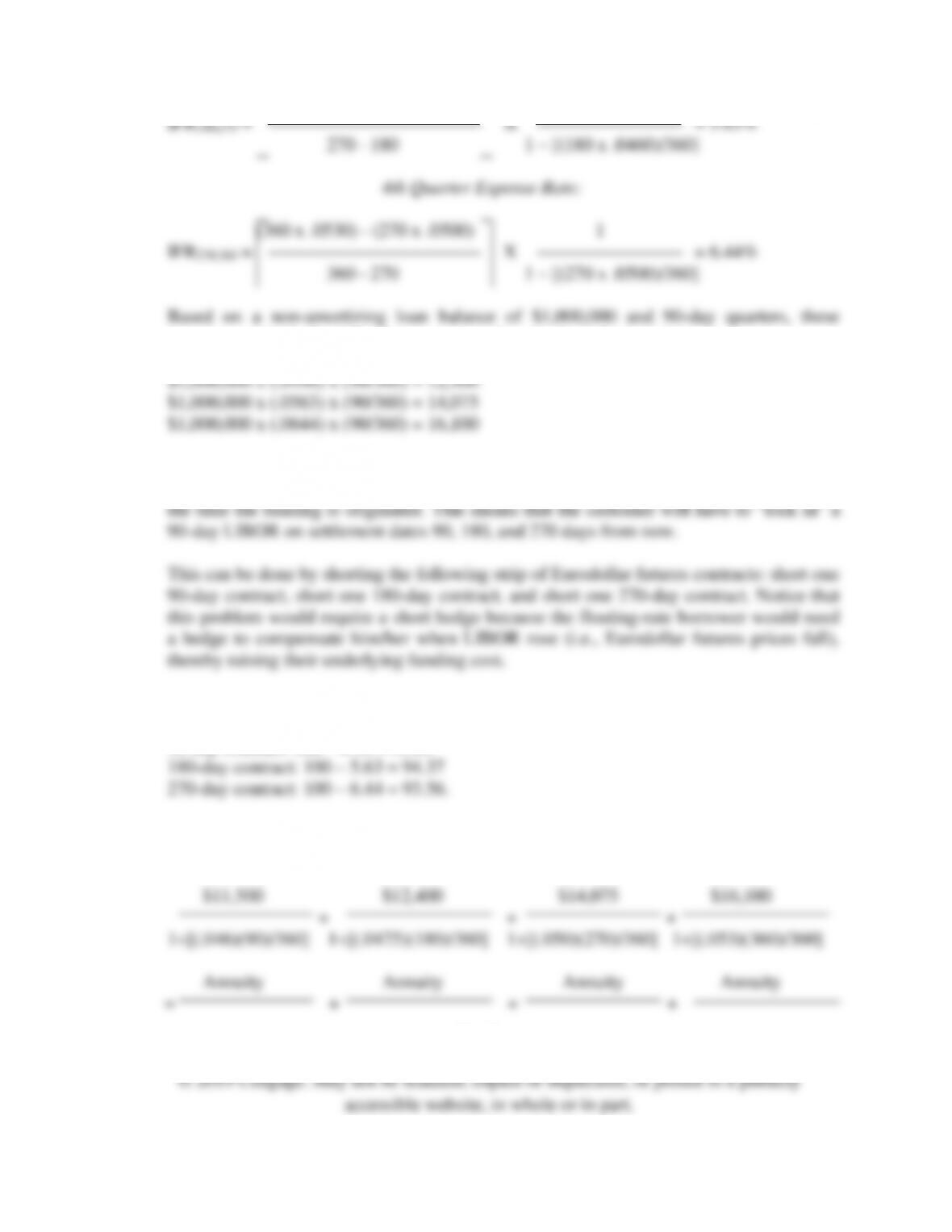
6 (a). Recalling the convention that the interest expense on floating-rate debt is determined in
advance and paid in arrears, the relevant quarterly LIBOR expenses (rounded to the basis
point) are: 1st Quarter Expense Rate:
4.60% (i.e., current 90-day LIBOR)
15-
13
percentages imply the following sequence of quarterly cash payments:
$1,000,000 x (.046) x (90/360) = 11,500
6(b). Although there are four interest payments due, the convention of setting LIBOR at the
front-end of a borrowing period means that there are only three uncertain cash flows at
6(c). If Eurodollar prices are consistent with the series of implied forward rates, we would
observe the following prices:
90-day contract: 100 – 4.96 = 95.04
The annuity that would be equivalent to locking in the preceding series of quarterly cash
expenses with the futures strip is calculated as the solution to:
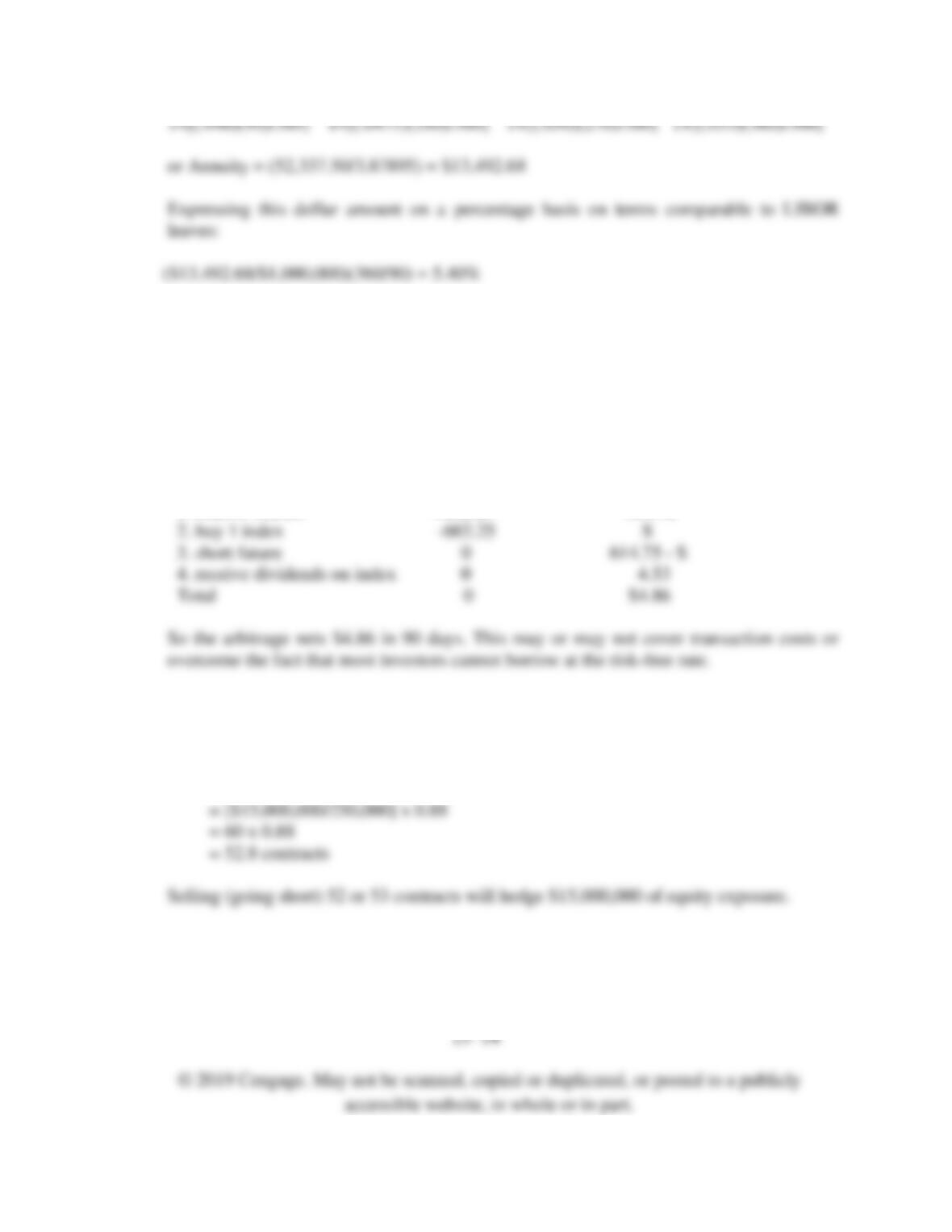
1+[(.046)(90)/360] 1+[(.0475)(180)/360] 1+[(.050)(270)/360] 1+[(.053)(360)/360]
or Annuity = (52,337.50/3.87895) = $13,492.68
Expressing this dollar amount on a percentage basis on terms comparable to LIBOR
leaves:
($13,492.68/$1,000,000)(360/90) = 5.40%
7. We can calculate the theoretical spot price for the index as S = F*exp[-(r-d)t] =
614.75*exp[-(.08-.03)*.25] = 607.11. Because this is larger than the actual spot price,
there is a theoretical arbitrage opportunity, so program trading may take place. This
would involve borrowing the money to buy 1 “index share,” taking a short position in the
futures, and “delivering” the share at the future date. The cash flows would be as follows:
T= now T=90 days
1. borrow 602.25 +602.25 -614.42
8.
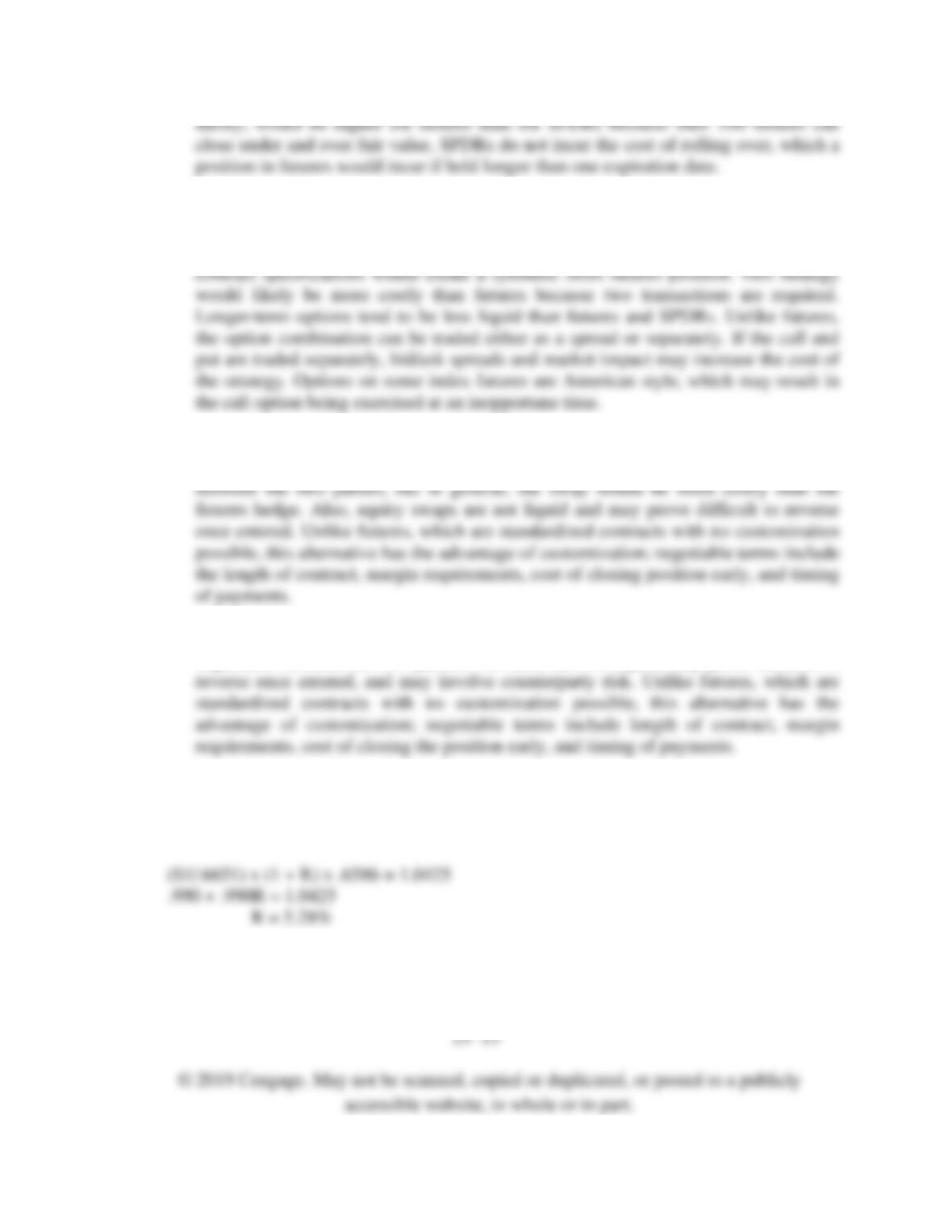
8(a). The number of futures contracts required is:
N = (value of the portfolio/value of the index futures) x beta of the portfolio
= [$15,000,000/(1,000 x 250)] x 0.88
8(b). Alternative methods that replicate the futures strategy in part A include:
1. Shorting at exchange-traded fund such as SPDRs. SPDRs would be more expensive
than futures to trade in terms of liquidity and transactions costs. Tracking error, in
theory, would be higher for futures than for SPDRs because S&P 500 futures can
close under and over fair value. SPDRs do not incur the cost of rolling over, which a
position in futures would incur if held longer than one expiration date.
2. Creating a synthetic short futures position using a combination of calls and puts.
Either options on the underlying index or options on the futures could be used.
Selling an index call option and purchasing an index put option with the same
3. Creating a fixed equity swap in which Andrew pays the appreciation and dividends
on the portfolio and receives a fixed rate. The price of this transaction is negotiated
4. Shorting a forward contract on the S&P 500 index. The price of this transaction is
negotiated between the two parties. Forwards are not liquid, may prove difficult to
9(a). To get a return of 4.25% by converting to CHF it must be the case that a dollar converted
today, invested at rate R, and converted back at the end of a year is then worth $1.0425.
So,
($1/.6651) x (1 + R) x .6586 = 1.0425
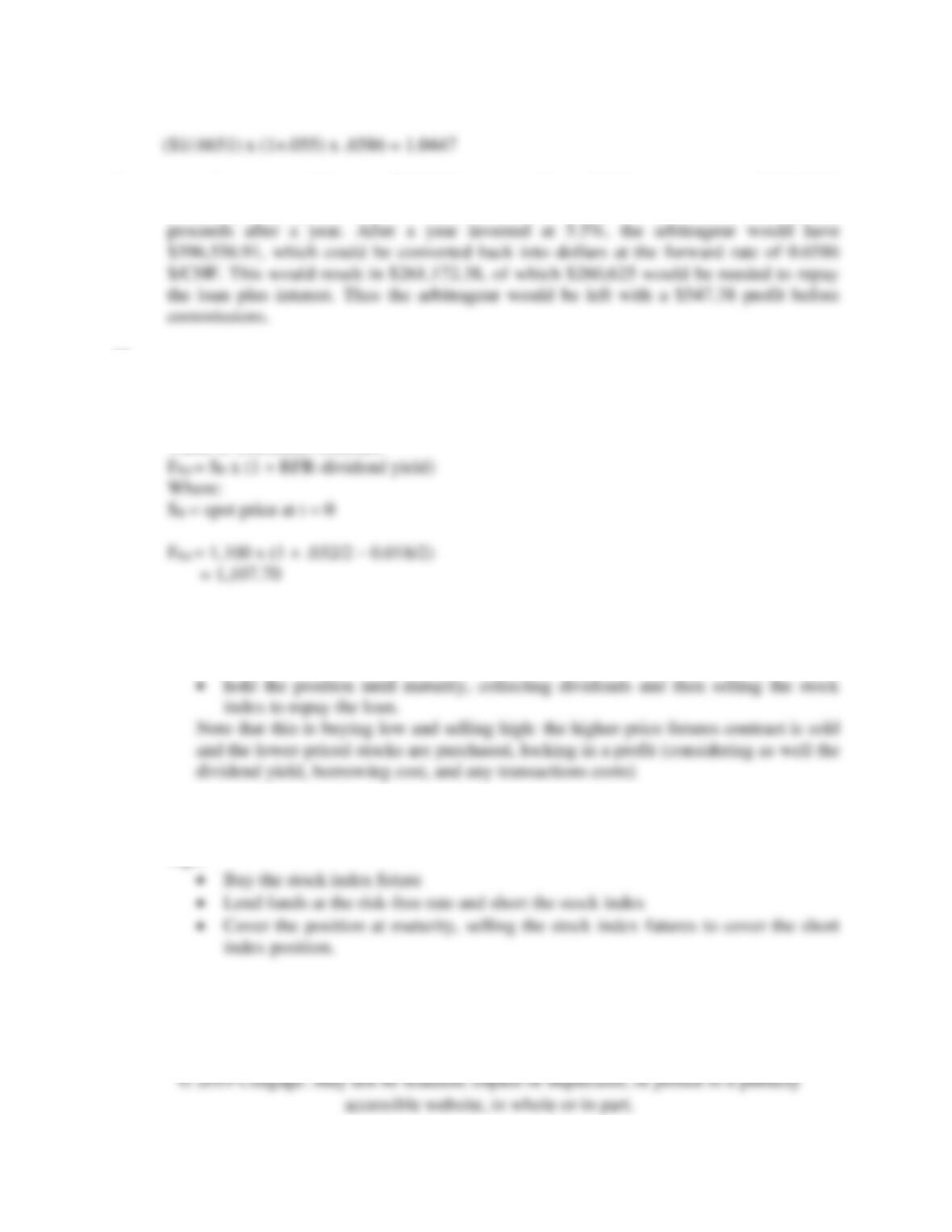
9(b). If the actual rate is 5.5% for a one-year Swiss government bond, then the return on
investing in CHF would be greater. This can be seen by plugging in R= .055 into the
above left-hand side to get
15-
16
9(c). An arbitrageur could borrow $250,000 domestically at 4.25%, convert it into 375,883.33
CHF, buy Swiss government bonds, and enter into a forward contract to reconvert the
10.
10(a). According to the cost-of-carry rule, the futures price must equal the spot price plus the
cost of carrying the spot commodity forward to the delivery date of the futures contract.
Value of December contract:
10(b). If the futures contract price were substantially higher, Singer should
• short the stock index future
• borrow funds at the risk-free rate to purchase the stock index
If the futures contract price were substantially lower than the spot price, Singer should
reverse the above transactions, again implementing the basic strategy of buy low, sell
high:
10(c). Arbitrage will not be profitable when the profit, including the transaction costs, is zero.
Thus, the upper bound for the theoretical contract price is:
F – 1100 – 1100 (0.032/2 – 0.018/2) – 20 ➔ F = 1,112.30
The lower bound will be:
F – 1100 – 1100 (0.018/2 – 0.032/2) – 20 ➔ F = 1,087.70
11. From Exhibit 15.17, we find that the fixed rate receiver will get the bid rate for the two
Notional principal:
$22,500,000
Date
Fixed
rate
Number of
Actual Days
Number
of
“30/360”
Days
LIBOR
Fixed Rate
Receipt
Floating
rate
payment
0
4.487%
4.25%
1
4.487%
183
180
4.40%
$504,787.50
$486,093.75
1
4.487%
183
180
4.90%
$504,787.50
$503.250.00
2
4.487%
182
180
5.05%
$504,787.50
$557,375.00
2
4.487%
183
180
4.60%
$504,787.50
$577,593.75
3
4.487%
182
180
4.35%
$504,787.50
$523,250.00
3
4.487%
183
180
4.20%
$504,787.50
$497,531.25
The values for the receipts and payments are found using:
12(a). With these estimates, the settlement payments can be calculated as follows:
15-
18
Floating-rate payment = (0.0375 – 0.0010) x ($50,000,000) x (92/360) = $466.389
Equity-index receipt =[(480.86 – 464.74)/464.74] x ($50,000,000) = $1,734,303
12(b). It is also quite common for equity swaps to be based on a notional principal amount that
varies directly with the level of the underlying index. If, for instance, the swap