
1/6/2015
Situation
Net Income
$140.00
Distribution = Net Income – [(Target equity ratio) * (Total capital budget)]
Capital budget
$112.50
$140
$90
What would happen to the payout ratio and DPS if net income were forecasted to decrease to $90 million?
Net Income
$90.00
$112.50
$90
$90
What would happen to the payout ratio and DPS if net income were forecasted to increase to $160 million?
Net Income
$160.00
Capital budget
$112.50
$160
$90
Chapter 15. Mini Case
Your new boss at the consulting firm Flick and Associates, which has been retained to help IWT prepare for its public offering, has asked
you to make a presentation to Jackson and Smithfield in which you review the theory of dividend policy and discuss the following issues.
a. (1.) What is meant by the term “distribution policy”? How have dividend payouts versus stock repurchases changed over time?
Answer:
Answer: See
Integrated Waveguide Technologies, Inc. (IWT) is a 6-year old company founded by Hunt Jackson and David Smithfield to exploit
metamaterial plasmonic technology to develop and manufacture miniature microwave frequency directional transmitters and receivers for
use in mobile Internet and communications applications. The technology, although highly-advanced, is relatively inexpensive to implement
and their patented manufacturing techniques require little capital in comparison to many electronics fabrication ventures. Because of the
low capital requirement, Jackson and Smithfield have been able to avoid issuing new stock and thus own all of the shares. Because of the
explosion in demand for its mobile Internet applications, IWT must now access outside equity capital to fund its growth and Jackson and
Smithfield have decided to take the company public. Until now, Jackson and Smithfield have paid themselves reasonable salaries but
routinely reinvested all after-tax earnings in the firm, so dividend policy has not been an issue. However, before talking with potential
outside investors, they must decide on a dividend policy.
c. (1.) Assume that IWT has a $112.5 million capital budget planned for the coming year. You have determined its present capital structure
(80% equity and 20% debt) is optimal, and its net income is forecasted at $140 million. Use the residual distribution model approach to
determine IWT’s total dollar distribution. Assume for now that the distribution is in the form of a dividend. IWT has 100 million shares. What
is the forecasted dividend payout ratio? What is the forecasted dividend per share?
(2.) The terms “irrelevance,” “dividend prefernce, or bird-in-the-hand,” and “tax effect” have been used to describe three major theories
regarding the way dividend payouts affect a firm’s value. Explain what these terms mean, and briefly describe each theory. Answer: See
c. (2.) In general terms, how would a change in investment opportunities affect the payout ratio under the residual payment policy?
$112.50
Declaration date:
Inputs
Value of operations
$1,937.50
$50.00
$387.50
Value of operations $1,937.50
Value of operations $1,937.50 $1,937.50
Suppose the value of operations, available funds for distribution, and debt increase at 10% a year. Here is the impact of repurchases versus dividends.
Growth in value of operations: 10%
If Distributed
as Repurchase
f. Suppose IWT has decided to distribute $50 million, which it presently is holding in very liquid short-term investments. IWT’s value of
operations is estimated to be about $1,937.5 million. IWT has $387.5 million in debt (it has no preferred stock). As mentioned previously,
IWT has 100 million shares of stock outstanding.
Prior to
Distribution
Thursday, November 19, 2015
f. (3.) Suppose instead that IWT has just made the $50 million distribution in the form of a stock repurchase. Now what is IWT’s intrinsic
value of equity? How many shares did IWT repurchase? How many shares remained outstanding after the repurchase? What is its intrinsic
per share stock price after the repurchase?
d. (2.) What is a stock repurchase? Describe the procedures a company follows when it make a distribution through a stock repurchase.
If Distributed
as Dividend
Prior to
Distribution
f. (1.) Assume that IWT has not yet made the distribution. What is IWT’s intrinsic value of equity? What is its intrinsic per share stock
price?
Prior to
Distribution
f. (2.) Now suppose that IWT has just made the $50 million distribution in the form of dividends. What is IWT’s intrinsic value of equity?
What is its intrinsic per share stock price?
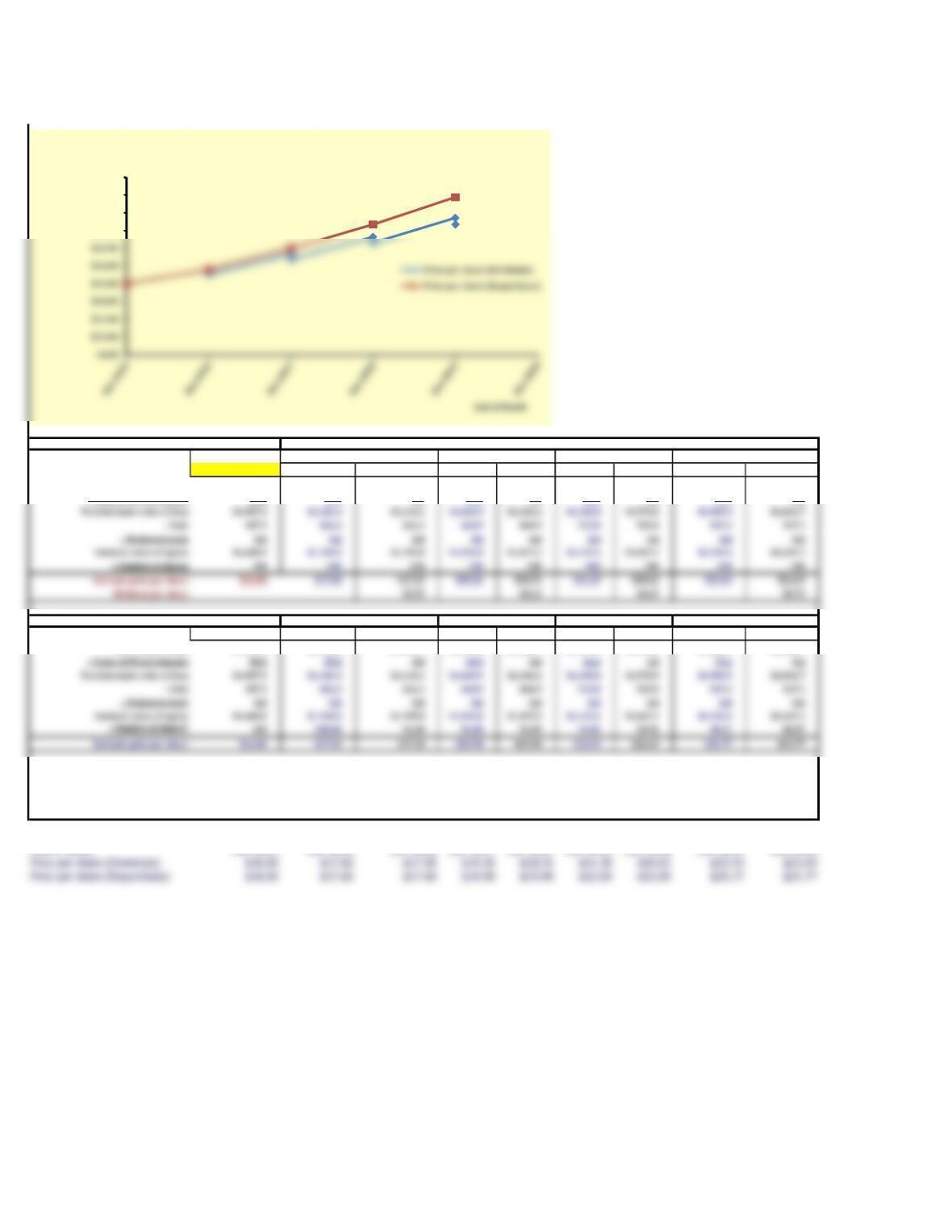
1. Distribute as Dividends
12/31/2015 12/30 12/31 12/30 12/31 12/30 12/31 12/30 12/31
Value of operations $1,937.5 $2,131.3 $2,131.3 $2,344.4 $2,344.4 $2,578.8 $2,578.8 $2,836.7 $2,836.7
+ Value of ST investments 50.0 55.0 0.0 60.5 0.0 66.6 0.0 73.2 0.0
Section 2. Distribute as Repurchase
12/31/15 12/30 12/31 12/30 12/31 12/30 12/31 12/30 12/31
Value of operations $1,937.5 $2,131.3 $2,131.3 $2,344.4 $2,344.4 $2,578.8 $2,578.8 $2,836.7 $2,836.7
Notes:
End of Month
Dec-2015
Dec-2016
Dec-2016
Dec-2017
Dec-2017
Dec-2018
Dec-2018
Dec-2019
Dec-2019
Price per share (Dividends)
$16.00
$17.60
$17.05
$19.36
$18.76
$21.30
$20.63
$23.43
$22.69
Price per share (Repurchase)
$16.00
$17.60
$17.60
$19.98
$19.98
$22.69
$22.69
$25.77
$25.77
Projected
aThe number of shares after the repurchase is: nPost = nPrior − (CashRep/PPrior). In this example, the entire amount of ST investments (i.e., the balance of
nonoperating assets) is used to repurchase stock.
2016 2017 2018 2019
2016
2017
2018
2019
$22.00
$24.00
$26.00
$28.00
Stock
Price