428 Instructor’s Manual
Putting these numbers into equation 15.1 yields:
g = 0.057 = 5.7%
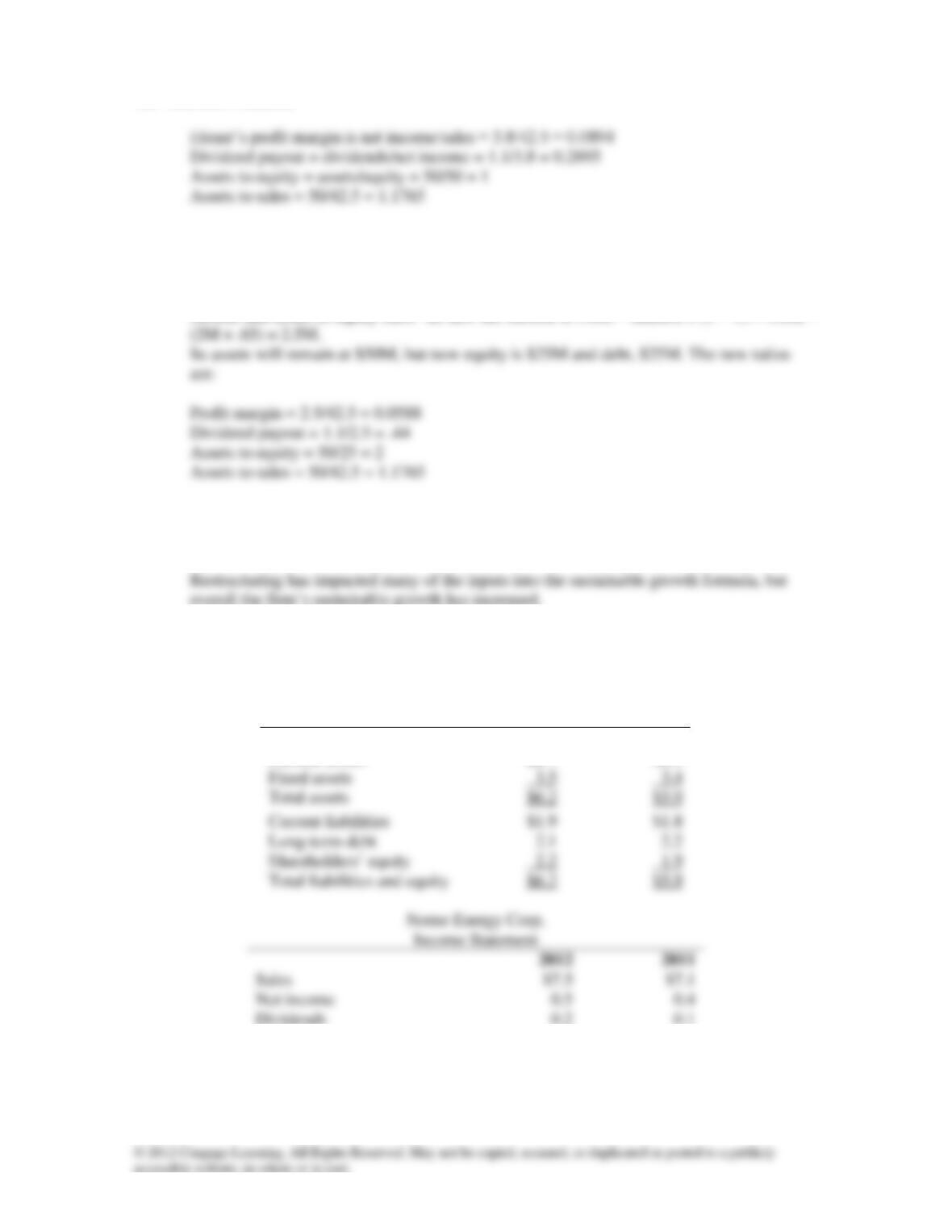
If the firm issues bonds and uses the proceeds to repurchase equity, it will impact its net
income and assets to equity ratio. Its new net income is 3.8M – Interest × (1 – T) = 3.8M –
Putting these numbers into equation 15.1 yields:
g = 0.059 = 5.9%
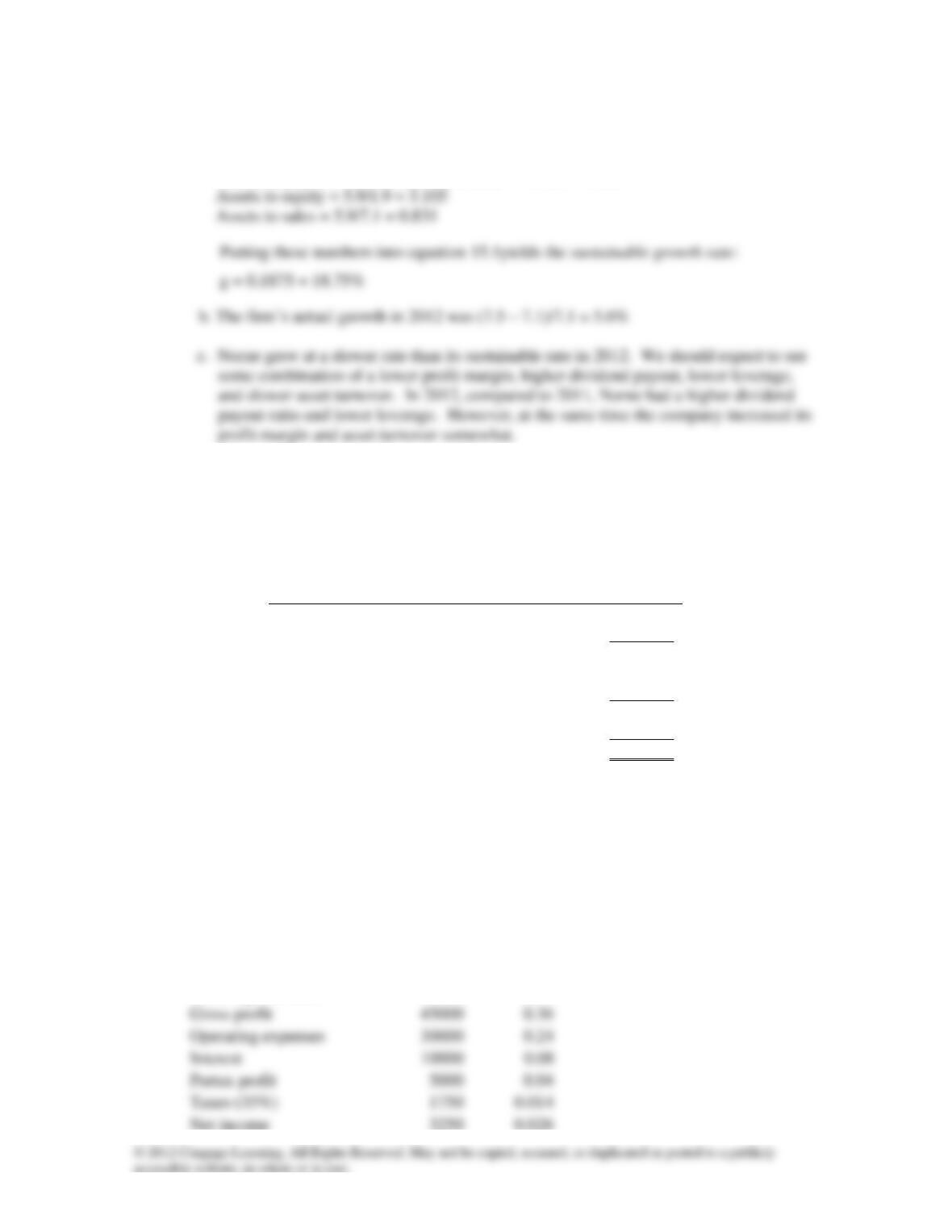
P15-3. Review the abbreviated financial statements for the last two years for the Norne Energy
Corp. All values are expressed in billions of dollars.
Norne Energy Corp.
Balance Sheet
2012
2011
Current assets
$2.7
$2.5
Fixed assets
Total assets
Current liabilities
$1.9
$1.8
Long-term debt
2.2
1.9
Total liabilities and equity
Sales
Net income
Dividends
0.2
0.1
a. What was Norne’s sustainable growth rate at the end of 2011?
b. How rapidly did Norne actually grow in 2012?
c. What changes in Norne’s financial condition from 2011 to 2012 can you trace to the
difference between the actual and sustainable growth rates?
Chapter 15 Financial Planning 429
A15-3. a. At the end of 2011, profit margin = Net income/Sales = 0.4/7.1 = 0.0563
Dividend payout = Dividends/Net income = 0.1/0.4 = 0.25
P15-4. The 2013 sales forecast for Clearwater Development Co. is $150 million. Interest expense
will not change in the coming year. Use Clearwater’s 2012 income statement ($ in
thousands) presented below to answer the questions that follow:
Clearwater Development Co.
Income Statement
Sales
$125,000
Less: Cost of goods sold
80,000
Gross profit
$ 45,000
Less: Operating expenses
30,000
Less: Interest
10,000
Pretax profit
$ 5,000
Less: Taxes (35%)
1,750
Net income
$ 3,250
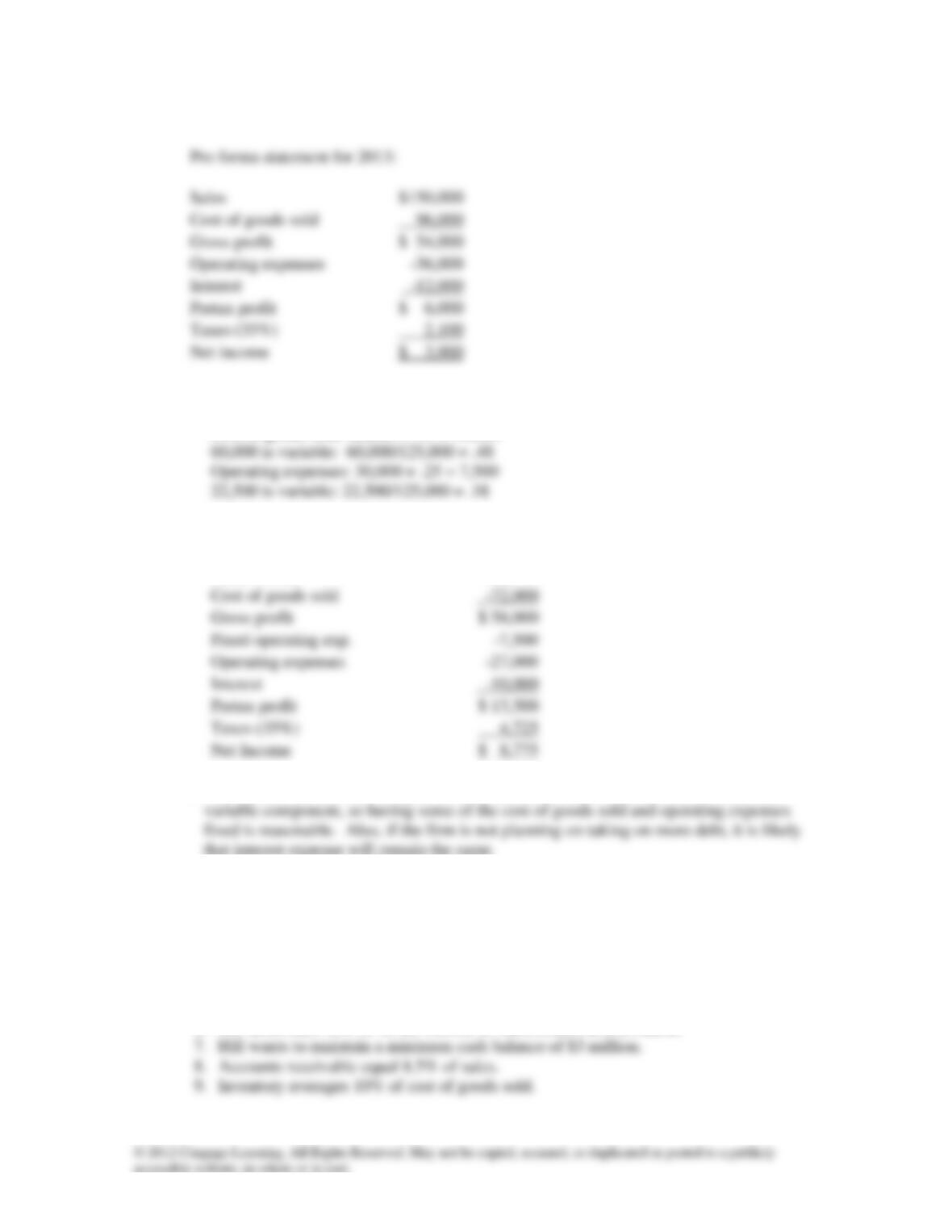
a. Use the percentage-of-sales method to construct a pro forma income statement for
2013.
b. You learn that 25 percent of the cost of goods sold and operating expense figures for
2012 are fixed costs that will not change in 2013. Reconstruct the pro forma income
statement.
c. Compare and contrast the statement prepared in parts (a) and (b). Which statement will
likely provide the better estimate of 2013 income? Explain.
A15-4. a.
Sales
125000
1.00
Cost of goods sold
80000
0.64
Gross profit
45000
0.36
Operating expenses
30000
0.24
Interest
10000
Pretax profit
0.04
430 Instructor’s Manual
b. New pro forma assuming 25% of cost of goods sold is fixed:
Cost of goods sold: 80,000 × .25 = 20,000
Sales
$150,000
Fixed COGS
-20,000
Cost of goods sold
Gross profit
Fixed operating exp.
Operating expenses
Interest
Pretax profit
Taxes (35%)
Net Income
c. The second statement is likely to be more accurate. Most costs do have a fixed and
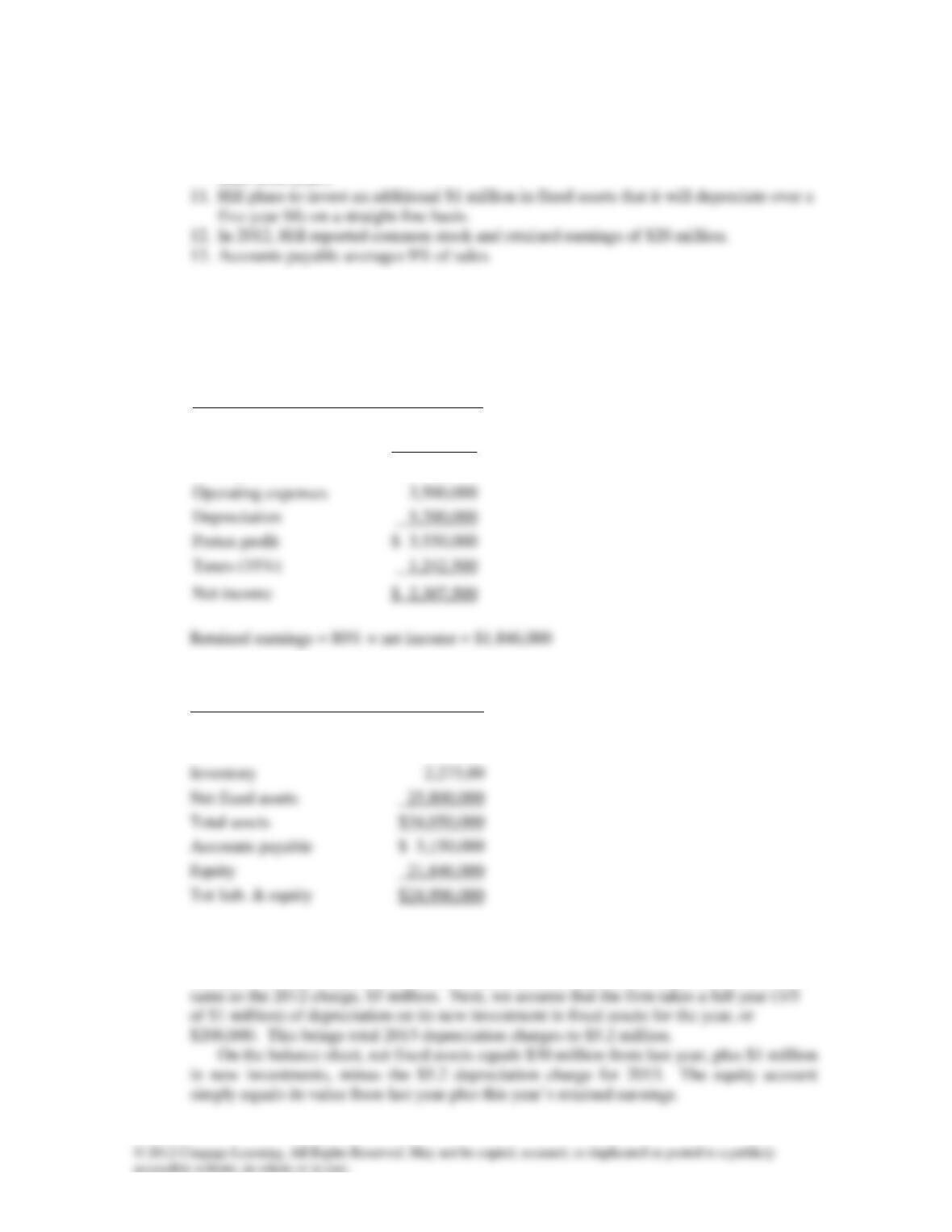
P15-5. Hill Propane Distributors wants to construct a pro forma balance sheet for 2013. Build the
statement using the following data and assumptions:
1. Projected sales for 2013 are $35 million.
2. Hill’s gross profit margin is 35%.
3. Operating expenses average 10% of sales.
4. Depreciation expense last year was $5 million.
5. Hill faces a tax rate of 35%.
6. Hill distributes 20% of its net income to shareholders as a dividend.
Sales
Cost of goods sold
Gross profit
Operating expenses
Interest
Pretax profit
Taxes (35%)
Net income
Chapter 15 Financial Planning 431
10. Last year’s balance sheet lists net fixed assets of $30 million. All these assets are
depreciated on a straight-line basis, and none of them will be fully depreciated for at
least three years.
Will Hill Propane’s cash balance at the end of 2013exceed its minimum requirement of $3
million?
A15-5.
Income Statement
2013
Sales
$35,000,000
Cost of goods sold
22,750,000
Gross profit
$12,250,000
Operating expenses
3,500,000
Depreciation
Pretax profit
$ 3,550,000
Taxes (35%)
Balance Sheet
2013
Cash
$ 3,000,000
Accounts receivable
2,975,000
Inventory
2,275,000
Net fixed assets
Total assets
$34,050,000
Accounts payable
$ 3,150,000
Equity
21,846,000
In the income statement, we arrive at the depreciation figure as follows. First, existing
assets are depreciated on a straight-line basis, and none of them will be fully depreciated
during 2013. This implies that the 2013 depreciation charge on existing assets will be the
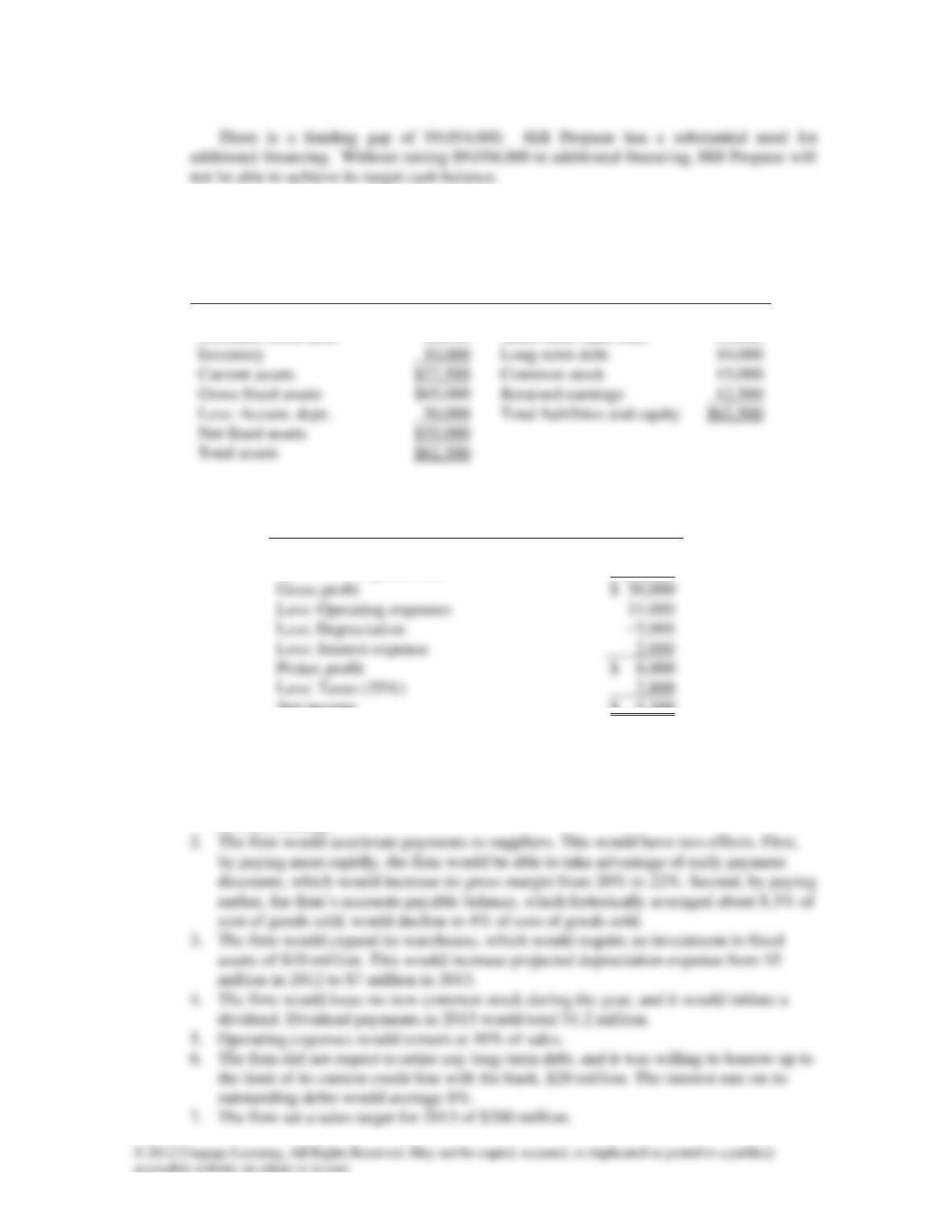
432 Instructor’s Manual
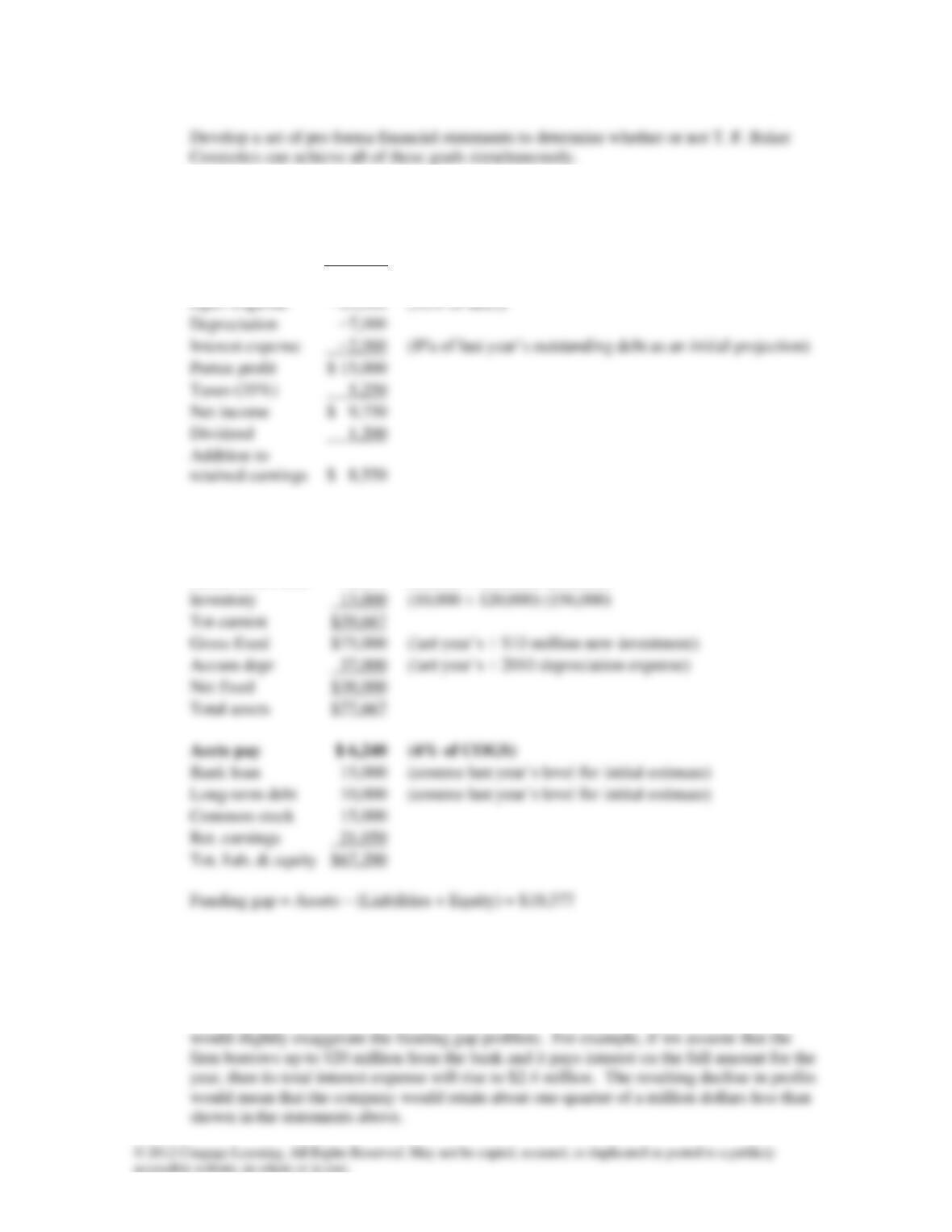
P15-6. Review the following 2012 balance sheet and income statement for T. F. Baker Cosmetics
Inc. appear below. The numerical values are in thousands of dollars.
T. F. Baker Cosmetics, Inc.
Balance Sheet
Cash
$ 5,000
Accounts payable
$10,000
Accounts receivable
12,500
Short-term bank loan
15,000
Inventory
10,000
Long-term debt
Gross fixed assets
$65,000
Retained earnings
12,500
Less: Accum. depr.
Total liabilities and equity
Net fixed assets
$35,000
Total assets
$62,500
T. F. Baker Cosmetics, Inc.
Income Statement
Sales
$150,000
Less: Cost of goods sold
120,000
Gross profit
Less: Operating expenses
Less: Depreciation
Less: Interest expense
Pretax profit
$ 8,000
Less: Taxes (35%)
Net income
$ 5,200
At a recent board meeting, the firm decided on the following objectives for 2013:
1. The firm would increase liquidity. For competitive reasons, accounts receivable and
inventory balances were expected to continue their historical relationships with sales
and cost of goods sold, respectively, but the board felt that the company should double
its cash holdings.
Chapter 15 Financial Planning 433
A15-6. Start with the income statement for 2013. All figures are in thousands of dollars.
Sales
$200,000
COGS
156,000
(78% of sales)
Gross profit
$ 44,000
Oper. expense
(10% of sales)
Depreciation
Interest expense
Pretax profit
Taxes (35%)
Net income
Dividend
retained earnings
Now turn to the balance sheet. Again, all figures are in thousands of dollars.
Cash
$10,000
Accts. receivable
16,667
(12,500 ÷ 150,000) (200,000)
Inventory
13,000
(10,000 ÷ 120,000) (156,000)
Tot current
$39,667
Gross fixed
$75,000
Accum depr
37,000
Net fixed
$38,000
Total assets
$77,667
Bank loan
15,000
Long-term debt
10,000
Common stock
15,000
Ret. earnings
21,050
Tot. liab. & equity
$67,290
The firm has a funding gap of just over $10.37 million. This means that it cannot fully
meet all of its 2013 goals. The problem states that the firm is willing to borrow up to $20
million from the bank, but that would provide only $5 million in additional financing.
Furthermore, if the firm did borrow the full $20 million from the bank, its interest expense
for the year would rise, resulting in reduced retained earnings. Lower retained earnings
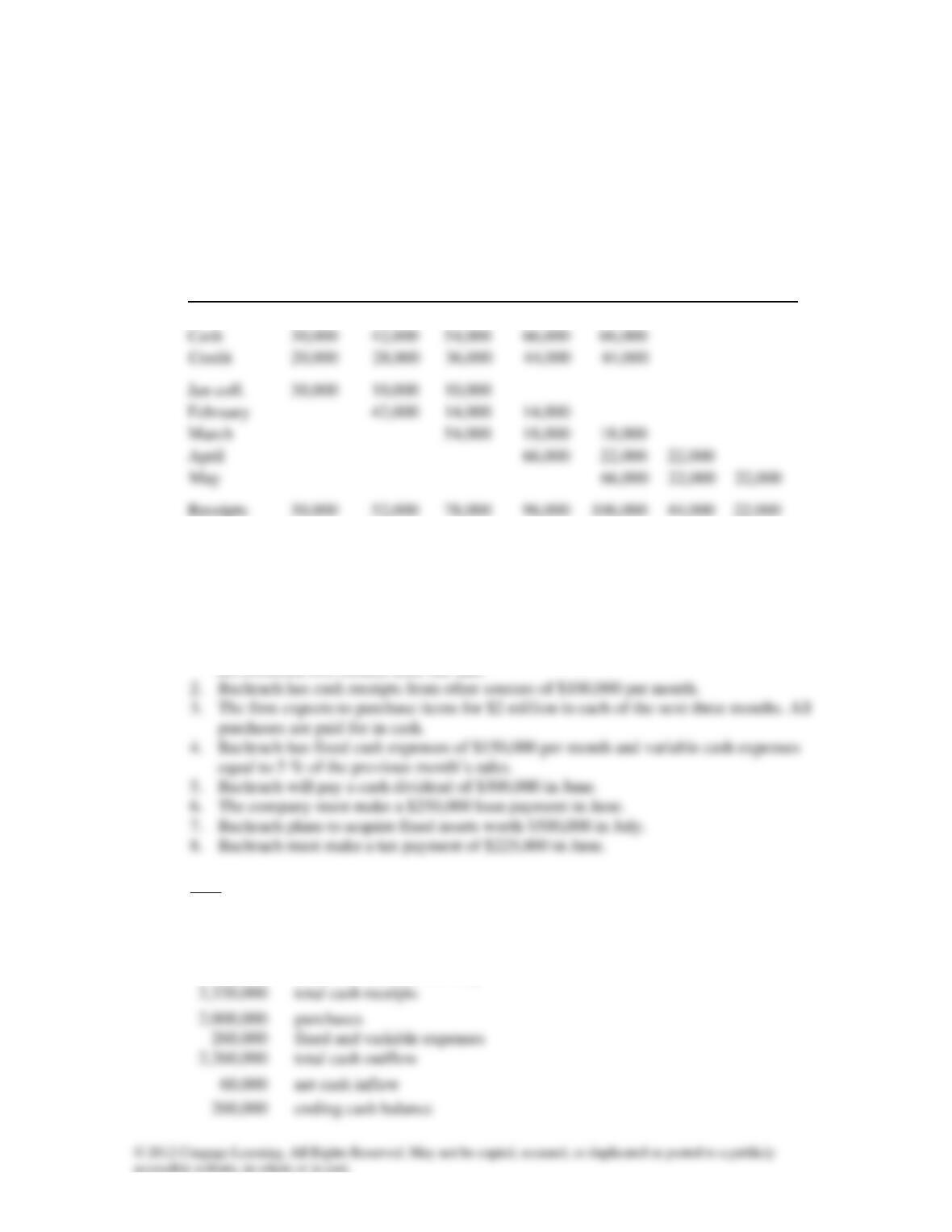
434 Instructor’s Manual
Planning and Control
P15-7. A firm has actual sales of $50,000 in January and $70,000 in February. It expects sales of
$90,000 in March and $110,000 in both April and May. Assuming that sales are the only
source of cash inflow, and that 60 % of these are for cash and the rest are collected evenly
over the following two months, what are the firm’s expected cash receipts for March,
April, and May?
A15-7.
January
February
March
April
May
June
July
Sales
50,000
70,000
90,000
110,000
110,000
Cash
30,000
42,000
54,000
Jan coll.
30,000
10,000
10,000
P15-8. Bachrach Fertilizer Corp. had sales of $2 million in March and $2.2 million in April.
Expected sales for the next three months are $2.4 million, $2.5 million, and $2.7 million.
Bachrach has a cash balance of $200,000 on May 1 and does not want its balance to dip
below that level. Prepare a cash budget for May, June, and July given the following
information:
1. Of total sales, 30% are for cash, 50% are collected in the month after the sale, and 20%
are collected two months after the sale.
A15-8. May
720,000 cash sales in May
400,000 collections on credit sales from March
1,100,000 collections on credit sales from April
100,000 other cash receipts for May
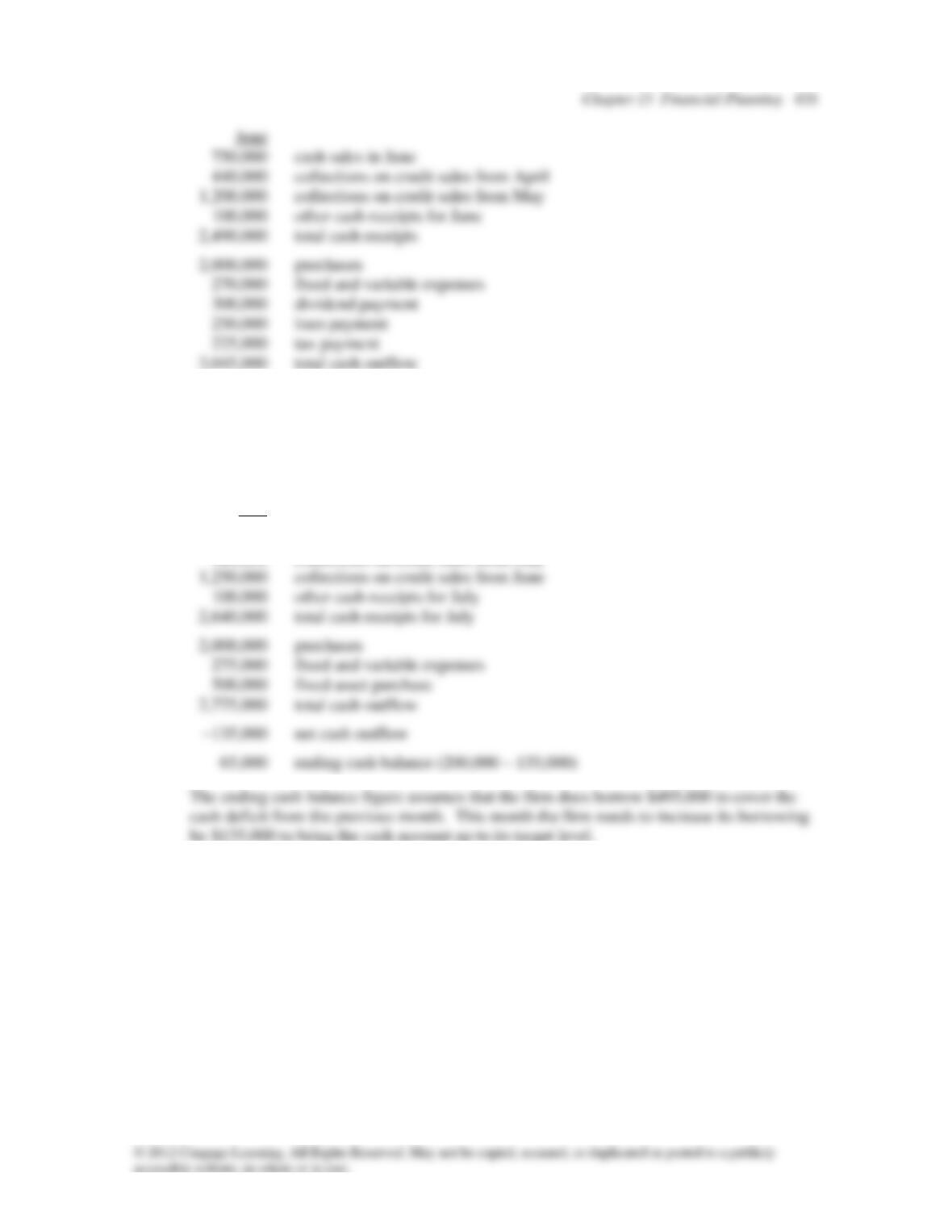
–555,000 net cash outflow
295,000 ending cash balance
Notice here that the firm would have to borrow $495,000 to take its cash balance back up
to the desired $200,000 level.
July
810,000 cash sales in July
480,000 collections on credit sales from May
P15-9. The actual sales and purchases for White Inc. for September and October 2012, along with
its forecast sales and purchases for the November 2012 through April 2013, follow.
Year Month Sales Purchases
2012 September $310,000 $220,000
2012 October 350,000 250,000
2012 November 270,000 240,000
2012 December 260,000 200,000
2013 January 240,000 180,000
2013 February 280,000 210,000
2013 March 300,000 200,000
2013 April 350,000 190,000
436 Instructor’s Manual
The firm makes 30 percent of all sales for cash and collects 35% of its sales in
each of the two months following the sale. Other cash inflows are expected to be $22,000
in September and April, $25,000 in January and March, and $37,000 in February. The firm
pays cash for 20% of its purchases. It pays for 40% of its purchases in the following month
and for 40% of its purchases two months later.
Wages and salaries amount to 15% of the preceding month’s sales. Lease expenses of
$30,000 per month must be paid. Interest payments of $20,000 are due in January and
April. A principal payment of $50,000 is also due in April. The firm expects to pay a cash
dividend of $30,000 in January and April. Taxes of $120,000 are due in April. The firm
also intends to make a $55,000 cash purchase of fixed assets in December.
a. Assuming that the firm has a cash balance of $42,000 at the beginning of November
and its desired minimum cash balance is $25,000, prepare a cash budget for November
through April.
b. If the firm is requesting a line of credit, how large should the line be? Explain your
answer.
A15-9. a.
Nov.
Dec.
Jan.
Feb.
March
April
Cash Inflows
Current month cash
sales
$81,000
$78,000
$72,000
$84,000
$90,000
Collections from
previous month
$122,500
$94,500
$91,000
$84,000
$105,000
Collections from two
$108,500
$94,500
$91,000
$84,000
$98,000
Total cash inflow
$312,000
Cash Outflows
Current month cash
purchases
$48,000
$40,000
$36,000
$42,000
$40,000
$38,000
month’s purchases
$100,000
$96,000
$80,000
$72,000
Payments on purch.
two months ago
$100,000
$96,000
$80,000
Wages
$40,500
$39,000
$36,000
Lease payment
$30,000
$30,000
$30,000
Principal
Dividends
$30,000
Payments on last
Taxes
$120,000
Fixed assets
$55,000
Total cash outflow
$318,500
$361,500
$331,000
$260,000
$268,000
$497,000
Chapter 15 Financial Planning 437
Nov.
Dec.
Jan.
Feb.
March
April
Net cash flow
–$6,500
–$66,500
–$48,500
$36,000
$29,000
–$167,000
Beginning cash balance
$42,000
$35,500
$25,000
$25,000
$61,000
$90,000
Ending cash balance
$35,500
$61,000
$90,000
Borrowing need
$56,000
$48,500
Excess cash
$36,000
$65,000
P15-10. Berlin Inc. expects sales of $300,000 during each of the next three months. It will make
monthly purchases of $180,000 during this time. Wages and salaries are $30,000 per
month plus 5% of monthly sales. The firm expects to make a tax payment of $60,000 in
the first month and a $45,000 purchase of fixed assets in the second month and to receive
$24,000 in cash from the sale of an asset in the third month. All sales and purchases are
for cash. Beginning cash and the minimum cash balance equal zero.
a. Construct a cash budget for the next three months.
b. Berlin is unsure of the level of sales, but all other figures are certain. If the most
pessimistic sales figure is $240,000 per month and the most optimistic is $360,000 per
month, what are the minimum and maximum monthly ending cash balances that the
firm can expect for each month?
c. Discuss how the financial manager can use the data in parts (a) and (b).
A15-10. a.
Month 1
Month 2
Month 3
Sales
$300,000
$300,000
$300,000
Asset sale
$24,000
Cash inflow
Purchases
$180,000
$180,000
$180,000
Wages
$45,000
$45,000
$45,000
Taxes
$60,000
Fixed assets
$45,000
Cash outflow
Net cash flow
$15,000
$30,000
$99,000
Beginning cash
$15,000
$45,000
Ending cash
$15,000
$45,000
$144,000
438 Instructor’s Manual
b.
Pessimistic Case
Month 1
Month 2
Month 3
Sales
$240,000
$240,000
$240,000
Asset sale
$24,000
Cash inflow
$240,000
$240,000
$264,000
Purchases
$180,000
$180,000
$180,000
Wages
$42,000
$42,000
$42,000
Taxes
Fixed Assets
$45,000
Cash outflow
$282,000
$267,000
$222,000
Net cash flow
–$42,000
–$27,000
$42,000
Beginning cash
$0
–$42,000
–$69,000
Ending cash
–$42,000
–$69,000
–$27,000
Optimistic Case
Month 1
Month 2
Month 3
Sales
$360,000
$360,000
$360,000
Asset sale
$24,000
Cash inflow
$360,000
$360,000
$384,000
Purchases
$180,000
$180,000
$180,000
Wages
$48,000
$48,000
$48,000
Taxes
$60,000
Fixed assets
$45,000
Cash outflow
$288,000
$273,000
$228,000
Net cash flow
$72,000
$87,000
$156,000
Beginning cash
$0
$72,000
$159,000
Ending cash
$72,000
$159,000
$315,000
Month 1
Month 2
Month 3
Optimistic case
$72,000
$159,000
$315,000
Pessimistic case
–$42,000
–$69,000
–$27,000
c. The financial manager can use this data to point out the need for contingency financing
Chapter 15 Financial Planning 439
THOMSON ONE Business School Edition: Because P15-11 and P15-12 are based on using a
live database, answers will vary from moment to moment. This is a chance for your students to use
a version of a tool that CFAs use every day.
Answer to MiniCase
Financial Planning
Burrito Brothers, Incorporated, a regional restaurant chain, has decided to expand nationwide and
consequently, expects rapid growth. As Burrito Brothers new CFO you are in charge of planning
for this growth. Before beginning this planning, you decide to refresh your knowledge of financial
planning by answering the following questions.
1. One method of estimating the effects of growth is the sustainable growth model. What are the
assumptions inherent with this model?
2. Another method of estimating growth is for firm managers to forecast pro forma financial
statements. How are the sales forecasts that are necessary to create pro forma statements
derived?
3. Why might the estimates for external fund required differ between using the percentage-of-
sales method to estimate pro forma statements and using the shorthand approach in Equation
15.2?
4. If sales volume fluctuates in the short-term around the long-term estimated trend, what
alternative financing strategies might be considered?
5. Discuss how managers might monitor company cash flows and outflows on a day-to-day basis.
Answers
1. The sustainable growth model assumes the following: (i) the firm has only common stock
2. The sales forecast may be derived in either a “top-down” or “bottom-up” approach. Top-down
sales forecasts rely heavily on macroeconomic and industry forecasts. Some firms use
complex statistical models or subscribe to forecasts produced by firms specializing in
3. Estimates for external funds required may differ because several of the assumptions made
4. Three strategies that may be considered are the conservative, the aggressive, and the matching
strategies. The conservative strategy calls for managers to make sure that there is enough long-
term financing to cover both the firm’s permanent investments in fixed and current assets and
440 Instructor’s Manual
5. Managers could use a cash budget, which is a statement of the firm’s planned inflows and
outflows of cash, typically spanning a 1-year period of time. Managers use the cash budget to
ensure that they will have enough cash available to meet short-term financial obligations and
that any surplus cash resources can be invested quickly and efficiently. A cash budget includes