CHAPTER 14
AN INTRODUCTION TO DERIVATIVE MARKETS AND SECURITIES
Answers to Questions
1. It is generally true that futures contracts are traded on exchanges, whereas forward
contracts are done directly with a financial institution. Consequently, there is a liquid
market for most exchange traded futures, whereas there is no guarantee of closing out a
2. For forwards, calls, and puts, what the long position gains, the short position loses, and
vice versa. However, while payoffs to forward positions are symmetric, payoffs to call
and put positions are asymmetric. That is to say, long and short forwards can gain as
much as they can lose, whereas long calls and puts have a gain potential dramatically
greater than their loss potential. Conversely, short calls and puts have gains limited to the
3(a). Derivatives can be used in an attempt to bridge the 90-day time gap in the following three
ways:
(1) The hedge fund could buy (long) calls on an equity index, such as the S&P 500 Index
and on Treasury bonds, notes, or bills. This strategy would require the hedge fund to
(2) The hedge fund could write or sell (short) puts on an equity index and on Treasury
bonds, notes, or bills. By writing puts, the hedge fund would receive an immediate cash
(3). The hedge fund could buy (long) equity and fixed-income futures. This is probably
the most practical way for the hedge fund to hedge its expected gift. Futures are available
on the S&P 500 Index and on Treasury bonds, notes, and bills. No cash outlay would be
required. Instead, the hedge fund could use some of its current portfolio as a good faith
3(b). There are both positive and negative factors to be considered in hedging the time gap
before the expected cash inflows.
Positive factors
(1). The hedge fund could establish its position in stock and bond markets using
(2). The cost of establishing the synthetic position is relatively low, depending on the
derivative strategy used. If calls are used, the cost is limited to the premiums paid. If
14- 3
(3). Derivative markets (for the types of contracts under consideration here) are liquid.
Negative factors
(1). The expected cash flows could be delayed or not received at all. This would create a
(2). The manager may be wrong in his/her expectation that stock and bond prices will rise
(3). Because there is a limited choice of option and futures derivative contract compared
to the universe that the manager may wish to invest in, there could be a mismatch
(4). The cost of the derivatives is potentially high. For example, if the market in general
Evaluation
4. Because the manager is considering adding either short index futures or long index
options (a form of protective put) to an existing well-diversified equity portfolio, he
evidently intends to create a hedged position for the existing portfolio. Both the short
futures and the long options positions will reduce the risk of the resulting combined
combined portfolio. If the hedge is less than perfect, some risk and some potential for
return beyond the risk-free rate are present, but only in proportion to the completeness of
the hedge.
If, on the other hand, the manager hedges the portfolio by purchasing stock index puts, he
will be placing a floor price on the equity portfolio. If the market declines and the index
5. The important distinction is whether the option is a covered or uncovered position. If the
option is added to a portfolio that already contains the underlying asset (or something
highly correlated), then the option will frequently be a covered position and,
consequently, lower overall risk. For example, selling a call without owning the
14- 5
6. Call options differ from forward contracts in that calls have unlimited upside potential
and limited downside potential, whereas the gains and losses from a forward contract are
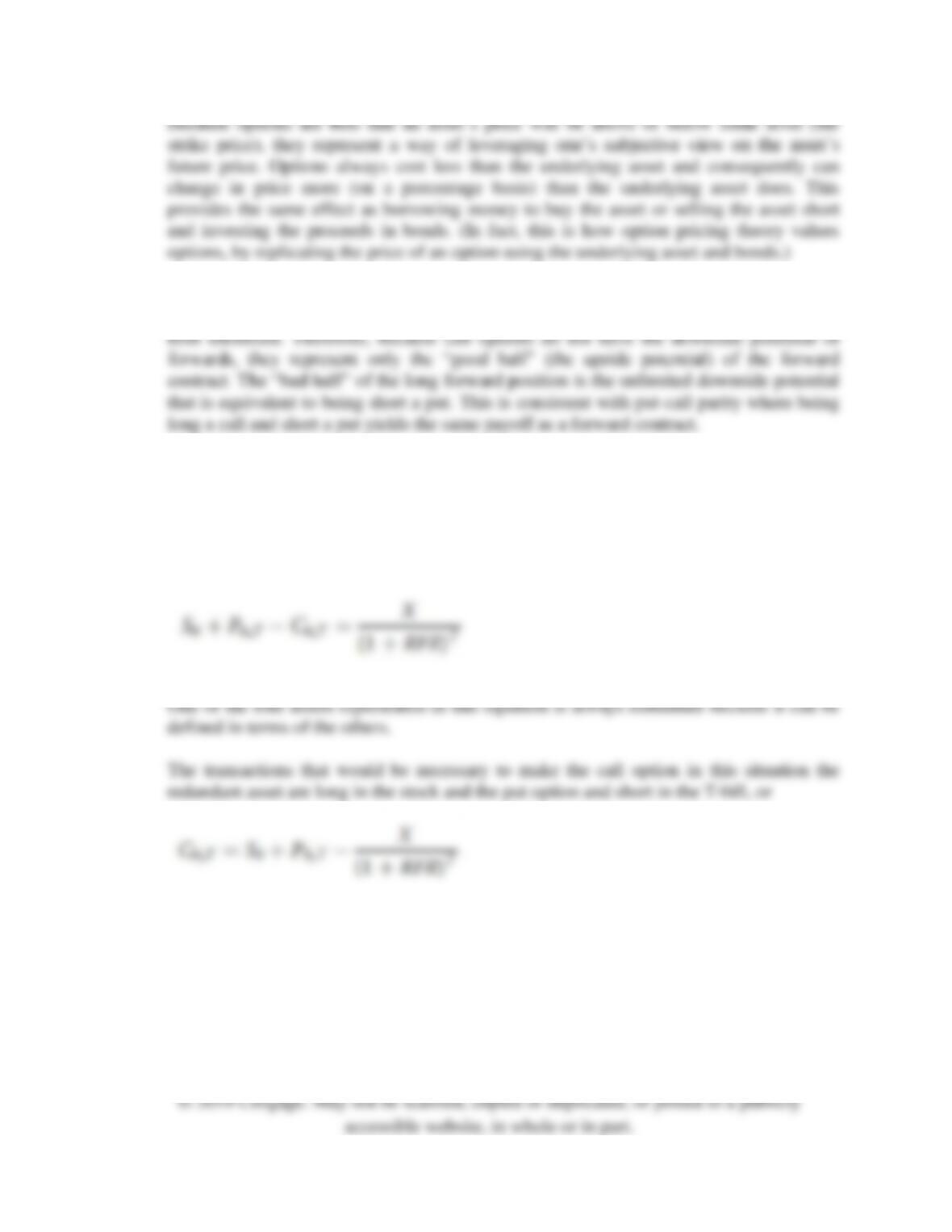
7. The put–call–spot parity relationship can be expressed as:
(Long Stock) + (Long Put) + (Short Call) = (Long T-Bill)
or
8. If the underlying security pays a dividend during the life of the contracts, the current
stock price must be adjusted downward by the present value of the dividend. The
payment of the dividend reduces the price of the call relative to the put by the discounted
amount of the cash distribution.
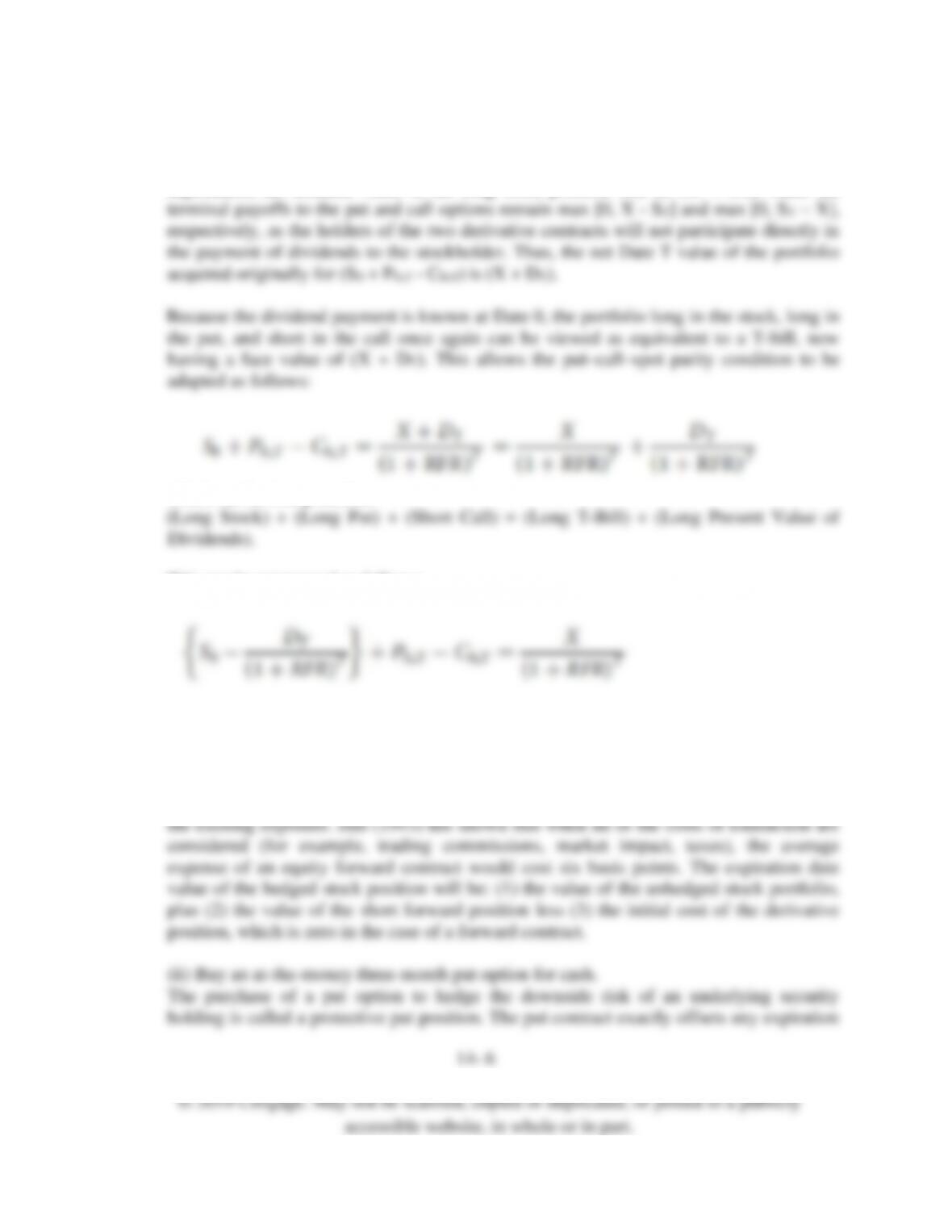
Expressed as an extension of the put–call–spot parity model, suppose the stock pays a
dividend of DT immediately prior to the expiration of the options at Date T and that the
amount of this distribution is known when the investment is initiated. With this
adjustment, the terminal value of the long stock position will be (ST + DT), while the
which can be interpreted as:
This can be rearranged as follows:
9.
(i) Short a three-month forward contract.
This is a hedge position, where the price risk of the underlying asset is offset by a
supplementary derivative transaction. To neutralize the risk of falling stock prices, the
fund manager requires a hedge position with payoffs that are negatively correlated with
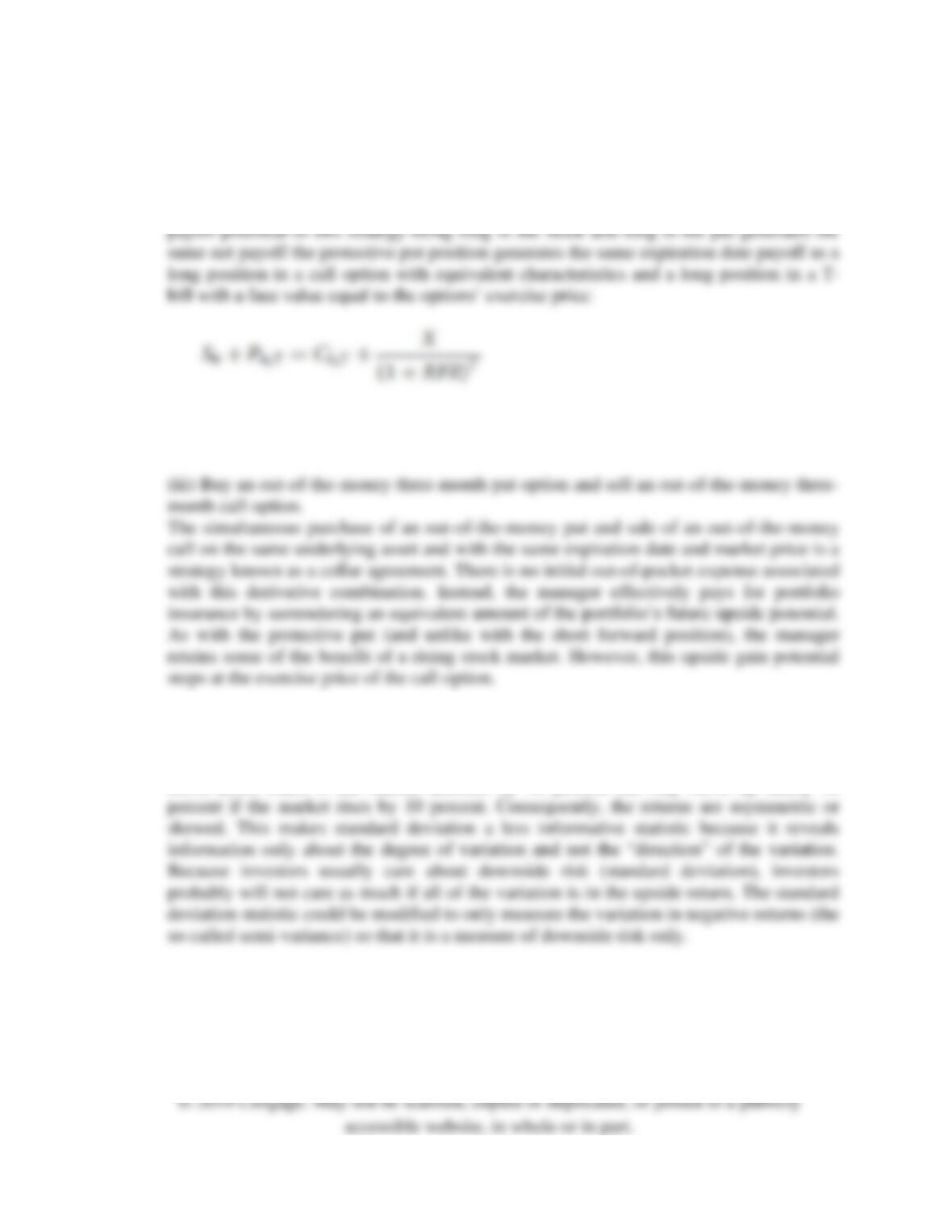
14- 7
date share price decline while allowing the position to increase in value as stock prices
increase. Thus, the put provides the manager with insurance against falling prices with no
deductible.
The initial cost is the upfront premium or the cost of the put option. The expiration date
10. Because options have nonlinear (kinked) payoffs, broad market movements may have
different relative effects on the value of a portfolio with options that depend on whether
the market moves up or down. For example, a portfolio that is put-protected may not
move down much if the market declines by 10 percent but may move up nearly 10

CHAPTER 14
Answers to Problems
l(a).
(i). A long position in a forward with a contract price of $50.
Expiration Date Sophia Long Forward Initial Long
Stock Price (S) (X=$50) Payoff=S-50 Forward Premium Net Profit
25 ($25.00) $0.00 ($25.00)
30 ($20.00) $0.00 ($20.00)
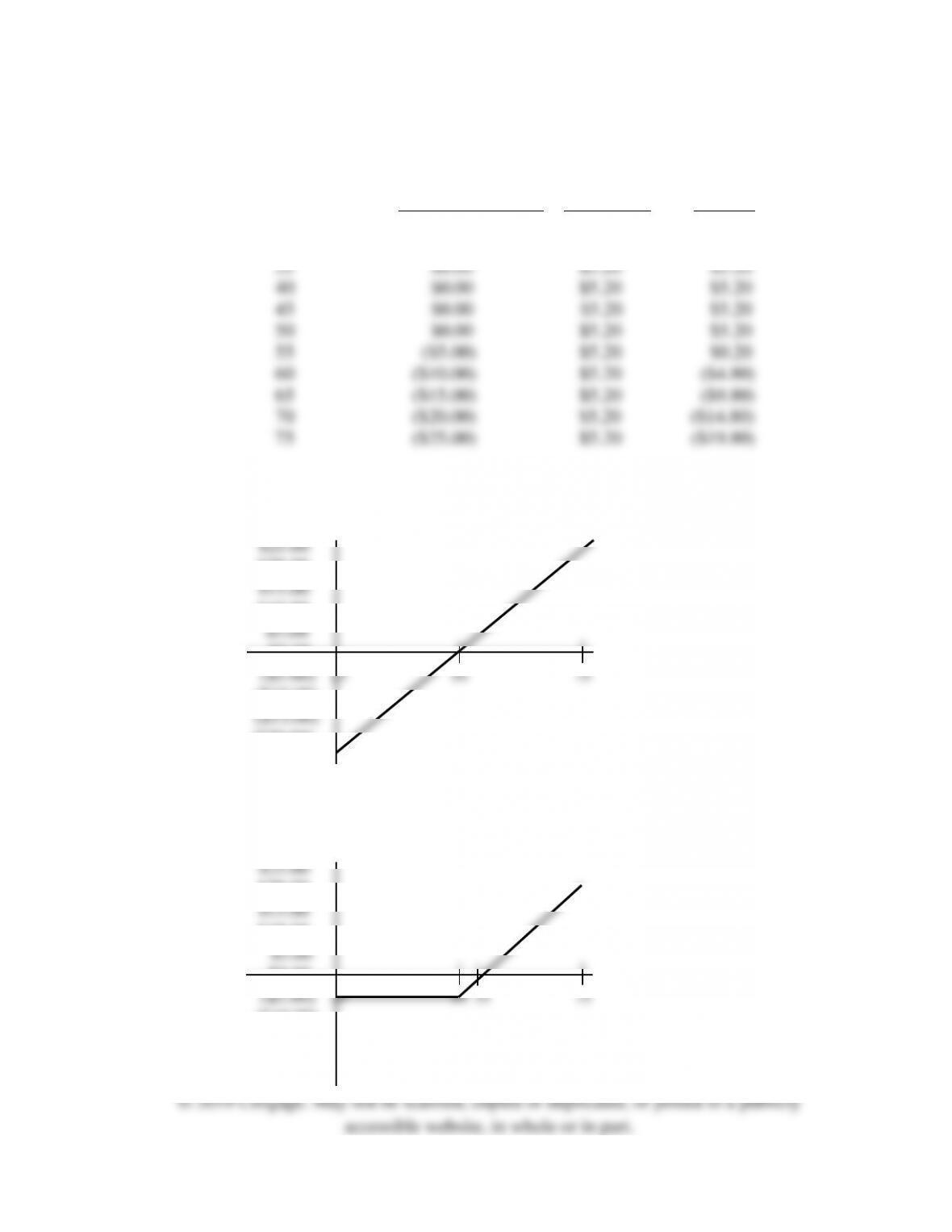
(ii). A long position in a call option with a exercise price of $50 and a front-end
premium expense of $5.20.
Expiration Date Sophia Long Call (K=$50) Initial Long
Stock Price (S) Payoff = max (0,S-50) Call Premium Net Profit
25 $0.00 ($5.20) ($5.20)
30 $0.00 ($5.20) ($5.20)
14- 9
(iii). A short position in a call option with an exercise price of $50 and a front-end
premium receipt of $5.20.
Expiration Date Sophia Short Call (K=$50) Initial Short
Stock Price (S) Payoff = -max (0,S-50) Call Premium Net Profit
25 $0.00 $5.20 $5.20
30 $0.00 $5.20 $5.20
l(b). (i). A long position in a forward with a contract price of $50.
Long Forward
$20.00
$10.00
$0.00
($10.00)
($20.00)
($25.00)
(ii.) A long position in a call option with an exercise price of $50 and a front-end premium
expense of $5.20:
Long Call
$20.00
$10.00
$0.00
($10.00)
($20.00)
($25.00)
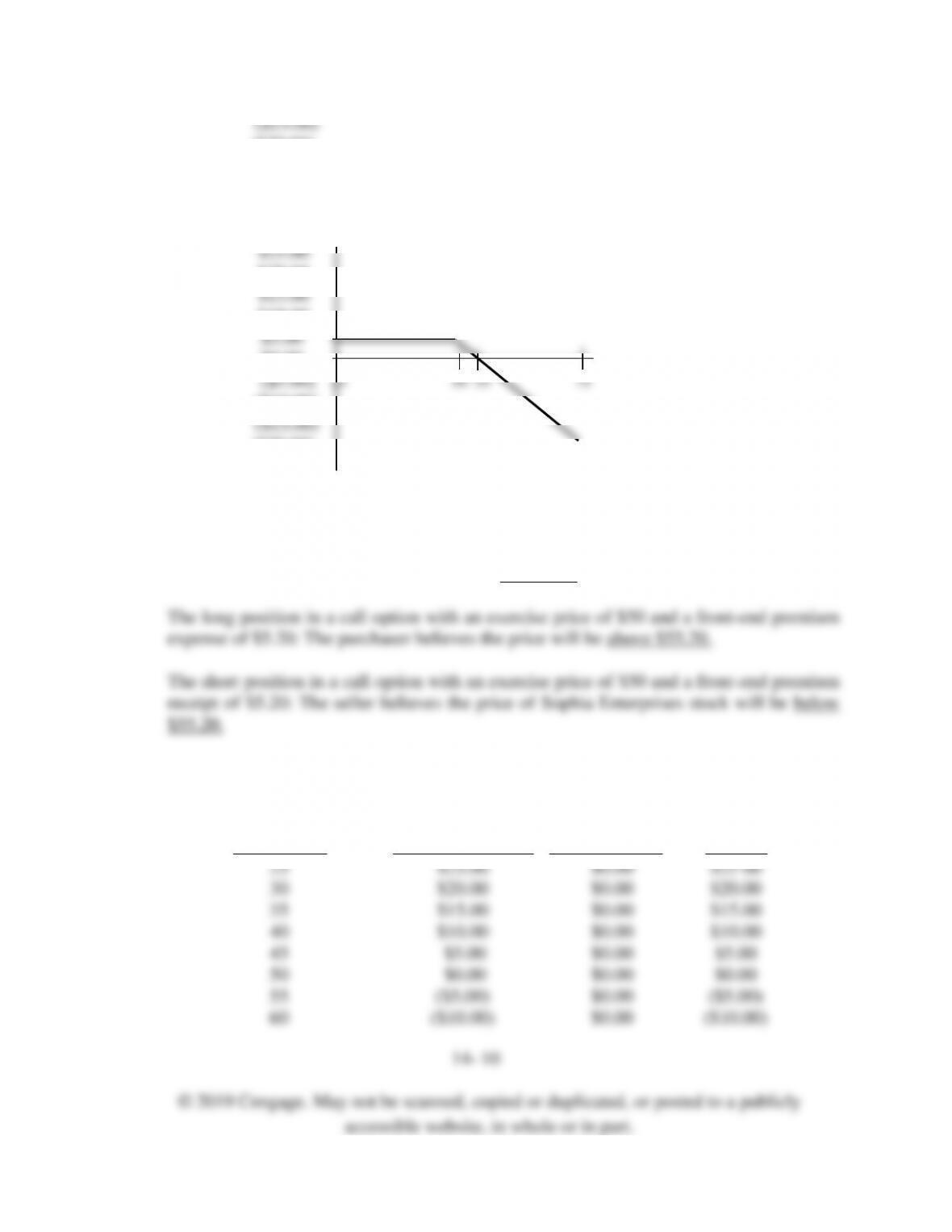
(iii.) A short position in a call option with an exercise price of $50 and a front-end
premium receipt of $5.20
Short Call
$20.00
$10.00
$0.00
($10.00)
($20.00)
($25.00)
THE BREAKEVEN POINT FOR THE CALL OPTIONS IS $55.20.
l(c). The long position in a forward with a contract price of $50: The purchaser believes that
the price of Sophia Enterprises stock will be above $50.
2(a).
(i). A short position in a forward with a contract price of $50.
Expiration Date Sophia Short Forward Initial Short
Stock Price (S) (K=$50) Payoff= S-50 Forward Premium Net Profit

14- 11
70 ($20.00) $0.00 ($20.00)
75 ($25.00) $0.00 ($25.00)
(ii). A long position in a put option with a exercise price of $50 and a front-end premium
expense of $3.23.
Expiration Date Sophia Long Put (K=$50) Initial Long
Stock Price (S) Payoff= max (0,50-S) Put Premium Net Profit
25 $25.00 ($3.23) $21.77
(iii.) A short position in a put option with an exercise price of $50 and a front-end
premium receipt of $3.23.
Expiration Date Sophia Short Put (K=$50) Initial Short
Stock Price (S) Payoff= -max (0,50-S) Put Premium Net Profit
25 ($25.00) $3.23 ($21.77)
30 ($20.00) $3.23 ($16.77)
14- 12
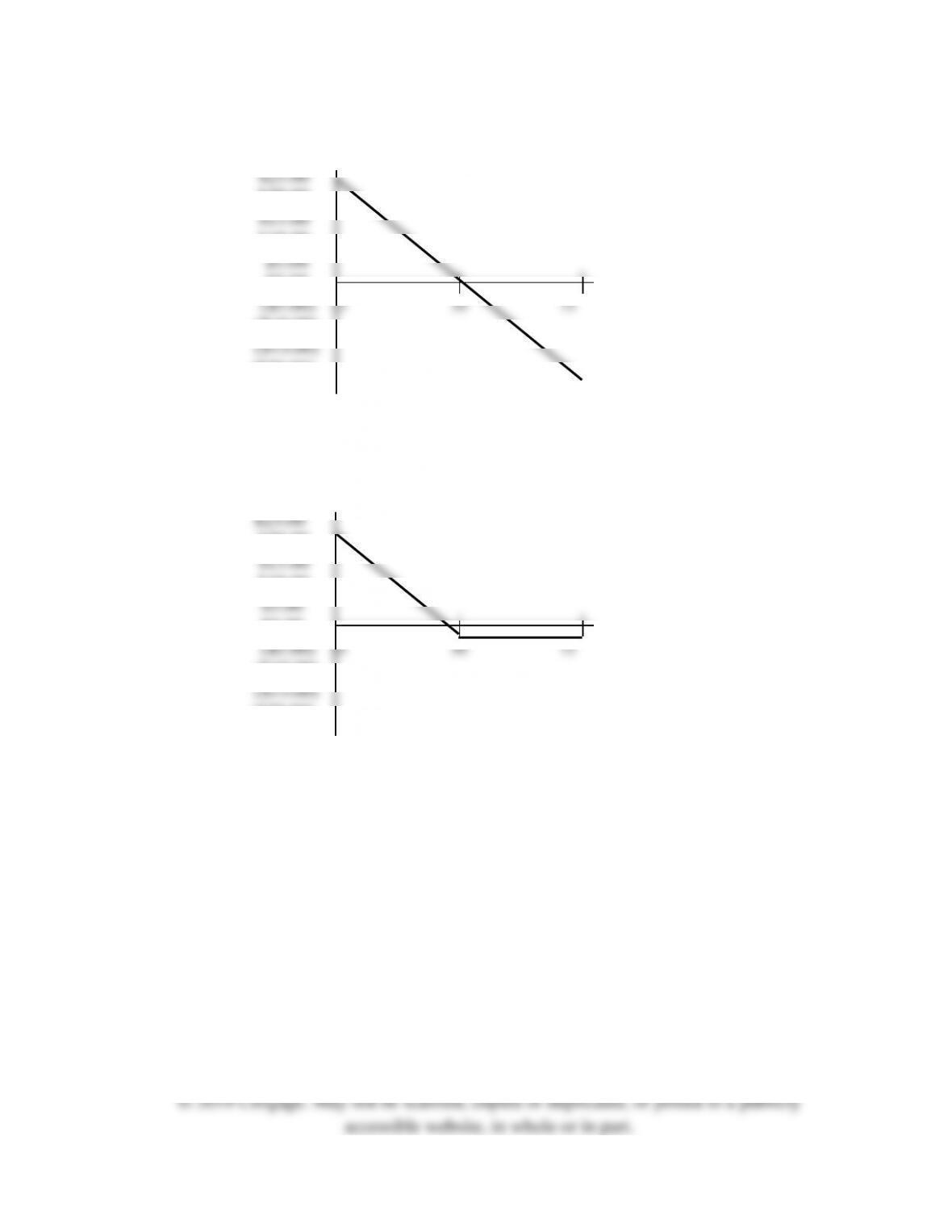
2(b). (i). A short position in a forward with a contract price of $50:
Short Forward
$20.00
$10.00
$0.00
($10.00)
($20.00)
($25.00)
(ii). A long position in put option with an exercise price of $50 and front-end premium
expenses of $3.23:
Long Put
$20.00
$10.00
$0.00
($10.00)
($20.00)
($25.00)
14- 13
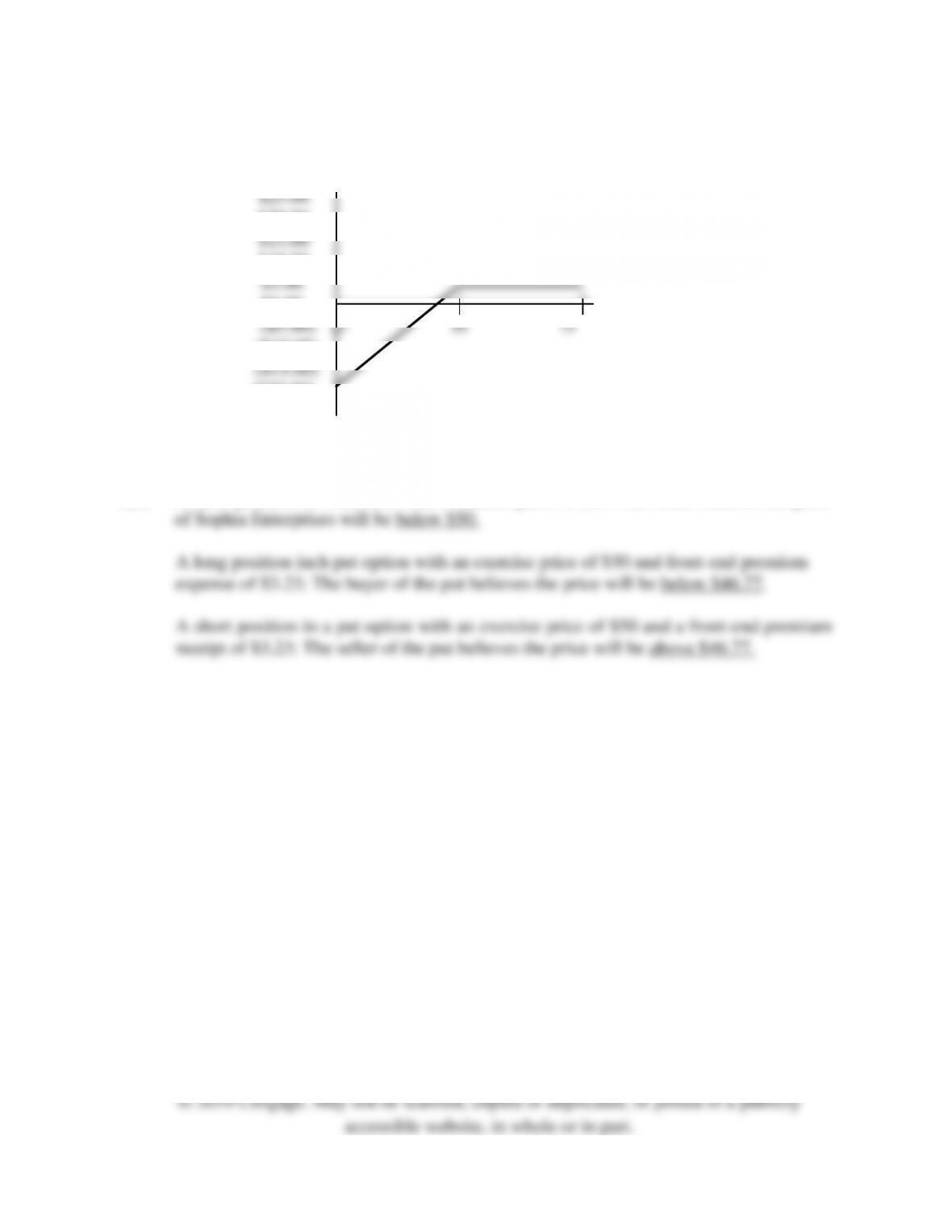
(iii). A short position in a put option with an exercise price of $50 and a front-end
premium receipt of $3.23:
Short Put
$20.00
$10.00
$0.00
($10.00)
($20.00)
($25.00)
THE BREAKEVEN POINT FOR BOTH PUT OPTIONS IS $46.77.
2(c). A short position in a forward with a contract price of $50: The seller believes the price