ANSWERS TO CHAPTER QUESTIONS
Chapter 14 Tax Planning
1) Taxes are relevant to the five major financial planning areas in the following
ways:
a) Cash Flow Planning – Taxes affect cash flows directly.
b) Educational Planning – Taxes influence the choice of structure for
educational savings.
2) You perform tax planning to map out future cash flow needs and in some
3) The average tax bracket is the total amount divided by taxable income while the
marginal tax bracket is the amount on the last dollar earned divided by the last
dollar.
4) The marginal tax bracket is often the best one to use to calculate the tax saving or
tax charge for a given strategy or projection being analyzed. That is because it

5) False – The deduction of state and local income taxes on the federal return needs
to be taken into account.
6) Marginal tax bracket. It is the one that will provide the right answer on the
amount of the benefit he will receive.
7) Shifting income is transferring income from one person to another. It is typically
done to have the amount taxed by the person in the lower tax bracket.
8) Clustering is taking expenses for two years and combining them in one year to
exceed the floor on what is deductible. For example you can have an annual
9) Because the full sum can be invested and enjoy the benefits of compounding of
returns. This effect is particularly powerful when the deferral takes place in a tax
sheltered vehicle like a retirement account.

10) Conversion is the overall method of reducing the amount of tax. Shifting income
is one of two approaches for doing so, the other being transforming income.
11) Three methods of tax elimination are purchase of municipal bonds, placing
12) Sarah should sell the shares in the new year to postpone the tax for one year.
From a tax standpoint Marcy should sell the shares in the current year to take
advantage of the $3,000 limit tax loss in the current year (assuming she has no
other taxable transactions.)
13) You may want to consider postponing the sale until the next year if you expect the
14) There are two elements to the benefit of a qualified pension plan:
a) The fact that pretax dollars go into the plan. That means the deposits are

15) The qualified pension plan is attractive because of pretax dollar contributions and
no taxation on gains until amounts are withdrawn. The Roth IRA has no further
taxation on gains subsequent to after tax deposits. Tax deferred annuities and non
16) A municipal bond provides tax free returns and flexibility in withdrawals
whenever you wish. The tax deferred annuity does not eliminate it just postpones
taxes. It has limits of flexibility and maintenance costs but also options on
ANSWERS TO CHAPTER PROBLEMS
Chapter 14 Tax Planning
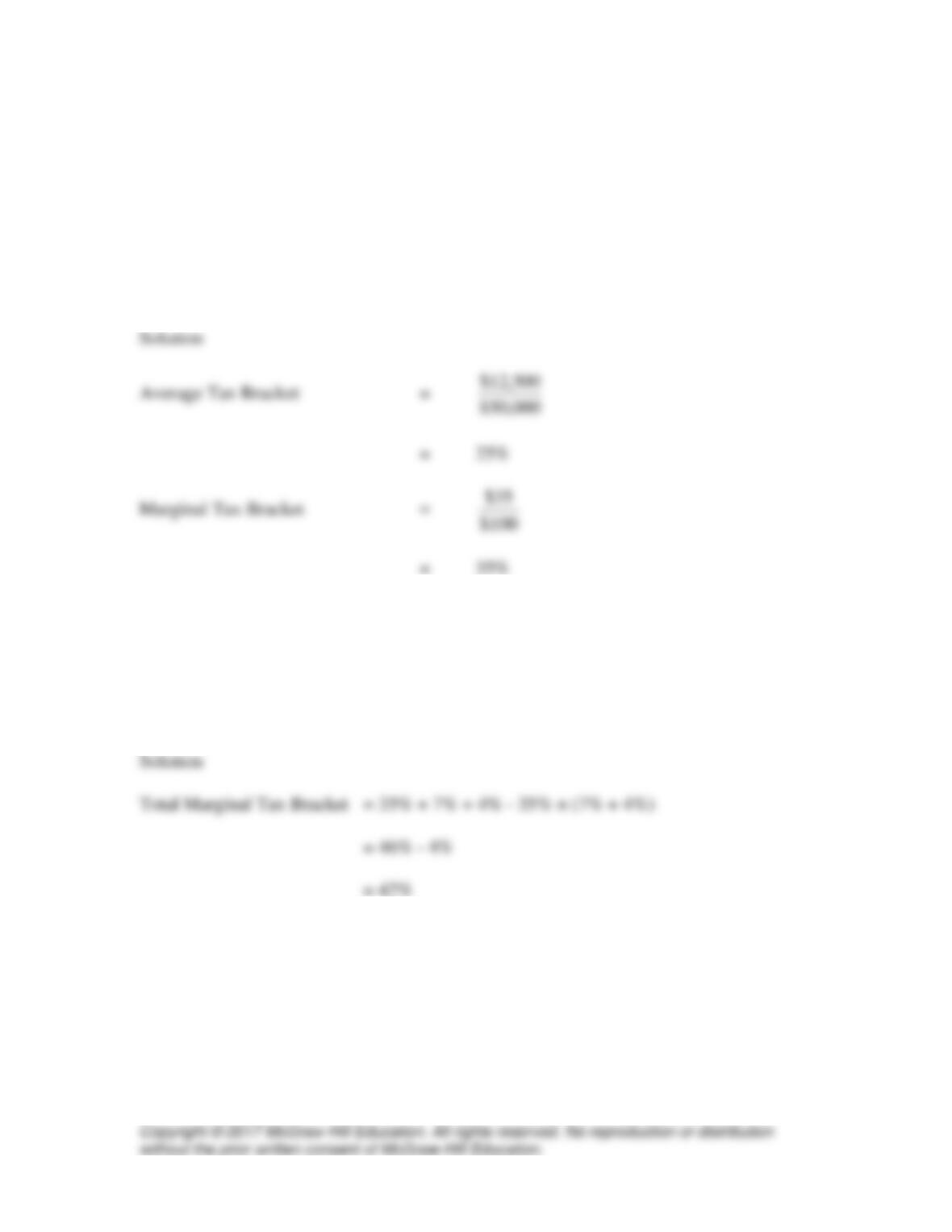
1) Melinda earned $50,000 and paid taxes of $12,500. She would have paid $35 on the
next $100 she made. Compute her average and marginal tax brackets.
2) Murray was in the following marginal tax brackets: federal, 35 percent; state, 7
percent; local, 4 percent. What is his total marginal tax bracket?
3) Sally was able to negotiate a deferral in her $8,000 bonus from December to the
beginning of January. Compute the benefit of receiving the bonus in January,
assuming that she is in a 30 percent marginal tax bracket and could earn 6 percent
after tax per year and that the bonus would remain for 30 years until retirement.
Solution
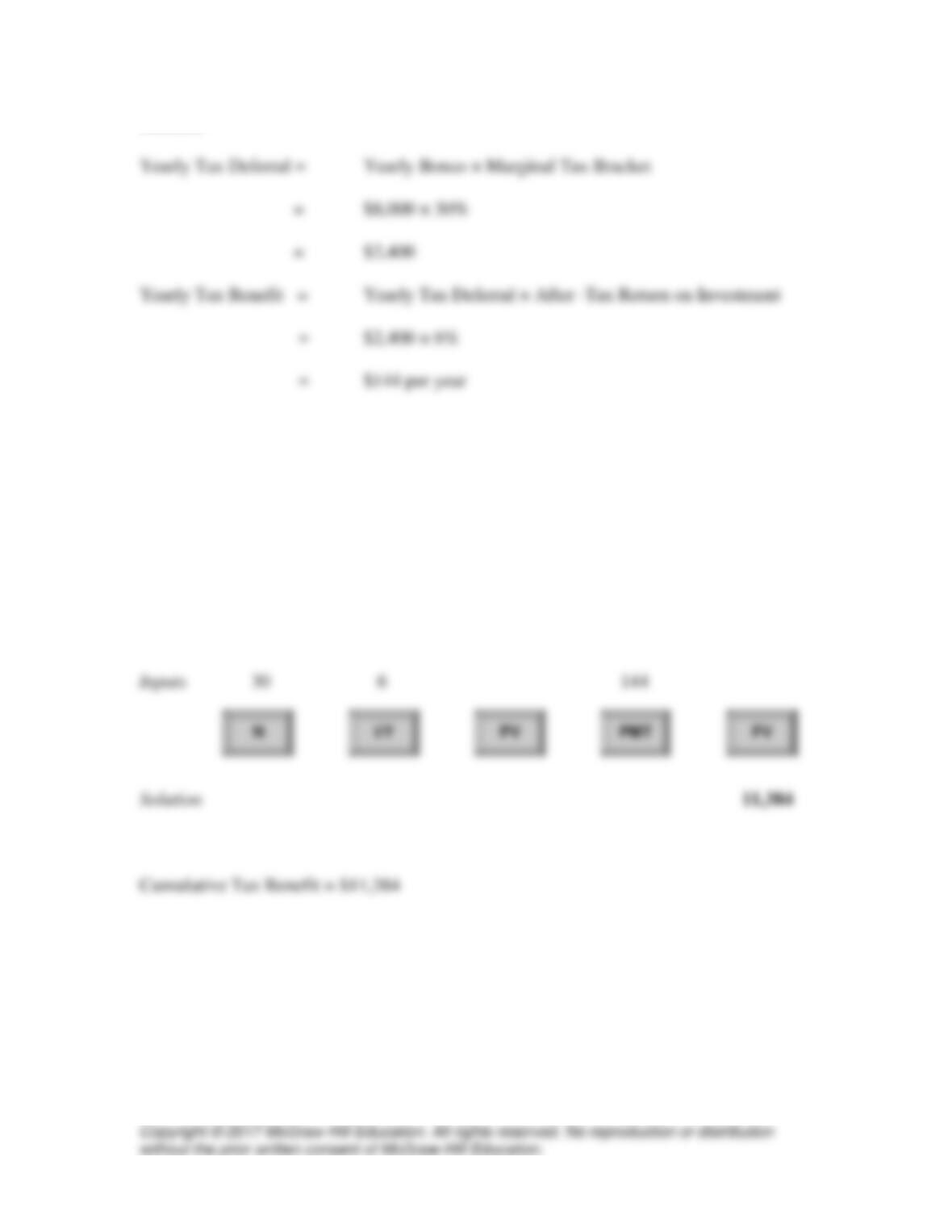
For as long as she performed this service, Sally had a continuing tax benefit of $144 a
year when a December payout was compared with a January one. The cumulative benefit
at the end of 30 years is calculated as follows:
Calculator Solution
4) What is the annual benefit of parents gifting $300 each year to their child if the
parents are in the 35 percent bracket and the child is in the 15 percent bracket?

Note: The problem in the text should read:
What is the annual benefit of parents gifting bonds with annual investment income of
$300 to their 10-year-old child if the parents are in the 35 percent and the child is in the
15 percent bracket?
The solution to the problem then should be:
5) Laurence bought a classic car for $40,000 as a business investment opportunity. He
was allowed to depreciate it over 10 years and take the amount as a business tax
deduction on his return. At the end of 10 years, the car was sold for $40,000. If
Laurence was in the 38 percent marginal tax bracket and could earn 8 percent after
tax on the cash flow generated, what was his cumulative cash benefit after sale on this
transaction?
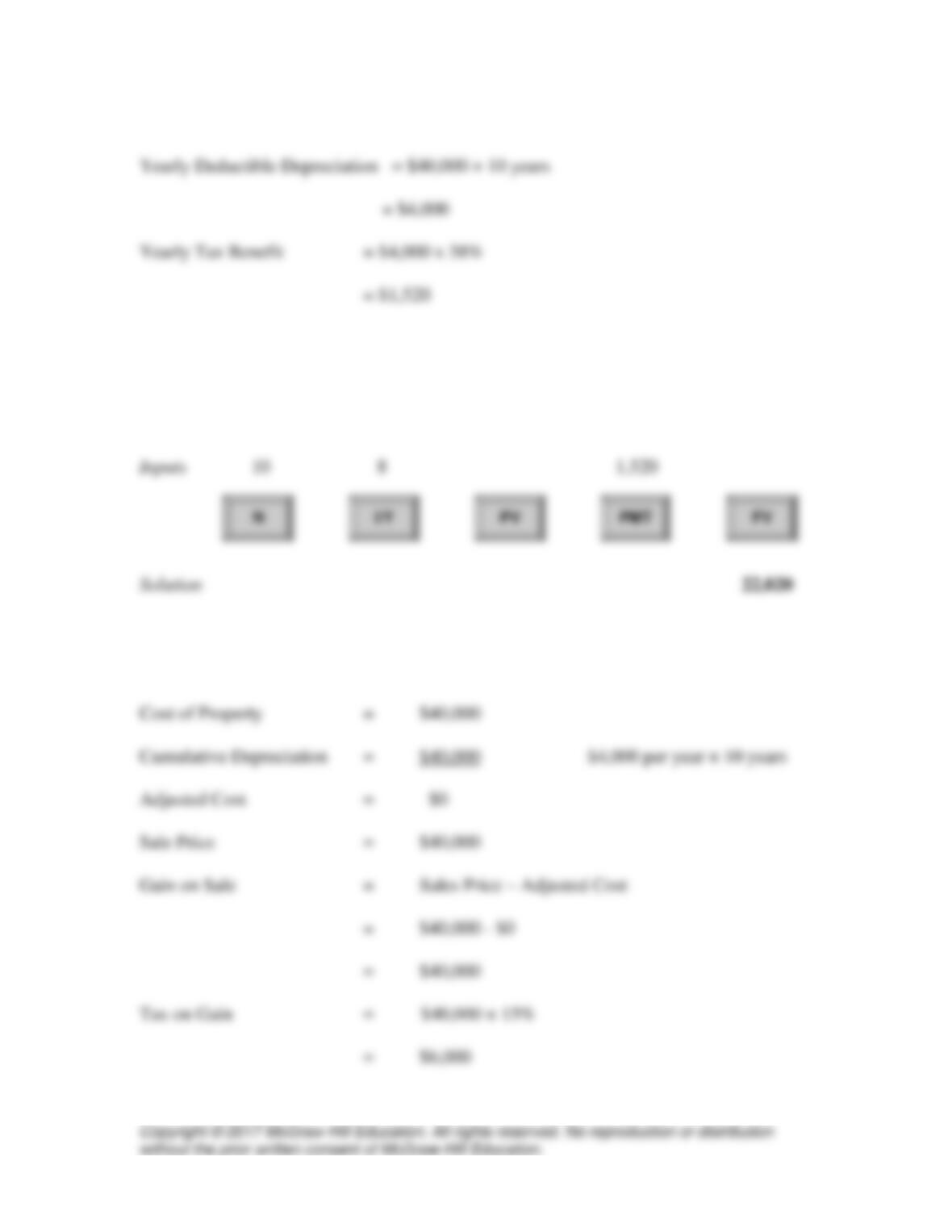
Solution
Cumulative Tax Benefit
Calculator Solution
Tax Paid on Sale: Explanation

The amount of cumulative cash benefit for Laurence was $16,020. The benefit came
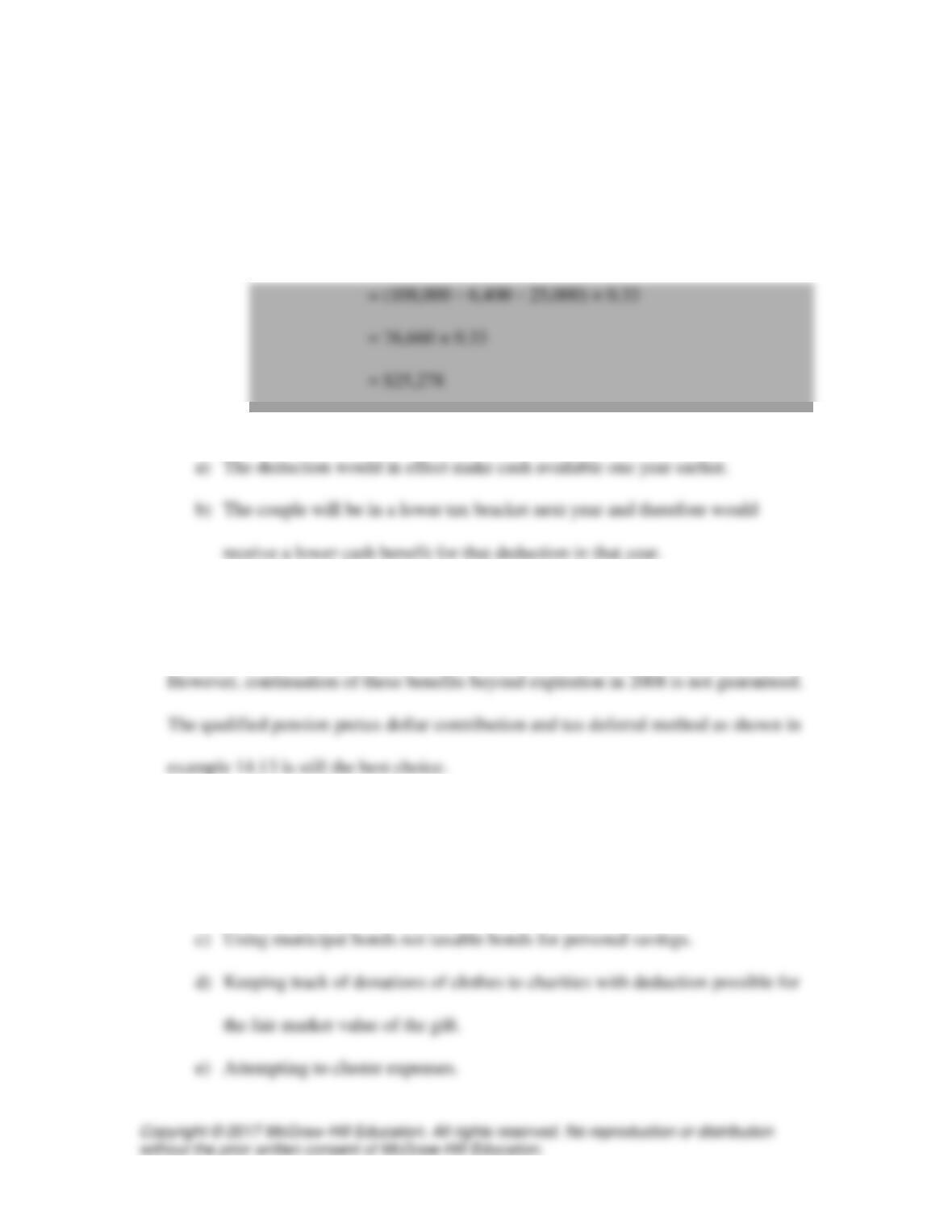
6) Frances donated $20,000 to a charity each year. This year she thought that, instead of
cash, she would donate $25,000 of a stock that cost her $8,000. She was going to sell
the shares anyway. If the combined federal and state capital gains tax for Frances is
20 percent, how much would she save in taxes by donating stock instead of selling the
shares and then donating the proceeds?
Solution
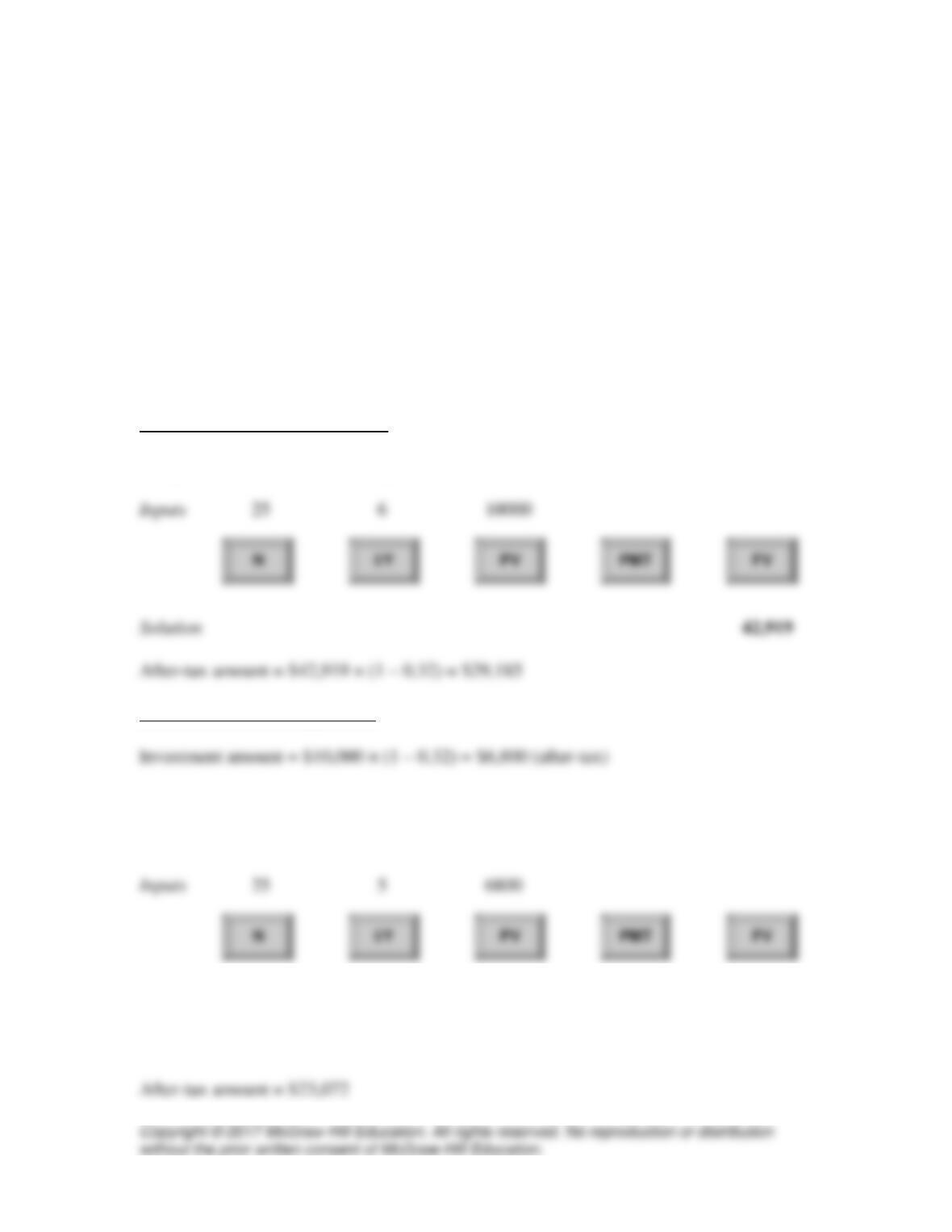
7) Compare a pretax $10,000 sum placed in bonds yielding 6 percent in a qualified
pension with an investment in a municipal bond yielding 5 percent. The municipal
bond sum deposited was made with after-tax dollars on the same pretax $10,000. The
marginal tax rate was 32 percent. Assume that the sums were accumulated for 25
years and the pension was liquidated at that time.
Solution
Investment in a qualified pension
Lump sum accumulated over 25 years:
Investment in a municipal bond
Investment value in 25 years:
Solution 23,072

The investment in a qualified pension plan grows to $42,919 pre-tax and $29,185 after-
ANSWERS TO CASE APPLICATION QUESTIONS
Chapter 14 Tax Planning
1) Projected taxes = (AGI – Exemptions – Deductions) × Tax rate
2) There are two reasons why Richard should take the deduction this year.
3) Richard’s losses could be taken currently and saving personally now has tax benefits
since capital gains and dividend income are subject to lower federal taxation.
4) Recommendations:
a) Making charitable gifts by donating appreciated stocks.
b) Having as much saving as possible through qualified pension plans.

Answers to CFP® Questions
Question
Answer
Author’s Explanation
ERRATA TO CFP® CERTIFICATION EXAMINATION QUESTIONS AND
PROBLEMS
14.1
The author assumed that since the taxpayer didn’t itemize the state tax, deduction on the
federal tax return wouldn’t be available. Therefore, in his calculations he uses the sum of

SOLUTIONS TO SELECTED CFP® CERTIFICATION EXAMINATION
PROBLEMS
1
14.1
Your client’s federal marginal tax rate is 36 percent, and the state marginal rate is 7
percent. The client does not itemize deductions on his federal return and is considering
investing in a municipal bond issued in his state of residence that yields 5 percent. What
is the adjusted taxable equivalent yield?
a. 3.2%
b. 4.65%
c. 5.38%
d. 7.81%
e. 8.40%
Solution:
Note: The author assumed that since the taxpayer didn’t itemize the state tax, deduction
1
The solutions supplied are those of the author and not of the CFP Board.
14.2
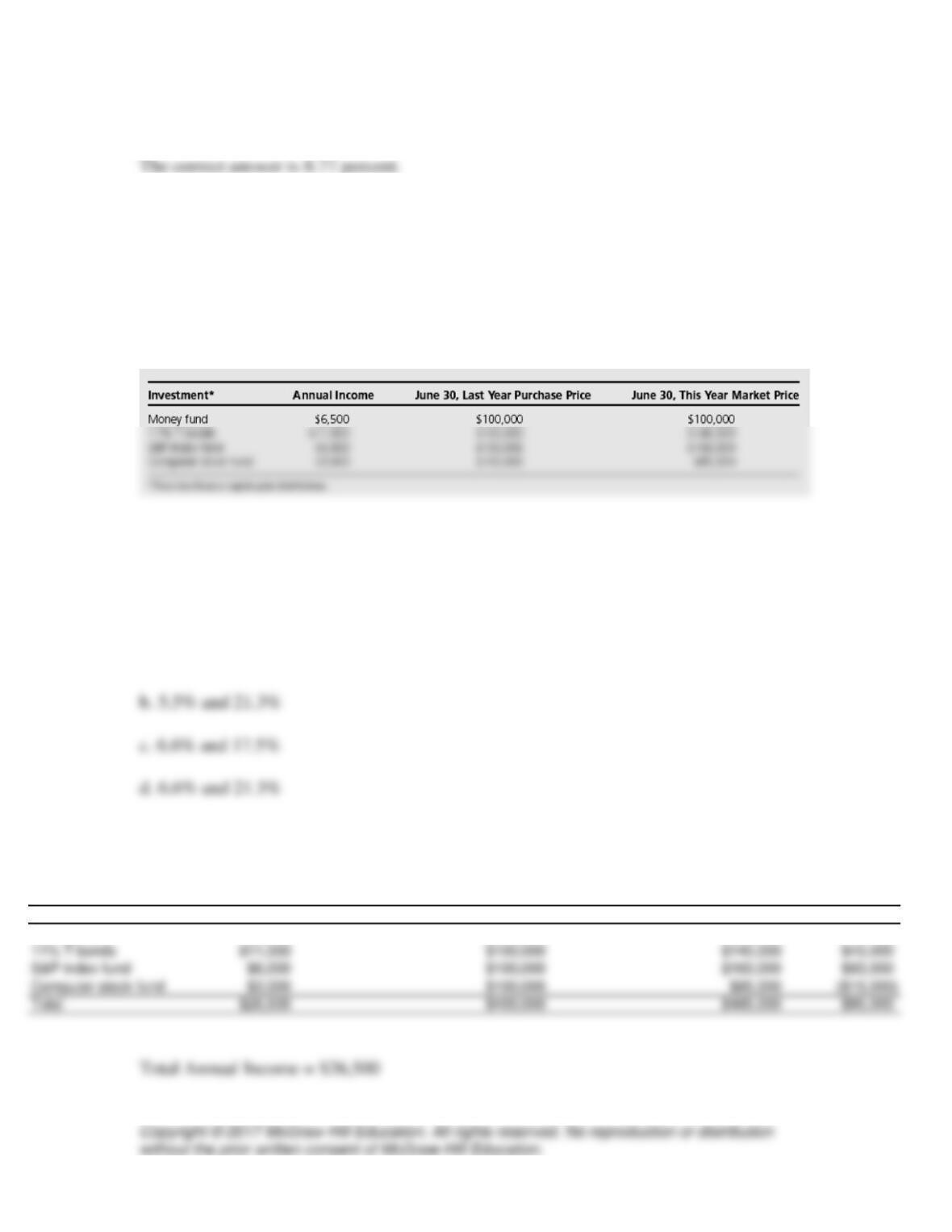
The tax bracket and holdings of your client are as follows:
Federal tax bracket – 33%
During the 12 months from June 30 last year through June 30 this year, the portfolio
earned, in annual yield and before-tax appreciation, respectively
a. 5.5% and 17.5%
Solution:
Investment* Annual Income June 30, Last Year Purchase Price June 30, This Year Market Price Appreciation
Money fund $6,500 $100,000 $100,000 $0
14.4
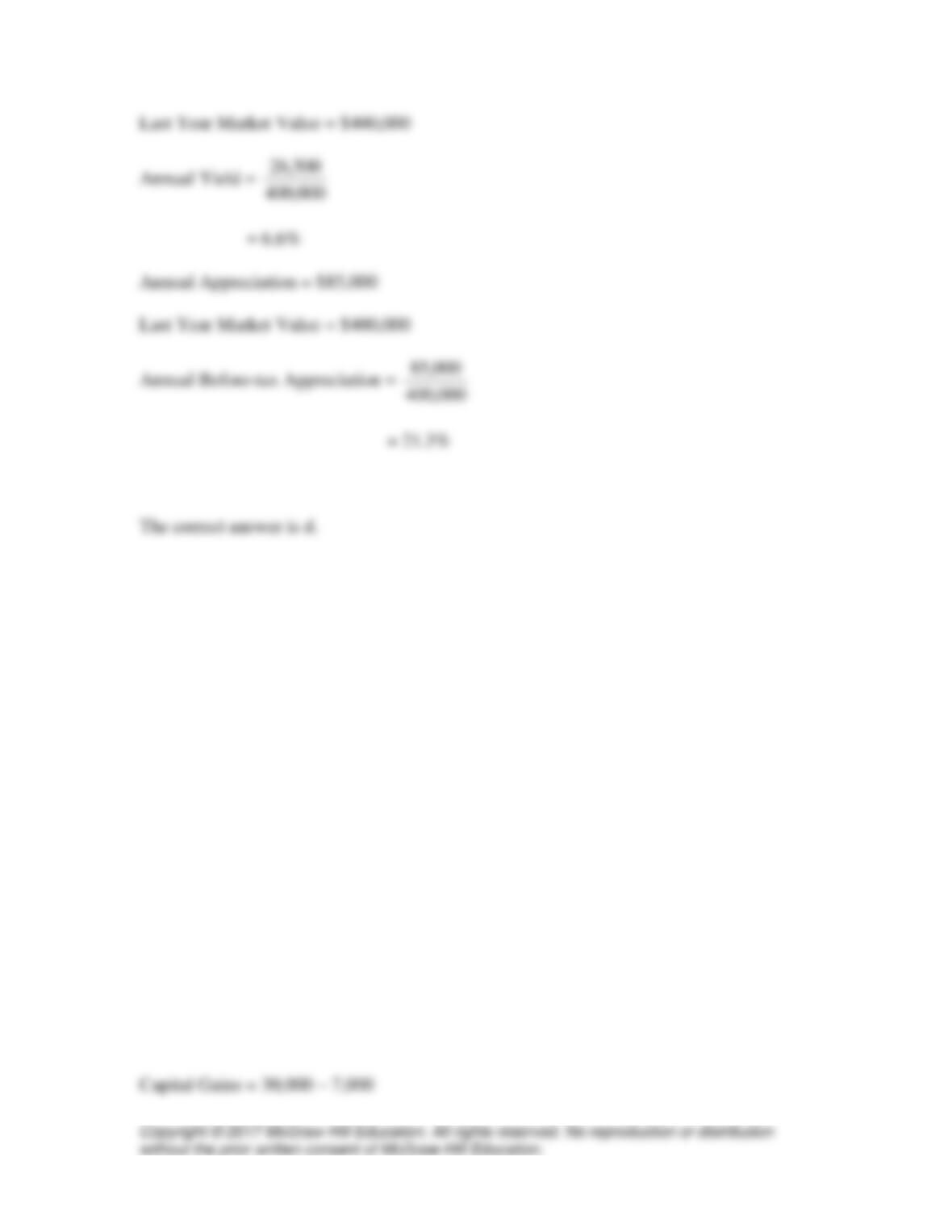
Jorge is single and owns $30,000 of stock he originally purchased four years ago for
$7,000. His adjusted gross income (AGI) is $40,000. If Jorge donates the stock to his
church, which of the following is the maximum amount he can deduct as a charitable
contribution for this gift on his federal income tax return this year?
a. $12,000
b. $15,000
c. $20,000
d. $30,000
Solution: