Introduction to Corporate Finance, Fourth Edition Booth, Cleary, Rakita
b.
Annual opportunity cost
4.00%
Opportunity cost:
0.003274
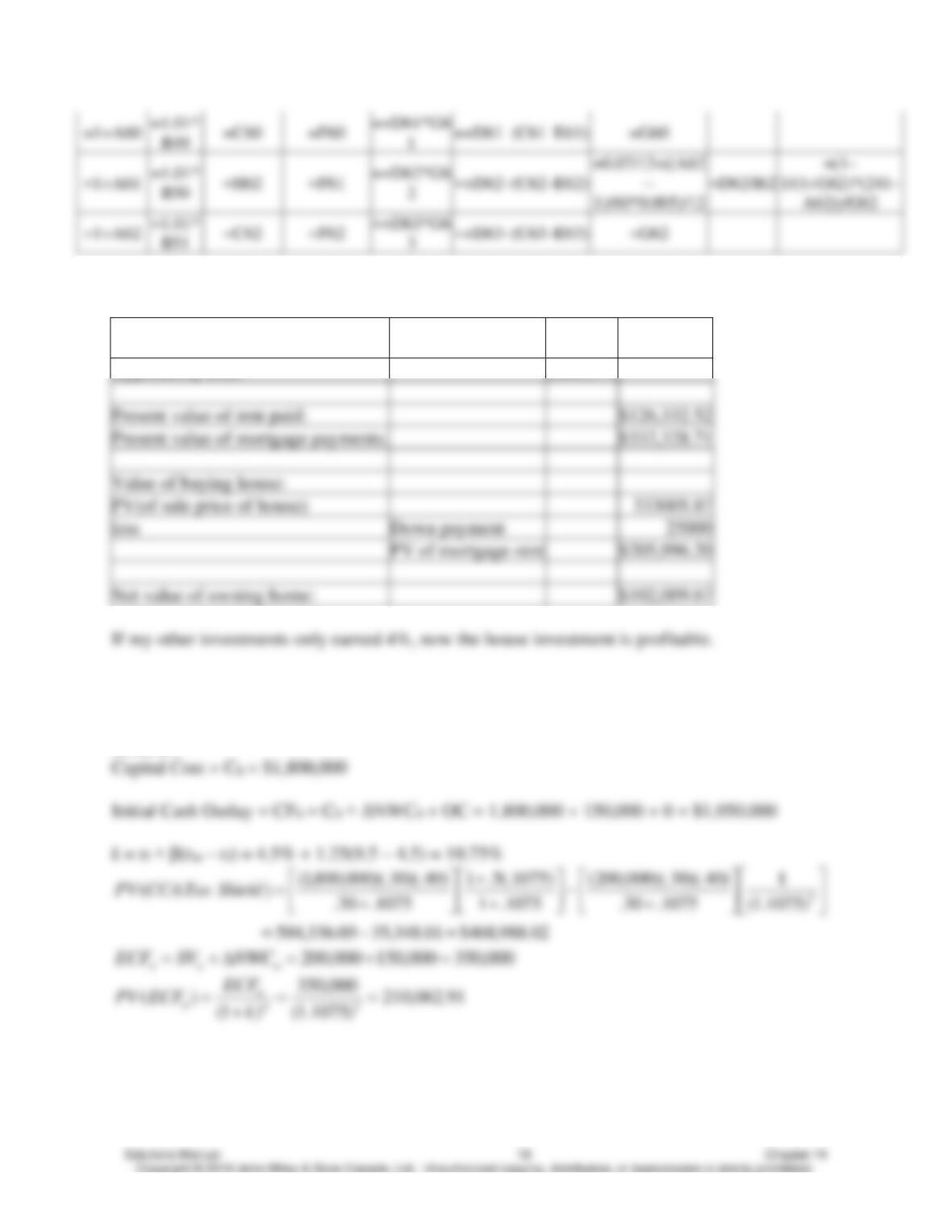
Present value of rent paid:
$126,332.52
Present value of mortgage payments:
$332,328.71
Value of buying house:
PV(of sale price of house)
less
Down payment
PV of mortgage-rent
$205,996.20
Net value of owning home:
$102,009.67
45. Section: 14.2 Estimating and Discounting Cash Flows
Learning Objective: 14.2
Level of difficulty: Challenging
Solution:
Introduction to Corporate Finance, Fourth Edition Booth, Cleary, Rakita
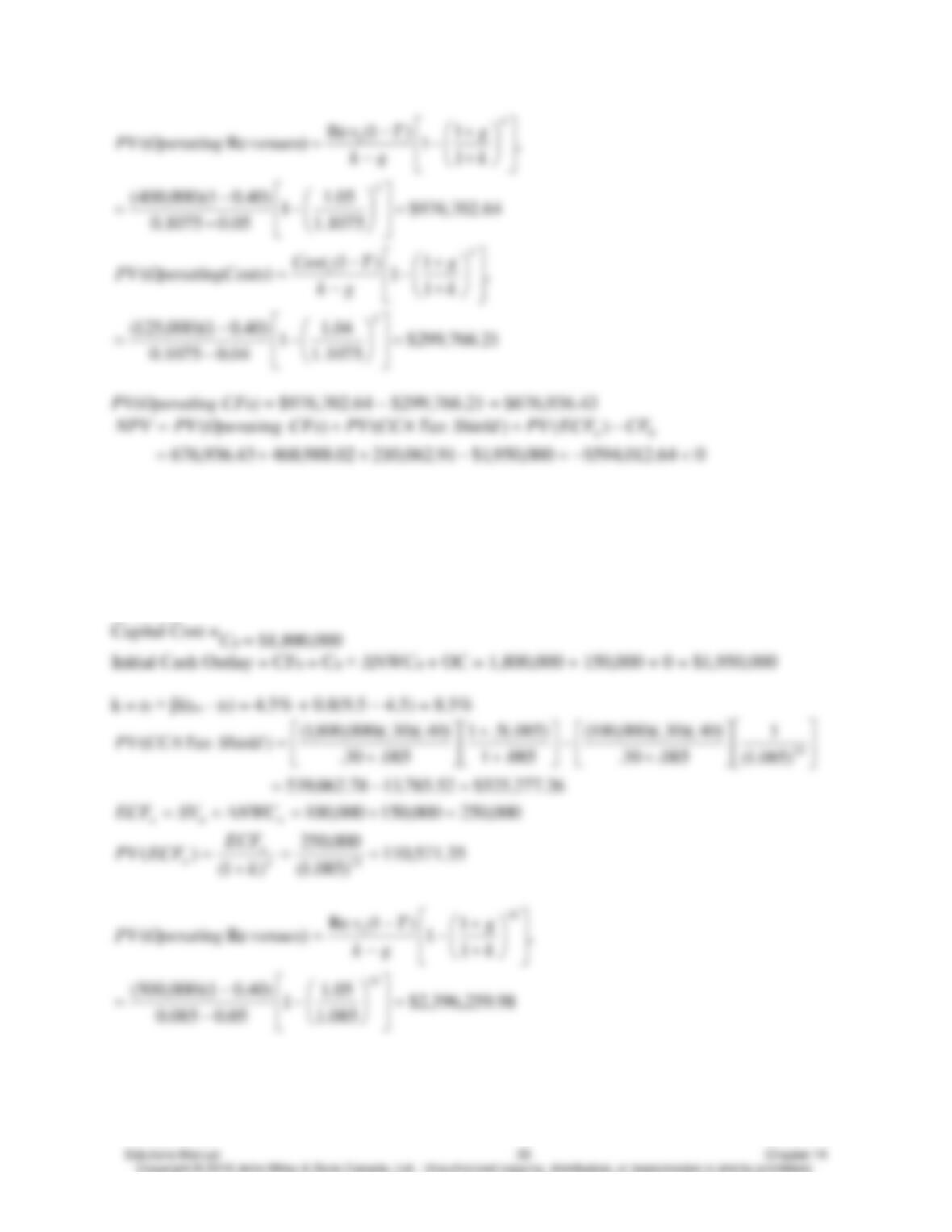
Therefore, Brigid Co. should not accept this project.
46. Section: 14.4 Sensitivity to Inputs
Learning Objective: 14.4
Level of difficulty: Challenging
Solution:
Introduction to Corporate Finance, Fourth Edition Booth, Cleary, Rakita
47. Section: 14.2 Estimating and Discounting Cash Flows
Learning Objective: 14.2
Level of difficulty: Challenging
Solution:
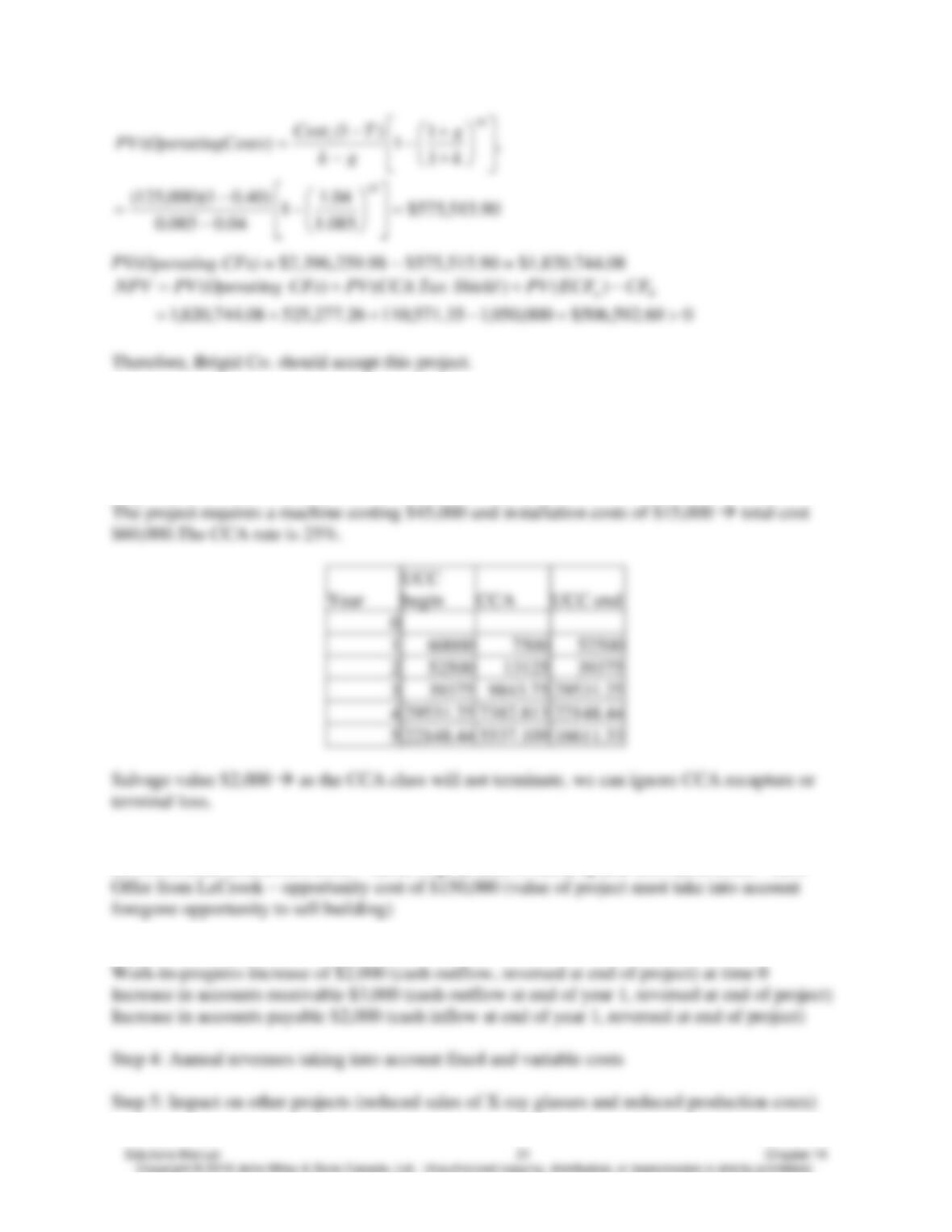
Step 1: CCA considerations:
Step 2: Opportunity and sunk costs:
Environmental assessment costs – sunk; original cost of building and renovation costs – sunk
Step 3: Working capital effects:
Introduction to Corporate Finance, Fourth Edition Booth, Cleary, Rakita
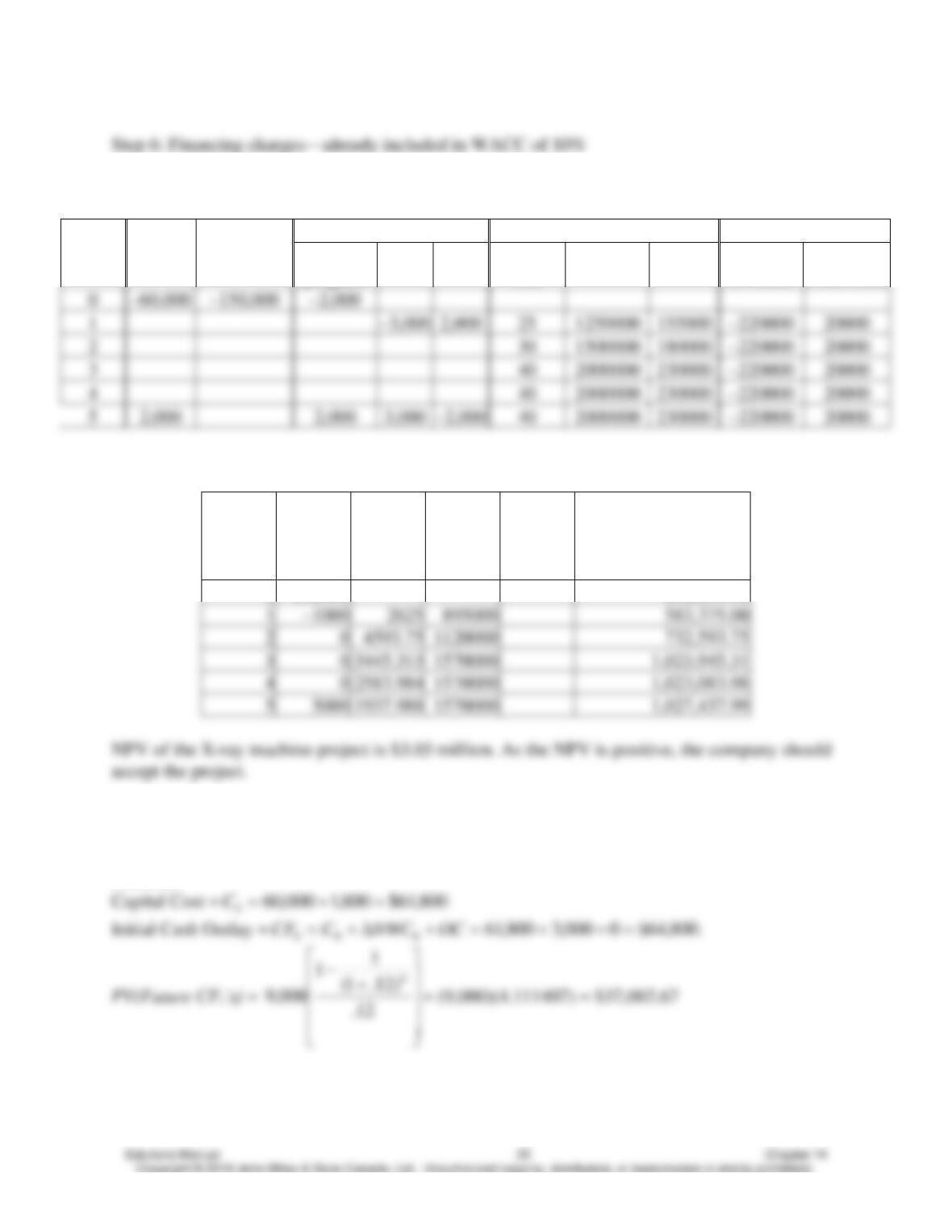
Summary of cash flows (before taxes):
Year
Invest.
Opportunity
costs
Working capital effects
Operating cash flows
X-ray Glasses
Work-in–
progress
A/R
A/P
Machines
sold
Revenues
Costs
Lost
revenues
Saved
Prod. costs
1250000
–220000
1500000
–220000
2000000
–220000
2000000
–220000
2000000
–220000
Determining after-tax cash flows:
Year
Non-
taxable
cash
flows
CCA tax
effects
Taxable
cash
flows
Total after-tax cash
flows
0
–212000
–212,000.00
1
2
0
1120000
3
0
1570000
4
0
1570000
5
1570000
48. Section: 14.2 Estimating and Discounting Cash Flows
Learning Objective: 14.2
Level of difficulty: Challenging
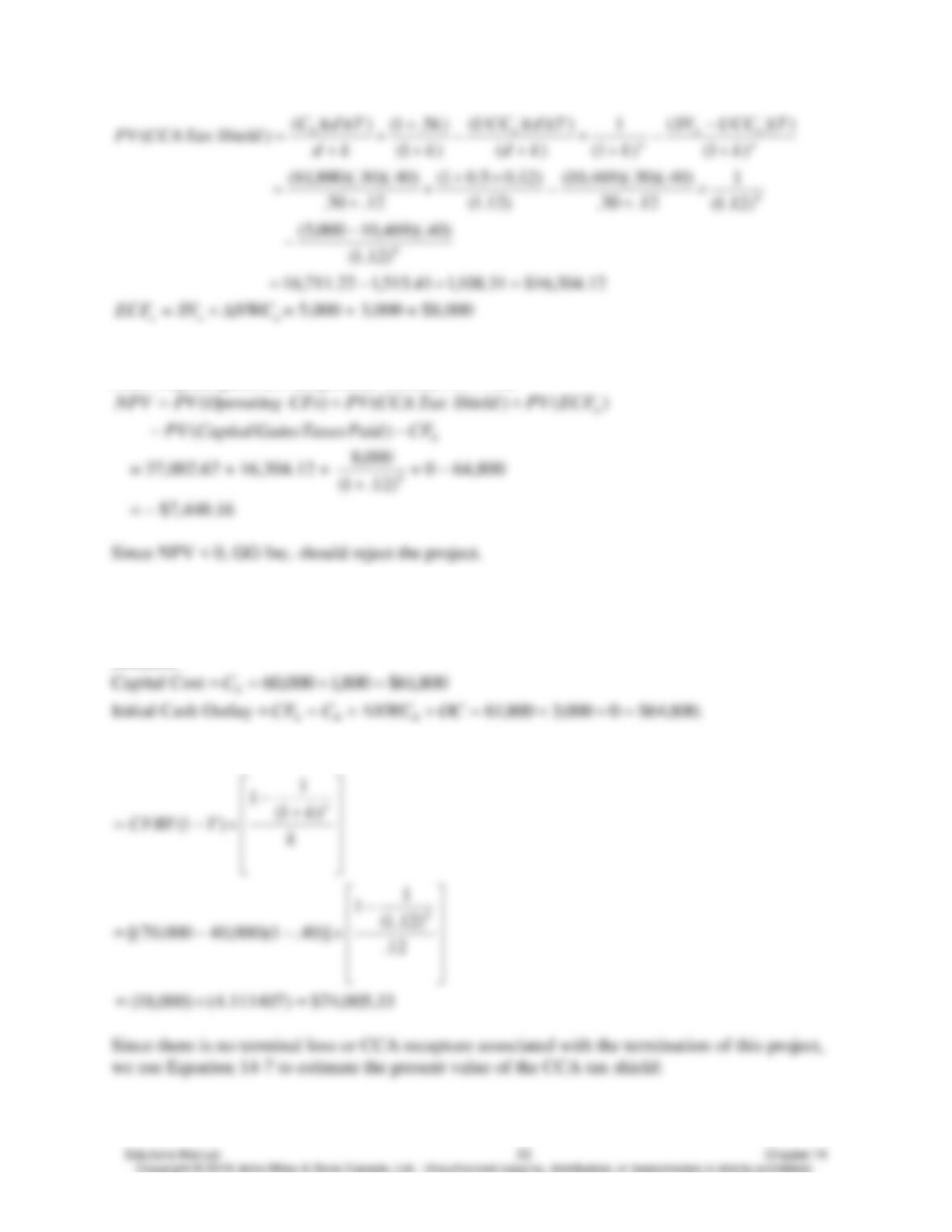
Solution:
Introduction to Corporate Finance, Fourth Edition Booth, Cleary, Rakita
Note: Capital gains are not possible because SV < C0.
49. Section: 14.2 Estimating and Discounting Cash Flows
Learning Objective: 14.2
Level of difficulty: Challenging
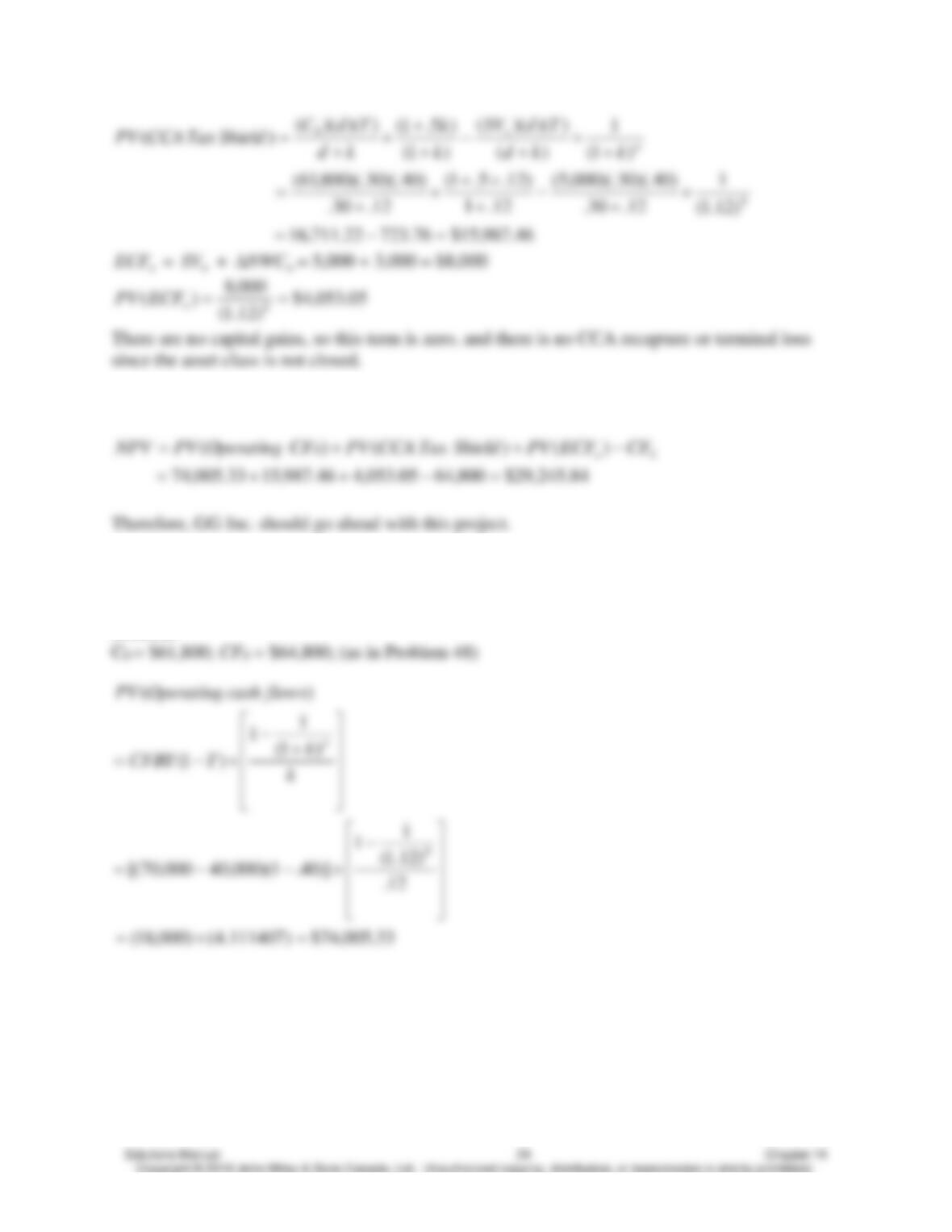
Solution:
)(
flowscashOperatingPV
Introduction to Corporate Finance, Fourth Edition Booth, Cleary, Rakita
Now we can put these items together to determine the NPV of the project.
50. Section: 14.2 Estimating and Discounting Cash Flows
Learning Objective: 14.2
Level of difficulty: Challenging
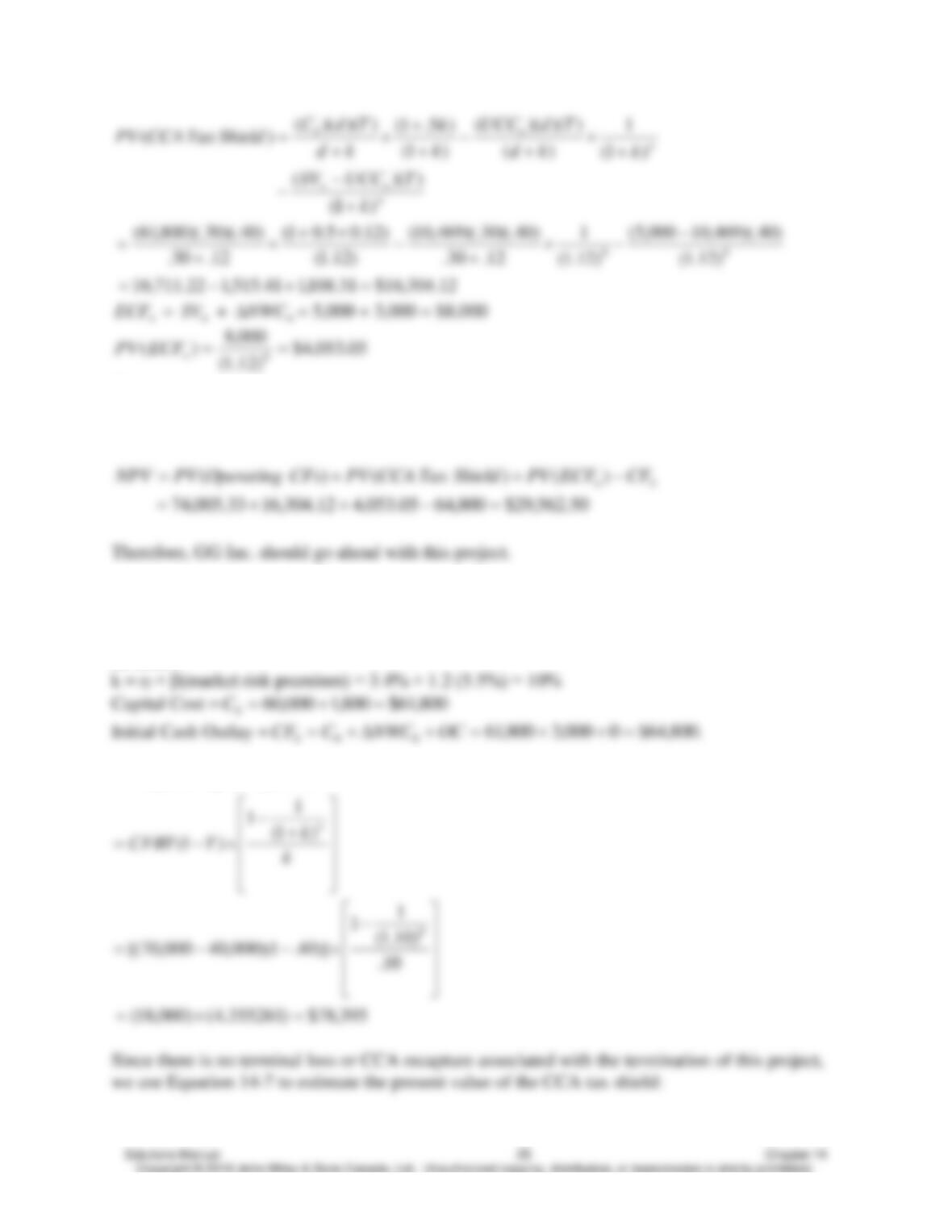
Solution:
Since the asset class is closed, we use Equation 14-8 to estimate the present value of the CCA tax
shield:
Introduction to Corporate Finance, Fourth Edition Booth, Cleary, Rakita
There are no capital gains, so this term is zero.
Now we can put these items together to determine the NPV of the project.
51. Section: 14.2 Estimating and Discounting Cash Flows
Learning Objective: 14.2
Level of difficulty: Challenging
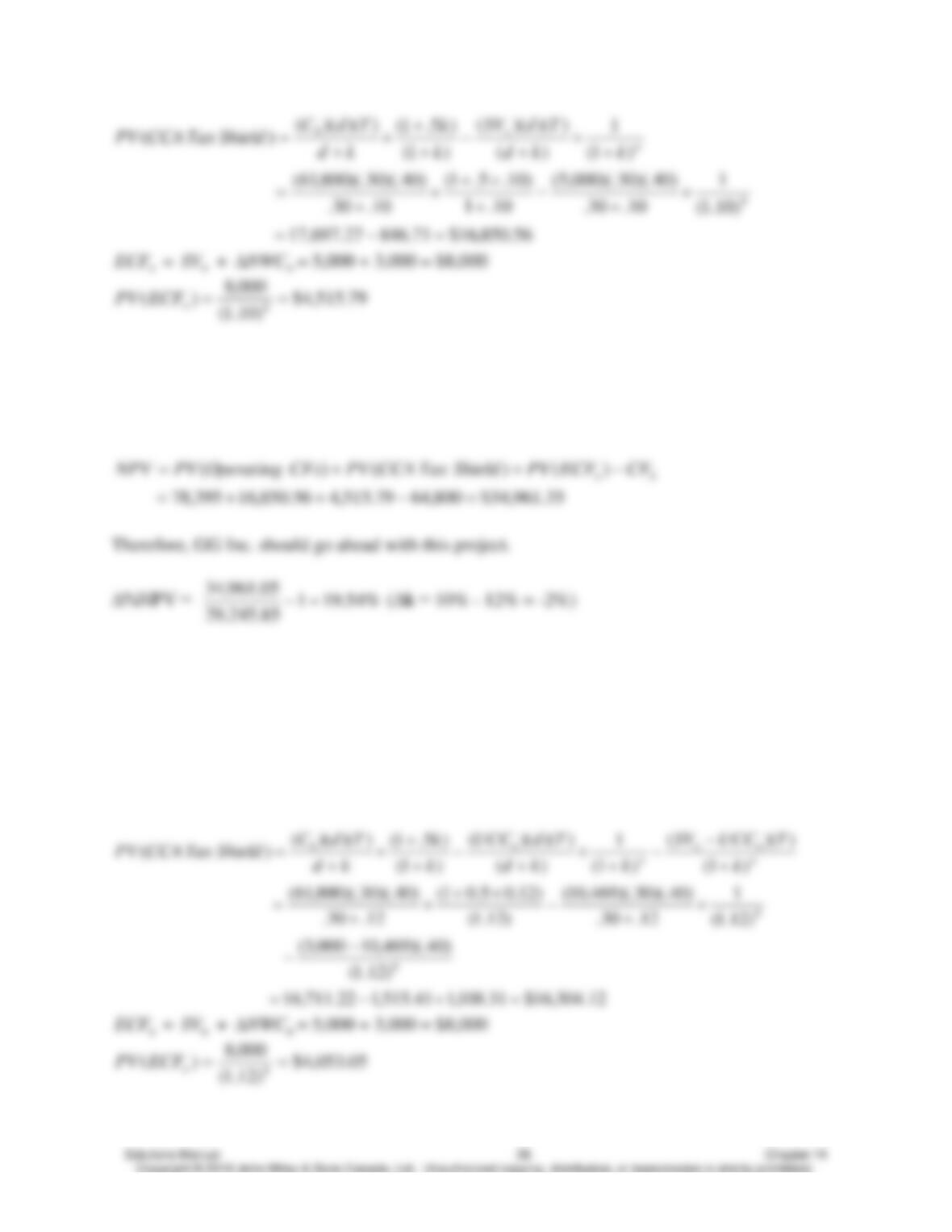
Solution:
)(
flowscashOperatingPV
Introduction to Corporate Finance, Fourth Edition Booth, Cleary, Rakita
There are no capital gains, so this term is zero, and there is no CCA recapture or terminal loss
since the asset class is not closed.
Now we can put these items together to determine the NPV of the project.
52. Section: 14.4 Sensitivity to Inputs
Learning Objective: 14.4
Level of difficulty: Challenging
Solution:
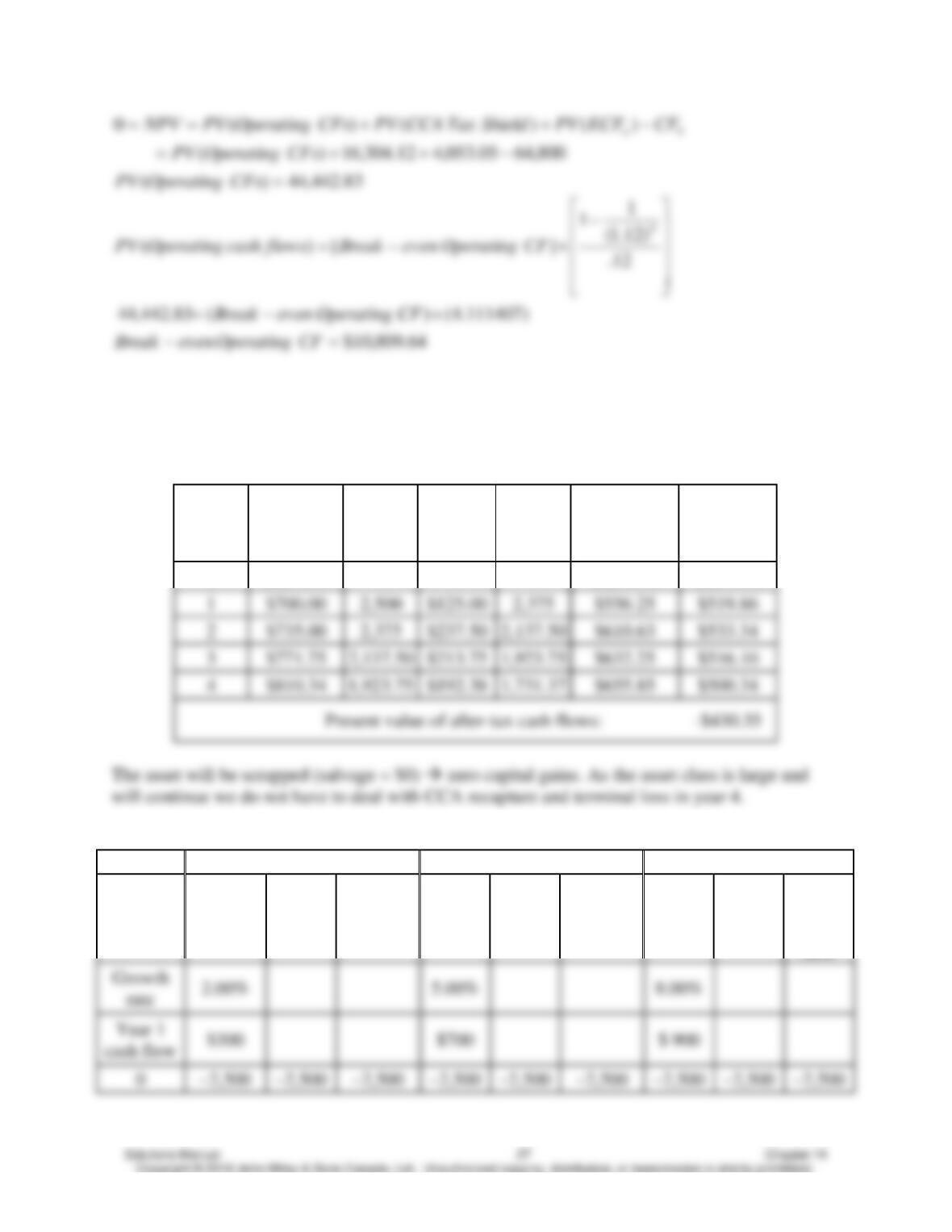
Initial Cash Outlay =
.800,64$
0=CF
Since there is a terminal loss or CCA recapture associated
with the termination of this project, we use Equation 14-8 to estimate the present value of the
CCA tax shield:
Introduction to Corporate Finance, Fourth Edition Booth, Cleary, Rakita
53. Section: 14.4 Sensitivity to Inputs
Learning Objective: 14.4
Level of difficulty: Challenging
Solution:
a.
Year
Cash flow
UCC
(open)
CCA
UCC
(close)
After-tax cash
flow
PV of after-
tax cash
flow
0
-$2,500.00
-$2,500.00
-$2,500.00
1
$125.00
b.
Worst case
Base case
Best case
Year
Cash flow
After-
tax cash
flow
PV of
after-tax
cash flow
Cash
flow
After-
tax cash
flow
PV of
after-tax
cash flow
Cash
flow
After-
tax cash
flow
PV of
after-tax
cash
flow
Introduction to Corporate Finance, Fourth Edition Booth, Cleary, Rakita
c.
Year
PV of cash flows
Growth rate
0.03
0.05
0.07
0.03
0.05
0.07
0.03
0.05
0.07
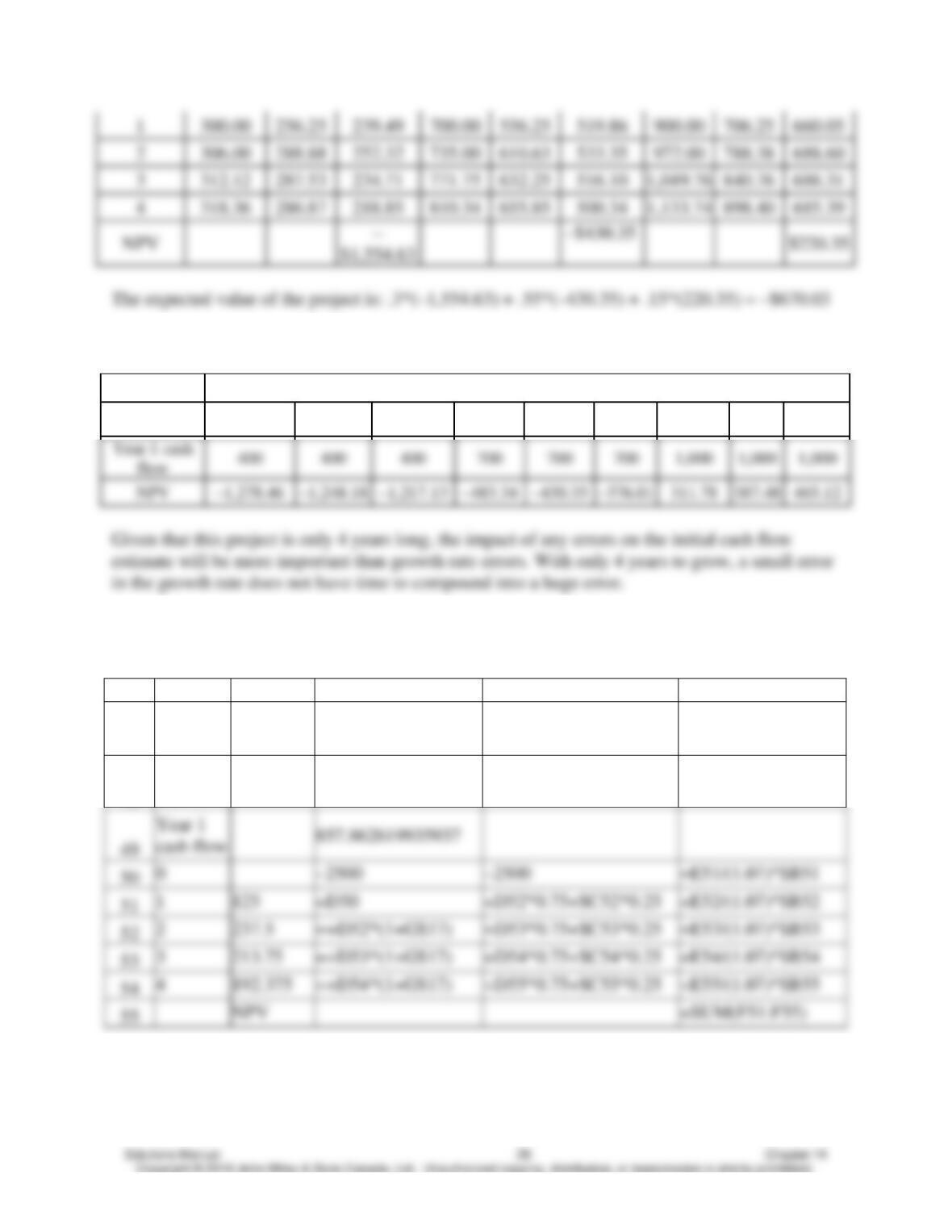
d. Using the solver function in Excel, we find that the initial cash flow that results in a break-
even or zero NPV is $857.86
B
C
D
E
F
47
Year
CCA
Cash flow
After-tax cash flow
PV of after-tax cash
flows
48
Growth
rate
0.05
49
Year 1
cash flow
857.862619935937
50
51
52
237.5
=+D52*(1+G$17)
=D53*0.75+$C53*0.25
=E53/(1.07)^$B53
53
213.75
=+D53*(1+G$17)
=D54*0.75+$C54*0.25
=E54/(1.07)^$B54
54
55
54. Section: 14.4 Sensitivity to Inputs
Learning Objective: 14.4
Level of difficulty: Challenging
Introduction to Corporate Finance, Fourth Edition Booth, Cleary, Rakita
Solution:
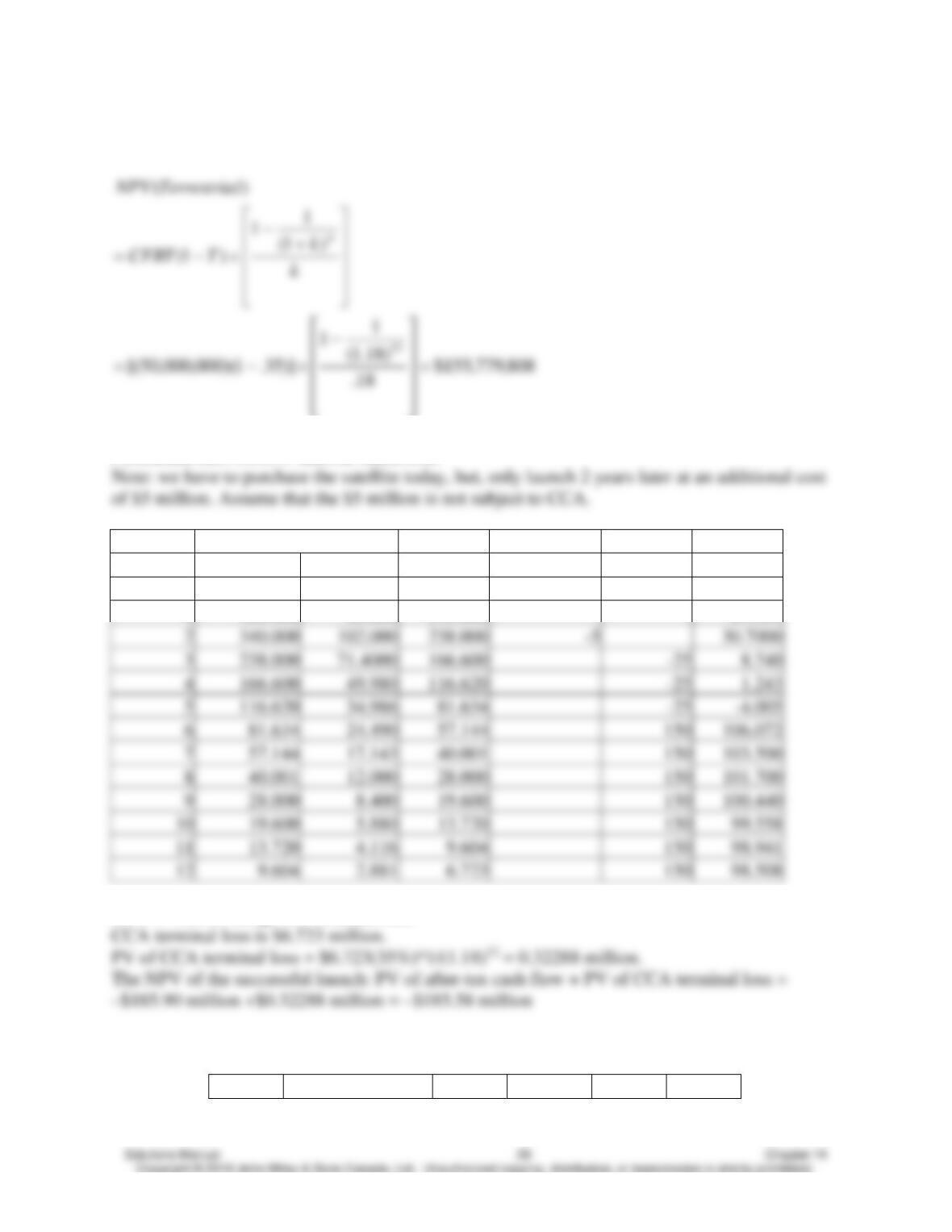
a. The NPV of the terrestrial alternative: NPV = $155.7798 million
b. Expected NPV of the satellite alternative:
Forecasted cash flows if satellite successful:
Satellite survives
Year
UCC begin.
CCA
UCC end
Investment
Revenue:
After tax
0
-400
-400
1
400.000
60.000
340.000
21.000
2
340.000
238.000
30.7000
3
238.000
166.600
4
166.600
49.980
116.620
5
116.620
34.986
81.634
6
24.490
57.144
106.072
7
17.143
40.001
103.500
8
12.000
28.000
101.700
9
8.400
19.600
100.440
5.880
13.720
99.558
4.116
98.941
2.881
98.508
NPV = -185.90 using 18% discount rate.
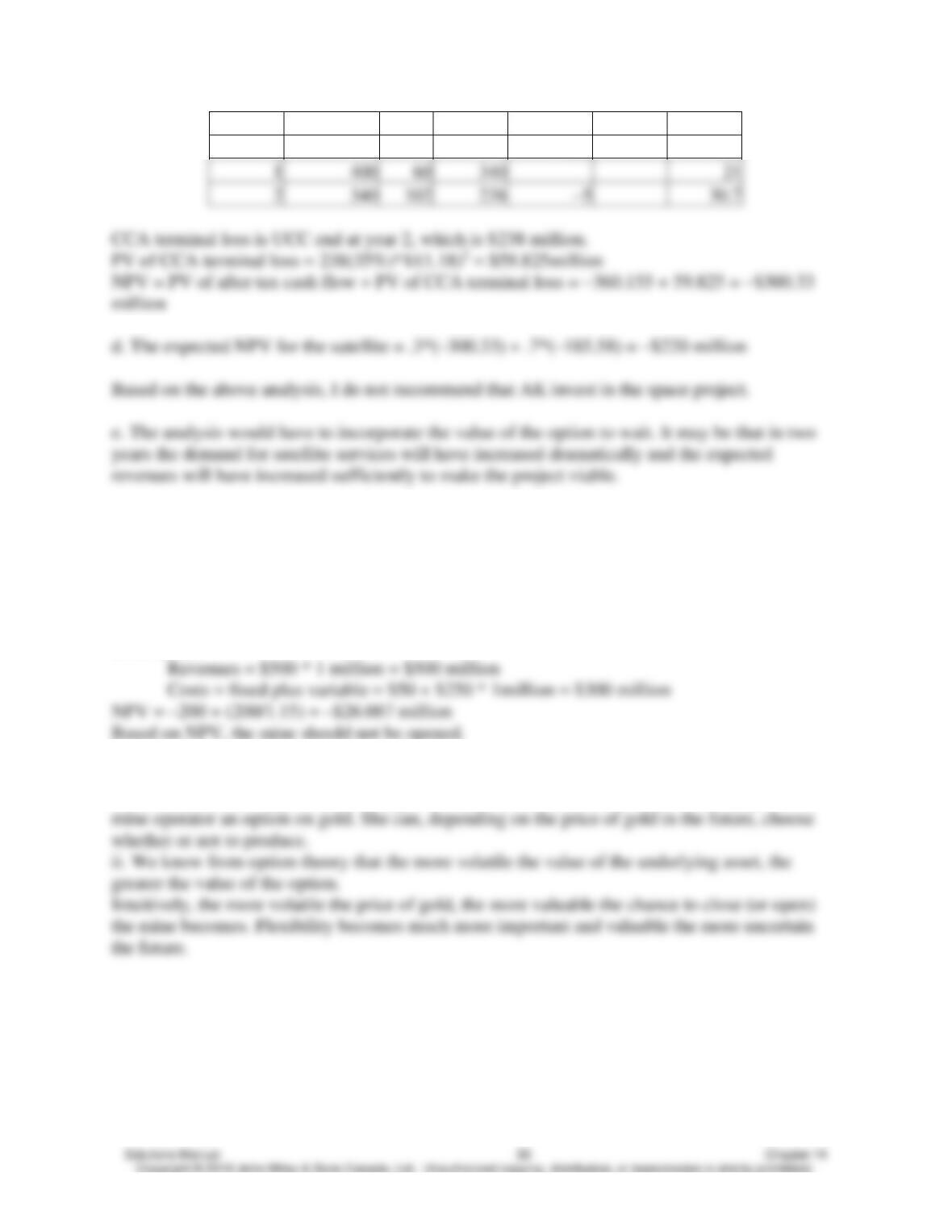
c. If the satellite explodes:
Satellite explodes
Introduction to Corporate Finance, Fourth Edition Booth, Cleary, Rakita
Year
UCC beg
CCA
UCC end
Investment
Revenue:
After tax
0
–400
–400
1
2
55. Section: 14.4 Sensitivity to Inputs
Learning Objective: 14.4
Level of difficulty: Challenging
Solution:
a.
Investment today = $200 million
In one year:
b.
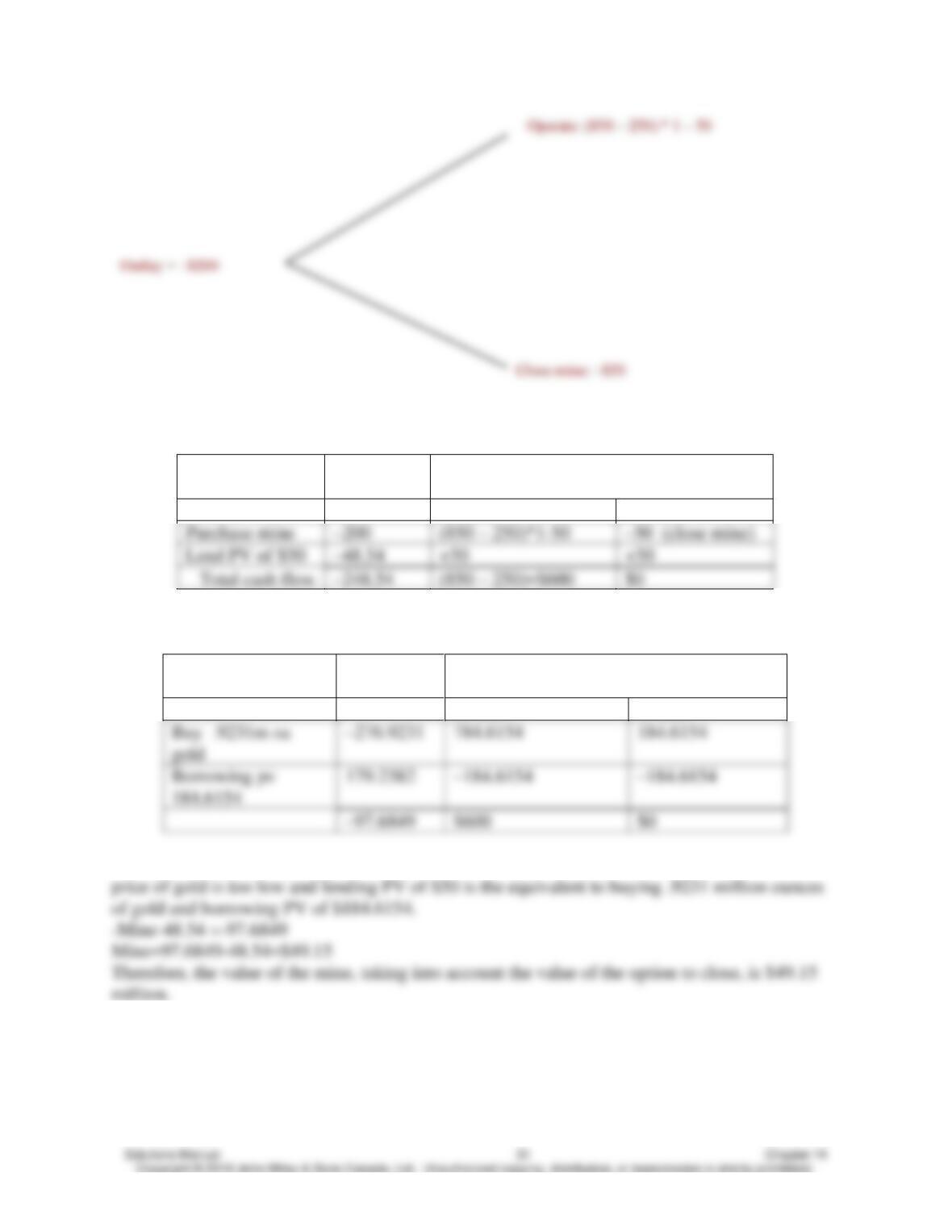
i. The choice of closing the mine changes the value of the asset because it essentially gives the
iii.
Introduction to Corporate Finance, Fourth Edition Booth, Cleary, Rakita
iv.
Portfolio 1:
Action
Cash flow
today
Cash flow in future
G=850
G=200
Purchase mine
(850 – 250)*1-50
Lend PV of $50
+50
+50
Total cash flow
(850 – 250)=$600
$0
Portfolio 2:
Action
Cash flow
today
Cash flow in future
G=850
G=200
Buy .9231m oz
gold
784.6154
184.6154
Borrowing pv
184.6154
179.2382
$600
$0
Putting the two portfolios together, we find that buying the mine with the option to close if the
56. Section: 14.3 Replacement Decisions
Learning Objective: 14.3
Level of difficulty: Challenging
Introduction to Corporate Finance, Fourth Edition Booth, Cleary, Rakita
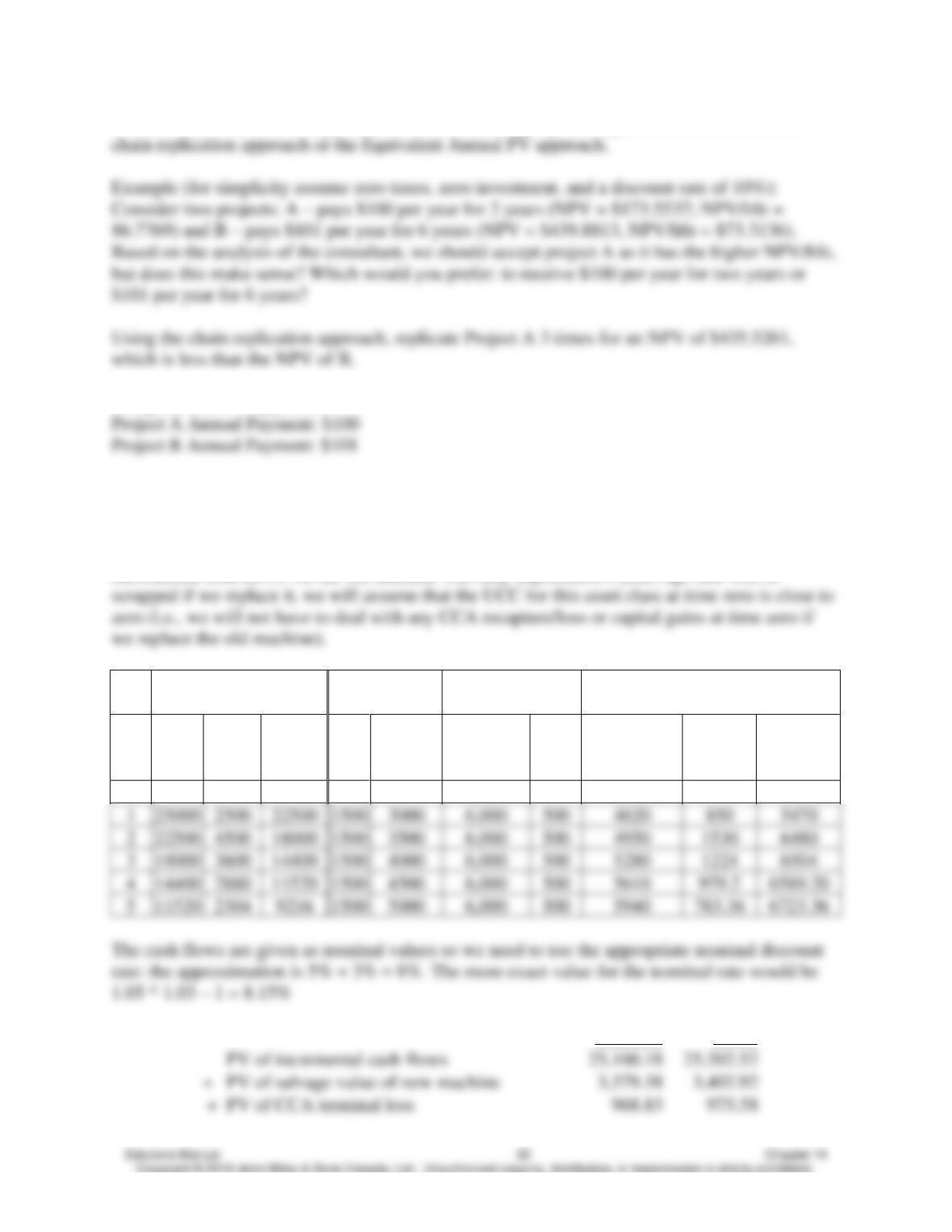
Solution: The consultant’s approach is incorrect; the appropriate approach is to either use the
Using the EANPV approach:
57. Section: 14.3 Replacement Decisions
Learning Objective: 14.3
Level of difficulty: Challenging
Solution: Because we are dealing with a replacement problem, we have to examine the
incremental cash flows. As the old machine was fully depreciated 8 years ago and will be
New machine
CCA schedule
Old machine
New machine
Incremental after-tax CF
Year
UCC
begin
CCA
UCC
end
Rev.
Maint.
Invest/Rev.
Maint.
New – Old
CCA
Tax
shield
Total
0
–25000
–25000
–25000
1
1500
2
1500
3
1500
4
1500
5
1500
k=8.15%
k=8%
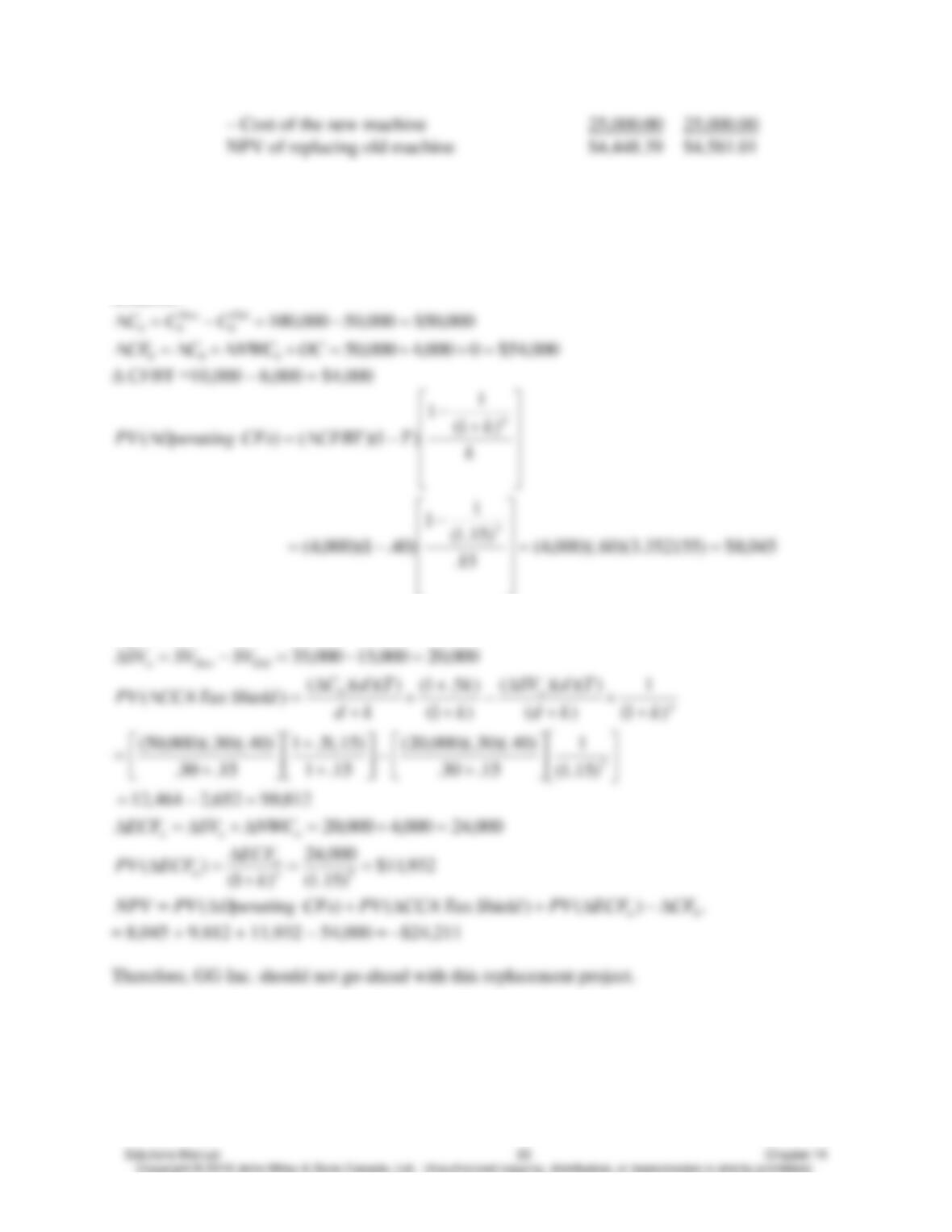
PV of incremental cash flows
25,202.52
Introduction to Corporate Finance, Fourth Edition Booth, Cleary, Rakita
Based on the analysis above, the old machine should be replaced.
58. Section: 14.3 Replacement Decisions
Learning Objective: 14.3
Level of difficulty: Challenging
Solution:
Since the asset class is left open and there is no CCA recapture or terminal loss, we can use
Equation 14-7:
59. Section: 14.5 Inflation and Capital budgeting Decisions
Learning Objective: 14.5
Level of difficulty: Challenging
a.
Introduction to Corporate Finance, Fourth Edition Booth, Cleary, Rakita
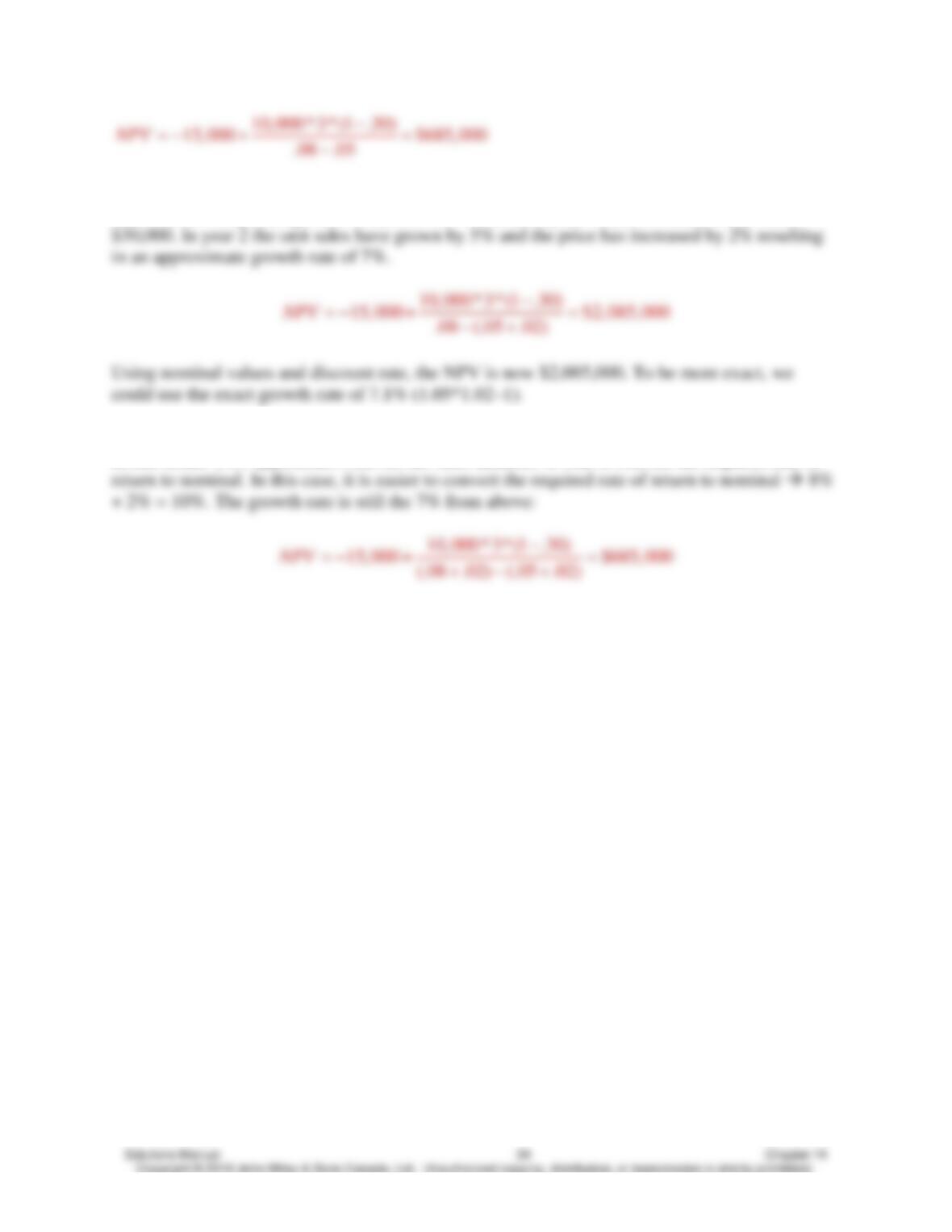
b. We are expecting unit sales to grow at 5% per year. If prices now grow at 2% per year then the
after-inflation expected growth in sales is 7%. To see this: year 1 sales is 10,000 units *$3 =
c. Now we have an inconsistency – the sales number is nominal but the required rate of return is
in real terms. Two approaches: convert the sales numbers to real or convert the required rate of
Introduction to Corporate Finance, Fourth Edition Booth, Cleary, Rakita
Answers to Concept Review Questions
14.1 General Guidelines for Capital Expenditure Analysis
Concept review questions
1. How should we treat taxes and inflation when determining the present value of future cash
flows?
2. What do we mean by incremental cash flows?
3. What are externalities and opportunity costs?
Externalities are the consequences that often result from an investment that may benefit or harm
4. Why do we not deduct interest costs from the cash flows to be discounted?
We do not deduct associated interest and dividend payments in estimated project cash flows,
14.2 Estimating and Discounting Cash Flows
Concept review questions
1. Why does the initial cash outlay often exceed the purchase price of an asset?
2. How do taxes affect the annual cash flows and terminal cash flows of an investment project?
The annual cash flows are those that are estimated to occur as a result of the investment decision.
These cash flows comprise the associated expected incremental increase in after-tax operating
Introduction to Corporate Finance, Fourth Edition Booth, Cleary, Rakita
3. Explain why the valuation by components approach can save computational time and still lead
to the correct answer.
The components approach considers all the cash flows from CCA: the annual CCA tax and the
14.3 Replacement Decisions
Concept review questions
1. Discuss any differences in the evaluation of a replacement decision versus the evaluation of an
expansion decision.
The incremental cash flows are different. For expansion decisions, the new cash flows arise from
14.4 Sensitivity to Inputs
Concept review questions
1. What insights can be gained by using sensitivity analysis, scenario analysis, and NPV break–
even analysis?
Sensitivity analysis shows the sensitivity of NPV to one input variable, scenario analysis shows
2. What limitations of scenario analysis does the real option valuation approach address?
Scenario analysis assumes that a firm’s action is fixed in a scenario. However, in practice, firms
14.5 Inflation and Capital Budgeting Decisions
Concept review questions
1. Why is it usually more precise to use nominal cash flows and nominal discount rates when
evaluating projects?
2. Why might inflation affect cash inflows differently from the way it would affect cash
outflows?