Chapter 14
Options Markets
Outline
Background on Options
Comparison of Options and Futures
Markets Used to Trade Options
Determinants of Stock Option Premiums
Determinants of Call Option Premiums
Speculating with Stock Options
Speculating with Call Options
Hedging with Stock Options
Hedging with Covered Call Options
Hedging with Put Options
Options on ETFs and Stock Indexes
Hedging with Stock Index Options
Options on Futures Contracts
Speculating with Options on Futures
Options as Executive Compensation
Limitations of Option Compensation Programs
Chapter 14: Options Markets ❖ 2
Key Concepts
1. Explain why speculators take positions in stock options and how the outcome is determined.
2. Explain why institutional investors take positions in stock options and the tradeoff involved.
POINT/COUNTER-POINT:
If You Were a Major Shareholder of a Publicly Traded Firm, Would You
Prefer That Stock Options Be Traded on That Stock?
POINT: No. Options can be used by investors to speculate, and excessive trading of the options may push
the stock price away from its fundamental price.
WHO IS CORRECT? Use the Internet to learn more about this issue and then formulate your own
opinion.
ANSWER: Either argument has some validity. The main point is that students recognize the interaction
Questions
1. Options versus Futures. Describe the general differences between a call option and a futures
contract.
ANSWER: A call option requires a premium above and beyond the price to be paid for the financial
2. Speculating with Call Options. How do speculators use call options? Describe the conditions under
which their strategy would backfire. What is the maximum loss that could occur for a purchaser of a
call option?
ANSWER: Call options are purchased by speculators when the price of the underlying stock is
Chapter 14: Options Markets ❖ 3
3. Speculating with Put Options. How do speculators use put options? Describe the conditions under
which their strategy would backfire. What is the maximum loss that could occur for a purchaser of a
put option?
ANSWER: Put options are purchased by speculators when the price of the underlying stock is
4. Selling Options. Under what conditions would speculators sell a call option? What is the risk to
speculators who sell put options?
ANSWER: Speculators sell call options if they expect the price of the underlying stock to remain
5. Factors Affecting Call Option Premiums. Identify the factors affecting the premium paid on a call
option. Describe how each factor affects the size of the premium.
6. Factors Affecting Put Option Premiums. Identify the factors affecting the premium paid on a put
option. Describe how each factor affects the size of the premium.
ANSWER: The greater the volatility of the underlying stock’s price, the higher the premium. The
7. Leverage of Options. How can financial institutions with stock portfolios use stock options when
they expect stock prices to rise substantially but do not yet have sufficient funds to purchase more
stock?
ANSWER: They could purchase stock options on various stocks to lock in the maximum price they
8. Hedging with Put Options. Why would a financial institution holding Hinton stock consider buying
a put option on that stock rather than simply selling it?
Chapter 14: Options Markets ❖ 4
ANSWER: If a financial institution is concerned about a possible temporary decline in ABC stock,
9. Call Options on Futures. Describe a call option on interest rate futures. How does it differ from
purchasing a futures contract?
ANSWER: A call option on interest rate futures provides the right to purchase a specified financial
10. Put Options on Futures. Describe a put option on interest rate futures. How does it differ from
selling a futures contract?
ANSWER: A put option on interest rate futures provides the right to sell a specified interest rate
Advanced Questions
11. Hedging Interest Rate Risk. Assume a savings institution has a large number of fixed-rate
mortgages and obtains most of its funds from short-term deposits. How could it use options on
financial futures to hedge its exposure to interest rate movements? Would futures or options on
futures be more appropriate if the institution is concerned that interest rates will decline, causing a
large number of mortgage prepayments?
ANSWER: The financial institution could purchase put options on interest rate futures. If interest
12. Hedging Effectiveness. Three savings and loan institutions (S&Ls) have identical balance sheet
compositions: a high concentration of short-term deposits that are used to provide long-term, fixed-
rate mortgages. The S&Ls took the following positions one year ago.
Chapter 14: Options Markets ❖ 5
Name of S&L Position
LaCrosse Sold financial futures
Stevens Point Purchased put options on interest rate futures
Whitewater Did not take any position in futures
Assume that interest rates declined consistently over the last year. Which of the three S&Ls would
have achieved the best performance based on this information? Explain.
ANSWER: Whitewater would have achieved the best performance because its long-term, fixed-rate
13. Change in Stock Option Premiums. Explain how and why the option premiums may change in
response to a surprise announcement that the Fed will increase interest rates even if stock prices are
not affected.
ANSWER: The option premiums will increase in response to increased uncertainty. A stock’s value
14. Speculating with Stock Options. The price of Garner stock is $40. There is also a call option on
Garner stock that is at the money, with a premium of $2.00. There is a put option on Garner stock that
is at the money, with a premium of $1.80. Why would investors consider writing this call option and
this put option? Why would some investors consider buying this call option and this put option?
ANSWER: If the investors expected that the stock price would remain somewhat stable, they could
15. How Stock Index Option Prices May Respond to Prevailing Conditions. Consider the prevailing
conditions that could affect the demand for stocks, including inflation, the economy, the budget
deficit, and the Fed’s monetary policy, political conditions, and the general mood of investors. Based
on prevailing conditions, would you consider purchasing stock index options at this time? Offer some
logic to support your answer. Which factor do you think will have the biggest impact on stock index
option prices?
ANSWER: This question is open-ended. It requires students to apply the concepts that were presented
16. CBOE Volatility Index. How would you interpret a large increase in the CBOE volatility index
(VIX)? Explain why the VIX increased substantially during the credit crisis that began in 2008.
Chapter 14: Options Markets ❖ 6
The CBOE volatility index (VIX) represents the implied volatility derived from options on the S&P
CRITICAL THINKING QUESTION
17. Strategy for Investing in CBOE Volatility Index An investment newsletter suggests that because
the prevailing stock market conditions are subject to much uncertainty, investors should purchase call
options on the CBOE volatility index (VIX). Write a short essay on the logic behind how the
valuation of VIX is influenced by market uncertainty. Also support or refute the advice provided by
the newsletter and offer a strategy for investing in call options on the VIX based on expectations of
changes in market uncertainty.
ANSWER
When market uncertainty is high, the implied market volatility is high. Under these conditions, the
Interpreting Financial News
Interpret the following statements made by Wall Street analysts and portfolio managers.
a. “Our firm took a hit because we wrote put options just before the stock market crash.”
Writers of put options on stocks are obligated to purchase those stocks at a specified exercise
b. “Before hedging our stock portfolio with options on index futures, we search for the index that is
most appropriate.”
The ideal index option would represent the same composition of stocks as the portfolio, so that
Chapter 14: Options Markets ❖ 7
c. “We prefer to use covered call writing to hedge our stock portfolios.”
Covered call writing involves the sale of call options on stocks that are already owned. If the
prices of the stocks decline, the losses are partially offset by the gains (premiums) earned from
selling call options.
If stock prices decline substantially, covered call writing will not offset the losses as much as the
Managing in Financial Markets
As a stock portfolio manager, you have investments in many U.S. stocks and plan to hold these stocks
over a long-term period. However, you are concerned that the stock market may experience a temporary
decline over the next three months, and that your stock portfolio will probably decline by about the same
degree as the market. The following options on a stock index futures contract are available and have an
expiration date about three months from now:
Exercise Price Call Premium Put Premium
The options on the stock index futures contract are priced at $250 times the quoted premium.
Currently, the stock index level is 1400. The exercise price of 1372 represents a 2 percent decline
a. Assume that you wanted to take an options position to hedge your entire portfolio, which is
currently valued at about $700,000. How many index option contracts should you take a position
in to hedge your entire portfolio?
The prevailing index is worth 1400, so that $250 times the index is $350,000. If the underlying
b. Assume that you want to create a hedge so that your portfolio will lose no more than 2 percent of
its present value. How could you take a position in options on index futures to achieve this goal?
What is the cost to you as a result of creating this hedge?
You could purchase two put option contracts on index futures with a strike price of 1372, which
Chapter 14: Options Markets ❖ 8
c. Given your expectations of a weak stock market over the next three months, how can you
generate some fees from the sale of options on stock index futures to help cover the cost of
purchasing options?
You could sell call options on stock index futures with a strike price of 1428 at a premium of 24.
Problems
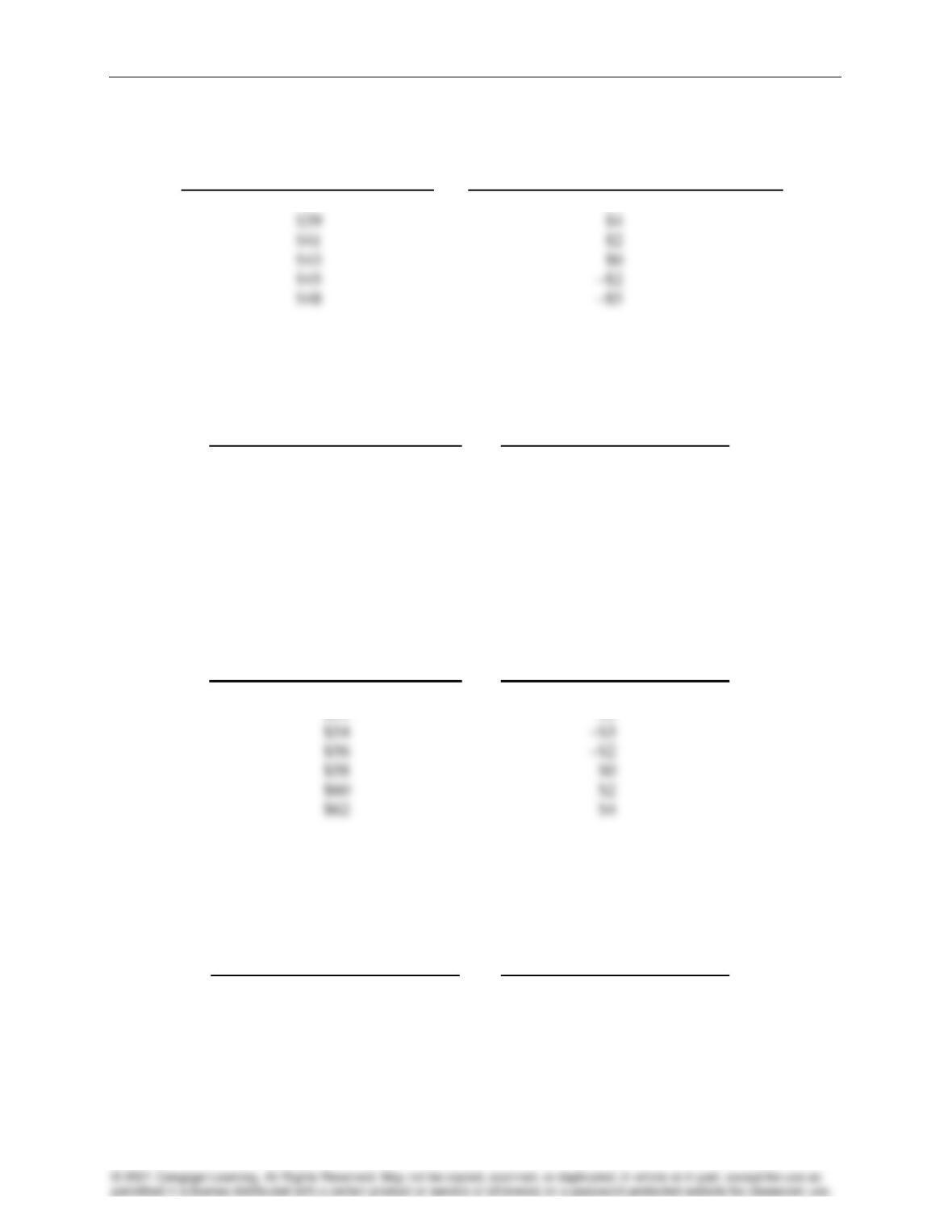
1. Writing Call Options. A call option on Illinois stock specifies an exercise price of $38. Today’s
price of the stock is $40. The premium on the call option is $5. Assume the option will not be
exercised until maturity, if at all. Complete the following table:
Assumed Stock Price at the Time Net Profit or Loss per Share to Be Earned
the Call Option Is About to Expire by the Writer (Seller) of the Call Option
$37
Chapter 14: Options Markets ❖ 9
ANSWER:
Assumed Stock Price at the Time Net Profit or Loss per Share to Be Earned
the Call Option Is About to Expire by the Writer (Seller) of the Call Option
$37 $5
2. Purchasing Call Options. A call option on Michigan stock specifies an exercise price of $55. Today the
stock’s price is $54 per share. The premium on the call option is $3. Assume the option will not be exercised
until maturity, if at all. Complete the following table for a speculator who purchases the call option:
Assumed Stock Price at the Time Net Profit or Loss per Share
the Call Option Is About to Expire to Be Earned by the Speculator
$50
$52
$54
$56
$58
$60
$62
ANSWER:
Assumed Stock Price at the Time Net Profit or Loss per Share
the Call Option Is About to Expire to Be Earned by the Speculator
$50 –$3
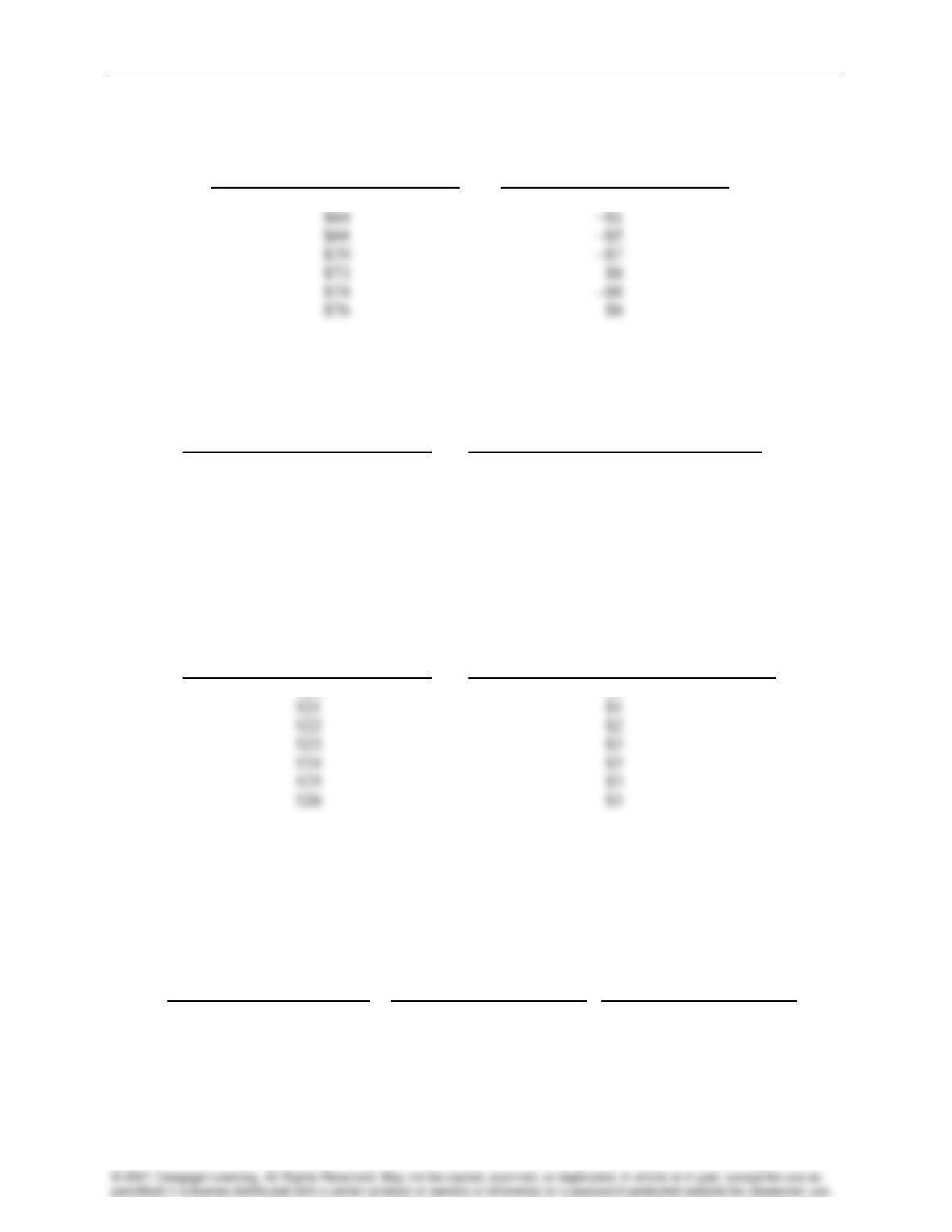
3. Purchasing Put Options. A put option on Iowa stock specifies an exercise price of $71. Today the
stock’s price is $68. The premium on the put option is $8. Assume the option will not be exercised
until maturity, if at all. Complete the following table for a speculator who purchases the put option
(and currently does not own the stock):
Assumed Stock Price at the Time Net Profit or Loss per Share
the Put Option Is About to Expire to Be Earned by the Speculator
$60
$64
$68
$70
$72
$74
$76
Chapter 14: Options Markets ❖ 10
ANSWER:
Assumed Stock Price at the Time Net Profit or Loss per Share
the Put Option Is About to Expire to Be Earned by the Speculator
$60 $3
4. Writing Put Options. A put option on Indiana stock specifies an exercise price of $23. Today the
stock’s price is $24. The premium on the put option is $3. Assume the option will not be exercised
until maturity, if at all. Complete the following table:
Assumed Stock Price at the Time Net Profit or Loss per Share to Be Earned
the Put Option Is About to Expire by the Writer (Seller) of the Put Option
$20
$21
$22
$23
$24
$25
$26
ANSWER:
Assumed Stock Price at the Time Net Profit or Loss per Share to Be Earned
the Put Option Is About to Expire by the Writer (Seller) of the Put Option
5. Covered Call Strategy.
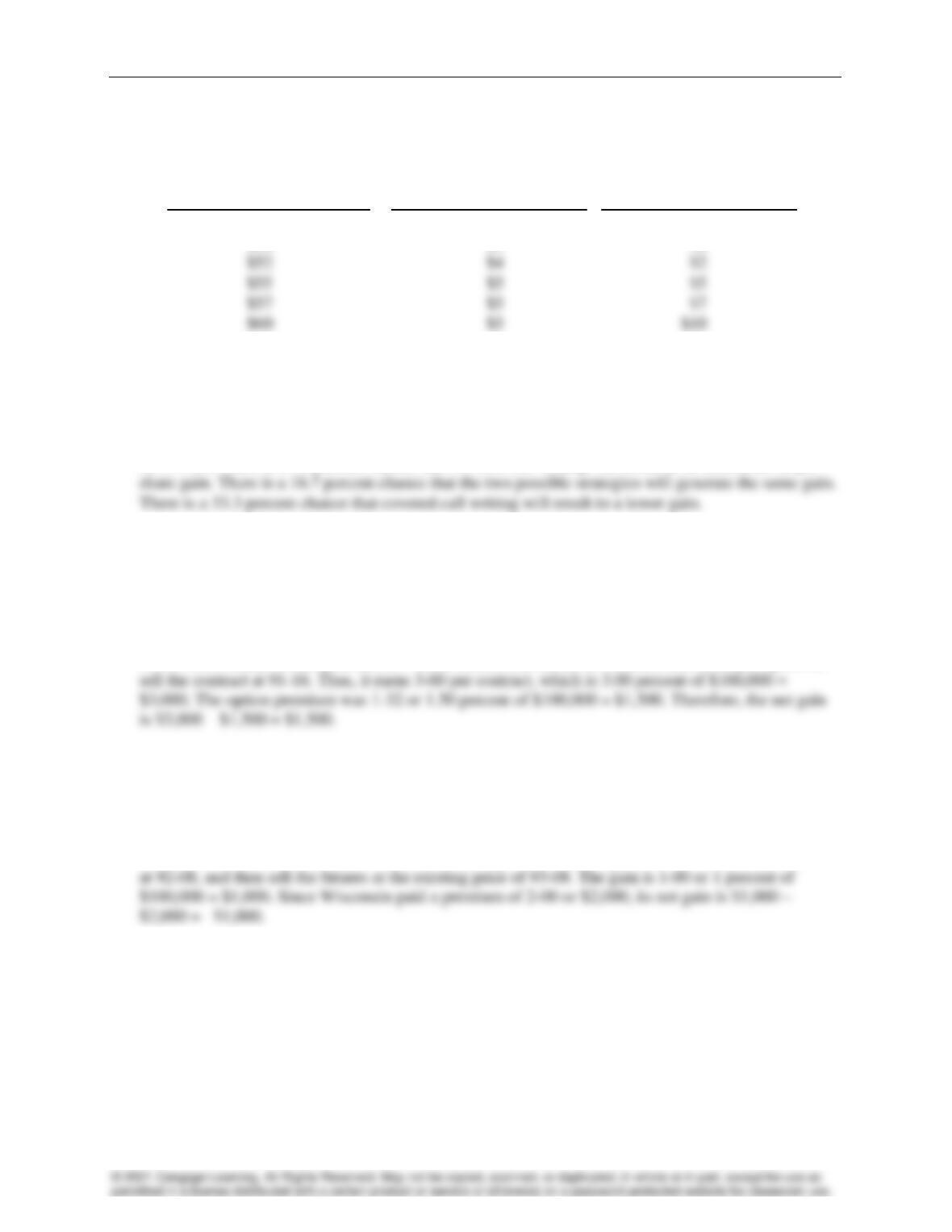
a. Evanston Insurance Inc. has purchased shares of Stock E at $50 per share. It will sell the stock in
six months. It considers using a strategy of covered call writing to partially hedge its position in
this stock. The exercise price is $53, the expiration date is six months, and the premium on the
call option is $2. Complete the following table.
Profit or Loss per Share Profit or Loss per Share
Possible Price of Stock E If a Covered Call Strategy If a Covered Call Strategy
in 6 Months Is Used Is Not Used
$47
$50
$52
$55
$57
$60
Chapter 14: Options Markets ❖ 11
ANSWER:
Profit or Loss per Share Profit or Loss per Share
Possible Price of Stock E If a Covered Call Strategy If a Covered Call Strategy
in 6 Months Is Used Is Not Used
$47 –$1 –$3
b. Assume that each of the six stock prices in the table’s first column has an equal probability of
occurring. Compare the probability distribution of the profits (or losses) per share when using
covered call writing versus not using it. Would you recommend covered call writing in this
example? Explain.
ANSWER: There is a 50 percent chance that covered call writing will result in an additional $2 per
6. Put Options on Futures. Purdue Savings and Loan Association purchased a put option on Treasury
bond futures with a September delivery date and an exercise price of 91-16. Assume the put option
has a premium of 1-32. Assume that the price of the Treasury bond futures decreases to 88-16. Should
Purdue exercise the option or should it let the option expire? What is Purdue’s net gain or loss after
accounting for the premium paid on the option?
ANSWER: Purdue should purchase a T-bond futures contract at 88-16 and exercise its put option to
7. Call Options on Futures. Wisconsin Inc. purchased a call option on Treasury bond futures at a
premium of 2-00. The exercise price is 92-08. If the price of the Treasury bond futures rises to 93-08,
should Wisconsin Inc. exercise the call option or should it let the option expire? What is Wisconsin’s
net gain or loss after accounting for the premium paid on the option?
ANSWER: Wisconsin Inc. should exercise its call option in order to purchase Treasury bond futures
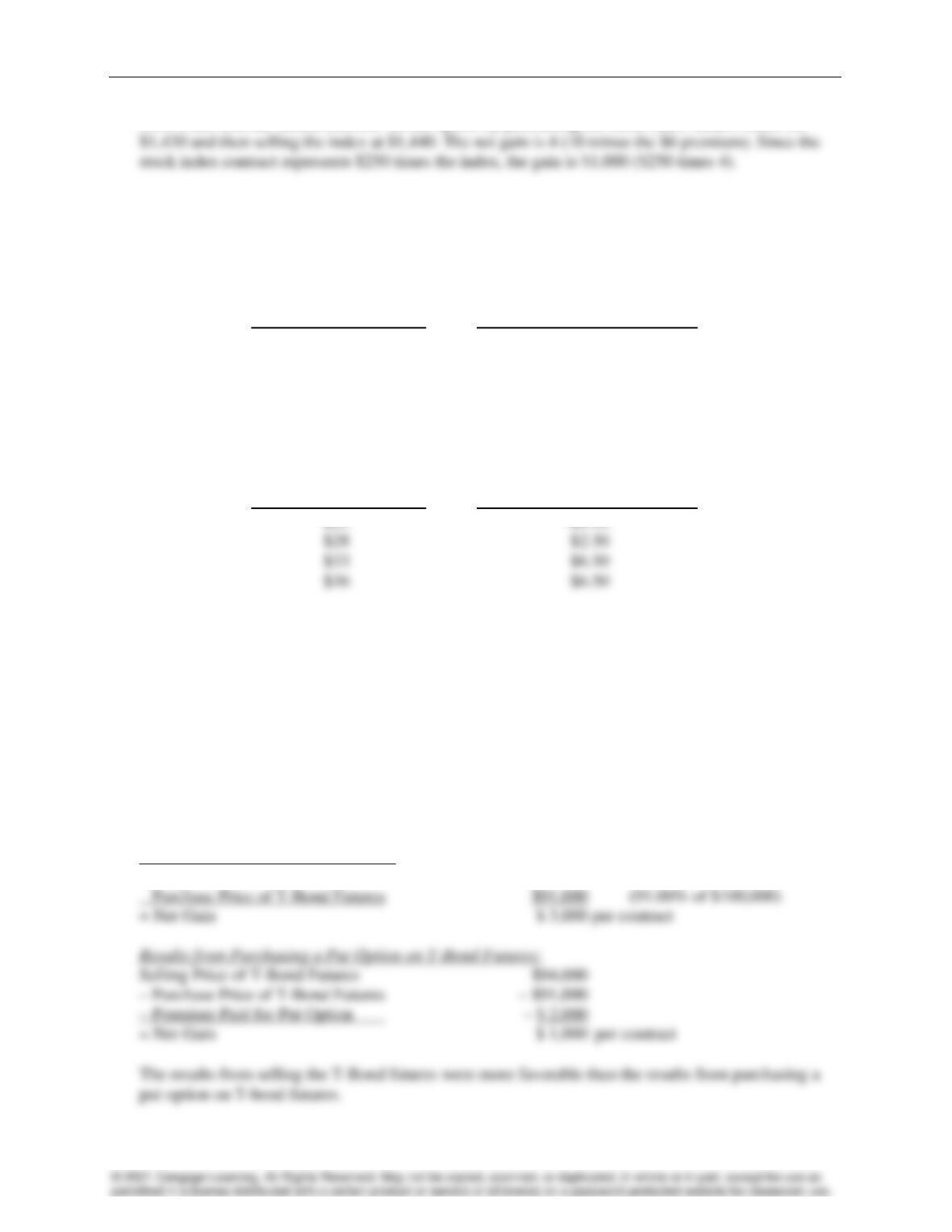
8. Call Options on Futures. DePaul Insurance Company purchased a call option on a stock index
futures contract. The option premium is quoted as $6. The exercise price is $1,430. Assume the index
on the futures contract becomes $1,440. Should DePaul exercise the call option or let it expire? What
is the net gain or loss to DePaul after accounting for the premium paid for the option (assume the
value is measured as $250 times the index)?
Chapter 14: Options Markets ❖ 12
9. Covered Call Strategy. Coral Inc. has purchased shares of stock M at $28 per share. It will sell the
stock in six months. It considers using a strategy of covered call writing to partially hedge its position
in this stock. The exercise price is $32, the expiration date is six months, and the premium on the call
option is $2.50. Complete the following table:
Possible Price of Stock M Profit or Loss per Share If a
in 6 Months Covered Call Strategy Is Used
$25
$28
$33
$36
ANSWER:
Possible Price of Stock M Profit or Loss per Share If a
in 6 Months Covered Call Strategy Is Used
10. Hedging with Bond Futures. Smart Savings Bank desired to hedge its interest rate risk. It was
considering two possibilities: (1) sell Treasury bond futures at a price of 94-00, or (2) purchase a put
option on Treasury bond futures. At the time, the price of Treasury bond futures was 95-00, and the
face value was $100,000. The put option premium was 2-00, and the exercise price was 94-00. Just
before the option expired, the Treasury bond futures price was 91-00, and Smart Savings Bank would
have exercised the put option at that time, if at all. This is also the time when it would offset its
futures position, if it had sold futures. Determine the net gain to Smart Savings Bank if it had sold
Treasury bond futures versus if it had purchased a put option on Treasury bond futures. Which
alternative would have been more favorable, based on the situation that occurred?
ANSWER:
Results from Selling T-Bond Futures:
Selling Price of T-Bond Futures $94,000 (94.00% of $100,000)

Chapter 14: Options Markets ❖ 13
Chapter 14: Options Markets ❖ 14
Flow of Funds Exercise
Hedging with Options Contracts
Carson Company would like to acquire Vinnet Inc., a publicly traded firm in the same industry. Vinnet’s
stock price is currently much lower than the prices of other firms in the industry, because it operates
inefficiently. Carson believes that it could restructure Vinnet’s operations and improve the company’s
performance. It is about to contact Vinnet to determine whether Vinnet will agree to an acquisition.
a. How can Carson use stock options to reduce its exposure to this risk? Are there any limitations to
this strategy, given that Carson will ultimately have to buy most or all of the Vinnet stock if the
acquisition occurs?
Carson could purchase call options on Vinnet stock so that it would lock in the amount it would
pay for the stock if the acquisition occurs.
b. Describe the maximum possible loss that may be directly incurred by Carson as a result of
engaging in this strategy.
The maximum loss is the premium paid for the call options.
c. Explain the results of the strategy you offered in the previous question if Vinnet plans to avoid
the acquisition attempt by Carson.
Carson would still have the call options. It may be able to profit from the strategy if it can sell the