Chapter 14
Distributions to Shareholders:
Dividends and Repurchases
ANSWERS TO END-OF-CHAPTER QUESTIONS
14-1 a. The optimal distribution policy is one that strikes a balance between dividend yield and
capital gains so that the firm’s stock price is maximized.
c. The signaling hypothesis holds that investors regard dividend changes as “signals” of
management forecasts.
Thus, when dividends are raised, this is viewed by investors as recognition by
management of future earnings increases. Therefore, if a firm’s stock price increases
with a dividend increase, the reason may not be investor preference for dividends, but
expectations of higher future earnings. Conversely, a dividend reduction may signal
that management is forecasting poor earnings in the future. The clientele effect is the
e. The declaration date is the date on which a firm’s directors issue a statement declaring
a dividend. If a company lists the stockholder as an owner on the holder-of-record date,
then the stockholder receives the dividend. The ex-dividend date is the date when the
right to the dividend leaves the stock. This date was established by stockbrokers to
avoid confusion and is 2 business days prior to the holder of record date. If the stock
sale is made prior to the ex-dividend date, the dividend is paid to the buyer.
If the stock is bought on or after the ex-dividend date, the dividend is paid to the
seller. The date on which a firm actually mails dividend checks is known as the
payment date.
g. In a stock split, current shareholders are given some number (or fraction) of shares for
each stock owned. Thus, in a 3-for-1 split, each shareholder would receive 3 new shares
in exchange for each old share, thereby tripling the number of shares outstanding.
Stock splits usually occur when the stock price is outside of the optimal trading range.
Stock dividends also increase the number of shares outstanding, but at a slower rate
than splits. In a stock dividend, current shareholders receive additional shares on some
proportional basis. Thus, a holder of 100 shares would receive 5 additional shares at no
14-2 a. From the stockholders’ point of view, an increase in the personal income tax rate would
make it more desirable for a firm to retain and reinvest earnings. Consequently, an
increase in personal tax rates should lower the aggregate payout ratio.
c. If interest rates were to increase, the increase would make retained earnings a relatively
attractive way of financing new investment. Consequently, the payout ratio might be
expected to decline. On the other hand, higher interest rates would cause rd, rs, and
firm’s MCCs to rise—that would mean that fewer projects would qualify for capital
budgeting and the residual would increase (other things constant), hence the payout
ratio might increase.
e. If investment opportunities for firms declined while cash inflows remained relatively
constant, an increase would be expected in the payout ratio.
g. This change would make capital gains less attractive and would lead to an increase in
the payout ratio.
14-3 The difference is largely one of accounting. In the case of a split, the firm simply increases
the number of shares and simultaneously reduces the par or stated value per share. In the
case of a stock dividend, there must be a transfer from retained earnings to capital stock.
For most firms, a 100 percent stock dividend and a 2-for-1 split accomplish exactly the
same thing; hence, investors may choose either one.
14-5 a. True. When investors sell their stock they are subject to capital gains taxes.
b. True. If a company’s stock splits 2 for 1, and you own 100 shares, then after the split
you will own 200 shares.
d. False. The tax code, through the tax deductibility of interest, encourages firms to use
debt and thus pay interest to investors rather than dividends, which are not tax
deductible. In addition, due to a lower capital gains tax rate than the highest personal
tax rate, the tax code encourages investors in high tax brackets to prefer firms who
retain earnings rather than those that pay large dividends.
SOLUTIONS TO END–OF-CHAPTER PROBLEMS
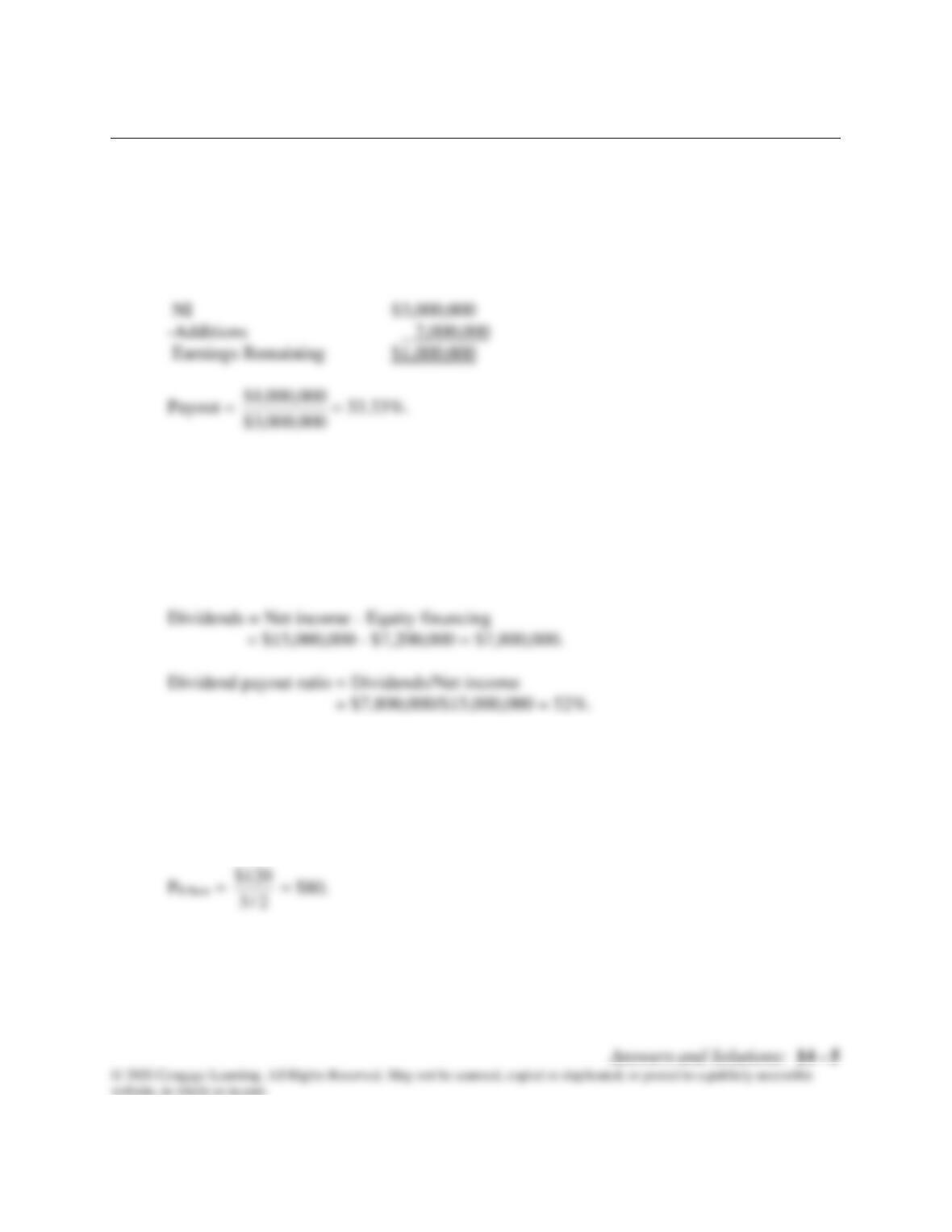
14-1 60% Debt; 40% Equity; Capital Budget = $5,000,000; NI = $3,000,000;
PO = ?
Equity retained for capital budget = 0.4($5,000,000) = $2,000,000.
14-2 The company requires 0.40($1,200,000) = $480,000 of equity financing. If the company
follows a residual dividend policy it will retain $480,000 for its capital budget and pay out
the $120,000 “residual” to its shareholders as a dividend. The payout ratio would therefore
be $120,000/$600,000 = 0.20 = 20%.
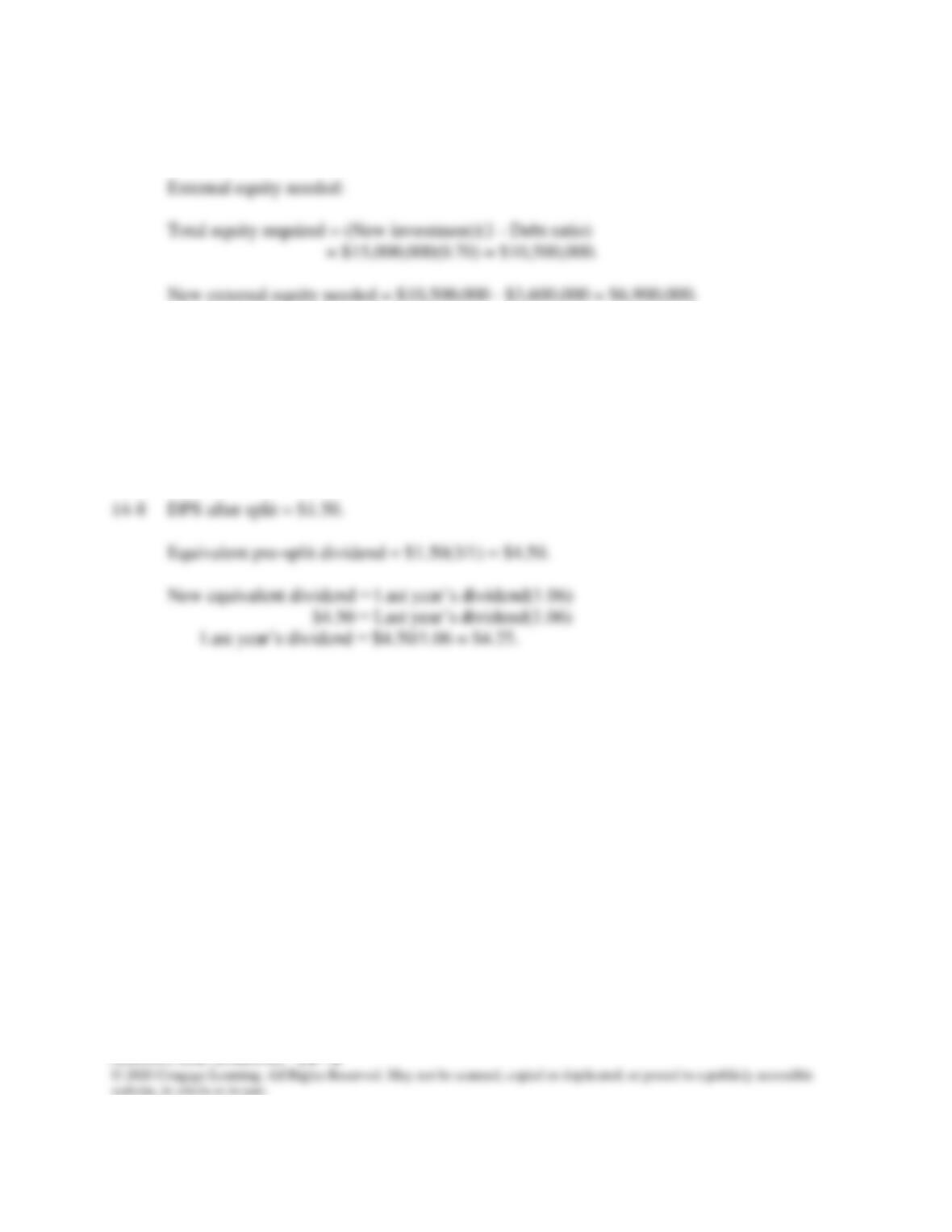
14-3 Equity financing = $12,000,000(0.60) = $7,200,000.
14-4 Vop = (n0 P) − Extra cash = (10,000,000 x $20) − $25,000,000 = $175,000,000.
n = Vop / P = $175,000,000 / $20 = 8,750,000.
14-5 P0 = $120; Split = 3 for 2; New P0 = ?
14-6 Retained earnings = Net income (1 – Payout ratio)
= $8,000,000(0.45) = $3,600,000.
14-7 Number of shares = 2,000(2) = 4,000.
EPS = $10.00/2 = $5.00.
DPS = $3.00/2 = $1.50.
Price = $40.00.
14-9 Capital budget should be $6 million since the company will accept all independent projects
whose IRR exceeds the project’s cost of capital. We know that 65% of the $6 million
should be equity. Therefore, the company should pay dividends of:
Dividends = Net income – needed equity
= $4,750,000 – $3,900,000 = $850,000.
Payout ratio = $850,000/$4,750,000 = 0.1789 = 17.89%.
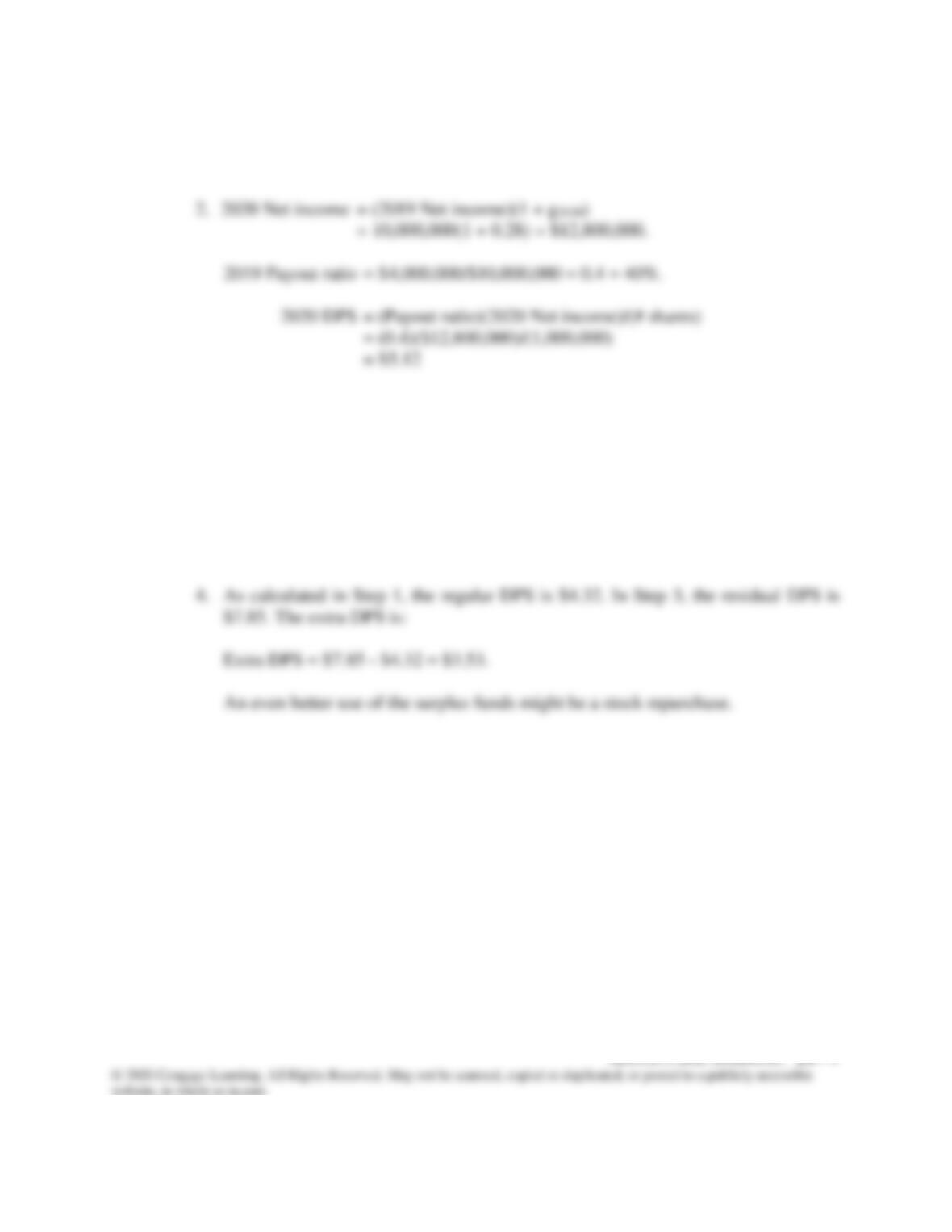
14-10 a. 1. 2020 DPS = (2019 Dividends)(1 + LT g)/ # shares
= ($4,000,000)(1 + 0.08) /1,000,000
= $4.32.
3. Equity financing = $7,500,000(1 – 0.34) = $4,950,000.
2020 DPS = (2020 Net income – Equity financing)/(# shares)
=($12,800,000 – $4,950,000)/(1,000,000)
= $7.85
All of the equity financing is done with reinvested retained earnings as long as they
are available.
b. Policy 4, based on the regular dividend with an extra, seems most logical. Implemented
properly, it would lead to the correct capital budget and the correct financing of that
budget, and it would give correct signals to investors.
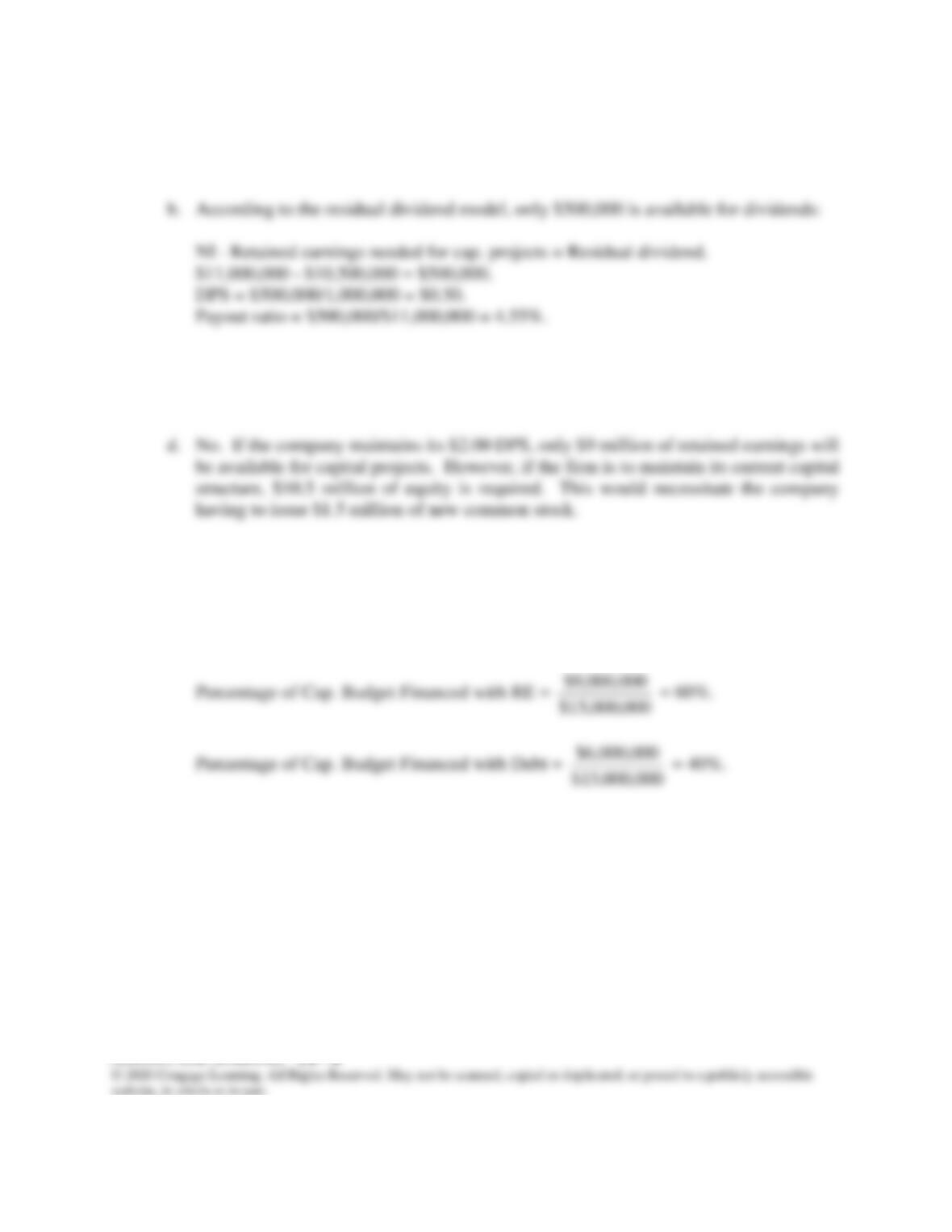
14-11 a. Capital Budget = $15,000,000; Capital structure = 70% equity, 30% debt.
Retained Earnings Needed = $15,000,000 (0.7) = $10,500,000.
c. Retained Earnings Available = $11,000,000 – $2.00 (1,000,000)
Retained Earnings Available = $11,000,000 – $2,000,000
Retained Earnings Available = $9,000,000.
e. Capital Budget = $15 million; Dividends = $2 million; NI = $11 million.
Capital Structure = ?
RE Available = $11,000,000 – $2,000,000
= $9,000,000.
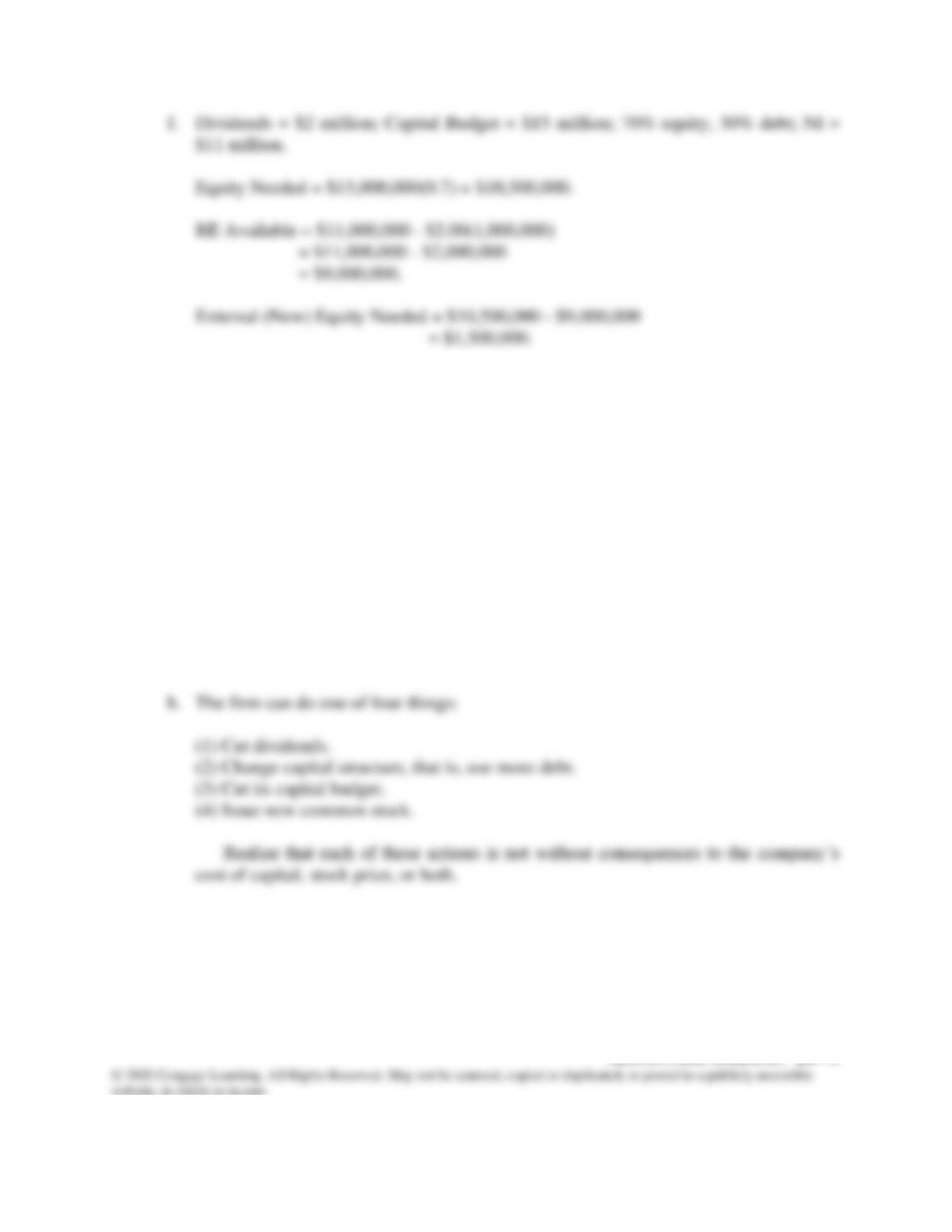
g. Dividends = $2 million; NI = $11 million; Capital structure = 70% equity, 30% debt.
RE Available = $11,000,000 – $2,000,000
= $9,000,000.
We’re forcing the RE Available = Required Equity to find the new capital budget.
Required Equity = Capital Budget (Target Equity Ratio)
$9,000,000 = Capital Budget(0.7)
Capital Budget = $12,857,143.
Therefore, if Reynolds cuts its capital budget from $15 million to $12.86 million, it can
maintain its $2.00 DPS, its current capital structure, and still follow the residual
dividend policy.
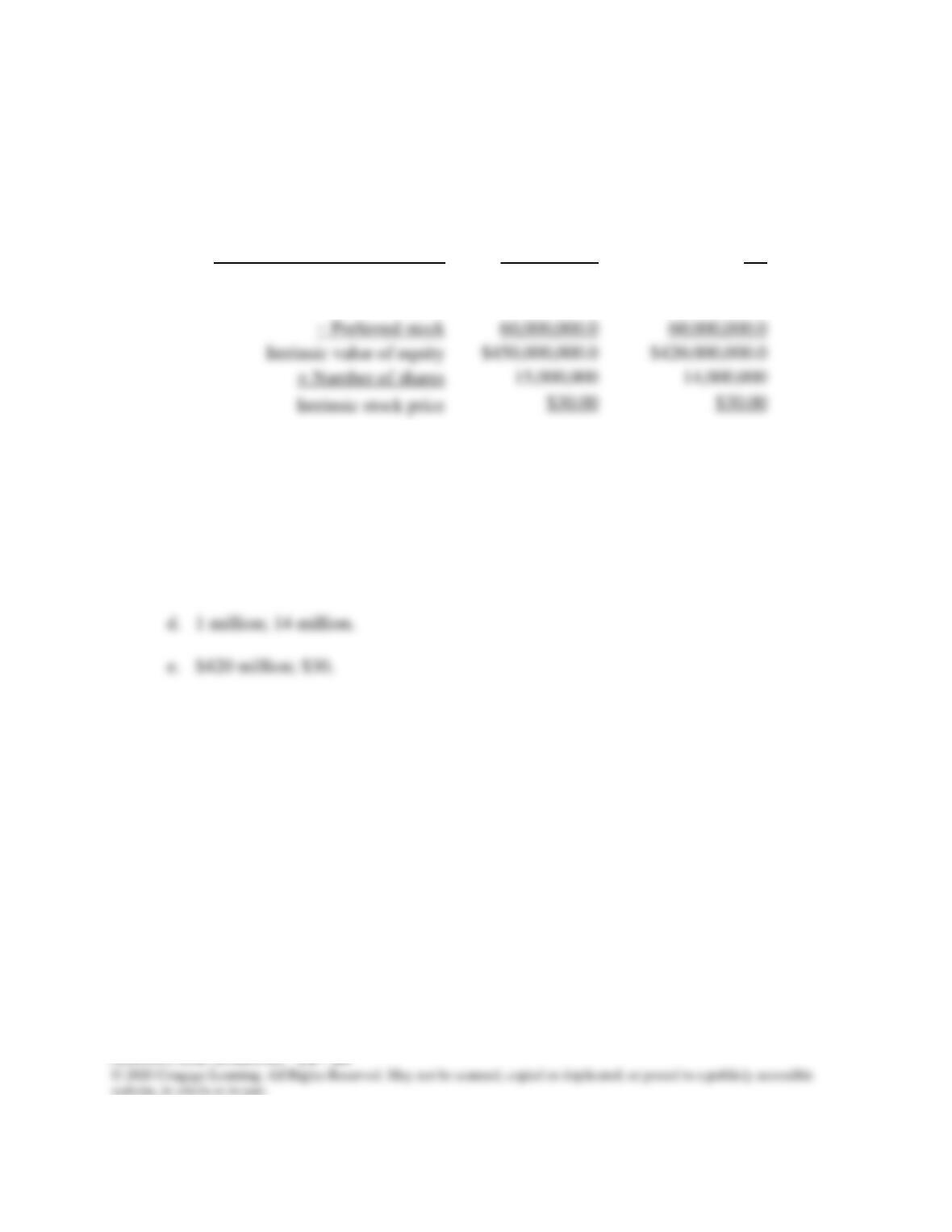
14-12
Prior to
Repurchase
After Repurchase
Value of operations =
(FCF(1+gL))/(WACC-gL) =
$848,000,000.0
$848,000,000.0
+ Value of nonoperating assets
30,000,000.0
0.0
Total intrinsic value of firm
$878,000,000.0
$848,000,000.0
− Debt
368,000,000.0
368,000,000.0
60,000,000.0
60,000,000.0
$450,000,000.0
$420,000,000.0
# shares repurchased =
(Cash used in repurchase)/Price =
1,000,000
a. $848 million.
b. $450 million.
c. $30.

SPREADSHEET PROBLEM
14-13 The detailed solution for the problem is available in the file Ch14 P13 Build a Model
Solution.xlsx on the textbook’s Web site.
MINI CASE
Integrated Waveguide Technologies (IWT) is a 6-year old company founded by Hunt
Jackson and David Smithfield to exploit metamaterial plasmonic technology to develop and
manufacture miniature microwave frequency directional transmitters and receivers for use
in mobile Internet and communications applications. The technology, although highly–
advanced, is relatively inexpensive to implement and their patented manufacturing
techniques require little capital in comparison to many electronics fabrication ventures.
Because of the low capital requirement, Jackson and Smithfield have been able to avoid
issuing new stock and thus own all of the shares. Because of the explosion in demand for its
mobile Internet applications, IWT must now access outside equity capital to fund its
growth and Jackson and Smithfield have decided to take the company public. Until now,
Jackson and Smithfield have paid themselves reasonable salaries but routinely reinvested
all after-tax earnings in the firm, so dividend policy has not been an issue. However, before
talking with potential outside investors, they must decide on a dividend policy.
Your new boss at the consulting firm Flick and Associates, which has been retained
to help IWT prepare for its public offering, has asked you to make a presentation to
Jackson and Smithfield in which you review the theory of dividend policy and discuss the
following issues.
a. 1. What is meant by the term “distribution policy”? How have dividend payouts
versus stock repurchases changed over time?
Answer: Distribution policy is defined as the firm’s policy with regard to (1) the level of
distributions, (2) the form of distributions (dividends or stock repurchases), and (3) the
stability of distributions.