
CHAPTER 14: CAPITAL BUDGETING FOR THE MULTINATIONAL CORPORATION 1
CHAPTER 14
CAPITAL BUDGETING FOR THE MULTINATIONAL CORPORATION
This chapter focuses on three aspects of foreign investment analysis that are infrequently considered in
evaluating domestic projects: the difference between project and parent cash flows; incorporating political
risks such as expropriation and currency controls; and factoring in inflation and exchange rate changes in
cash flow estimates. It also evaluates the various methods used to incorporate in the investment analysis
the additional risks encountered overseas. These points are brought out in the process of working through
the International Diesel Corporation Case. The ability to perform a capital budgeting analysis is one of the
most valuable skills we can provide our students; this case is designed to make them aware of many of the
intricacies involved in doing such an analysis.
SUGGESTED ANSWERS TO CHAPTER 14 QUESTIONS
1. A foreign project that is profitable when valued on its own will always be profitable from the
parent firm’s standpoint. True or false. Explain.
2. Early results on the Lexus, Toyota’s upscale car, showed it was taking the most business from
customers changing from either BMW (15%), Mercedes (14%), Toyota (14%), General
Motors’ Cadillac (12%), and Ford’s Lincoln (6%). With what in the auto business is considered
a high percentage of sales coming from its own customers, how badly is Toyota hurting itself
with the Lexus?
3. What factors should be considered in deciding whether the cost of capital for a foreign affiliate
should be higher, lower, or the same as the cost of capital for a comparable domestic operation?
4. According to an article in Forbes, “American companies can and are raising capital in Japan at
relatively low rates of interest. Dow Chemical, for instance, has raised $500 million in yen. That
cost the company over 50% less than it would have at home.” Comment on this statement.
5. Boeing Commercial Airplane Co. manufactures all its planes in the U.S. and prices them in
dollars, even the 50% of its sales destined for overseas markets. What financing strategy would
you recommend for Boeing? What data do you need?
ANSWER. Boeing faces foreign exchange risk for two reasons: (1) It sells half its planes overseas and the
6. United Airlines recently inaugurated service to Japan and now wants to finance the purchase
of Boeing 747s to service that route. The CFO for United is attracted to yen financing because
the interest rate on yen is 300 basis points lower than the dollar interest rate. Although he
doesn’t expect this interest differential to be offset by yen appreciation over the ten-year life of
the loan, he would like an independent opinion before issuing yen debt.
6.a. What are the key questions you would ask in responding to UAL’s CFO?
6.b. Can you think of any other reason for using yen debt?
6.c. What would you advise him to do, given his likely responses to your questions and your
answer to part b?
7. Eastman Kodak’s CFO is thinking of borrowing Japanese yen because of the low interest rate,
currently 4.5%. The interest rate on U.S. dollars is 9%. What is your advice to the CFO?
8. Name some of the advantages and disadvantages of having highly leveraged foreign subsidiaries.
ANSWER. A more highly leveraged subsidiary may also be a more efficient firm because management is
unable to turn to the parent for help.
9. Compania Troquelados ARDA is a medium-sized Mexico City auto parts maker. It is trying to
decide whether to borrow dollars at 9% or Mexican pesos at 75%. What advice would you give
it? What information would you need before you gave the advice?
ANSWER. To begin, it is necessary to recognize that 75% in pesos is not the same as 9% in dollars. In the
10. What are the principal cash outflows associated with the IDC-U.K. project?
11. What are the principal cash inflows associated with the IDC-U.K. project?
ANSWER. The principal cash inflows associated with the IDC-U.K. project include
12. In what ways do parent and project cash flows differ on the IDC- U.K. project? Why?
ANSWER. Parent and project cash flows differ on the IDC-U.K. project in several ways:
these lost exports.
13. Why are loan repayments by IDC-U.K. to Lloyds and NEB treated as a cash inflow to the
parent company?
14. How sensitive is the value of the project to the threat of currency controls and expropriation?
How can the financing be structured to make the project less sensitive to these political risks?
ANSWER. Figures in Exhibit 13.6 reveal that the value of IDC’s English project is quite sensitive to the
potential political risks of currency controls and expropriation. The project NPV does not turn positive
15. What options does investment in the new British diesel plant provide to IDC-U.S.? How can
these options be accounted for in the traditional capital budgeting analysis?
ANSWER. Here are some options IDC-U.S. will realize by investing in the British diesel plant: The plant’s
ADDITIONAL CHAPTER 14 QUESTIONS AND ANSWERS
1. Suppose the real value of the pound declines. How would this decline likely affect the economics
of the IDC-U.K. project?
ANSWER. If the real value of the pound declines, the dollar value of revenues on sales in England will
undoubtedly decline. At the same time, however, dollar costs of production will also decline. The net
6 INSTRUCTORS MANUAL: MULTINATIONAL FINANCIAL MANAGEMENT, 6TH ED.
2. Describe the alternative ways to treat the interest subsidy provided by the British government.
ANSWER. The interest subsidy provided by the British government can be incorporated in the investment
3. Under what circumstances should IDC-U.S. earnings on lost export sales to the United
Kingdom and the rest of the Common Market countries be treated as a cost of the project?
4. When should these lost export earnings be ignored when evaluating the project?
5. Should the cost of capital for the IDC-U.K. project be higher, lower, or the same as the cost of
capital for a similar project to manufacture and sell diesel engines in the U.S.? Explain.
ANSWER. There is no obviously correct answer. However, three points that are relevant here. First, one of
6. Some economists have stated that too many companies are not calculating the cost of not
investing in new technology, world-class manufacturing facilities, or market position overseas.
What are some of these costs? How do these costs relate to the notion of growth options
discussed in the chapter?
ANSWER. The company that gets to market first often goes on to dominate it. Those companies that don’t
invest early may quickly be out of the business altogether. They may also lose out on other opportunities
7. Comment on the following statement that appeared in The Economist (August 20, 1988, p. 60):
“Those oil producers that have snapped up overseas refineries – Kuwait, Venezuela, Libya,
and, most recently, Saudi Arabia – can feed the flabbiest of them with dollar-a-barrel crude
and make a profit. … The majority of OPEC’s existing overseas refineries would be scrapped
without its own cheap oil to feed them. Both Western European refineries fed by Libyan oil (in
West Germany and Italy) and Kuwait’s two overseas refineries (in Holland and Denmark)
would almost certainly be idle without it.”
ANSWER. The statement is incorrect, assuming the author is referring to true economic profit. On an
8. In December 1989, General Electric spent $150 million to buy a controlling interest in
Tungsram, the Hungarian state-owned light bulb maker. Even in its best year, Tungsram
earned less than a 4% return on equity (based on the price GE paid).
8.a. What might account for GE’s decision to spend so much money to acquire such a dilapidated,
inefficient manufacturer?
ANSWER. Eastern Europe has the potential to be both a large market for Western goods and a low-cost
manufacturing platform for export to Western Europe. But there are major uncertainties as to whether

8.b. A Hungarian light bulb worker earns about $170 a month in Hungary, compared with about
$1,700 a month in the U.S. Do these figures indicate Tungsram will be a low-cost producer?
SUGGESTED SOLUTIONS TO CHAPTER 14 PROBLEMS
1. Suppose a firm projects a $5 million perpetuity from a $20 million investment in Spain. If the
required return on this investment is 20%, how large does the probability of expropriation in
year 4 have to be before the investment has a negative NPV? Assume that all cash inflows occur
at the end of each year and that the expropriation, if it occurs, will occur prior to the year–4
cash inflow or not at all. There is no compensation in the event of expropriation.
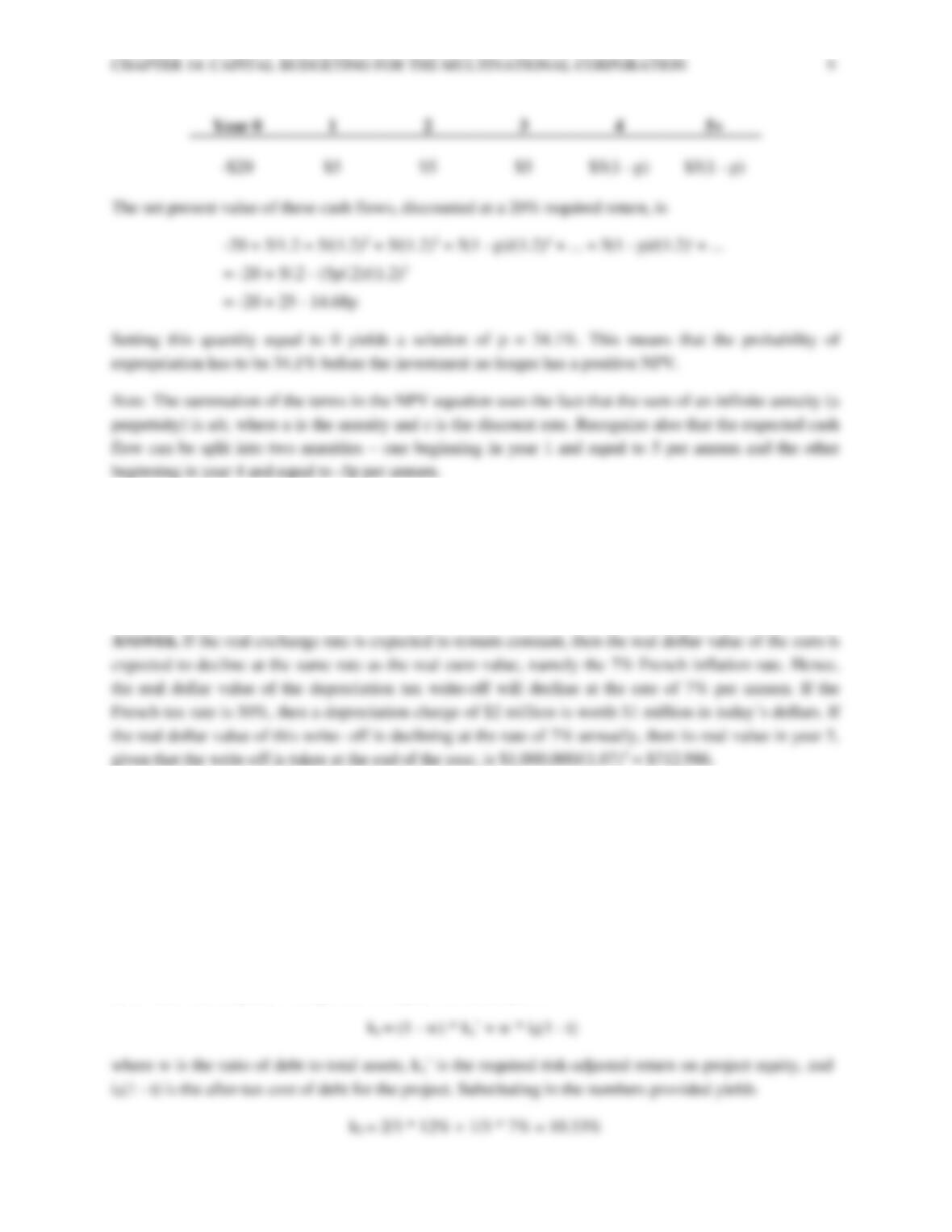
ANSWER. This problem can be solved by breaking the cash flow stream into two components – one
component if expropriation takes place and the other if no expropriation takes. The expected value of
2. Suppose a firm has just made an investment in France that will generate $2 million annually in
depreciation, converted at today’s spot rate. Projected annual rates of inflation in France and in
the U.S. are 7% and 4%, respectively. If the real exchange rate is expected to remain constant
and the French tax rate is 50%, what is the expected real value (in terms of today’s dollars) of
the depreciation charge in year 5, assuming that the tax write-off is taken at the end of the year?
3. A firm with a corporate-wide debt/equity ratio of 1:2, an after-tax cost of debt of 7%, and a
cost of equity capital of 15% is interested in pursuing a foreign project. The debt capacity of
the project is the same as for the company as a whole, but its systematic risk is such that the
required return on equity is estimated to be about 12%. The after-tax cost of debt is expected
to remain at 7%.
3.a. What is the project’s weighted average cost of capital? How does it compare with the
parent’s WACC?
ANSWER. The weighted average cost of capital for the project is

3.b. If the project’s equity beta is 1.21, what is its unlevered beta?
ANSWER. The following approximation is usually used to unlever beta:
4. Suppose that a foreign project has a beta of 0.85, the risk-free return is 12%, and the required
return on the market is estimated at 19%. What is the cost of capital for the project?
ANSWER. The cost of capital for the project is
5. IBM is considering having its German affiliate issue a 10-year, $100 million bond denominated
in euros and priced to yield 7.5%. Alternatively, IBM’s German unit can issue a dollar-
denominated bond of the same size and maturity and carrying an interest rate of 6.7%.
5.a. If the euro is forecast to depreciate by 1.7% annually, what is the expected dollar cost of the
euro-denominated bond? How does this compare to the cost of the dollar bond?
5.b. At what rate of euro depreciation will the dollar cost of the euro-denominated bond equal
the dollar cost of the dollar-denominated bond?
5.c. Suppose IBM’s German unit faces a 35% corporate tax rate. What is the expected after-tax
dollar cost of the euro-denominated bond?
CHAPTER 14: CAPITAL BUDGETING FOR THE MULTINATIONAL CORPORATION 11
6. Suppose the cost of borrowing restricted euros is 7% annually, whereas the market rate for
these funds is 12%. If a firm can borrow €10 million of restricted funds, how much will it save
annually in before-tax franc interest expense?
7. Suppose one of the inducements provided by Taiwan to Xidex to set up a local production
facility is a ten-year, $12.5 million loan at 8%. The principal is to be repaid at the end of the
tenth year. The market interest rate on such a loan is about 15%. With a marginal tax rate of
40%, how much is this loan worth to Xidex?
8. Jim Toreson, CEO of Xebec Corp., a California, manufacturer of disk-drive controllers, must
decide whether to switch to offshore production. Given Xebec’s well-developed engineering and
marketing capabilities, Toreson could use offshore manufacturing to ramp up production,
taking advantage of low-wage labor, tax holidays, low-interest loans, and other government
largess. Most of his competitors seem to be doing it. The faster he follows suit, the better off
Xebec would be according to the conventional discounted cash-flow analysis, which shows that
switching production offshore is clearly a positive NPV investment. However, Toreson is
concerned that such a move would entail the loss of certain intangible strategic benefits
associated with domestic production.
8.a. What might be some strategic benefits of domestic manufacturing for Xebec? Consider the
fact that its customers are all U.S. firms and that manufacturing technology – particularly
automation skills – is key to survival in this business.
ANSWER. Short-run benefits include better quality control and communication with customers and the
ability to adapt quickly to changing markets. Longer term, a domestic manufacturing facility would give
8.b. What analytic framework can be used to factor these intangible strategic benefits of domestic
manufacturing (which are intangible costs of offshore production) into the factory location
decision?
ANSWER. The intangible strategic benefits of domestic manufacturing can be factored into the factory
location decision by using the option pricing framework. By investing in domestic manufacturing, Xebec
8.c. How would the possibility of radical shifts in manufacturing technology affect the production
location decision?
ANSWER. The possibility of radical shifts in manufacturing technology would increase the benefits from
investing in factory automation in the U.S. The phrase “radical shifts” implies that the project is high risk,
which increases the option component of value.
CHAPTER 14: CAPITAL BUDGETING FOR THE MULTINATIONAL CORPORATION 13
8.d. Xebec is considering producing more-sophisticated drives that require substantial
customization. How does this possibility affect its production decision?
8.e. Suppose the Taiwan government is willing to provide a loan of $10 million at 5% to Xebec to
build a factory there. The loan would be paid off in equal annual installments over a five-year
period. If the market interest rate for such an investment is 14%, what is the before-tax value
of the interest subsidy?
ANSWER. Borrowing at 5% when the market rate of interest is 14% saves Xebec 9% annually on the
8.f. Projected before-tax income from the Taiwan plant is $1 million annually, beginning at the
end of the first year. Taiwan’s corporate tax rate is 25%, and there is a 20% dividend
withholding tax. However, Taiwan will exempt the plant’s income from corporate tax (but not
withholding tax) for the first five years. If Xebec plans to remit all income as dividends back
to the U.S., how much is the tax holiday worth?
ANSWER. Very little. Assuming that Xebec doesn’t have any excess foreign tax credits (FTCs), it will
Taiwan
No Tax Holiday
Tax Holiday
PBT
$1,000,000
PBT
$1,000,000
8.g. An alternative sourcing option is to shut down all domestic production and contract to have
Xebec’s products built for it by a foreign supplier in a country such as Japan. What are some
of the potential advantages and disadvantages of foreign contracting vis-á-vis manufacturing
in a wholly owned foreign subsidiary?