Chapter 14 CFIN6
Chapter 14 Solutions
14-1 Inventory conversion period = 45 days
DSO = 30 days
DPO = 20 days
a. Cash conversion cycle = 45 days + 30 days – 20 days = 55 days
b. Accounts receivable = $1,800,000/(360 days) x 30 days = $150,000
14-2 Sales = $180,000
Cost of goods sold = 85 percent of sales
Inventory turnover = 8.0
Accounts receivable turnover = 10.0
DPO = 30 days
a. DSO = (360 days)/10 = 36 days
14-3 Cost of goods sold = $480,000
Cost of goods sold = 80 percent of sales
Inventory turnover = 24.0
Accounts receivable turnover = 15.0
Chapter 14 CFIN6
Inventory conversion period = (360 days)/24 = 15 days
a. Cash conversion cycle = 24 days + 15 days – 9 days = 30 days
14-4 September 30, 2019
DSO = $251.5/($1,650/360) = 54.9 days
Inventory conversion period = $410.0/($1,353/360) = 109.1 days
DPO = $90.0/($1,353/360) = 23.9 days
Cash conversion cycle = 54.9 days + 109.1 days – 23.9 days = 140.1 days
December 31, 2019
14-5 g = 5%
TA on 1/1 = $420,000,000
TA on 6/30 = $480,000,000
Based on 5 percent growth, Permanent assets = $420,000,000[1+ (6/12)0.05] = $430,500 at the end of
June. Because assets are expected to be $480,000,000, Temporary current assets = $480,000,000 –
430,500,000 = $49,500,000.
Chapter 14 CFIN6
rEAR = (1.020408)(360/30) – 1.0 = 0.2743 = 27.43%
14-8 a. Terms: 3/10, net 50—non-discount customers pay on Day 50
0.03 360
APR = = (0.030928)(9) = 0.2784 27.84%
0.97 50 10
=
−
b. Terms: 3/10, net 50—non-discount customers pay on Day 60
0.03 360
APR = = (0.030928)(7.2) = 0.2227 22.27%
0.97 60 10
=
−
rEAR = (1.030928)(360/50) – 1.0 = 0.2452 = 24.52%
14-9 a. Interest each 30 days = (0.10/12)($150,000) = $1,250
PER $1,250
r 0.008333
$150,000
==
Chapter 14 CFIN6
b. If a 20 percent compensating balance was required, the compensating balance would be $30,000
= 0.2($150,000). If the company holds no funds at the bank, the $30,000 compensating balance
would have to be taken out of the loan proceeds, which means that only $120,000 = $150,000 –
$30,000 could be used by the company and the periodic rate and effective rate would be:
PER
14–10 Interest each 40 days = [0.12(40/360)]($60,000) = $800
( )
40
$60,000 0.12 $800
360
14–11 a. Interest each 60 days = [0.12(60/360)]($150,000) = $3,000
PER $3,000
r 0.02
$150,000
==
APR = 0.02 x 6 = 0.12 = 12.0%
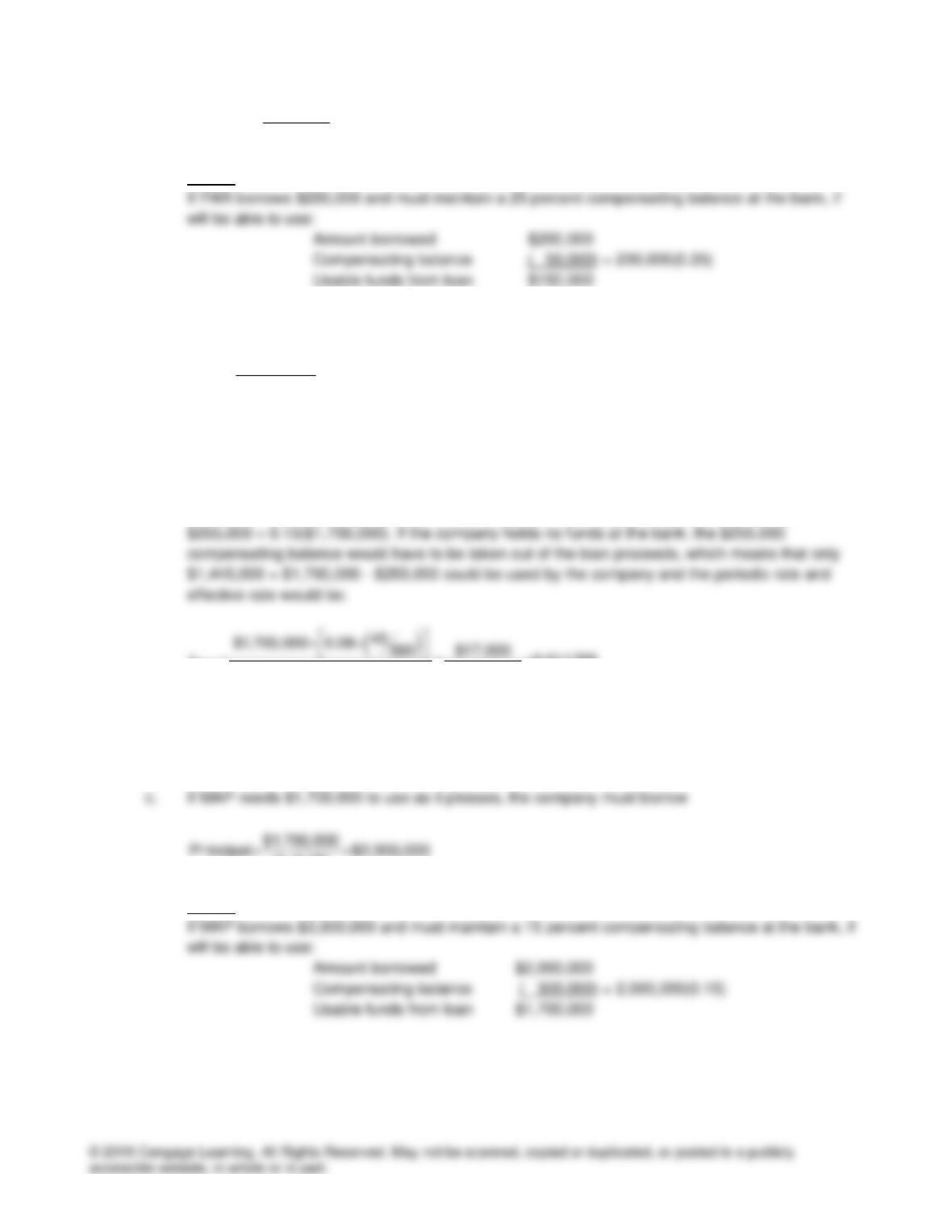
= 0.25($150,000). If the company holds no funds at the bank, the $37,500 compensating balance
would have to be taken out of the loan proceeds, which means that only $112,500 = $150,000 –
PER
r 0.026667
$150,000 $150,000(0.25) $112,500
= = =
−
APR = 0.02667% x 6 = 0.16 = 16.00%
rEAR = (1.026667)6 – 1.0 = 0.1711 = 17.11%
Chapter 14 CFIN6
$150,000
Principal $200,000
(1 0.25)
==
−
Check:
14-12 a. Interest each 45 days = [0.08(45/360)]($1,700,000) = $17,000
PER $17,000
r 0.01
$1,700,000
==
APR = 0.01 x (360/45) = 0.08 = 8.0%
rEAR = (1.01)(360/45) – 1.0 = 0.0829 = 8.29% = [1 + (0.08/8)]8 – 1
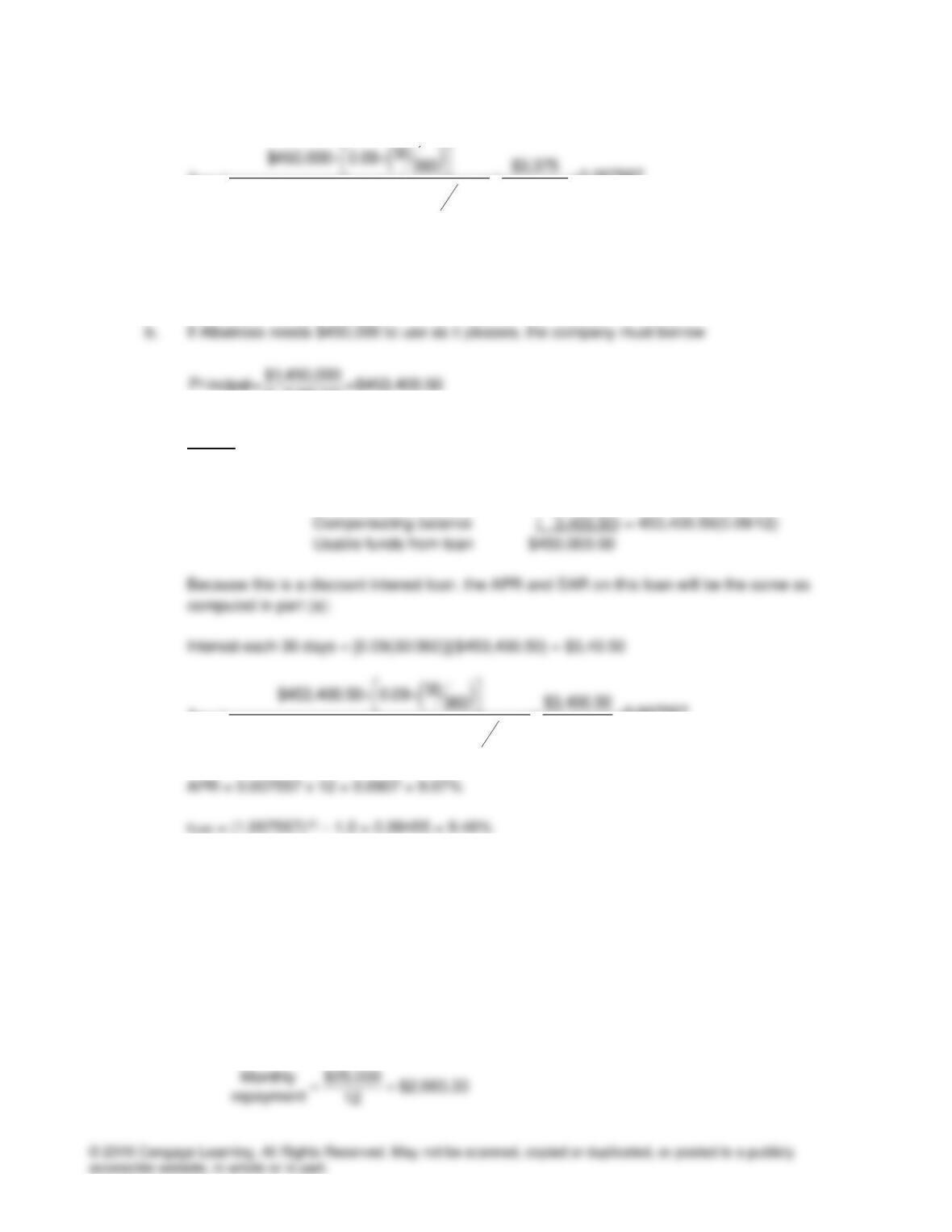
b. If a 15 percent compensating balance was required, the compensating balance would be
PER
r 0.011765
$1,700,000 $1,700,000(0.15) $1,445,000
= = =
−
APR = 0.011765% x (360/45) = 0.0941 = 9.41%
rEAR = (1.011765)8 – 1.0 = 0.0981 =9.81%
(1 0.15)
−
Check:
Chapter 14 CFIN6
14-13 a. Interest each 30 days = [0.09(30/360)]($450,000) = $3,375
( )
PER
r 0.007557
$446,625
30
$450,000 $450,000 0.09 360
= = =
−
APR = 0.007557 x 12 = 0.0907 = 9.07%
rEAR = (1.007557)12 – 1.0 = 0.0945 = 9.45%
(1 0.09/12)
−
Check:
If Albatross borrows $453,400.50 using a discount interest loan, if will be able to use:
Amount borrowed $453,400.50
( )
PER
r 0.007557
$450,000
30
$453,400.50 $453,400.50 0.09 360
= = =
−
14–14 a. Interest = $25,000(0.11) = $2,750
Total amount to be repaid = $25,000 + $2,750 = $27,750
Monthly payments = $27,750/12 = $2,312.50
b. Because the loan is repaid evenly during the year, the amount of principal that is repaid each
month is:
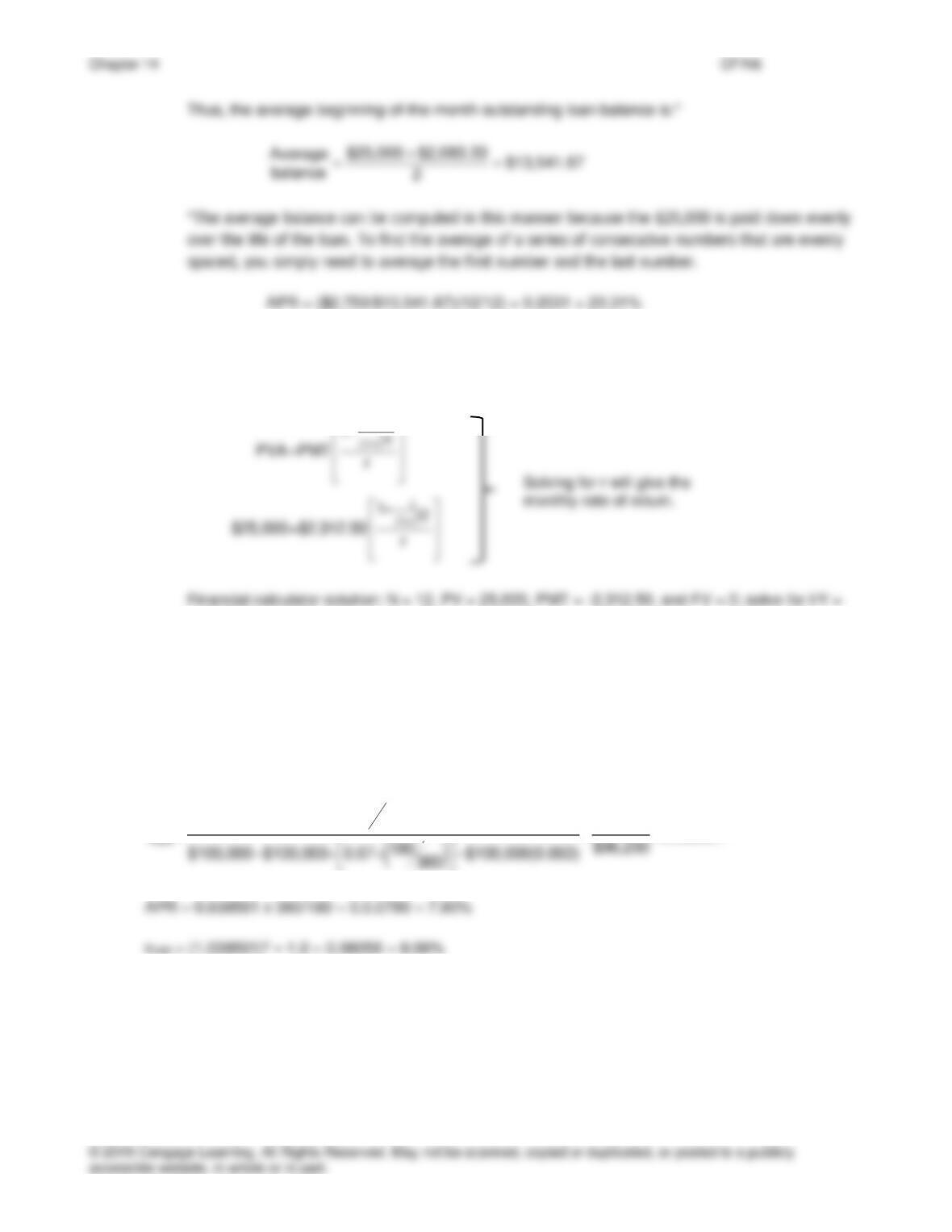
rEAR: Because the monthly payment of $2,312.50 is an annuity, the effective rate can be computed
as follows:
1.643237 = monthly rate
rEAR = (1.01643237)12 – 1.0 = 0.2160 = 21.6%
14–15 Interest = $100,000(0.07)(180/360) = $3,500
Transaction fee = $100,000(0.003) = $300
( )
180
$100,000 0.07 $100,000(0.003) $3,800
360
+
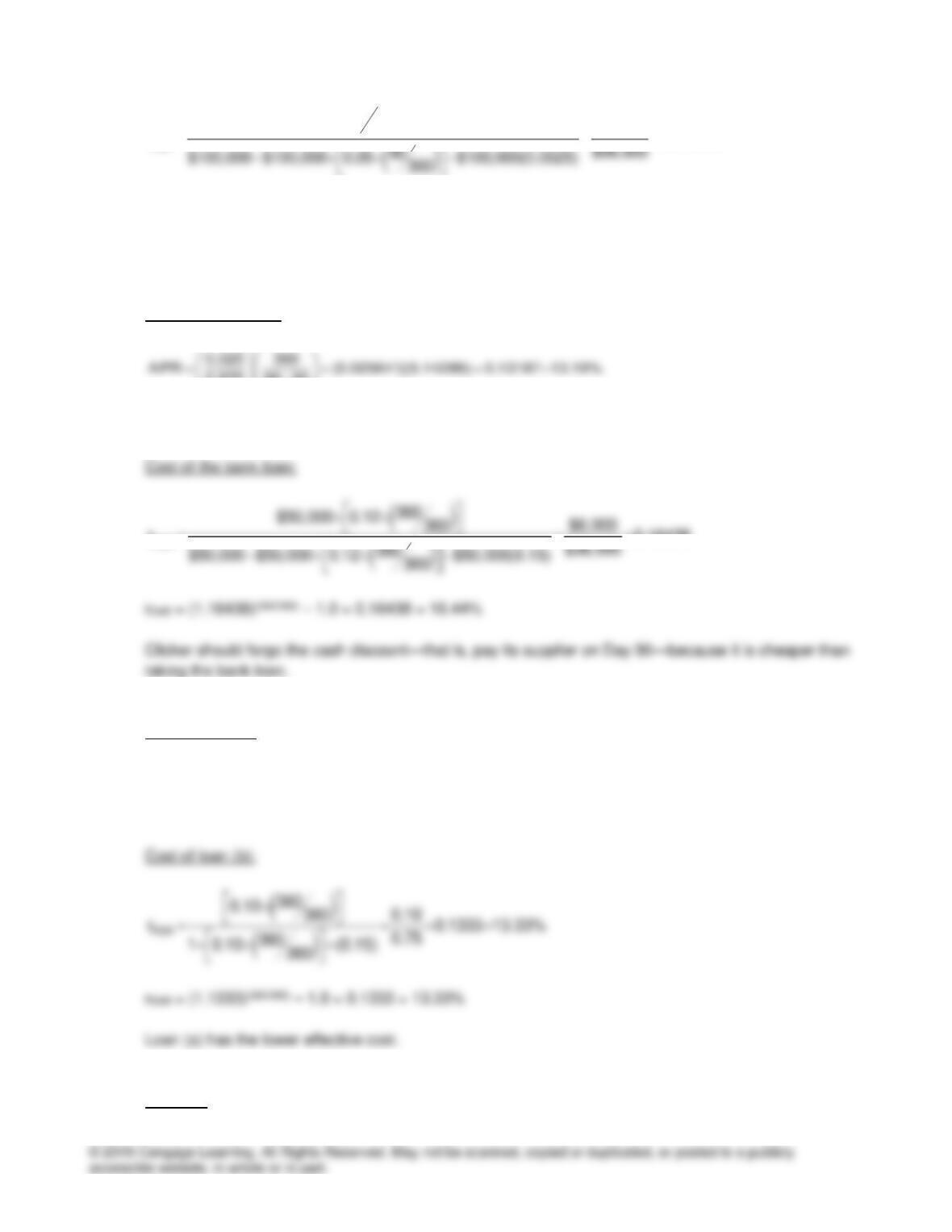
14–16 Interest = $100,000(0.05)(90/360) = $1,250
Transaction fee = $100,000(0.0025) = $250
112
Chapter 14 CFIN6
( )
90
$100,000 0.05 $100,000(0.0025) $1,500
360
r 0.015228
+
= = =
APR = 0.015228 x 360/90 = 0.0.0609 = 6.09%
rEAR = (1.015228)4 – 1.0 = 0.062319 = 6.23%
14–17 Cost of trade credit:
0.975 90 20
−
rEAR = (1.025641)(360/70) – 1.0 = 0.13906 = 13.91%
r 0.16438
= = =
14–18 Cost of loan (a):
rPER = 0.12(360/360) = 0.12
rEAR = (1.12)(360/360) – 1.0 = 0.12 = 12.0%
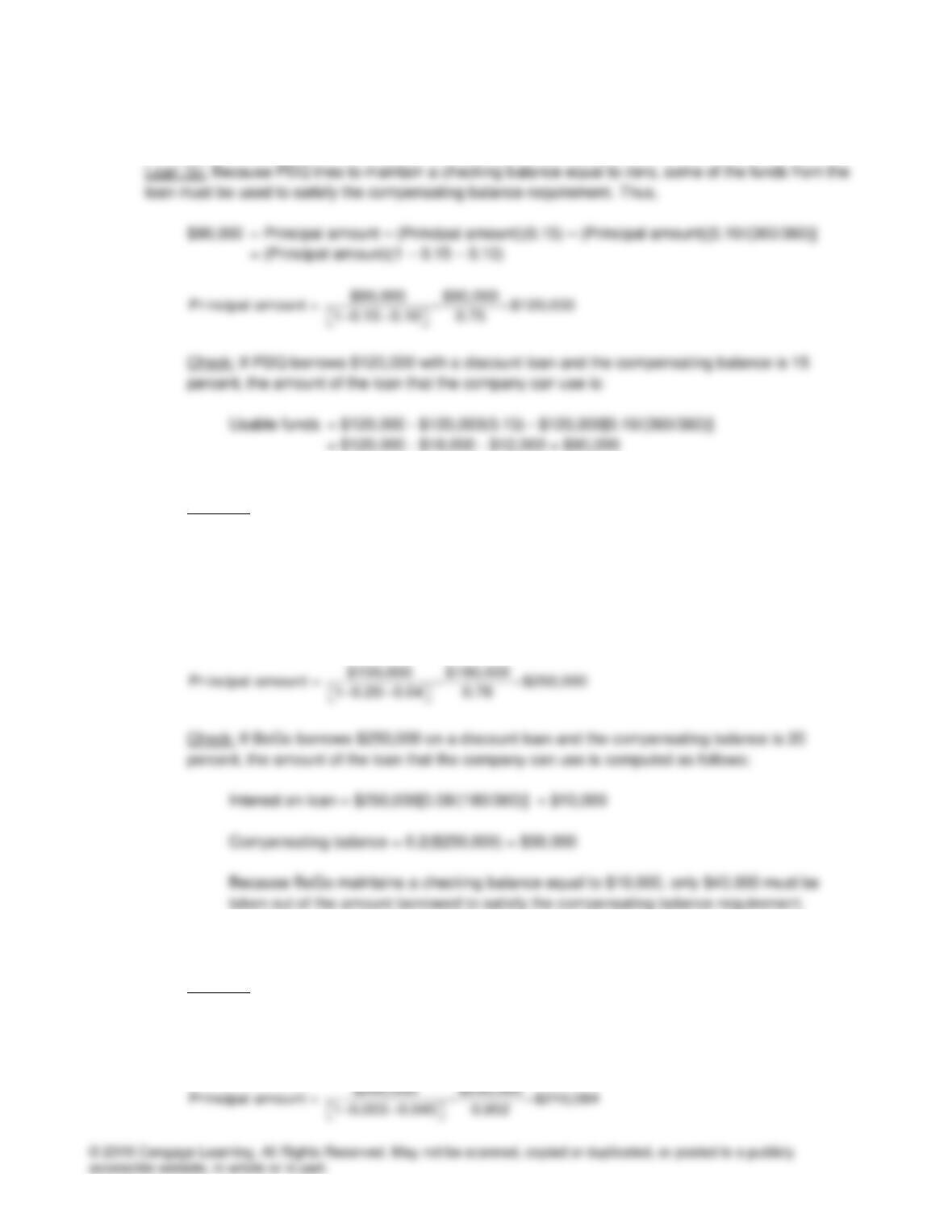
14–19 Loan (a):
Chapter 14 CFIN6
Because this is a simple interest loan that has no compensating balance and a maturity of one year, the
PDQ can borrow $90,000. No adjustments are made to the principal amount.
14–20 a. Option 1: Because BoGo tries to maintain a checking balance equal to $10,000, some of the
funds from the loan must be used to satisfy the compensating balance requirement. Thus,
$200,000 = Principal amount – [(Principal amount)(0.20) – $10,000]
– (Principal amount)[0.08/(180/360)]
$190,000 = (Principal amount)(1 – 0.20 – 0.04)
Usable funds = $250,000 – $40,000 – $10,000 = $200,000
Option 2: Commercial paper costs reduce the amount the firm has to use.
$200,000 = Principal amount – (Principal amount)(0.003) – (Principal amount)[0.09/(180/360)]
= (Principal amount)(1 – 0.003 – 0.045)
Chapter 14 CFIN6
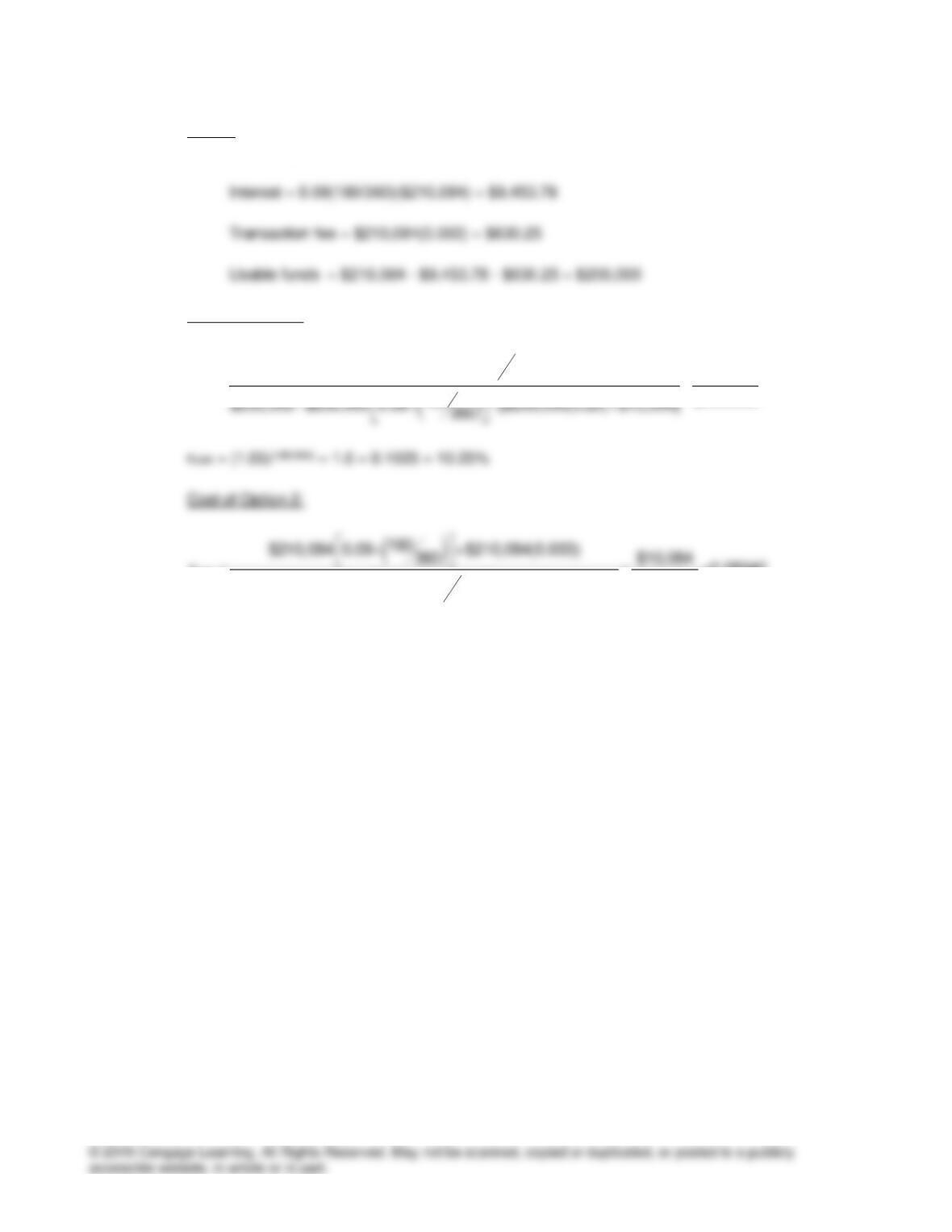
Check: If BoGo issues commercial paper with a face value of $210,084, the amount the company
can use is computed as follows:
b. Cost of Option 1:
( )
PER
180
$250,000 0.08 $10,000
360
r 0.05
= = =
( )
PER
r 0.05042
$200,000
180
$210,084 $210,084 0.09 $210,084(0.003)
360
= = =
− −
rEAR = (1.05042)(180/360) – 1.0 = 0.1034 = 10.34%
Option 1 has the lower effective cost.