Planning for Retirement
Chapter 14
How Will This Affect Me?
While almost everyone understands that planning for retirement is important, far too few people
actually implement a comprehensive plan, much less set aside enough savings to fund their
retirement adequately. This chapter discusses the importance of retirement planning and
encourages action by identifying the major pitfalls that you must overcome. In order to make the
process more concrete and accessible, the steps for estimating your retirement income needs and
LEARNING GOALS
14-1 Recognize the importance of retirement planning and identify the three biggest pitfalls
to good planning.
If your school or community will allow it, I suggest you take a branding iron and brand the
student’s forehead with the words: ”Plan NOW”. Planning for retirement needs to begin when
you take your the first job. It stops when you are dead. Consider the following:
14-2 Estimate your income needs in retirement and the level of retirement income you’ve
estimated from various sources.
Worksheet 14.1 does this, and I suggest you go over the worksheet and assign Financial Planning

14-3 Explain the eligibility requirements and benefits of the Social Security program.
14-4 Differentiate among the types of basic and supplemental employer sponsored pension
plans.
The basic plans are defined benefit and defined contribution plans. More common today are
14-5 Describe the various types of self-directed retirement plans.
Traditional and ROTH IRAs are discussed. The features of these plans should be discussed
14-6 Choose the right type of annuity for your retirement plan.
Annuities have a place, especially for the risk adverse person who want a fixed sum for
Financial Facts or Fantasies?
These may be used as “teasers” to get the students on the right page with you. Also, they may be
used as quizzes after you covered the material or as “pre–test questions” to get their attention.
• Social security retirement benefits should be sufficient to provide retired workers and their
spouses with a comfortable standard of living.
Fantasy: Social security is intended to be only a foundation or supplement for retirement
income. By itself, these benefits will likely permit retirees only a small fraction of their pre-
retirement standard of living.
• Since an annuity is only as good as the insurance company that stands behind it, you should
check the company’s financial rating before buying an annuity.
Fact: Because it’s a life insurance company that guarantees the payout of the policy during the
distribution period, it’s a good idea to see how the company’s financial strength is rated in Best’s
Insurance Reports. And if you’re looking for maximum protection, stick with companies that are
rated A+ or A.

Financial Facts or Fantasies?
These may be used as a quiz or as a pre-test to get the students interested.
1. True False The first step in retirement planning is to set your retirement goals.
2. True False In order to receive maximum social security retirement benefits, a
worker must retire before his or her 66th birthday.
3. True False Social security retirement benefits should be sufficient to provide
retired workers and their spouses with a comfortable standard of
living.
4. True False Because participation in a company’s defined benefit pension plan
is mandatory, you’re entitled to immediate vesting of all
contributions.
5. True False Your contributions to an IRA account may or may not be tax
deductible, depending in part on your level of income.
6. True False Since an annuity is only as good as the insurance company that
stands behind it, you should check the company’s financial rating
before buying an annuity.

YOU CAN DO IT NOW
The “You Can Do It Now” cases may be assigned to the students as short cases or problems.
They will help make the topic more real or relevant to the students. In most cases, it will only
take about ten minutes to do, that is, until the student starts looking around at the web site. But
they will learn by doing so.
YOU CAN DO IT NOW
Get a Rough Estimate of Your Future Social Security Benefits
YOU CAN DO IT NOW
Calculating the Benefits of a Traditional IRA
YOU CAN DO IT NOW
What Do Annuities Cost?
Want to get a sense of how a fixed annuity might fit into a retirement plan? Try the American

Financial Impact of Personal Choices
Read and think about the choices being made. Do you agree or not? Ask the students to discuss
the choices being made.
Kaitlyn and Ava’s Different Approaches to a Traditional IRA
Kaitlyn Bradley and Ava Spencer, both 30 years old, are good friends who work together at a
At age 66 the pre-tax value of Kaitlyn’s IRA should be about $553,455 while the value of Ava’s
Applying Personal Finance
Envisioning Your Ideal Retirement Plan!
Many people have little or no money set aside for their retirement. Those who do may find their
retirement funds insufficient for maintaining their desired standard of living during retirement. In
1. Would the plan be contributory or noncontributory?
2. Stated as a percentage of your base salary, how much would be put into your retirement plan
each year? Remember that there are certain allowable limits.
3. What would be the eligibility and vesting provisions? Would your plan be portable? Under
what conditions?
Solutions to Financial Planning Exercises
1. Calculating amount available at retirement.
Olivia Stephens, a 25-year-old personal loan
officer at Third National Bank, understands the importance of starting early when it comes
to saving for retirement. She has designated $3,000 per year for her retirement fund and
assumes that she’ll retire at age 65.
a. How much will she have if she invests in CDs and similar money market instruments
that earn 4 percent on average?
b. How much will she have if instead she invests in equities and earns 10 percent on
average?
c. Olivia is urging her friend, Brian Snyder, to start his plan right away because he’s 35.
What would his nest egg amount to if he invested in the same manner as Olivia and he, too,
retires at age 65? Comment on your findings.
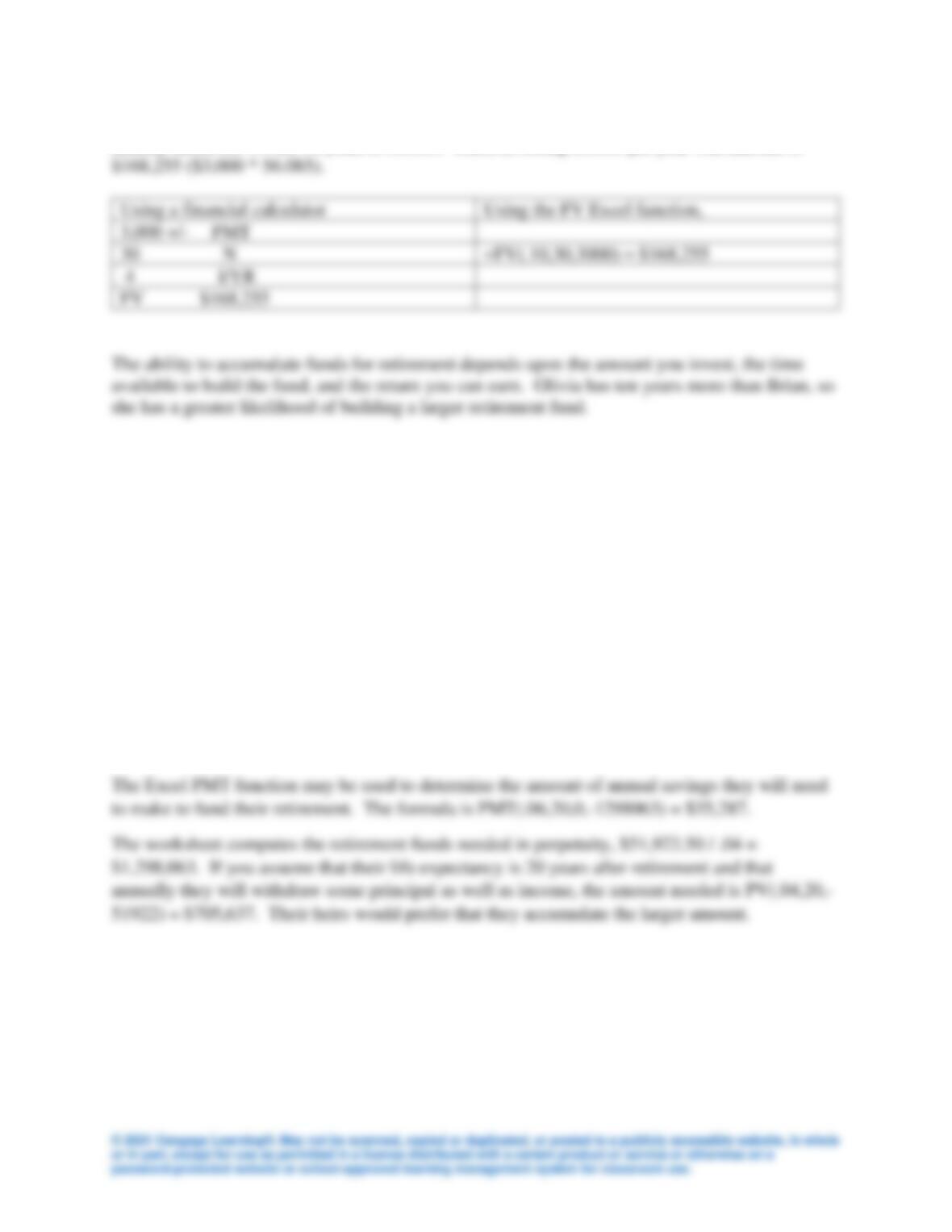
Assuming funds earn 4%: Brian will only be able to invest for 30 years. Using Appendix B, the
2. Calculating annual investment to meet retirement target.
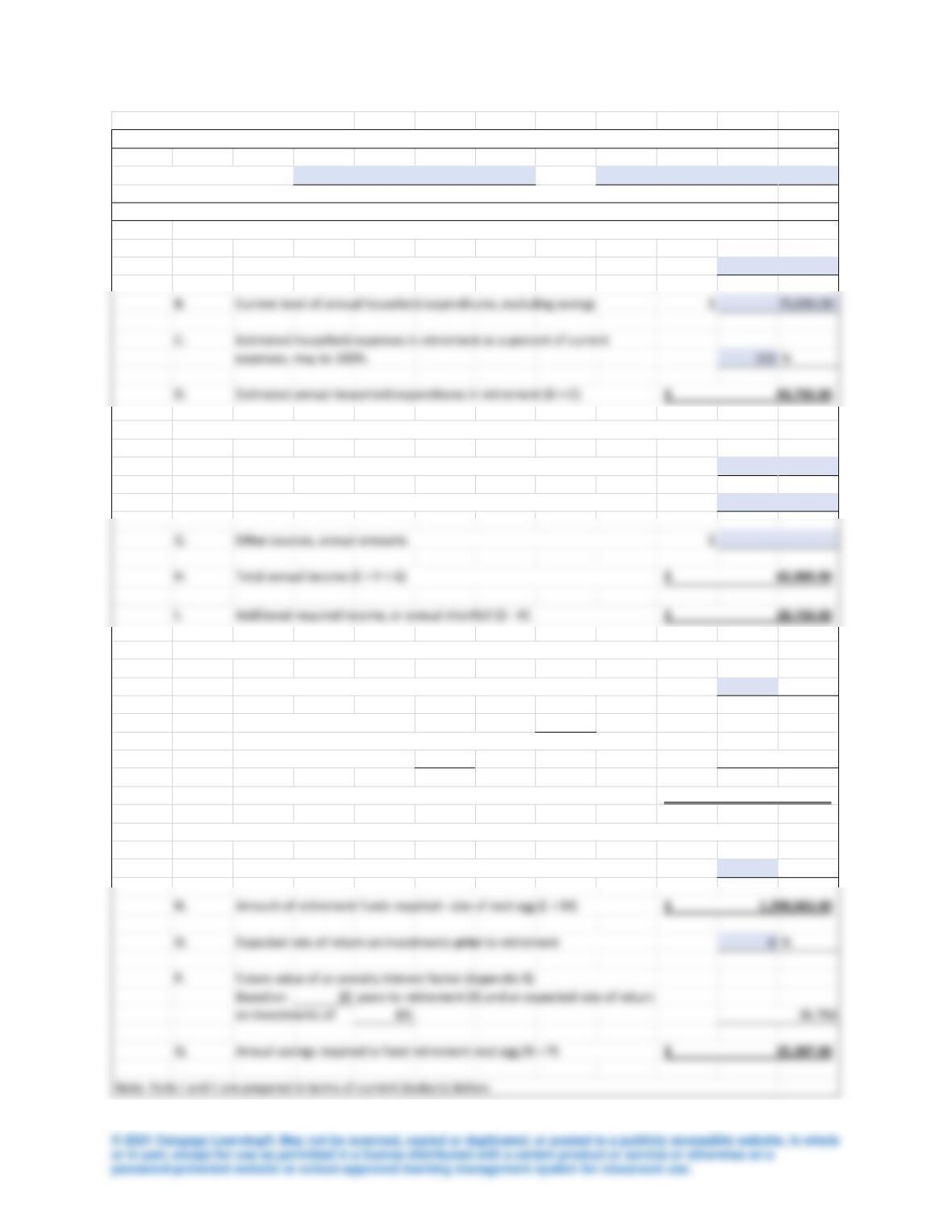
Use Worksheet 14.1 to help Paul
and Crystal Meyer, who’d like to retire in about 20 years. Both have promising careers,
and both make good money. As a result, they’re willing to put aside whatever is necessary
to achieve a comfortable lifestyle in retirement. Their current level of household
expenditures (excluding savings) is around $75,000 a year, and they expect to spend even
more in retirement; they think they’ll need about 125 percent of that amount. (Note: 125
percent equals a multiplier factor of 1.25.) They estimate that their Social Security benefits
will amount to $30,000 a year in today’s dollars and that they’ll receive another $35,000
annually from their company pension plans. They feel that future inflation will amount to
about 3 percent a year, and they think they’ll be able to earn about 6 percent on their
investments before retirement and about 4 percent afterward. Use Worksheet 14.1 to find
out how big Paul and Crystal’s investment nest egg will have to be and how much they’ll
have to save annually to accumulate the needed amount within the next 20 years.
years to retirement (A) and an expected rate of return
Annual savings required to fund retirement nest egg (N ÷ P)
35,287.00$
Expected rate of return on investments prior to retirement
Worksheet 14.1, Chapter 14, Exercise 2
Date
I.
A.
Current level of annual household expenditures, excluding savings
75,000.00
Estimated household expenses in retirement as a percent of current
Estimated annual household expenditures in retirement (B × C)
93,750.00$
II.
E. $
F. $
Other sources, annual amounts
Additional required income, or annual shortfall (D – H)
28,750.00$
III.
J. 3 %
K. Based on 20 years to
annual rate of inflation (J) of 3%
L.
IV.
M. 4 %
Inflation Factor:
Expected average annual rate of inflation over the period to retirement
Inflation factor (in Appendix A):
retirement (A) and an expected average
1.806
Size of inflation-adjusted annual shortfall (I × K)
51,922.50$
Funding the Shortfall:
Anticipated return on assets held after retirement
Company/employer pension plans, annual amounts
35,000.00
Estimated Household Expenditures in Retirement:
Approximate number of years to retirement
20
Estimated Income in Retirement:
Social security, annual income
30,000.00
PROJECTING RETIREMENT INCOME AND INVESTMENT NEEDS
Name(s)
Paul and Crystal Myer

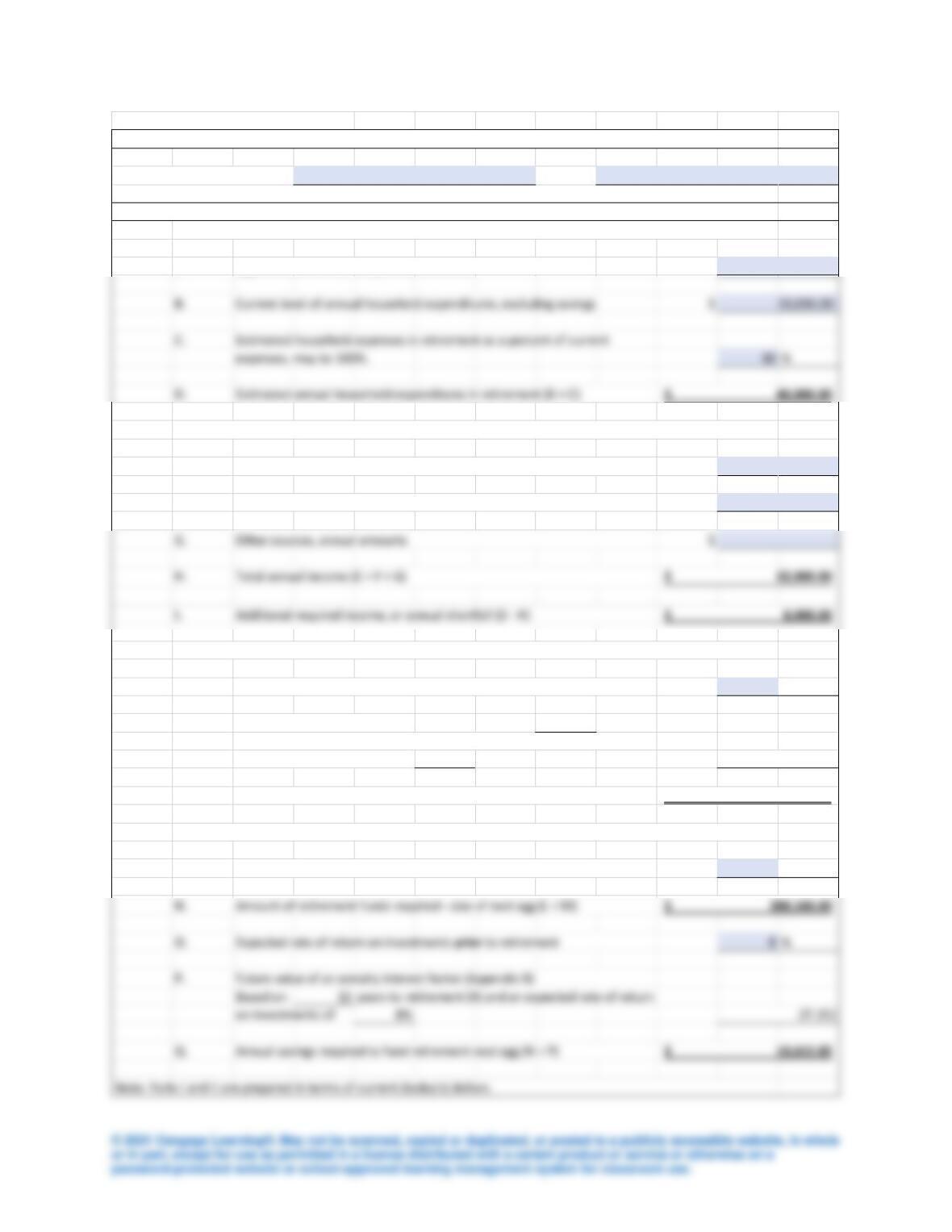
3. Retirement planning. Use Worksheet 14.1 to assist Lindsay McCoy with her retirement
planning needs. She plans to retire in 15 years, and her current household expenditures
run about $50,000 per year. Lindsay estimates that she’ll spend 80 percent of that amount
in retirement. Her Social Security benefit is estimated at $20,000 per year, and she’ll
receive $12,000 per year from her employer’s pension plan (both in today’s dollars).
years to retirement (A) and an expected rate of return
Annual savings required to fund retirement nest egg (N ÷ P)
10,612.85$
Expected rate of return on investments prior to retirement
Worksheet 14.1, Chapter 14, Exercise 3
Date
I.
A.
Current level of annual household expenditures, excluding savings
50,000.00
Estimated household expenses in retirement as a percent of current
Estimated annual household expenditures in retirement (B × C)
40,000.00$
II.
E. $
F. $
Other sources, annual amounts
Additional required income, or annual shortfall (D – H)
III.
J. 4 %
K. Based on 15 years to
annual rate of inflation (J) of 4%
L.
IV.
M. 5 %
Inflation Factor:
Expected average annual rate of inflation over the period to retirement
Inflation factor (in Appendix A):
retirement (A) and an expected average
1.801
Size of inflation-adjusted annual shortfall (I × K)
14,408.00$
Funding the Shortfall:
Anticipated return on assets held after retirement
Company/employer pension plans, annual amounts
12,000.00
Estimated Household Expenditures in Retirement:
Approximate number of years to retirement
15
Estimated Income in Retirement:
Social security, annual income
20,000.00
PROJECTING RETIREMENT INCOME AND INVESTMENT NEEDS
Name(s)
Lindsay McCoy
4. Critical evaluation of Social Security benefits. Many critics of the Social Security
program feel participants are getting a substandard investment return on their money.
Discuss why you agree or disagree with this viewpoint.
Student answers may vary. Most people agree that if a participant’s Social Security taxes
(including the employer portion) were invested in a market fund, the return on investment would
exceed that provided by social Security. However, some argue that the return is higher than it
5. Average Social Security benefits and taxes. Use Exhibit 14.3 to estimate the average
Social Security benefits for a retired couple. Assume that one spouse has a part-time job
that pays $24,000 a year, and that this person also receives another $47,000 a year from a
company pension. Based on current policies, would this couple be liable for any tax on their
Social Security income?
Average benefits for a retired couple are $2,448 per month or $29,376 per year. With the part-
6. Average Social Security benefits. Use Exhibit 14.3 to determine the annual Social
Security benefit for Travis Burton, assuming that he is an “average” retiree. Travis is 66
years old, single, and earns $28,000 a year at a part-time job. (Note that Travis is already at
“full retirement age,” because he was born before 1960.)
As an average retired worker, Travis’s Social Security benefit is $1,461 per month or $17,532
per year. He is past full retirement age so there is no reduction of benefits from the part-time
job.
7. Retirement Planning. At what age would you like to retire? Describe the type of lifestyle
you envision—where you want to live, whether you want to work part-time, and so on.
Discuss the steps you think you should take to realize this goal.
I personally think you should be able to retire at 25 for a 5-year period, and then work until you

8. Comparing Retirement Plans. Holly Richards has just graduated from college and is
considering job offers from two companies. Although the salary and insurance benefits are
similar, the retirement programs are not. One firm offers a 401(k) plan that matches
employee contributions with 25 cents for every dollar contributed by the employee, up to a
$10,000 limit. The other firm has a contributory plan that allows employees to contribute
up to 10 percent of their annual salary through payroll deduction and matches it dollar for
dollar; this plan vests fully after five years. Because Holly is unfamiliar with these plans,
explain the features of each to her so she can make an informed decision.
Under the first plan, the maximum contribution would be $10,000 by Holly plus $2,500 by
employer, total contribution of $12,500. The contribution vests immediately to Holly and it
looks like she can pick the investments.
9. After-tax cost of 401(k) contribution. Jared Nguyen is an operations manager for a large
manufacturer. He earned $110,000 in 2019 and plans to contribute the maximum allowed
to the firm’s 401(k) plan. Assuming that Jared is in the 24 percent tax bracket, calculate his
taxable income and the amount of his tax savings. How much did it actually cost Jared on
an after-tax basis to make this retirement plan contribution?
The 401(k) maximum is $19,000 in 2019. For those over 50 years old, there is a “catch–up”
provision that allows them to contribute up to $25,000 in 2019.
10. Defined benefit vs. defined contribution pension plans. Briefly describe the main
characteristics of defined contribution and defined benefit pension plans, and discuss how
they differ from cash-balance plans. In each of these plans, does the employee or employer
bear the risk of poor investment performance?
A defined contribution plan specifies the amount of contribution that both the employer and the
employee must make. At retirement, the worker is awarded whatever level of monthly benefits
those contributions will purchase.
11. Nature of different types of IRAs. Describe the three basic types of IRAs (traditional,
Roth, and nondeductible), including their respective tax features and what it takes to
qualify for each. Which is most appealing to you personally? Explain.
Traditional IRA: Key feature is the contributions are deductible, the earnings are not taxed
until withdrawn, and the distributions are fully taxable. At age 72, must take distribution of a
minimum distribution amount. Inherited IRAs must be distributed over 10 years.
12. Deciding between traditional and Roth IRAs. Dustin Hansen is in his early 30s and is
thinking about opening an IRA. He can’t decide whether to open a traditional/deductible
IRA or a Roth IRA, so he turns to you for help.
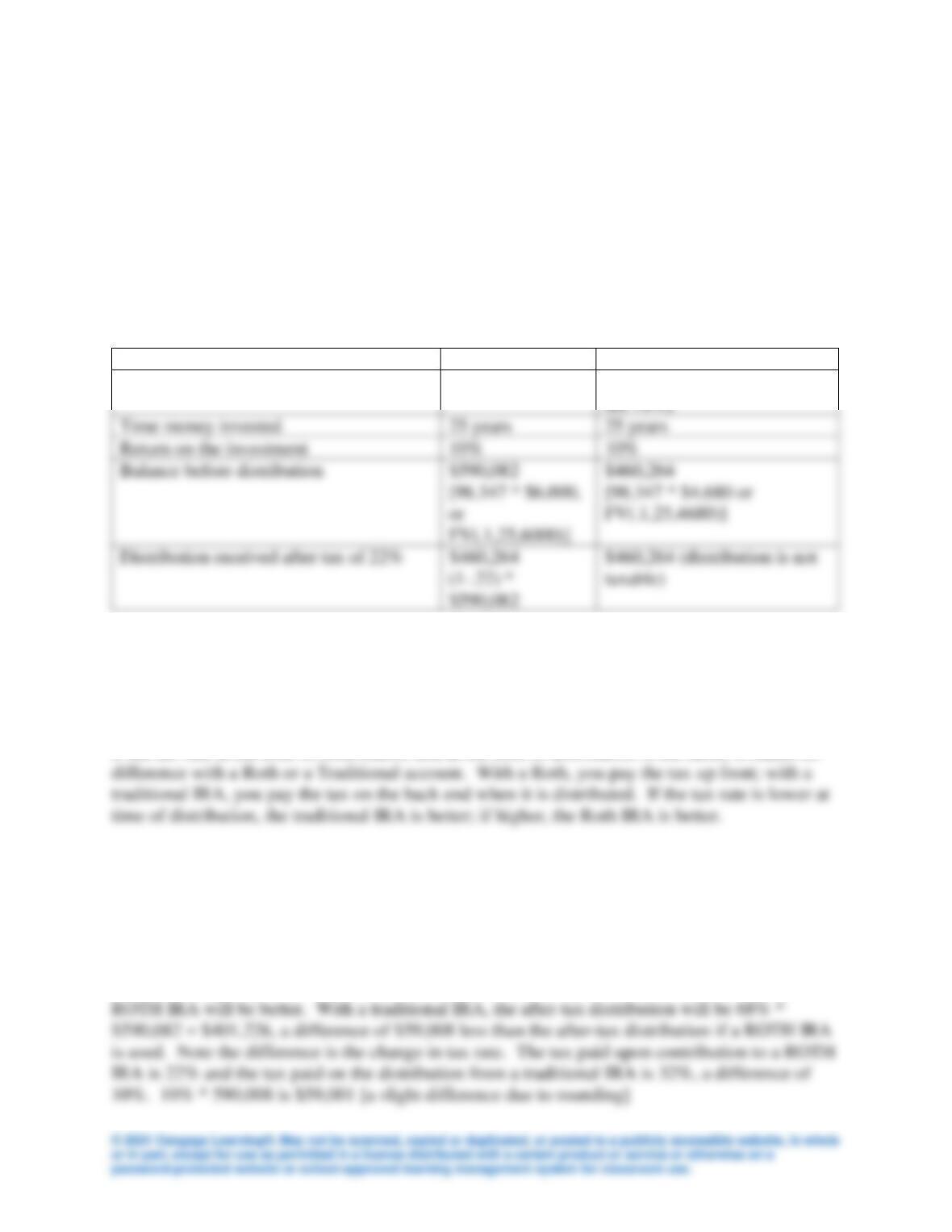
a. To support your explanation, you decide to run some comparative numbers on the two
types of accounts; for starters, use a 25-year period to show Dustin what contributions of
$6,000 per year will amount to (after 25 years), given that he can earn, say, 10 percent on
his money. Will the type of account he opens have any impact on this amount? Explain.
The following table is used for both a and b.
Traditional
Roth
Amount available to contribute
$6,000
$4,680 [tax rate is 22%, after-
Time money invested
25 years
25 years
Return on the investment
10%
10%
$590,082
b. Assuming that Dustin is in the 22 percent tax bracket (and will remain there for the next
25 years), determine the annual and total (over 25 years) tax savings that he’ll enjoy from
the $6,0,000-a-year contributions to his IRA; contrast the (annual and total) tax savings
he’d generate from a traditional IRA with those from a Roth IRA.
c. Now, fast-forward 25 years. Given the size of Dustin’s account in 25 years (as computed
in part a), assume that he takes it all out in one lump sum. If he’s still in the 32 percent tax
bracket, how much will he have, after taxes, with a traditional IRA, as compared with a
Roth IRA? How do the taxes computed here compare with those computed in part b?
Comment on your findings.
If the tax rate goes from 22% at the time of contribution to 32% at the time of distribution, the