200
Chapter 14
Capital Structure in a Perfect Market
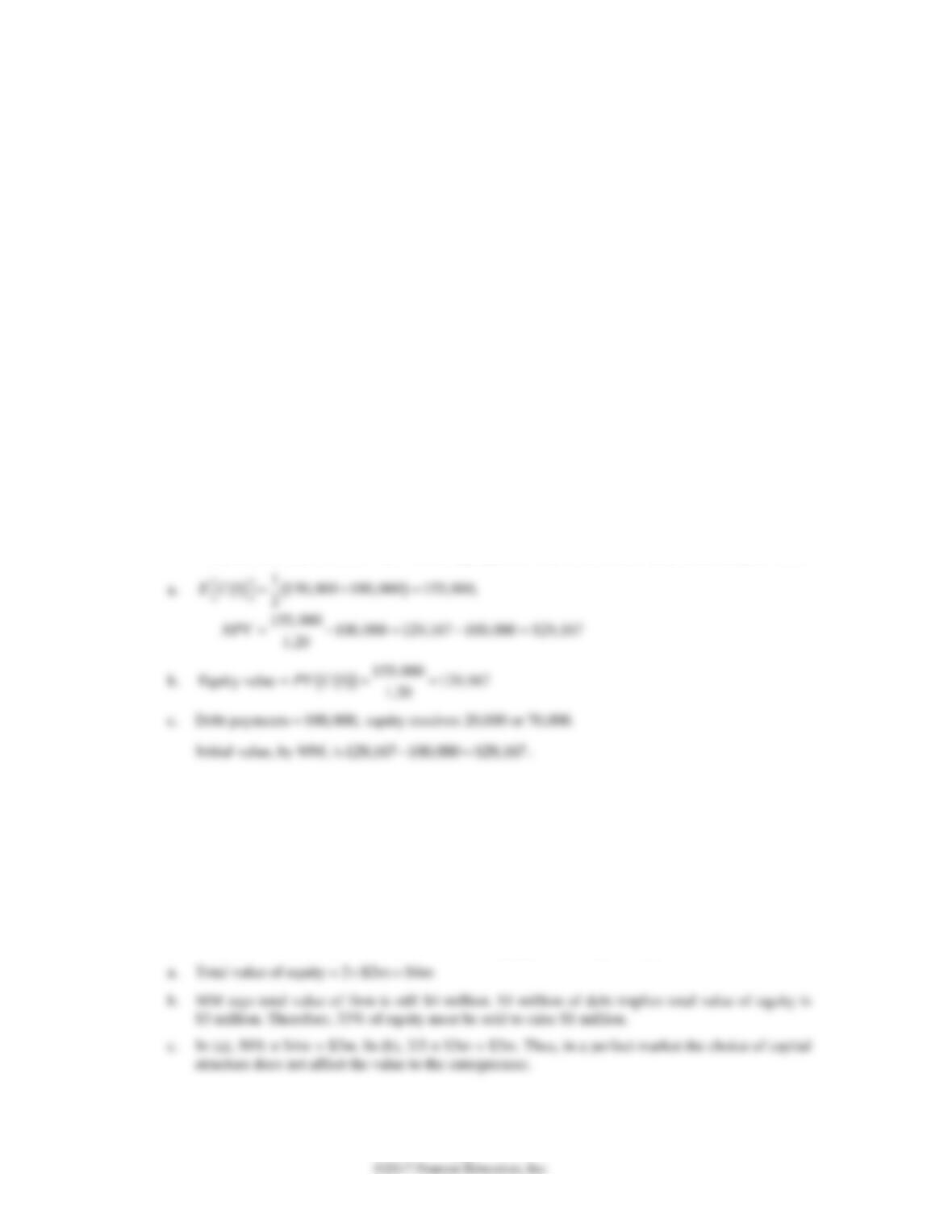
14–1. Consider a project with free cash flows in one year of $130,000 or $180,000, with each outcome
being equally likely. The initial investment required for the project is $100,000, and the project’s
cost of capital is 20%. The risk-free interest rate is 10%.
a. What is the NPV of this project?
b. Suppose that to raise the funds for the initial investment, the project is sold to investors as an
all-equity firm. The equity holders will receive the cash flows of the project in one year. How
much money can be raised in this way—that is, what is the initial market value of the
unlevered equity?
c. Suppose the initial $100,000 is instead raised by borrowing at the risk-free interest rate.
What are the cash flows of the levered equity, and what is its initial value according to MM?
14–2. You are an entrepreneur starting a biotechnology firm. If your research is successful, the
technology can be sold for $30 million. If your research is unsuccessful, it will be worth nothing.
To fund your research, you need to raise $2 million. Investors are willing to provide you with $2
million in initial capital in exchange for 50% of the unlevered equity in the firm.
a. What is the total market value of the firm without leverage?
b. Suppose you borrow $1 million. According to MM, what fraction of the firm’s equity will
you need to sell to raise the additional $1 million you need?
c. What is the value of your share of the firm’s equity in cases (a) and (b)?
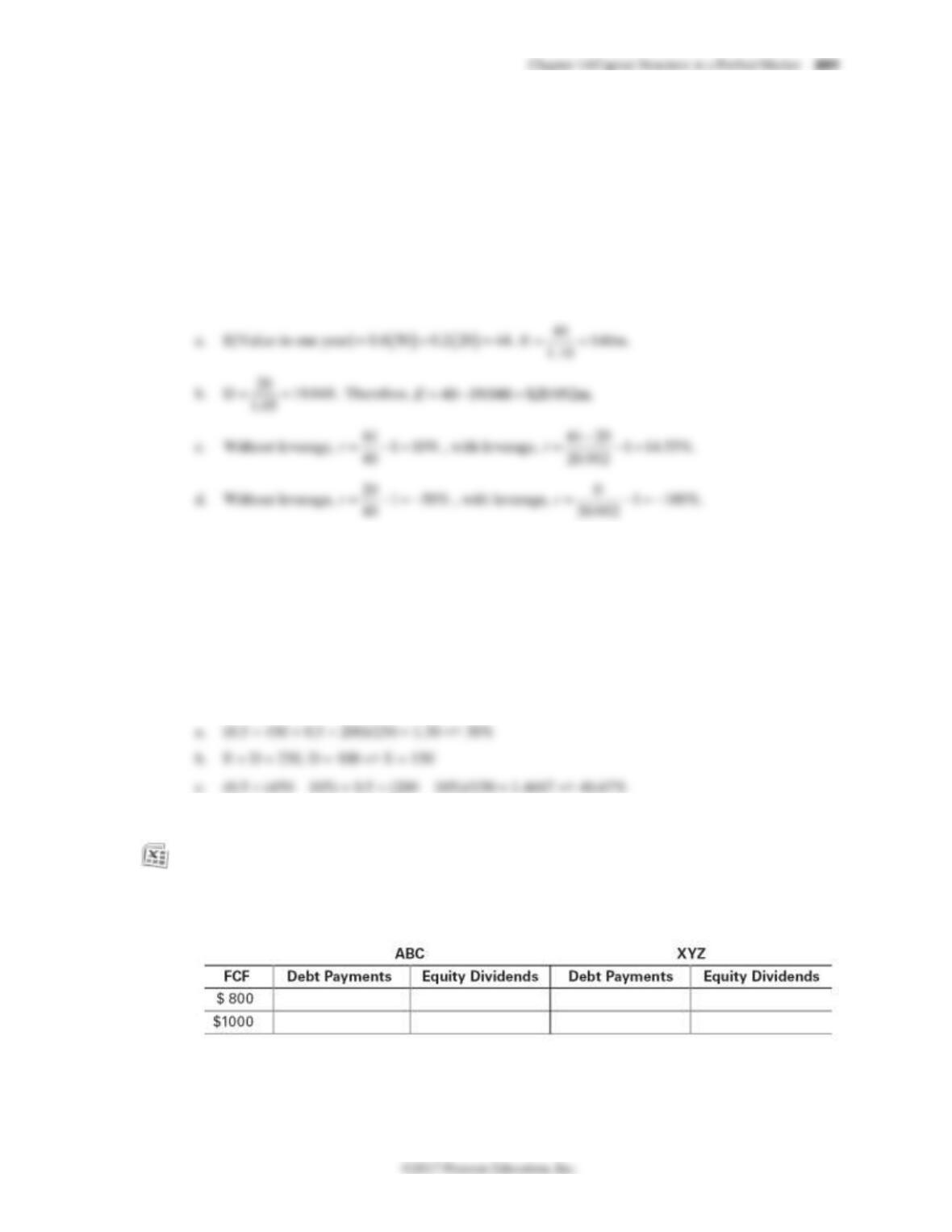
14–3. Acort Industries owns assets that will have an 80% probability of having a market value of $50
million in one year. There is a 20% chance that the assets will be worth only $20 million. The
current risk-free rate is 5%, and Acort’s assets have a cost of capital of 10%.
a. If Acort is unlevered, what is the current market value of its equity?
b. Suppose instead that Acort has debt with a face value of $20 million due in one year.
According to MM, what is the value of Acort’s equity in this case?
c. What is the expected return of Acort’s equity without leverage? What is the expected return
of Acort’s equity with leverage?
d. What is the lowest possible realized return of Acort’s equity with and without leverage?
14–4. Wolfrum Technology (WT) has no debt. Its assets will be worth $450 million in one year if the
economy is strong, but only $200 million in one year if the economy is weak. Both events are
equally likely. The market value today of its assets is $250 million.
a. What is the expected return of WT stock without leverage?
b. Suppose the risk-free interest rate is 5%. If WT borrows $100 million today at this rate and
uses the proceeds to pay an immediate cash dividend, what will be the market value of its
equity just after the dividend is paid, according to MM?
c. What is the expected return of WT stock after the dividend is paid in part (b)?
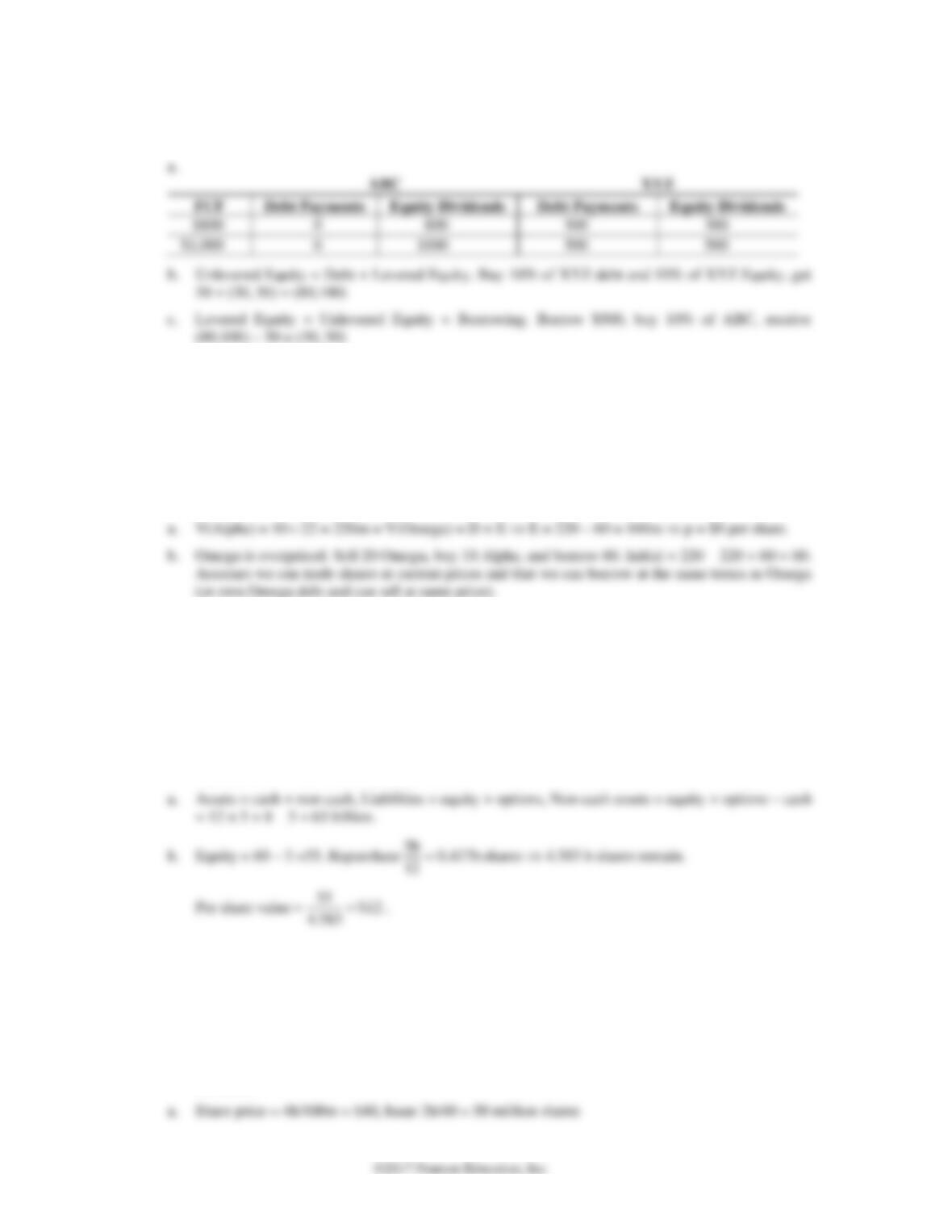
14–5. Suppose there are no taxes. Firm ABC has no debt, and firm XYZ has debt of $5000 on which it
pays interest of 10% each year. Both companies have identical projects that generate free cash
flows of $800 or $1000 each year. After paying any interest on debt, both companies use all
remaining free cash flows to pay dividends each year.
a. Fill in the table below showing the payments debt and equity holders of each firm will
receive given each of the two possible levels of free cash flows.
b. Suppose you hold 10% of the equity of ABC. What is another portfolio you could hold that
would provide the same cash flows?
202 Berk/DeMarzo, Corporate Finance, Fourth Edition
c. Suppose you hold 10% of the equity of XYZ. If you can borrow at 10%, what is an
alternative strategy that would provide the same cash flows?
14–6. Suppose Alpha Industries and Omega Technology have identical assets that generate identical
cash flows. Alpha Industries is an all-equity firm, with 10 million shares outstanding that trade
for a price of $22 per share. Omega Technology has 20 million shares outstanding as well as debt
of $60 million.
a. According to MM Proposition I, what is the stock price for Omega Technology?
b. Suppose Omega Technology stock currently trades for $11 per share. What arbitrage
opportunity is available? What assumptions are necessary to exploit this opportunity?
14–7. Cisoft is a highly profitable technology firm that currently has $5 billion in cash. The firm has
decided to use this cash to repurchase shares from investors, and it has already announced these
plans to investors. Currently, Cisoft is an all–equity firm with 5 billion shares outstanding. These
shares currently trade for $12 per share. Cisoft has issued no other securities except for stock
options given to its employees. The current market value of these options is $8 billion.
a. What is the market value of Cisoft’s non-cash assets?
b. With perfect capital markets, what is the market value of Cisoft’s equity after the share
repurchase? What is the value per share?
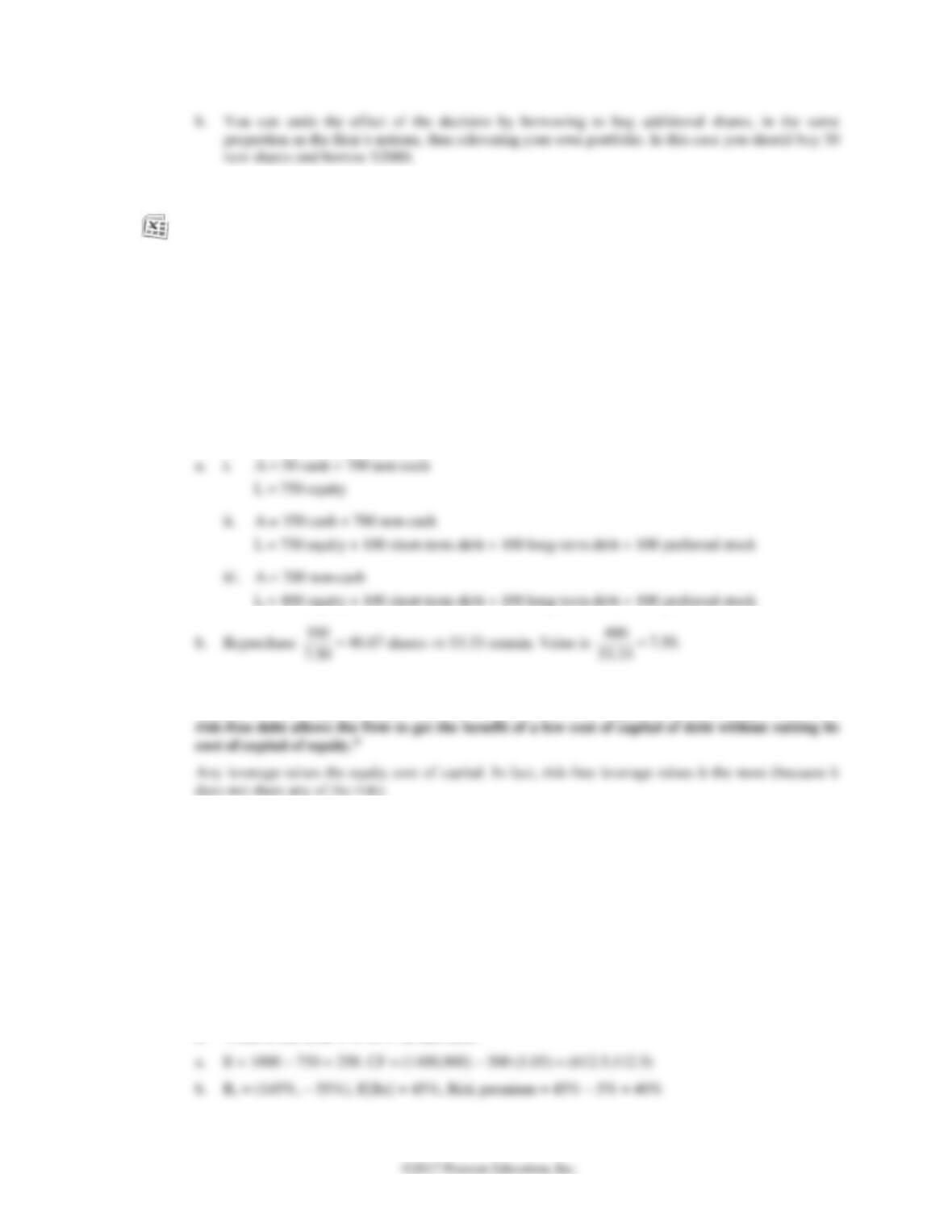
14–8. Schwartz Industry is an industrial company with 100 million shares outstanding and a market
capitalization (equity value) of $4 billion. It has $2 billion of debt outstanding. Management have
decided to delever the firm by issuing new equity to repay all outstanding debt.
a. How many new shares must the firm issue?
b. Suppose you are a shareholder holding 100 shares, and you disagree with this decision.
Assuming a perfect capital market, describe what you can do to undo the effect of this
decision.
Chapter 14/Capital Structure in a Perfect Market 203
14–9. Zetatron is an all-equity firm with 100 million shares outstanding, which are currently trading
for $7.50 per share. A month ago, Zetatron announced it will change its capital structure by
borrowing $100 million in short-term debt, borrowing $100 million in long–term debt, and
issuing $100 million of preferred stock. The $300 million raised by these issues, plus another $50
million in cash that Zetatron already has, will be used to repurchase existing shares of stock. The
transaction is scheduled to occur today. Assume perfect capital markets.
a. What is the market value balance sheet for Zetatron
i. Before this transaction?
ii. After the new securities are issued but before the share repurchase?
iii. After the share repurchase?
b. At the conclusion of this transaction, how many shares outstanding will Zetatron have, and
what will the value of those shares be?
14-10. Explain what is wrong with the following argument: “If a firm issues debt that is risk free,
because there is no possibility of default, the risk of the firm’s equity does not change. Therefore,
14-11. Consider the entrepreneur described in Section 14.1 (and referenced in Tables 14.1–14.3).
Suppose she funds the project by borrowing $750 rather than $500.
a. According to MM Proposition I, what is the value of the equity? What are its cash flows if
the economy is strong? What are its cash flows if the economy is weak?
b. What is the return of the equity in each case? What is its expected return?
c. What is the risk premium of equity in each case? What is the sensitivity of the levered equity
return to systematic risk? How does its sensitivity compare to that of unlevered equity? How
does its risk premium compare to that of unlevered equity?
d. What is the debt-equity ratio of the firm in this case?
e. What is the firm’s WACC in this case?
14-12. Hardmon Enterprises is currently an all-equity firm with an expected return of 12%. It is
considering a leveraged recapitalization in which it would borrow and repurchase existing
shares.
a. Suppose Hardmon borrows to the point that its debt-equity ratio is 0.50. With this amount of
debt, the debt cost of capital is 6%. What will the expected return of equity be after this
transaction?
b. Suppose instead Hardmon borrows to the point that its debt-equity ratio is 1.50. With this
amount of debt, Hardmon’s debt will be much riskier. As a result, the debt cost of capital
will be 8%. What will the expected return of equity be in this case?
c. A senior manager argues that it is in the best interest of the shareholders to choose the
capital structure that leads to the highest expected return for the stock. How would you
respond to this argument?
14-13. Suppose Visa Inc. (V) has no debt and an equity cost of capital of 9.2%. The average debt–to–
value ratio for the credit services industry is 13%. What would its cost of equity be if it took on
the average amount of debt for its industry at a cost of debt of 6%?
At a cost of debt of 6%:
14-14. Global Pistons (GP) has common stock with a market value of $200 million and debt with a value
of $100 million. Investors expect a 15% return on the stock and a 6% return on the debt. Assume
perfect capital markets.
a. Suppose GP issues $100 million of new stock to buy back the debt. What is the expected
return of the stock after this transaction?
b. Suppose instead GP issues $50 million of new debt to repurchase stock.
i. If the risk of the debt does not change, what is the expected return of the stock after this
transaction?
ii. If the risk of the debt increases, would the expected return of the stock be higher or
lower than in part (i)?
14-15. Hubbard Industries is an all-equity firm whose shares have an expected return of 10%. Hubbard
does a leveraged recapitalization, issuing debt and repurchasing stock, until its debt-equity ratio
is 0.60. Due to the increased risk, shareholders now expect a return of 13%. Assuming there are
no taxes and Hubbard’s debt is risk free, what is the interest rate on the debt?
14-16. Hartford Mining has 50 million shares that are currently trading for $4 per share and $200
million worth of debt. The debt is risk free and has an interest rate of 5%, and the expected
return of Hartford stock is 11%. Suppose a mining strike causes the price of Hartford stock to
fall 25% to $3 per share. The value of the risk-free debt is unchanged. Assuming there are no
taxes and the risk (unlevered beta) of Hartford’s assets is unchanged, what happens to
Hartford’s equity cost of capital?
14-17. Mercer Corp. has 10 million shares outstanding and $100 million worth of debt outstanding. Its
current share price is $75. Mercer’s equity cost of capital is 8.5%. Mercer has just announced
that it will issue $350 million worth of debt. It will use the proceeds from this debt to pay off its
existing debt, and use the remaining $250 million to pay an immediate dividend. Assume perfect
capital markets.
a. Estimate Mercer’s share price just after the recapitalization is announced, but before the
transaction occurs.
b. Estimate Mercer’s share price at the conclusion of the transaction. (Hint: use the market
value balance sheet.)
c. Suppose Mercer’s existing debt was risk-free with a 4.25% expected return, and its new debt
is risky with a 5% expected return. Estimate Mercer’s equity cost of capital after the
transaction.
14-18. In mid-2015, Qualcomm Inc. had $11 billion in debt, total equity capitalization of $89 billion,
and an equity beta of 1.43 (as reported on Yahoo! Finance). Included in Qualcomm’s assets was
$21 billion in cash and risk-free securities. Assume that the risk-free rate of interest is 3% and
the market risk premium is 4%.
a. What is Qualcomm’s enterprise value?
b. What is the beta of Qualcomm’s business assets?
206 Berk/DeMarzo, Corporate Finance, Fourth Edition
c. What is Qualcomm’s WACC?
14-19. Indell stock has a current market value of $120 million and a beta of 1.50. Indell currently has
risk-free debt as well. The firm decides to change its capital structure by issuing $30 million in
additional risk-free debt, and then using this $30 million plus another $10 million in cash to
repurchase stock. With perfect capital markets, what will be the beta of Indell stock after this
transaction?
14–20. Jim Campbell is founder and CEO of OpenStart, an innovative software company. The
company is all equity financed, with 100 million shares outstanding. The shares are trading at a
price of $1. Campbell currently owns 20 million shares. There are two possible states in on year.
Either the new version of their software is a hit, and the company will be worth $160 million, or
it will be a disappointment, in which case the value of the company will drop to $75 million. The
current risk free rate is 2%. Campbell is considering taking the company private by
repurchasing the rest of the outstanding equity by issuing debt due in one year. Assume the debt
is zero-coupon and will pay it’s face value in one year.
a. What is the market value of the new debt that must be issued?
b. Suppose OpenStart issues risk-free debt with a face value of $75 million. How much of its
outstanding equity could it repurchase with the proceeds from the debt? What fraction of
the remaining equity would Jim still not own?
c. Combine the fraction of the equity Jim does not own with the risk-free debt. What are the
payoffs of this combined portfolio? What is the value of this portfolio?
d. What face value of risky debt would have the same payoffs as the portfolio in (c)?
Chapter 14/Capital Structure in a Perfect Market 207
e. What is the yield on the risky debt in (d) that will be required to take the company private?
f. If the two outcomes are equally likely, what is OpenStart’s current WACC (before the
transaction)?
g. What is OpenStart’s debt and equity cost of capital after the transaction? Show that the
WACC is unchanged by the new leverage.
14–21. Yerba Industries is an all-equity firm whose stock has a beta of 1.2 and an expected return of
12.5%. Suppose it issues new risk-free debt with a 5% yield and repurchases 40% of its stock.
Assume perfect capital markets.
a. What is the beta of Yerba stock after this transaction?
b. What is the expected return of Yerba stock after this transaction?
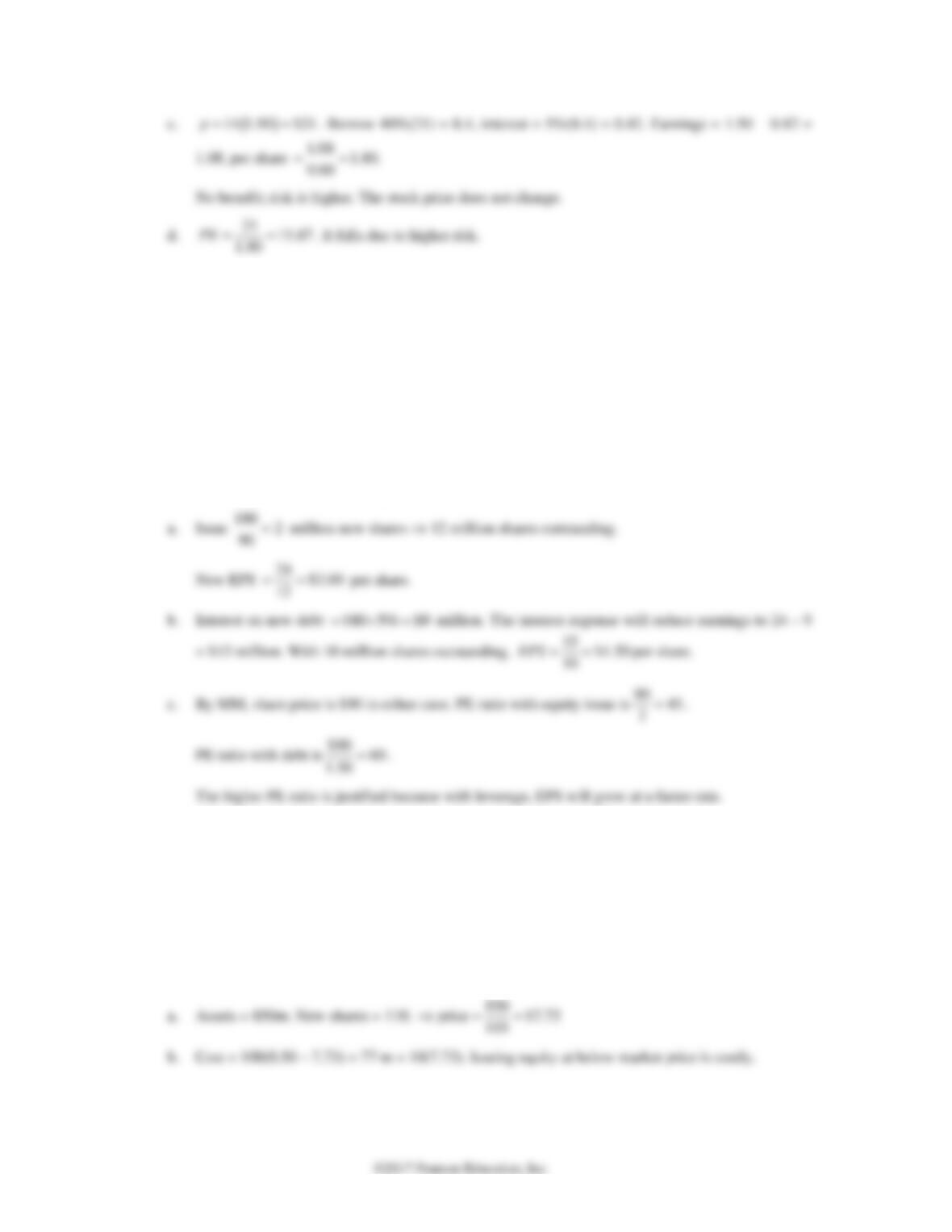
Suppose that prior to this transaction, Yerba expected earnings per share this coming year of
$1.50, with a forward P/E ratio (that is, the share price divided by the expected earnings for the
coming year) of 14.
c. What is Yerba’s expected earnings per share after this transaction? Does this change benefit
shareholders? Explain.
d. What is Yerba’s forward P/E ratio after this transaction? Is this change in the P/E ratio
reasonable? Explain.
208 Berk/DeMarzo, Corporate Finance, Fourth Edition
14–22. You are CEO of a high-growth technology firm. You plan to raise $180 million to fund an
expansion by issuing either new shares or new debt. With the expansion, you expect earnings
next year of $24 million. The firm currently has 10 million shares outstanding, with a price of
$90 per share. Assume perfect capital markets.
a. If you raise the $180 million by selling new shares, what will the forecast for next year’s
earnings per share be?
b. If you raise the $180 million by issuing new debt with an interest rate of 5%, what will the
forecast for next year’s earnings per share be?
c. What is the firm’s forward P/E ratio (that is, the share price divided by the expected
earnings for the coming year) if it issues equity? What is the firm’s forward P/E ratio if it
issues debt? How can you explain the difference?
14–23. Zelnor, Inc., is an all-equity firm with 100 million shares outstanding currently trading for $8.50
per share. Suppose Zelnor decides to grant a total of 10 million new shares to employees as part
of a new compensation plan. The firm argues that this new compensation plan will motivate
employees and is a better strategy than giving salary bonuses because it will not cost the firm
anything.
a. If the new compensation plan has no effect on the value of Zelnor’s assets, what will be the
share price of the stock once this plan is implemented?
b. What is the cost of this plan for Zelnor’s investors? Why is issuing equity costly in this case?
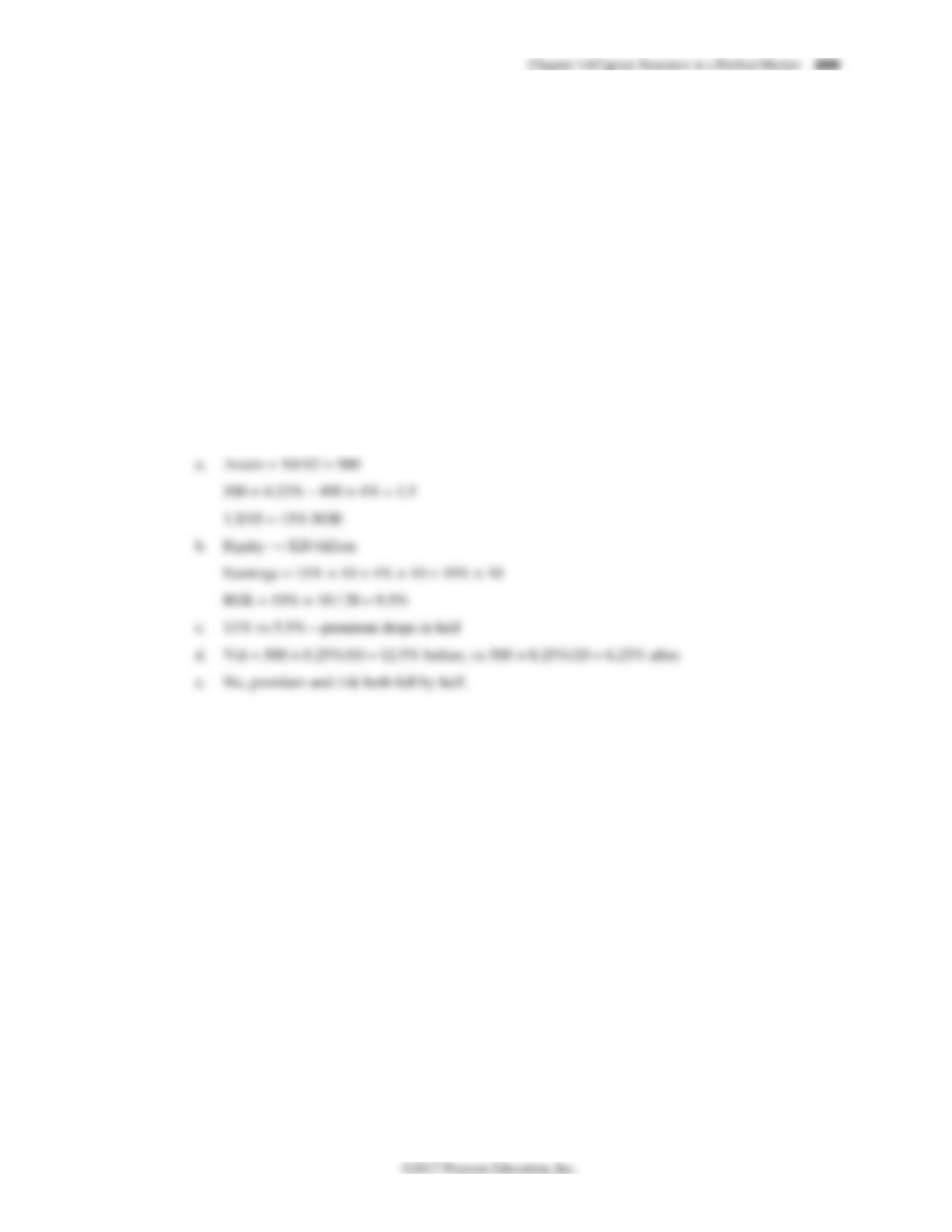
14–24. Suppose Levered Bank is funded with 2% equity and 98% debt. Its current market
capitalization is $10 billion, and its market to book ratio is 1. Levered Bank earns a 4.22%
expected return on its assets (the loans it makes), and pays 4% on its debt.
New capital requirements will necessitate that Levered Bank increase its equity to 4% of its
capital structure. It will issue new equity and use the funds to retire existing debt. The interest
rate on its debt is expected to remain at 4%.
a. What is Levered Bank’s expected ROE with 2% equity?
b. Assuming perfect capital markets, what will Levered Bank’s expected ROE be after it
increases its equity to 4%?
c. Consider the difference between Levered Bank’s ROE and its cost of debt. How does this
“premium” compare before and after the Bank’s increase in leverage?
d. Suppose the return on Levered Bank’s assets has a volatility of 0.25%. What is the volatility
of Levered Bank’s ROE before and after the increase in equity?
e. Does the reduction in Levered Bank’s ROE after the increase in equity reduce its
attractiveness to shareholders? Explain.