d. Based on the numbers you have computed as well as any other factors, what kind of IRA
would you recommend to Dustin? Explain. Would knowing that maximum contributions
are scheduled to increase to $7,000 per year make any difference in your analysis? Explain.
Since I believe that the tax rates later will not be higher for Dustin, I still think that at Traditional
13.
Comparing variable annuities and mutual funds. Explain how buying a variable
annuity is much like investing in a mutual fund. Do you, as a buyer, have any control over
the amount of investment risk to which you’re exposed in a variable annuity contract?
Explain.
With a mutual fund, the investor gives money to the mutual fund, which in turn uses that money
to buy and sell stocks and other securities. The investor pays taxes on the gains, dividends, and
interest each year. The gains and dividends are taxed as capital gains; the interest as ordinary
income.
14. Tax shelter aspects of annuities. Briefly explain how annuities are a type of tax-
sheltered investment. Do you have to give up anything to obtain this tax-favored
treatment? (Hint: Age 59½.)
With annuities, you typically give money to an insurance company (or bank or other financial
institution). That entity will invest your money and then pay you a monthly amount for a period

15. Considerations in annuity purchase. Why is it important to check an insurance
company’s financial ratings when buying an annuity? Why should you look at past
performance when considering the purchase of a variable annuity?
The annuity is a contract with an insurance company [typically]. If the insurance company
bankrupts, you are just one of the creditors. Thus, it is very important that you carefully chose
16. Fixed vs. variable annuities. What are the main differences between fixed and variable
annuities? Which type is more appropriate for someone who is 60 years old and close to
retirement?
In a fixed-rate annuity, the insurance company safeguards your principal and agrees to pay a
guaranteed minimum rate of interest over the life of the contract—which often amounts to little
more than prevailing money market rates existing when you bought the contract.
Test Yourself
14-1 Discuss the relationship of retirement planning to financial planning. Do investment
and tax planning have a role in retirement planning?
The financial planning process would be incomplete without retirement planning. Arguably no
financial goal is more important than achieving a comfortable standard of living in retirement. In
many respects, retirement planning is financial planning.
14-2 Identify and briefly discuss the three biggest mistakes people tend to make when
setting up retirement programs.
When it comes to retirement planning, people tend to make three big mistakes:
• Starting too late.
Many people in their 20s, or even their 30s, find it hard to put money away for retirement. Most
14-3 How do income needs fit into the retirement planning process?
Both your personal budget and the general state of the economy will change over time which
makes accurate forecasting of retirement needs difficult at best. Two ways to approach the
forecasting problem. One is to state your retirement income objectives as a percentage of your
14-4 What are the most important sources of retirement income?
plans. Next in line is the contributions you make to a 401(k) or other tax deferred account.
14-5 What benefits are provided under the Social Security Act, and who is covered?
There are three basic benefits:
Disability income: If you become disable you can receive social security benefits in the same
14-6 What is the earnings test, and how does it affect Social Security retirement benefits?
Social Security benefits are based upon the level of income on which you paid taxes. The
maximum salary subject to tax for 2020 is $137,700. The maximum level changes each year.
14-7 Does Social Security coverage relieve you of the need to do some retirement planning
on your own?
Social Security was designed to be a supplement to other retirement income. If all you receive is
14-8 Which basic features of employer-sponsored pension plans should you be familiar
with?
An employee should be familiar with the following features of an employer-sponsored pension
plan:
a. Participation requirements are the eligibility criteria for participation. Most common
are requirements relating to years of service, minimum age, level of earnings, and employee
14-9 Under which procedure will you become fully vested most quickly—cliff or graded
vesting?
Cliff vesting, requires full vesting after no more than three years of service—but you obtain no
vesting privileges until then.
14-10 What is the difference between a profit-sharing plan and a salary reduction, or
401(k), plan?
A profit-sharing plan may be qualified under the IRS and become eligible for essentially the
same tax treatment as other types of pension plans. An argument supporting the use of profit-
sharing plans is that they encourage employees to work harder because the employees benefit
when the firm prospers. From the firm’s perspective, a big advantage of profit-sharing plans is
that they impose no specific levels of contribution or benefits by the employer. When profits are
low, the firm makes smaller contributions to the plan, and when profits are high, it pays more.
14-11 Why is it important to evaluate and become familiar with the pension plans and
retirement benefits offered by your employer?
When participating in a company-sponsored pension plan, you’re entitled to certain benefits in
14-12 Briefly describe the tax provisions of 401(k) plans and Keogh plans.
The tax law generally treats qualified plans the same. The basic feature is the contributions to
the plan are not subject to tax, that is either they are excluded if contributed by the employer or
14-13 Describe and differentiate between Keogh plans and individual retirement
arrangements. What’s the difference between a nondeductible IRA and a Roth IRA?
Keogh and IRAs are very similar. The major difference is the limit on the amount that may be
contributed to the plan. Keoghs are limited to $57,000 or 25% of income in 2020 [limit changes
yearly]. IRAs are limited to $6,000 per year [$7,000 for taxpayers over 50].
14-14 Under what circumstances would it make sense to convert your traditional IRA to a
Roth IRA?
The decision to convert depends upon the applicable tax rate: the current tax rate is compared to
14-15 What is an annuity? Briefly explain how an annuity works and how it differs from a
life insurance policy.
An annuity is the systematic liquidation of an estate [a distribution of funds from the estate or
other source] in such a way that it provides protection against the economic difficulties that
14-16 Which one of the annuity distribution procedures will result in the highest monthly
benefit payment?
The three options are life annuity, life annuity with refund, and annuity certain. The largest
14-17 What is a fixed-rate annuity, and how does it differ from a variable annuity?
A fixed rate annuity is an annuity in which the insurance company safeguards your principal and
Does the type of contract (fixed or variable) have any bearing on the amount of money
you’ll receive at the time of distribution?
Yes. In periods when the market is bullish, the variable annuity will payout more than the fixed
14-18 Which type of contract (fixed or variable) might be most suitable for someone who
wants a minimum amount of risk exposure?
The fixed annuity is less risky than a variable annuity. And you will most likely get less.
14-19 How do variable annuity returns generally compare to mutual fund returns? Can
you explain why there would be any difference in returns?
The average returns on variable annuities are usually lower than the average returns on mutual
funds. The major cause of such differences in performance is the much higher costs associated
Critical Thinking Cases
14.1 Comparing Pension Plan Features
Patricia Little and Brandi Wheeler are neighbors in Reston, Virginia. Patricia works as a
software engineer for Progressive Apps Corporation, while Brandi works as an executive
for an industrial packaging company. Both are married, have two children, and are well
paid. Patricia and Brandi are interested in better understanding their pension and
retirement plans.
Critical Thinking Questions
1. Discuss and contrast the features of the retirement plans offered by Patricia and
Brandi’s companies.
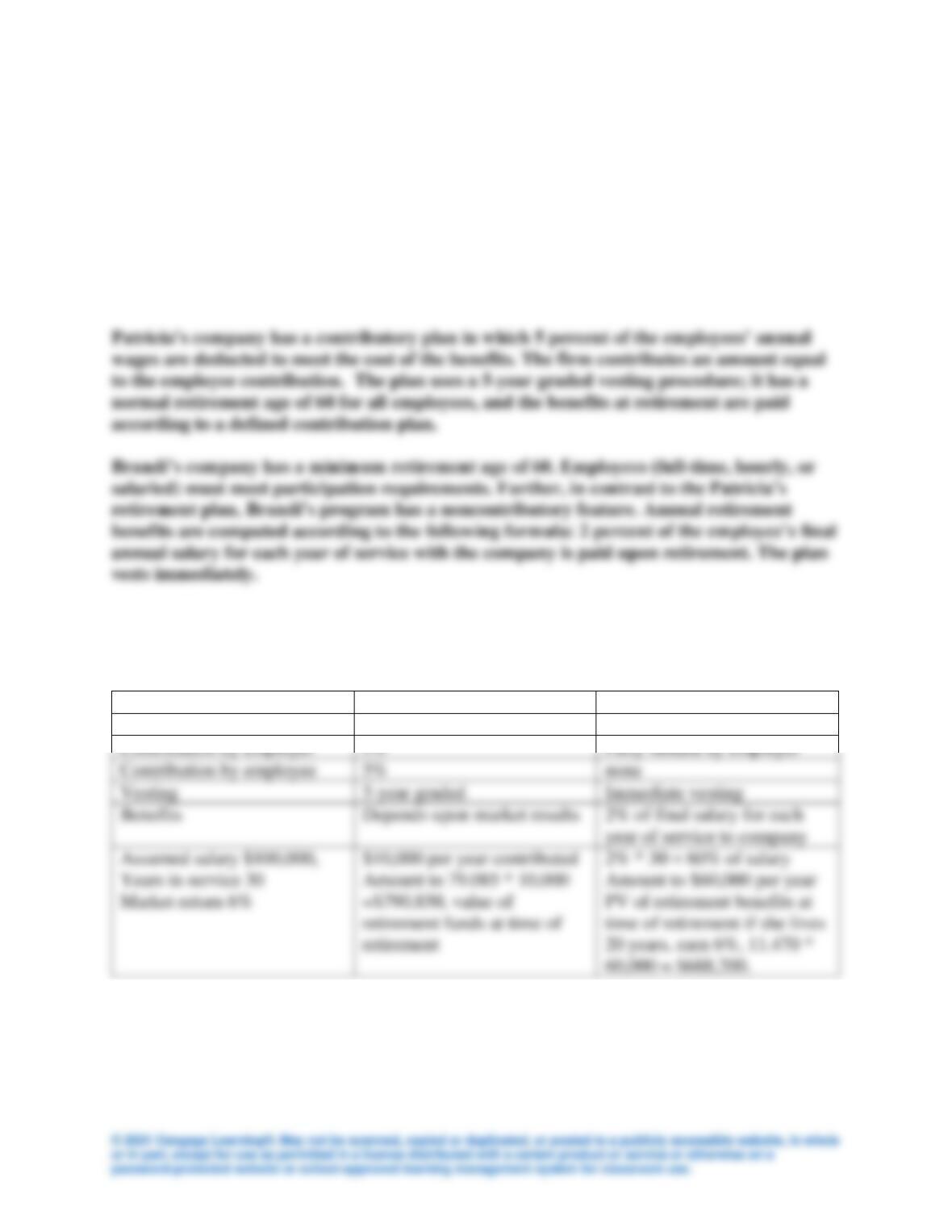
Plan feature
Patricia
Brandi
Type of Plan
Defined Contribution
Define Benefit
Contribution by employer
5%
Fully funded by employer
Contribution by employee
5%
none
Vesting
5-year graded
Immediate vesting
year of service to company
The plans are examples of the two major types of plans. If make assumptions in last row of table
above, the plans will yield somewhat similar benefits. The defined contribution plan has a larger
present value, but there is more risk to the employee. If the market does not perform at the 6%
level, the amount available for retirement will be less. The defined benefit plan is more certain
but total amount received depends upon life expectancy.

2. Which plan do you think is more desirable? Consider the features, retirement age, and
benefit computations just described. Which plan do you think could be subject to a
conversion to a cash balance plan sometime in the future? Explain. Include in your answer
the implications for the employee’s future retirement benefits.
As above, the defined contribution plan has a larger present value and a greater risk. The option
3. Explain how you would use each of these plans in developing your own retirement
program.
The defined contribution gives the employee more control over their benefits along with more
risk. When you are 50 years old and have a balance of $500,000 in a retirement plan, if the
4. What role, if any, could annuities play in these retirement programs? Discuss the pros
and cons of using annuities as a part of retirement planning.
Most likely when employee reaches retirement age, the retirement funds will be converted to an
14.2 Evaluating Felicia Garza’s Retirement Prospects
Felicia Garza is 57 years old and has been widowed for 13 years—in addition to raising her
two children, the youngest of whom is now finishing college. After being forced to go back
to work in her 40s, Felicia’s obtained a supervisory position in the personnel department of
a major corporation, where she’s now earning $85,000 a year.
Although her financial focus for the past 13 years has, of necessity, been on meeting living
expenses and getting her kids through college, she feels that now she can turn her attention
to her retirement needs. Felicia has accumulated the following investment assets:
Critical Thinking Questions
1. After taking into account the income that Felicia will receive from Social Security and
her company-sponsored pension plan, the financial planner has estimated that her
investment assets will need to provide her with about $25,000 a year to meet the balance of
her retirement income needs. Assuming a 6 percent after-tax return on her investments,
how big a nest egg will Felicia need to earn that kind of income?
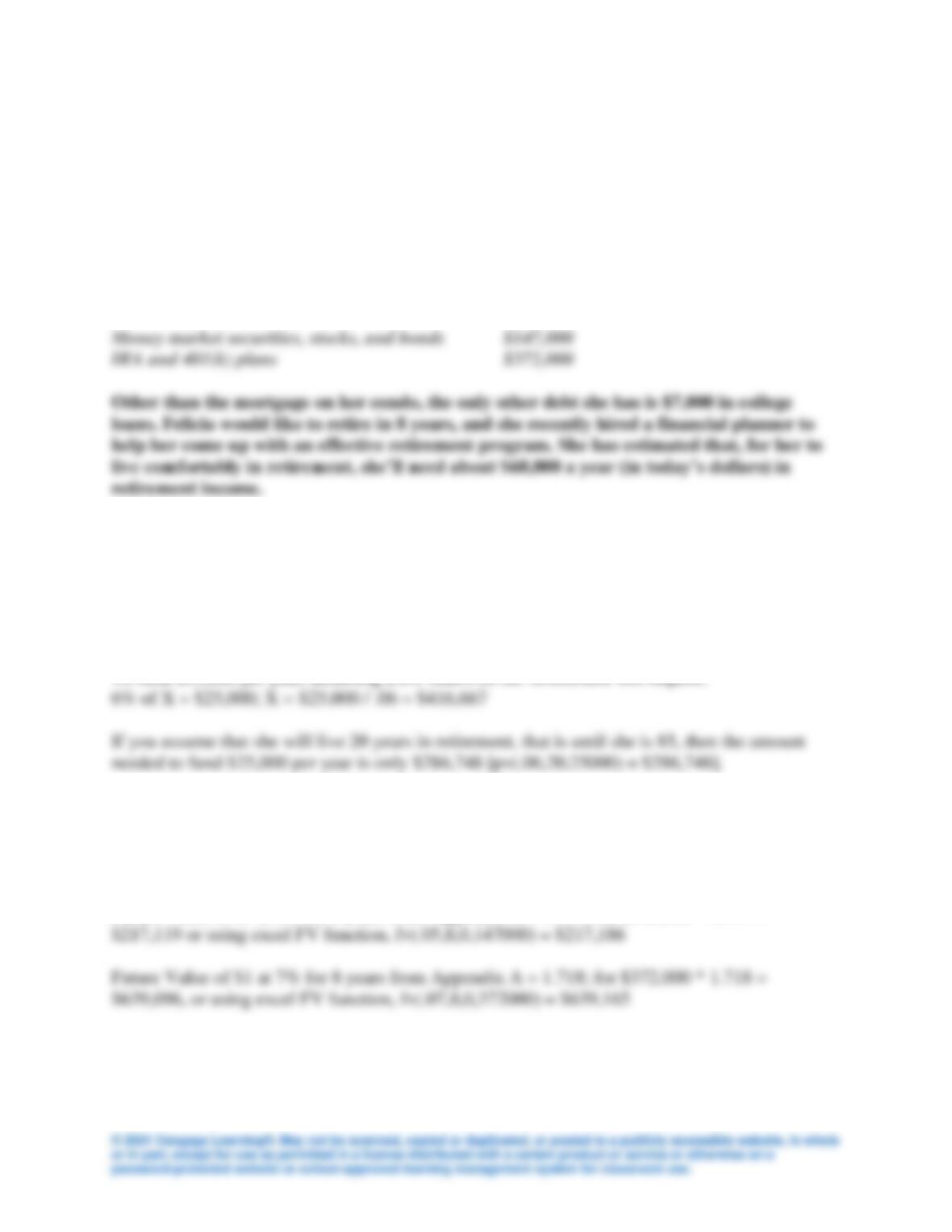
2. Suppose she can invest the money market securities, stocks, and bonds (the $147,000) at
5 percent after taxes and can invest the $372,000 accumulated in her tax-sheltered IRA and
401(k) at 7 percent. How much will Felicia’s investment assets be worth in eight years,
when she retires?
Future Value of $1 at 5% for 8 years from Appendix A = 1.477; for $147,000 * 1.477 =
3. If Felicia continues to put $10,000 a year into her 401(k) program, how much more will
she have in 8 years, given a 7 percent rate of return?
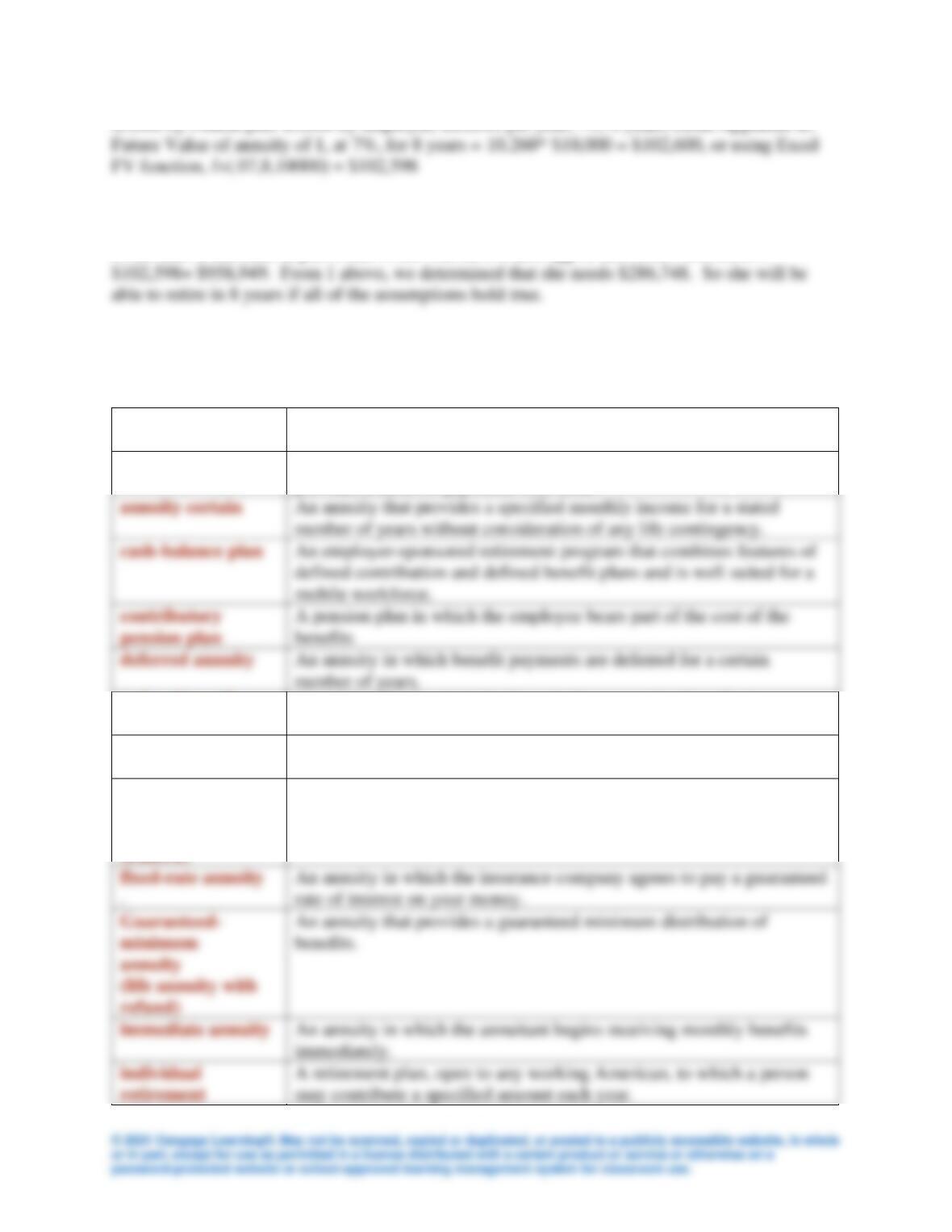
4. What would you advise Felicia about her ability to retire in 8 years, as she hopes to?
From sum of amounts in part 2 and 3, she will have a nest egg of $217,186+ $639,165+
Key Terms
accumulation
period
The period during which premiums are paid for the purchase of an
annuity.
annuity
provides a series of payments over time.
annuity certain
An annuity that provides a specified monthly income for a stated
number of years without consideration of any life contingency.
cash-balance plan
An employer-sponsored retirement program that combines features of
defined contribution and defined benefit plans and is well suited for a
mobile workforce.
contributory
pension plan
A pension plan in which the employee bears part of the cost of the
benefits
deferred annuity
An annuity in which benefit payments are deferred for a certain
number of years.
An investment product created by life insurance companies that
defined benefit
plan
A pension plan in which the formula for computing benefits is
stipulated in its provisions.
distribution period
The period during which annuity payments are made to an annuitant.
Employee
Retirement Income
Security Act
(ERISA)
fixed-rate annuity
An annuity in which the insurance company agrees to pay a guaranteed
rate of interest on your money.
minimum
annuity
(life annuity with
refund)
benefits.
immediate annuity
An annuity in which the annuitant begins receiving monthly benefits
immediately.
A law passed in 1974 to ensure that workers eligible for pensions
actually receive such benefits; also permits uncovered workers to
establish individual tax sheltered retirement plans.
installment
premium annuity
contract
An annuity contract purchased through periodic payments made over
time.
Keogh plan
An account to which self-employed persons may make specified
payments that may be deducted from taxable income; earnings also
accrue on a tax-deferred basis.
life annuity, period
certain
A type of guaranteed-minimum annuity that guarantees the annuitant a
stated amount of monthly income for life; the insurer agrees to pay for
a minimum number of years.
life annuity with no
refund (pure life)
An option under which an annuitant receives a specified amount of
income for life, regardless of the length of the distribution period.
noncontributory
pension plan
A pension plan in which the employer pays the total cost of the
benefits.
Nondeductible
(after-tax) IRA
An IRA with contributions from after-tax income, the contribution is
not deductible. The distributions sourced to the contributions are not
subject to tax, but the distributions sourced to the earnings are taxable.
Pension
Protection Act
integrity of private traditional (defined benefit) plans and, at the same
time, to encourage employees to make greater use of salary reduction
(defined contribution) plans.
profit-sharing plan
An arrangement in which the employees of a firm participate in the
refund annuity
A guaranteed-minimum annuity that, on the annuitant’s death, makes
is refunded.
salary reduction,
or 401(k), plan
An agreement by which part of a covered employee’s pay is withheld
and invested in some form
of investment; taxes on the contributions and the account earnings are
deferred until the funds are withdrawn.
single premium
annuity contract
An annuity contract purchased with a lump sum payment
survivorship
benefit
thrift and
savings plan
A plan to supplement pension and other fringe benefits; the firm
contribution.
Traditional
(deductible) IRA
An IRA that is deductible in determining taxable income, thus
contributions are from before-tax income. The total distributions from
the IRA are taxable when made.
as a function of the insurer’s actual investment experience.
On an annuity, the portion of premiums and interest that has not been
returned to the annuitant before his or her death.

vested rights
Employees’ non-forfeitable rights to receive benefits in a pension plan
based on their own and their employer’s contributions.
Planning for Retirement
Chapter Outline
Learning Goals
I. An Overview of Retirement Planning
A. Role of Retirement Planning in Personal Financial Planning
B. The Three Biggest Pitfalls to Sound Retirement Planning
1. Compounding the Errors
II. Social Security
A. Coverage
B. Social Security Payroll Taxes
C. Social Security Retirement Benefits
1. Old-Age Benefits
III. Pension Plans and Retirement Programs
A. Employer-Sponsored Programs: Basic Plans
1. Participation Requirements
D. Self-Directed Retirement Programs
1. Keogh and SEP Plans
2. Individual Retirement Account (IRAs)
3. Self-Directed Accounts and Their Investment Vehicles

IV. Annuities
A. Classification of Annuities
1. Single Premium or Installments
2. Disposition of Proceeds