a. 2. The terms “irrelevance,” “bird–in-the-hand,” and “tax effect” have been used to
describe three major theories regarding the way dividend payouts affect a firm’s
value. Explain what these terms mean, and briefly describe each theory.
Answer: Dividend irrelevance refers to the theory that investors are indifferent between
dividends and capital gains, making dividend policy irrelevant with regard to its effect
on the value of the firm. “Bird-in-the-hand” refers to the theory that a dollar of
dividends in the hand is preferred by investors to a dollar retained in the business, in
which case dividend policy would affect a firm’s value.
The dividend preference, or “bird–in-the-hand” theory is identified with Myron
Gordon and John Lintner, who argued that investors perceive a dollar of dividends in
the hand to be less risky than a dollar of potential future capital gains in the bush; hence,
stockholders prefer a dollar of actual dividends to a dollar of retained earnings. In
addition, high payouts mitigate agency costs by depriving managers of cash to waste
and by causing companies to go to the external capital markets more often (which leads
to greater scrutiny and less misuse of resources by managers). If the bird-in-the-hand
theory is true, then investors would regard a firm with a high payout ratio as being less
risky than one with a low payout ratio, all other things equal; hence, firms with high
a. 3. What do the three theories indicate regarding the actions management should
take with respect to dividend payout?
Answer: If the dividend irrelevance theory is correct, then dividend payout is of no consequence,
a. 4. What results have empirical studies of the dividend theories produced? How does
all this affect what we can tell managers about dividend payouts?
Answer:
Unfortunately, empirical tests of the theories have been mixed (because firms don’t
differ just with respect to payout).
Some evidence shows that high payout firms have higher required stock return,
which supports the tax effect theory.
Research shows that in countries with relatively low dividend tax penalties: (1)
b. Discuss the effects on distribution policy consistent with: (1) the signaling
hypothesis (also called the information content hypothesis) and (2) the clientele
effect.
Answer: 1. It has long been recognized that the announcement of a dividend increase often
results in an increase in the stock price, while an announcement of a dividend cut
typically causes the stock price to fall. One could argue that this observation
supports the premise that investors prefer dividends to capital gains. However, MM
argued that dividend announcements are signals through which management
conveys information to investors. Information asymmetries exist—managers know
more about their firms’ prospects than do investors. Further, managers tend to raise
dividends only when they believe that future earnings can comfortably support a
higher dividend level, and they cut dividends only as a last resort. Therefore, (1) a
larger-than-normal dividend increase “signals” that management believes the future
is bright, (2) a smaller-than-expected increase, or a dividend cut, is a negative
signal, and (3) if dividends are increased by a “normal” amount, this is a neutral
signal.
3. Clienteles do exist, but the real question is whether there are more members of one
clientele than another, which would affect what a change in its dividend policy
would do to the demand for the firm’s stock. There are also costs (taxes and
brokerage) to stockholders who would be forced to switch from one stock to another
if a firm changes its policy. Therefore, we cannot say whether a policy change to
appeal to one particular clientele or another would lower or raise a firm’s cost of
c. 1. Assume that IWT has a $112.5 million capital budget planned for the coming year.
You have determined its present capital structure (80% equity and 20% debt) is
optimal, and its net income is forecasted at $140 million. Use the residual
distribution model approach to determine IWT’s total dollar distribution. Assume
for now that the distribution is in the form of a dividend. IWT has 100 million
shares. What is the forecasted dividend payout ratio? What is the forecasted
dividend per share? What would happen to the payout ratio and DPS if net income
were forecasted to decrease to $90 million? To increase to $160 million?
Answer: We make the following points:
a. Given the optimal capital budget and the target capital structure, we must now
determine the amount of equity needed to finance the projects. Of the $112.5
million required for the capital budget, 0.8($112.5) = $90 million must be raised as
equity and 0.2($112.5) = $22.5 million must be raised as debt if we are to maintain
the optimal capital structure:
c. 2. In general terms, how would a change in investment opportunities affect the
payout ratio under the residual payment policy?
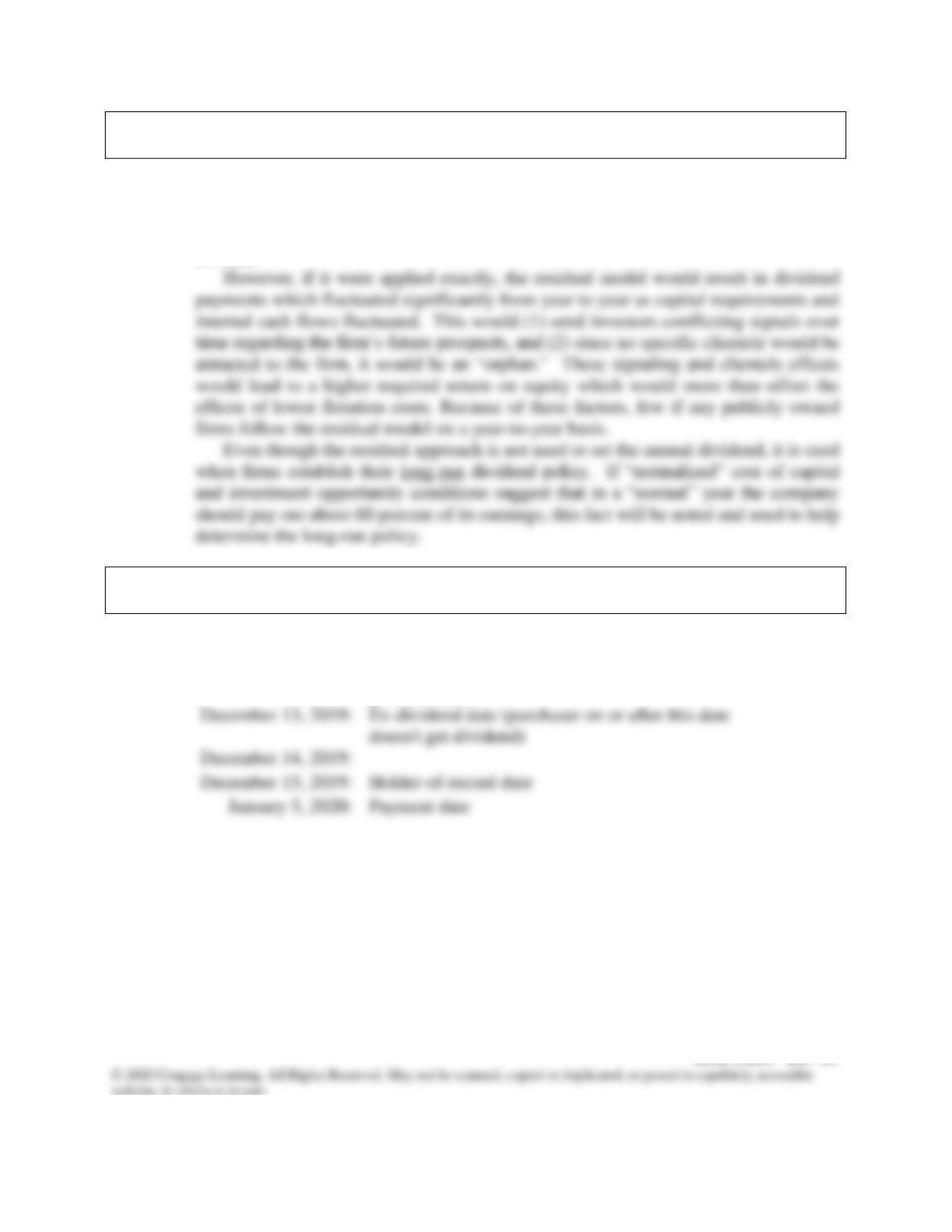
Answer: A change in investment opportunities would lead to an increase (if investment
opportunities were good) or a decrease (if investment opportunities were not good) in
c. 3. What are the advantages and disadvantages of the residual policy? (Hint: don’t
neglect signaling and clientele effects.)
Answer: The primary advantage of the residual policy is that under it the firm makes maximum
use of lower cost retained earnings, thus minimizing flotation costs and hence the cost
of capital. Also, whatever negative signals are associated with stock issues would be
avoided.
d. 1. Describe the procedures a company follows when it make a distribution through
dividend payments.
Answer:
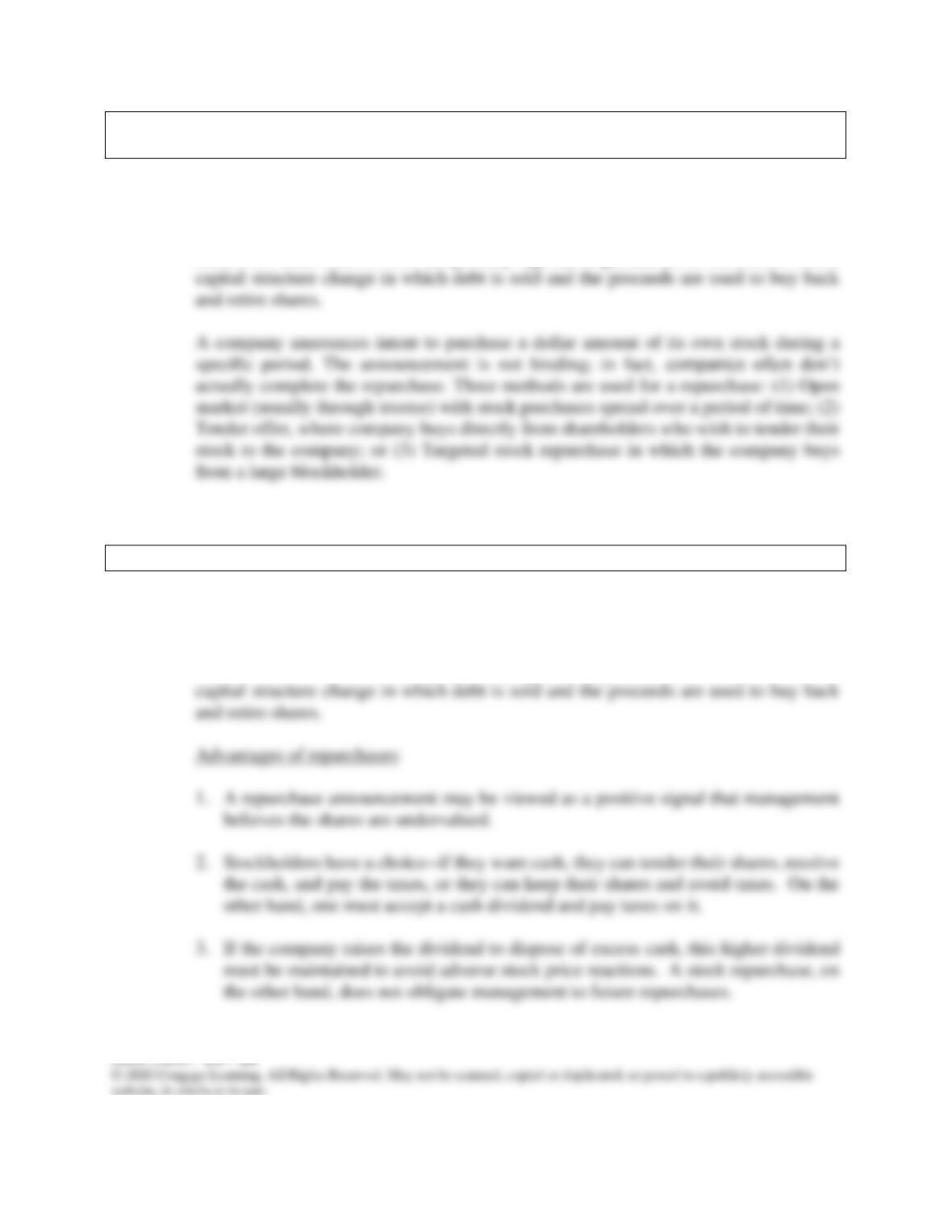
November 16, 2019:
Declaration date
December 12, 2019:
Dividend goes with stock (owner on this day will
get dividend)
December 13, 2019:
doesn’t get dividend)
Holder-of-record date
Payment date
d. (2) What is a stock repurchase? Describe the procedures a company follows when it
make a distribution through a stock repurchase.
Answer: A firm may distribute cash to stockholders by repurchasing its own stock rather than
paying out cash dividends. Stock repurchases can be used (1) somewhat routinely as
an alternative to regular dividends, (2) to dispose of excess (nonrecurring) cash that
came from asset sales or from temporarily high earnings, and (3) in connection with a
e. Discuss the advantages and disadvantages of a firm’s repurchasing its own shares.
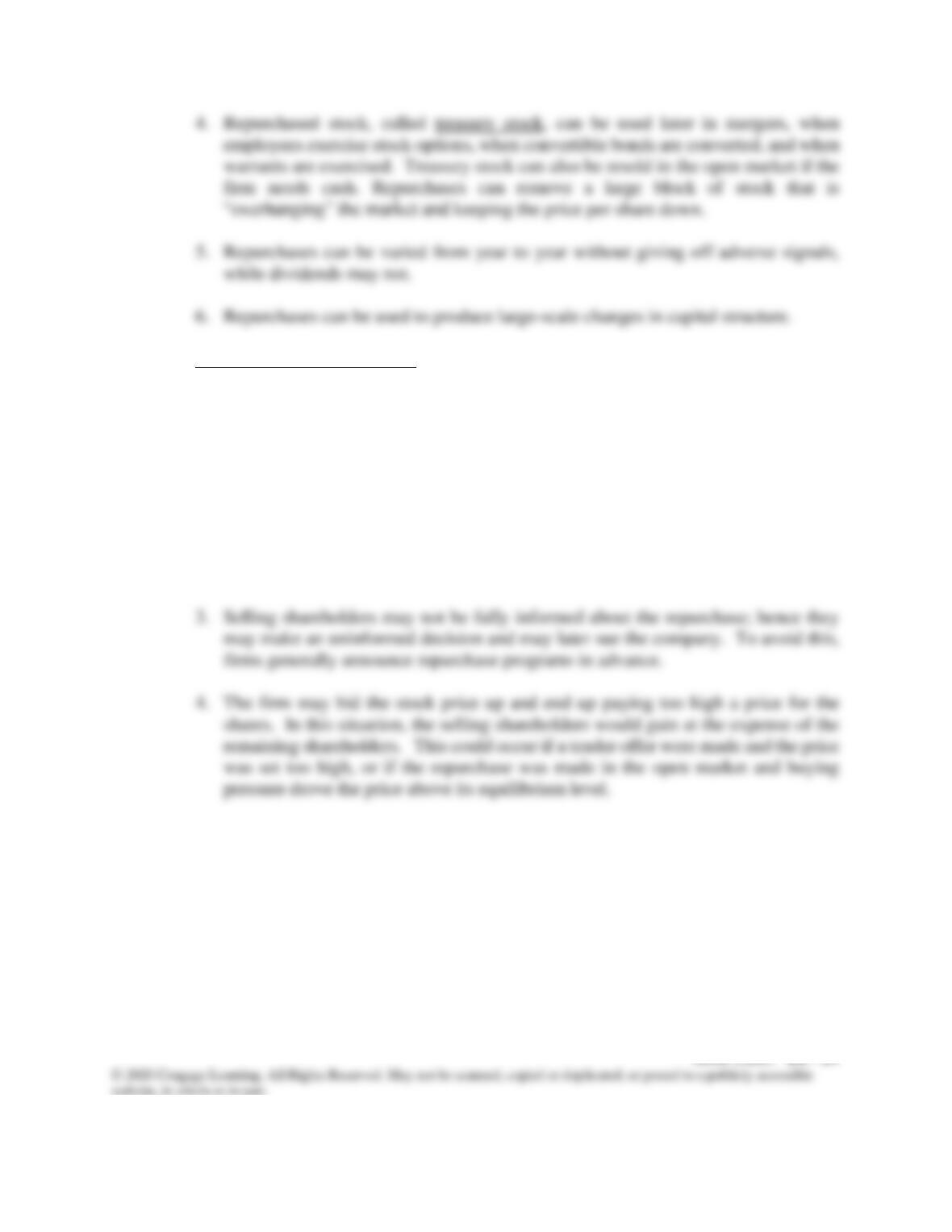
Answer: A firm may distribute cash to stockholders by repurchasing its own stock rather than
paying out cash dividends. Stock repurchases can be used (1) somewhat routinely as
an alternative to regular dividends, (2) to dispose of excess (nonrecurring) cash that
came from asset sales or from temporarily high earnings, and (3) in connection with a
Disadvantages of repurchases:
1. A repurchase could lower the stock’s price if it is taken as a signal that the firm has
relatively few good investment opportunities. On the other hand, though, a
repurchase can signal stockholders that managers are not engaged in “empire
building,” where they invest funds in low-return projects.
2. If the IRS establishes that the repurchase was primarily to avoid taxes on dividends,
then penalties could be imposed. Such actions have been brought against closely
held firms, but to our knowledge charges have never been brought against publicly
held firms.
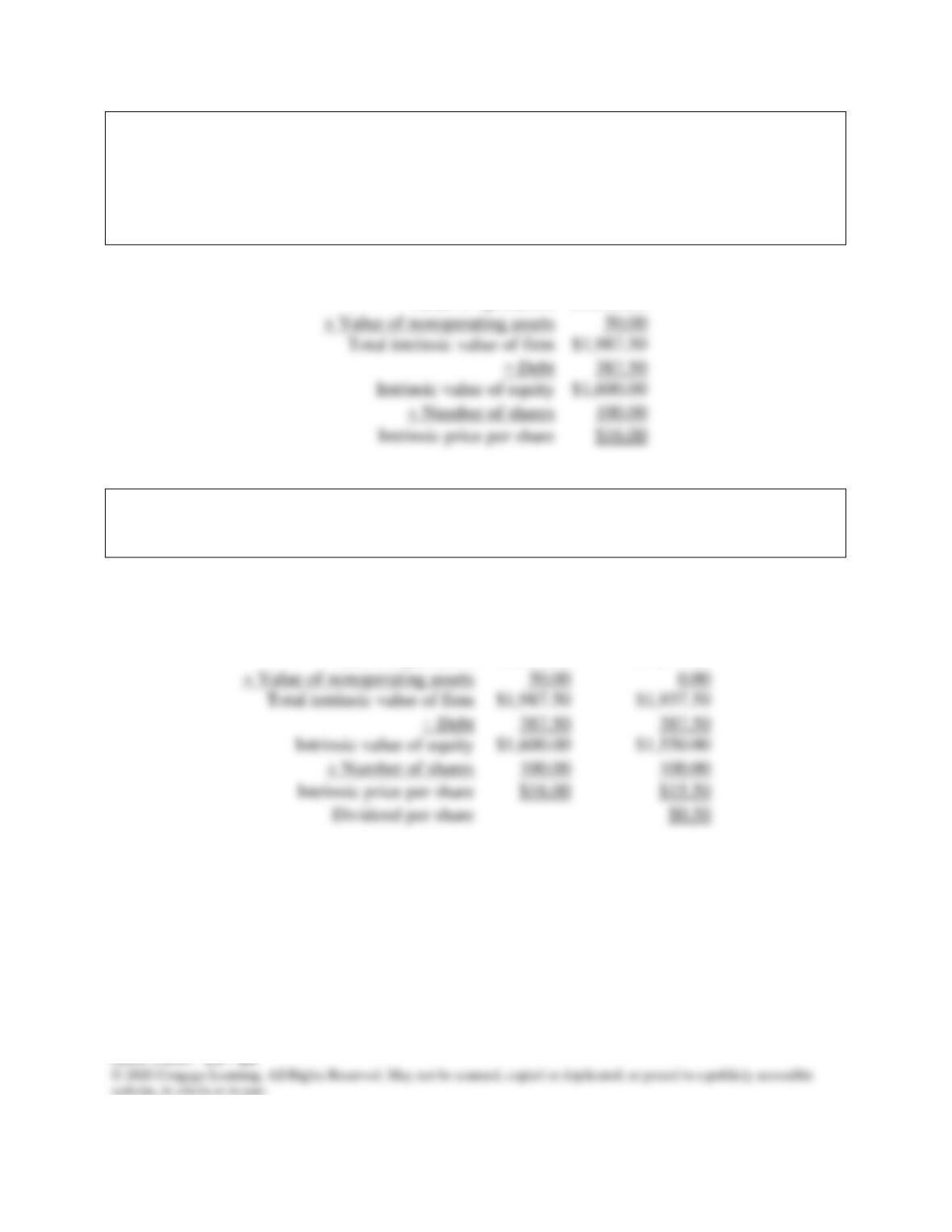
f. 1. Suppose IWT has decided to distribute $50 million, which it presently is holding
in very liquid short-term investments. IWT’s value of operations is estimated to
be about $1,937.5 million. IWT has $387.5 million in debt (it has no preferred
stock). As mentioned previously, IWT has 100 million shares of stock outstanding.
Assume that IWT has not yet made the distribution. What is IWT’s intrinsic value
of equity? What is its intrinsic per share stock price?.
Answer:
Value of operations
$1,937.50
$1,987.50
$1,600.00
f. (2) Now suppose that IWT has just made the $50 million distribution in the form of
dividends. What is IWT’s intrinsic value of equity? What is its intrinsic per share
stock price?
Answer:
Before
After Dividend
Value of operations
$1,937.50
$1,937.50
$1,987.50
$1,937.50
387.50
$1,600.00
$1,550.00
÷ Number of shares
100.00
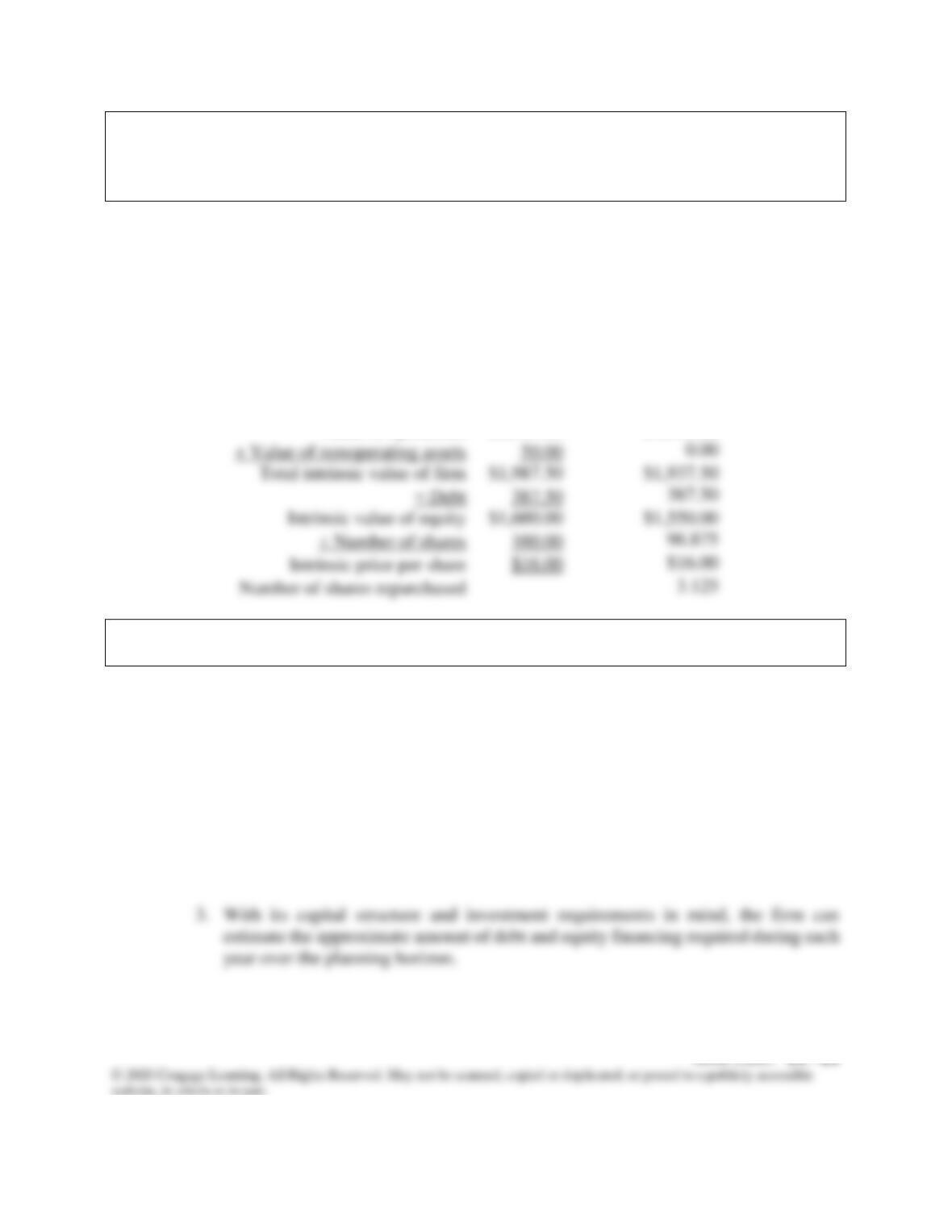
f. (3) Suppose instead that IWT has just made the $50 million distribution in the form
of a stock repurchase. Now what is IWT’s intrinsic value of equity? How many
shares did IWT repurchase? How many shares remained outstanding after the
repurchase? What is its intrinsic per share stock price after the repurchase?
Answer:
nPost = nPrior − (CashRep/PPrior)
nPost = 100 − ($50/$16)
nPost = 100 − 3.125 = 96.875
Before
After Repurchase
Value of operations
$1,937.50
$1,937.50
$1,987.50
$1,937.50
387.50
$1,600.00
$1,550.00
÷ Number of shares
100.00
Number of shares repurchased
g. Describe the series of steps that most firms take in setting dividend policy in
practice.
Answer: Firms establish dividend policy within the framework of their overall financial plans.
The steps in setting policy are listed below:
1. The firm forecasts its annual capital budgets and its annual sales, along with its
working capital needs, for a relatively long-term planning horizon, often 5 years.
2. The target capital structure, presumably the one which minimizes the WACC while
retaining sufficient reserve borrowing capacity to provide “financing flexibility,”
will also be established.
h. What are stock dividends and stock splits? What are the advantages and
disadvantages of stock dividends and stock splits?
Answer: When it uses a stock dividend, a firm issues new shares in lieu of paying a cash
dividend. For example, in a 5 percent stock dividend, the holder of 100 shares would
receive an additional 5 shares. In a stock split, the number of shares outstanding is
increased (or decreased in a reverse split) in an action unrelated to a dividend payment.
For example, in a 2-for-1 split, the number of shares outstanding is doubled. A 100%
stock dividend and a 2-for-1 stock split would produce the same effect, but there would
be differences in the accounting treatments of the two actions.
purchased in round lots, hence at reduced commissions, by most investors. A higher
price would put round lots out of the price range of many small investors, while a stock
price lower than about $20 would convey the image of a stock that is doing poorly.
Thus, most firms try to keep their stock prices within the $20 to $80 range. If the
i. What is a dividend reinvestment plan (drip), and how does it work?
Answer: Under a dividend reinvestment plan (DRIP), shareholders have the option of
automatically reinvesting their dividends in shares of the firm’s common stock. In an
open market purchase plan, a trustee pools all the dividends to be reinvested and then
buys shares on the open market. Shareholders use the drip for three reasons: (1)
brokerage costs are reduced by the volume purchases, (2) the drip is a convenient way
to invest excess funds, and (3) the company generally pays all administrative costs
associated with the operation.