Introduction to Corporate Finance, Fourth Edition Booth, Cleary, Rakita
Chapter 14: Cash Flow Estimation and Capital Budgeting Decisions
Multiple Choice Questions
1. Section: 14.1 General Guidelines for Capital Expenditure Analysis
Learning Objective: 14.1
Level of difficulty: Intermediate
2. Section: 14.1 General Guidelines for Capital Expenditure Analysis
Learning Objective: 14.1
Level of difficulty: Intermediate
3. Section: 14.1 General Guidelines for Capital Expenditure Analysis
Learning Objective: 14.1
Level of difficulty: Basic
4. Section: 14.1 General Guidelines for Capital Expenditure Analysis
Learning Objective: 14.1
Level of difficulty: Basic
5. Section: 14.2 Estimating and Discounting Cash Flows
Learning Objective: 14.2
Level of difficulty: Intermediate
6. Section: 14.2 Estimating and Discounting Cash Flows
Learning Objective: 14.2
Level of difficulty: Basic
7. Section: 14.2 Estimating and Discounting Cash Flows
Learning Objective: 14.2
Level of difficulty: Intermediate

Introduction to Corporate Finance, Fourth Edition Booth, Cleary, Rakita
8. Section: 14.2 Estimating and Discounting Cash Flows
Learning Objective: 14.2
Level of difficulty: Intermediate
9. Section: 14.2 Estimating and Discounting Cash Flows
Learning Objective: 14.2
Level of difficulty: Intermediate
10. Section: 14.2 Estimating and Discounting Cash Flows
Learning Objective: 14.2
Level of difficulty: Intermediate
11. Section: 14.2 Estimating and Discounting Cash Flows
Learning Objective: 14.2
Level of difficulty: Intermediate
12. Section: 14.2 Estimating and Discounting Cash Flows
Learning Objective: 14.2
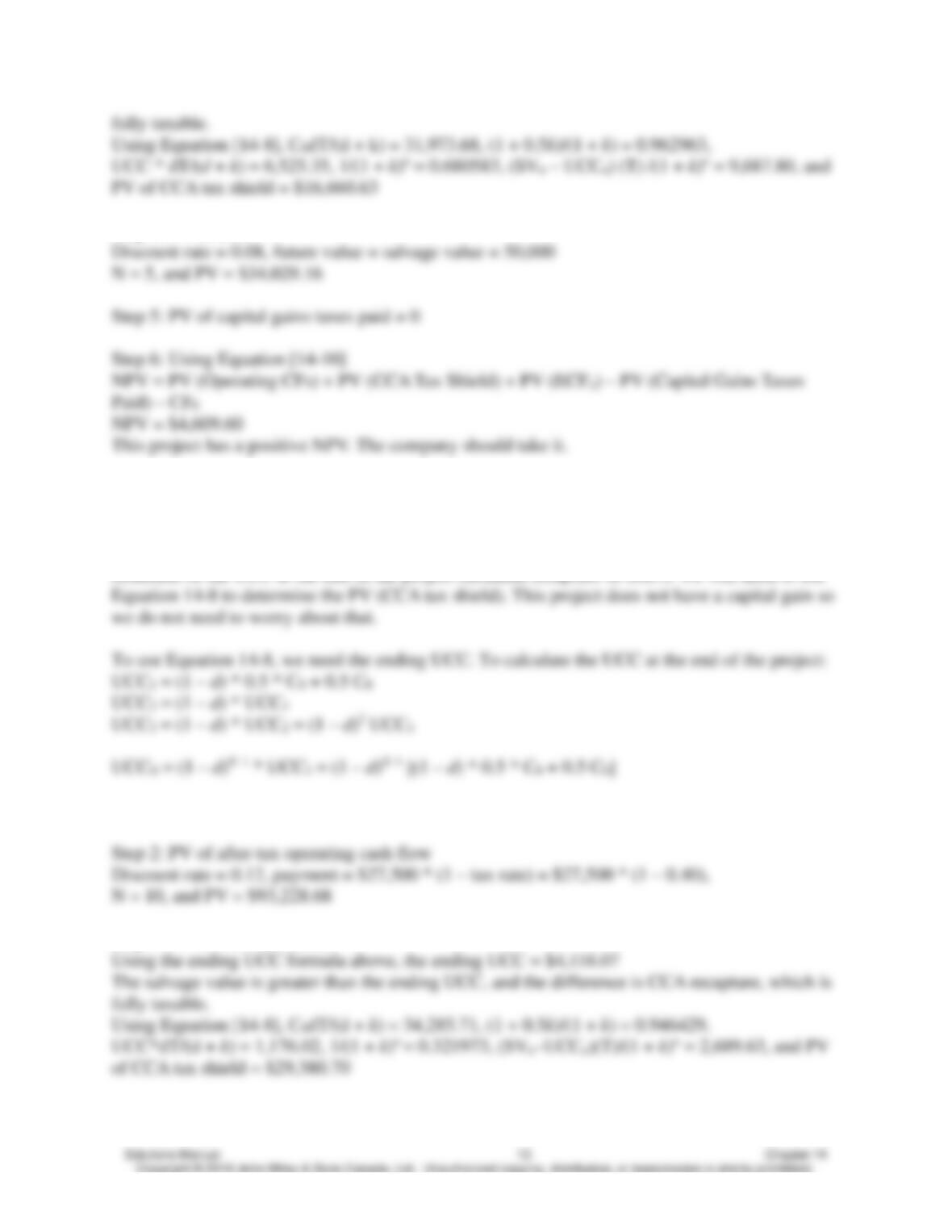
Level of difficulty: Intermediate
13. Section: 14.2 Estimating and Discounting Cash Flows
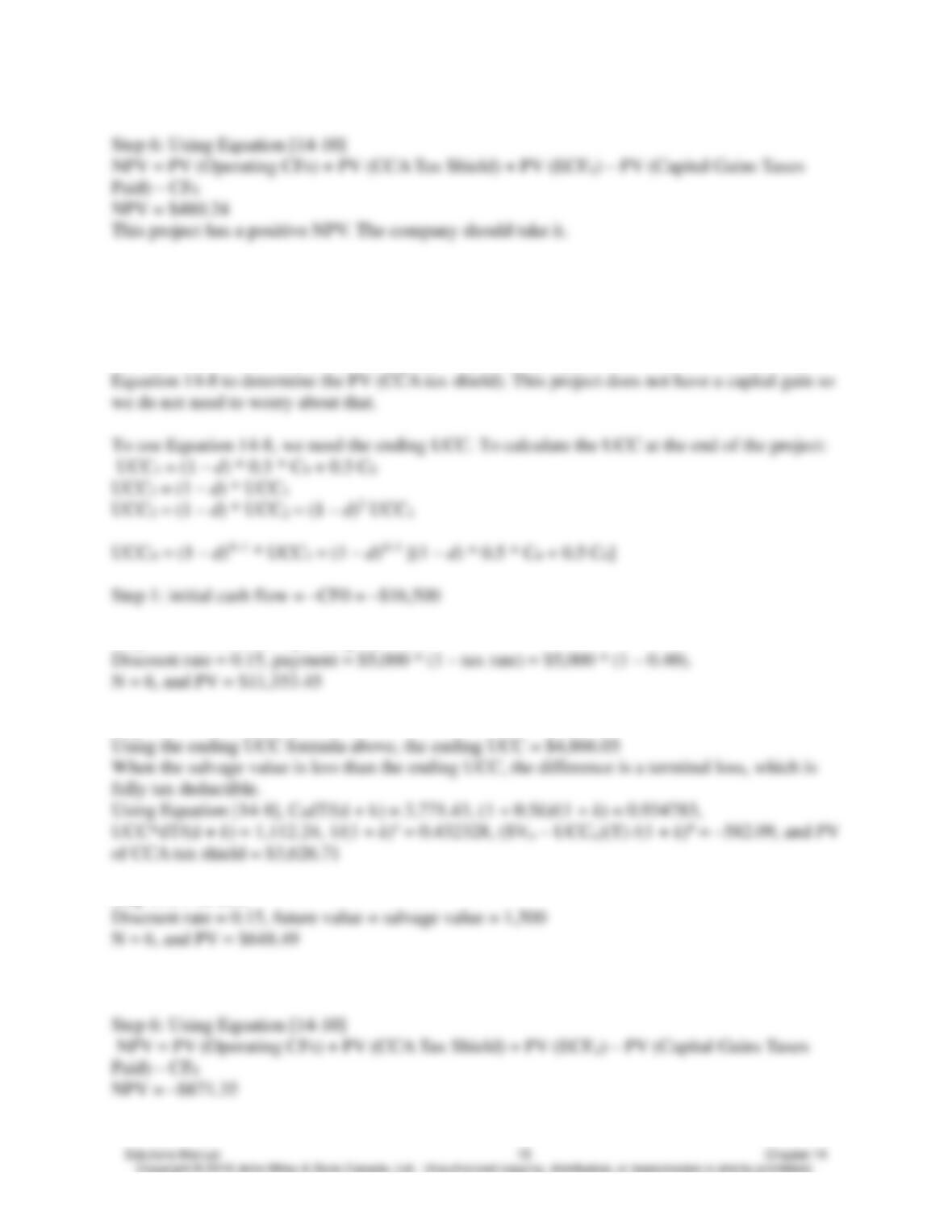
Learning Objective: 14.2
Level of difficulty: Intermediate
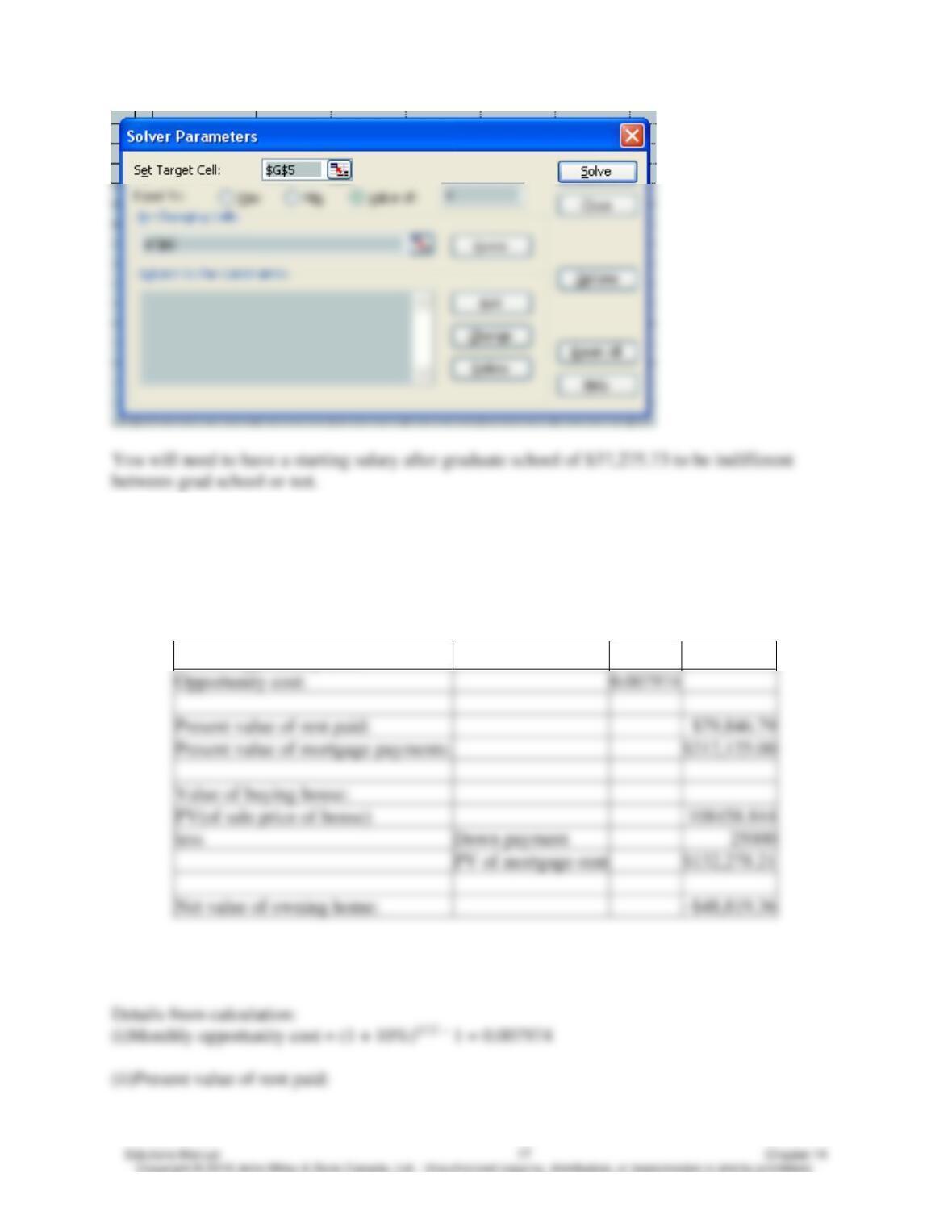
Introduction to Corporate Finance, Fourth Edition Booth, Cleary, Rakita
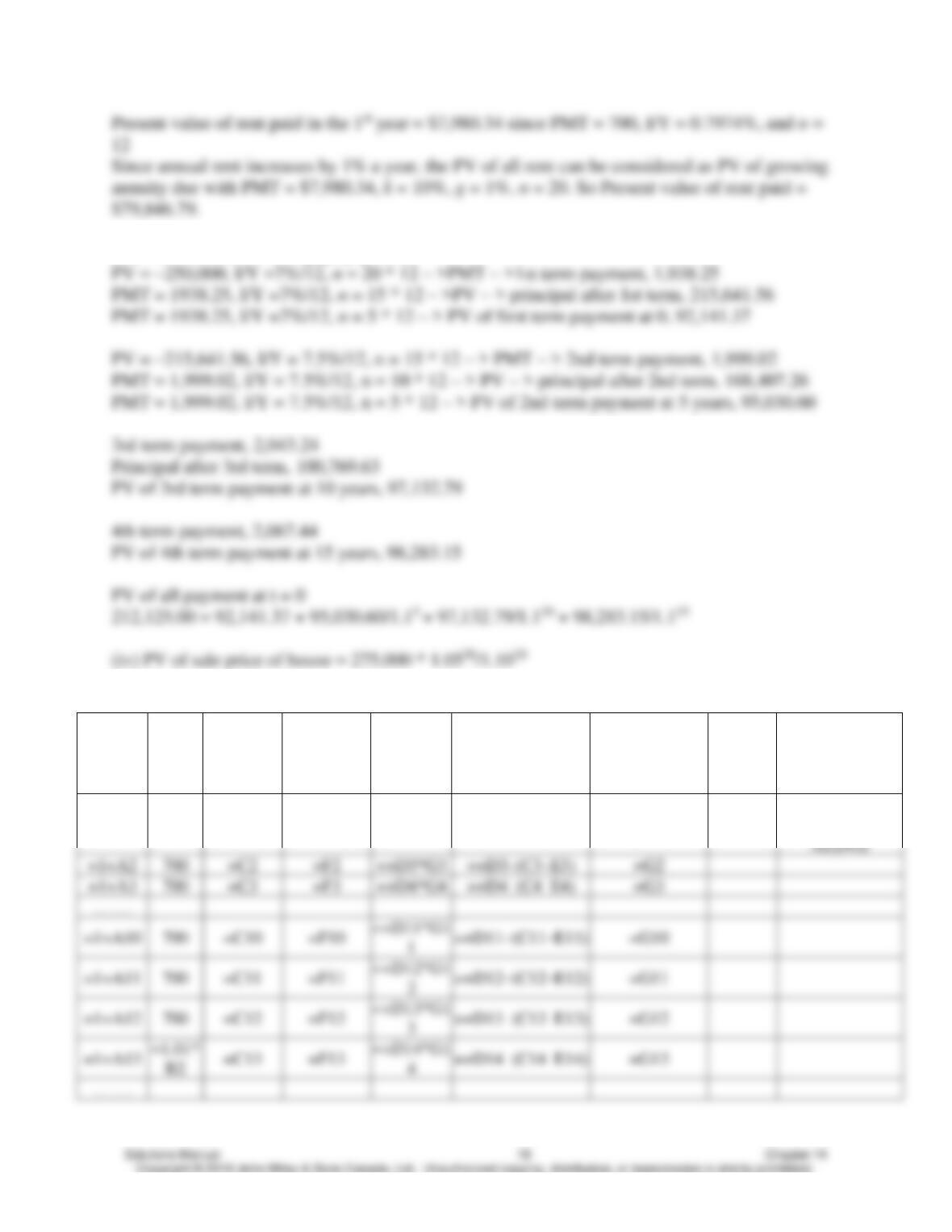
14. Section: 14.4 Sensitivity to Inputs
Learning Objective: 14.4
Level of difficulty: Basic
15. Section: 14.3 Replacement Decisions
Learning Objective: 14.3
Level of difficulty: Intermediate
16. Section: 14.3 Replacement Decisions
Learning Objective: 14.3
Level of difficulty: Intermediate
17. Section: 14.5 Inflation and Capital Budgeting Decisions
Learning Objective: 14.5
Level of difficulty: Intermediate
Practice Problems
Basic
18. Section: 14.1 General Guidelines for Capital Expenditure Analysis
Learning Objective: 14.1
Level of difficulty: Basic
19. Section: 14.1 General Guidelines for Capital Expenditure Analysis
Learning Objective: 14.1
Level of difficulty: Basic
Solution: The investor has not taken into account the impact of financial distress on the firm’s
decision making. If BathGate is in financial distress, then accepting a negative NPV project may
20. Section: 14.1 General Guidelines for Capital Expenditure Analysis
Learning Objective: 14.1
Level of difficulty: Basic
Solution: Sunk costs cannot be included because we are considering future cash flows while sunk
costs have occurred in the past and cannot be recovered.
21. Section: 14.2 Estimating and Discounting Cash Flows
Learning Objective: 14.2
Level of difficulty: Basic
Solution:
22. Section: 14.2 Estimating and Discounting Cash Flows
Learning Objective: 14.2
Level of difficulty: Basic
Solution: CCA recapture or terminal losses may be generated by the sale of an asset (or assets).
These may arise when the asset is the only asset in that asset class for the firm. The firm would

Introduction to Corporate Finance, Fourth Edition Booth, Cleary, Rakita
23. Section: 14.4 Sensitivity to Inputs
Learning Objective: 14.4
Level of difficulty: Basic
Solution: Sensitivity analysis examines how an investment’s NPV changes as the value of one
24. Section: 14.4 Sensitivity to Inputs
Learning Objective: 14.4
Level of difficulty: Basic
Solution: ROV can be used in corporate decision making to give the firm the option to defer or
Intermediate
25. Section: 14.1 General Guidelines for Capital Expenditure Analysis
Learning Objective: 14.1
Level of difficulty: Intermediate
Solution:
To evaluate any investment we have to begin by determining the cash flows associated with the
project. Depreciation and CCA are non-cash expenses that can have cash flow consequences
i) Depreciation: to determine cash flow we can start with net income and then add back the non-
Question: How do you evaluate this project?
If we invest the $9,000 using ½ from equity and ½ from debt we need the project to generate the
Introduction to Corporate Finance, Fourth Edition Booth, Cleary, Rakita
Calculating the NPV:
i) The PV of the cash flows is $1,500/.15 = $10,000>$9,000 cost → positive NPV, good
26. Section: 14.1 General Guidelines for Capital Expenditure Analysis
Learning Objective: 14.1
Level of difficulty: Intermediate
Solution:
a. Not relevant (sunk cost)
27. Section: 14.2 Estimating and Discounting Cash Flows
Learning Objective: 14.2
Level of difficulty: Intermediate
Solution:
For Project A:
Tax rate
Annual CFBT
Discount rate
Project life
PV(Future CFs)
A
24%
$5,000
5%
5
$16,452.01
B
43%
$3,000
6
C
36%
$8,000
8%
3
$13,194.74
Introduction to Corporate Finance, Fourth Edition Booth, Cleary, Rakita
F
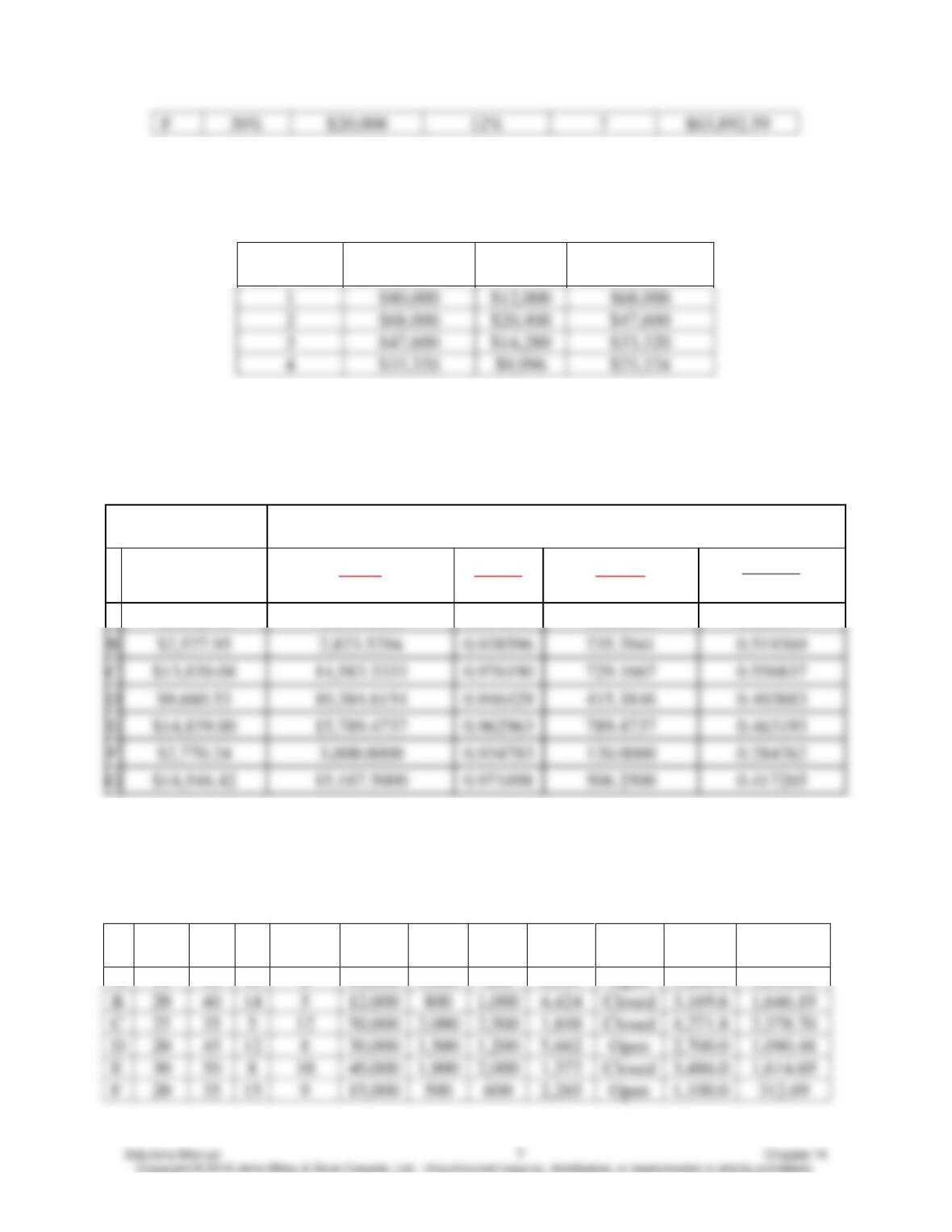
$63,892.59
28. Section: 14.2 Estimating and Discounting Cash Flows
Learning Objective: 14.2
Level of difficulty: Intermediate
Solution:
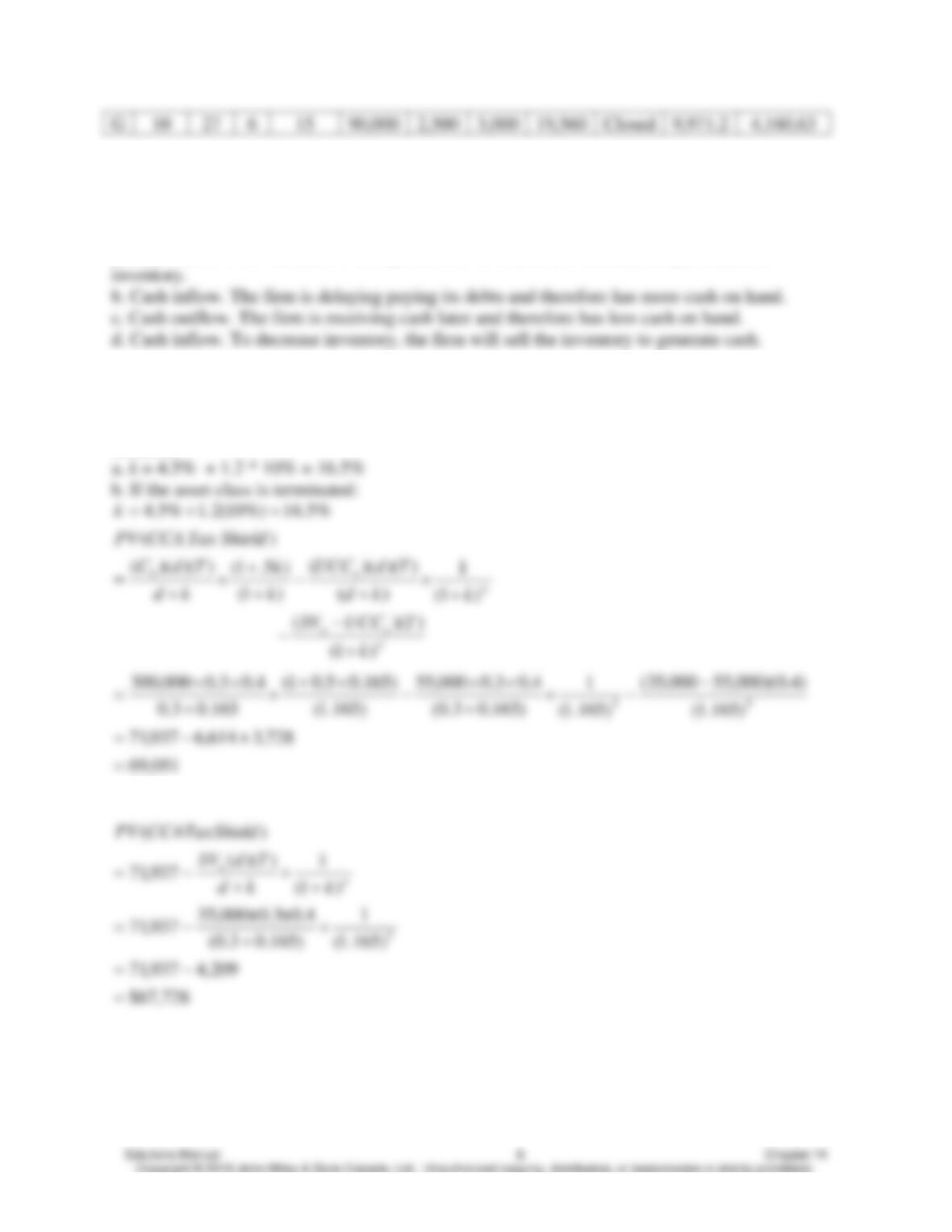
End of year
Opening UCC
balance
CCA
Closing UCC
balance
$12,000
$20,400
$14,280
$9,996
29. Section: 14.2 Estimating and Discounting Cash Flows
Learning Objective: 14.2
Level of difficulty: Intermediate
Solution:
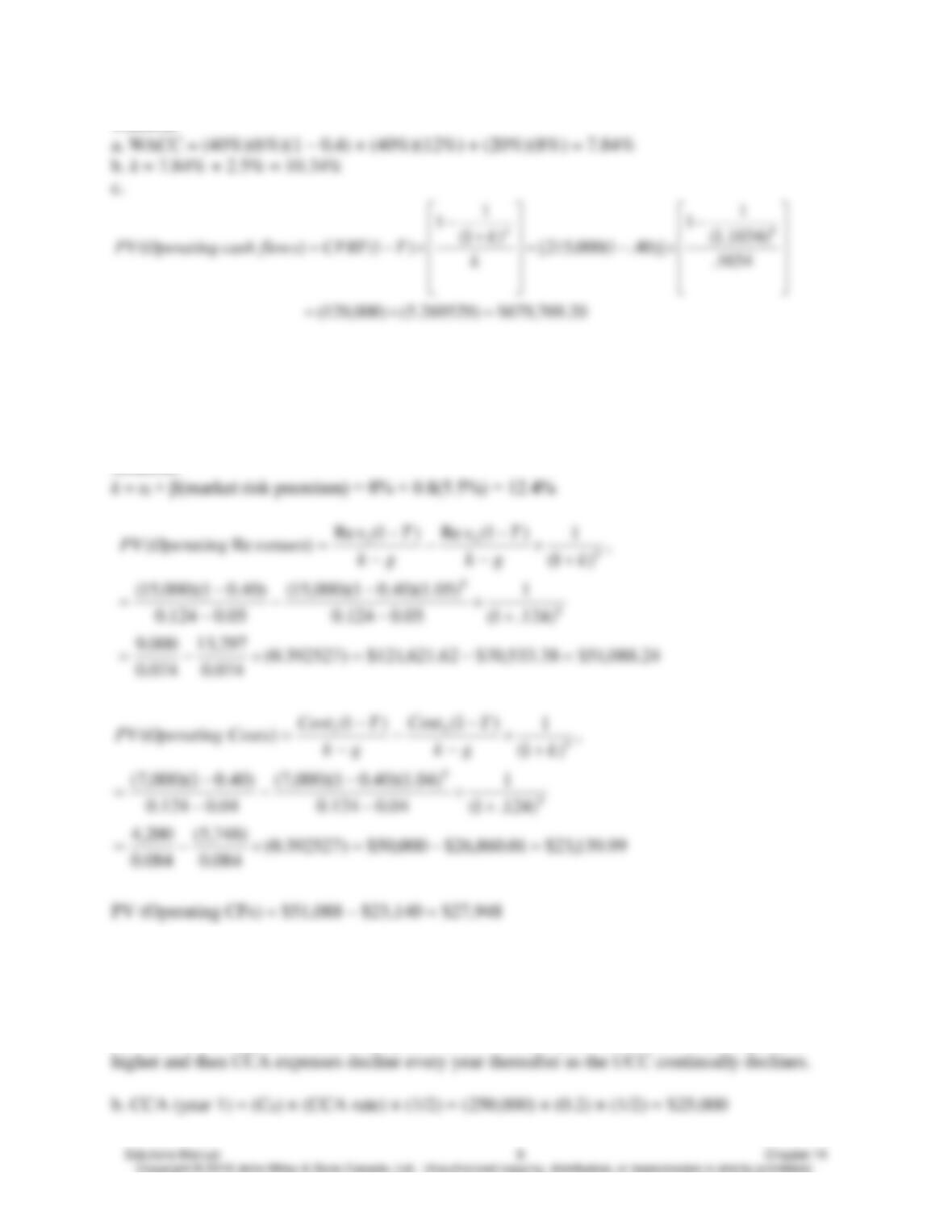
Components
PV(CCA Tax
shields)
0
C dT
dk+
1 .5
1
k
k
+
+
0
SV dT
dk+
n
k)1(
1
+
A
$3,112.44
3,360.0000
0.954545
168.0000
0.564474
$2,770.24
3,000.0000
0.934783
120.0000
0.284262
G
0.971698
506.2500
0.417265
30. Section: 14.2 Estimating and Discounting Cash Flows
Learning Objective: 14.2
Level of difficulty: Intermediate
Solution:
CCA
%
Tax
%
k
%
Project
Life
C0
$
NWC
$
SV
$
UCC
$
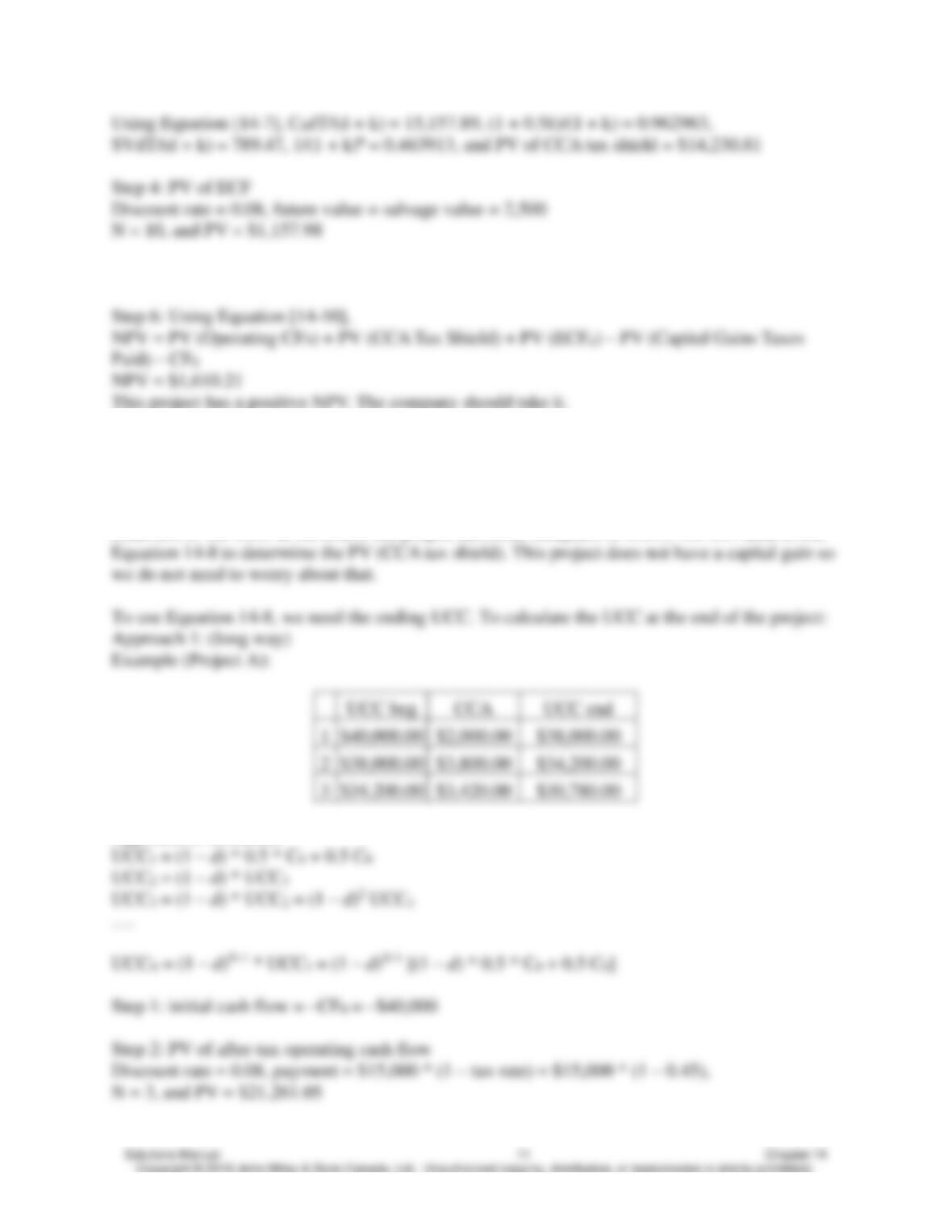
Asset
Class
ECFn $
PV(ECFn)
$
A
15
35
10
6
16,000
1,000
800
6,567
Open
1,800.0
1,016.05
B
20
40
14
5
12,000
800
1,000
4,424
Closed
3,169.6
1,646.19
C
25
35
5
12
50,000
2,000
2,500
1,848
Closed
4,271.8
2,378.70
D
20
45
12
8
30,000
1,500
1,200
5,662
Open
2,700.0
1,090.48
Introduction to Corporate Finance, Fourth Edition Booth, Cleary, Rakita
31. Section: 14.2 Estimating and Discounting Cash Flows
Learning Objective: 14.2
Level of difficulty: Intermediate
Solution:
a. Cash outflow. To increase inventory, the firm will have to invest cash to purchase the
32. Section: 14.2 Estimating and Discounting Cash Flows
Learning Objective: 14.2
Level of difficulty: Intermediate
Solution:
c. If the asset class remains open:
33. Section: 14.2 Estimating and Discounting Cash Flows
Learning Objective: 14.2
Level of difficulty: Intermediate
Introduction to Corporate Finance, Fourth Edition Booth, Cleary, Rakita
Solution:
34. Section: 14.2 Estimating and Discounting Cash Flows
Learning Objective: 14.2
Level of difficulty: Intermediate
Solution:
35. Section: 14.2 Estimating and Discounting Cash Flows
Learning Objective: 14.2
Level of difficulty: Intermediate
Solution:
a. Year 1 CCA expense is lower than year 2 due to the half-year rule. Year 2 CCA expense is

Introduction to Corporate Finance, Fourth Edition Booth, Cleary, Rakita
Challenging
36. Section: 14.2 Estimating and Discounting Cash Flows
Learning Objective: 14.2
Level of difficulty: Challenging
Solution:
Step 1: initial cash flow = –CF0 = –$4,000
Step 4: PV of ECF
37. Section: 14.2 Estimating and Discounting Cash Flows
Learning Objective: 14.2
Level of difficulty: Challenging
Solution:
Step 1: initial cash flow = –CF0 = –$48,000
Introduction to Corporate Finance, Fourth Edition Booth, Cleary, Rakita
Step 5: PV of capital gains taxes paid = 0
38. Section: 14.2 Estimating and Discounting Cash Flows
Learning Objective: 14.2
Level of difficulty: Challenging
Solution: As the asset classes will be terminated when the project ends, we have to consider the
treatment of the UCC at the end of the project (terminal recapture or loss?). We will need to use
Approach 2: (formula)

Introduction to Corporate Finance, Fourth Edition Booth, Cleary, Rakita
Step 3: PV of CCA tax shield.
Step 4: PV of ECF
39. Section: 14.2 Estimating and Discounting Cash Flows
Learning Objective: 14.2
Level of difficulty: Challenging
Solution: As the asset classes will be terminated when the project ends, we have to consider the
treatment of the UCC at the end of the project (terminal recapture or loss?). We will need to use
To use Equation 14-8, we need the ending UCC. To calculate the UCC at the end of the project:
Step 1: initial cash flow = –CF0 = –$90,000
Introduction to Corporate Finance, Fourth Edition Booth, Cleary, Rakita
Step 4: PV of ECF
40. Section: 14.2 Estimating and Discounting Cash Flows
Learning Objective: 14.2
Level of difficulty: Challenging
Solution: As the asset classes will be terminated when the project ends, we have to consider the
treatment of the UCC at the end of the project (terminal recapture or loss?). We will need to use
Step 1: initial cash flow = –CF0 = –$120,000.
Step 3: PV of CCA tax shield.

Introduction to Corporate Finance, Fourth Edition Booth, Cleary, Rakita
Step 4: PV of ECF
41. Section: 14.2 Estimating and Discounting Cash Flows
Learning Objective: 14.2
Level of difficulty: Challenging
Solution: As the asset classes will be terminated when the project ends, we have to consider the
treatment of the UCC at the end of the project (terminal recapture or loss?). We will need to use
To use Equation 14-8, we need the ending UCC. To calculate the UCC at the end of the project:
Step 1: initial cash flow = –CF0 = –$4,000
Step 4: PV of ECF
Introduction to Corporate Finance, Fourth Edition Booth, Cleary, Rakita
42. Section: 14.2 Estimating and Discounting Cash Flows
Learning Objective: 14.2
Level of difficulty: Challenging
Solution: As the asset classes will be terminated when the project ends, we have to consider the
treatment of the UCC at the end of the project (terminal recapture or loss?). We will need to use
Step 2: PV of after-tax operating cash flow
Step 3: PV of CCA tax shield.
Step 4: PV of ECF
Step 5: PV of capital gains taxes paid = 0

Introduction to Corporate Finance, Fourth Edition Booth, Cleary, Rakita
43. Section: 14.2 Estimating and Discounting Cash Flows
Learning Objective: 14.2
Level of difficulty: Challenging
Solution:
To solve this problem, begin by considering the various cash flows. Assume that all cash flows
occur at the end of the year.
Year
Salary (ugrad
only)
CF (grad
school)
1
40000
-8000
PV of ugrad option:
=NPV(0.04,B2:B41)
=1+A2
=+(1.05)*B2
-8000
PV grad option:
=NPV(0.04,C2:C41)
=1+A3
=+(1.05)*B3
-8000
=1+A4
=+(1.05)*B4
-8000
Difference:
=1+A5
=+(1.05)*B5
100
=1+A6
=+(1.05)*B6
=+(1.07)*C6
=1+A7
=+(1.05)*B7
=+(1.07)*C7
=1+A8
=+(1.05)*B8
=+(1.07)*C8
=1+A9
=+(1.05)*B9
=+(1.07)*C9
=1+A10
=+(1.05)*B10
=+(1.07)*C10
=1+A11
=+(1.05)*B11
=+(1.07)*C11
=1+A12
=+(1.05)*B12
=+(1.07)*C12
=1+A13
=+(1.05)*B13
=+(1.07)*C13
=1+A14
=+(1.05)*B14
=+(1.07)*C14
Introduction to Corporate Finance, Fourth Edition Booth, Cleary, Rakita
44. Section: 14.2 Estimating and Discounting Cash Flows
Learning Objective: 14.2
Level of difficulty: Challenging
Solution:
a.
Annual opportunity cost
10.00%
Opportunity cost:
0.007974
Present value of rent paid:
Present value of mortgage payments:
$212,125.00
Value of buying house:
PV(of sale price of house)
less
Down payment
PV of mortgage-rent
$132,278.21
Net value of owning home:
If my investments earn 10% per annum, I’m better off financially by renting than investing. The
growth rate of the house investment does not offset the opportunity cost.
Introduction to Corporate Finance, Fourth Edition Booth, Cleary, Rakita
(iii) Present value of mortgage payments
Details from spreadsheet:
Month
Rent
Mortgage
Payments
Mortgage
balance at
beginning
of month
Interest
Mortgage balance
at end of month
Mortgage
interest rate per
month
Payment
Annuity factor
1
700
=H2
250000
=+D2*G2
=+D2–(C2–E2)
=0.07/12
=D2/I2
=(1–
1/(1+G2)^(241–