
Introduction to Corporate Finance, Fourth Edition Booth, Cleary, Rakita
Chapter 13: Capital Budgeting, Risk Considerations, and Other Special Issues
Multiple Choice Questions
1. Section: 13.1 Capital Expenditures
Learning Objective: 13.1
Difficulty: Intermediate
2. Section: 13.1 Capital Expenditures
Learning Objective: 13.1
Difficulty: Basic
3. Section: 13.2 Evaluating Investment Alternatives
Learning Objective: 13.2
Difficulty: Intermediate
4. Section: 13.2 Evaluating Investment Alternatives
Learning Objective: 13.2
Difficulty: Challenging
5. Section: 13.2 Evaluating Investment Alternatives
Learning Objective: 13.2
Difficulty: Challenging

Introduction to Corporate Finance, Fourth Edition Booth, Cleary, Rakita
6. Section: 13.2 Evaluating Investment Alternatives
Learning Objective: 13.2
Difficulty: Intermediate
7. Section: 13.2 Evaluating Investment Alternatives
Learning Objective: 13.2
Difficulty: Intermediate
8. Section: 13.2 Independent and Interdependent Projects
Learning Objective: 13.3
Difficulty: Intermediate
9. Section: 13.4 Capital Rationing
Learning Objective: 13.4
Difficulty: Challenging
10. Section: 13.4 Capital Rationing
Learning Objective: 13.4
Difficulty: Intermediate

Introduction to Corporate Finance, Fourth Edition Booth, Cleary, Rakita
11. Section 13.5 International Considerations
Learning Objective: 13.5
Difficulty: Intermediate
12. Section 13.5 International Considerations
Learning Objective: 13.5
Difficulty: Intermediate
13. Section 13A The Modified Internal Rate of Return
Learning Objective: 13.6
Difficulty: Intermediate
14. Section 13A The Modified Internal Rate of Return
Learning Objective: 13.6
Difficulty: Intermediate
Practice Problems
Basic
15. Section: 13.2 Evaluating Investment Alternatives
Learning Objective: 13.2
Difficulty: Basic
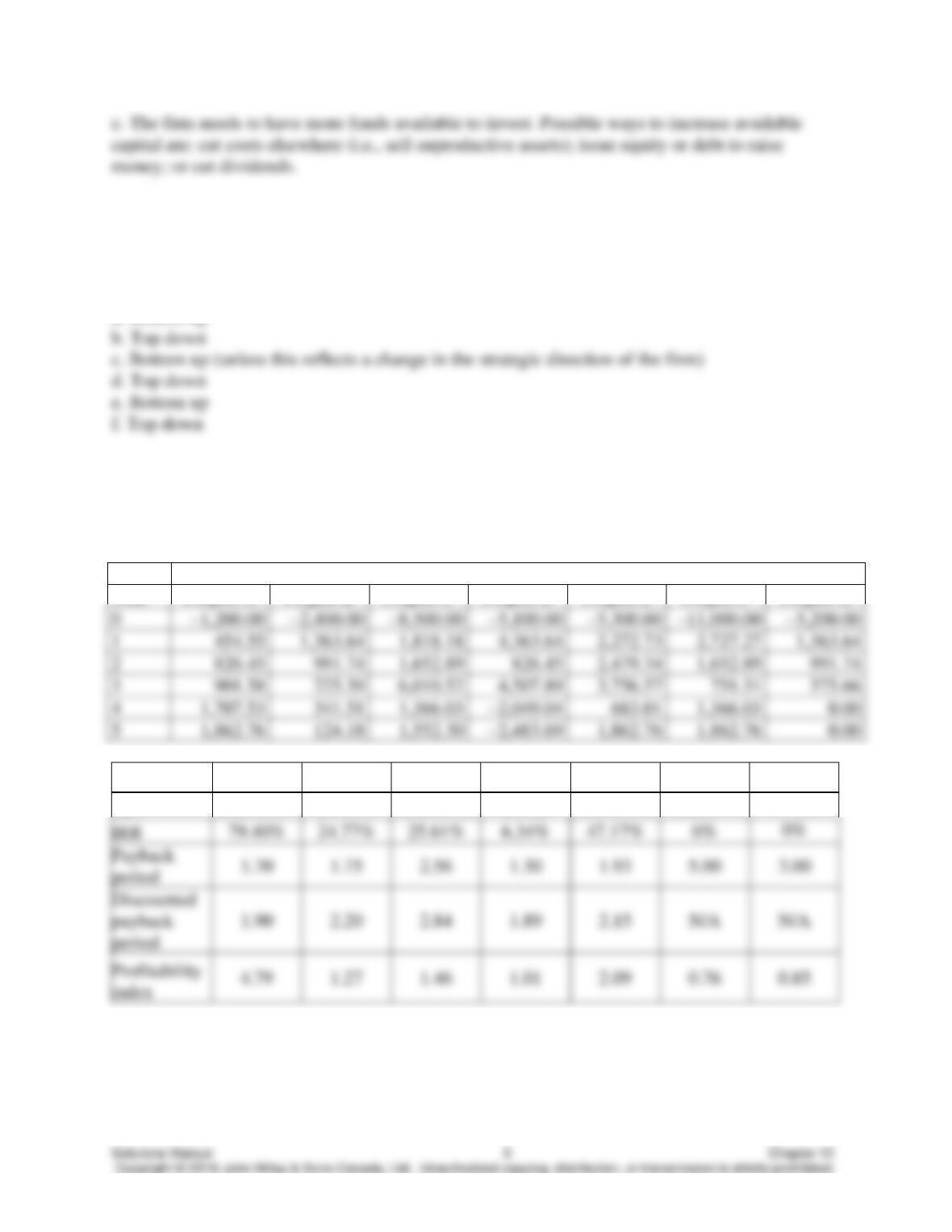
Solution:
a. Payback period:

Introduction to Corporate Finance, Fourth Edition Booth, Cleary, Rakita
c. Possible reasons can include:
16. Section: 13.2 Evaluating Investment Alternatives
Learning Objective: 13.2
Difficulty: Basic
Solution: The payback period does not take into account the time value of money. In addition, it
17. Section: 13.2 Evaluating Investment Alternatives
Learning Objective: 13.2
Difficulty: Basic
18. Section: 13.4 Capital Rationing
Learning Objective: 13.4
Difficulty: Basic
Solution:
19. Section: 13.4 Capital Rationing
Learning Objective: 13.4
Difficulty: Basic
Solution:
a. With no capital constraint, the firm should invest in all positive NPV projects; therefore, it
Introduction to Corporate Finance, Fourth Edition Booth, Cleary, Rakita
Intermediate
20. Section: 13.1 Capital Expenditures
Learning Objective: 13.1
Difficulty: Intermediate
Solution:
a. Bottom up
21. Section: 13.2 Evaluating Investment Alternatives
Learning Objective: 13.2
Difficulty: Intermediate
Solution:
Discounted cash flows
Year
Project A
Project B
Project C
Project D
Project E
Project F
Project G
0
1
2
3
4
5
Project A
Project B
Project C
Project D
Project E
Project F
Project G
NPV
$4,552.87
$646.46
$3,899.92
$65.25
$5,754.42
–$2,639.73
–$468.97
IRR
period
period
index
22. Section: 13.2 Evaluating Investment Alternatives
Learning Objective: 13.2
Difficulty: Intermediate
Solution:
Introduction to Corporate Finance, Fourth Edition Booth, Cleary, Rakita
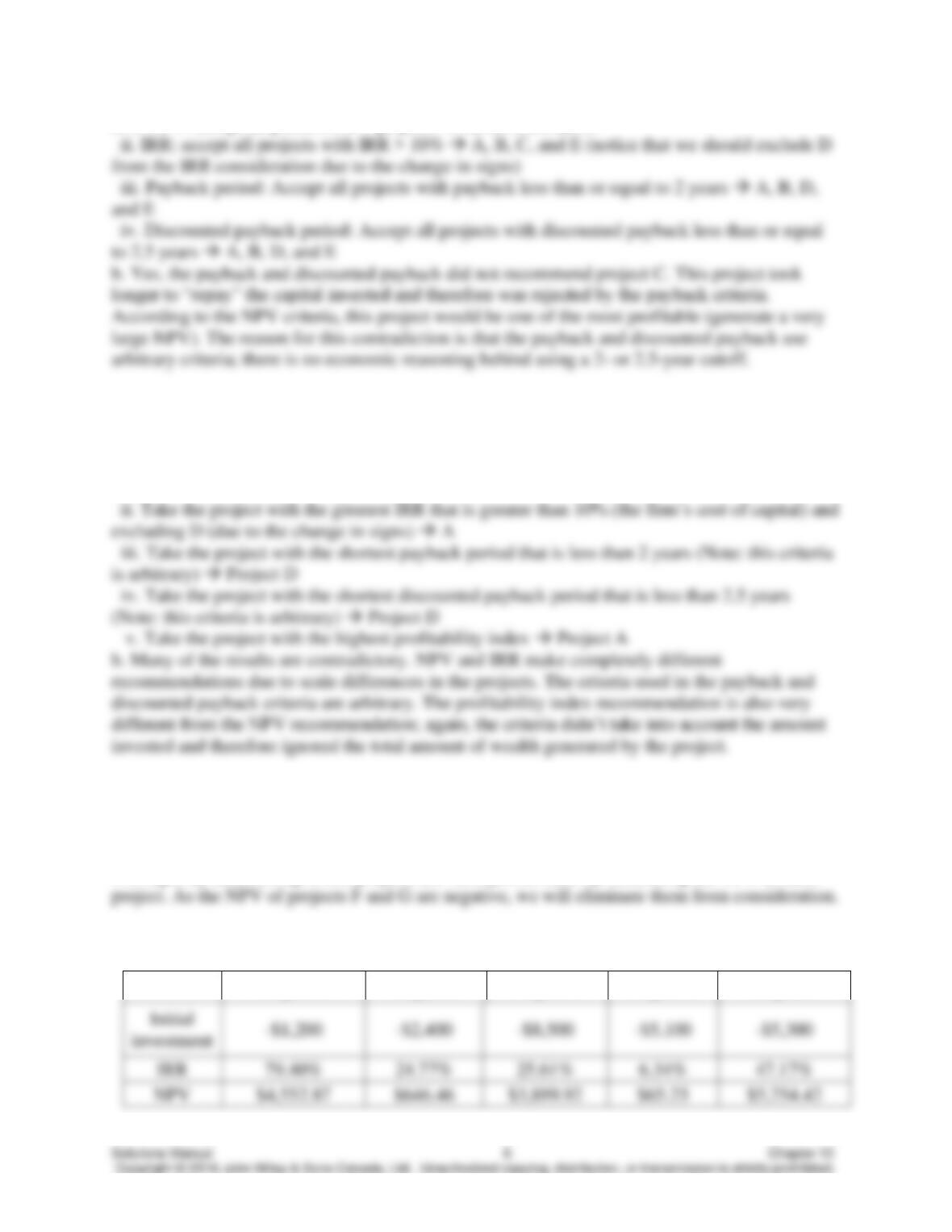
a. i. NPV: accept all positive NPV projects → A, B, C, D, and E
23. Section: 13.2 Evaluating Investment Alternatives
Learning Objective: 13.2
Difficulty: Intermediate
Solution:
a. i. Take the project with the greatest NPV → E
24. Section: 13.4 Capital Rationing
Learning Objective: 13.4
Difficulty: Intermediate
Solution:
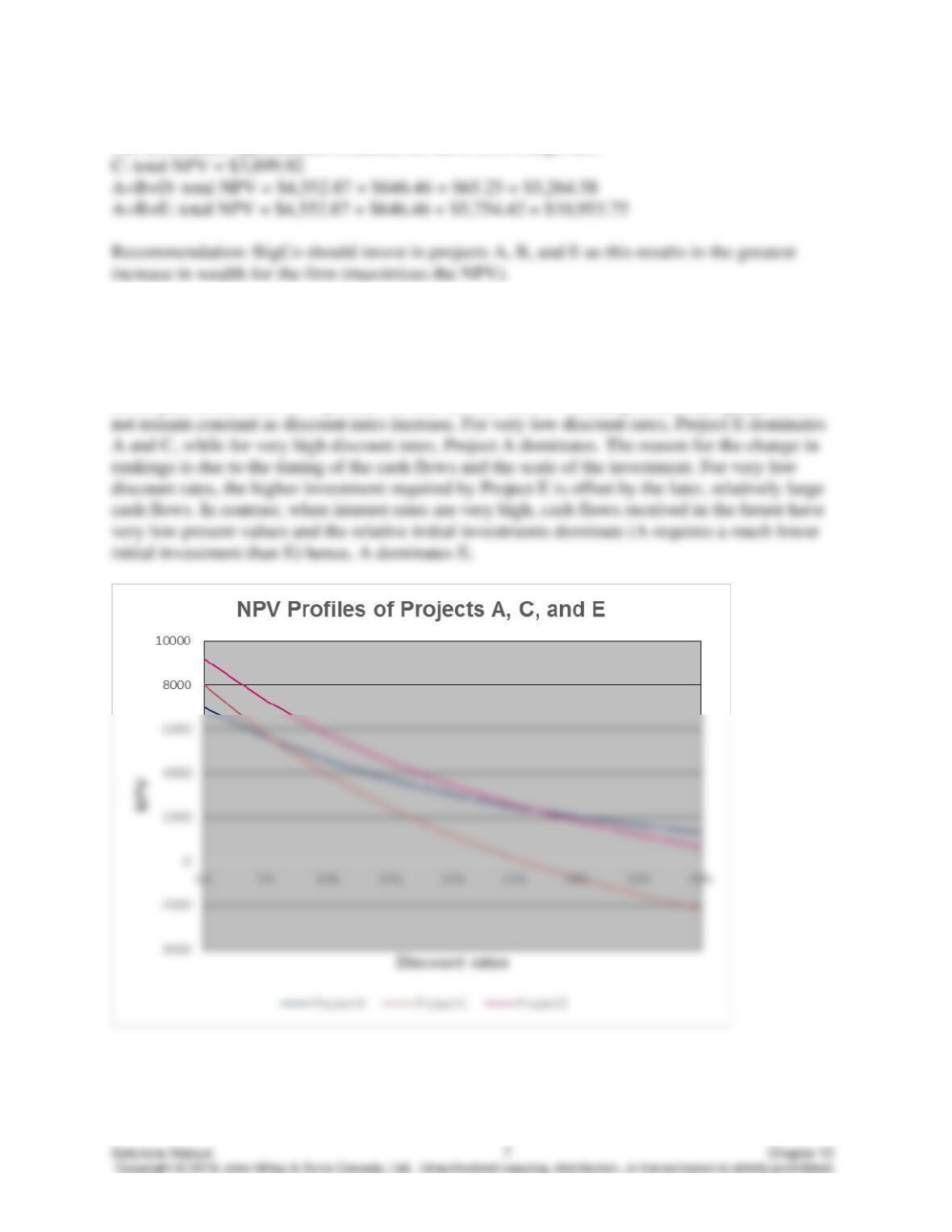
We begin by determining which projects are valid possibilities by calculating the NPV of each
The investment and NPV is summarized in the following table:
Project A
Project B
Project C
Project D
Project E
Introduction to Corporate Finance, Fourth Edition Booth, Cleary, Rakita
The investment opportunities available for the $9,000 budget are:
25. Section: 13.2 Evaluating Investment Alternatives
Learning Objective: 13.2
Difficulty: Intermediate
Solution:
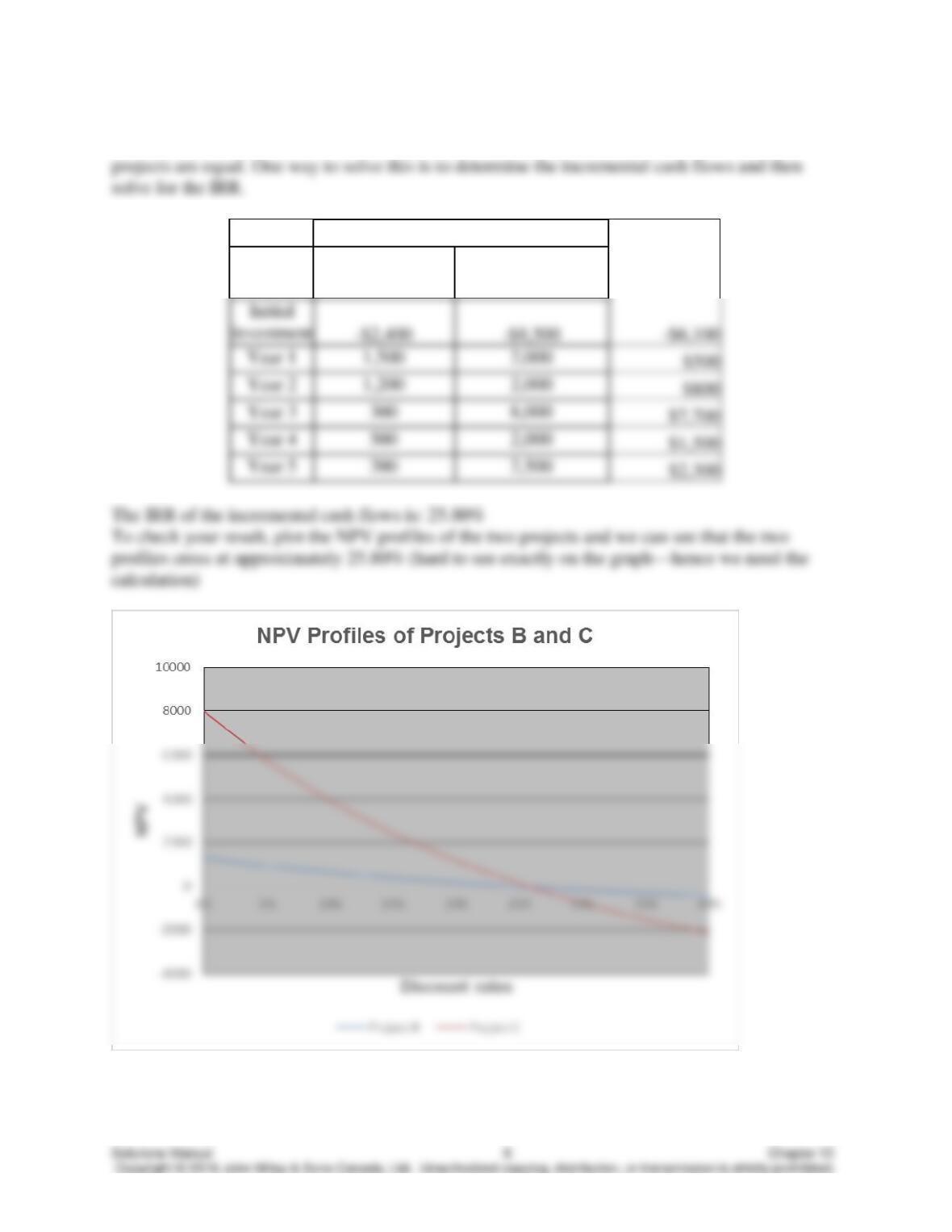
In the plot of the three NPV profiles we can see that the NPV ranking of the three projects does
26. Section: 13.2 Evaluating Investment Alternatives
Learning Objective: 13.2
Difficulty: Intermediate
Introduction to Corporate Finance, Fourth Edition Booth, Cleary, Rakita
Solution:
To determine the crossover rate, determine the discount rate at which the NPV of the two
Project annual cash flows
Incremental
cash flows:
C – B
Project B
Project C
27. Section: 13.4 Capital Rationing
Learning Objective: 13.4
Introduction to Corporate Finance, Fourth Edition Booth, Cleary, Rakita
Difficulty: Intermediate
Solution:
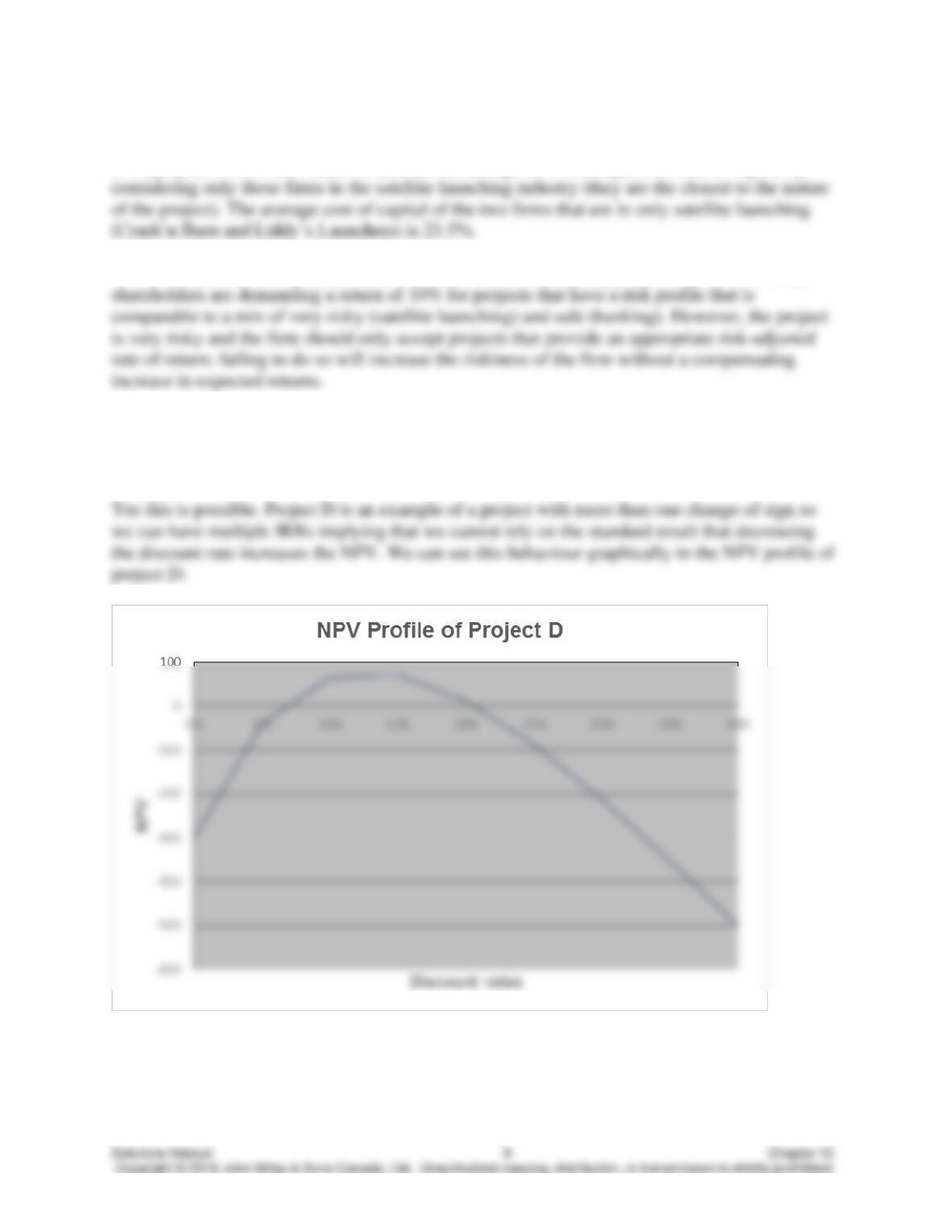
a. As projects A to G are related to satellite launching, we will compute the cost of capital by
b. Shareholder value would decrease. The firm would be accepting projects that are too risky;
28. Section: 13.2 Evaluating Investment Alternatives
Learning Objective: 13.2
Difficulty: Intermediate
Solution:
29. Section: 13.2 Evaluating Investment Alternatives
Learning Objective: 13.2
Difficulty: Intermediate
Solution:
Introduction to Corporate Finance, Fourth Edition Booth, Cleary, Rakita
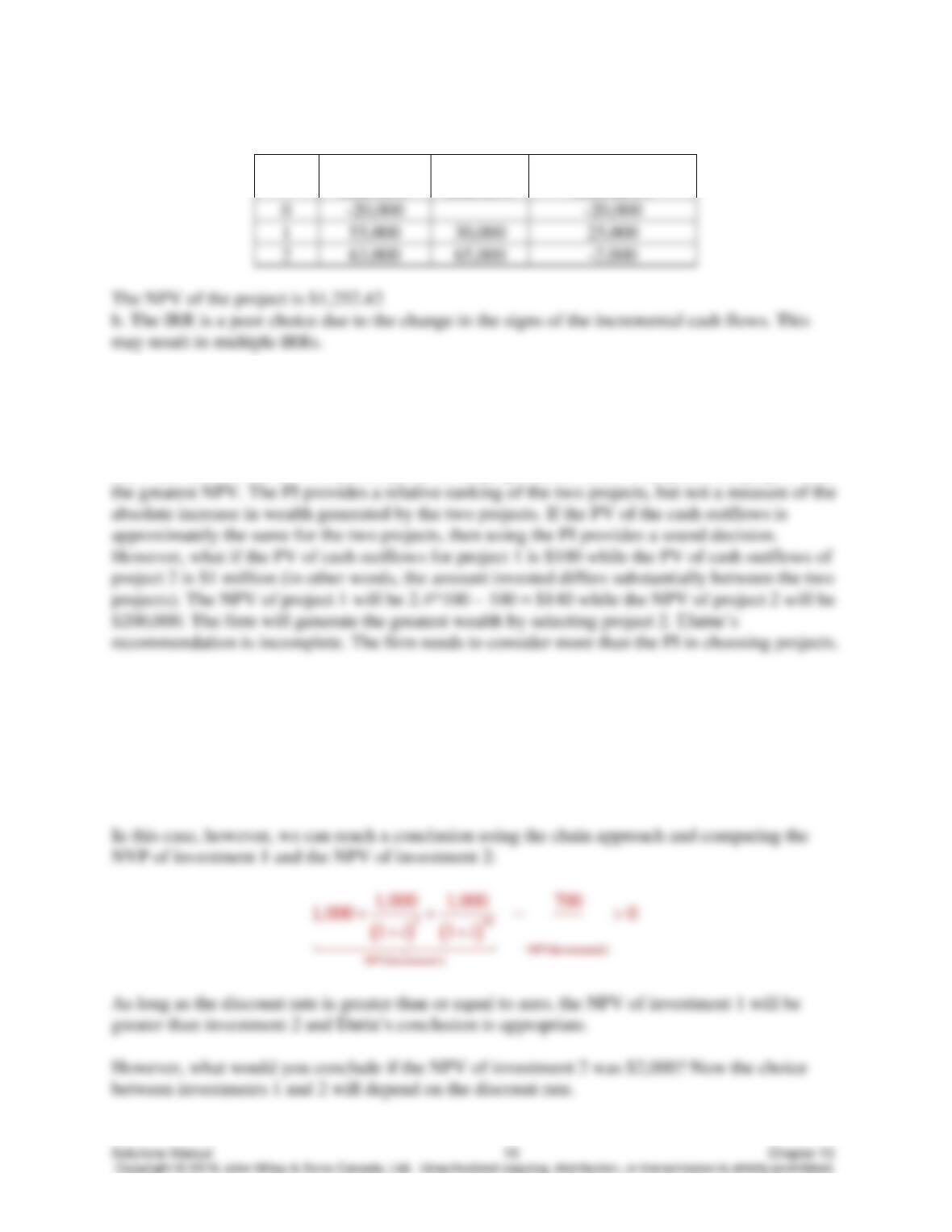
a. To determine the NPV of the project we need to determine the incremental cash flows:
Year
Projected
cash flow
Current
cash flow
Projected – current
cash flows
30. Section: 13.2 Evaluating Investment Alternatives
Learning Objective: 13.2
Difficulty: Intermediate
Solution: The PI is calculated as the ratio of the PV of inflows to the PV of outflows. As the firm
must choose between the two mutually exclusive projects, the firm would prefer the project with
31. Section: 13.2 Evaluating Investment Alternatives
Learning Objective: 13.2
Difficulty: Intermediate
Solution:
The two projects do not have the same lifetimes and therefore, either a chain-replication or
EANPV analysis needs to be done to determine which project is better.

Introduction to Corporate Finance, Fourth Edition Booth, Cleary, Rakita
32. Section: 13.2 Evaluating Investment Alternatives
Learning Objective: 13.2
Difficulty: Intermediate
Solution:
The crossover rate is the discount rate that makes the NPVs of both projects the same.
Using a financial calculator (TI BA II Plus):
[CF][2nd][CLR WORK]
–5,000 [Enter][]
1,200 [Enter][] []
2,400 [Enter][] []
3,300 [Enter][] []
[IRR] [CPT] gives 15.2895%.
If you use 15.2895% to calculate NPVs of both projects, you will get the same NPV of
$1,319.69.
33. Section: 13.2 Evaluating Investment Alternatives
Learning Objective: 13.2
Difficulty: Intermediate
Solution:
34. Section: 13.2 Evaluating Investment Alternatives
Learning Objective: 13.2
Difficulty: Intermediate
Solution:
Project A:

Introduction to Corporate Finance, Fourth Edition Booth, Cleary, Rakita
Project B:
35. Section: 13.2 Evaluating Investment Alternatives
Learning Objective: 13.2
Difficulty: Intermediate
Solution:
Projects
Initial CF
CF1
CF2
CF3
CF4
A
2,500
800
1,200
900
2,000
discounted CF
714.2857
956.6327
640.6022
1,271.0362
B
3,000
750
1,500
1,000
4,000
discounted CF
669.6429
1,195.7908
711.7802
2,542.0723
Project A:
36. Section: 13.2 Evaluating Investment Alternatives
Learning Objective: 13.2
Difficulty: Intermediate
Solution:
37. Section: 13.2 Evaluating Investment Alternatives
Learning Objective: 13.2
Difficulty: Intermediate
Solution:

Introduction to Corporate Finance, Fourth Edition Booth, Cleary, Rakita
Using a financial calculator (TI BA II Plus):
[CF][2nd][CLR WORK]
–60,000 [Enter][]
20,000 [Enter][] []
22,000 [Enter][] []
–8,000 [Enter][] []
38,050 [Enter][] []
55,000 [Enter][] []
16,000 [Enter][] []
[NPV][20.4][Enter] []
[CPT] gives $12,302.15
Since NPV > 0, SK Inc. should accept the project.
38. Section: 13.2 Evaluating Investment Alternatives
Learning Objective: 13.2
Difficulty: Intermediate
Solution:
Using a financial calculator (TI BA II Plus):
39. Section: 13.2 Evaluating Investment Alternatives
Learning Objective: 13.2
Difficulty: Intermediate
Solution:
Sell to brother:

Introduction to Corporate Finance, Fourth Edition Booth, Cleary, Rakita
40. Section: 13.2 Evaluating Investment Alternatives
Learning Objective: 13.2
Difficulty: Intermediate
Solution:
41. Section: 13.2 Evaluating Investment Alternatives
Learning Objective: 13.2
Difficulty: Intermediate
42. Section: 13.2 Evaluating Investment Alternatives
Learning Objective: 13.2
Difficulty: Intermediate
Solution:
Year
Discounted Cash Flow
(A)
Discounted Cash Flow
(B)
0
-160,000
-110,000
1
2
3
4
Project A
Project B
43. Section: 13.2 Evaluating Investment Alternatives
Learning Objective: 13.2
Difficulty: Intermediate
Solution:
44. Section: 13.2 Evaluating Investment Alternatives

Introduction to Corporate Finance, Fourth Edition Booth, Cleary, Rakita
Learning Objective: 13.2
Difficulty: Intermediate
Solution:
45. Section: 13.2 Evaluating Investment Alternatives
Learning Objective: 13.2
Difficulty: Intermediate
Solution:
46. Section: 13.3 Independent and Interdependent Projects
Learning Objective: 13.3
Difficulty: Intermediate
Solution:
Independent projects are those that have no relationship with one another. A firm’s decision to
47. Section: 13.3 Independent and Interdependent Projects
Learning Objective: 13.3
Difficulty: Intermediate
Solution:
a. The two projects are mutually exclusive. This assumes that the cruise line needs to carry a
48: Section: 13.5 International Considerations
Learning Objective: 13.5