Chapter 13
Capital Budgeting: Estimating Cash Flows
and Analyzing Risk
ANSWERS TO BEGINNING-OF–CHAPTER QUESTIONS
13-1 The firm’s FCFs reflect both its past and current investments. Past investments produce
current FCFs, but current investments are expected to add to FCF at some future point.
Conceptually, a project’s projected cash flows and are expected to contribute that same
amount to the firm’s future free cash flows. In practice, project cash flows are analyzed to
13-2 Externalities relate to effects that a given project might have on the firm’s other assets.
More broadly, externalities relate to effects within and outside the firm. An internal
externality might be a situation where a utility has an old and inefficient plant that is costly
to operate and that also produces a lot of air pollution, and if a new plant is built, then the
firm’s costs will be reduced and it will also pollute less and thus have lower external costs.
Sunk costs are costs that have already been incurred, and on which the current decision
will have no effect. For example, if a company had spent $2 million on an engineering
feasibility study, then that $2 million would be a sunk cost. It should not be worked into
the current decision analysis. For the current decision, we are concerned only with
incremental costs and income. Incremental costs are defined as costs that will be incurred
in the future if the decision is made to go ahead with the project, and incremental revenues
are the future revenues the plant will produce if it is built. Together, the incremental costs
13-3 Shorter depreciable lives result in assets being depreciated faster—the total amount of
depreciation is still limited to the cost of the asset, but the depreciation is taken sooner.
Further, depreciation is not a cash cost, so a larger depreciation charge does not lower the
cash flow for a given year. However, depreciation is deducted when calculating taxable
13-4 Using current dollars would probably lower the calculated NPV and IRR. Any acceptable
project will have positive cash flows, which means that in total revenues will exceed costs.
If we assume that inflation is positive and that it affects revenues and costs equally, then it
will cause revenues to rise more than costs, and hence net cash flows to increase over time.
13-5 Managers never know for sure the results that a project will produce. In our example, the
company might have a good idea of the $50 million cost of the plant, but something could
happen to raise or lower that estimate. Similarly, output could vary from the estimated
amount, variable costs (mainly for gas as fuel for the plant) could vary, and so on. The
sensitivity analysis performed in the model gives an idea of how changes in the input
13-6 Real options are opportunities to respond to changing circumstances in the context of
Answers and Solutions: 13 – 3
investment decisions. An investment timing option gives management the opportunity to
change when or how a project is undertaken as more information about the project becomes
available. For example, a consumer products company might choose to delay the full scale
An abandonment option allows management to discontinue an investment if it is not
going well or the financial environment changes. For example, the health care giant
Columbia/HCA contracted with the University of Tennessee to develop and deliver a
Physician’s Executive MBA program to 22 HCA doctors per year. This program was
expected to lower HCA’s management expenses significantly through better business
contracts for shipping their products to various retail outlets. It is usually cheapest for Sony
to make large shipments via trucks. However, sometimes Sony has to take longer to produce
the products—either because of manufacturing delays or because they allow for
specifications to be changed by the retailer. When this happens, rather than ship late via
truck and have the products arrive late, and potentially lose sales, Sony will pay for
“expedited shipping” via, for example FedEx. Although this costs more for a specific
shipment, it is more valuable not to lose the customer. Sony’s flexibility in shipping allows
Answers and Solutions: 13 – 4
ANSWERS TO END–OF–CHAPTER QUESTIONS
13-1 a. Project cash flow, which is the relevant cash flow for project analysis, represents the
actual flow of cash, which includes investments in capital and working capital, but does
b. Incremental cash flows are those cash flows that arise solely from the asset that is being
evaluated. For example, assume an existing machine generates revenues of $1,000 per
year and expenses of $600 per year. A machine being considered as a replacement would
generate revenues of $1,000 per year and expenses of $400 per year. On an incremental
c. Net operating working capital changes are the increases in current operating assets
resulting from accepting a project less the resulting increases in current operating
d. Stand–alone risk is the risk a project would have if it was held in isolation. Corporate
(within–firm) risk is the risk that a project contributes to a company after taking into
Answers and Solutions: 13 – 5
e. Sensitivity analysis indicates exactly how much NPV or other output variables such as
IRR or MIRR will change in response to a given change in an input variable, other things
held constant. Sensitivity analysis is sometimes called “what if” analysis because it
f. A risk–adjusted discount rate incorporates the risk of the project’s cash flows. The cost
of capital to the firm reflects the average risk of the firm’s existing projects. Thus, new
g. A decision tree is a way of structuring a set of sequential decisions that depend on the
outcomes at specific points in time. A staged decision tree analysis divides the analysis
h. Real options occur when managers can influence the size and risk of a project’s cash
flows by taking different actions during the project’s life. They are referred to as real
i. Investment timing options give companies the option to delay a project rather than
implement it immediately. This option to wait allows a company to reduce the
uncertainty of market conditions before it decides to implement the project. Capacity
Answers and Solutions: 13 – 6
13-2 Only cash can be spent or reinvested, and since accounting profits do not represent cash, they
13-3 Since the cost of capital includes a premium for expected inflation, failure to adjust cash
13-4 Capital budgeting analysis should only include those cash flows which will be affected by
the decision. Sunk costs are unrecoverable and cannot be changed, so they have no bearing
13-5 When a firm takes on a new capital budgeting project, it typically must increase its
investment in receivables and inventories, over and above the increase in payables and
13-6 Scenario analysis analyzes a limited number of outcomes. Although the base case scenario
may be the most likely, or expected outcome, the bad and good scenarios are frequently worst
case and best case scenarios, that is, when everything goes bad together, or everything goes
13-7 The costs associated with financing are reflected in the weighted average cost of capital.
13-8 Daily cash flows would be theoretically best, but they would be costly to estimate and
probably no more accurate than annual estimates because we simply cannot forecast
13-9 In replacement projects, the benefits are generally cost savings, although the new
machinery may also permit additional output. The data for replacement analysis are
13-10 Stand–alone risk is the project’s risk if it is held as a lone asset. It disregards the fact that
it is but one asset within the firm’s portfolio of assets and that the firm is but one stock in
a typical investor’s portfolio of stocks. Stand-alone risk is measured by the variability of
13-11 It is often difficult to quantify market risk. On the other hand, we can usually get a good
idea of a project’s stand–alone risk, and that risk is normally correlated with market risk:
SOLUTIONS TO END–OF–CHAPTER PROBLEMS
13-1 a. Equipment $ 17,000,000
NWC Investment 5,000,000
13-2 Operating Cash Flows: t = 1
Sales revenues $18,000,000
Operating costs 9,000,000
13-3 Equipment’s original cost $12,000,000
Depreciation (80%) 9,000,000
13-4 Cash outflow = $40,000.
Increase in annual after–tax cash flows: CF = $9,000.
13-5 a. The MACRS rates are 33.33%, 44.45%, 14.81%, and 7.41%. The first MACRS
depreciation expense is 33.33%($1,700,000) = $566,610. The others are calculated
b. To find the difference in net present values under these two methods, we must determine
the difference in incremental cash flows each method provides. The depreciation
expenses cannot simply be subtracted from each other, as there are tax ramifications due
Answers and Solutions: 13 – 10
Depreciation Expense Depreciation Expense
Year Difference (2 – 1) Diff. × 0.4 (MACRS)
1 $141,610 $56,644
c. If Wendy’s boss has a bonus plan that depends on net income instead of cash flow, then
13-6 a. The net cost is $1,118,000:
Price ($1,080,000)
b. The operating cash flows follow:
Year 1 Year 2 Year 3
1. After–tax savings $247,000 $247,000 $28,600
Answers and Solutions: 13 – 11
2. The depreciation expense in each year is the depreciable basis, $1,102,500, times
c. The terminal year cash flow is $473,343:
Salvage value $605,000
d. The project has an NPV of $78,790; thus, it should be accepted.
Year Net Cash Flow PV @ 12%
0 ($1,118,000) ($1,118,000)
13-7 a. The net cost is $89,000:
Price ($70,000)
Modification (15,000)
Answers and Solutions: 13 – 12
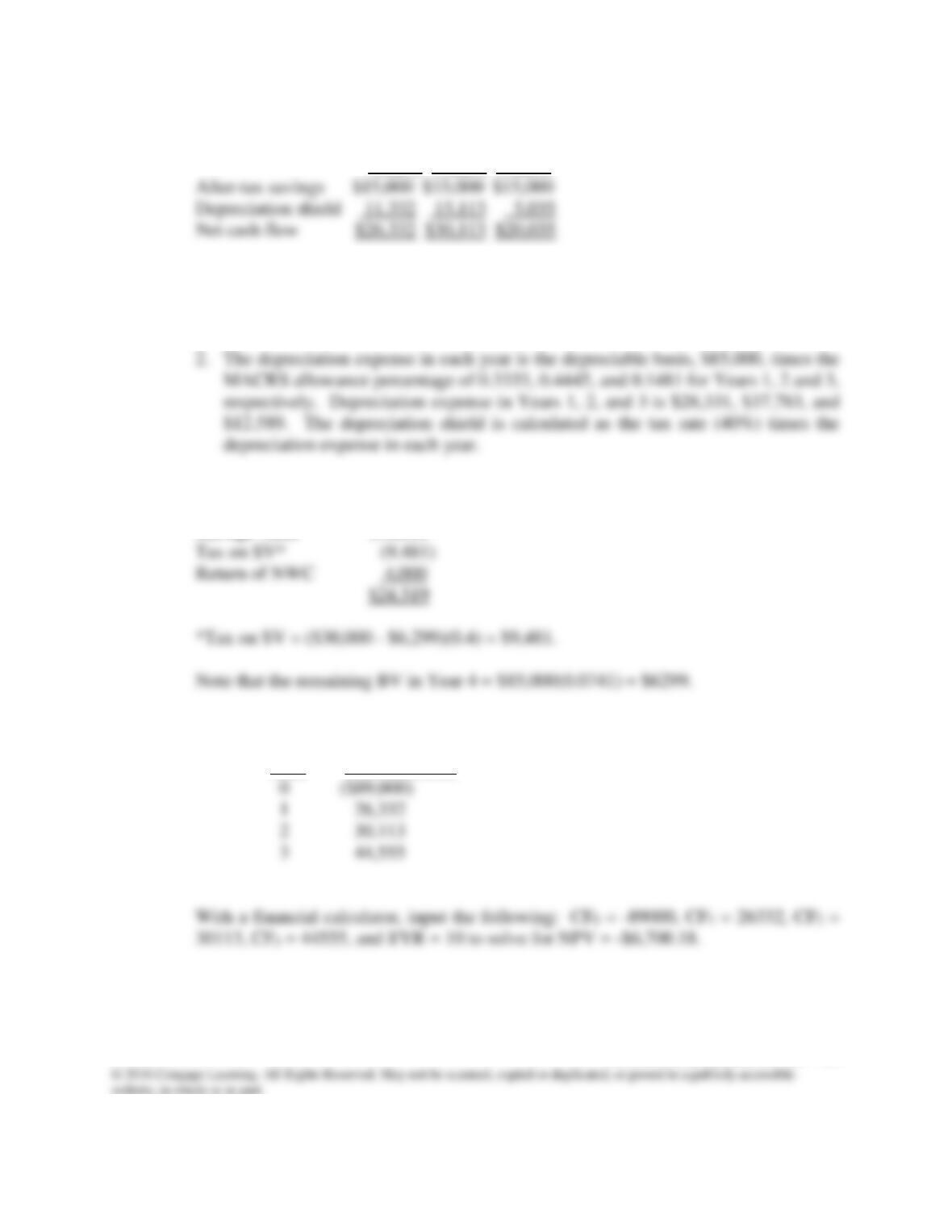
b. The operating cash flows follow:
Year 1 Year 2 Year 3
Notes:
1. The after-tax cost savings is $25,000(1 – T) = $25,000(0.6)
= $15,000.
c. The additional end-of-project cash flow is $24,519:
Salvage value $30,000
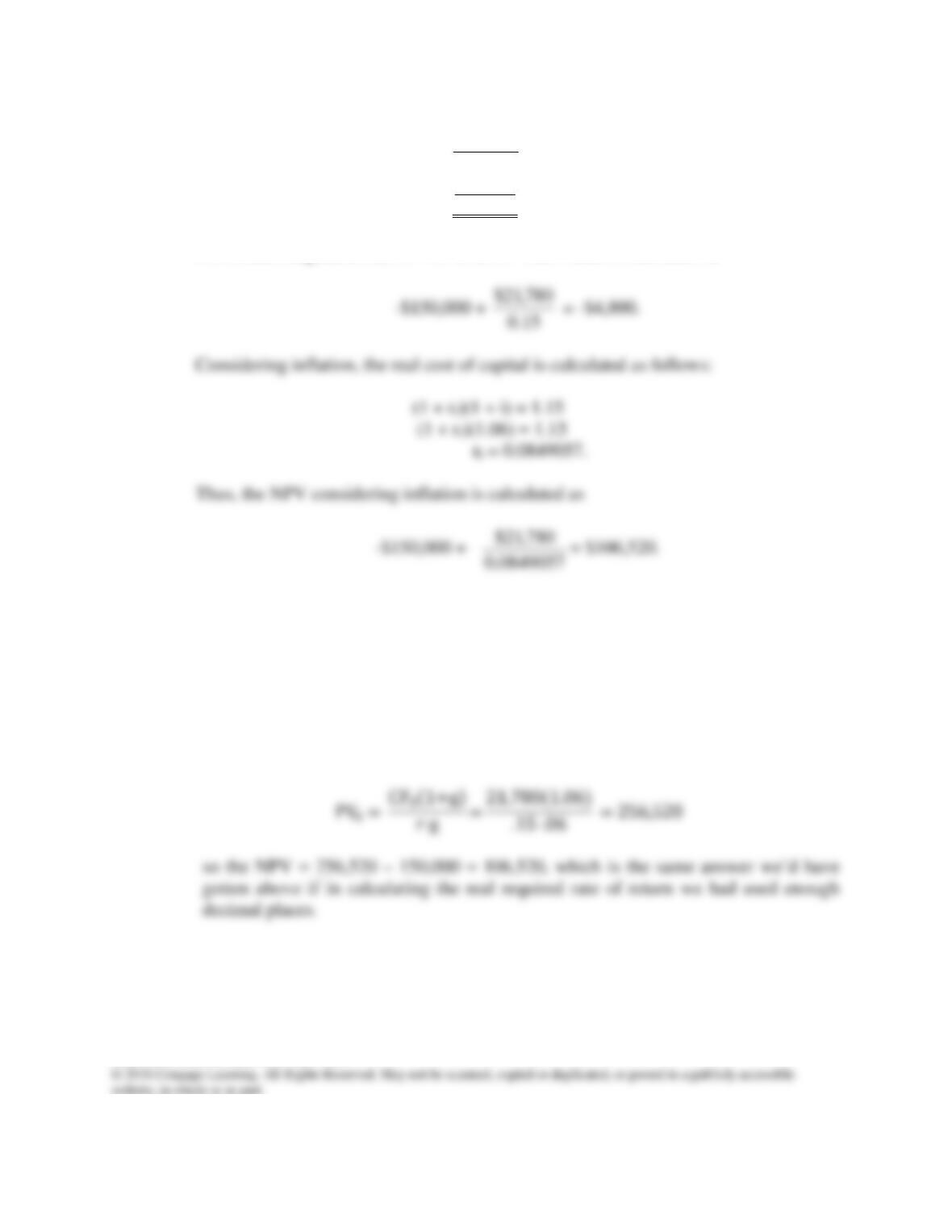
d. The project has an NPV of -$6,700. Thus, it should not be accepted.
Year Net Cash Flow
Answers and Solutions: 13 – 13
13-8 a. Sales = 1,000($138) $138,000
Cost = 1,000($105) 105,000
Net before tax $ 33,000
Taxes (34%) 11,220
Net after tax $ 21,780
Not considering inflation, NPV is -$4,800. This value is calculated as
After adjusting for expected inflation, we see that the project has a positive NPV and
should be accepted. This demonstrates the bias that inflation can induce into the capital
budgeting process: Inflation is already reflected in the denominator (the cost of
capital), so it must also be reflected in the numerator.
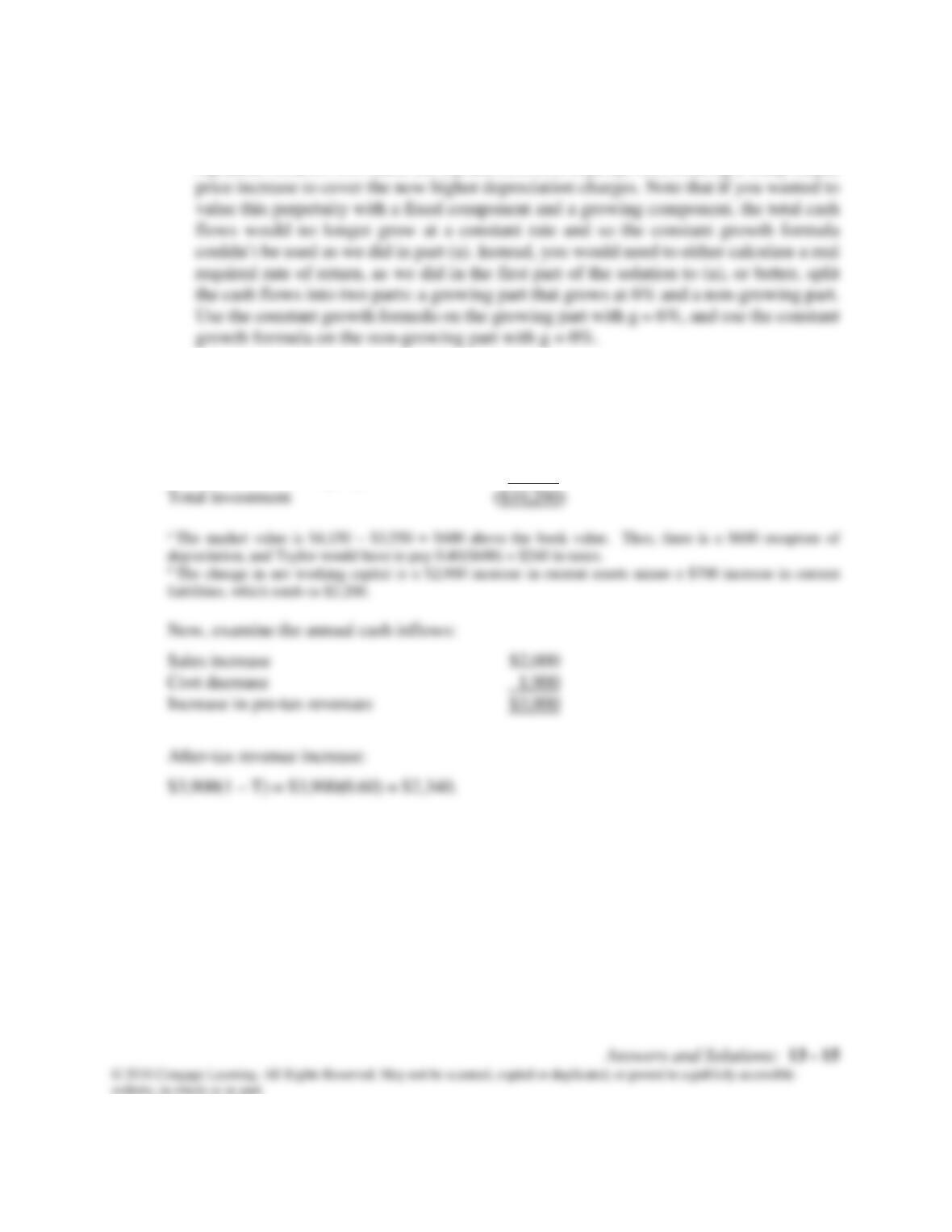
A more straightforward way to calculate the present value without having to calculate
a real required rate of return is to use the constant growth formula, instead. Here, the
present value of all of the future cash flows is:
Answers and Solutions: 13 – 14
b. If part of the costs were fixed, and hence did not rise with inflation, then sales revenues
would rise faster than total costs. However, when the plant wears out and must be
replaced, inflation will cause the replacement cost to jump, necessitating a sharp output
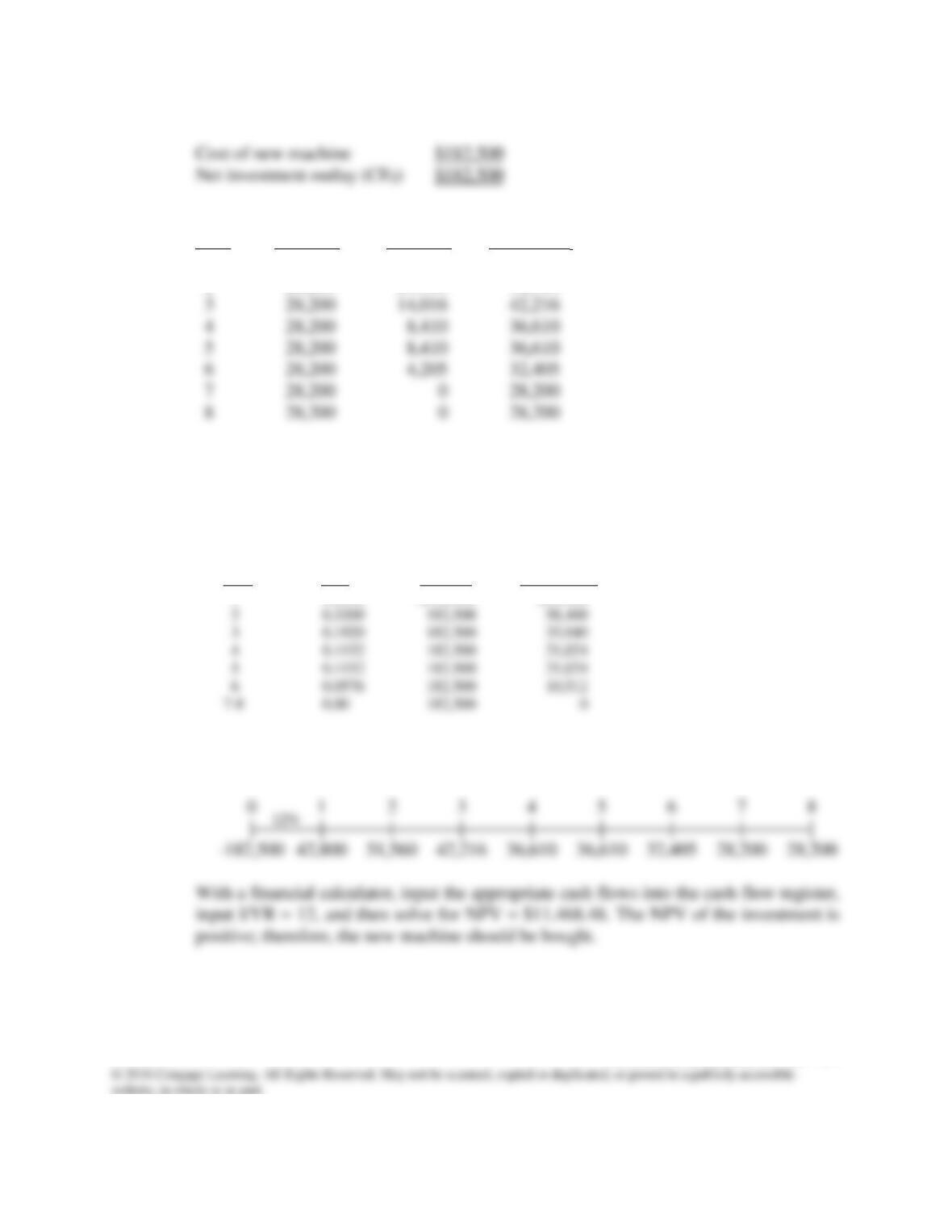
13-9 First determine the net cash flow at t = 0:
Purchase price ($12,000)
Sale of old machine 4,150
Tax on sale of old machine (240)a
Change in net working capital (2,200)b
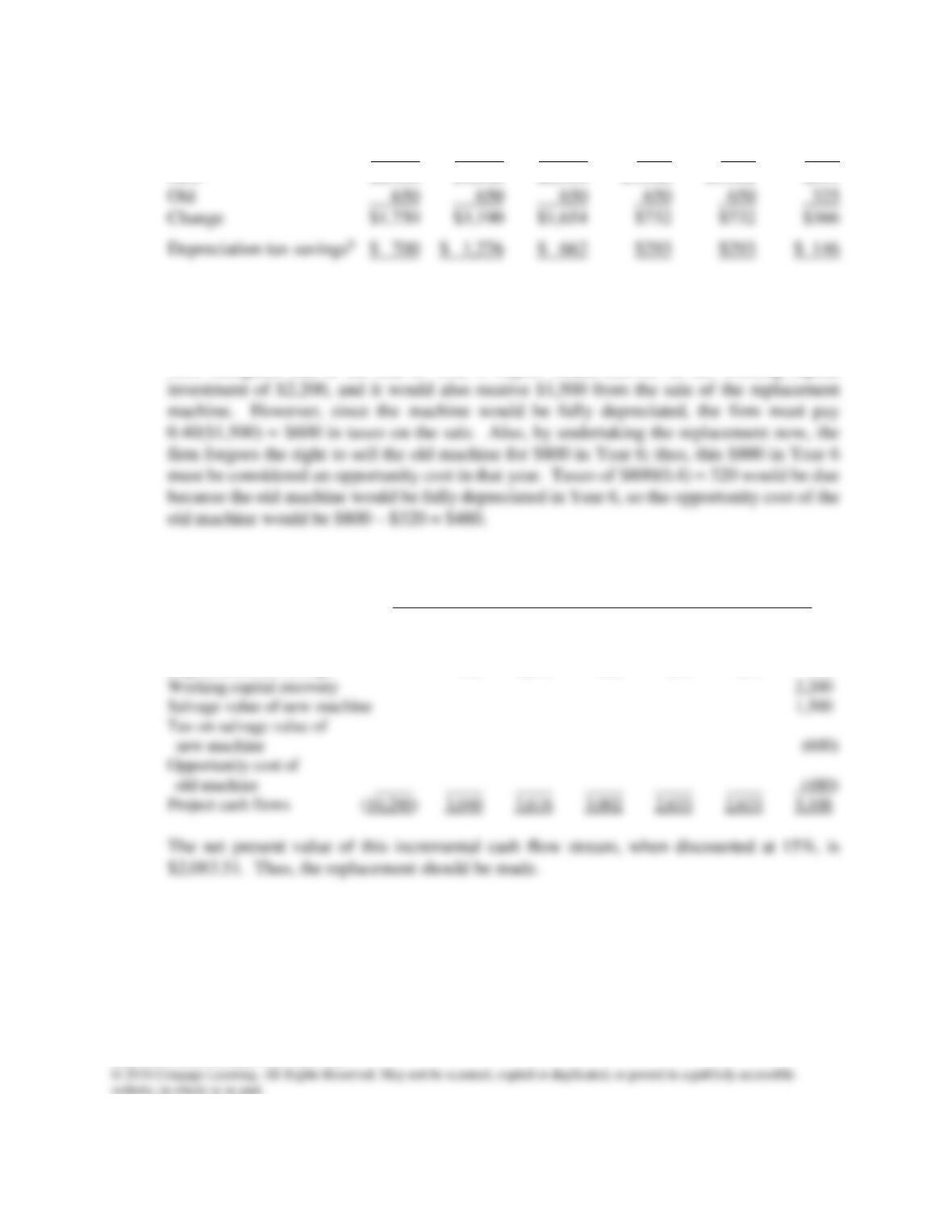
Depreciation:
Year 1 2 3 4 5 6
Newa $2,400 $8,840 $2,304 $1,382 $1,382 $691
a Depreciable basis = $12,000. Depreciation expense in each year equals depreciable basis times the MACRS
percentage allowances of 0.2000, 0.3200, 0.1920, 0.1152, 0.1152, and 0.0576 in Years 1–6, respectively.
b Depreciation tax savings = T(∆Depreciation) = 0.4(∆Depreciation).
Now recognize that at the end of Year 6 Taylor would recover its net working capital
Finally, place all the cash flows on a time line:
0 1 2 3 4 5 6
| | | | | | |
Net investment (10290)
After–tax revenue increase 2,340 2,340 2,340 2,340 2,340 2,340
Depreciation tax savings 700 1,276 662 293 293 146
15%
Answers and Solutions: 13 – 16
13–10 1. Net investment at t = 0:
2. After–tax
Year Earnings T(∆Dep) Annual CFt
1 $28,200 $ 14,600 $42,800
2 28,200 23,360 51,560
Notes:
a. The after–tax earnings are $47,000(1 – T) = $47,000(0.6) = $28,200.
b. Find ∆Dep over Years 1–8:
The old machine was fully depreciated; therefore, ∆Dep = Depreciation on the new machine.
Dep Dep
Year Rate Basis Depreciation
1 0.2000 $182,500 $36,500
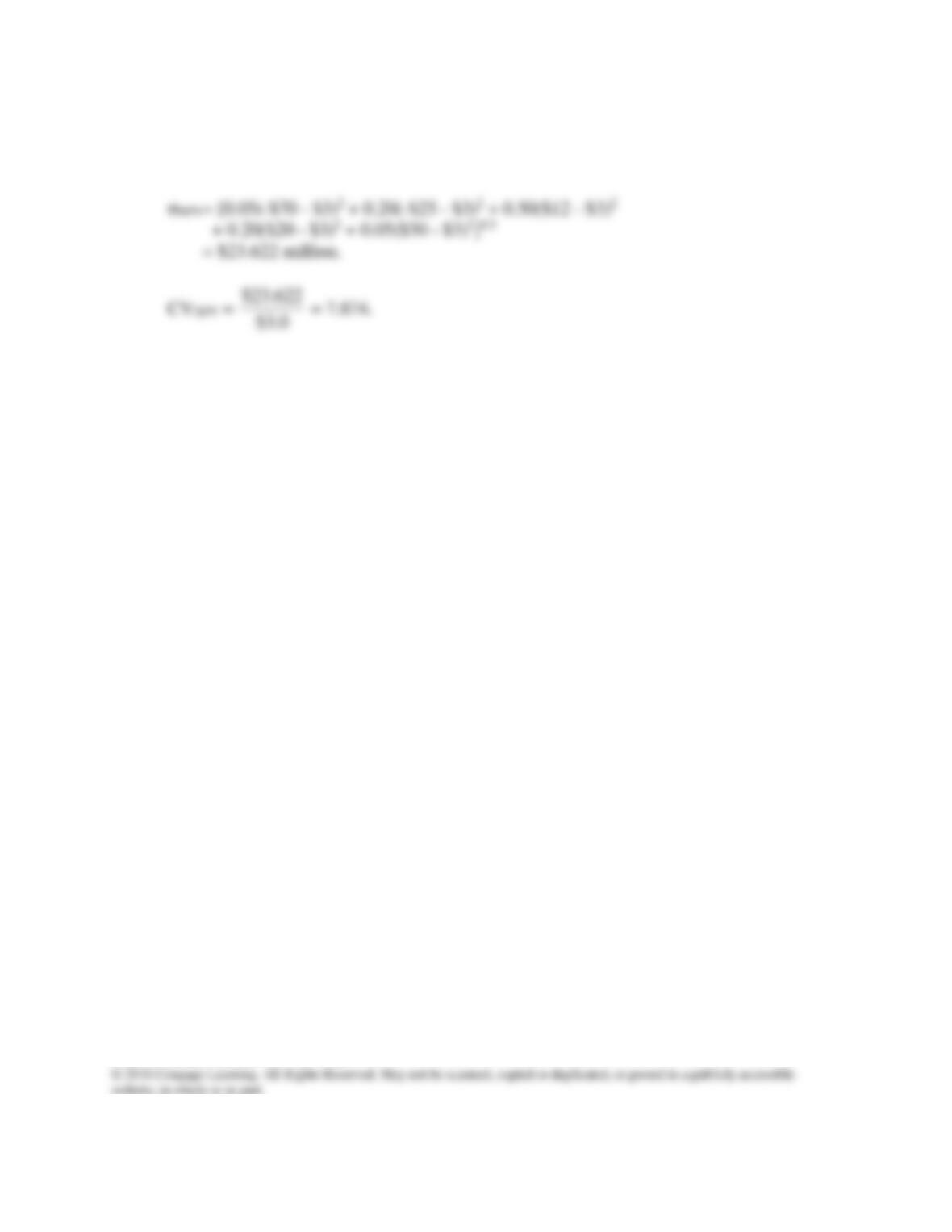
3. Now find the NPV of the replacement machine:
Place the cash flows on a time line:
Answers and Solutions: 13 – 17
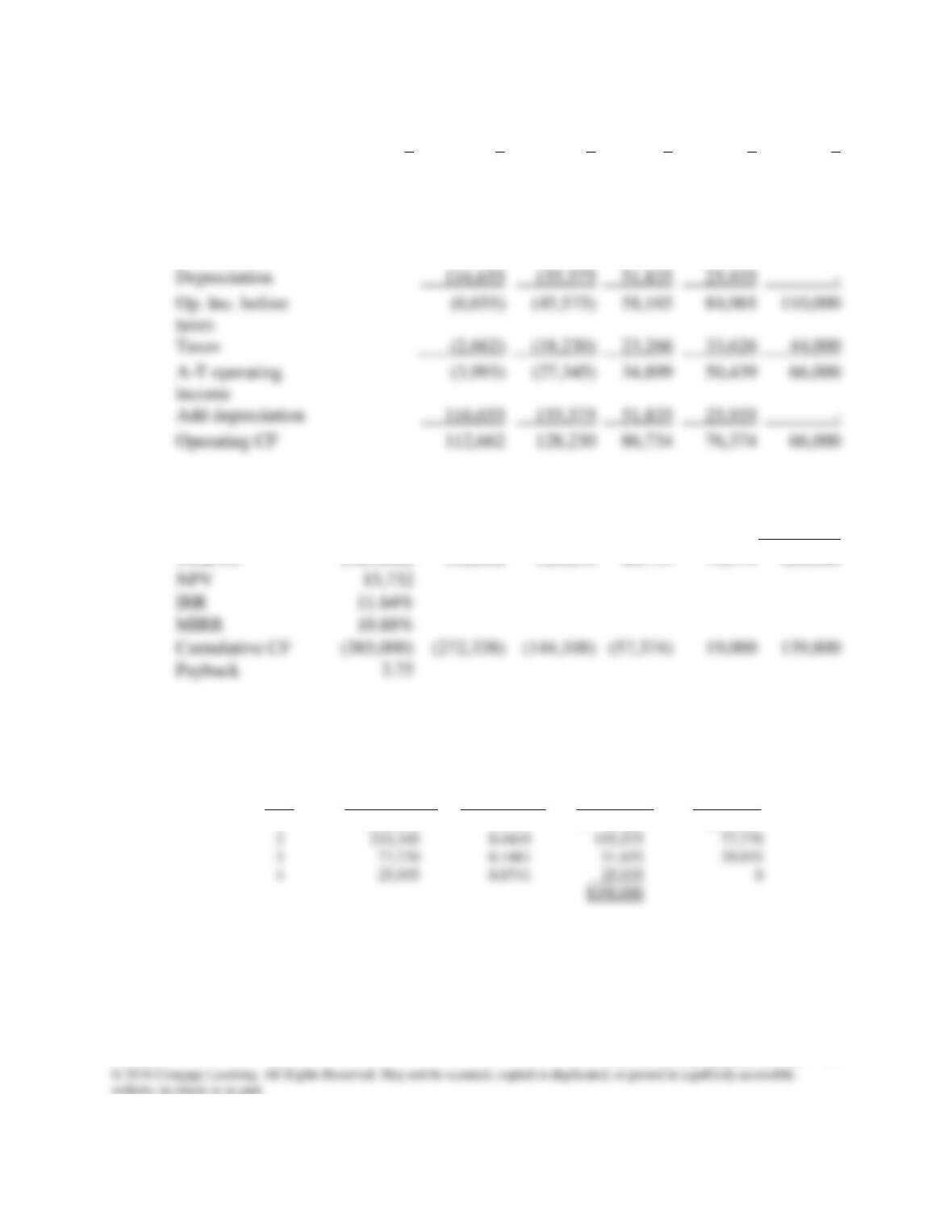
13-11 E(NPV) = 0.05(-$70) + 0.20(-$25) + 0.50($12) + 0.20($20) + 0.05($30)
= -$3.5 + -$5.0 + $6.0 + $4.0 + $1.5
= $3.0 million.
Answers and Solutions: 13 – 18
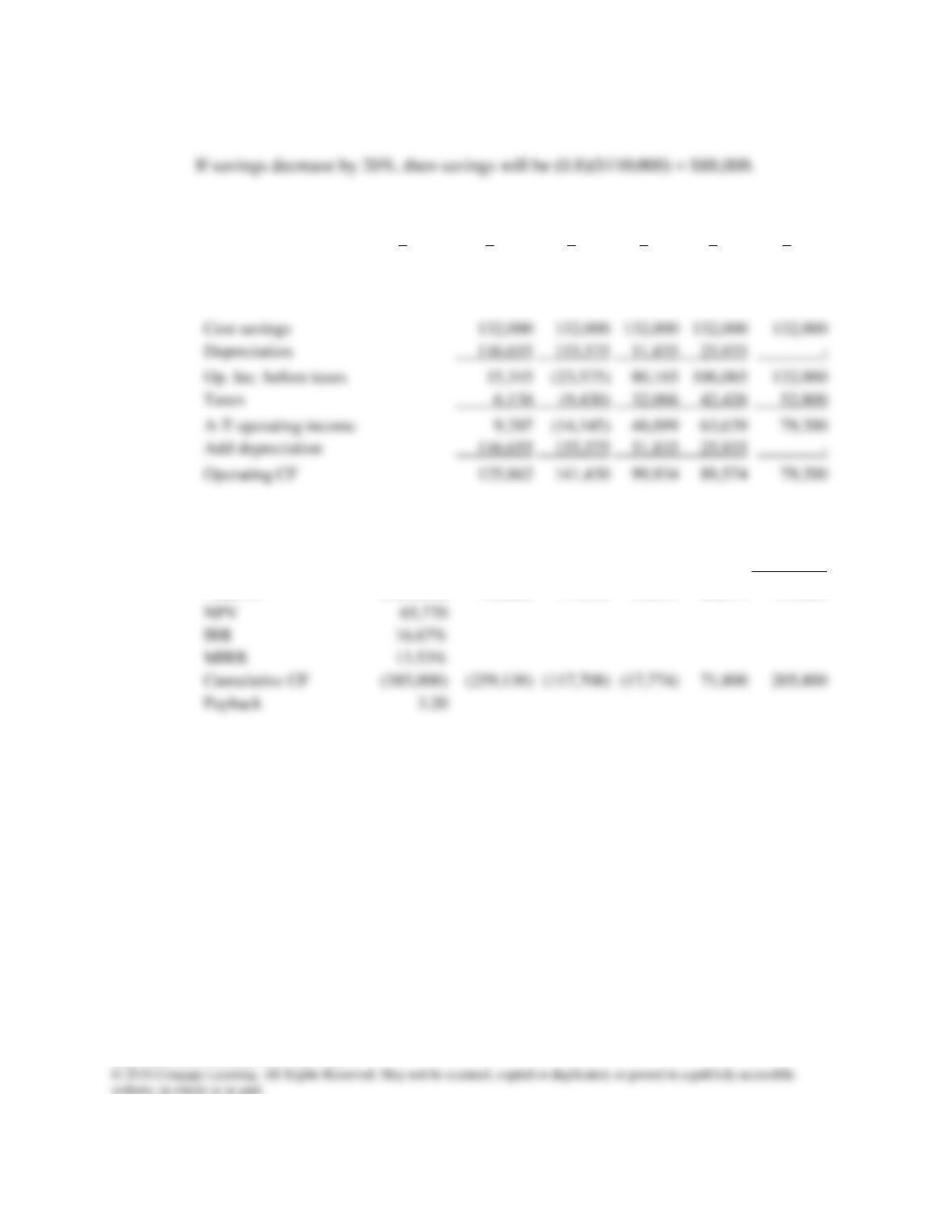
13-12 a.
0
1
2
3
4
5
Machine cost
(350,000)
Net working
capital
(35,000)
Cost savings
110,000
110,000
110,000
110,000
110,000
Return of NWC
35,000
Sale of machine
33,000
Tax on sale
(13,200)
(385,000)
112,662
128,230
86,734
76,374
120,800
15,732
Notes:
a Depreciation Schedule, Basis = $250,000
MACRS Rate
× Basis =
Year Beg. Bk. Value MACRS Rate Depreciation Ending BV
1 $350,000 0.3333 $ 116,665 $233,345
Answers and Solutions: 13 – 19
taxes
(45,575)
84,065
(27,345)
50,439
Add depreciation
Operating CF
112,662
128,230
86,734
76,374
66,000
b. If savings increase by 20%, then savings will be (1.2)($110,000) = $132,000.
(1) Savings increase by 20%:
0
1
2
3
4
5
Machine cost
(350,000)
Net working capital
(35,000)
Cost savings
132,000
132,000
132,000
132,000
132,000
155,575
51,835
25,935
Op. Inc. before taxes
15,345
80,165
106,065
132,000
32,066
42,426
A-T operating income
9,207
48,099
63,639
79,200
Add depreciation
155,575
51,835
25,935
Operating CF
125,862
141,430
99,934
89,574
79,200
Return of NWC
35,000
Sale of machine
33,000
Tax on sale
(13,200)
Total CF
(385,000)
125,862
141,430
99,934
89,574
134,000
16.67%
13.53%
Cumulative CF
(385,000)
71,800
205,800
Answers and Solutions: 13 – 20