
MINI CASE
Shrieves Casting Company is considering adding a new line to its product mix, and the capital
budgeting analysis is being conducted by Sidney Johnson, a recently graduated MBA. The
production line would be set up in unused space in Shrieves’ main plant. The machinery’s
invoice price would be approximately $200,000, another $10,000 in shipping charges would be
required, and it would cost an additional $30,000 to install the equipment. The machinery has
an economic life of 4 years, and Shrieves has obtained a special tax ruling that places the
equipment in the MACRS 3–year class. The machinery is expected to have a salvage value of
$25,000 after 4 years of use.
The new line would generate incremental sales of 1,250 units per year for 4 years at an
incremental cost of $100 per unit in the first year, excluding depreciation. Each unit can be
sold for $200 in the first year. The sales price and cost are expected to increase by 3% per year
due to inflation. Further, to handle the new line, the firm’s net working capital would have to
increase by an amount equal to 12% of sales revenues. The firm’s tax rate is 40%, and its
overall weighted average cost of capital is 10%.
a. Define “incremental cash flow.”
a. 1. Should you subtract interest expense or dividends when calculating project cash
flow?
Answer: The cash flow statement should not include interest expense or dividends. The return
a. 2. Suppose the firm had spent $100,000 last year to rehabilitate the production line
site. Should this cost be included in the analysis? Explain.
Answer: The $100,000 cost to rehabilitate the production line site was incurred last year, and
Mini Case: 13 – 34

a. 3. Now assume that the plant space could be leased out to another firm at $25,000 per
year. Should this be included in the analysis? If so, how?
Answer: If the plant space could be leased out to another firm, then if Shrieves accepts this project,
a. 4. Finally, assume that the new product line is expected to decrease sales of the firm’s
other lines by $50,000 per year. Should this be considered in the analysis? If so,
how?
Answer: If a project affects the cash flows of another project, this is an “externality” that must be
b. Disregard the assumptions in part a. What is Shrieves’ depreciable basis? What
are the annual depreciation expenses?
Answer: The asset’s depreciable basis includes shipping and installation costs. Thus, the asset’s
$240
Mini Case: 13 – 35
c. Calculate the annual sales revenues and costs (other than depreciation). Why is it
important to include inflation when estimating cash flows?
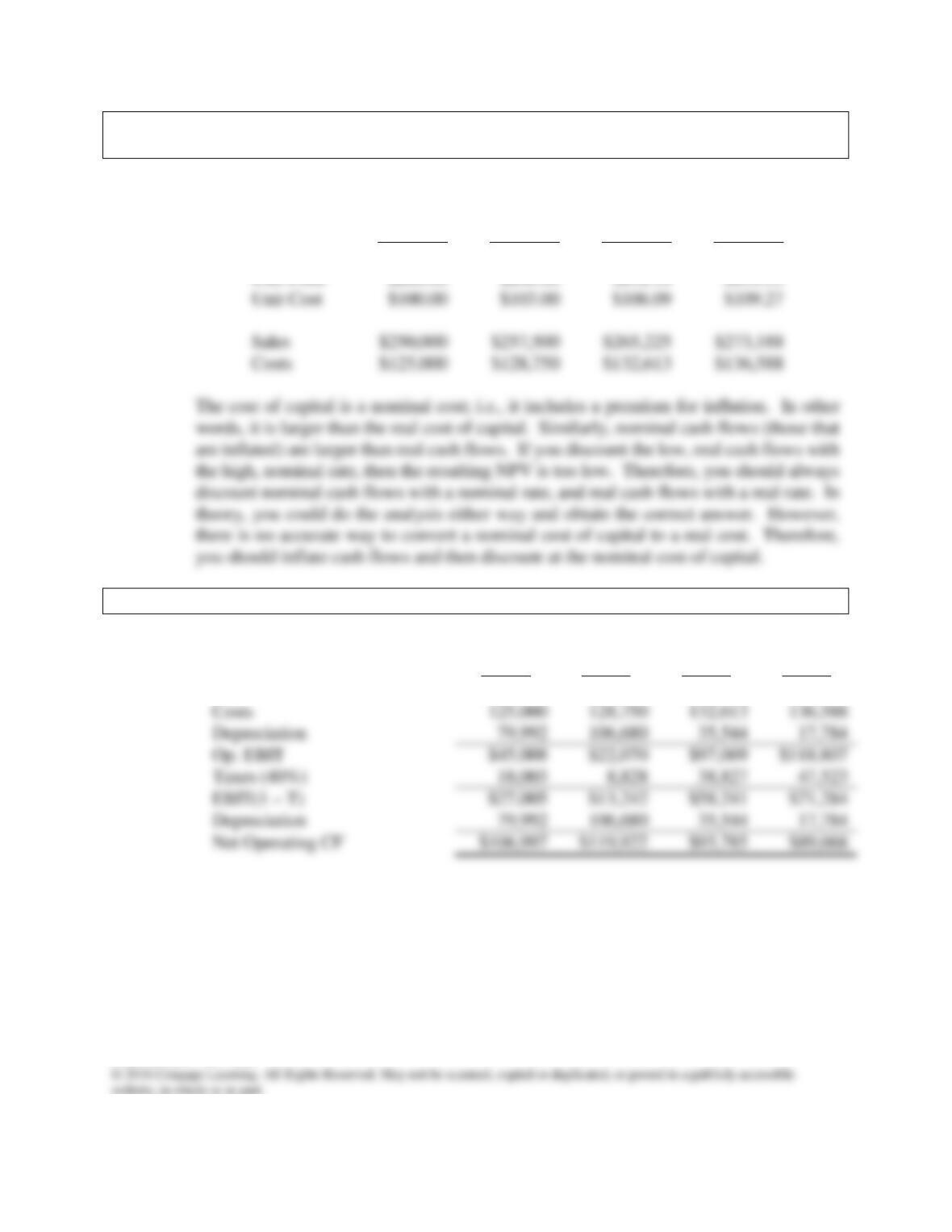
Answer: With an inflation rate of 3%, the annual revenues and costs are:
Year 1 Year 2 Year 3 Year 4
Units 1,250 1,250 1,250 1,250
Unit Price $200.00 $206.00 $212.18 $218.55
d. Construct annual incremental operating cash flow statements.
Answer:
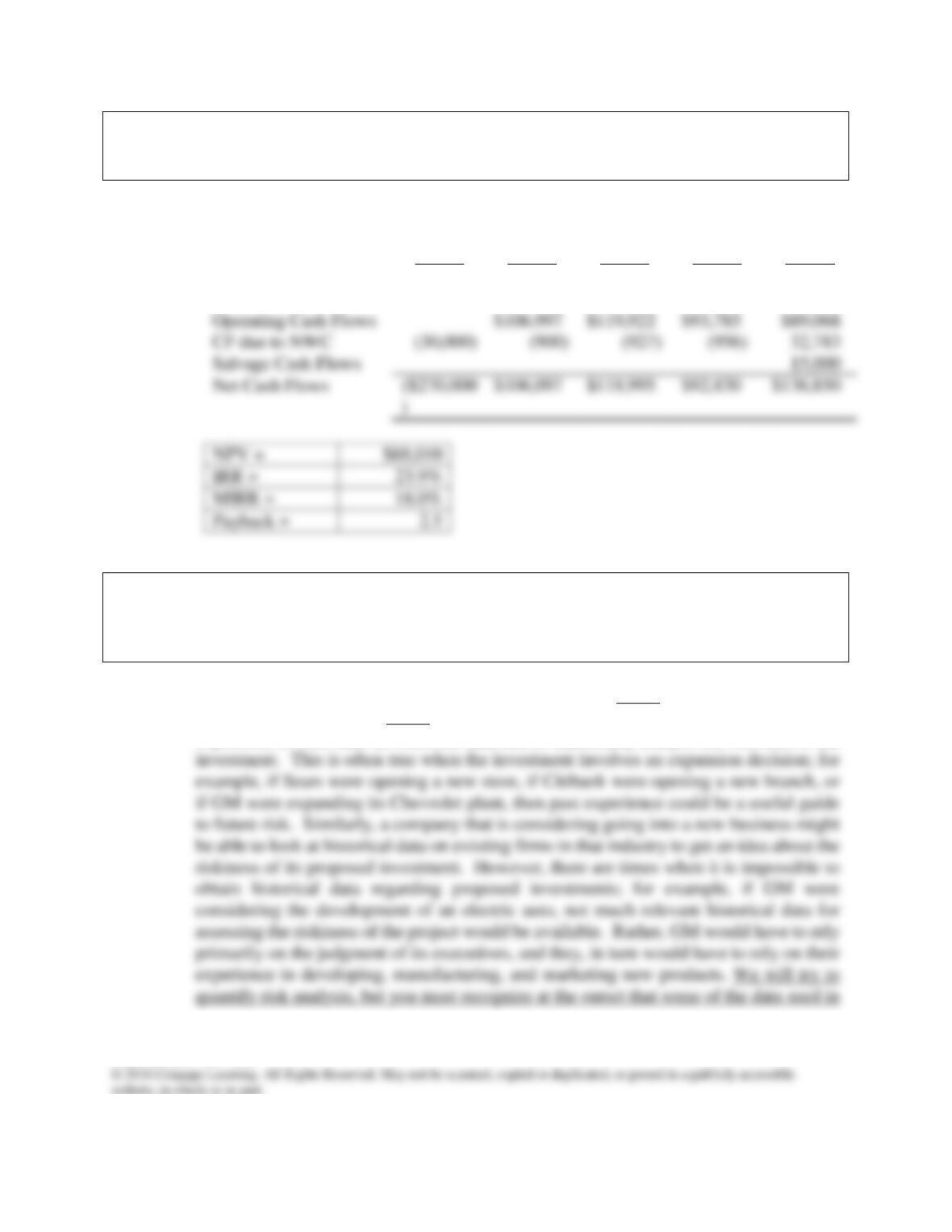
Year 1
Year 2
Year 3
Year 4
Sales
$250,000
$257,500
$265,225
$273,188
Depreciation
$118,807
Depreciation
$106,997
$119,922
Mini Case: 13 – 36

e. Estimate the required net working capital for each year, and the cash flow due to
investments in net working capital.
Answer: The project requires a level of net working capital in the amount equal to 12% of the next
f. Calculate the after–tax salvage cash flow.
Answer: When the project is terminated at the end of Year 4, the equipment can be sold for
$25,000. But, since it has been depreciated to a $0 book value, taxes must be paid on the
Mini Case: 13 – 37
g. Calculate the net cash flows for each year. Based on these cash flows, what are the
project’s NPV, IRR, MIRR, PI, payback, and discounted payback? Do these
indicators suggest the project should be undertaken?
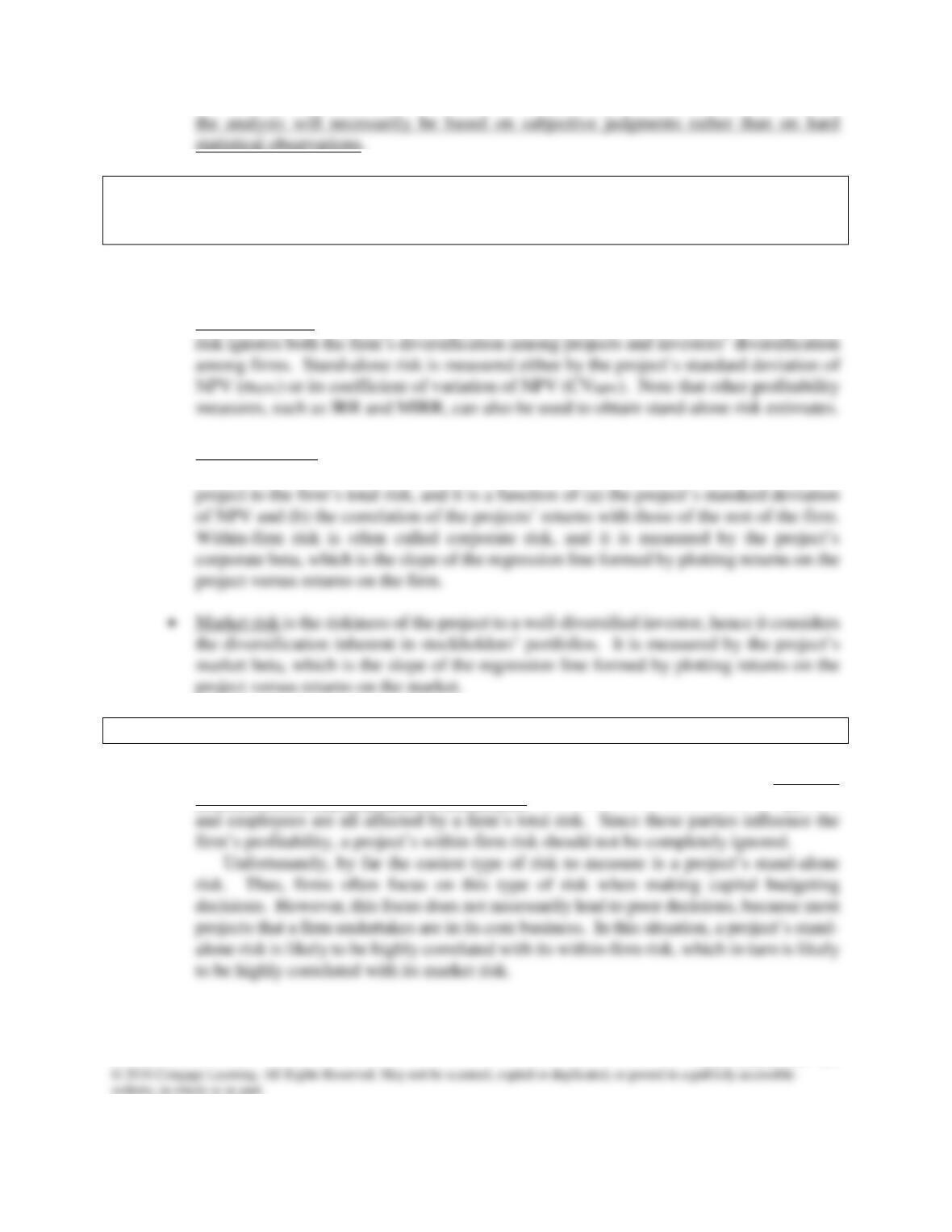
Answer: The net cash flows are:
Year 0
Year 1
Year 2
Year 3
Year 4
Initial Outlay
($240,000
)
h. What does the term “risk” mean in the context of capital budgeting; to what extent
can risk be quantified; and when risk is quantified, is the quantification based
primarily on statistical analysis of historical data or on subjective, judgmental
estimates?
Answer: Risk throughout finance relates to uncertainty about future events, and in capital
budgeting, this means the future profitability of a project. For certain types of projects, it
is possible to look back at historical data and to statistically analyze the riskiness of the
Mini Case: 13 – 38
$93,785
($270,000
)
$92,830
i. 1. What are the three types of risk that are relevant in capital budgeting?
2. How is each of these risk types measured, and how do they relate to one another?
Answer: Here are the three types of project risk:
• Stand–alone risk is the project’s total risk if it were operated independently. Stand–alone
• Within–firm risk is the total riskiness of the project giving consideration to the firm’s
other projects, that is, to diversification within the firm. It is the contribution of the
i. 3. How is each type of risk used in the capital budgeting process?
Answer: Because management’s primary goal is shareholder wealth maximization, the most
relevant risk for capital projects is market risk. However, creditors, customers, suppliers,
Mini Case: 13 – 39

j. 1. What is sensitivity analysis?
Answer: Sensitivity analysis measures the effect of changes in a particular variable, say revenues,
j. 2. Perform a sensitivity analysis on the unit sales, salvage value, and cost of capital for
the project. Assume each of these variables can vary from its base–case, or expected,
value by ±10%, ±20%, and ±30%. Include a sensitivity diagram, and discuss the
results.
Answer: The sensitivity data are given here in tabular form:
Deviation
from
Base Case
NPV Deviation from
Base Case
WACC
Units
Sold
Salvage
-30%
$113,270
$16,649
$84,936
-15%
123,690
159,371
Mini Case: 13 – 40
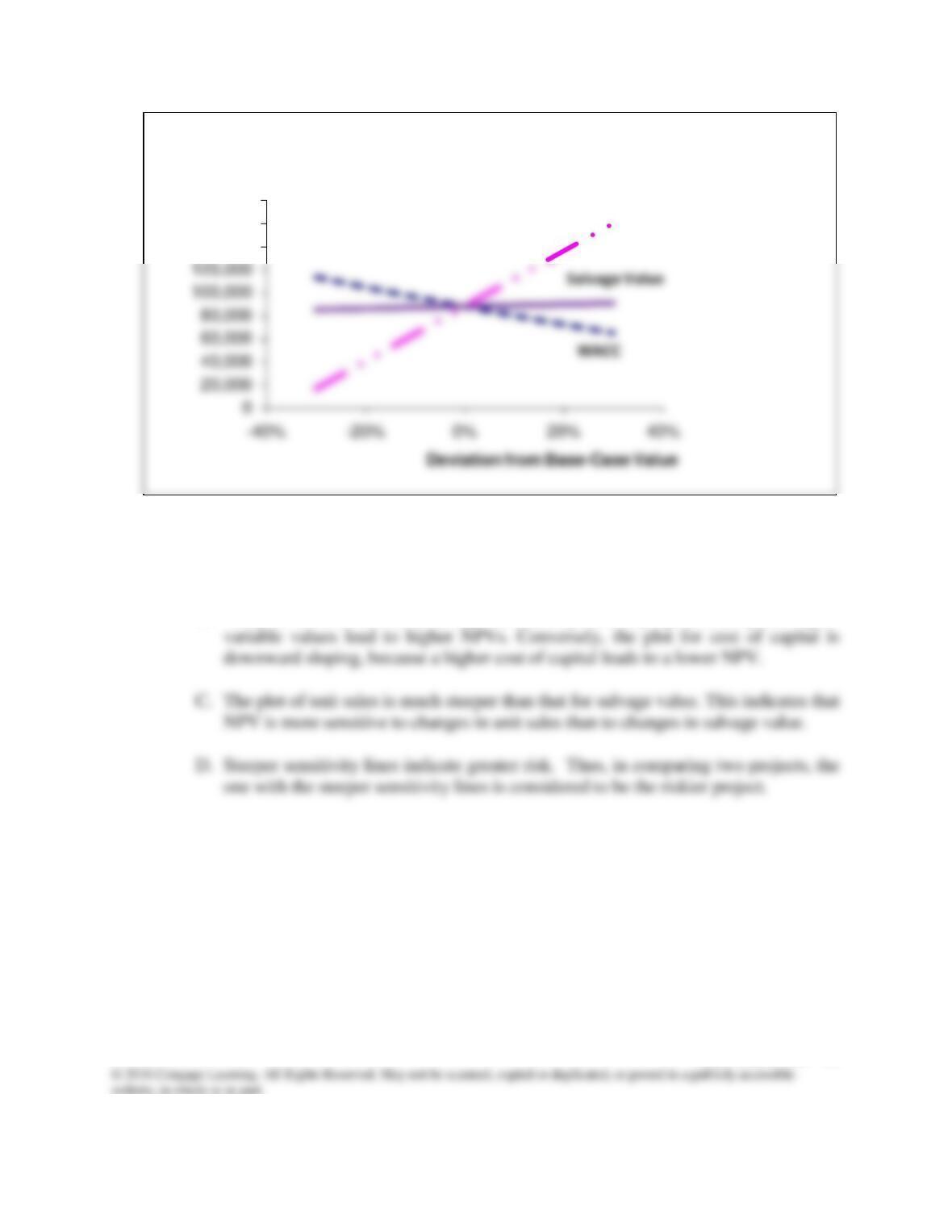
A. The sensitivity lines intersect at 0% change and the base–case NPV, $88,030. Since
all other variables are set at their base–case, or expected, values the zero change
situation is the base case and gives the base–case NPV, $88,030.
B. The plots for unit sales and salvage value are upward sloping, indicating that higher
140,000
160,000
180,000
NPV ($)
Sensitivity Analysis
Units Sold
Mini Case: 13 – 41

j. 3. What is the primary weakness of sensitivity analysis? What is its primary
usefulness?
Answer: The two primary disadvantages of sensitivity analysis are (1) that it does not reflect the
effects of diversification and (2) that it does not incorporate any information about the
k. Assume that Sidney Johnson is confident of her estimates of all the variables that
affect the project’s cash flows except unit sales and sales price. If product
acceptance is poor, unit sales would be only 900 units a year and the unit price
would only be $160; a strong consumer response would produce sales of 1,600 units
and a unit price of $240. Sidney believes that there is a 25% chance of poor
acceptance, a 25% chance of excellent acceptance, and a 50% chance of average
acceptance (the base case).
k. 1. What is scenario analysis?
Answer: Scenario analysis examines several possible situations, usually worst case, most likely
Mini Case: 13 – 42
k. 2. What is the worst–case NPV? The best–case NPV?
k. 3. Use the worst–, base–, and best–case NPVs and probabilities of occurrence to find
the project’s expected NPV, standard deviation, and coefficient of variation.
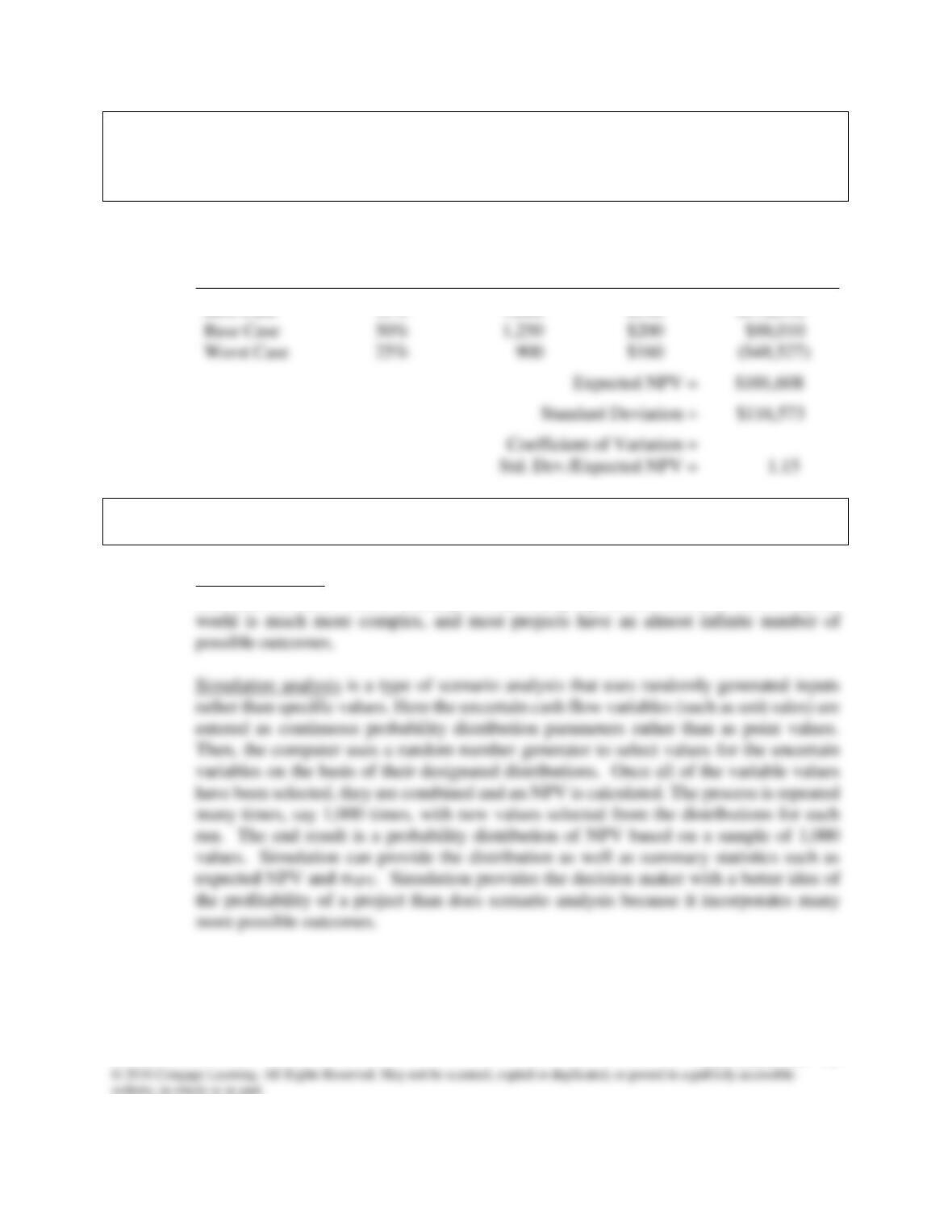
Answer: We used a spreadsheet model to develop the scenarios, which are summarized below:
Scenario
Probability
Unit Sales
Unit Price
NPV
Best Case
25%
1,600
$240
$278,940
l. Are there problems with scenario analysis? Define simulation analysis, and discuss
its principal advantages and disadvantages.
Answer: Scenario analysis examines several possible scenarios, usually worst case, most likely
case, and best case. Thus, it usually considers only 3 possible outcomes. Obviously the
Mini Case: 13 – 43
50%
1,250
$200
Although simulation analysis is technically refined, its usefulness is limited because
managers are often unable to accurately specify the variables’ probability distributions.
m. 1. Assume that Shrieves’ average project has a coefficient of variation in the range of
0.2 to 0.4. Would the new line be classified as high risk, average risk, or low risk?
What type of risk is being measured here?
Answer: The project has a CV of 1.15, which is above the average range of 0.2 to 0.4, so it falls
m. 2. Shrieves typically adds or subtracts 3 percentage points to the overall cost of capital
to adjust for risk. Should the new line be accepted?
Answer: Since the project is judged to have above–average risk, its differential risk–adjusted, or
m. 3. Are there any subjective risk factors that should be considered before the final
decision is made?
Answer: A numerical analysis such as this one may not capture all of the risk factors inherent in
Mini Case: 13 – 44

n. What is a real option? What are some types of real options?
Answer: Real options exist when managers can influence the size and risk of a project’s cash flows
by taking different actions during the project’s life in response to changing market
Mini Case: 13 – 45