
Introduction to Corporate Finance, Fourth Edition Booth, Cleary, Rakita
Difficulty: Intermediate
Solution:
How do we account for the political risk of expropriation or insurrection or the imposition of
Challenging
49. Section: 13.3 Independent and Interdependent Projects
Learning Objective: 13.3
Difficulty: Challenging
Solution:
a. Project D’s life = 5 years, NPV (using discount rate of 10% given earlier) = $65.25. Project
Project D:
Project H:
b.

Introduction to Corporate Finance, Fourth Edition Booth, Cleary, Rakita
50. Section: 13.2 Evaluating Investment Alternatives
Learning Objective: 13.2
Difficulty: Challenging
Solution:
a. Malcolm is assuming that the investors (or the company) will be able to reinvest any cash
51. Section: 13.2 Evaluating Investment Alternatives
Learning Objective: 13.2
Difficulty: Challenging
Solution:
a. Begin by determining the required rate of return (WACC) for the firm. The firm generates
b. To demonstrate the impact on the cash flows to shareholders and debt holders, begin by

Introduction to Corporate Finance, Fourth Edition Booth, Cleary, Rakita
Therefore, at a 5% borrowing rate, the firm will have to pay $115.38 (i.e., $2,307.69 × .05) per
52. Section: 13.2 Evaluating Investment Alternatives
Learning Objective: 13.2
Difficulty: Challenging
Solution:
b. To answer this question, first address the fact that the project is of the same risk class as MLS
53. Section: 13.2 Evaluating Investment Alternatives
Learning Objective: 13.2
Difficulty: Challenging
Solution:
54. Section: 13.2 Evaluating Investment Alternatives
Learning Objective: 13.2

Introduction to Corporate Finance, Fourth Edition Booth, Cleary, Rakita
Difficulty: Challenging
Solution:
Using a financial calculator (TI BA II Plus) to calculate k by using the same method of
calculating IRR:
55. Section: 13.2 Evaluating Investment Alternatives
Learning Objective: 13.2
Difficulty: Challenging
Solution:

Introduction to Corporate Finance, Fourth Edition Booth, Cleary, Rakita
56. Section: 13.2 Evaluating Investment Alternatives
Learning Objective: 13.2
Difficulty: Challenging
Solution:
a. re = 5% + (1.2)(12% – 5%) = 13.4%
b. Project 4:
57. Section: 13.2 Evaluating Investment Alternatives
Learning Objective: 13.2
Difficulty: Challenging
Solution:
Time
0
1
2
3
4
5
Cash Inflows
Initial cost
Maintenance cost
Net Cash Flows
Discount Factor
Present Value
4,136.36
3,760.33
3,418.48
3,107.71
3,570.30
NPV
1,793.18
58. Section: 13.3 Independent and Interdependent Projects

Introduction to Corporate Finance, Fourth Edition Booth, Cleary, Rakita
Learning Objective: 13.3
Difficulty: Challenging
Solution:
First, note that the life of the two projects is not the same and consequently, we need to do more
BAII+: using the CF worksheet:
NPV of PDW581:
BAII+: using the CF worksheet:
Approach 1: The Chain Approach:

Introduction to Corporate Finance, Fourth Edition Booth, Cleary, Rakita
Approach 2: Using the EANPV approach:
59. Section: 13.3 Independent and Interdependent Projects
Learning Objective: 13.3
Difficulty: Challenging
Solution:
60. Section: 13.3 Independent and Interdependent Projects
Learning Objective: 13.3
Difficulty: Challenging
Solution:
Solving the problem by financial calculator (TI BA II Plus):

Introduction to Corporate Finance, Fourth Edition Booth, Cleary, Rakita
61. Section: 13.3 Independent and Interdependent Projects
Learning Objective: 13.3
Difficulty: Challenging
Solution:
Project A:
Project B:
Replicate Project A three times:
Replicate Project B twice:
62. Section: 13.3 Independent and Interdependent Projects
Learning Objective: 13.3
Difficulty: Challenging
Solution:
63. Section: 13.4 Capital Rationing

Introduction to Corporate Finance, Fourth Edition Booth, Cleary, Rakita
Learning Objective: 13.4
Difficulty: Challenging
Solution:
First calculate each project’s NPV:
Project A:
Project B:
Project C:
Combinations
Total budget
Total NPV
Within the budget?
A & B
220,000
61,186.82
Yes
A & C
250,000
56,098.46
Yes
B & C
230,000
64,657.68
Yes
64: Section: Appendix 13A Modified Internal Rate of Return
Learning Objective: 13.6
Difficulty: Challenging
Solution:
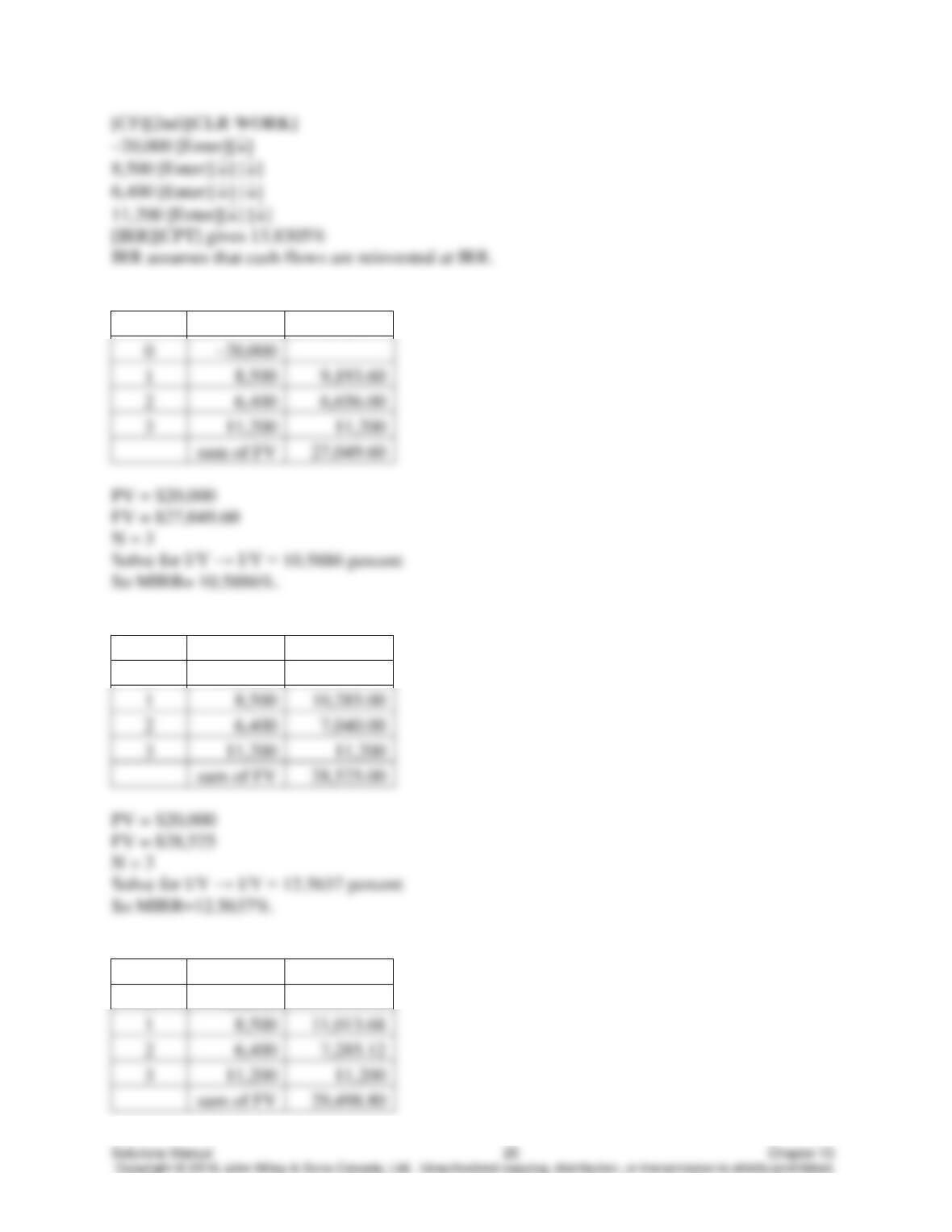
a. IRR is the discount rate that makes the NPV equal to zero for a given set of cash flows. This
Introduction to Corporate Finance, Fourth Edition Booth, Cleary, Rakita
b. At an annual interest rate of 4%:
cf
FV of cf
0
–20,000
1
2
3
c. At an annual interest rate of 10%:
cf
FV of cf
0
–20,000
1
2
3
d. At an annual interest rate of 13.83%:
cf
FV of cf
0
–20,000
1
2

Introduction to Corporate Finance, Fourth Edition Booth, Cleary, Rakita

Introduction to Corporate Finance, Fourth Edition Booth, Cleary, Rakita
Answers to Concept Review Questions
13.1 Capital Expenditures
Concept Review Questions
1. What is the difference between a tangible asset and an intangible asset?
Tangible assets include property, plant and equipment; intangible assets include research and
2. What are irrevocable investment decisions? Why are they important for capital budgeting?
A firm’s capital expenditures (capex) usually involve large amounts of money and the decisions
3. Contrast top down and bottom up analysis.
Bottom up analysis is based on the idea that a firm is simply a set of capex decisions.
4. In what ways is DCF capex analysis similar to valuing common shares, and in what ways is it
different?
DCF capex analysis is similar to valuing common shares is that we need to estimate the timing
13.2 Evaluating Investment Alternatives
Concept Review Questions
1. Why is the payback period a poor evaluation technique?
The payback period has some important drawbacks. It disregards the time and risk value of
2. What discount rate do we use to determine the NPV of a project and why?
3. Why do we sometimes get multiple IRRs for a project?

Introduction to Corporate Finance, Fourth Edition Booth, Cleary, Rakita
4. What are the reinvestment rate assumptions underlying NPV and IRR?
5. What is the crossover rate?
6. Is the PI rule consistent with the NPV rule?
13.3 Independent and Interdependent Projects
Concept Review Questions
1. What is the difference between independent and mutually exclusive projects?
Two or more independent projects are those that have no relationship with one another. This
2. How can we compare two choices, one involving a wooden bridge lasting 10 years and
another involving a steel bridge lasting 25 years that costs more?
13.4 Capital Rationing
Concept Review Questions
1. What complications arise when firms are rationed in terms of their available capital budget?
Theoretically, firms should accept all independent projects that generate positive NPVs, which
2. Explain how firms should decide which projects to accept and which to reject when capital
rationing exists.
3. How and why do we adjust the discount rate for multi-divisional firms?
If a project is a typical investment, and will not substantially change the asset mix of the
4. What mistakes can occur if firms do not make the appropriate adjustments?
The firm may accept a project with negative NPV, or reject a project with positive NPV. By
Introduction to Corporate Finance, Fourth Edition Booth, Cleary, Rakita
13.5 International Considerations
Concept Review Questions
1. What is so different about evaluating FDI compared to domestic projects?
Some practical difficulties arise when attempting to apply the NPV evaluation process to foreign
investments. For example:
• How do we account for the political risk of expropriation or an insurrection or the imposition
2. Name some unique risks that may arise when evaluating FDI.
• Breach of contract risk
Appendix 13A The Modified Internal Rate of Return (MIRR)
Concept Review Questions
1. What improvement does MIRR represent over traditional IRR?
2. When will a calculated MIRR be greater than a calculated IRR?