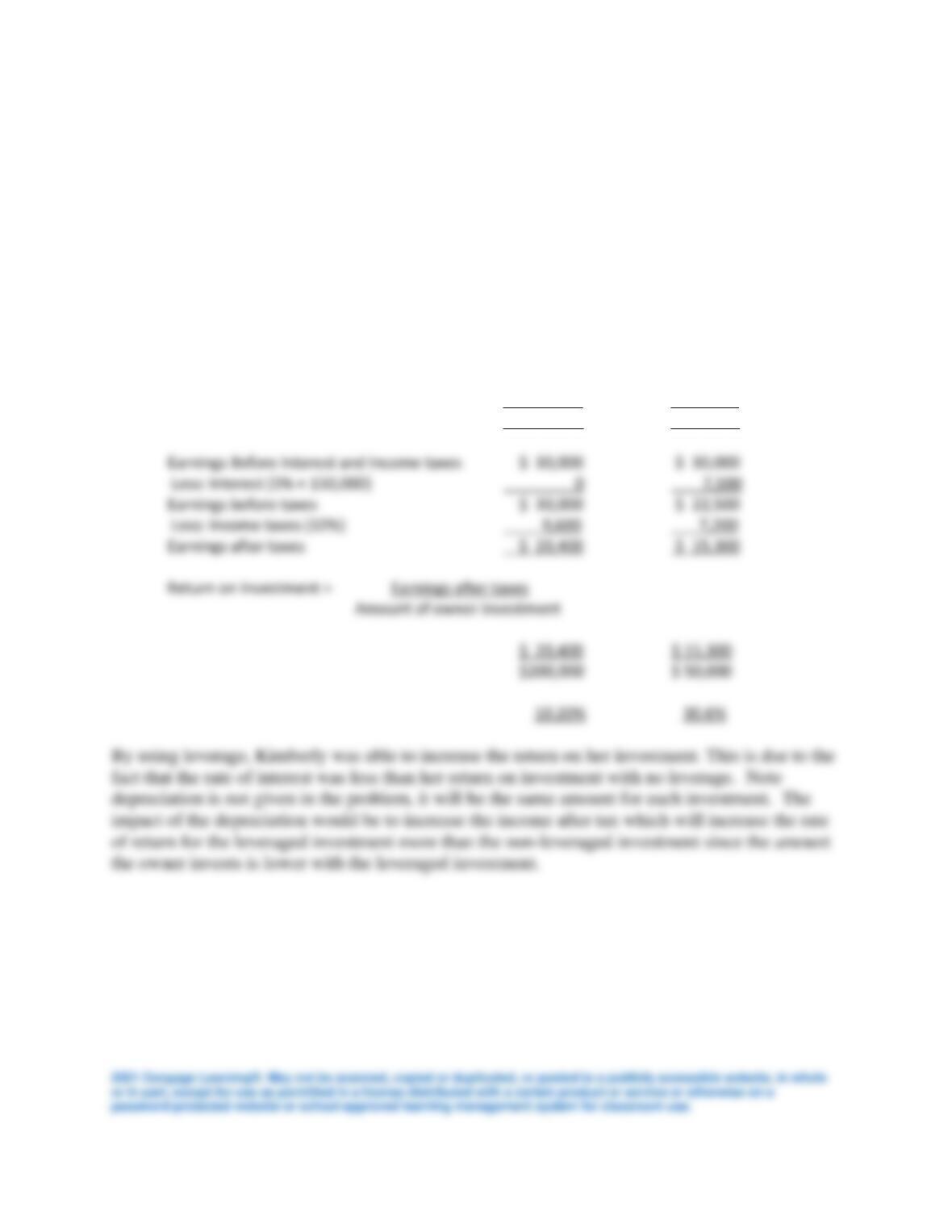
13. Investing in residential income-producing property. Kimberly Bishop is thinking about
investing in some residential income-producing property that she can purchase for
$200,000. Kimberly can either pay cash for the full amount of the property or put up
$50,000 of her own money and borrow the remaining $150,000 at 5 percent interest. The
property is expected to generate $30,000 per year after all expenses but before interest and
income taxes. Assume that Kimberly is in the 32 percent tax bracket. Calculate her annual
profit and return on investment, assuming that she (a) pays the full $200,000 from her own
funds or (b) borrows $150,000 at 5 percent. Then discuss the effect, if any, of leverage on
her rate of return.
No Leverage Leveraged
Owner investment $200,000 $ 50,000
Borrowed Money 0 150,000
Total Investment $200,000 $200,000

a. The type of REIT that each represents (e.g., apartment, office, mortgage).
b. The type and quality of the properties they hold.
c. Each REIT’s financial performance and management track record.
Based on your analysis, in which REIT would you invest? Explain why in terms of how it
does or does not meet your investment objectives.
Here are two that are near the top of the listing.
Type of
REIT
Type and Quality
Financial
Performance
Alexandria Real Estate
Equities, Inc. (ARE)
Office
Office, focused on collaborative
science and technology campuses in
urban innovation clusters. Alexandria
Yield 2.5%

15. Finding real estate stocks. Using Yahoo Finance or another investor information
Internet site, find three real estate-related stocks. Evaluate them as potential additions to
your portfolio. Do you think they provide the same degree of diversification as other forms
of real estate investments? Explain.
Student choices and evaluation will vary. A sample answer is provided to show that it can be
done.
Sun Communities (NYSE:SUI). Dividend yield 1.89%. Manufactured homes are showing the
highest percentage growth of all REIT sub sectors in 2019. Sun Communities is one of the
leading REITs in this sector and focuses on the midwestern and southeastern United States.

Critical Thinking Cases
13.1 Kyle’s Dilemma: Common Stocks, Mutual Funds, or ETFs?
Kyle Watkins has worked in the management services division of Niche Consultants for the
past 5 years. He currently earns an annual salary of about $120,000. At 33, he’s still a
Critical Thinking Questions
1. Explain to Kyle the key reasons for purchasing mutual fund or ETF shares.
Mutual funds offer professional management with substantial support from security analysts who
2. What special fund features might help Kyle achieve his investment objectives?
There are mutual funds for all types of risk. If Kyle wants to go for appreciation, there are
3. What types of mutual funds or ETFs would you recommend to Kyle?
4. What recommendations would you make regarding Kyle’s dilemma about whether to go
into stocks, mutual funds, or ETFs? Explain.
5. Explain to Kyle the rationale for choosing ETFs over mutual funds.
ETFs offer trading during the day and a variety of index funds to match whatever interest Kyle
13.2 Jada Considers Mutual Funds and ETFs
Jada Wagner is the director of a major charitable organization in Savannah, Georgia. A
single mother of one young child, she earns what could best be described as a modest
income. Because charitable organizations aren’t known for their generous retirement
Critical Thinking Questions
1. In view of Jada’s long-term investment goals, do you think mutual funds or ETFs are the
more appropriate investment vehicle for her?
I suggest mutual funds. ETFs have higher fees and she does not need the flexibility they
provide.
2. Do you think that Jada should use her $15,000 savings to start a mutual fund or an ETF
investment program?
Jada needs to keep some funds for emergencies. The guide is to have 6 to 9 months of living
3. What type of mutual fund or ETF investment program would you set up for Jada? In
your answer, discuss the types of funds you’d consider, the investment objectives you’d set,
and any investment services (such as withdrawal plans) you’d seek. Would taxes be an
important consideration in your investment advice? Explain.

As before, I would use a money market for her emergency fund; move the $250 per quarter
4. Do you think some type of real estate investment would make sense for Jada? If so, what
type would you suggest? Explain.
Test Yourself
13-1 What is a mutual fund? Why are diversification and professional management so
important to mutual funds?
A mutual fund is a financial services organization that receives money from its shareholders and
13-2 Who are the key players in a typical mutual fund organization?
The primary players are the investors and the money managers who takes the investor’s money
and invest it for them. Supporting the money managers are security analysts who investigates
13-3 What’s the difference between an open-end mutual fund and an ETF?
An exchange traded fund (ETF) is an investment company whose shares trade on stock
exchanges. Unlike mutual funds, ETF shares can be bought or sold (or sold short) throughout the
day.

13-4 What types of ETFs are available to investors?
Most all ETFs are structured as index funds, set up to match the performance of a certain market
segment; they do this by owning all or a representative sample of the stocks (or bonds) in a
targeted market segment or index. Thus, ETFs offer the professional money management of
13-5 What’s the difference between a load fund and a no-load fund?
Most open-end mutual funds are so-called load funds because they charge a commission when
the shares are purchased (such charges are often referred to as frontend loads).
13-6 What is a 12b-1 fund? Can such a fund operate as a no-load fund?
Also known as hidden loads, 12b-1 fees have been allowed by the Securities and Exchange
13-7 Briefly describe a back-end load, a low load, and a hidden load. How can you tell what

Funds that charge a commission—or a redemption fee—when you sell your shares are known as
back-end load funds. These charges tend to decline over time and usually disappear altogether
after five or six years.
13-8 What’s the difference between a growth fund and a balanced fund?
The objective of a growth fund is simple—capital appreciation. Long-term growth and capital
13-9 What’s an international fund, and how does it differ from a global fund?
The term international fund is used to describe a type of fund that invests exclusively in foreign
securities, often confining the fund’s activities to specific geographical regions (such as Mexico,
13-10 What’s an asset allocation fund? How do these funds differ from other types of
mutual funds?
Asset allocation funds spread investors’ money across all different types of markets. That is,
whereas most mutual funds concentrate on one type of investment—whether it be stocks, bonds,

13-11 If growth, income, and capital preservation are the primary objectives of mutual
funds, why do we bother to categorize them by type?
There is a mutual fund for any plan an investor wants to follow. Granted all have the same
13-12 What are fund families? What advantages do these families offer investors?
Family of funds are offered by investment companies in order to offer the investor choices
13-13 What are automatic reinvestment plans, and how do they differ from automatic
investment plans?
Automatic reinvestment is one of the real draws of mutual funds, and it’s offered by just about
13-14 What are the most common reasons for buying mutual funds and ETFs?
Individuals tend to use these investment vehicles for one or more of these reasons: (1) to achieve
diversification in their investment holdings, (2) to obtain the services of professional money
13-15 Briefly describe the steps in the mutual fund selection process.
The selection process itself (especially regarding the types of funds to purchase) obviously plays
an important role in defining the amount of success you’ll have with mutual funds or ETFs. It
means putting into action all you know about investing in order to gain as much return as

13-16 Why does it pay to invest in no-load funds rather than load funds? Under what
conditions might it make sense to invest in a load fund?
With no-load funds, the cost are less. Load funds are charging more so you may expect to get
13-17 Identify three potential sources of return to mutual fund and ETF investors, and
briefly discuss how each could affect total return to shareholders.
Mutual funds and ETFs pay dividends, have capital appreciation, and have gains [and losses]
13-18 Which would you rather have: $100 in dividend income or $100 in capital gains
distribution? $100 in realized capital gains or $100 in unrealized capital gains?
Between capital gains and dividends in a mutual fund, there is little difference Both the gain
13-19 Describe how to evaluate the attractiveness of investing in an index-based ETF.
The primary reason for investing in an index-based ETF, of course, is to replicate the
performance of the index. It follows that an important aspect of ETF performance is how well it

13-20 How important is general market in affecting the price performance of mutual
funds?
Since a mutual fund is really a large portfolio of securities, it behaves very much like the market
13-21 Define and briefly discuss the role of each of these factors in evaluating a proposed
real estate investment:
a. Cash flow and taxes
Cash flow and taxes: An investor’s cash flow, or annual after-tax earnings, depends not only on
b. Appreciation in value
Appreciation in value: Most types of real estate – including everything from raw land to various
forms of income-producing properties – have experienced significant growth in value over time.
c. Use of leverage
Use of leverage: Leverage involves the use of borrowed money to magnify returns, which is a
13-22 Why is speculating in raw land considered a high-risk venture?
13-23 Describe the major categories of income property, and explain the advantages and
disadvantages of investing in income property. How can a single-family home be used to
generate income?
The major categories of income property include commercial properties and multi-family
residential rental properties. The advantages of investing in income properties is that they
13-24 Describe how the following securities allow investors to participate in the real estate
market.
a. Stock in real estate–related companies
If you buy stock in publicly traded real estate–related companies, you are investing indirectly in
b. Real estate limited partnerships (LPs) or limited liability companies (LLCs)
Most of these are local and not traded on exchanges. Some very large LPs or LLCs are listed on
13-25 Briefly describe the basic structure and investment considerations associated with a
REIT. What are the three basic types of REITs?
A real estate investment trust (REIT) is a type of closed-end investment company that invests
money in various types of real estate and real estate mortgages. A REIT is like a mutual fund in
Key Terms
12b-1 fee
.
A annual fee that’s supposed to be used to offset promotion and selling
expenses
automatic
investment plan
amount of money systematically into a given mutual fund.
automatic
reinvestment plan
A plan that gives share owners the option of electing to have dividends
and capital gains distributions reinvested in additional fund shares.
back-end load
.
A commission charged for redeeming fund shares
closed-end
investment
company
An investment company that issues a fixed number of shares, which
are themselves listed and traded like any other share of stock.
An automatic savings program that enables an investor to channel a set
exchange traded
fund (ETF)
An investment company whose shares trade on stock exchanges; unlike
mutual funds, ETF shares can be bought or sold (or sold short)
throughout the day. ETFs are usually structured as an index fund that’s
set up to match the performance of a certain market segment.
general-purpose
money fund
A money fund that invests in virtually any type of short-term
investment vehicle.
government
securities money
fund
A money fund that limits its investments to short-term securities of the
U.S. government and its agencies.
income (income-
producing)
property
Real estate purchased for leasing or renting to tenants in order to
generate ongoing monthly/annual income in the form of rent receipts.
international fund
A mutual fund that does all or most of its investing in foreign
securities.
load fund
.
A fund that charges a fee at time of purchase.
low-load fund
A fund that has a low purchase fee
management fee
A fee paid to the professional money managers who administer a
mutual fund’s portfolio.
mutual fund
A financial services organization that receives money from its
shareholders and invests those funds on their behalf in a diversified
portfolio of securities.
net asset value
(NAV)
The current market value of all the securities the fund owns, less any
liabilities, on a per-share basis.
open-end
investment
company
sells at a price based on the current market value of the securities it
owns; also called a mutual fund.
pooled
diversification
A process whereby investors buy into a diversified portfolio of
securities for the collective benefit of individual investors.
socially responsible
fund (SRF)
A fund that invests only in companies meeting certain moral, ethical,
and/or environmental criteria.
systematic
withdrawal plan
A plan offered by mutual funds that allows shareholders to be paid
specified amounts of money each period.
tax-exempt money
fund
A money fund that limits its investments to short-term, tax-exempt
municipal securities.

Investing in Mutual Funds, ETFs, and Real Estate
Chapter Outline
Learning Objectives
I. Mutual Funds and Exchange Traded Funds: Some Basics
A. The Mutual Fund Concept
1. Pooled Diversification
B. Why Invest in Mutual Funds or ETFs?
4. Convenience
C. How Mutual Funds Are Organized and Run
D. Open-End versus Closed-End Funds
1. Open-End Investment Companies
2. Closed-End Investment Companies
E. ETFs
F. Choosing between ETFs and Mutual Funds
G. Some Important Cost Considerations
1. Load Funds
H. Buying and Selling Funds
II. Types of Funds and Fund Services
A. Types of Funds
1. Growth Funds
2. Aggressive Growth Funds

7. Bond Funds
8. Money Market Mutual Funds
B. Services Offered by Mutual Funds
1. Automatic Investment Plans
5. Retirement Plans
III. Making Mutual Fund and ETF Investments
A. The Selection Process
1. Objectives and Motives for Using Funds
2. What Funds Have to Offer
1. Measuring Fund Performance
a. Evaluating ETF Performance
2. What About Future Performance?
IV. Investing in Real Estate
A. Some Basic Considerations
1. Cash Flow and Taxes
1. Commercial Properties
2. Residential Properties
D. Other Ways to Invest in Real Estate