
Chapter 13
Investor Behavior and Capital Market Efficiency
I. Chapter Outline
The following chapter outline is correlated to the PowerPoint Lecture Slides. The PowerPoint slides
are referenced in bold. Alternative Examples to selected textbook examples are also available in the
PowerPoint Lecture Slides and are also referenced in bold.
13.1 Competition and Capital Markets (Slides 8–12)
• Identifying a Stock’s Alpha (Slides 8–9)
13.2 Information and Rational Expectations (Slides 13–19)
13.3 The Behavior of Individual Investors (Slides 20–25)
• Underdiversification and Portfolio Biases (Slide 20)
13.4 Systematic Trading Biases (Slides 26–30)
• Hanging on to Losers and the Disposition Effect (Slide 26)
13.5 The Efficiency of the Market Portfolio (Slides 31–38)
• Trading on News or Recommendations (Slides 31, 33)
– Takeover Offers (Slide 31)
• Figure 13.5 Returns to Holding Target Stocks Subsequent to Takeover Announcements
(Slide 32)

56 Berk/DeMarzo • Corporate Finance, Fourth Edition
13.6 Style-Based Techniques and the Market Efficiency Debate (Slides 39–52)
• Size Effects (Slides 39, 42)
– Excess Return and Market Capitalizations
• Figure 13.9 Excess Return of Size Portfolios, 1926–2015 (Slide 40)
13.7 Multifactor Models of Risk (Slides 53–72)
• Using Factor Portfolios (Slides 54–57)
• Selecting the Portfolios (Slides 58–61)
– Market Capitalization Strategy (Slide 58)
13.8 Methods Used in Practice (Slides 73, 75)
• Financial Managers (Slide 73)
• Figure 13.11 How Firms Calculate the Cost of Capital (Slide 74)
Chapter 13 Appendix Building a Multifactor Model (Slides 80–84)
II. Learning Objectives
13-2 Explain how investors’ attempts to “beat the market” should keep the market portfolio
13-3 Describe the effect of homogeneous expectations on a security’s alpha.
13-5 Understand what the CAPM requires about investors’ expectations.
13-7 Explain diversification bias and familiarity bias.
13-9 Assess how uninformed investors’ behavior deviates from the CAPM in systematic ways.
13-11 Review why investors, on average, earn negative alphas when they invest in managed mutual
funds.
13-13 Discuss the size effect.
13-15 Explain how the choice of the market proxy may lead to nonzero alphas.
13-17 Assess how a preference for stocks with a positively skewed return distribution would impact
the market portfolio’s efficiency.
13-19 Discuss the expected return on a self-financing portfolio using equation 13.5.
13-20 Discuss the Fama-French-Carhart model using equation 13.6.
III. Chapter Overview
13.1 Competition and Capital Markets
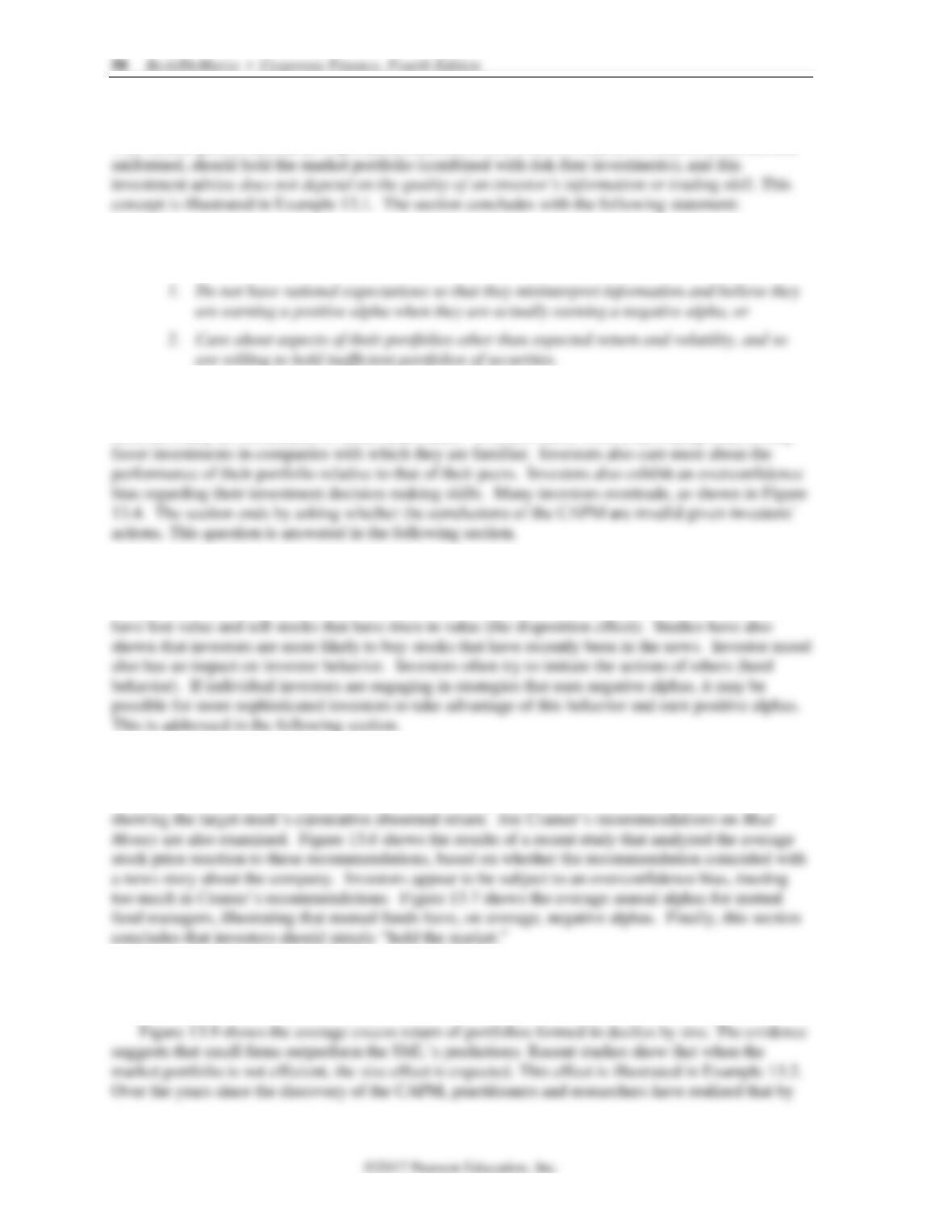
The chapter begins by revisiting the efficient and inefficient portfolios in Figure 13.1. Alpha is
defined as:
13.2 Information and Rational Expectations
This section points out that an important conclusion of the CAPM is that all investors, informed and
The market portfolio can be inefficient (so it is possible to beat the market) only if a significant
number of investors either
13.3 The Behavior of Individual Investors
This section begins by examining whether individual investors hold the market portfolio. Despite the
benefits, many do not because of behavioral biases. Investors suffer from a familiarity bias, so they
13.4 Systematic Trading Biases
For the behavior of individual investors to affect market prices, there must be systematic patterns in
the types of errors individual investors make. For example, investors tend to hold on to stocks that
13.5 The Efficiency of the Market Portfolio
This section examines evidence as to whether or not investors can outperform the market without
taking on additional risk. Figure 13.5 shows the average response to takeover announcements,
13.6 Style-Based Anomalies and the Market Efficiency Debate
Several characteristics can be used to pick stocks that produce high average returns, including size,
book-to-market, and momentum. Each of these characteristics is examined in this section.

13.7 Multifactor Models of Risk
The first part of this section points out that it is not actually necessary to identify the efficient
portfolio itself. All that is required is to identify a collection of portfolios from which the efficient
13.8 Methods Used in Practice
Figure 13.11 summarizes Graham and Harvey’s results about how firms actually calculate cost of
capital. The chapter concludes with the point that, “All the techniques we covered are imprecise.”
That is, there is no clear answer to the question of which technique is used to measure risk in
Chapter 13 Appendix Building a Multifactor Model
This appendix derives of a two-factor model of expected returns.
IV. Spreadsheet Solutions in Excel
The following Problems for Chapter 13 have spreadsheet versions of the problems available: 2, 19,