CFIN6 – CHAPTER 13
INTEGRATIVE PROBLEM SOLUTION
a(1). Dividend policy is defined as the firm’s policy with regard to paying out earnings as dividends
versus retaining them for reinvestment in the firm. Dividend policy really involves two issues: (1)
the dollar amount of dividends to be paid out in the near future, say the next year, and (2) the
long-run policy regarding the average percentage of earnings to be paid out to stockholders.
a(2). Dividend irrelevance refers to the theory that investors are indifferent between dividends and capital
gains, making dividend policy irrelevant with regard to its effect on the value of the firm. On the
other hand, according to the dividend relevance theory, dividend policy can affect the value of a firm
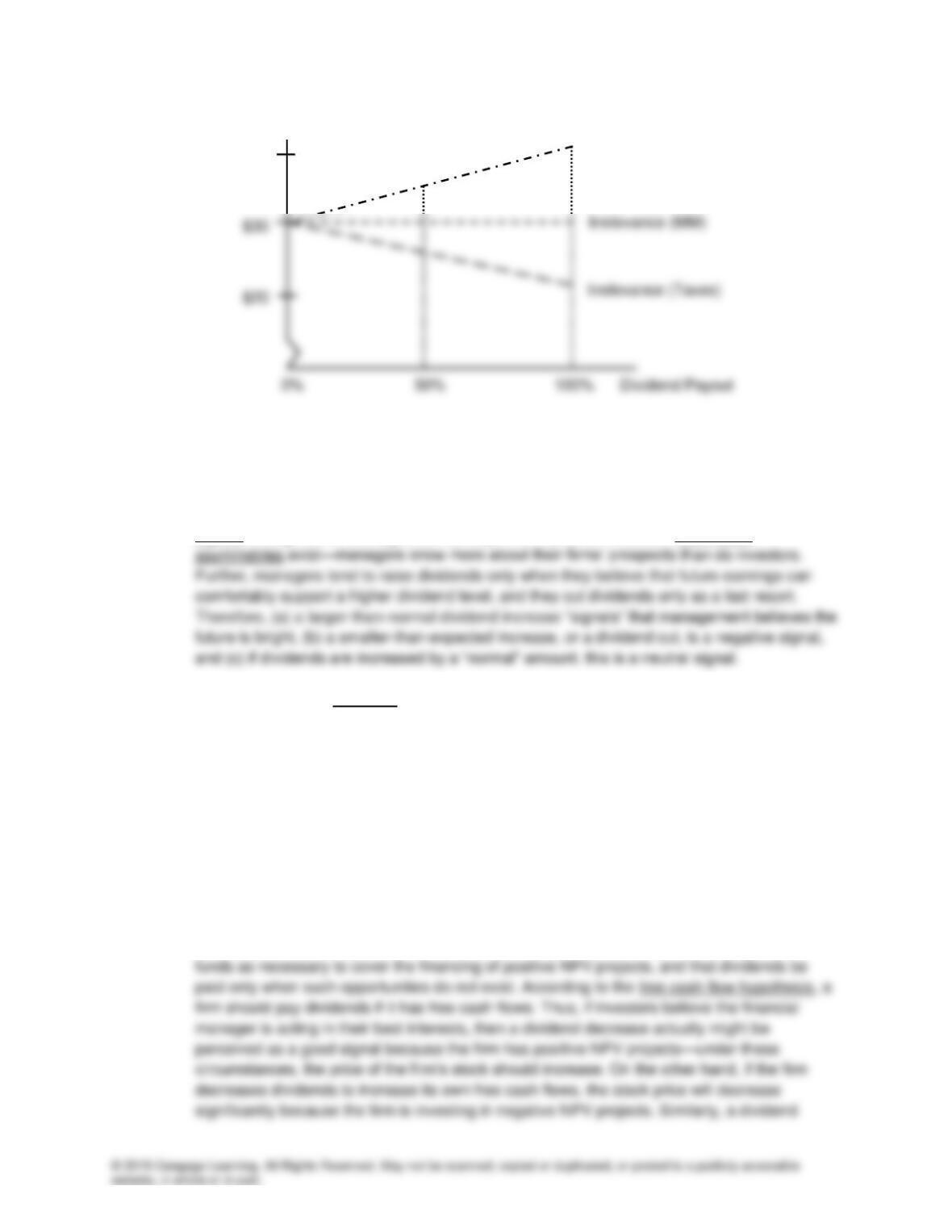
a(3). In the graph given here we plot stock price versus dividend policy (payout) under the dividend
relevance theory and dividend irrelevance when investors prefer current dividends (GL) and when
investors prefer to delay tax payments associated with their investment (taxes). It is assumed that a
zero percent payout produces a stock price of $30. If the dividend irrelevance theory (MM) is
correct, then the stock price will remain constant at $30 regardless of whether the firm retains all
Irrelevance (MM)
Irrelevance (Taxes)
b. (1) It has long been recognized that the announcement of a dividend increase often results in an
increase in the stock price, while an announcement of a dividend cut typically causes the
stock price to fall. One could argue that this observation supports the premise that investors
prefer dividends to capital gains. However, MM argued that dividend announcements are
signals through which management conveys information to investors. Information
(2) Different groups, or clienteles, of stockholders prefer different dividend payout policies. For
example, many retirees, pension funds, and university endowment funds are in a low (or
zero) tax bracket, and they have a need for current cash income. Therefore, this group of
stockholders might prefer high payout stocks. These investors could, of course, sell some of
their stock, but this would be inconvenient, transactions costs would be incurred, and the sale
might have to be made in a down market. Conversely, investors in their peak earnings years
who are in high tax brackets and who have no need for current cash income should prefer
low payout stocks.
(3) Investors expect financial managers to make decisions that help maximize the value of the
firm. If positive net present value capital budgeting projects are available for current
investment, the firm should invest in these projects. Thus, if investors want wealth
maximization, they should prefer the financial manager uses as much internally generated
Relevance (GL)
Price
$40
(4) Firms are aware of these “hypotheses” when selecting dividend policies. For example,
evidence indicates that most firms are very reluctant to cut dividends, even if they have to
borrow to make the payments. Likewise, firms generally increase dividends only when they
are sure operations can support the increase long into the future.
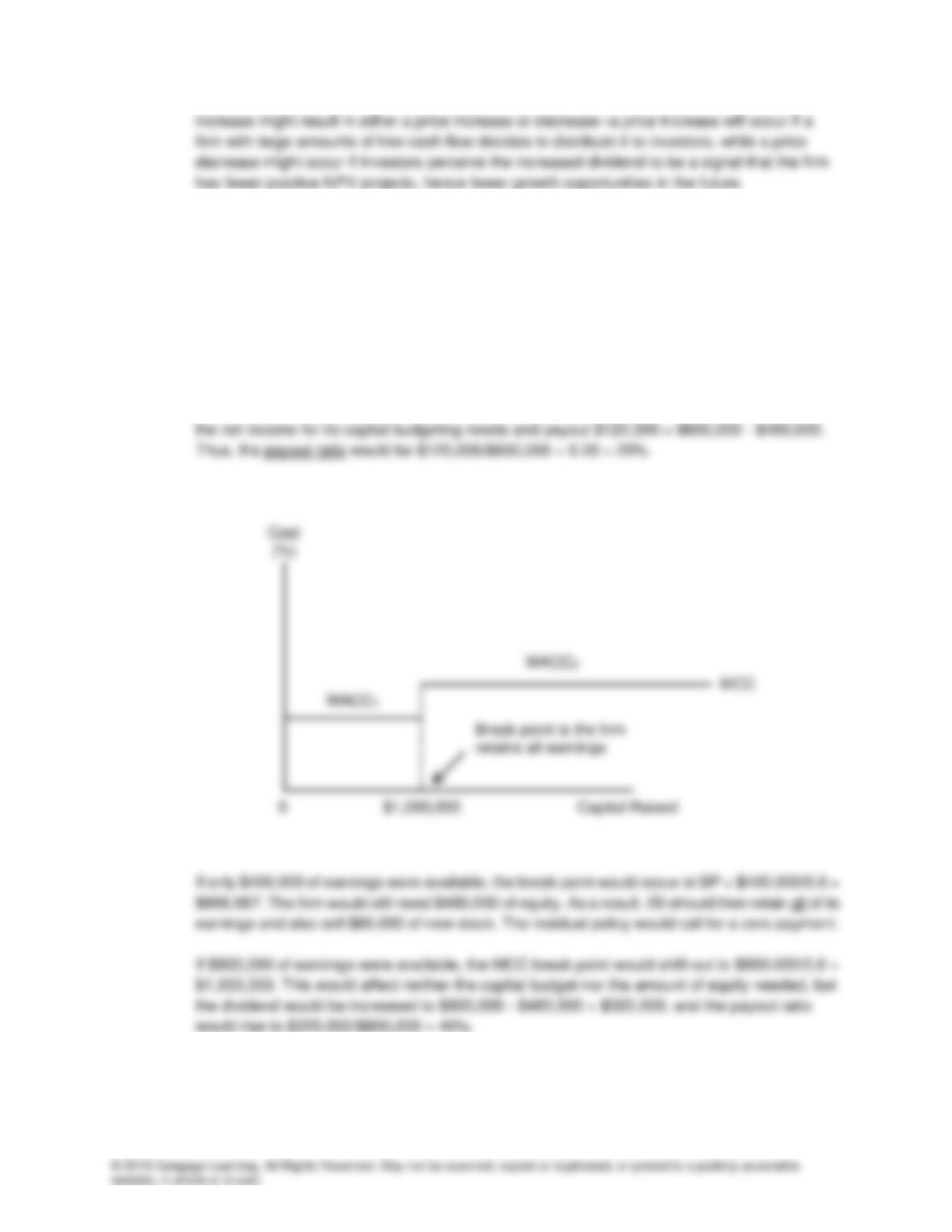
c(1). The following graph shows that the WACC as is WACC1 as long as only retained earnings
are used. Once new stock must be sold, the MCC rises to WACC2. The break point occurs at
a capital budget level equal to (net income/% equity) = $600,000/0.6 = $1 million. As a result,
if it strictly follows the residual dividend policy, ISI should retain $480,000 = $800,000(0.6) of
c(2). A change in investment opportunities would either increase or decrease the amount of equity
needed, hence in the residual dividend payout.
c(3). The primary advantage of the residual policy is that under it the firm makes maximum use of lower
cost retained earnings, thus minimizing flotation costs and hence the cost of capital. Also, whatever
negative signals are associated with stock issues would be avoided.
d. Three other dividend payment policies are (1) pay a stable, predictable dollar dividend, (2) pay out a
constant percentage of earnings, and (3) pay a low regular dividend plus an extra when funds are
available. Note: in virtually all cases, an annual dividend is set, but then paid in 4 quarterly
installments.
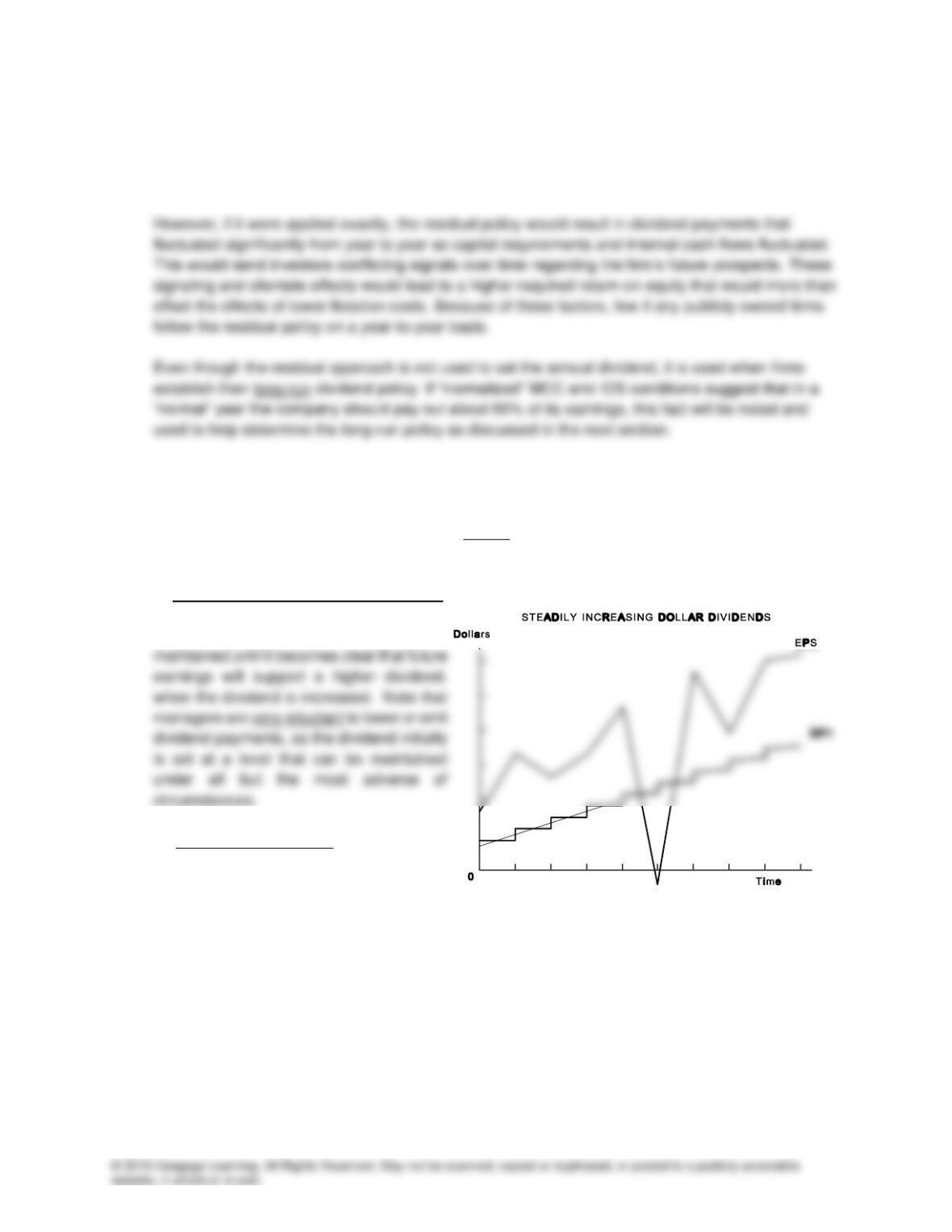
1. Stable, predictable dollar dividend policy.
Here the firm sets a specific annual dollar
dividend per share, and this payment is
2. Constant payout ratio. This policy is
followed when a firm sets a constant payout
ratio and then lets its dividend fluctuate with earnings.
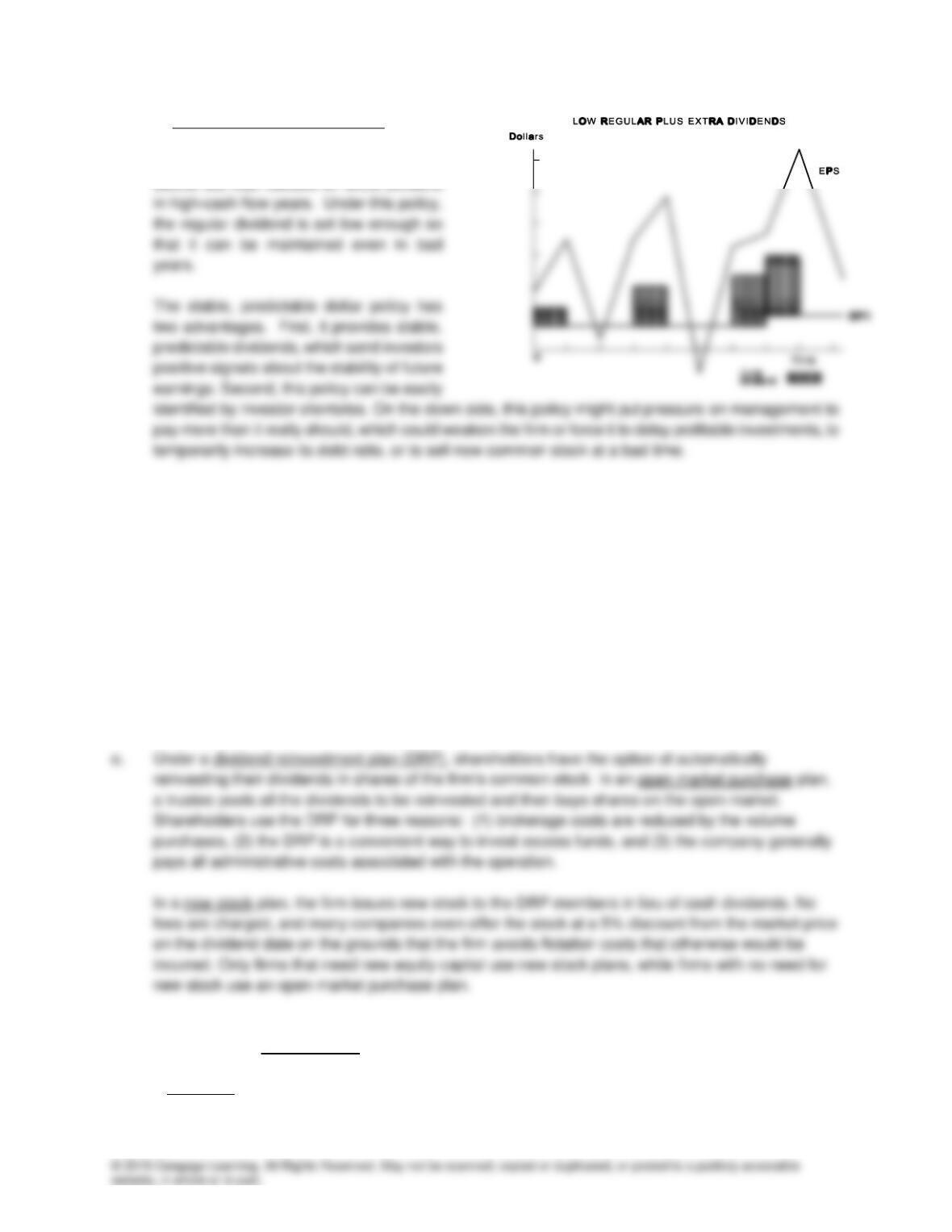
3. Low regular plus extras policy. Here a
firm would set a constant or steadily
increasing payment policy as discussed
The constant payout ratio policy creates fluctuating dollar dividends, hence (1) sends mixed signals
about future earnings expectations and (2) is not appealing to many clienteles.
The low regular plus extras policy has advantages similar to the stable, predictable dollar dividend
policy, but, because the dollar amount is low, there is less risk that the firm will be forced into
undesirable actions just to meet the dividend payment. From an investor’s viewpoint, though, cash
flows are less dependable than under the stable, predictable dollar dividend policy.
Because of its disadvantages, few firms today follow the constant payout ratio policy. Low growth firms
with relatively stable, or steadily growing, earnings generally follow the stable, predictable dividend
policy. Cyclical firms with volatile earnings tend to use the low regular plus extras policy.
f. When it uses a stock dividend, a firm issues new shares in lieu of paying a cash dividend. For
example, in a 5% stock dividend, the holder of 100 shares would receive an additional 5 shares. In
a stock split, the number of shares outstanding is increased (or decreased in a reverse split) in an
action unrelated to a dividend payment. For example, in a 2-for-1 split, the number of shares
of higher earnings, then one would expect the price of the stock to adjust such that each investor’s
wealth remains unchanged. For example, a 2-for-1 split of a stock selling for $50 would result in the
stock price being cut in half, to $25.
It is hard to come up with a convincing rationale for small stock dividends, like 5percent or 10%. No
economic value is being created or distributed, yet stockholders have to bear the administrative
outside the $20 to $80 range, but most stay within it.
Another factor that might influence stock splits and dividends is the belief that they signal
management’s belief that the future is bright. If a firm’s management would be inclined to split the
stock or pay a stock dividend only if it anticipated improvements in earnings and dividends, then a
split/dividend action could provide a positive signal and thus boost the stock price. However, if
1. Distribute excess funds to stockholders. Firms sometimes use stock repurchases to distribute
funds that exceed capital budgeting needs in a particular year, especially when the price of
the stock is considered low (undervalued).
2. Adjust the firm’s capital structure. When a firm has more equity than its target capital
soon, it might buy back shares in the financial markets to ensure that sufficient shares are
available when the options are exercised.
4. Protect against a takeover attempt. A stock repurchase can be used to fend off a hostile
takeover attempt because (a) repurchasing stock increases demand in the stock markets,
The principal advantages of repurchases include:
1. A company can use a stock repurchase to distribute excess cash (free cash flows) without
increasing the amount of dividends that is paid during the year. Most firms are reluctant to
increase dividend payments unless management is confident that future operations can
the “dilution effect” associated with exercising the options.
4. Stockholders do not have to sell their shares to the company during a repurchase period.
Thus, those investors who need cash and don’t mind paying the taxes associated with selling
their stock will participate in the repurchase program; other stockholders will not.
The principal disadvantages of stock repurchases include:
1. The company might pay too much for stock that is repurchased. A firm that buys back
substantial amounts of its stock will bid up the per share price of the stock that remains
outstanding, perhaps to an artificially high level.