
CHAPTER 13: INTERNATIONAL PORTFOLIO INVESTMENT
1
CHAPTER 13
INTERNATIONAL PORTFOLIO INVESTMENT
The basic message of this chapter is that international stock and bond diversification can provide
substantially higher returns with less risk than investment in a single market. A major reason is that
international investment offers a much broader range of opportunities than domestic investment alone, even
in a market as large as the U.S. An investor restricted to the U.S. stock market, for example, is cut off, in
effect, from about two-thirds of the available investment opportunities. International diversification pushes
out the efficient frontier – the set of portfolios that has the smallest possible standard deviation for its level
of expected return and has the maximum expected return for a given level of risk—allowing investors
simultaneously to reduce their risk and increase their expected return.
The chapter shows how to measure the total dollar return on foreign currency-denominated securities as
well as how to estimate the risk-return trade-off associated with foreign portfolio investing. It does this by
providing the formulas for the expected return and standard deviation for a portfolio consisting of a fraction
a invested in U.S. stocks and the remaining fraction, 1 – a, invested in foreign stocks. The chapter details
the several ways in which U.S. investors can diversify into foreign securities: buying stocks of firms that
have listed their securities on the New York Stock Exchange or the American Stock Exchange; buying
American Depository Receipts or American shares; and buying shares in the growing number of
internationally diversified mutual funds.
SUGGESTED ANSWERS TO “DEUTSCHE BANK LISTS AS A GLOBAL SHARE”
1. List the pros and cons of Deutsche Bank listing on the NYSE as a global share instead of an ADR.
ANSWER. Pros include the savings to U.S. investors in trading Deutsche Bank global shares as opposed to
2. Are these pros and cons of a GSR issue likely to change over time? In which direction?
3. What changes would increase the desirability of issuing global shares?
INSTRUCTORS MANUAL: FOUNDATIONS OF MULTINATIONAL FINANCIAL MANAGEMENT, 6TH ED.
2
SUGGESTED ANSWERS TO CHAPTER 13 QUESTIONS
1. What characteristics of foreign securities lead to diversification benefits for American investors?
ANSWER. The two basic characteristics are:
i Many foreign securities are issued by companies that produce goods and services not available
2. Will increasing integration of national capital markets reduce the benefits of international
diversifications?
ANSWER. Despite increasing integration of national capital markets, they still don’t march in lock step.
3. Studies show that the correlations between domestic stocks are greater than the correlations
between domestic and foreign stocks. Explain why this is likely to be the case. What implications
does this fact have for international investing?
4. Who is likely to gain more from investing overseas, a resident of the U.S. or of Mexico? Explain.
5. Suppose Mexican bonds are yielding more than 100% annually. Does this high yield make them
suitable for American investors looking to raise the return on their portfolios? Explain.
6. According to one investment advisor, “I feel more comfortable investing in Western Europe or
Canada. I would not invest in South America or other regions with a record of debt defaults and
restructuring. The underwriters of large new issues of ADRs of companies from these areas
assure us that things are different now. Maybe, but who can say that a government that has
defaulted on debt won’t change the rules again?” Comment on this statement.
7. As noted in the chapter, from 1949 to 1990, the Japanese market rose 25,000%.
7.a. Given these returns, does it make sense for Japanese investors to diversify internationally?
ANSWER. Note that the same argument could be made as to why non-Japanese investors should also invest
7.b. What arguments would you use to persuade a Japanese investor to invest overseas?
ANSWER. Here are two arguments. First, you can’t expect stock markets to keep going up in a straight line.
7.c. Why might Japanese (and other) investors still prefer to invest in domestic securities despite
the potential gains from international diversification?
8. Because ADRs are denominated in dollars and are traded in the U.S., they present less foreign
exchange risk to U.S. investors than do the underlying foreign shares of stock. Comment.
ANSWER. The answer to this question depends on the distinction between the currency of denomination
ADDITIONAL CHAPTER 13 QUESTIONS AND ANSWERS
1. An alternative to investing in foreign stocks is to invest in the shares of domestic multinationals.
Are MNCs likely to provide a reasonable substitute for international portfolio investment?
2. Why did Latin American stocks perform so well in recent years? Is this performance likely to
continue? Explain.
3. Would you expect emerging markets on average to outperform developed country markets in
the future? Explain.
ANSWER. As in the answer to question 7, in an efficient market, the performance of emerging markets
4. The Brazilian stock market rose by 165% during 1988. Are American investors likely to be
pleased with that performance? Explain.
5. Persian Gulf countries receive virtually all their income from oil revenues denominated in
dollars. At the same time, they buy substantial amounts of goods and services from Japan and
Western Europe. Their investment portfolios are heavily weighted towards short-term U.S.
Treasury bills and other dollar-denominated money market instruments. Comment on their
asset allocation.
ANSWER. Persian Gulf countries face exchange risk because of the currency mismatch between the dollar
6. In deciding where to invest your money, you read that Germany looks like it’s well-positioned to
capitalize on the opening of Eastern Europe. But Britain is troubled by weak growth and high
inflation and interest rates. Which of these countries would it make sense to invest in? Explain.
ANSWER. As noted in the answer to the previous question, investors have already factored these
7. Does the high volatility of emerging markets lead to high expected returns for investors?
8. As more U.S. investors shift funds into emerging markets, what will drive expected returns?
ANSWER. Historically, most foreign investors have stayed out of emerging markets because of local
9. During 1995, the Morgan Stanley Capital International world index of developed country stock
markets rose by 18.7% in dollar terms. In contrast, the IFC emerging markets index fell by just
over 17% in dollar terms. Many investment advisors point to this sorry performance of emerging
markets as an expensive lesson to investors not to venture too far from home. Do the diverging
performances of mature and emerging markets argue against investing in emerging markets?
ANSWER. The experience of 1995 illustrates the riskiness of emerging markets. Paradoxically, however,
CHAPTER 13: INTERNATIONAL PORTFOLIO INVESTMENT
7
SUGGESTED SOLUTIONS TO CHAPTER 13 PROBLEMS
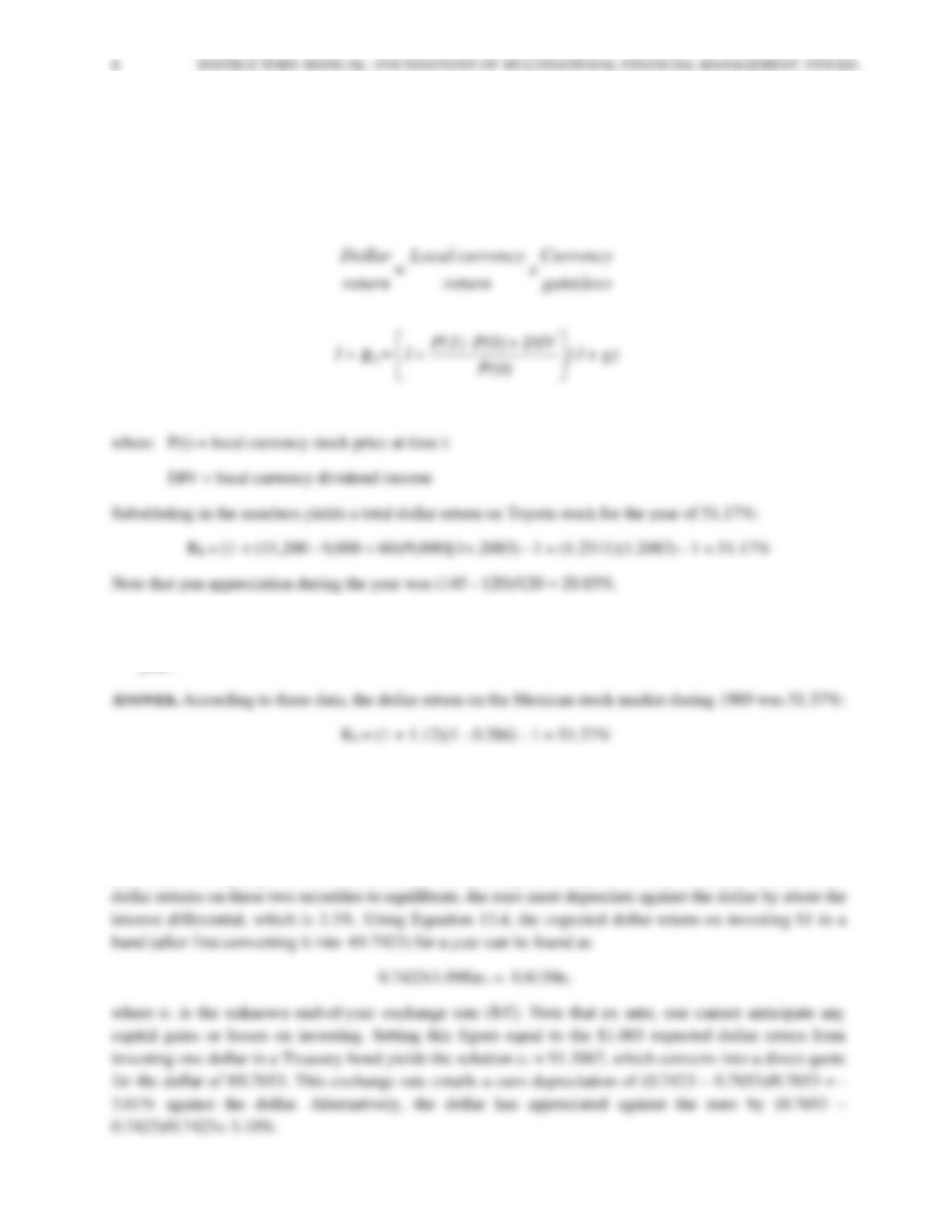
1. During the year the price of British gilts (government bonds) went from £102 to £106, while
paying a coupon of £9. At the same time, the exchange rate went from £1:$1.76 to £1:$1.62.
What was the total dollar return, in percent, on gilts for the year?
ANSWER. Rewriting Equation 13.4, the one-period total dollar return on a foreign bond investment r$ can
be calculated as follows:
2. Suppose during the first half of the year, government bonds yielded a local-currency return of
-1.6%. However, the Swiss franc rose by 8% against the dollar over this six-month period.
Corresponding figures for France were 1.8% and 2.6%. Which bond earned the higher U.S.
dollar return? What was the return?
3. During the year Toyota Motor Company shares went from ¥9,000 to ¥11,200, while paying a
dividend of ¥60. At the same time, the exchange rate went from $1 = ¥145 to $1 = ¥120. What
was the total dollar return, in percent, on Toyota stock for the year?
ANSWER. Rewriting Equation 15.5, the one-period total dollar return on a foreign stock investment R$ can
be calculated as follows:
4. During 1989, the Mexican stock market climbed 112%in peso terms while the peso depreciated by
28.6% against the U.S. dollar. What was the dollar return on the Mexican stock market during the
year?
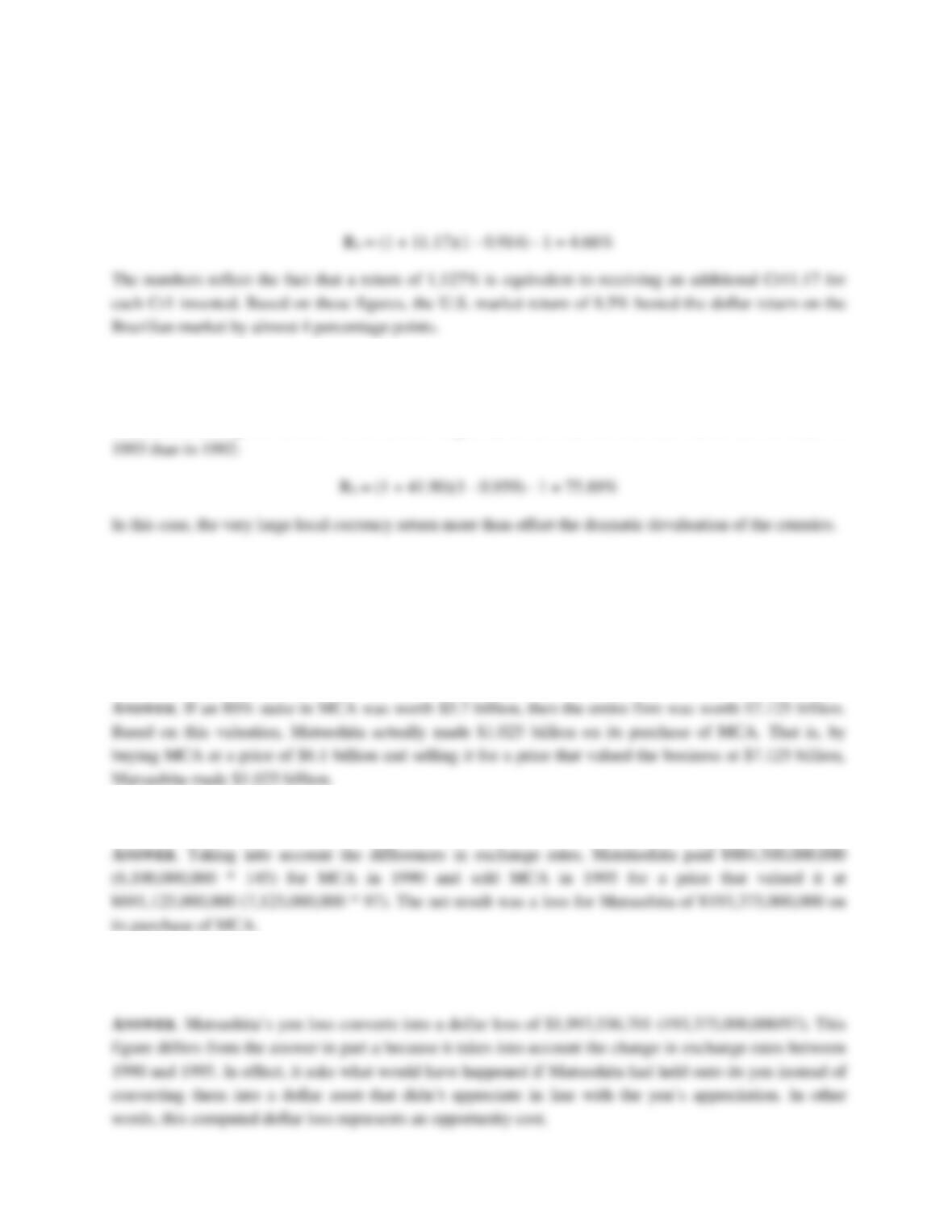
5. Suppose that the dollar is now worth €0.7423. If one-year German bunds are yielding 9.8% and
one-year U.S. Treasury bonds are yielding 6.5%, at what end–of–year exchange rate will the
dollar returns on the two bonds be equal? What amount of euro appreciation or depreciation
does this equilibrating exchange rate represent?
ANSWER. To begin, given that German bunds are yielding more than U.S. Treasuries, it is clear that for
CHAPTER 13: INTERNATIONAL PORTFOLIO INVESTMENT
9
6. In 1992, the Brazilian market rose by 1,117% in cruzeiro terms, while the cruzeiro fell by 91.4%
in dollar terms. Meanwhile, the U.S. market rose by 8.5%.
6.a. Which market did better?
ANSWER. The dollar return on the Brazilian market can be calculated using Equation 15.5:
6.b. In 1993, the Brazilian market rose by 4,190% in cruzeiro terms, while the cruzeiro fell by
95.9% in dollar terms. Did the Brazilian market do better in dollar terms in 1992 or in 1993?
ANSWER. Redoing the numbers in the answer to part a, we see that the Brazilian market did far better in
7. In 1990, Matsushita bought MCA Inc. for $6.1 billion. At the time of the purchase, the exchange
rate was about ¥145/$. By the time that Matsushita sold an 80% stake in MCA to Seagram for
$5.7 billion in 1995, the yen had appreciated to a rate of about ¥97/$.
7.a. Ignoring the time value of money, what was Matsushita’s dollar gain or loss on its investment
in MCA?
7.b. What was Matsushita’s yen gain or loss on the sale?
7.c. What did Matsushita’s yen gain or loss translate into in terms of dollars? What accounts for
the difference between this figure and your answer to part a?
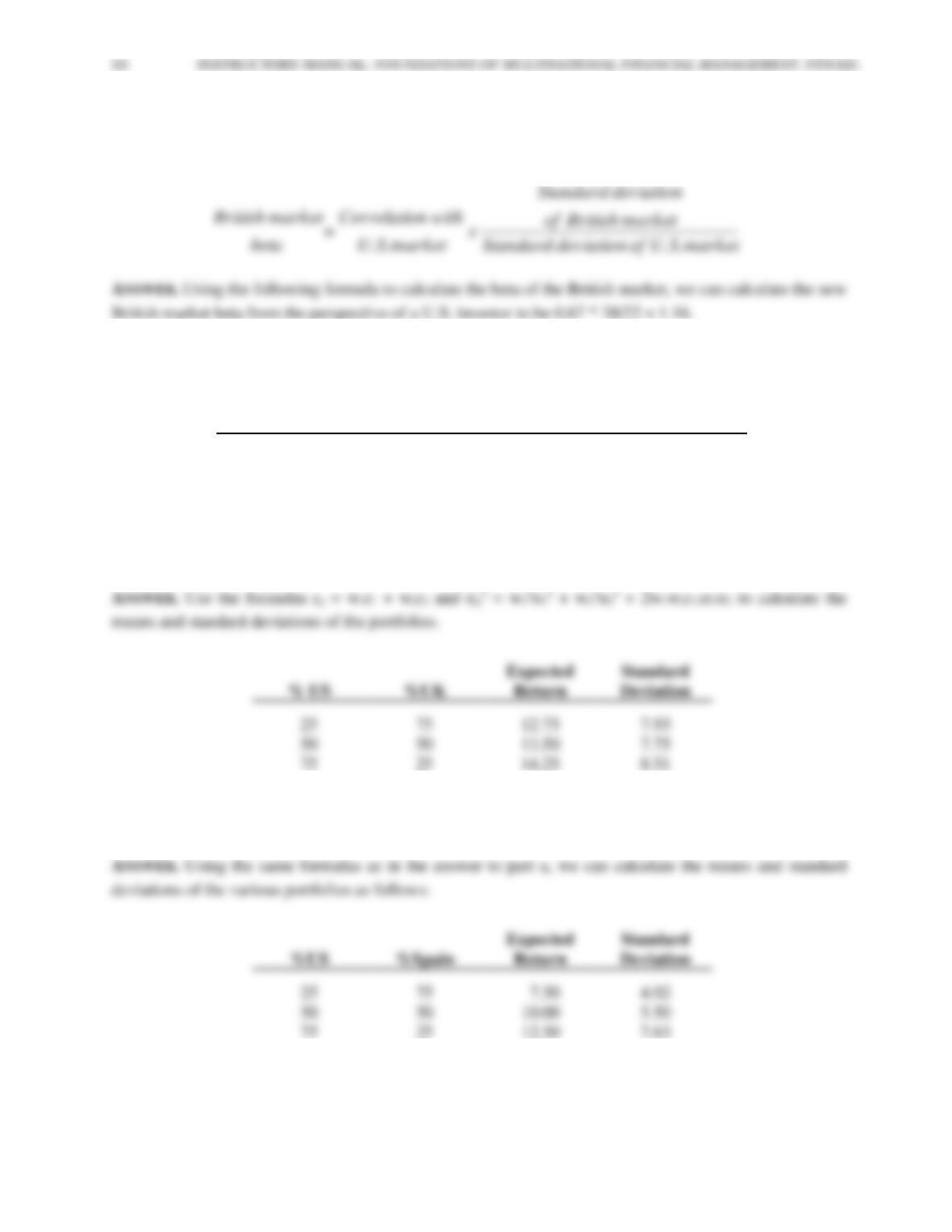
8. Suppose the standard deviations of the British and U.S. stock markets have risen to 38% and
22%, respectively, while the correlation between the U.S. and British markets has risen to 0.67.
What is the new beta of the British market from a U.S. perspective?
9. A portfolio manager is considering the benefits of increasing his diversification by investing
overseas. He can purchase shares in individual country funds with the following characteristics:
U.S. (%)
U.K. (%)
Spain (%)
Expected Return
Standard Deviation
Correlation with U.S.
15
10
1.0
12
9
0.33
5
4
0.06
9.a. What is the expected return and standard deviation of return of a portfolio with 25% invested
in the United Kingdom and 75% in the U.S.?
9.b. What is the expected return and standard deviation of return of a portfolio with 25% invested
in Spain and 75% in the U.S.?
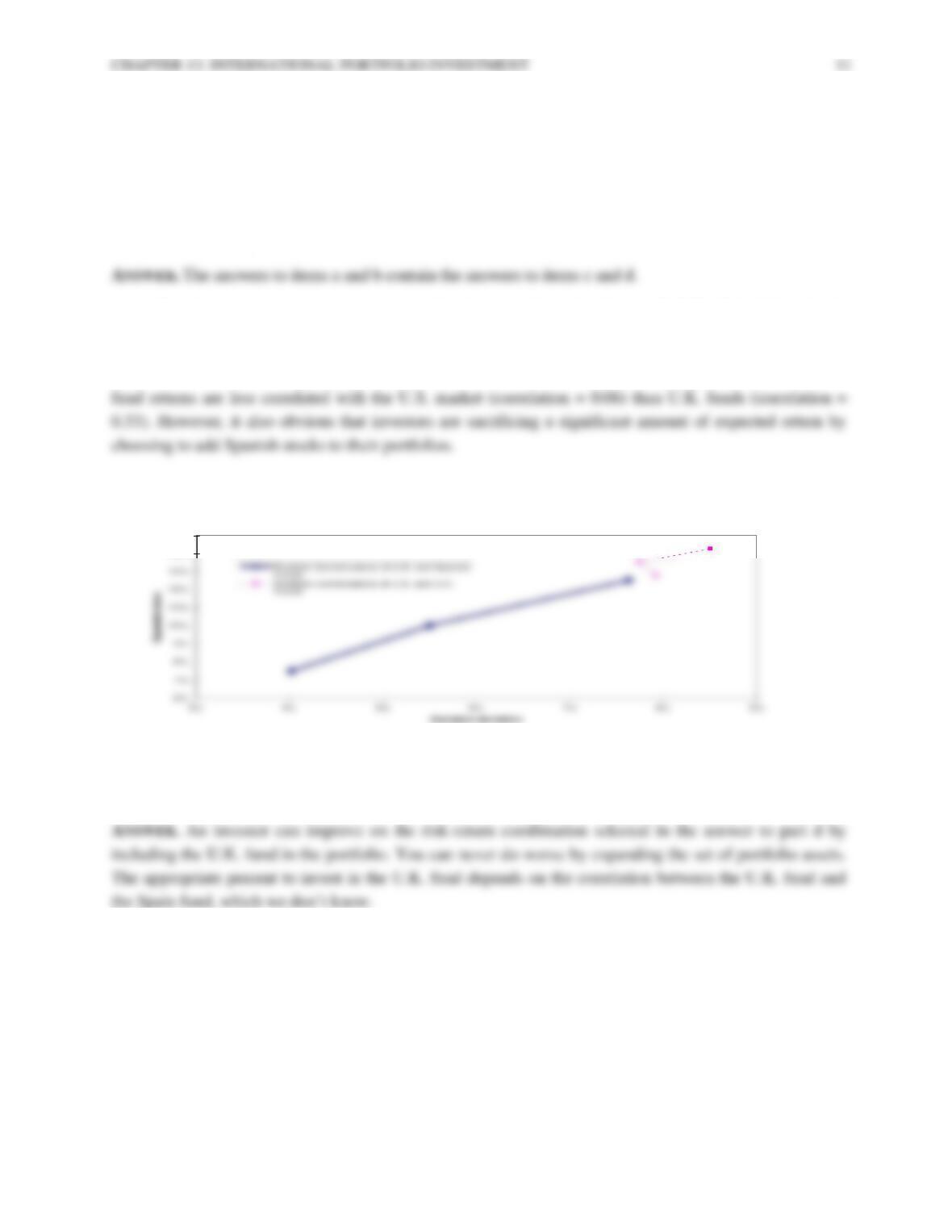
9.c. Calculate the expected return and standard deviation of return of a portfolio with 50%
invested in the U.S. and 50% in the United Kingdom. With 50% invested in the U.S. and 50%
invested in Spain.
9.d. Calculate the expected return and standard deviation of return of a portfolio with 25%
invested in the U.S. and 75% in the United Kingdom. With 25% invested in the U.S. and 75%
invested in Spain.
9.e. Plot these two sets of risk-return combinations (a) through (d) as in Exhibit 15.5. Which leads
to a better set of risk-return choices, Spain or the United Kingdom?
ANSWER. As the following diagram shows, Spain offers better diversification opportunities because its
Risk-Return Combinations for U.S., Spain, and the U.K.
14%
15%
9.f. How can you achieve an even better risk-return combination?

10. Suppose that the standard deviation of the return on Nestlé, a Swiss firm, in terms of Swiss
francs is 19% and the standard deviation of the rate of change in the dollar-franc exchange rate
is 15%. In addition, the estimated correlation between the Swiss franc return on Nestlé and the
rate of change in the exchange rate is 0.17. Given these figures, what is the standard deviation of
the dollar rate of return on investing in Nestlé stock?
ANSWER. According to Equation 15.8 in the text, we can write the standard deviation of the dollar return,
σ$, as
ADDITIONAL CHAPTER 13 PROBLEMS AND SOLUTIONS
1. On February 14, 1994, the dollar fell from ¥106.85 to ¥102.65. Meanwhile, the Tokyo stock
market fell 1.63% as measured in yen. What was the one-day dollar return on the Tokyo stock
market?
2. During 1997, the Korean Stock Exchange’s composite index fell by 42%, while the won lost half
its value against the dollar. What was the combined effect of these two declines on the dollar
return associated with Korean stocks during 1997?
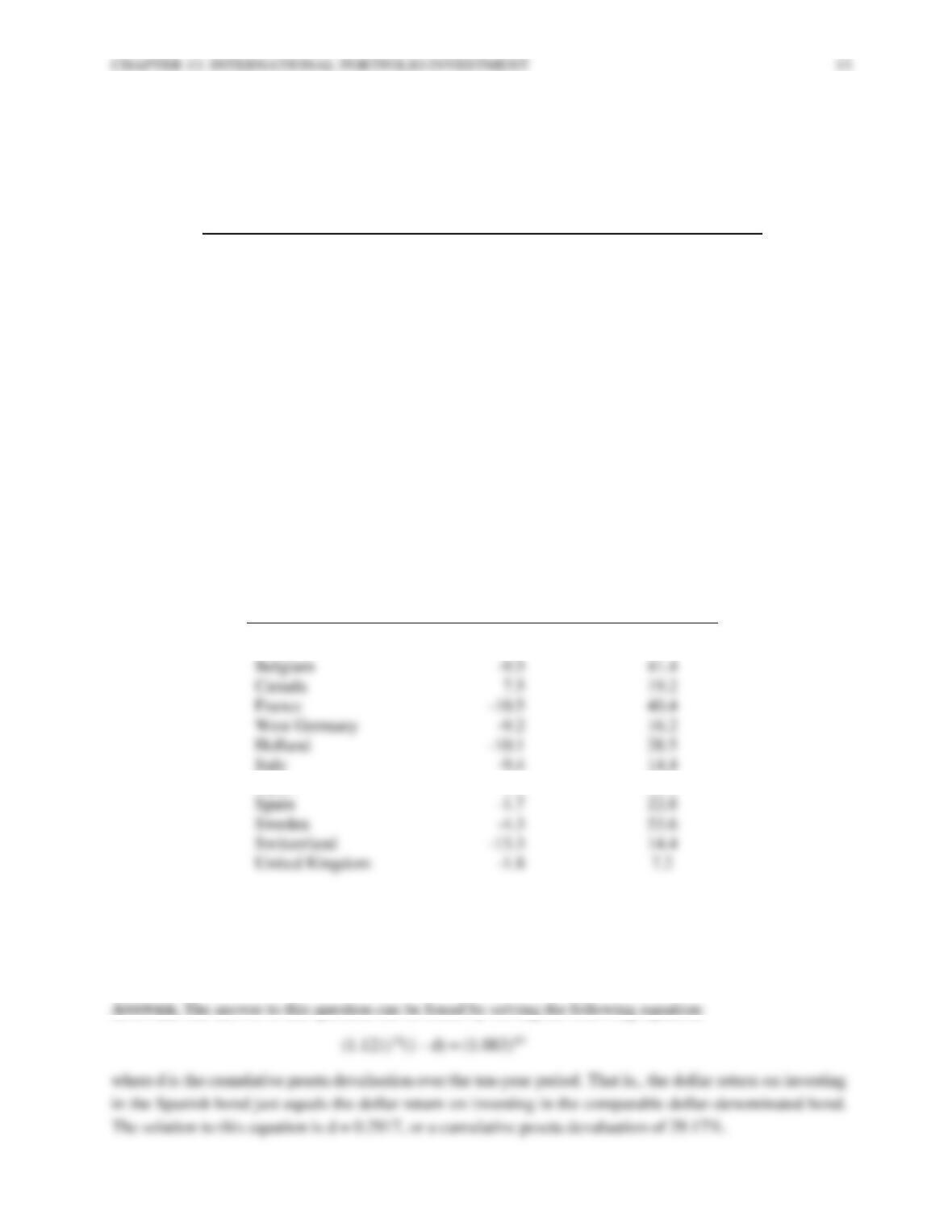
3. Here are data on stock market returns and exchange rate changes during 1988 for 12 stock
markets.
Country
Return
in Local
Currency
(%)
LC Units/Dollar
12/31/87
LC
Units/Dollars
12/31/88
Australia
Belgium
Canada
France
West Germany
Holland
Italy
Japan
Spain
Sweden
Switzerland
United Kingdom
14.5
56.3
10.9
56.8
27.9
42.8
26.2
44.8
25.0
60.5
31.9
9.1
1.41
35.1
1.29
5.65
1.68
1.88
1230
129
114
6.03
1.37
0.56
1.17
38.8
1.20
6.31
1.85
2.09
1357
128
116
6.30
1.58
0.57
Determine the dollar return on each of these markets.
ANSWER. Using Equation 15.5, here are the total dollar returns on these markets during 1988:
Currency Gain
(loss) (%)
Total Dollar
Return (%)
Spain
Sweden
Switzerland
United Kingdom
Australia
Japan
20.5
0.8
38.0
45.9
4. Suppose over a ten-year period the annualized peseta return of a Spanish bond has been 12.1%.
If a comparable dollar bond has yielded an annualized return of 8.3%, what cumulative
devaluation of the peseta over this period would be necessary for the return on the dollar bond
to exceed the dollar return on the Spanish bond?
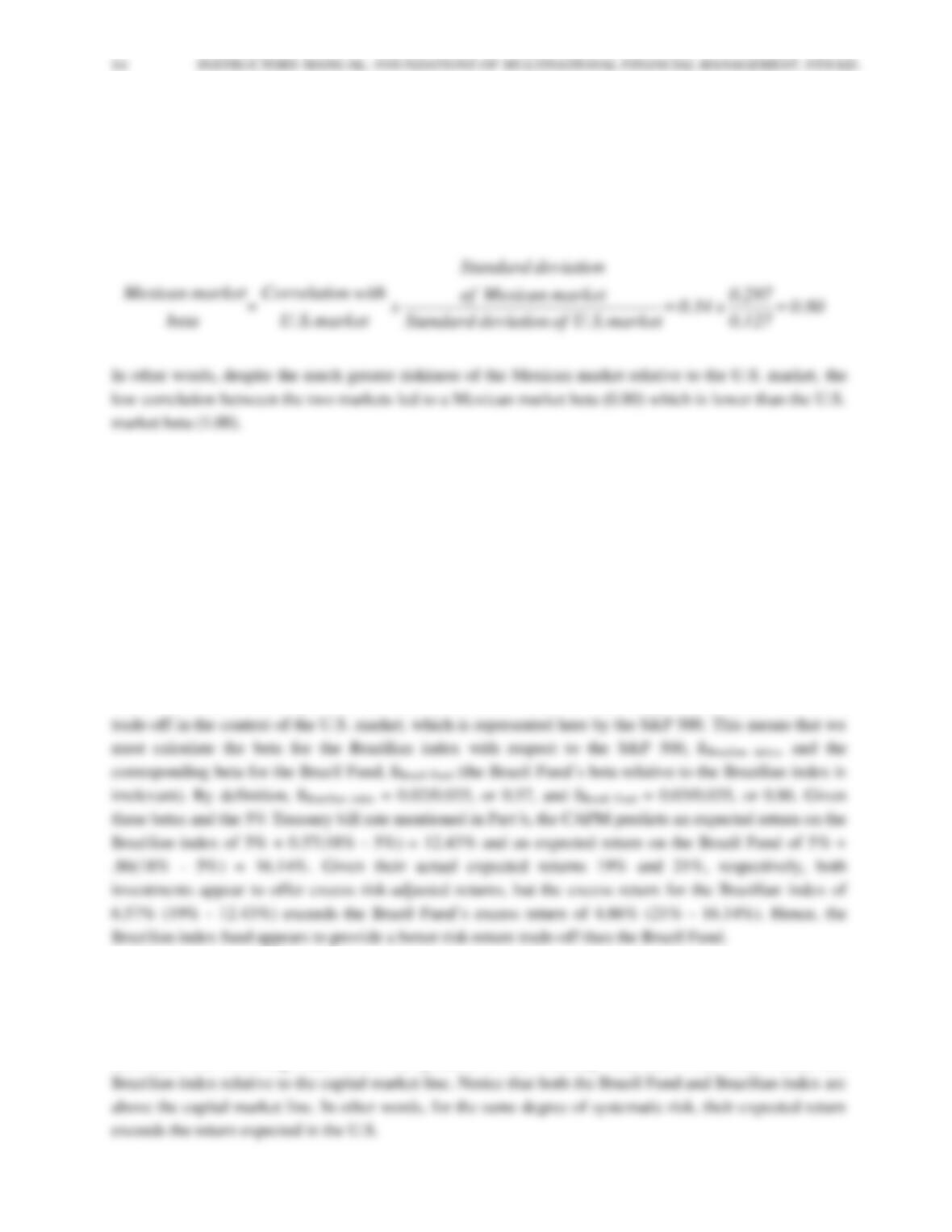
5. The standard deviations of U.S. and Mexican returns over the period 1989-1993 were 12.7% and
29.7%, respectively. In addition, the correlation between the U.S. and Mexican markets over this
period was 0.34. Assuming that these data reflect the future as well, what is the Mexican market
beta relative to the U.S. market?
ANSWER. Using the formula presented in the text, and substituting in the numbers in the problem, we have
6. In an attempt to diversify your portfolio internationally, you must decide how to invest in Brazil.
You can invest in an index fund that replicates the Brazilian stock market, or you can buy shares
of the Brazil Fund traded on the New York Stock Exchange. The covariance of dollar returns on
the index with the S&P 500 is 0.02; the covariance of dollar returns on the Brazil Fund with the
S&P 500 is 0.03; the variance of the S&P 500 index is 0.035; and the beta of the Brazil Fund with
respect to the Brazilian index is 0.90. In addition, the Brazil Fund and the Brazilian index are
expected to yield annual dollar returns of 21% and 19%, respectively, in contrast to expected
annual returns of 18% from investing in the S&P 500.
6.a. Ignoring other considerations, should you buy the Brazil Fund or the Brazilian index fund?
ANSWER. To answer this question, we need to determine which investment provides a better risk-return
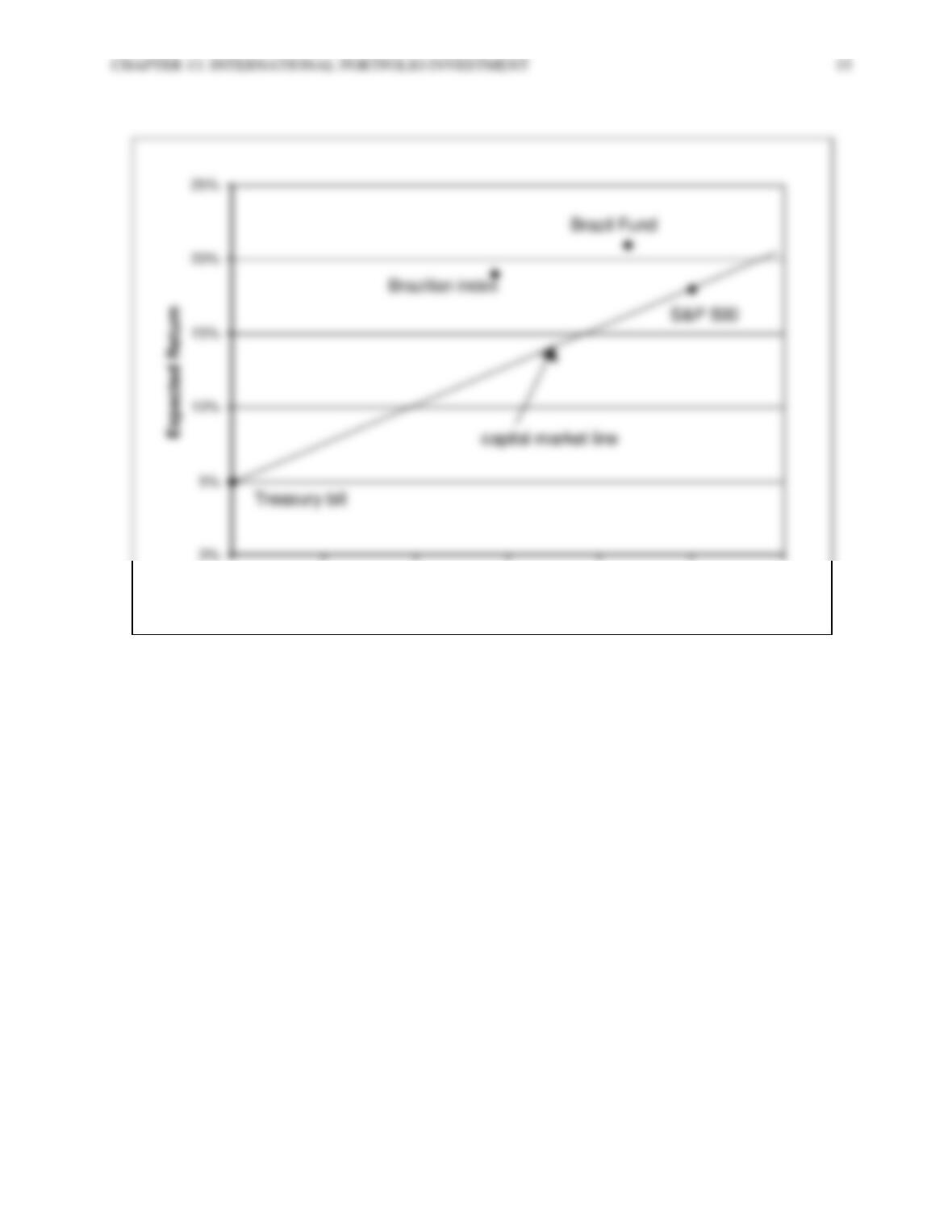
6.b. Suppose the U.S. Treasury bill rate is 5%. Assuming the S&P 500 has a beta of 1, plot the
capital market line and show the positions of the Brazil Fund and the Brazilian stock index
relative to the capital market line.
ANSWER. The following chart shows the position of the Treasury bill, S&P 500, Brazil Fund, and
0 0.2 0.4 0.6 0.8 1 1.2
Beta