
Investing in Mutual Funds,
ETFs, and Real Estate
Chapter 13
How Will This Affect Me?
Having a financial plan, and being aware that diversification is crucial is a great start to the task
of investment planning. The next step is figuring out how to implement your plan by deciding
what to invest in. For most people, diversification is best achieved using mutual funds and
exchange traded funds (ETFs). This chapter describes the key characteristics of each type of
LEARNING GOALS
13-1 Describe the basic features and operating characteristics of mutual funds and
exchange traded funds.
Terminology and understanding how things work drives this section. The Power Point Slides
13-2 Differentiate between open- and closed-end mutual funds as well as exchange traded
funds and discuss the various types of fund loads and charges.
Terminology and understanding how things work drives this section. The Power Point Slides
13-3 Discuss the types of funds available to investors and the different kinds of investor
services offered by mutual funds and exchange traded funds.

OK, I am repeating myself, but these first three goals have similar purposes. Terminology and
13-4 Gain an understanding of the variables that should be considered when selecting
funds for investment purposes.
13-5 Identify the sources of return and calculate the rate of return earned on an investment
in a mutual fund, as well as evaluate the performance of an exchange traded fund.
13-6 Understand the role that real estate plays in a diversified investment portfolio, along
with the basics of investing in real estate, either directly or indirectly.

Financial Facts or Fantasies?
These may be used as “teasers” to get the students on the right page with you. Also, they may be
used as quizzes after you covered the material or as “pre–test questions” to get their attention.
• Online and phone switching are services that enable you to move money from one fund to
another, so long as you stay within the same family of funds.
Fact: Online and phone switching are conversion (or exchange) privileges that allow you to sell
one fund and buy another, with the only condition being that you confine your switches to the
same family of funds.
• In many types of real estate investments, appreciation in the value of the property affects return
more than annual rental income.
Fact: Like most forms of investing, the biggest bang for your buck usually comes from capital
gains. You’ll find that’s the way the really big money is made, and real estate is certainly no
exception to that rule.

Financial Facts or Fantasies?
These may be used as a quiz or as a pre-test to get the students interested.
1. True False When a mutual fund is open-ended, it means there’s no limit on the
returns an investor can realize.
2. True False Online and phone switching are services that enable you to move
money from one fund to another, so long as you stay within the
same family of funds.
3. True False While exchange traded funds (ETFs) offer many of the benefits of
mutual funds, they have tax-timing disadvantages not present with
otherwise comparable mutual funds.
4. True False In many types of real estate investments, appreciation in the value
of the property affects return more than annual rental income.
5. True False A real estate investment trust (REIT) is a popular form of limited
partnership that enables individuals to invest directly in income-
producing property.

YOU CAN DO IT NOW
The “You Can Do It Now” cases may be assigned to the students as short cases or problems.
They will help make the topic more real or relevant to the students. In most cases, it will only
take about ten minutes to do, that is, until the student starts looking around at the web site. But
they will learn by doing so.
Objective Mutual Fund Resources
How to Choose the Best ETF for You
Financial Impact of Personal Choices
Read and think about the choices being made. Do you agree or not? Ask the students to discuss
the choices being made.
Mackenzie Finds a Simple Retirement Investment Plan
Mackenzie Perry, 27 years old, wants to get her retirement investing portfolio up and running.
• U.S. total stock market index fund
• International total stock market fund
• U.S. total bond market index fund

Mackenzie was indeed convinced and estimated that keeping the plan in place would take about
30 minutes a year. So she invested equal amounts in the following ETFs:
Applying Personal Finance
The Feeling’s Mutual!
Mutual funds offer convenience, diversification, and the services of professional money
managers and analysts. Mutual funds can be particularly appealing for small investors who don’t
• Growth
• Value
• Equity income
• Bond
Pick three or four categories that you believe best meet your financial needs and risk tolerance,
and then select one fund from each category. You are strongly encouraged to use some of the
online sources and other references mentioned in this chapter to help you make your selections.
For each fund, find the following information:
a. Name of fund, its ticker symbol, the fund manager, and the tenure of the fund manager.

e. How much did the fund pay out last year in dividends and in distributions of short- and long-
term capital gains?
password-protected website or school-approved learning management system for classroom use.
Solutions to Financial Planning Exercises
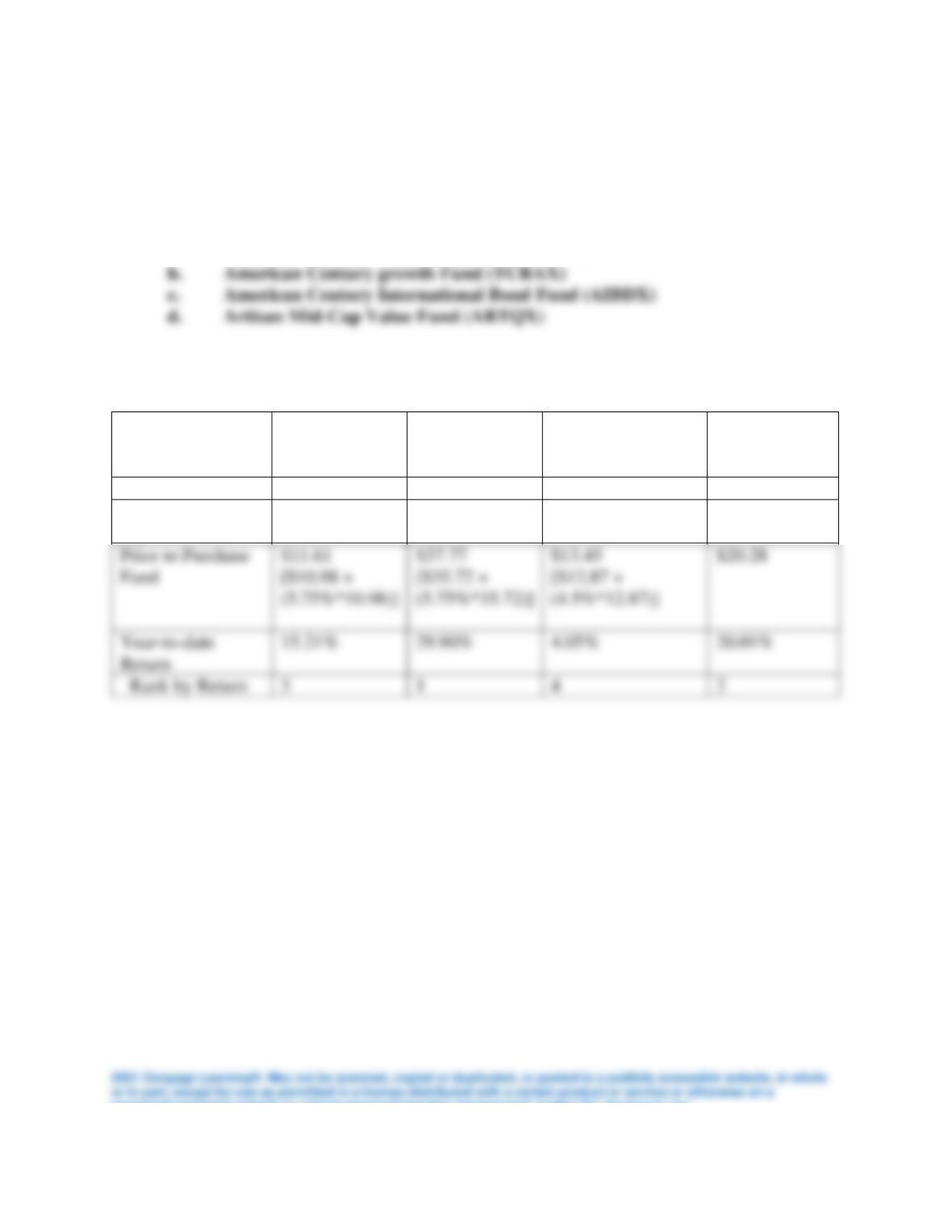
1. Estimating cost of mutual fund investments. Using the mutual fund quotes in Exhibit 13.4,
and assuming that you can buy these funds at their quoted NAVs, how much would you
have to pay to buy each of the following funds?
a. American Century Emerging Market Funds (AEMMX)
According to the quotes, which of these four funds have load fees and what are they?
Which fund has the highest year-to-date return? Which has the lowest?
From Exhibit 13.4
Emerging
Markets
AEMMX
Growth
TCRAX
International Bond
AIBDX
Mid-Cap
ARTQX
Net Asset Value,
10.98
35.72
12.87
20.28
Front End Load
Fee
5.75%
5.75%
4.50%
No fee
Fund
[$10.98 +
[$35.72 +
[$12.87 +
Rank by Return
3
1
4
2
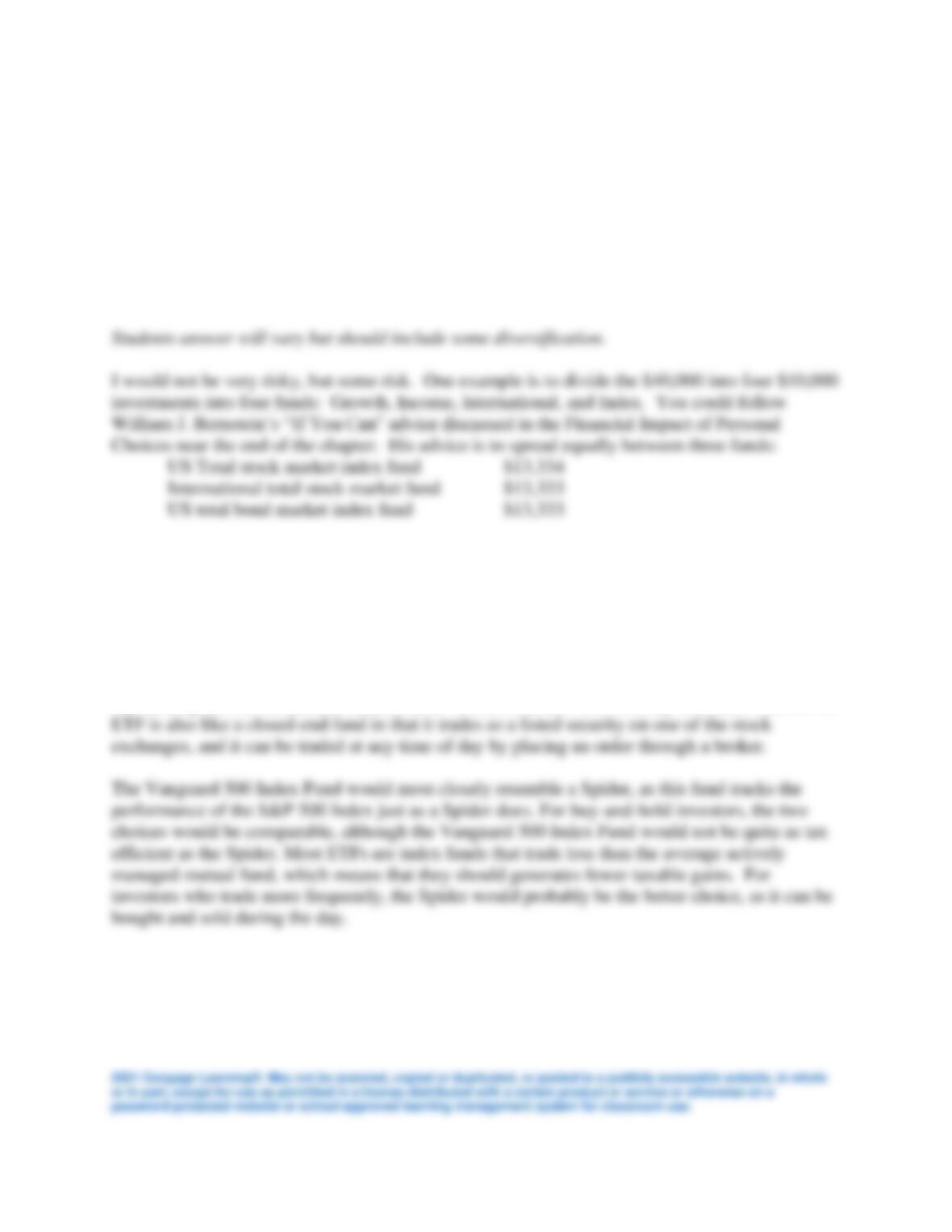
2. Building a mutual fund portfolio. Imagine that you’ve just inherited $40,000 from a rich
uncle. Now you’re faced with the problem of deciding how to spend it. You could make a
down payment on a condo—or better yet, on that BMW that you’ve always wanted; or you
could spend your windfall more profitably by building a mutual fund portfolio. Let’s say
that, after a lot of soul-searching, you decide to build a mutual fund portfolio. Your task is
to develop a $40,000 mutual fund portfolio. Use actual funds and actual quoted prices,
invest as much of the $40,000 as you possibly can, and be specific! Briefly describe the
portfolio that you end up with, including the investment objectives that you’re trying to
achieve.
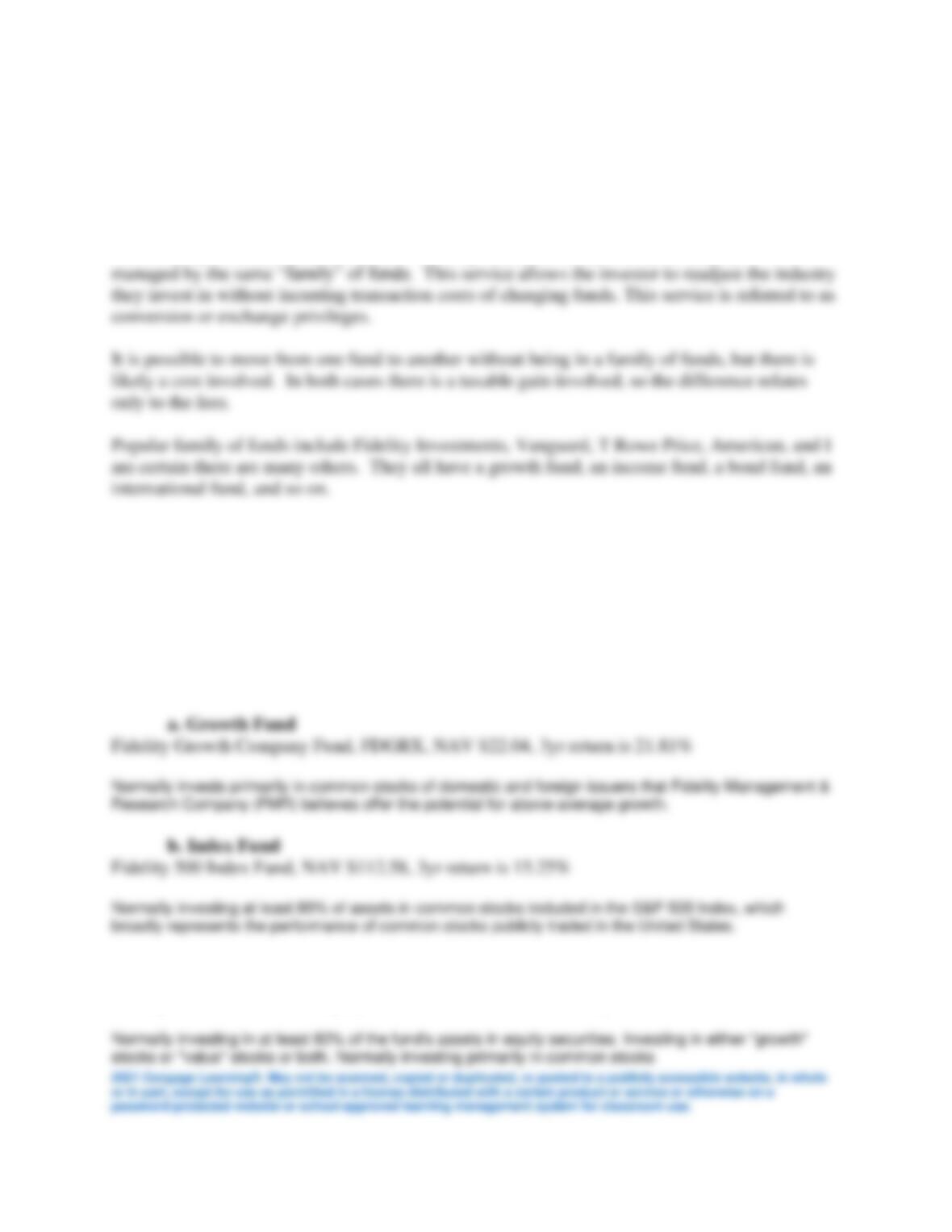
3. Comparing ETF with mutual fund. Describe an ETF and explain how these funds
combine the characteristics of open- and closed-end funds. In the Vanguard family of
funds, which would most closely resemble a “Spider” (SPDR)? In what respects are the
Vanguard fund (that you selected) and SPDRs the same, and how are they different? If you
could invest in only one of them, which would it be? Explain.
An Exchange Traded Fund (ETF) is like an open-end fund in that the number of shares
outstanding can be increased or decreased as investors send in more money or redeem shares. An
4. Mutual fund family services. What investor service is most closely linked to the notion of
a fund family? If a fund is not part of a family of mutual funds, can it still offer a full range
of investor services? Explain. Using a source such as The Wall Street Journal or an online
site find two examples of fund families and list some of the mutual funds that they offer.
A common feature offered by family of funds is the ability to go online (or pick up the phone) to
move money from one fund to another—the only constraint is that the funds must be
5. Comparing different types of mutual fund. Using a source like Barron’s, Forbes, Money, or
Morningstar, along with any related Internet sites, select five mutual funds—a growth fund,
an index fund, a sector fund, an international fund, and a high-yield corporate bond
fund—that you believe would make good investments. Briefly explain why you selected
each of the funds.
Note: All answers accessed on January 28, 2020. I accessed Fidelity Investments for all answers
because it was convenient. Students’ answers will vary greatly.
c. Sector Fund
Fidelity
®
Series All-Sector Equity Fund, FSAEX, NAV $10.45, 3yr return is 14.69%
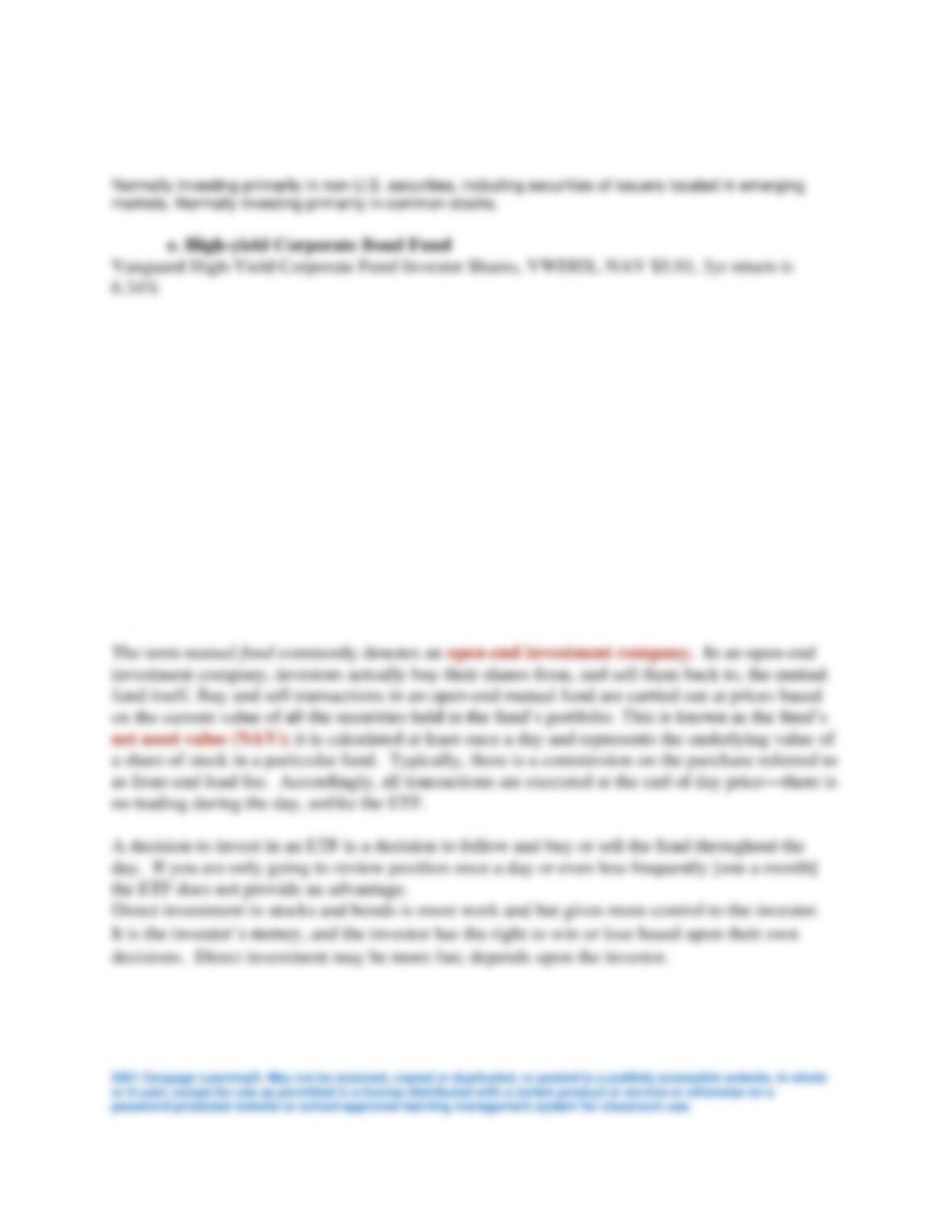
d. International Fund
Fidelity International Capital appreciation fund, FIVFX, NAV $23.06, 3yr return is 16.46%
The fund invests primarily in a diversified group of high-yielding, higher-risk corporate bonds-
commonly known as “junk bonds”-with medium- and lower-range credit-quality ratings. It
invests at least 80% of its assets in corporate bonds that are rated below Baa by Moody’s
Investors Service, Inc. (Moody’s).
6. Contrasting direct and mutual fund or ETF investing. Contrast mutual fund or ETF
ownership with direct investment in stocks and bonds. Assume that you’ve been asked to
debate the merits of investing through mutual funds versus investing directly in stocks and
bonds. Develop some pro and con arguments for this debate and be prepared to discuss
them. If you had to choose a side, which one would it be? Explain.
An exchange traded fund (ETF) is an investment company whose shares trade on stock
exchanges. Unlike mutual funds, ETF shares can be bought or sold (or sold short) throughout the
day.
Mutual funds or ETF gives the investor the ability to invest in a large number of companies,
much beyond what could be done with direct investment. I would choose to invest in Mutual
funds and rely on a “professional” fund manager rather than my own decisions.

7. Comparing risks of different mutual fund/ETF types. For each pair of funds listed below,
select the fund that would be less risky and briefly explain your answer.
a. Growth versus growth-and-income
b. Equity-income versus high-grade corporate bonds
c. Intermediate-term bonds versus high-yield municipals
d. International versus balanced
a. Growth versus growth-and-income
The objective of a growth fund is simple—capital appreciation. Long-term growth and capital
gains are the primary goals of such funds, so they invest principally in common stocks with
above-average growth potential.
b. Equity-income versus high-grade corporate bonds
c. Intermediate-term bonds versus high-yield municipals
Intermediate-term bond funds, which invest in bonds with maturities of 7 to 10 years or less
and offer not only attractive yields but also relatively low-price Volatility.
d. International versus balanced
The term international fund is used to describe a type of fund that invests exclusively in foreign
securities, often confining the fund’s activities to specific geographical regions (such as Mexico,
Australia, Europe, or the Pacific Rim).
8. Evaluating an ETF. Using the information in Exhibit 13.10, evaluate the performance of
QQQ index-based ETF. Specifically, comment on how well it tracks the underlying index
and how its performance compares with other similar ETFs.
The primary reason for investing in an index-based ETF, of course, is to replicate the
performance of the index. It follows that an important aspect of ETF performance is how well it
tracks the performance of the underlying index. You can determine this by checking the so-
called R-Squared (R2) statistical measure, which shows how much of the variability in an ETF’s
9. Calculating approximate return on mutual fund. About a year ago, Eric Roberson bought
some shares in the Diamond Mountain Mutual Fund. He bought the fund at $24.50 a share,
and it now trades at $26. Last year, the fund paid dividends of 40 cents a share and had
capital gains distributions of $1.83 a share. Using the approximate yield formula, what rate
of return did Elliot earn on his investment? Repeat the calculation using a handheld
financial calculator. Would he have made a 20 percent rate of return if the stock had risen
to $30 a share?
Trading at $26: Approximate Yield =[($0.40 + $1.83) + ($26.00 – $24.50)/1] / [($24.50 +
$26.00)/2] = $3.73 / $25.25 = 14.8%

10. Calculating mutual fund approximate rate of return
.
A year ago, the Sequoia Growth Fund
was being quoted at an NAV of $21.50 and an offer price of $23.35; today, it’s being quoted
at $23.04 (NAV) and $25.04 (offer). Use the approximate yield formula or a handheld
financial calculator to find the rate of return on this load fund; it was purchased a year
ago, and its dividends and capital gains distributions over the year totaled $1.05 a share.
(Hint: As an investor, you buy fund shares at the offer price and sell at the NAV.)
Trading at $23.04: Approximate Yield = ($1.05 + [($23.04 – $23.35)/1] ) / [($23.04 + $23.35/2]
= $0.74 / $23.20 = 3.19%
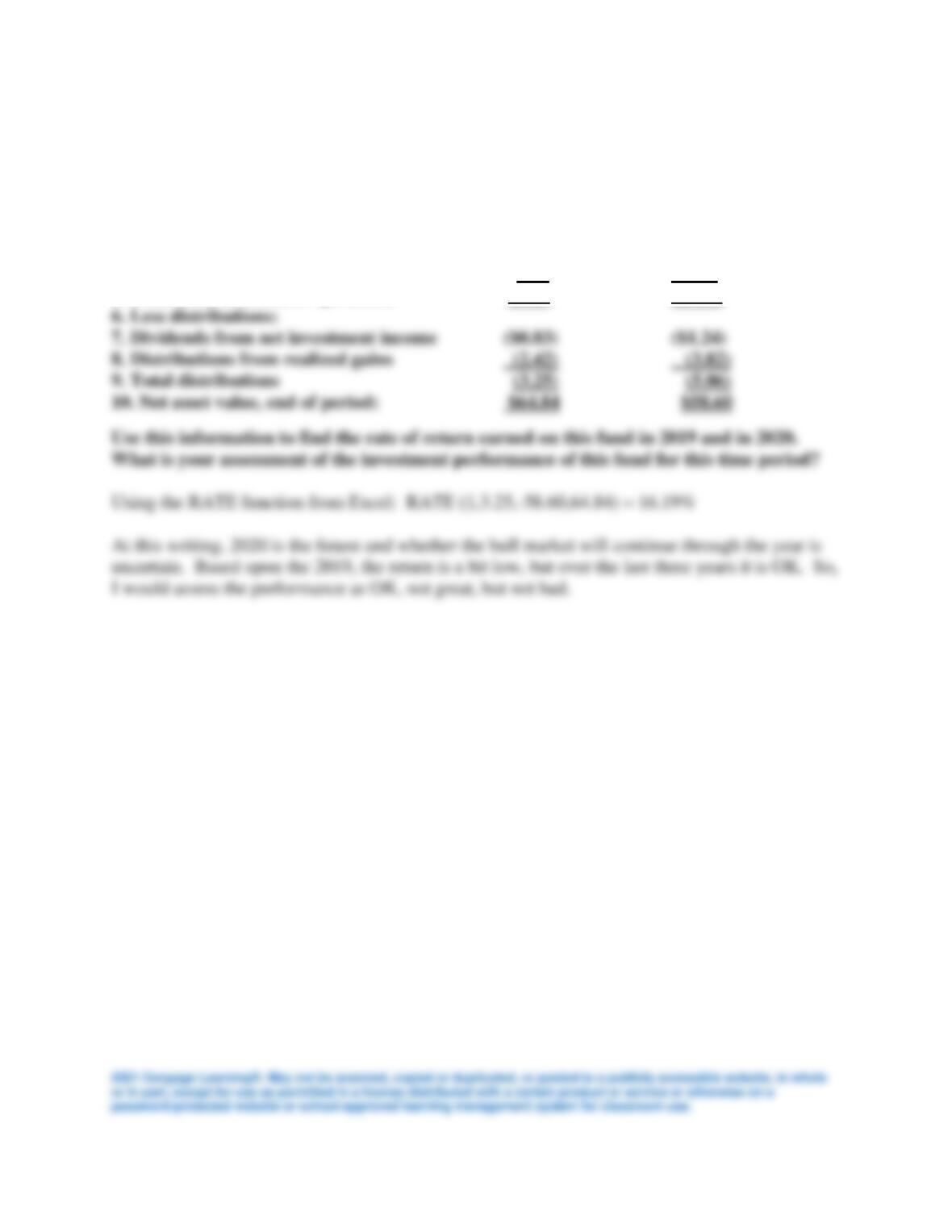
11. Calculating and evaluating mutual fund returns. Here is the per-share performance
record of the Stars Growth-and-Income fund for 2019 and 2020:
2020 2019
1. Net asset value, beginning of period: $58.60 $52.92
2. Income from investment operations:
3. Net investment income $1.39 $1.35
4. Net gains on securities (realized and unrealized) 8.10 9.39
5. Total from investment operations $9.49 $10.74

12. Different ways to invest in real estate. Assume that you’ve just inherited $100,000 and
wish to use all or part of it to make a real estate investment.
a. Would you invest directly in real estate, or indirectly through something like a REIT?
Explain.
One guiding principle of investing is to invest in what you know about and understand. If you
b. Assuming that you decided to invest directly, would you invest in income-producing
property or speculative property? Why? Describe the key characteristics of the types of
income producing or speculative property you would seek.
One of the most popular forms of real estate investing is income (or income- producing)
property, which includes commercial and residential properties. Investments in income
c. What financial and nonfinancial goals would you establish before beginning the search
for suitable property?
Two basic goals with real estate investing is income and appreciation in value of property. If
d. If you decide to invest in real estate indirectly, which type(s) of securities would you buy,
and why?
Options are a real estate investment trust (REIT), which is a type of closed-end investment
company that invests money in various types of real estate and real estate mortgages. Another