
ANSWERS TO CHAPTER QUESTIONS
Chapter 13 Retirement Planning
1) Retirement costs are a huge outlay. For most people it is their single most important
2) Their principal concerns are:
a) Will I have enough money to retire comfortably?
b) How much will I have to save to retire comfortably?
c) Will I run out of money in retirement?
d) How can I protect myself against retirement risks such as extraordinary eldercare
costs?
3) Life cycle theory as propounded by Modigliani says people plan their financial
4) A defined benefit plan guarantees a fixed sum of money at the end of a career based
5) A defined contribution plan is likely to be more beneficial to a young worker.
Defined benefit plans are more advantageous provide company contributions to older

6) Qualified pension plans provide pretax contributions and tax free compounding until
7) The principal benefit of non qualified plans is tax deferred compounding. After tax
8) A mutual fund would be more attractive than a tax deferred annuity when the lower
overhead expense for a mutual fund and its taxation for dividends and capital gains at
lower tax rates more than offset the benefits from tax deferred compounding for the
9) A capital needs analysis provides the amount of money required to fund a goal. It
incorporates various return assumptions and other time value of money principles.
Common complex capital needs analysis is performed for retirement, life insurance
and to a lesser extent disability insurance.

10) Longevity risk is the chance of living longer than expected which can create an
11) Retirement needs assumes the funders will live on and calculates the amount of
savings needed to support retirement. Life insurance protects against the possibility of
premature death of the wage earner. It can provide the amount of insurance needed to
12) Many people believe that investing after retirement should be more conservative than
investing prior to retirement. The reason is at retirement one of the life cycle assets,
human assets is no longer available. Since any loss cannot be overcome by additional
inflows from a job, people should invest more conservatively.
13) A significant portion of a retirement portfolio should be invested in equities.
14) Withdrawal risk is the potential for withdrawals to be made in retirement assets when
the stock market or other market invested in has declined sharply. Since the money is

15) Ordinary annuities
a) Strengths
i) Tax deferrals
b) Weaknesses
i) Often not adjusted for inflation
16) Decisions on taking Social Security early:
a) Risk tolerance and potential return on income taken and invested.
b) Current health.
ANSWERS TO CHAPTER PROBLEMS
Chapter 13 Retirement Planning
1) Marisa and Jennifer both attempted to put away $10,000 a year toward savings.
Marisa used a 401(k) pension plan while Jennifer tried to do the same but was forced
to pay taxes on that $10,000 in savings each year. Assuming that the process was the
Excel Solution
Marisa Jennifer
Savings
Pretax Dollars Saved $10,000 $10,000
Tax at 35% rate – ($3,500)

Calculator Solution
Jennifer:
Marisa:
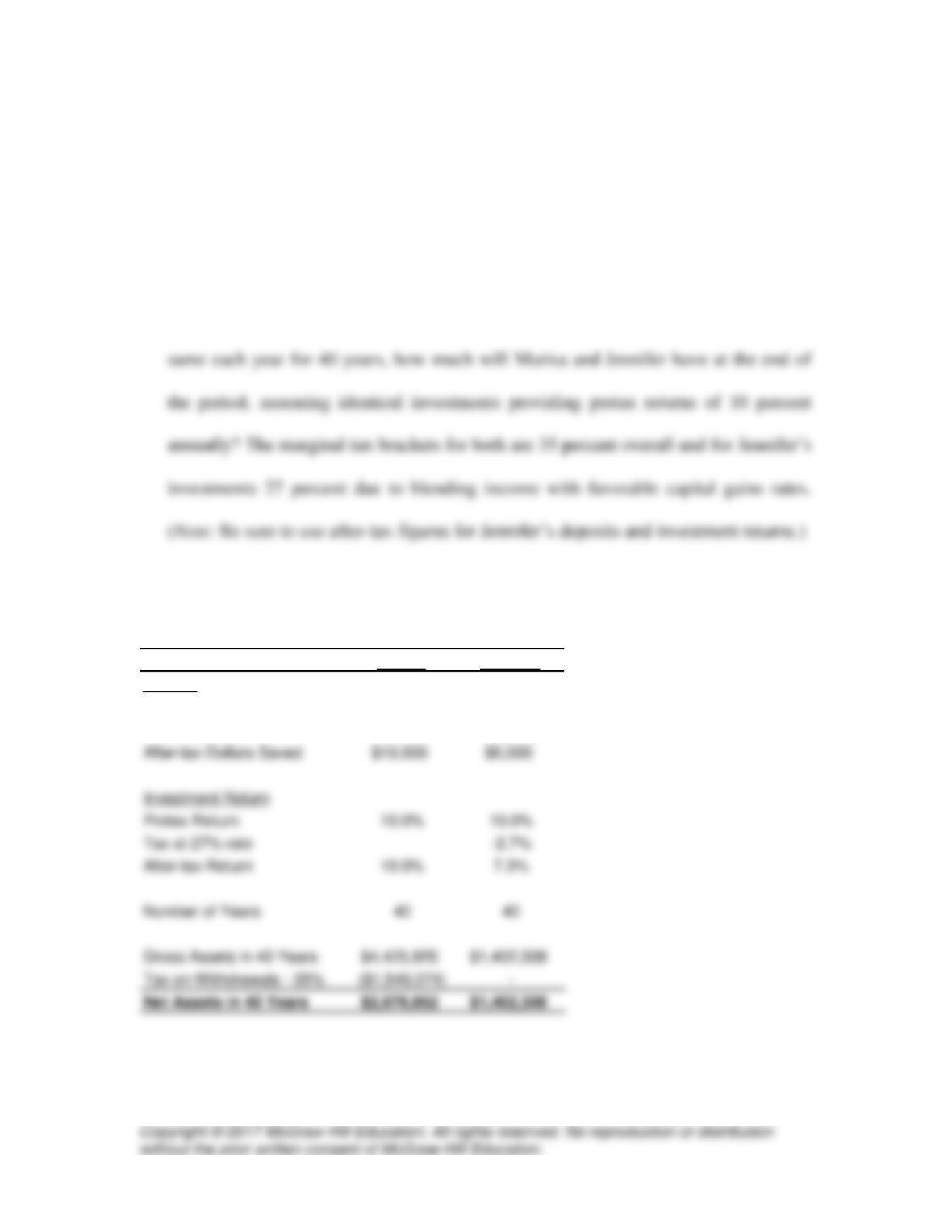
Although Marisa and Jennifer took the same amount from their salaries for savings and
earned the same pretax return, Marisa actually saved about $1,474,000 more, or more
than double what Jennifer saved. This due to the pretax savings which earned
compounded pretax return over a long period of time.
2) Dawn and Mildred had the same starting sum of $120,000. Each made withdrawals of
$12,000 a year. In years 2, 3, and 4, each had returns of 9 percent a year. Dawn had a
50 percent drop in year 1 and a 50 percent gain in year 5, while Mildred had a 50
percent gain in year 1 and a 50 percent drop in year 5.
a. Calculate the remaining sum for each woman at the end of year 5.

Note: The amount of withdrawals in the text should be $12,000 a year. It appears in red
above. The solution to the problem should then be:
Excel Solution
Inputs
Starting Sum $120,000
Annual Withdrawals $12,000
Return Years 2-4 9%
Solution
Year Dawn
Explanation Mildred Explanation
0$120,000 $120,000
b. Explain why there is such a big difference in the remaining amounts.
Mildred has more than three times as much money left at the end of year 5 as Dawn.
3) Kenneth was considering whether to place $10,000 in a tax-deferred annuity or a tax–
free municipal bond. Assume the municipal returned 5 percent a year and the tax–
deferred annuity 6 percent. Calculate approximately how long he would have to hold
ahead. His marginal tax rate is 35 percent.
Excel Solution
Inputs
Investment Amount $10,000
Return on Municipal Bond 5%
Return on Tax-Deferred Annuity 6%
Tax Rate 35%
Solution
Year
Municipal
Before-Tax
Municipal
After-Tax
Tax-Deferred
Before-Tax
Tax-Deferred
After-Tax
110,500 10,500 10,600 6,890
512,763 12,763 13,382 8,698
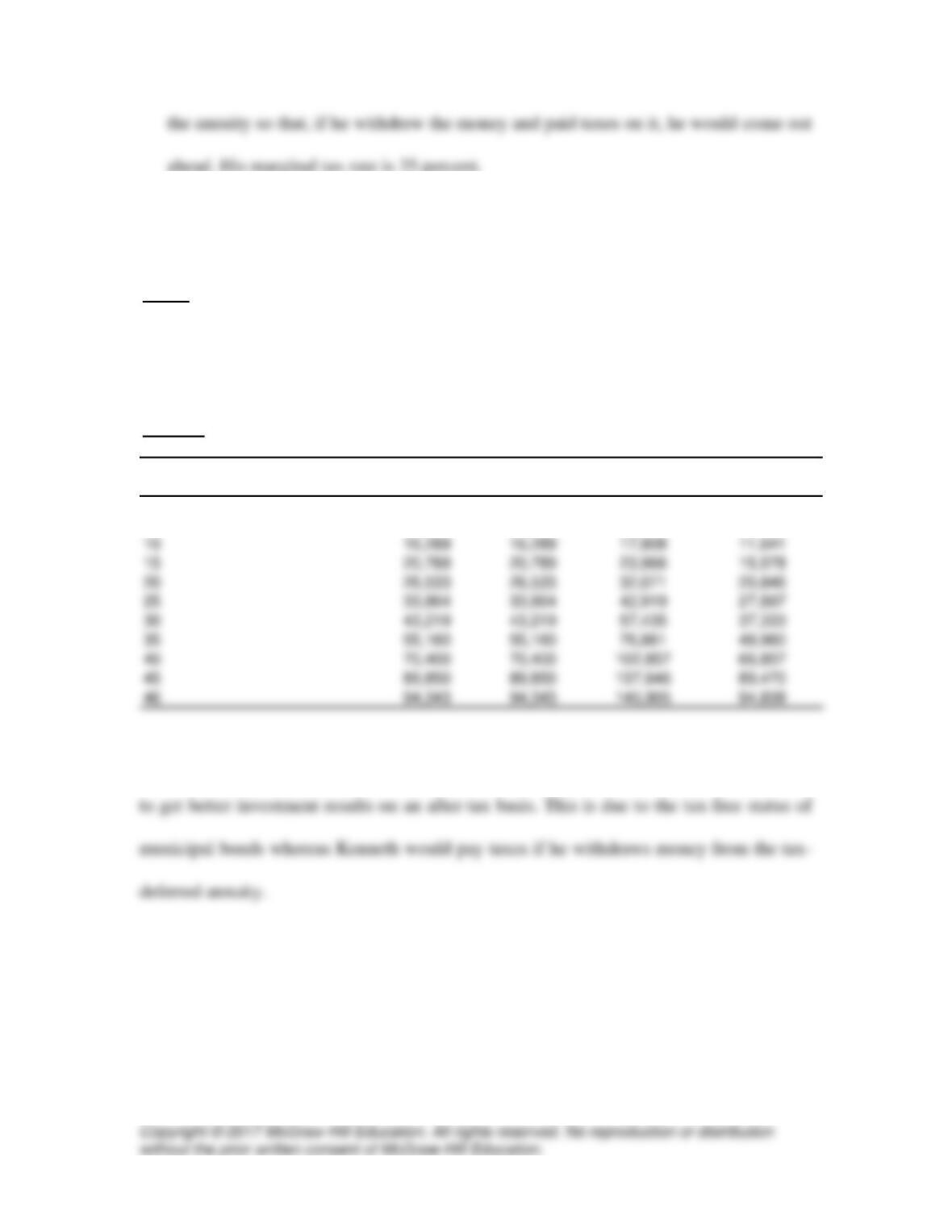
It turns out that Kenneth would have to hold the annuity for more than 45 years in order
4) Elizabeth, age 62, wanted to consider the benefits of age 62 Social Security at a
reduced 80 percent payout versus full payments at age 65. She could invest the
monies at 5.5 percent after tax and expects to live until age 88. She will receive
$15,000 a year after tax at age 65. Which alternative should she select? Show all
calculations.
Step Statistic Explanation
Calculator Solution
Solution 163,950
Benefit starts at age 65 $15,000
Solution 193,126
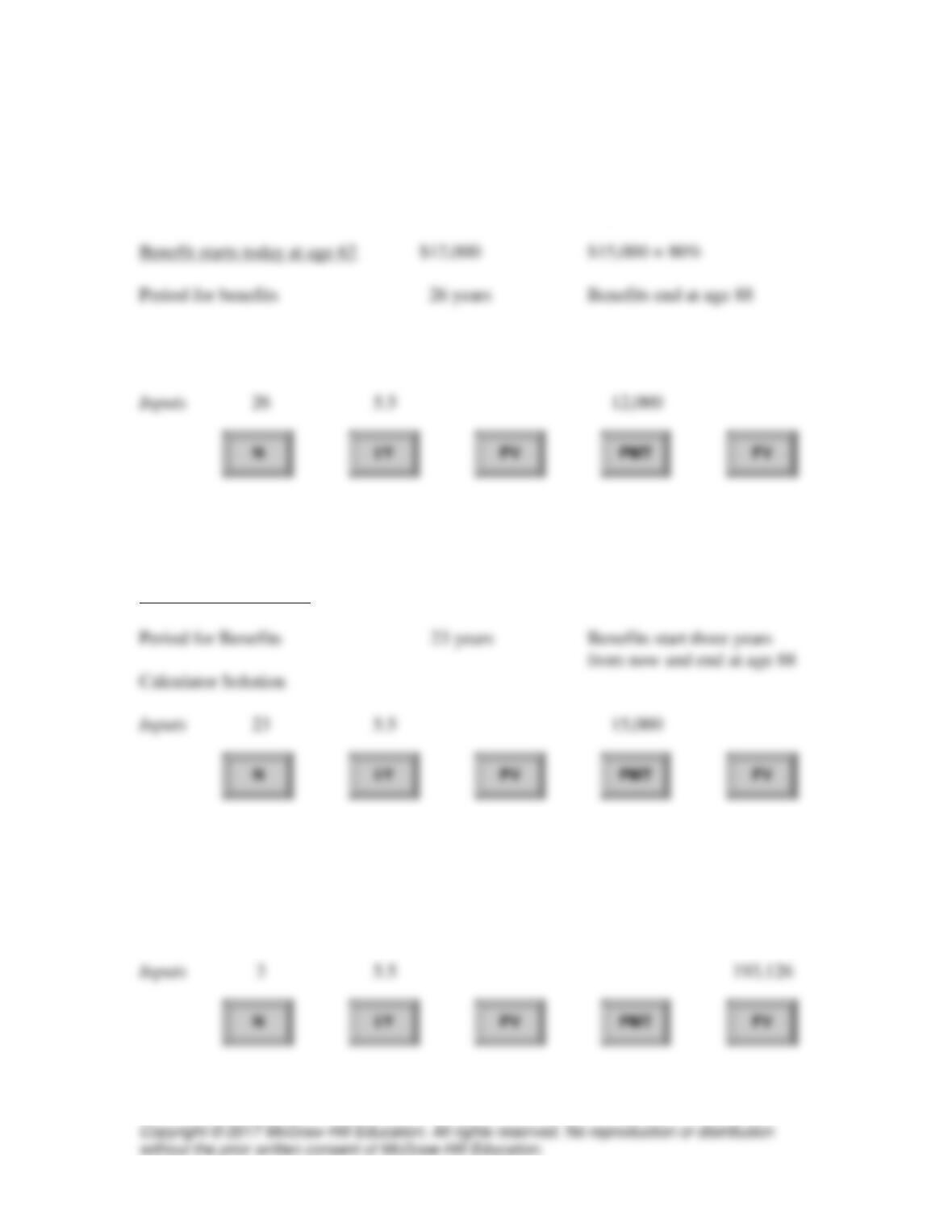
This is the present value at age 65. We now have to bring that amount back to age 62 so
that it can be compared with the benefit that starts at that age.
Solution 164,469

This is the present value at age 62, today. Since it is slightly higher than the benefit that
starts at age 62, it would be the preferred alternative for Elizabeth.
Excel Solution
Inputs
Benefit at Age 65 15000
Benefit at Age 62 12000
After-tax Return 5.5%
Assumed Age of Death 88
Solution
Benefits Starting at Age 62
Benefits Starting at Age 65

ANSWERS TO CASE APPLICATION QUESTIONS
Chapter 13 Retirement Planning
Part I
1) Monica doing her own investments could make sense given Richard’s poor past
record. She might need help and of course would need Richard’s acquiescence.
2) The lower tax rates for dividends and capital gains discussed in chapter 14 can
make non pension savings more competitive. If material withdrawals as a
3) Choices:
a) More savings today.
4) Recommendation:
a) Develop a retirement needs analysis (see chapter 18 for the quantitative

Part II
1) Their beliefs are fairly prevalent among younger adults. Many have difficulty in
2) Starting savings today in a 401 (k) or other pension vehicle can take advantage of
3) Assuming that the $1 million was in nominal dollars (non inflation adjusted)

Answers to CFP® Questions
Chapter/Question
Answer
Question 13.1
B
Question 13.2
B & D*
Question 13.3
E
Question 13.4
A
Question 13.5
A
Question 13.6
D
Question 13.7
C
Question 13.8
D
*The solution supplied is from the author and not the CFP Board.