370 Instructor’s Manual
can then be used as working capital.
Disadvantages of leasing include:
• A lease does not have a stated interest cost, and borrowing may be less costly for the
company.
Solutions to End-of-Chapter Problems
Corporate Bonds
P13-1. The initial proceeds per bond, the size of the issue, the initial maturity of the bond, and the
years remaining to maturity are shown in the following table for a number of bonds. In
each case the bond has a $1,000 par value, and the issuing firm is in the 40% tax bracket,.
Bond
Proceeds per
Bond
Size of
Issue
Initial
Maturity of
Bond
Years
Remaining to
Maturity
A
$ 985
10,000 bonds
20 years
15 years
B
1,025
20,000
25
16
C
1,000
22,500
12
9
D
960
5,000
25
15
E
1,035
10,000
30
16
A13-1. Premium/discount per bond = Proceeds per bond – Par value per bond
Total Premium/discount = Premium/Discount per bond Size of issue (# of bonds)
Annual premium/discount amortized per bond = Prem/Disc per bond Initial maturity (in
years)

Chapter 13 Long-Term Debt and Leasing 371
After-tax cash flow = [– (Unamortized prem/Disc per bond Size of issue Corporate tax
rate)]
[Retiring premium bonds: remaining premium realized as income, increasing taxes
payable;
Retiring discount bonds: remaining discount deducted from income, reducing taxes
payable]
Bond
Premium (+)
or Discount (–)
per Bond
Total
Premium or
Discount
per Bond
Annual
Premium or
Discount
per Bond
Unamortized
Premium
or Discount
per Bond
After-Tax
Cash Flows from
Retiring Issue
P13-2. For each of the callable bond issues in the following table, calculate the after-tax cost of
calling the issue. Each bond has a $1,000 par value, and the various issue sizes and call
prices are shown in the table. The firm is in the 40% tax bracket.
Bond
Size of Issue
Call Price
A
12,000 bonds
$1,050
D
50,000
1,050
F
500,000
1,060
A13-2. Call premium per bond = Call price – Par value
Total call premium = Call premium per bond Size of issue (# of bonds)
After-tax cost of calling bond issue = Total call premium (1 – Tax rate)
Bond
Call Premium
per Bond
Total Call
Premium
After-Tax Cost
of Calling Issue
A
$50
$ 600,000
$ 360,000
600,000
C
15
D
50
60
P13-3. The floatation cost, the initial maturity, and the number of years remaining to maturity are
shown in the following table for a number of bonds. The firm is in the 40% tax bracket.
Floatation
Initial Maturity
Years Remaining
372 Instructor’s Manual
Bond
Cost
of Bond
to Maturity
A
$250,000
30 years
22 years
B
500,000
15
5
20
D
750,000
10
1
15
A13-3. Annual floatation cost amortization = Floatation cost Initial maturity (# years)
[Charged against income each year, reducing taxable income and taxes payable]
Total unamortized floatation costs (TUFC) =
Annual amortization amount Years remaining
Tax savings from realizing unamortized floatation cost = TUFC Tax rate
Bond
Annual
Amortization
of Floatation Costs
Total
Unamortized
Floatation Costs
Tax Savings from
Realizing Unamortized
Floatation Costs
A
$ 8,333
$183,333
$ 73,333
166,667
D
P13-4. The principal, coupon interest rate, and interest overlap period are shown in the following
table for five different bonds.
Bond
Principal
Coupon
Interest Rate
Interest
Overlap Period
A
$ 5,000,000
8.0%
3 months
B
40,000,000
7.0
2
C
50,000,000
6.5
3
D
100,000,000
9.0
E
20,000,000
5.5
1
A13-4. Interest payable during overlap = Coupon rate Principal [Months overlap 12]
After-tax cost of overlapping interest = Interest during overlap period (1 – Tax rate)
Bond
Calculation of Interest Payable
During Overlap Period
Interest Payable During
Overlap Period
After-Tax Cost of
Overlapping Interest
Chapter 13 Long-Term Debt and Leasing 373
B
40,000,000 0.07 [2 12]
466,667
280,000
P13-5. Schooner Company is contemplating offering a new $50 million bond issue to replace an
outstanding $50 million bond issue. The firm wishes to take advantage of the decline in
interest rates that has occurred since the initial bond issuance. The old and new bonds are
described in what follows. The firm is in the 40% tax bracket.
Old bonds. The outstanding bonds have a $1,000 par value and a 9% coupon interest rate.
They were issued five years ago with a 20-year maturity. They were initially sold for their
par value of $1,000, and the firm incurred $350,000 in floatation costs. They are callable at
$1,090.
New bonds. The new bonds would have a $1,000 par value, a 7% coupon interest rate, and
a 15-year maturity. They could be sold at their par value. The floatation cost of the new
bonds would be $500,000. The firm does not expect to have any overlapping interest.
a. Calculate the tax savings that are expected from the unamortized portion of the old
bonds’ floatation cost.
A13-5. Steps in bond refunding decision: (1) Calculate the initial investment required to call the
old bond issue and float the new one; (2) Find the annual cash flow savings from the new
versus old bond issue; and, (3) Find the net present value of refunding decision. Answers
to parts (a)-(f) of this problem will be determined with this procedure.
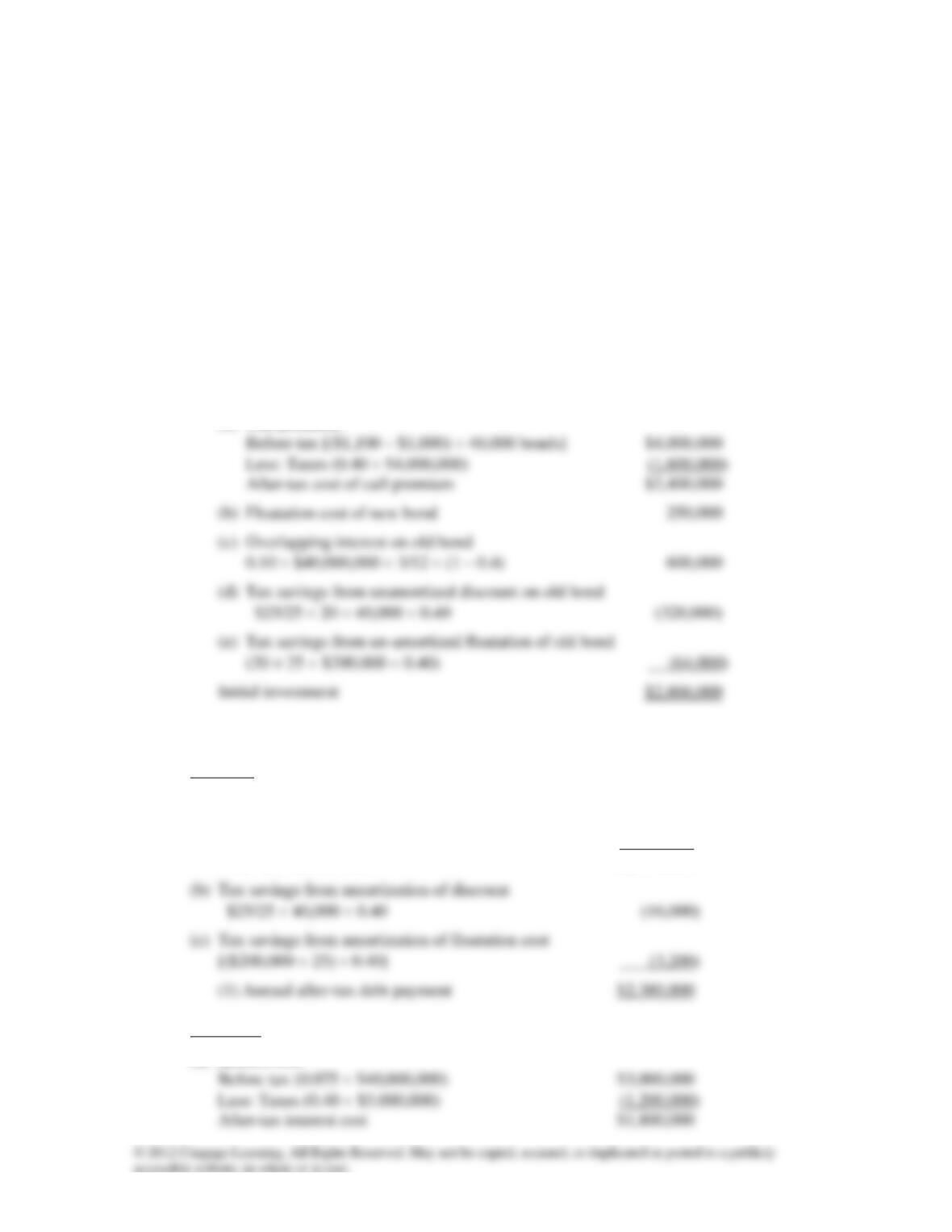
(1) Finding the Initial Investment for the Bond Refunding Decision
(a) Call premium
Before tax [($1,090 – $1,000) 50,000 bonds] $4,500,000
374 Instructor’s Manual
Initial investment $2,095,000
(2) Finding the Annual Cash Flow Savings for the Bond Refunding Decision
Old bond
(a) Interest cost
(1) Annual after-tax debt payment $2,693,000
New bond
(2) Annual after-tax debt payment $2,086,667
Annual cash flow savings [(1) – (2)] $ 606,333
(3) Finding the Net Present Value of the Bond Refunding Decision
(a) Present value of annual cash flow [from part (2)]
P13-6. High-Gearing Incorporated is considering offering a new $40 million bond issue to replace
an outstanding $40 million bond issue. The firm wishes to take advantage of the decline in
interest rates that has occurred since the original issue. The two bond issues are described
in what follows. The firm is in the 40% tax bracket.
Chapter 13 Long-Term Debt and Leasing 375
a. Calculate the initial investment that is required to call the old bonds and issue the new
bonds.
b. Calculate the annual cash flow savings, if any, expected from the proposed bond-
refunding decision.
c. If the firm uses its 4.5% after-tax cost of debt to evaluate low-risk decisions, find the
net present value (NPV) of the bond-refunding decision. Would you recommend the
proposed refunding? Explain your answer.
A13-6. Steps in bond refunding decision: (1) Calculate the initial investment required to call the
old bond issue and float the new one; (2) Find the annual cash flow savings from the new
versus old bond issue; and, (3) Find the net present value of refunding decision. Answers
to parts (a)-(f) of this problem will be determined with this procedure.
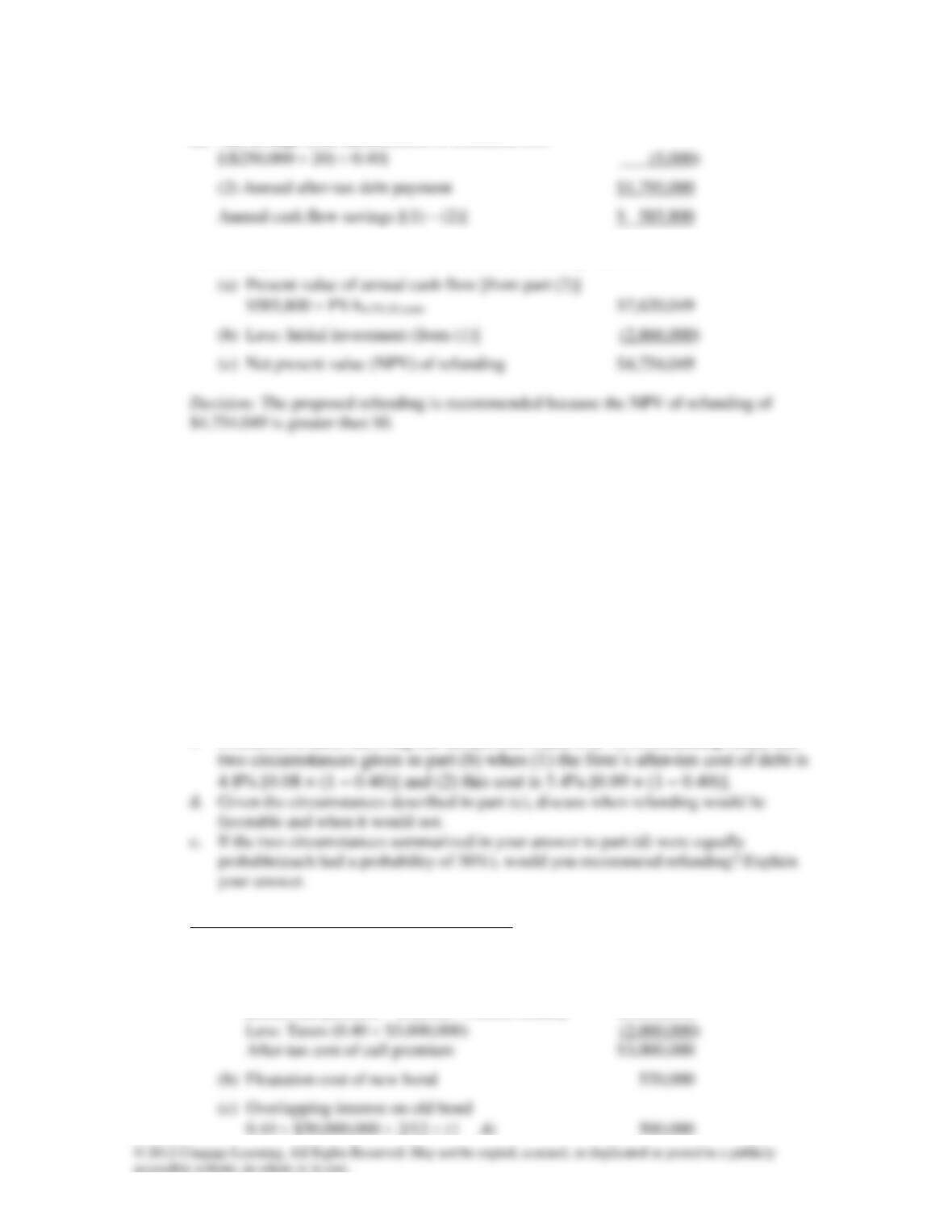
(1) Finding the Initial Investment for the Bond Refunding Decision
(a) Call premium
(2) Finding the Annual Cash Flow Savings for Bond Refunding Decision
Old bond
(a) Interest cost
Before tax (0.10 $40,000,000) $4,000,000
Less: Taxes (0.40 $4,000,000) (1,600,000)
After-tax interest cost $2,400,000
New bond
(d) Interest cost
376 Instructor’s Manual
(e) Tax savings from amortization of floatation cost
(3) Finding the Net Present Value of the Bond Refunding Decision
P13-7. Web Tools Company is considering using the proceeds from a new $50 million bond issue
to call and retire its outstanding $50 million bond issue. The details of both bond issues are
outlined in what follows. The firm is in the 40% tax bracket.
Old bonds. The firm’s old issue has a coupon interest rate of 10%, was issued four years
ago, and had a 20-year maturity. The bonds sold at a $10 discount from their $1,000 par
value, floatation costs were $420,000, and their call price is $1,100.
New bonds. The new bonds are expected to sell at par ($1,000), have a 16-year maturity,
and have floatation costs of $520,000. The firm will have a two-month period of
overlapping interest while it retires the old bonds.
a. What is the initial investment that is required to call the old bonds and issue the new
bonds?
b. What are the annual cash flow savings, if any, from the proposed bond-refunding
decision if the new bonds have an 8% coupon interest rate? If the new bonds have a
9% coupon interest rate?
c. Construct a table showing the net present value (NPV) of refunding under the
A13-7. 8% coupon interest, 4.8% after-tax cost of debt
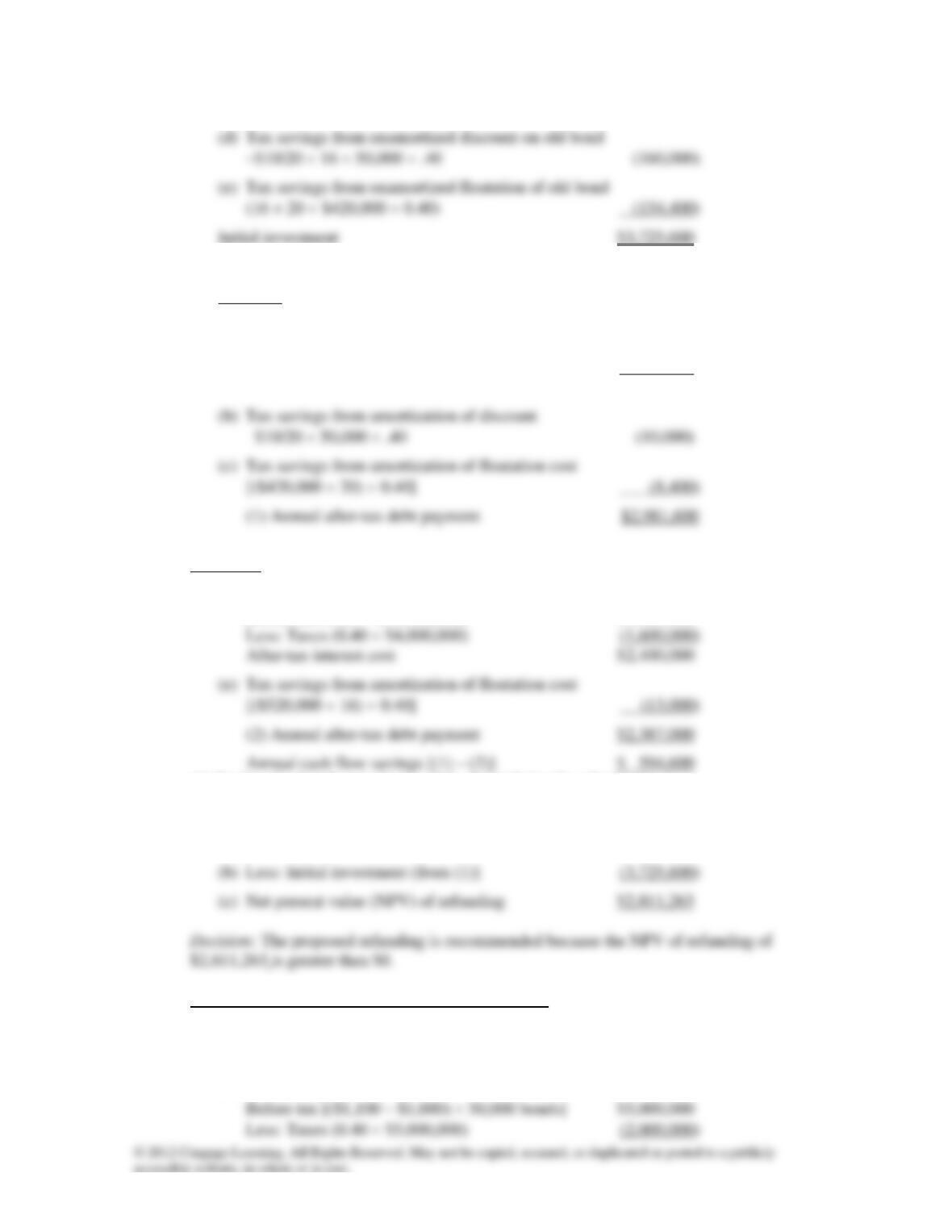
(1) Finding the Initial Investment for the Bond Refunding Decision
(a) Call premium
Before tax [($1,100 – $1,000) 50,000 bonds] $5,000,000
Chapter 13 Long-Term Debt and Leasing 377
(2) Finding the Annual Cash Flow Savings for the Bond Refunding Decision
Old bond
(a) Interest cost
Before tax (0.10 $50,000,000) $5,000,000
Less: Taxes (0.40 $5,000,000) (2,000,000)
After-tax interest cost $3,000,000
New bond
(d) Interest cost
Before tax (0.08 $50,000,000) $4,000,000
(3) Finding the Net Present Value of the Bond Refunding Decision
(a) Present value of annual cash flow [from part (2)]
$594,600 PVA4.8%,16 years $6,536,863
9.0% coupon interest, 5.4% after-tax cost of debt
(1) Finding the Initial Investment for the Bond Refunding Decision
(a) Call premium
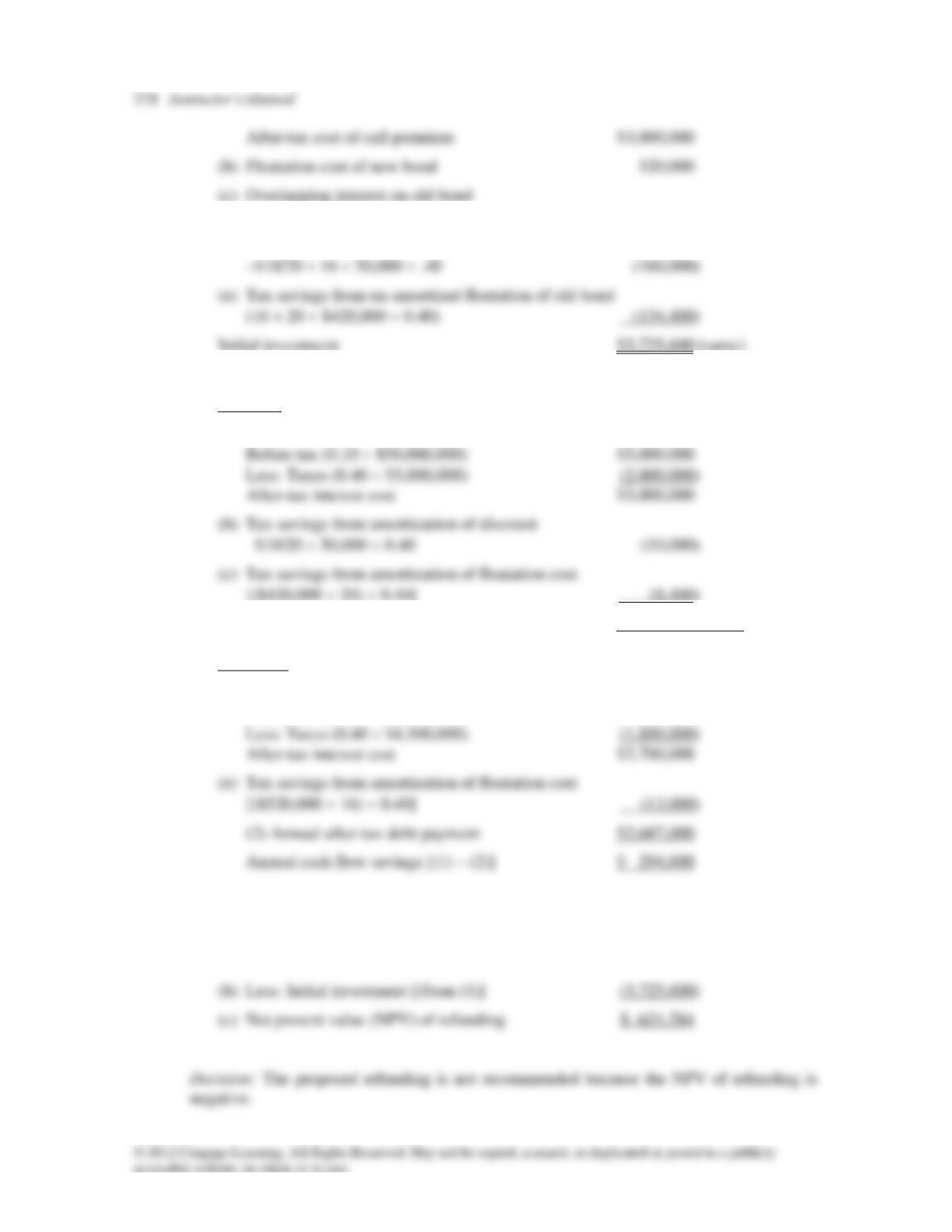
0.10 $50,000,000 2/12 (1 – .4) 500,000
(d) Tax savings from unamortized discount on old bond
(2) Finding the Annual Cash Flow Savings for the Bond Refunding Decision
Old bond
(a) Interest cost
(1) Annual after-tax debt payment $2,981,600 (same)
New bond
(d) Interest cost
Before tax (0.09 $50,000,000) $4,500,000
(3) Finding the Net Present Value of the Bond Refunding Decision
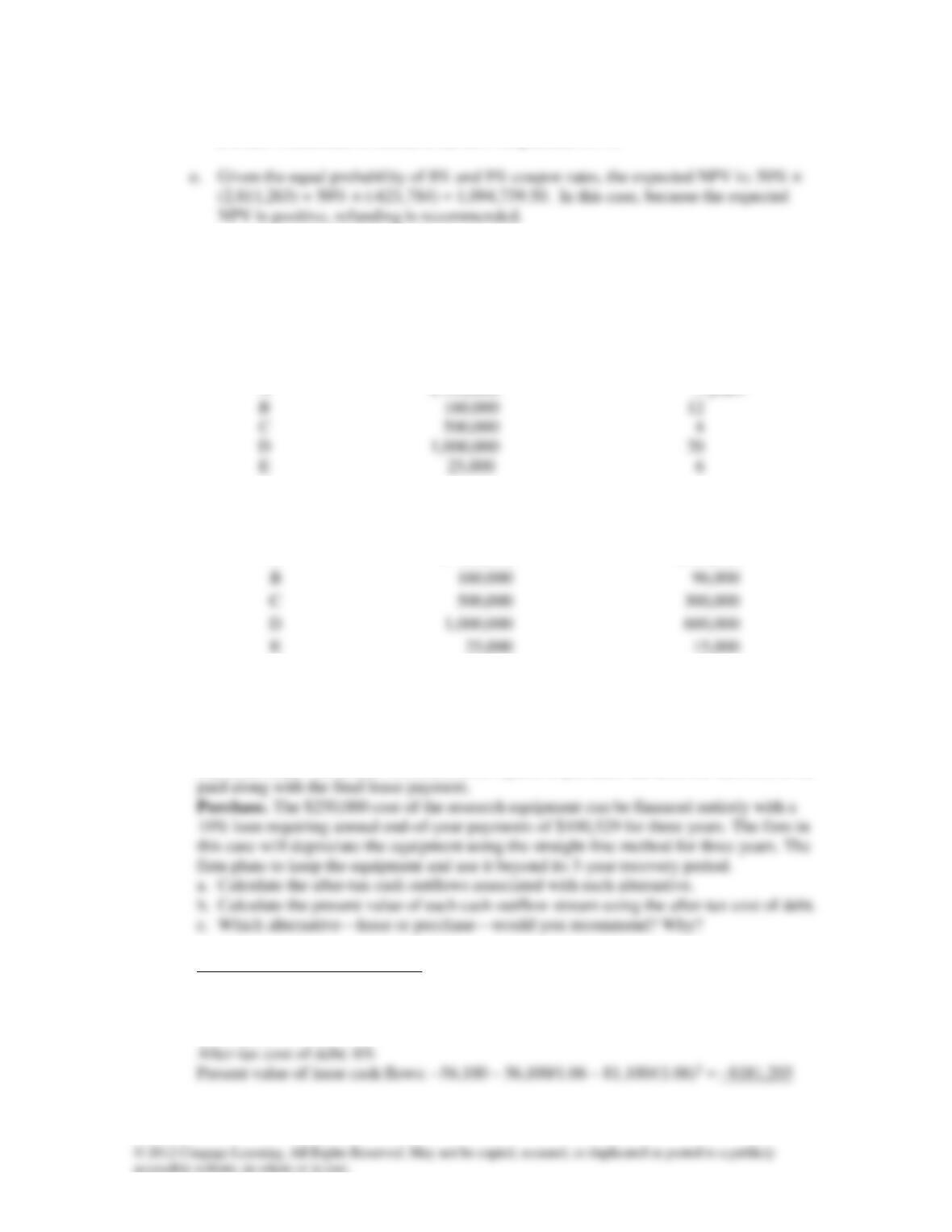
(a) Present value of annual cash flow [from part (2)]
$294,600 PVA5.4%,16 years $3,103,816
Chapter 13 Long-Term Debt and Leasing 379
It is not worthwhile to refund if the new coupon rate is 9%.
Leasing
P13-8. Given the lease payments and terms shown in the following table, determine the yearly
after-tax cash outflows for each firm. Assume that lease payments are made at the
beginning of each year. that the firm is in the 40% tax bracket, and that no purchase
option exists.
Firm
Annual Lease Payment
Term of Lease
A
$ 250,000
5 years
C
500,000
8
D
A13-8. The yearly after tax cash flows are the lease payment (1–Tax rate)
Firm
Lease Payment
After-Tax Cash Flow
A
$ 250,000
$150,000
C
D
P13-9. GMS Corporation is attempting to determine whether to lease or purchase research
equipment. The firm is in the 40% tax bracket, and its after-tax cost of debt is currently
6%. The terms of the lease and the purchase are as follows:
Lease. Annual beginning-of-year lease payments of $93,500 are required over the 3-year
life of the lease. The lessee will exercise its option to purchase the asset for $25,000, to be
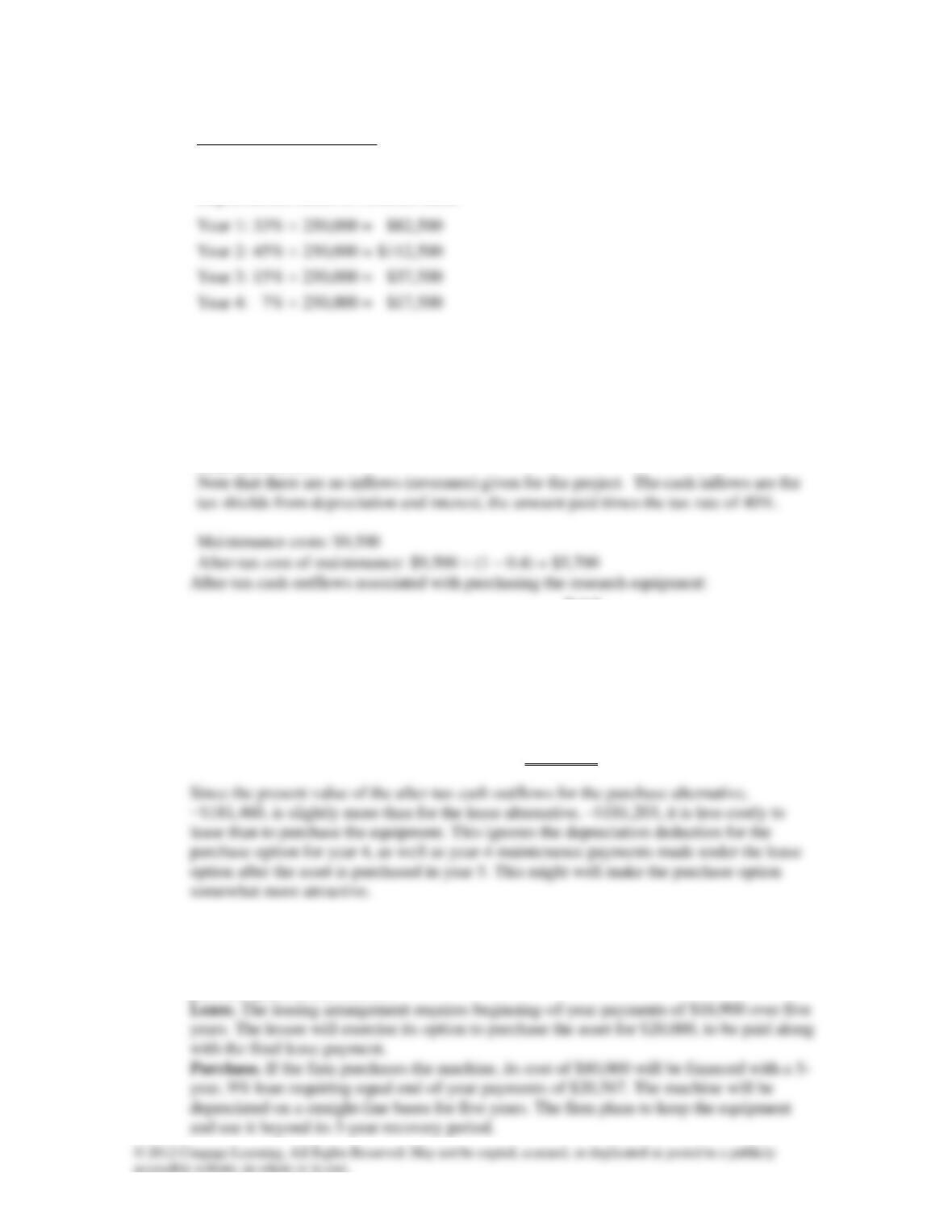
A13-9. Leasing the Research Equipment
Beginning of period lease payment: $93,500
After-tax lease payment = 93,500 (1 – 0.4) = $56,100
N = 3 years
380 Instructor’s Manual
Purchasing the Equipment
$250,000 equipment cost
Depreciation, based on MACRS table:
Loan interest and principal:
Principal Balance
Payment
Interest
Principal
Ending Principal
$250,000
$100,529
$25,000
$75,529
$174,471
174,471
100,529
17,447
83,082
91,389
91,389
100,529
9,139
91,389
0
Loan cash flows:
End of
Year
Loan
Payments
(1)
Maint.
Costs
(2)
Deprec.
(3)
Interest
(4)
Total
Deductions
(2)+(3)+(4)=
(5)
Tax
Shields
0.405=(6)
After-Tax
Cash Outflows
(1)+(2)-(6)=(7)
1
$100,529
$9,500
$ 82,500
$25,000
$117,000
$46,800
$63,229
2
100,529
9,500
112,500
17,447
139,447
55,779
54,250
3
100,529
9,500
37,500
9,139
56,139
22,456
87,573
Discounting the after-tax cash outflows at 6.0%: –$181,460
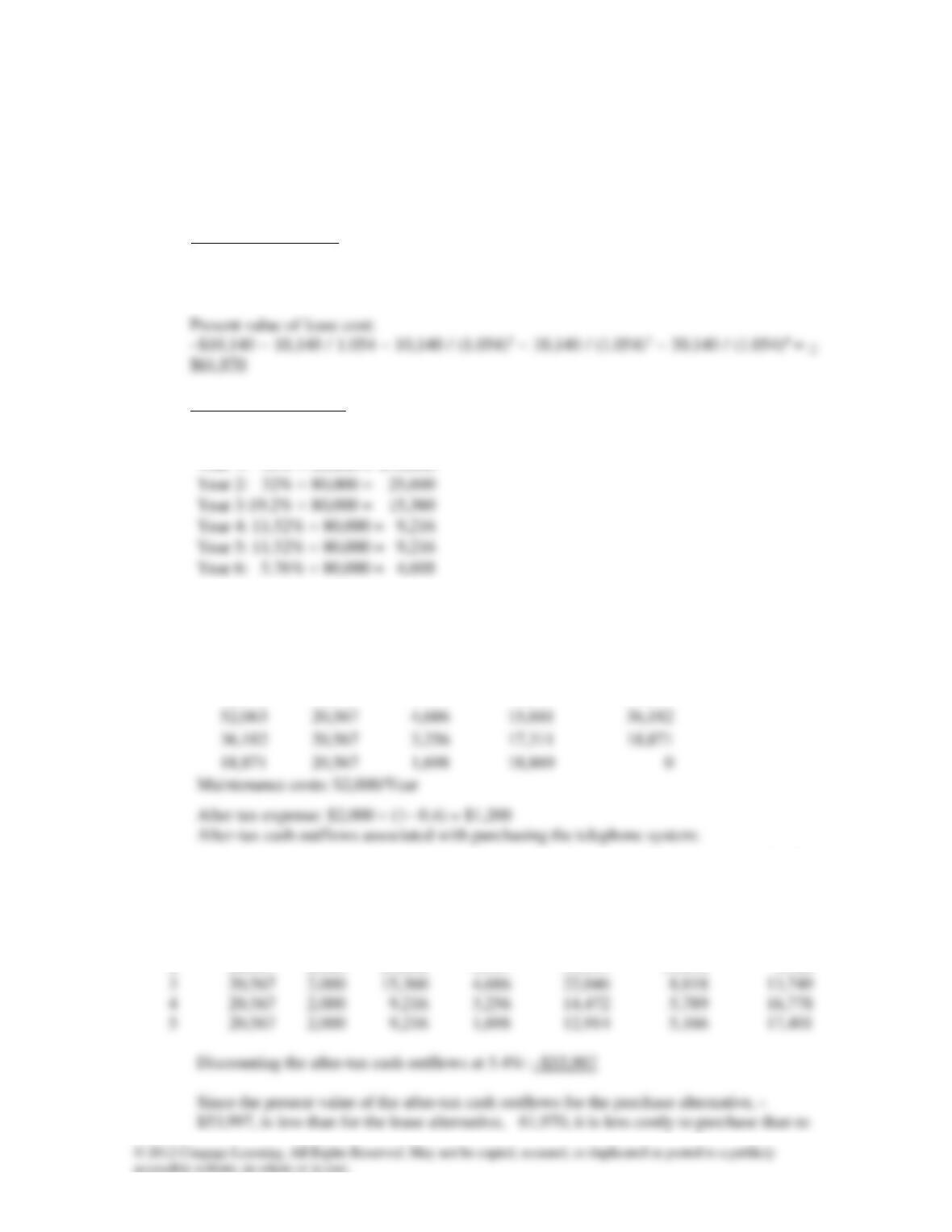
P13-10. Eastern Trucking Company needs to expand its facilities. In order to do so, the firm must
acquire a machine costing $80,000. The machine can be leased or purchased. The firm is in
the 40% tax bracket, and its after-tax cost of debt is 5.4%. The terms of the lease and
purchase plans are as follows:
Chapter 13 Long-Term Debt and Leasing 381
a. Determine the after-tax cash outflows of Eastern Trucking under each alternative.
b. Find the present value of the after-tax cash outflows for each alternative using the
after-tax cost of debt.
c. Which alternative—lease or purchase—would you recommend? Why?
A13-10.Leasing the Machine:
Lease payment: $16,900
After-tax payment: $16,900 .6 = $10,140
Purchase the Machine:
Depreciation, using MACRS tables
Year 1: 20% 80,000 = $16,000
Loan Interest
Principal
Payment
Interest
Principal Paid
Ending
Balance
$80,000
$20,567
$7,200
$13,367
$66,633
66,633
20,567
5,997
14,570
52,063
52,063
20,567
4,686
15,881
36,182
18,871
20,567
1,698
18,869
End of
Year
Loan
Payments
(1)
Maint.
Costs
(2)
Deprec
(3)
Interest
(4)
Total
Deductions
2+3+4=(5)
Tax
Shields
0.405=(6)
After-Tax
Cash
Outflows
1+2–6=(7)
1
$20,567
$2,000
$16,000
$7,200
$25,200
$15,120
$ 7,447
2
20,567
2,000
25,600
5,997
33,597
13,438
9,128
3
20,567
15,360
4
20,567
2,000
9,216
3,256
14,472
5
20,567
382 Instructor’s Manual
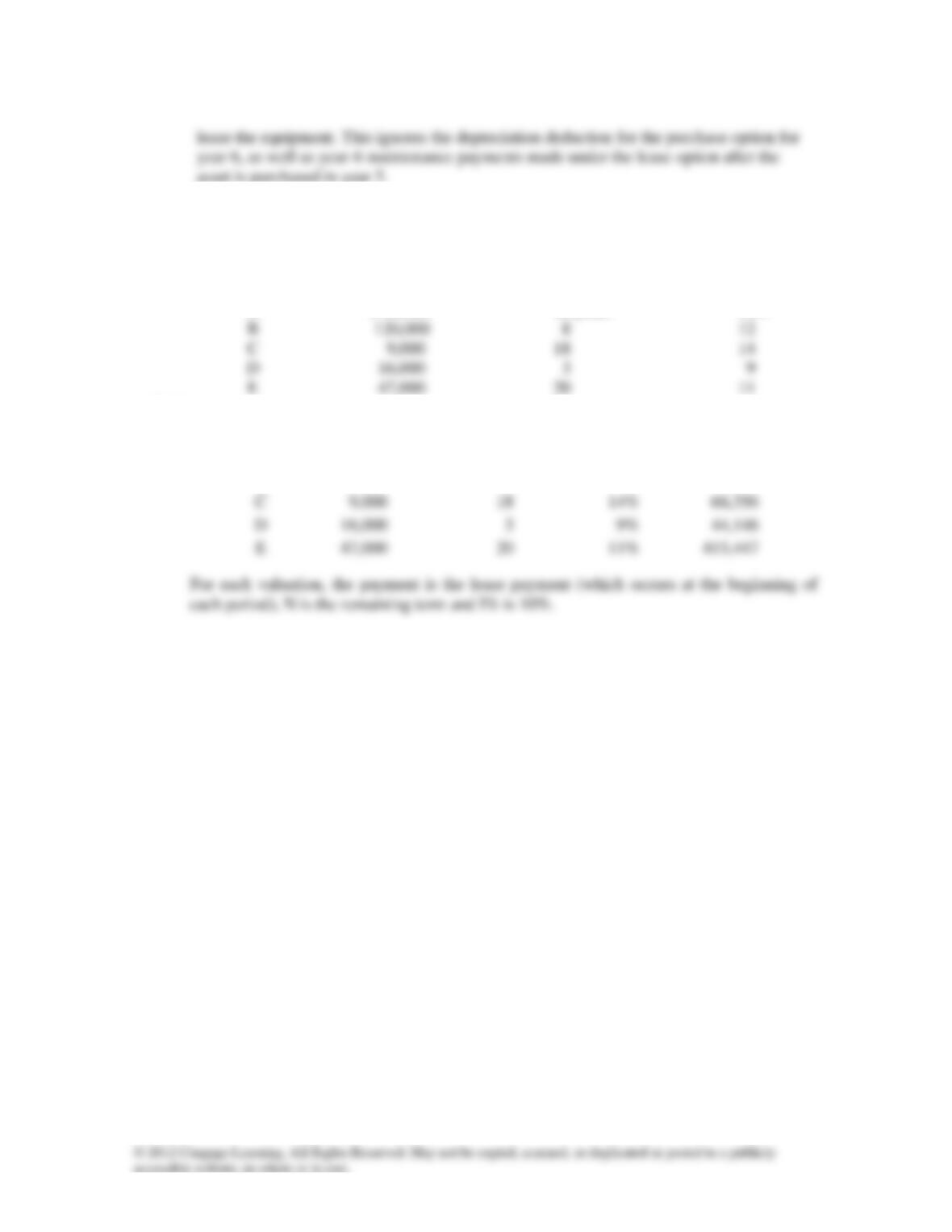
asset is purchased in year 5.
P13-11. Given the lease payments, terms remaining until the leases expire, and discount rates
shown in the following table, calculate the capitalized value of each lease. Assume that
lease payments are made annually at the beginning of each year.
Lease
Lease Payment
Remaining Term
Discount Rate
A
$ 40,000
12 years
10%
D
16,000
3
A13-11.
Lease
Lease Payment
Remaining Term
Discount Rate
Value
A
$ 40,000
12
10%
$299,802
B
120,000
8
12%
667,651
9,000
D
3
E
20
11%
415,447
THOMSON ONE Business School Edition: Because P13-12 is based on using a live data base,
answers will vary from moment to moment. For instructions on using Thomson ONE, refer to the
instructions provided with the Thomson ONE problems at the end of Chapters 1–6.
Answer to MiniCase
Long-Term Debt and Leasing
The CFO of your firm asks you to review the long-term debt position of the company to decide if
the company should make any changes in its borrowing arrangements. Before conducting this
review you decide to bring yourself up to date on terminology and types of long-term borrowing
arrangements. Therefore, as a start you decide to answer the following questions.
1. What types of debt covenants might managers consider?
2. What are the major factors that affect the cost or interest rate of a debt instrument?
3. What are term loans, and what are their characteristics?
4. What are syndicated loans and what are the primary applications?
5. What are some of the legal arrangements used to protect lenders related to corporate bonds?
6. What are some of the general features of corporate bonds?
7. What are the options available for a firm that wishes to avoid a large single repayment of
principal in the future or to refund a bond prior to maturity?
8. In what ways are leases similar to long-term debt?
9. What are the 2 basic types of leases?
10. What are the advantages and disadvantages of leasing?
Answers
Chapter 13 Long-Term Debt and Leasing 383
1. There are two general types of covenants, positive covenants that require the borrower to take a
specific action, and negative covenants that prohibit certain actions. Some of the most common
positive covenants require the borrower to do the following, (a) maintain satisfactory
2. The major factors affecting the cost or interest rate of long-term debt are loan maturity, loan
size, borrower risk, and the basic cost of money. Loan maturity is a factor since long-term
loans typically have higher interest rates than short-term loans primarily because yield curves
3. A term loan is made by an institution to a business and has an initial maturity of more than 1
year, generally 5 to 12 years. The following items commonly appear in the loan document, the
amount and maturity of the loan, payment dates, interest rate, positive and negative covenants,
4. A syndicated loan is large-denomination credit arranged by a group (syndicate) of commercial
banks for a single borrower. The syndicated loan market appeals to borrowers who need to
arrange very large loans quickly. Two primary uses of syndication include Eurocurrency
5. A bond indenture is a complex and lengthy legal document stating the conditions under which
a bond has been issued. It specifies both the rights of the bondholders and the duties of the
issuing corporation. An additional positive covenant often included in a bond indenture is a
384 Instructor’s Manual
6. Three features commonly observed in a U.S. bond issue are (a) a call feature, (b) a conversion
feature, and (c) stock purchase warrants. The call feature is included in most corporate bond
7. The borrower can issue serial bonds, where a certain proportion of the bond matures each year.
When firms issue serial bonds, they attach different interest rates to bonds maturing at different
8. You can think of a lease as being comparable to secured long-term debt, because in both cases
9. The two basic types of leases available to a business are operating leases and financial leases.
An operating lease is typically a contractual arrangement whereby the lessee agrees to make
10. The advantages of leasing are (a) the ability of the lessee to depreciate land, which is
prohibited if the land were purchased, (b) the use of sale–leaseback arrangements may permit
the firm to increase its liquidity by converting an asset into cash, which can then be used as
working capital, (c) leasing provides 100 percent financing, (d) the maximum claim of lessors