12 –
1
CHAPTER 12
BOND FUNDAMENTALS AND VALUATION
Answers to Questions
1. The three factors affecting the price of a bond are coupon, yield, and term to maturity. The
relationship between price and coupon is a direct one—the higher the coupon, the higher
2. Interest income from municipal bonds is normally not taxable by the federal government or
3. Calling a bond allows the issuer to retire the bond prior to its maturity. Callable bonds have
a call premium, which is the amount above par value that the issuer must pay to the
4. The purpose of bond ratings is to assess the possibility of default by the issuer. The
5. The differences between the Japanese and U.S. bond markets are clear from Exhibit 12.2.
The Japanese bond market is dominated by government bonds, which accounted for 81.4
percent of their market in 2010. The corporate sector accounted for only 11.1 percent. In
6. The difference between a foreign bond and a Eurobond can be broken down as a
12 –
2
© 2019 Cengage. May not be scanned, copied or duplicated, or posted to a publicly accessible website, in whole
or in part.
difference in issuer and the market in which they are issued. For example, a foreign bond
in Japan (for example, a Samurai) is denominated in the domestic currency (yen) and is
sold in the domestic market (Japan), but it is sold by non-Japanese issuers. On the other
hand, a Eurobond is denominated in the domestic currency (yen), but it is sold outside the
domestic country in a number of national markets. These bonds are typically underwritten
by international syndicates. The relative size of these two markets varies by country.
7. The discounted cash flow valuation equation is more useful for the bond investor, largely
because the bond investor has fewer uncertainties regarding future cash flows than does the
common stock investor. By investing in bonds with relatively no default risk (i.e.,
government securities) the investor can value a bond based primarily on expected cash
8. The most crucial assumption in both cases that the investor makes is that cash flows will be
9(a). RFR is the riskless rate of interest, I is the factor for expected inflation, and RP is the risk
premium for the individual firm.
9(b). The model considers the firm’s business conditions. The risk of not breaking even would
10(a). The term structure of interest rates refers to the relationship between yields and maturities
for fixed income securities with similar credit risk. Expectations regarding future interest
12 –
3
of longer maturity bonds.
10(b). According to the expectations theory of yield curve determination, if borrowers prefer to
sell short maturity issues at the time lenders prefer to invest in longs, which happens
10(c). The “real” rate of interest is simply the difference between nominal interest rates and
10(d). Over the past several years, fairly wide spreads have existed between AAA-corporates
and Treasuries. Investor preference for Treasuries stems from several factors. Treasury
securities typically are extremely liquid and provide investors with more flexibility.
Secondly, Treasury securities typically do not have restrictive call features generally
11. The asset-backed securities (ABS) market involves securitizing other types of debt
besides residential mortgages. Most ABSs are backed by one specific type of asset
CHAPTER 12
Answers to Problems
1(a). Present Value = Future Value / (1 + discount rate)n
1(b). PV = $1,000 / (1.05)40 = 142.05
2.
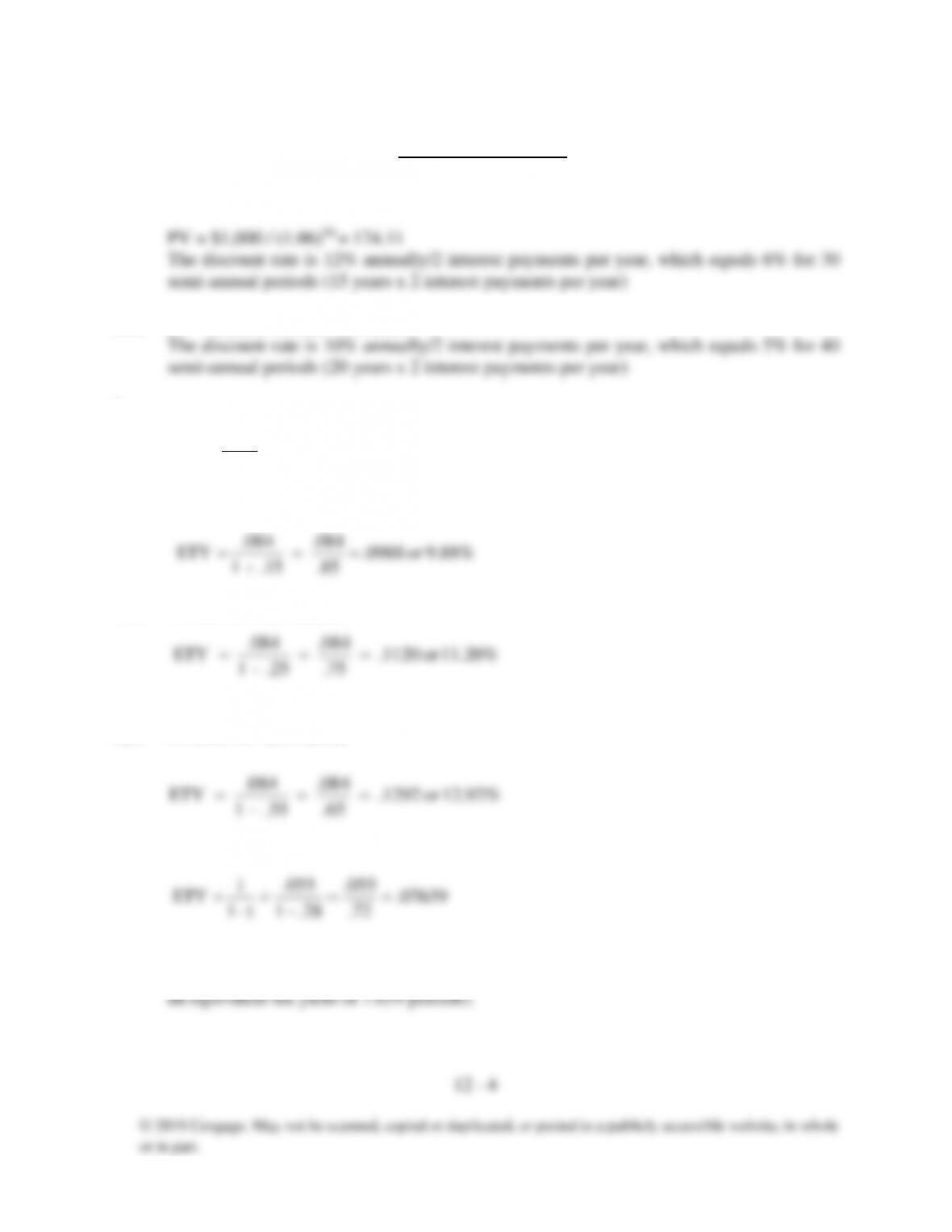
2(a). For the 15% tax bracket
2(b). For the 25% tax bracket
2(c). For the 35% tax bracket
3.
Assuming all other relevant factors are equal, the corporate bond carrying an 8 percent
coupon and selling at par offers a better return than a 5.5 percent municipal bond (with
t– 1
i
ETY =
9.88%or .0988
.85
.084
.15 – 1
.084
ETY ===
11.20%or .1120
.75
.084
.25 – 1
.084
ETY ===
12.92%or .1292
.65
.084
.35 – 1
.084
ETY ===
07639.
72.
055.
28.1
055.
t– 1
i
ETY ==
−
==
12 –
5
4(a). Present Value = Future Value / (1 + discount rate)n
4(b). PV = $1,000 / (1.04)24 = 390.12
4(c). PV = $1,000 / (1.05)24 = 310.07
5(a). PV = $1,000 / (1.06)40 = 97.22
5(b). PV = $1,000 / (1 + r)n inserting the known items,
5(c). PV = $1,000 / (1 + r)n inserting the known items,
6.
6(a). Using a financial calculator: PV= -1000, FV = 1100, PMT = 35, n= 8, as the bonds were
6(b). Using a financial calculator: FV = 1000, PMT = 35, n= 42, as the bonds mature in 21
7.
7(a). Using a financial calculator: PV= -1012.50, FV = 1000, PMT = 40, n= 24, as the bonds
7(b). Using a financial calculator: PV= -1012.50, FV = 1080, PMT = 40, n= 6, as the bond is
8
8(a). Current yield = Annual dollar coupon interest / Price = 70/960 = 7.3%.
8(b). The annual yield to maturity (YTM), using a financial calculator, is found using these
8(c). Horizon yield (also called total return) accounts for coupon interest, interest on interest,
and proceeds from sale of the bond.
9. The essence of the answer is to price each bond’s cash flows using the spot interest rates.
The non-arbitrage price of bond A is
The market price of Bond B is 88.34, which is only 2 cents (2.3 basis points of market

12 –
7
10.
10(a). Bond Valuation
On April 2, 2018 P0= PV of Coupons + PV of Face Value
10(b). (i) “Clean” or “Flat” Price = 102.5527– 1.495 = 101.0577