ANSWERS TO CHAPTER QUESTIONS
Chapter 12 Other Insurance
1) Adverse selection refers to people in an insurance pool who have greater knowledge
of their susceptibility to a negative outcome than the insurance company. An example
2) To prevent people from using insurance as a means to gain a profit at the sake of the
3) Insurance companies want policyholders to limit their use of less necessary medical
procedures. One way to do it is to have the policyholder contribute toward its cost.
4) Group policies often have distinct benefits over individual policies. These include
5) HO3 is a homeowner’s policy, while HO4 is a renter’s policy. As a tenant’s policy
6) The amount of coverage in force at 75% ($300,000 in force/$400,000 required) is less
7) If Erin paid for the insurance the payments she receives from the insurance company
8) Under a traditional tort system you would have to sue, demonstrate negligence, and a
9) Umbrella insurance can extend to selected risks not covered elsewhere such as
personal liability insurance. Importantly, it funds payments for amounts owed which
are greater than the coverage provided under individual more specialized policies
such as the one for automobile coverage.
10) At a preferred provider organization (PPO) the patient can select from nonaffiliated as
well as affiliated doctors and needn’t have a primary care physician approve of the
11) Elderly people require more care and may therefore want the flexibility and greater
12) An own occupation policy pays benefits based solely on whether you can perform the
13) Life insurance seems to be more salient, that is people can associate more with dying
14) People other than those who have relatively few assets or are affluent, who want to
15) Insurance provided by the government includes:
a) Workman’s compensation – disabilities incurred while on the job.
b) Medicare – medical care for people eligible for Social Security.

ANSWERS TO CHAPTER PROBLEMS
Chapter 12 Other Insurance
1) Jeremy lost a wing on his house, which resulted in an outlay of $250,000 to replace it.
The replacement cost on the house was $900,000, and he had $500,000 of insurance.
His policy had an 80 percent coinsurance clause. How much will the insurance
company reimburse him for?
Solution:
2) Paulette, a trial attorney for a corporation, was forced to leave the field due to an
injury to her vocal chords. She switched careers and became a lower-paying author.
Fortunately, she had three disability policies. Policy A had an own occupation
definition that was paid for by her employer and was for $20,000 per year. Policy B,
which she paid for, had an own occupation definition and was for $30,000 of
coverage per year. Policy C, which also was purchased by her, had no own
occupation definition and was for $60,000 in coverage per year. Paulette’s marginal
tax rate was 33 percent. How many after-tax dollars did she receive per year?
Solution:
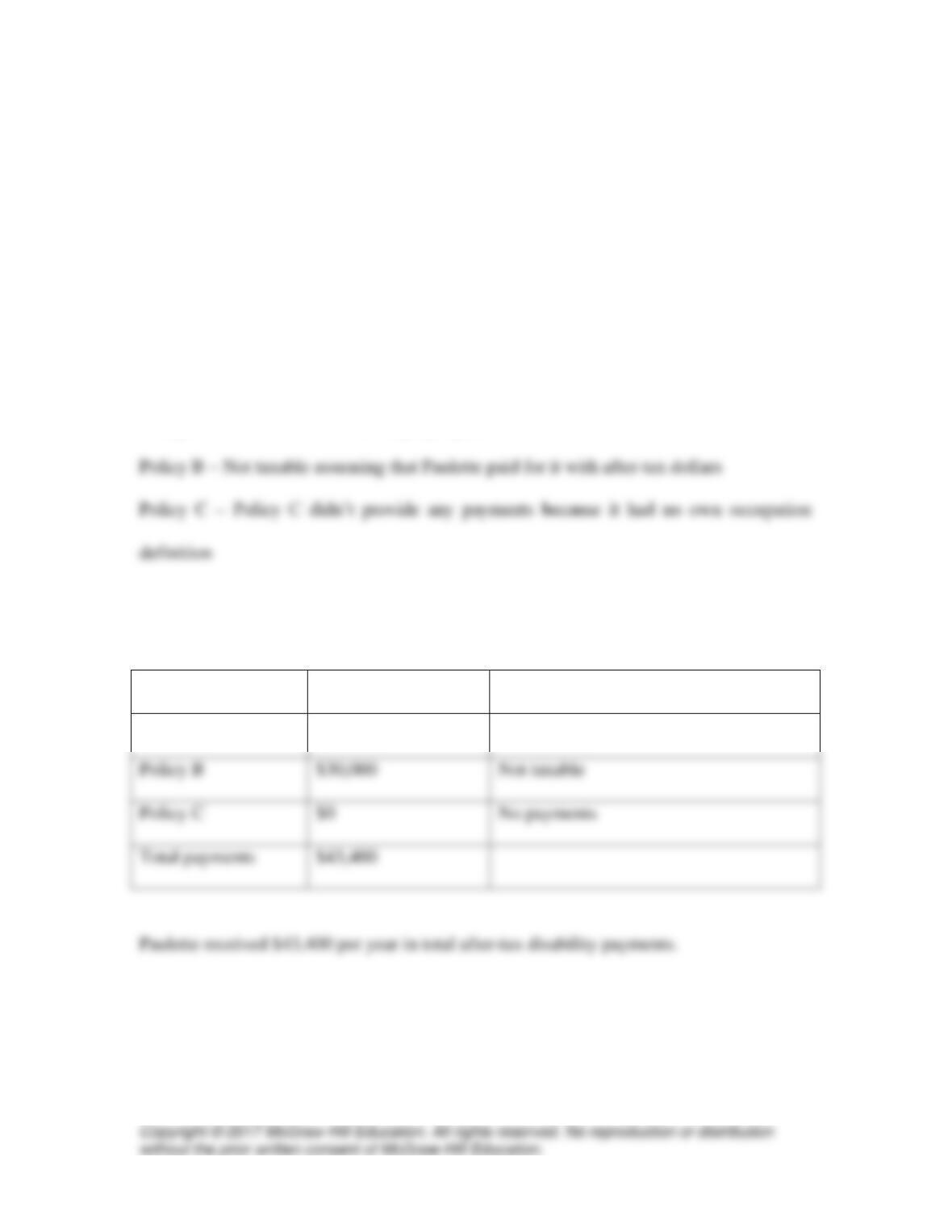
Policy A – Taxable because the employer paid for it
Total Yearly Disability Payments
Policy
Disability Payment
Explanation
Policy A
$13,400
$20,000 × (1 – 0.33)
Policy B
$30,000
Not taxable
Policy C
$0
No payments
ANSWERS TO CASE APPLICATION QUESTIONS
Chapter 12 Other Insurance
2) They should go to 90%. Anything less than that will result in less than full insurance
reimbursement for a loss.
3) Richard has a fairly good salary and a standard of living to go with it. Should he
become disabled his savings would not be sufficient to fund anywhere near his
4) Both Richard and Monica could use long-term care insurance. They are not wealthy
enough to cover costs of long-term care themselves and neither would be poor

Answers to CFP® Question
Question
Answer
Author’s Explanation
Question 12.1
A
Question 12.2
C
Question 12.3
B
Question 12.4
A
Question 12.5
A
Question 12.6
B
Question 12.7
E
Question 12.8.1
A
Question 12.8.2
C
Question 12.9
A
ERRATA TO CFP® CERTIFICATION EXAMINATION QUESTIONS AND
PROBLEMS
12.5
The text should read:


SOLUTIONS TO SELECTED CFP® CERTIFICATION EXAMINATION
PROBLEMS
1
12.3
A client recently purchased a new home from a builder for $150,000, including the lot
valued at $40,000. How much insurance would you recommend that your client purchase
to cover full replacement of the house in the event of a loss?
a. $88,000
b. $110,000
c. $120,000
d. $150,000
Solution:
12.8
Ginny is a sole proprietor. She wants to provide 60 percent of salary disability coverage
to Joanna, her employee who is in a 35 percent combined tax bracket. Joanna’s W–2
1
The solutions supplied are those of the author and not of the CFP Board.

1. Ignoring cost-of-living adjustments or any possible Social Security benefits, calculate
Joanna’s net–of-tax monthly disability payment if Ginny pays the disability premium and
Joanna’s tax bracket during disability remains at 35 percent.
a. $1,300
b. $1,430
c. $2,000
d. $2,200
Solution:
If Ginny pays the disability premium, Joanna’s monthly disability payment will be
subject to taxation.
2. Ignoring cost-of-living adjustments or any possible Social Security benefits, calculate
Joanna’s net–of-tax monthly disability benefit if Joanna pays the disability premium

and Joanna’s tax bracket during disability remains at 35 percent.
a. $1,300
b. $1,430
c. $2,000
d. $2,200
Solution: