Chapter 12
Capital Budgeting: Decision Criteria
ANSWERS TO BEGINNING-OF–CHAPTER QUESTIONS
12-1 The 6 criteria are discussed below. All are calculated and analyzed in the spreadsheet
model for the chapter.
Payback. Easy to calculate and understand, but doesn’t tell us if the project is
economically profitable because it doesn’t take account of either time value of money or
cash flows beyond the payback period.
IRR is widely used—about as widely used as NPV by large companies. A few years
ago IRR was much more widely used, but NPV has caught up.
IRR does give people an idea of the margin of safety in a project, i.e., cash inflows
could fall quite a bit below forecast and a high IRR project will still be profitable.
MIRR is not as widely used as IRR, but it is actually superior to the regular IRR
because it is generally more logical to assume reinvestment at the WACC (which the MIRR
generally does) than at the IRR (which the IRR does). Also, the MIRR can be calculated
Answers and Solutions: 12 – 1
All of the methods seek to help maximize shareholder wealth, but NPV is the most
direct in this regard and payback is the least direct. Note that NPV, IRR, MIRR, and PI
always produce consistent decisions for independent projects, but ranking conflicts can
will see in the next two chapters.
12-2 As discussed above, the NPV assumes that cash flows can be reinvested at the WACC,
whereas the IRR assumes reinvestment at the project’s own IRR. For a firm that is not
subject to capital rationing, all projects that have IRRs equal to or greater than the WACC
will be taken on, and they can be financed at the WACC. Therefore, the opportunity cost
rate—which is the reinvestment rate—is the WACC, and that makes the NPV method
12-3 The focus should be on the MIRR rather than the IRR for reasons discussed above,
especially the fact that the MIRR gives a more accurate estimate of the rate of return the
12-4 The multiple IRR problem is analyzed in the BOC model. This problem can, but doesn’t
always, arise if a project has more than one change of signs for the cash flows. The
12-5 The unequal life problem is the situation where the firm must choose between two mutually
exclusive projects that have differing lives. If the projects can be repeated, then it is
necessary to extend the analysis out to a common life. The unequal life problem and the
way it should be analyzed is illustrated in the model.
12-6 The post-audit is the process used to check the performance of a project after it has been
completed and goes on line. It is used to check on the accuracy of the estimates used

12-7 Capital rationing meanings limiting capital expenditures to some specific amount of
money. Typically, firms that impose capital rationing have limited access to capital
markets, or else their capital costs would rise very rapidly if they exceeded the prescribed
Answers and Solutions: 12 – 4
ANSWERS TO END-OF-CHAPTER QUESTIONS
12 -1 a. Capital budgeting is the whole process of analyzing projects and deciding whether they
should be included in the capital budget. This process is of fundamental importance to
the success or failure of the firm as the fixed asset investment decisions chart the course
b. Mutually exclusive projects cannot be performed at the same time. We can choose
c. The net present value (NPV) and internal rate of return (IRR) techniques are discounted
cash flow (DCF) evaluation techniques. These are called DCF methods because they
explicitly recognize the time value of money. NPV is the present value of the project’s
d. The modified internal rate of return (MIRR) assumes that cash flows from all projects
are reinvested at the cost of capital as opposed to the project’s own IRR. This makes
the modified internal rate of return a better indicator of a project’s true profitability.
Answers and Solutions: 12 – 5
f. Capital projects with nonnormal cash flows have a large cash outflow either sometime
g. The mathematics of the NPV method imply that project cash flows are reinvested at
the cost of capital while the IRR method assumes reinvestment at the IRR. Since
h. A replacement chain is a method of comparing mutually exclusive projects that have
unequal lives. Each project is replicated such that they will both terminate in a common
year. If projects with lives of 3 years and 5 years are being evaluated, the 3–year project
would be replicated 5 times and the 5–year project replicated 3 times; thus, both projects
12-2 Projects requiring greater investments or that have greater risk should be given detailed
analysis the capital budgeting process.
12-3 The NPV is obtained by discounting future cash flows, and the discounting process actually
12-4 This question is related to Question 12-3 and the same rationale applies. With regard to
12-5 Generally, the failure to employ common–life analysis in such situations will bias the NPV
against the shorter project because it “gets no credit” for profits beyond its initial life, even
though it could possibly be “renewed” and thus provide additional NPV.
SOLUTIONS TO END-OF-CHAPTER PROBLEMS
12-1 NPV = -$40,000 + $9,000[(1/I) – (1/(I × (1 + I)N)]
12-2 Financial calculator solution: Input CF0 = -40000, CF1-8 = 9000, and then solve for IRR =
12.84%.
12-3 MIRR: PV Costs = $40000.
FV Inflows:
PV FV
0 1 2 3 4 5 6 7
12%
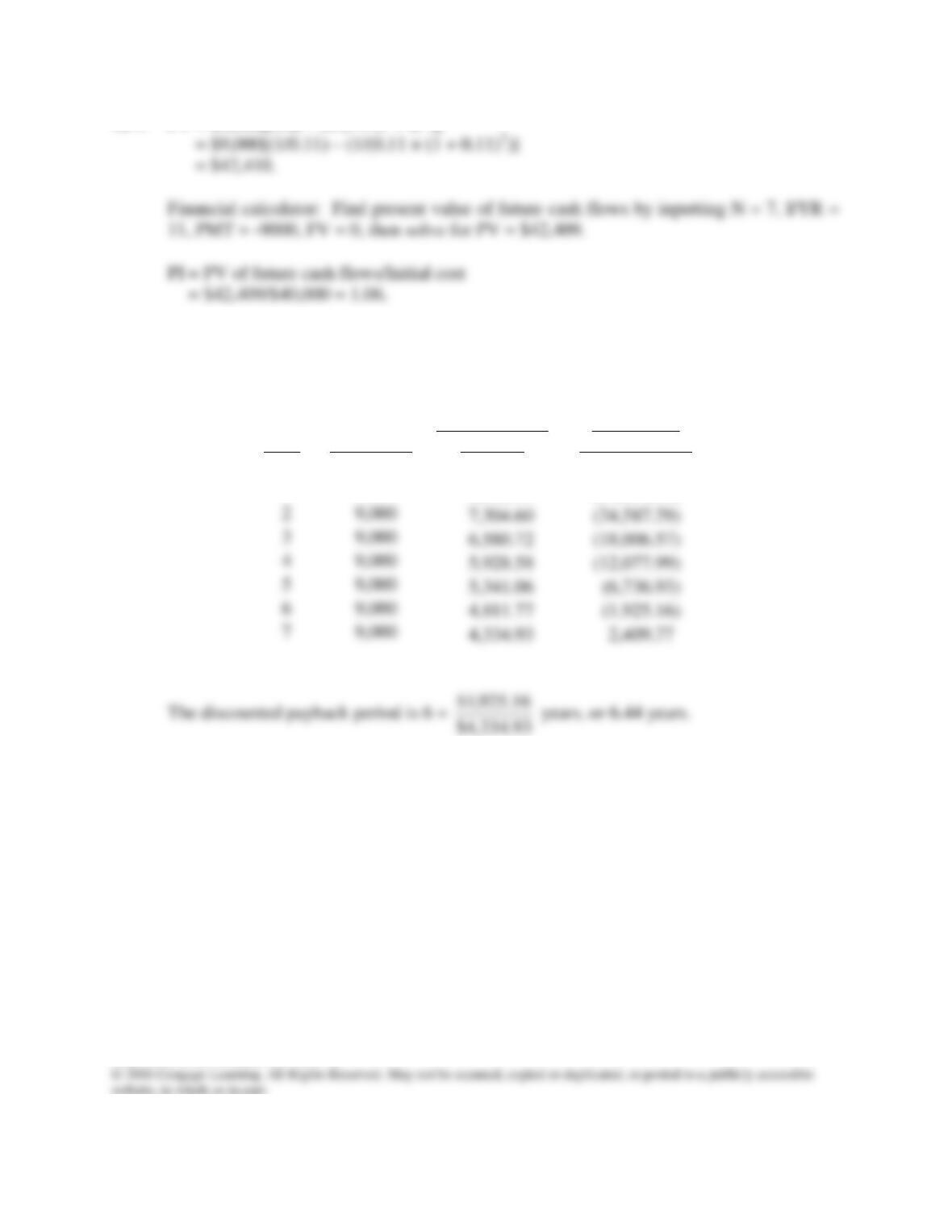
12-4 PV = $9,000[(1/I) – (1/(I × (1 + I)N)]
12-5 Since the cash flows are a constant $9,000, calculate the payback period as:
$40,000/$9,000 = 4.44, so the payback is about 4 years.
12-6 The project’s discounted payback period is calculated as follows:
Year
Annual CF
Discounted CF
(@11%)
Cumulative
Discounted CF
0
-40,000
-40,000.00
1
9,000
8,108.11
(31,891.89)
2
9,000
7,304.60
(24,587.29)
3
9,000
6,580.72
(18,006.57)
4
9,000
5,928.58
(12,077.99)
5
9,000
5,341.06
(6,736.93)
6
9,000
4,811.77
(1,925.16)
4,334.93
Answers and Solutions: 12 – 8

12-7 a. Project A: Using a financial calculator, enter the following:
Project B: Using a financial calculator, enter the following:
CF0 = -15000000
CF1 = 20000000
b. Using the data for Project A, enter the cash flows into a financial calculator and solve
for IRRA = 43.97%. The IRR is independent of the WACC, so IRR doesn’t change
when the WACC changes.
12-8 Truck:
NPV = -$17,100 + $5,100(PVIFA14%,5)
Answers and Solutions: 12 – 9
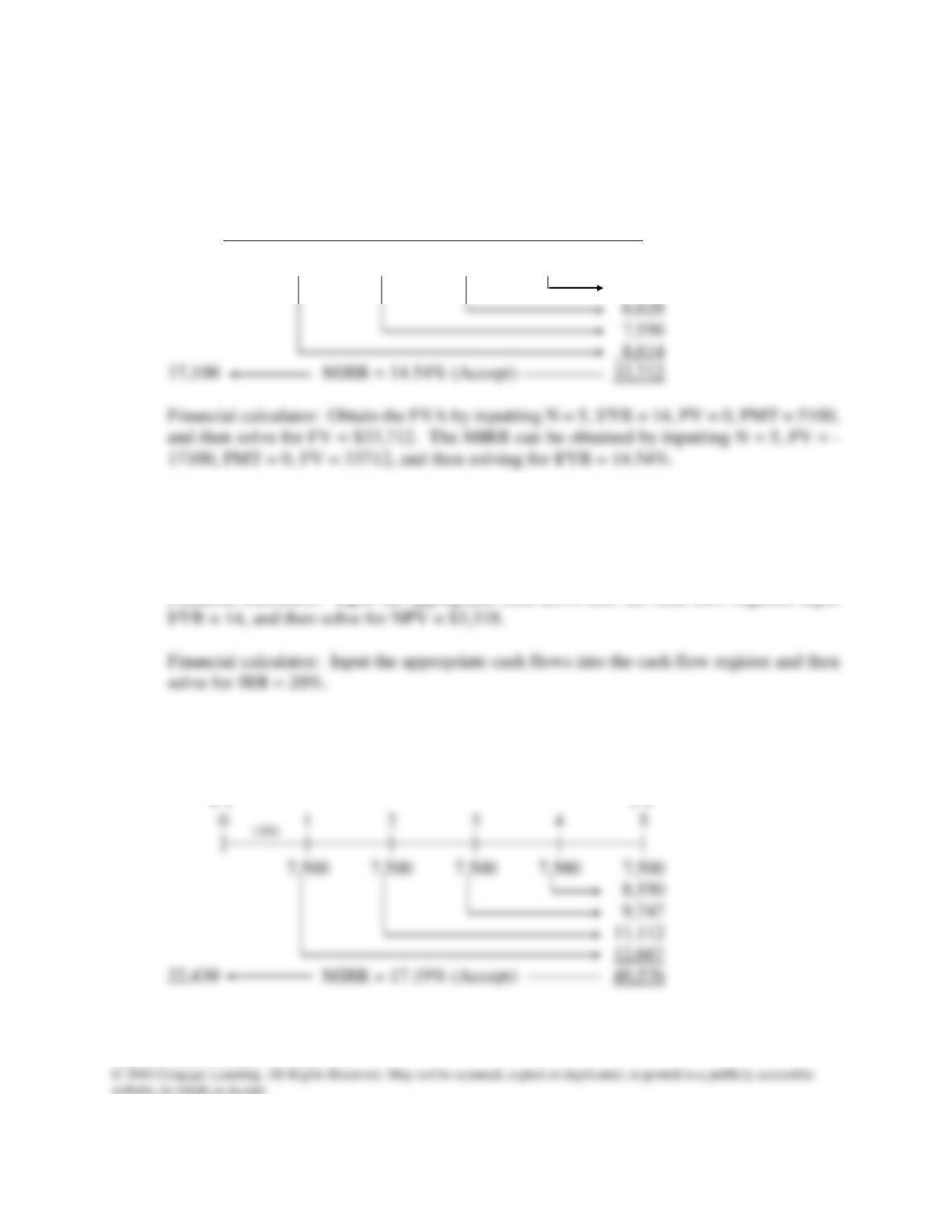
MIRR: PV Costs = $17,100.
FV Inflows:
PV FV
0 1 2 3 4 5
| | | | | |
5,100 5,100 5,100 5,100 5,100
5,814
Pulley:
NPV = -$22,430 + $7,500(3.4331) = -$22,430 + $25,748
= $3,318. (Accept)
Financial calculator: Input the appropriate cash flows into the cash flow register, input
MIRR: PV Costs = $22,430.
FV Inflows:
14%
Answers and Solutions: 12 – 10

12-9 Electric–powered:
NPVE = -$22,000 + $6,290[(1/i) – (1/(i × (1 + i)n)]
= -$22,000 + $6,290[(1/0.12) – (1/(0.12 × (1 + 0.12)6)]
= -$22,000 + $6,290(4.1114) = -$22,000 + $25,861 = $3,861.
Gas-powered:
NPVG = -$17,500 + $5,000[(1/i) – (1/(i × (1 + i)n)]
= -$17,500 + $5,000[(1/0.12) – (1/(0.12 × (1 + 0.12)6)]
= -$17,500 + $5,000(4.1114) = -$17,500 + $20,557 = $3,057.
12-10 Financial calculator solution, NPV:
Project S
Inputs 5 12 3000 0
NPVS = $10,814.33 – $10,000 = $814.33.
Answers and Solutions: 12 – 11

Project L
Inputs 5 12 7400 0
Output = -26,675.34
Financial calculator solution, MIRR:
Project S
Inputs 5 12 0 3000
Output = 13.77
MIRRS = 13.77%.
N I/YR FV PMT PV
Answers and Solutions: 12 – 12

Project L
Inputs 5 12 0 7400
Output = 13.46
MIRRL = 13.46%.
N I/YR FV PMT PV
Answers and Solutions: 12 – 13
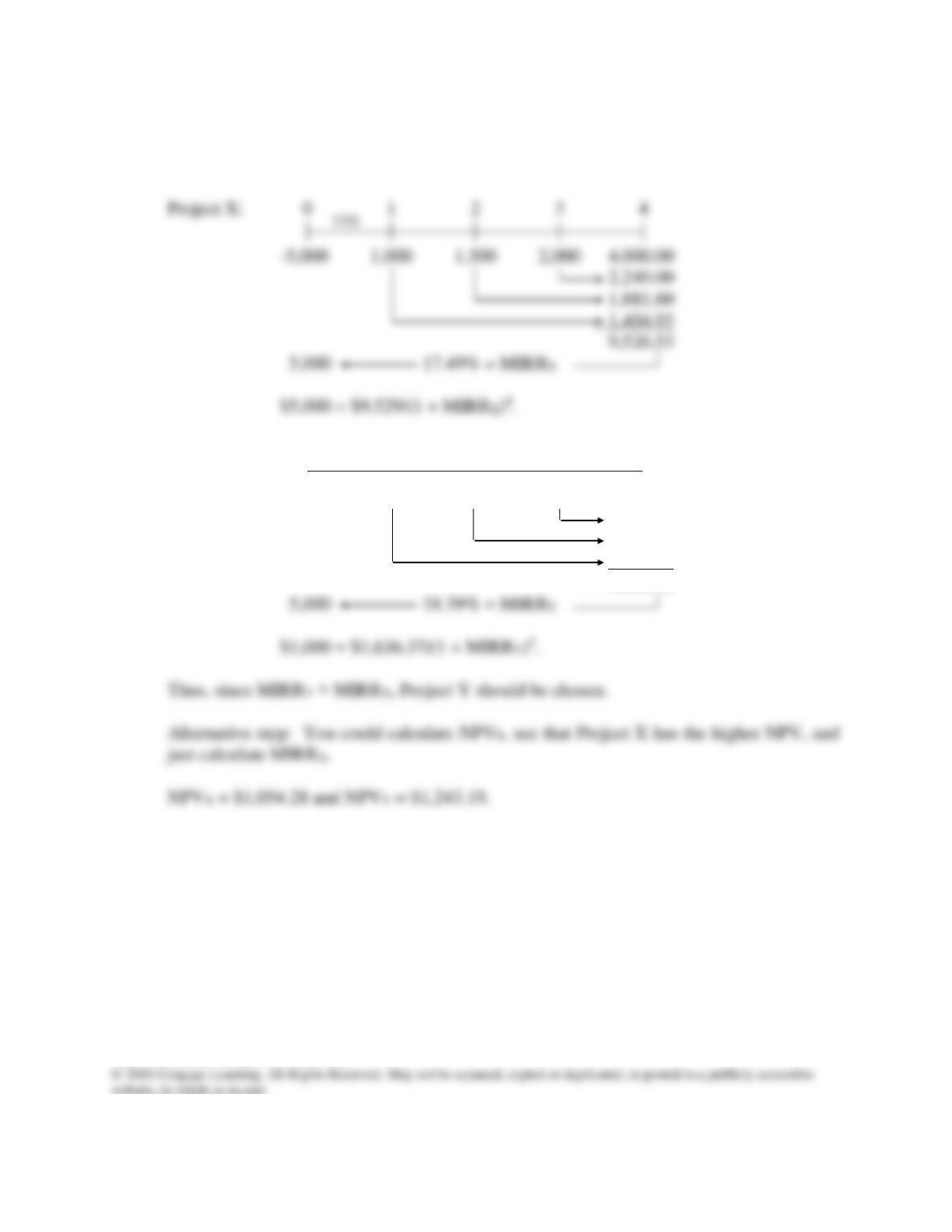
12-11 Because both projects are the same size you can just calculate each project’s MIRR and
choose the project with the higher MIRR. (Remember, MIRR gives conflicting results
from NPV when there are scale differences between the projects.)
Project Y: 0 1 2 3 4
| | | | |
-5,000 4,500 1,500 1,000 500.00
1,120.00
1,881.60
6,322.18
9,823.78
12%
Answers and Solutions: 12 – 14
12-12 a. Purchase price $ 900,000
Installation 165,000
Initial outlay $1,065,000
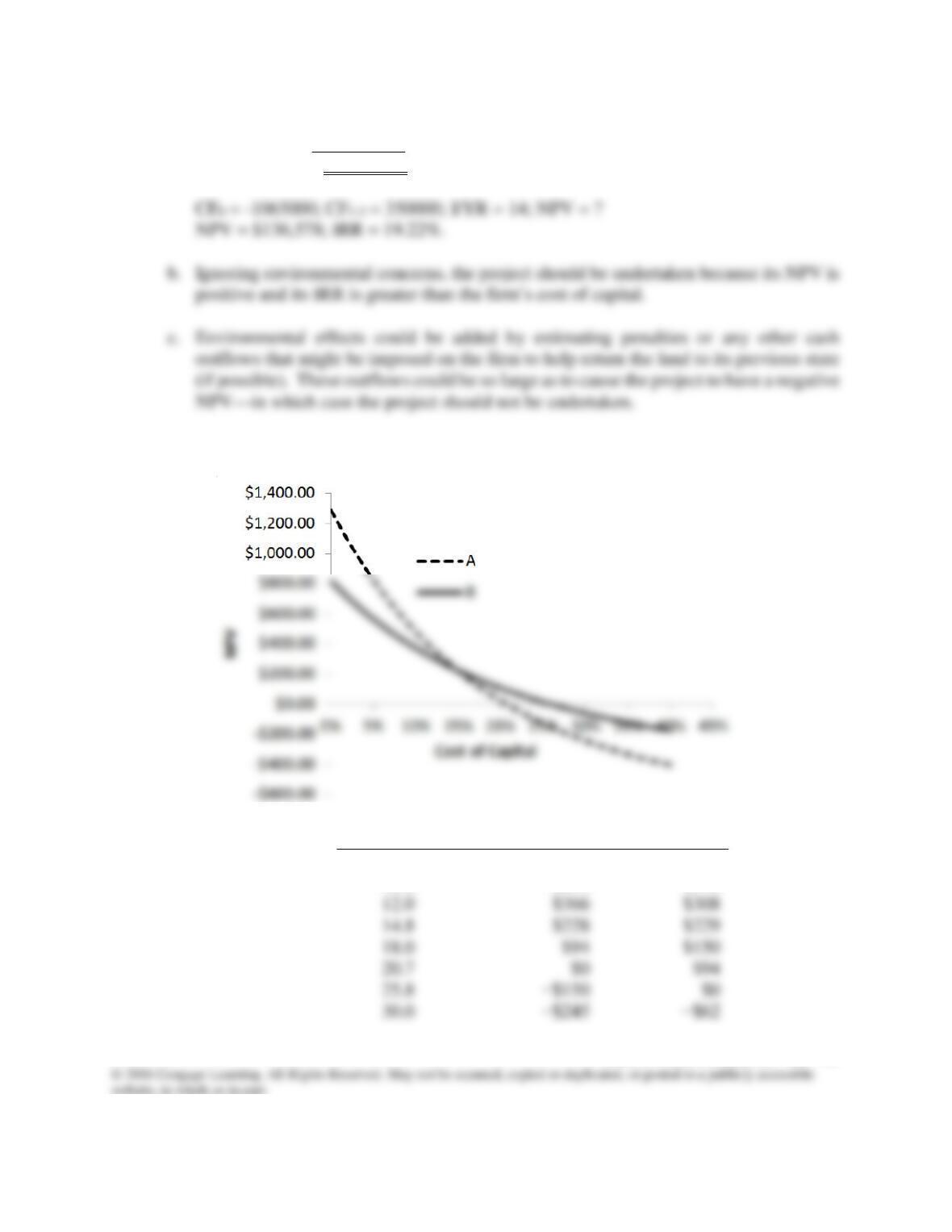
12-13 a.
r
NPVA
NPVB
0.0%
$1,288
$820
10.0
$479
$372
12.0
$366
$308
14.8
$228
$229
18.0
$150
20.7
25.8
30.0
Answers and Solutions: 12 – 15

b. IRRA = 20.7%; IRRB = 25.8%.
d. Here is the MIRR for Project A when r = 10%:
Here is the MIRR for Project B when r = 10%:
PV costs = 600.
TV of inflows: Financial calculator settings are N = 7, I/YR = 10, PV = 0, PMT = 210,
and solve for FV = -1992.3059.
Answers and Solutions: 12 – 16

e. To find the crossover rate, construct a Project ∆ which is the difference in the two
projects’ cash flows:
Year
Project ∆ = CFA – CFB
0
$250
1
−738
Projects A and B are mutually exclusive, thus, only one of the projects can be chosen.
As long as the cost of capital is greater than the crossover rate, both the NPV and IRR
methods will lead to the same project selection. However, if the cost of capital is less
than the crossover rate the two methods lead to different project selections—a conflict
exists. When a conflict exists the NPV method must be used.
12-14 a. Incremental Cash
Year Plan B Plan A Flow (B – A)
0 ($10,000,000) ($10,000,000) $ 0
Answers and Solutions: 12 – 17
2
−429
3
−360
4
5
6
7
−535

b. If the firm could invest the incremental $10,250,000 at a return of 16.07%, it would
receive cash flows of $1,750,000. If we set up an amortization schedule, we would
find that payments of $1,750,000 per year for 19 years would amortize a loan of
$10,250,000 at 16.0665%.
Financial calculator solution:
d. See graph. If the cost of capital is less than 16.07%, then Plan B should be accepted;
if r > 16.07%, then Plan A is preferred.
15
NPV (Millions of Dollars)
B
25
20
Answers and Solutions: 12 – 18

12-15 a. Financial calculator solution:
Plan A
Inputs 20 10 8000000 0
Output = -28,946,117
NPVB = $28,946,117 – $15,000,000 = $13,946,117.
Plan A
Inputs 20 -50000000 8000000 0
Plan B
Inputs 20 -15000000 3400000 0
Output = 22.26
N I/YR FV PMT PV
N I/YR FV PMT PV

b. If the company takes Plan A rather than B, its cash flows will be (in millions of dollars):
Cash Flows Cash Flows Project ∆
Year from A from B Cash Flows
0 ($50) ($15.0) ($35.0)
So, Project ∆ has a “cost” of $35,000,000 and “inflows” of $4,600,000 per year for 20
years.
Inputs 20 10 4600000 0
Output = -39,162,393
N I/YR FV PMT PV
Answers and Solutions: 12 – 20