Chapter 12 Capital Structure 339
Q12-13. What industrial and national capital structure patterns are exhibited globally? What fac-
tors seem to be driving these patterns?
A12-13. Certain industries appear to have high debt levels. These for the most part are mature,
low growth industries with stable cash flows and tangible assets. High tech, high growth
industries, that are highly cyclical with uncertain cash flows tend to have lower levels of
Q12-14. What is the observed relationship between debt ratios and profitability and the perceived
costs of financial distress? Why does the relationship between leverage and profitability
imply that capital structure choice is residual in nature?
A12-14. In general, more profitable firms will have less debt in their capital structures. This is
because they rely more on internally generated funds, and need less external financing.
Q12-15. How influential are corporate and personal taxes on capital structure? Historically, have
changes in American tax rates greatly affected debt ratios?
A12-15. Corporate and personal taxes do influence capital structures, but are not the only factors
that explain differences in capital structures. For example, U.S. corporations used no
less debt before income taxes were introduced in 1913 than after 1913. Taxes peaked in
Q12-16. How do stock prices generally react to announcements of firms’ changes in leverage?
Why is this result perplexing and seemingly contradictory given your answer to Question
12-2?
Shareholders find leverage increasing events to be good news and leverage decreasing
340 Instructor’s Manual
Solutions to End-of-Chapter Problems
Financial Leverage and Expected Returns to Shareholders
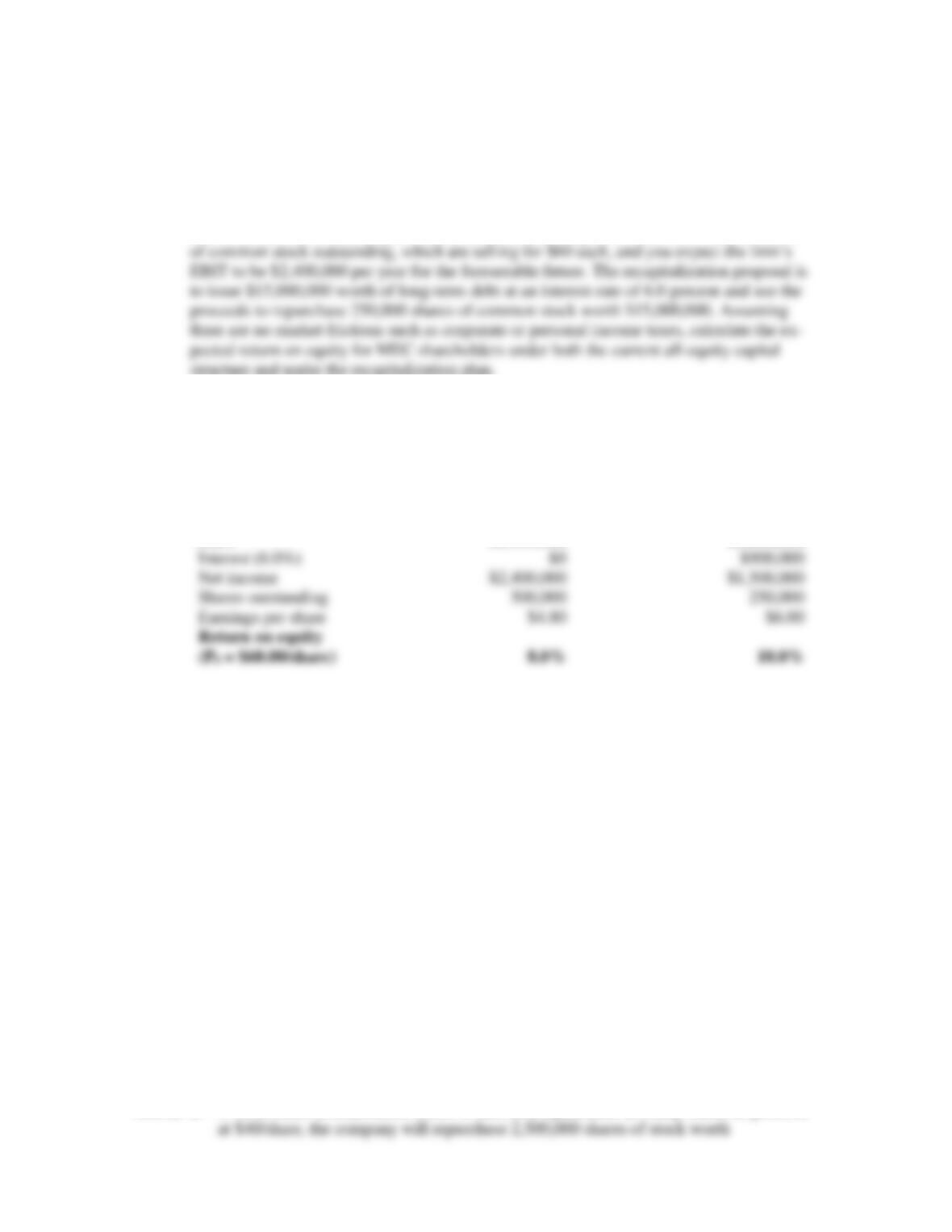
P12-1. As Chief Financial Officer of the Magnificent Electronics Corporation (MEC), you are
considering a recapitalization plan that would convert MEC from its current all-equity cap-
ital structure to one including substantial financial leverage. DIC now has 500,000 shares
A12-1.
Cash Flows to Stockholders and Bondholders
Under Current and Proposed Capital Structure for the Magnificent Electronics Corporation
Assuming EBIT = $2,400,000
Current capital structure:
All equity financing
Proposed capital structure:
50% debt: 50% equity
EBIT
$2,400,000
$2,400,000
Shares outstanding
P12-2. The All-Star Production Corporation (APC) is considering a recapitalization plan that
would convert APC from its current all-equity capital structure to one including some fi-
nancial leverage. APC now has 10,000,000 shares of common stock outstanding, which are
selling for $40.00 each, and you expect the firm’s EBIT to be $50,000,000 per year for the
foreseeable future. The recapitalization proposal is to issue $100,000,000 worth of long-
term debt at an interest rate of 6.50 percent and use the proceeds to repurchase as many
shares as possible at a price of $40.00 per share. Assume there are no market frictions such
as corporate or personal income taxes. calculate the expected return on equity for DIC
shareholders under both the current all-equity capital structure and under the recapitaliza-
tion plan.
a. Calculate the number of shares outstanding, the per-share price and the debt-to-equity
ratio for APC if the proposed recapitalization is adopted.
b. Calculate the earnings per share (EPS) and return on equity for APC shareholders un-
der both the current all-equity capitalization and the proposed mixed debt/equity capi-
tal structure.
c. Calculate the break-even level of EBIT where earnings per share for APC stockholders
are the same under the current and proposed capital structures.
d. At what level of EBIT will APC shareholders earn zero EPS under the current and the
proposed capital structures?
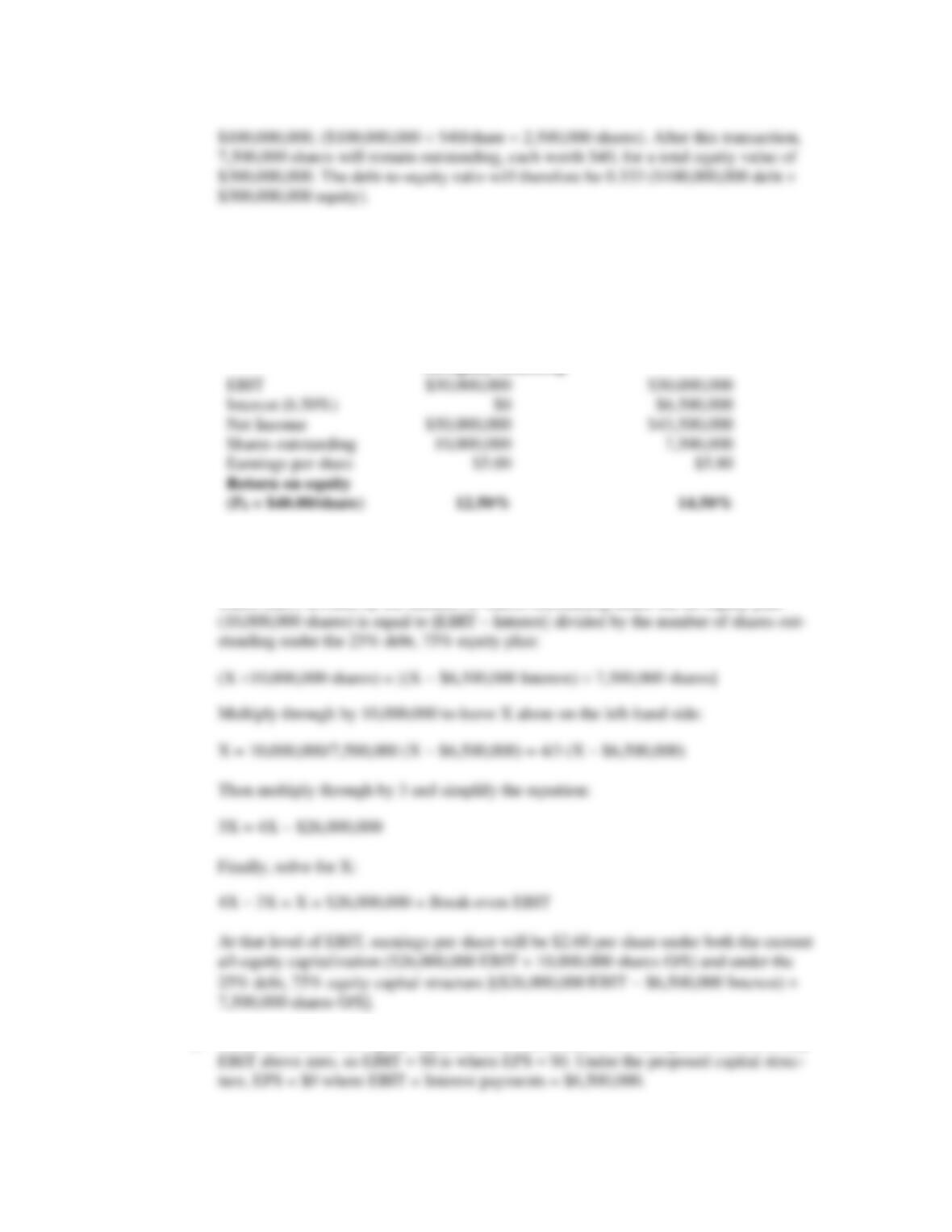
A12-2. a. If APC issues $100,000,000 worth of debt and repurchases as many shares as possible
Chapter 12 Capital Structure 341
b.
Cash Flows to Stockholders and Bondholders
Under Current and Proposed Capital Structure for the All-Star Production Corp.
Assuming EBIT = $50,000,000
Current capital struc-
ture:
All equity financing
Proposed capital structure:
25% debt: 75% equity
c. Since the recapitalization does not create a 50% debt, 50% equity capital structure, the
break-even point for EBIT cannot be determined simply by doubling the interest pay-
ment, but an answer can be deduced by reason. Begin by noting that the BEP occurs
where EBIT divided by the number of shares outstanding under the all-equity plan
d. Under the current all-equity capitalization, shareholders will earn positive EPS for any
342 Instructor’s Manual
P12-3. As Chief Financial Officer of the Campus Supply Corporation (CSC), you are considering
a recapitalization plan that would convert CSC from its current all-equity capital structure
to one including substantial financial leverage. CSC now has 250,000 shares of common
stock outstanding, which are selling for $60.00 each, and the recapitalization proposal is to
issue $7,500,000 worth of long-term debt at an interest rate of 6.0 percent and use the pro-
ceeds to repurchase 125,000 shares of common stock worth $7,500,000. CSC’s earnings
next year will depend on the state of the economy. If there is normal growth, EBIT will be
$2,000,000; EBIT will be $1,000,000 if there is a recession and EBIT will be $3,000,000 if
there is an economic boom. You believe that each economic outcome is equally likely. As-
sume there are no market frictions such as corporate or personal income taxes.
a. Calculate the number of shares outstanding, the per-share price and the debt-to-equity
ratio for CSC if the proposed recapitalization is adopted.
b. Calculate the expected earnings per share (EPS) and return on equity for CSC share-
holders under all three economic outcomes (recession, normal growth and boom), for
both the current all-equity capitalization and the proposed mixed debt/equity capital
structure.
c. Calculate the break-even level of EBIT where earnings per share for CSC stockholders
are the same under the current and proposed capital structures.
d. At what level of EBIT will CSC shareholders earn zero EPS under the current and the
proposed capital structures?
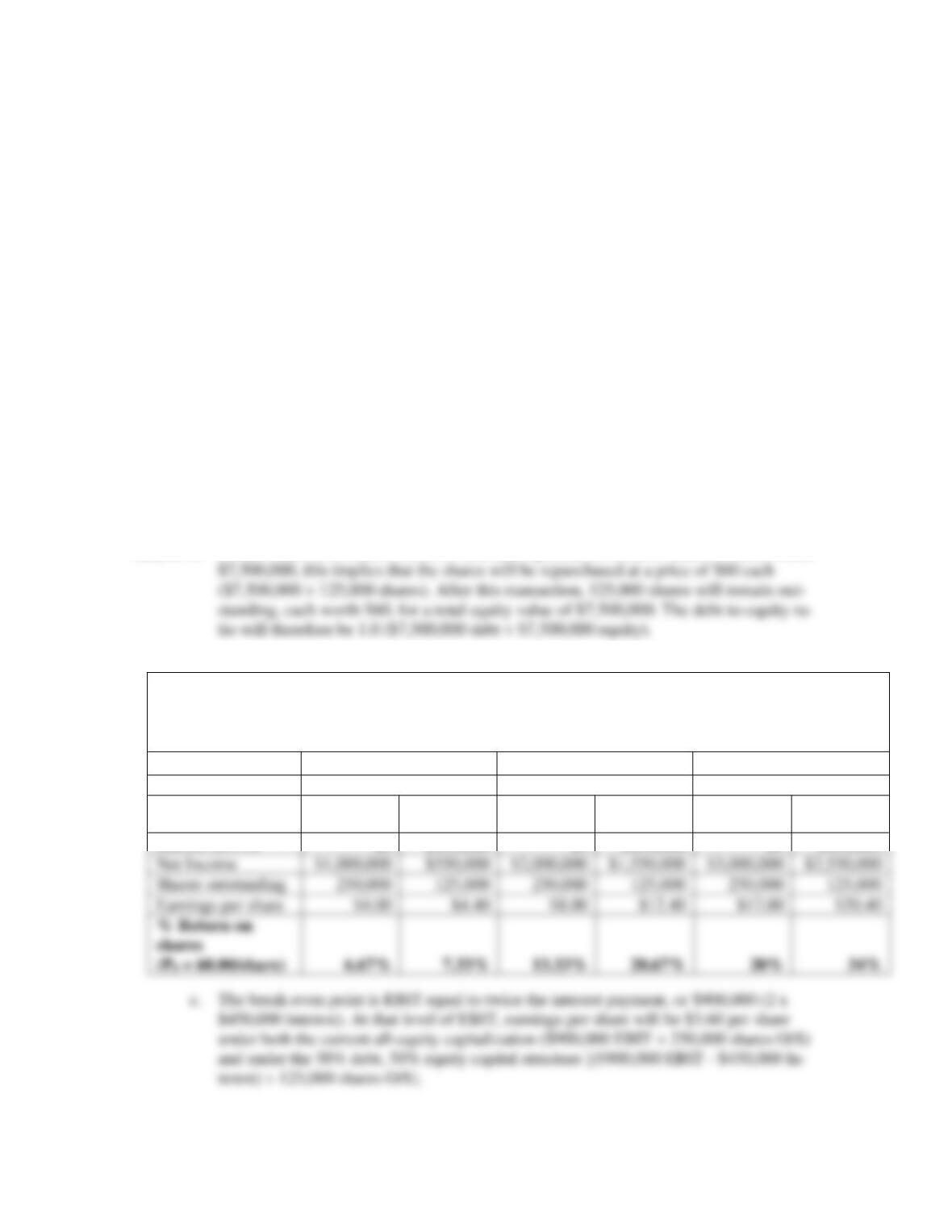
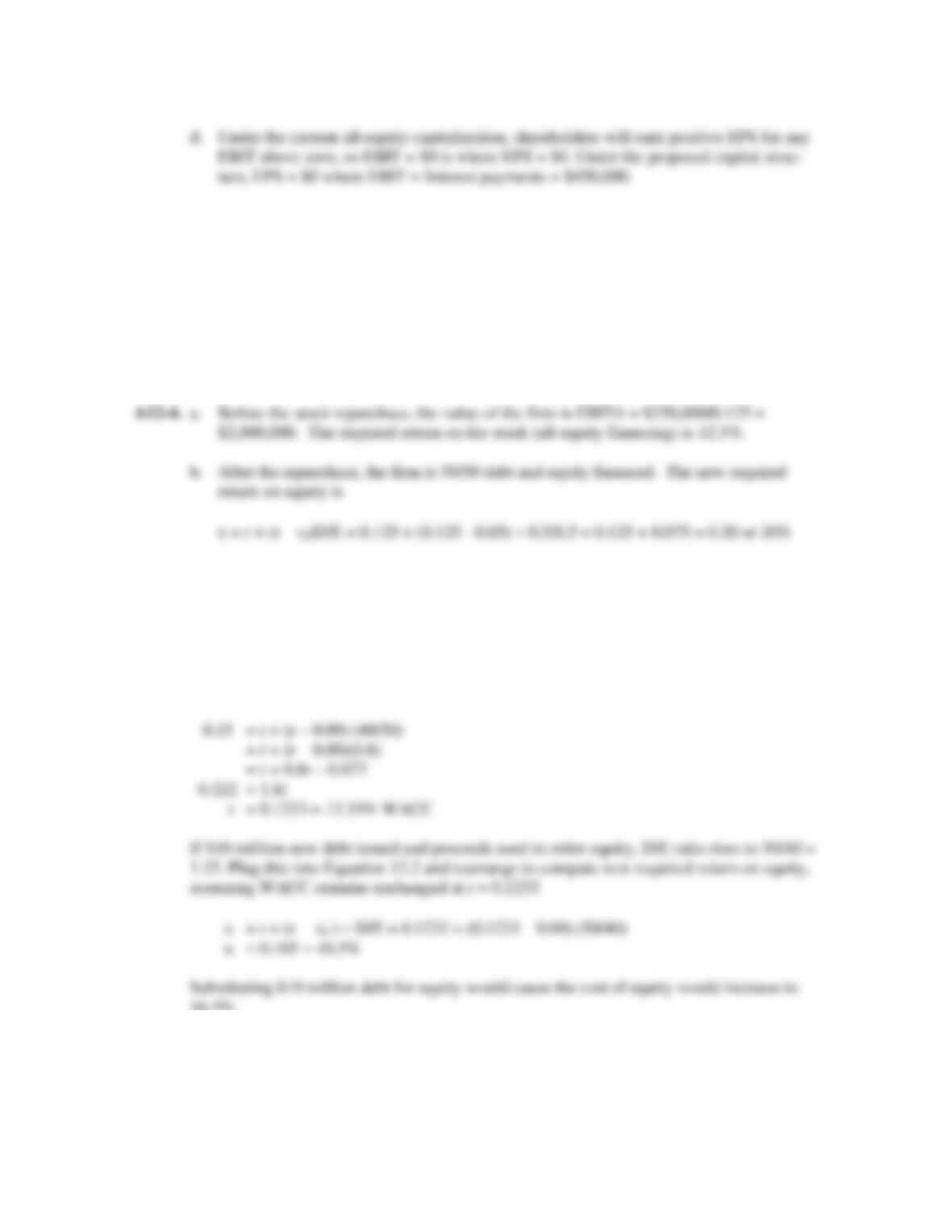
A12-3. a. If CSC issues $7,500,000 worth of debt and repurchases 125,000 shares of stock worth
b.
Expected Operating Profits
Cash Flows to Stockholders and Bondholders
Under Current and Proposed Capital Structure for USC
For Three Equally Likely Economic Outcomes
Recession
Normal Growth
Boom
EBIT
$1,000,000
$2,000,000
$3,000,000
All Equity
Financing
50% Debt:
50% Equity
All Equity
Financing
50% Debt:
50% Equity
All Equity
Financing
50% Debt:
50% Equity
Interest (6.0%)
$0
$450,000
$0
$450,000
$0
$450,000
Net Income
Shares outstanding
Earnings per share
Chapter 12 Capital Structure 343
The Modigliani & Miller Capital Structure Irrelevance Propositions
P12-4. An unlevered company operates in perfect markets and has net operating income (EBIT) of
$250,000. Assume that the required return on assets for firms in this industry is 12.5 per-
cent and that the firm issues $1 million worth of debt with a required return of 5 percent
and uses the proceeds to repurchase outstanding stock.
a. What is the market value and required return of this firm’s stock before the repurchase
transaction?
b. What is the market value and required return of this firm’s remaining stock after the
repurchase transaction?
P12-5. Assume that capital markets are perfect. A firm finances its operations with $50 million in
stock, with a required return of 15 percent, and $40 million in bonds with a required return
of 9 percent. Assume the firm could issue $10 million in additional bonds, at 9 percent. Us-
ing the proceeds to retire $10 million worth of equity, what would happen to the firm’s
WACC? What would happen to the required return on the company’s stock?
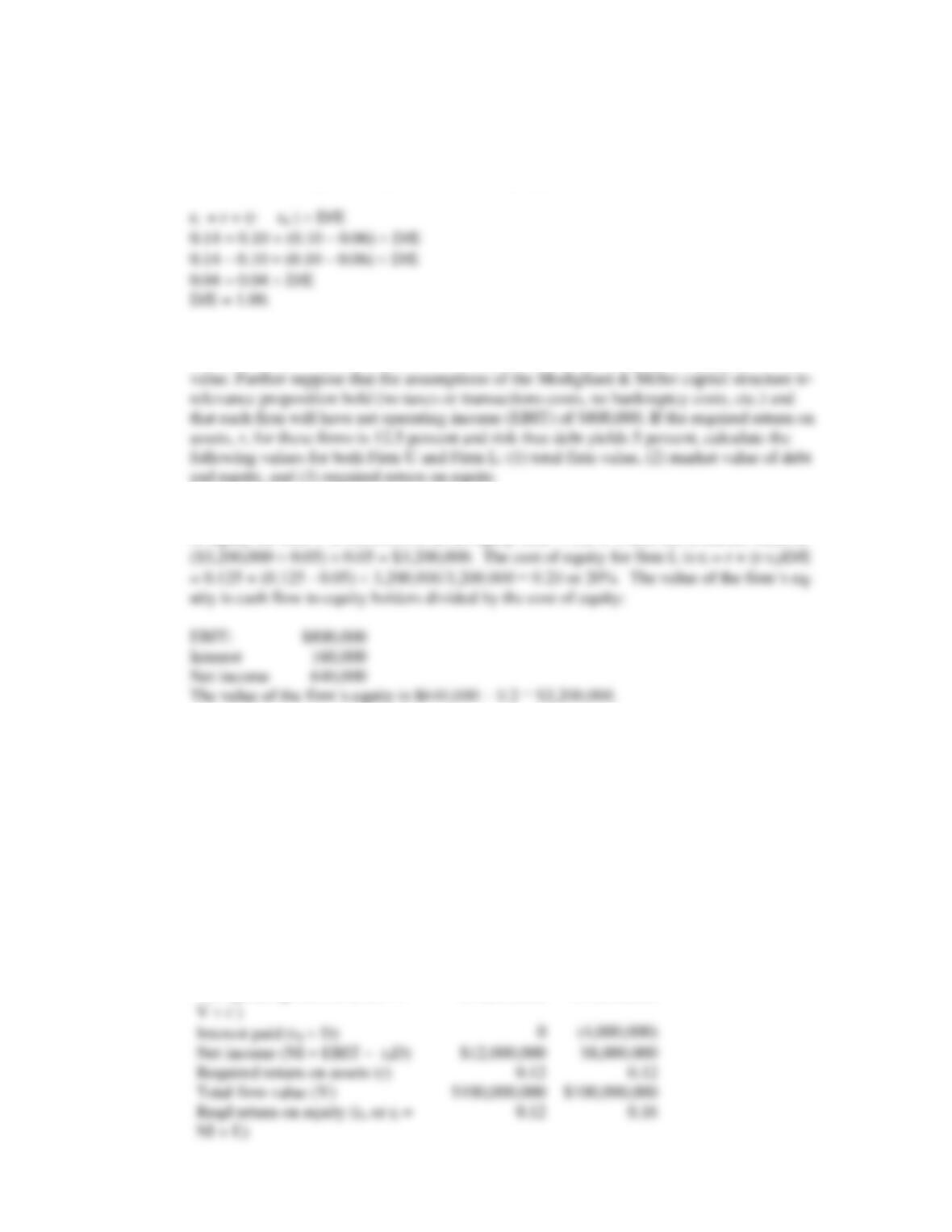
A12-5. rl = r + (r – rd ) D/E Plug in known values to calculate WACC
16.5%.
P12-6. A firm operates in perfect capital markets. The required return on its outstanding debt is 6
percent, the required return on its shares is 14 percent, and its WACC is 10 percent. What is
the firm’s debt–to–equity ratio?
344 Instructor’s Manual
A12-6. From equation 12.2 we know the relationship between the cost of equity for a levered firm,
the WACC, the cost of debt and the debt-to-equity ratio. We can plug in the values we
know, then rearrange to compute the debt-to-equity ratio, as follows:
P12-7. Assume that two firms, U and L, are identical in all respects except that Firm U is debt free
and Firm L has a capital structure that is 50 percent debt and 50 percent equity by market
A12-7. The market value of firm U and firm L is 800,000 ÷ 0.125 = $6,400,000. The market value
of equity for firm U is $6,400,000, an all equity firm. Firm L’s debt has a market value of
P12-8. Hearthstone Corp. and The Shaky Image Co. are companies that compete in the luxury
consumer goods market. The two companies are virtually identical, except that Hearthstone
is financed entirely with equity and The Shaky Image uses equal amounts of debt and equi-
ty. Suppose that each firm has assets with a total market value of $100 million. Hearthstone
has 4 million shares of stock outstanding worth $25 each. Shaky has 2 million shares out-
standing, and it also has publicly traded debt, with a market value of $50 million. Both
companies operate in a world with perfect capital markets (no taxes, etc.). The WACC for
each firm is 12 percent. The cost of debt is 8 percent.
a. What is the price of Shaky stock?
b. What is the cost of equity for Hearthstone? For Shaky?
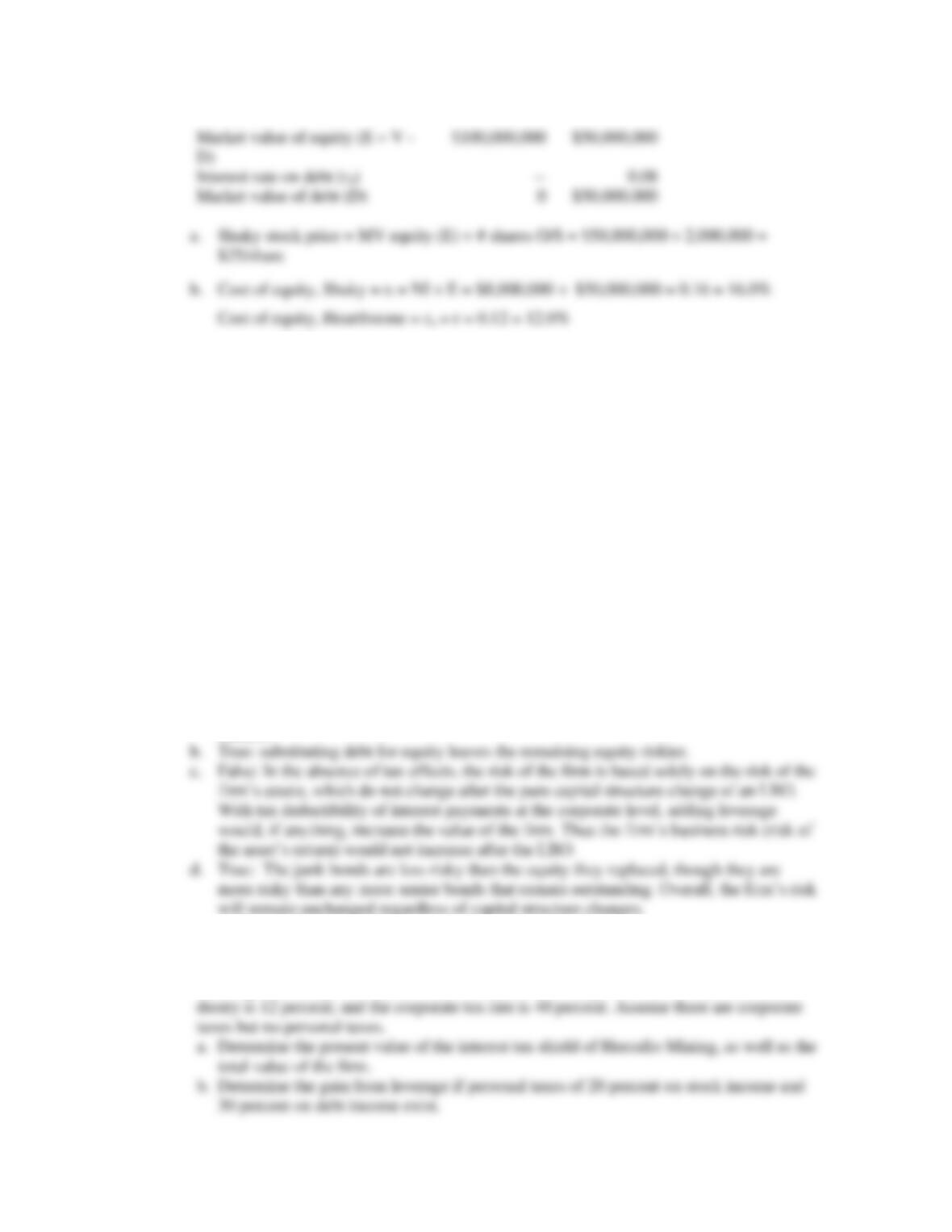
A12-8.
Hearthstone
Shaky
Net income (NI = EBIT – rdD)
Total firm value (V)
NI ÷ E)
Net operating income (EBIT =
$12,000,000
$12,000,000
Chapter 12 Capital Structure 345
P12-9. In the mid-1980s, Michael Milken and his firm, Drexel Burnham Lambert, made the term
“junk bonds” a household word. Many of Drexel’s clients issued junk bonds (bonds with
low credit ratings) to the public to raise money to conduct a leveraged buyout (LBO) of a
target firm. After the LBO, the target firm would have an extremely high debt-to-equity ra-
tio, with only a small portion of equity financing remaining. Many politicians and members
of the financial press worried that the increase in junk bonds would bring about an increase
in the risk of the U.S. economy because so many large firms had become highly leveraged.
Merton Miller disagreed. See if you can follow his argument by assessing whether each of
the statements below is true or false:
a. The junk bonds issued by acquiring firms were riskier than investment-grade bonds.
b. The remaining equity in highly leveraged firms was more risky than it had been before
the LBO.
c. After an LBO, the target firm’s capital structure would consist of very risky junk bonds
and very risky equity. Therefore, the risk of the firm would increase after the LBO.
d. The junk bonds issued to conduct the LBO were less risky than the equity they re-
placed.
A12-9. a. True: these bonds would have significant business risk and thus be similar to equity
finance.
The M&M Capital Structure Model with Corporate and Personal Taxes
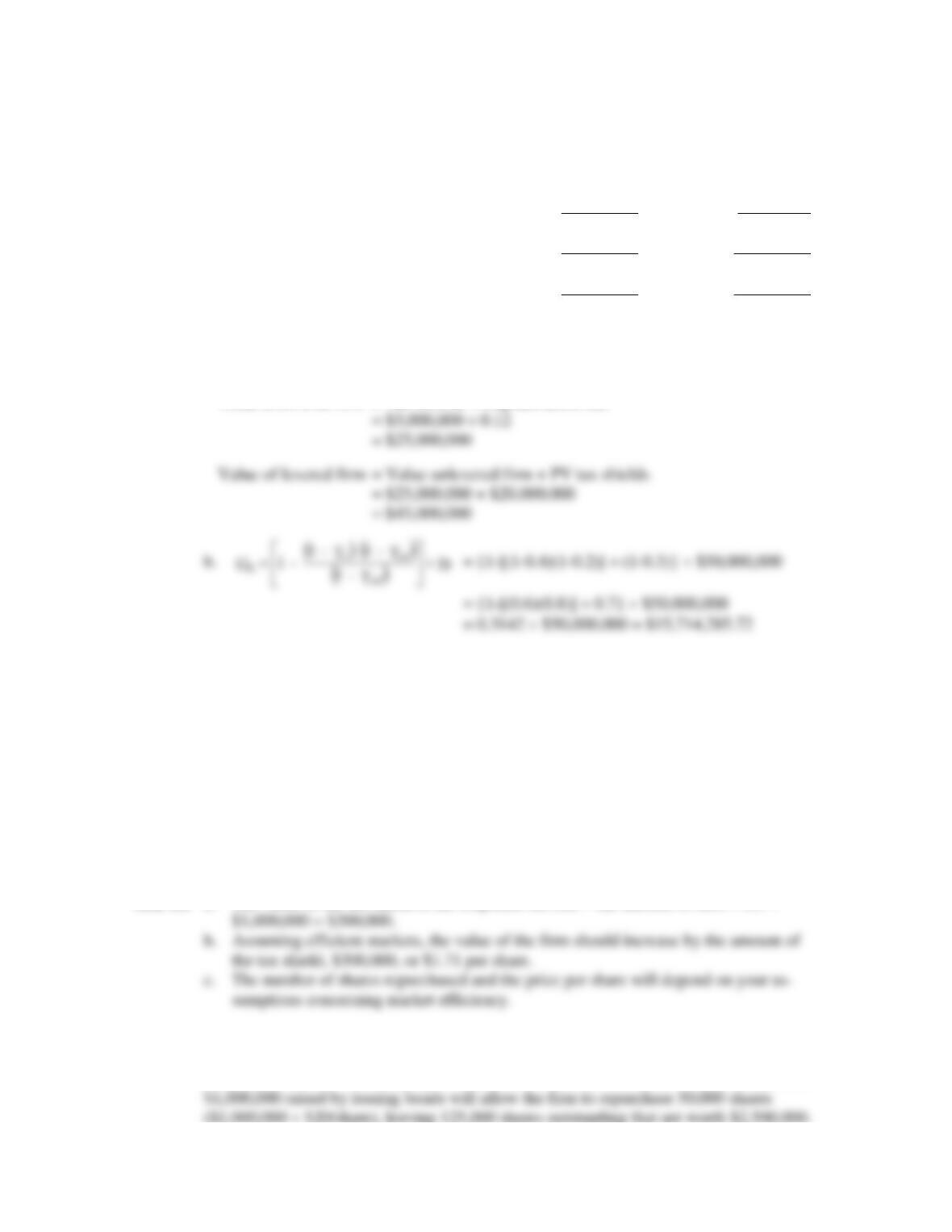
P12-10. Herculio Mining has net operating income of $5 million; there is $50 million of debt out-
standing with a required rate of return of 6 percent; the required rate of return on the in-
346 Instructor’s Manual
A12-10.
Levered
Unlevered
EBIT
$5,000,000
$5,000,000
− Interest paid (0.06 $50,000,000)
3,000,000
0
= Taxable income
$2,000,000
$5,000,000
− Taxes (TC = 0.40)
800,000
2,000,000
= Net income
$1,200,000
$3,000,000
+ Interest paid
3,000,000
0
= Total income available to investors
$4,200,000
$3,000,000
a. Present value of tax shield = Debt TC = $50,000,000 0.40 = $20,000,000
Value unlevered firm = Net income ÷ Capitalization rate
P12-11. An all-equity firm is subject to a 30 percent tax rate. Its total market value is initially
$3,500,000. There are 175,000 shares outstanding. The firm announces a program to is-
sue
$1 million worth of bonds at 10 percent interest and to use the proceeds to buy back
common stock. Assume that there is no change in costs of financial distress and that the
debt is
perpetual.
a. What is the value of the tax shield that the firm acquires through the bond issue?
b. According to Modigliani & Miller, what is the likely increase in market value per
share of the firm after the announcement, assuming efficient markets?
c. How many shares will the company be able to repurchase?
A12-11. a. The value of the tax shield is the corporate tax rate the amount of debt = 0.3
Case 1 – Information is not known about the new debt. In this case, shareholders who do
not tender their shares in the repurchase will benefit, at the expense of shareholders who
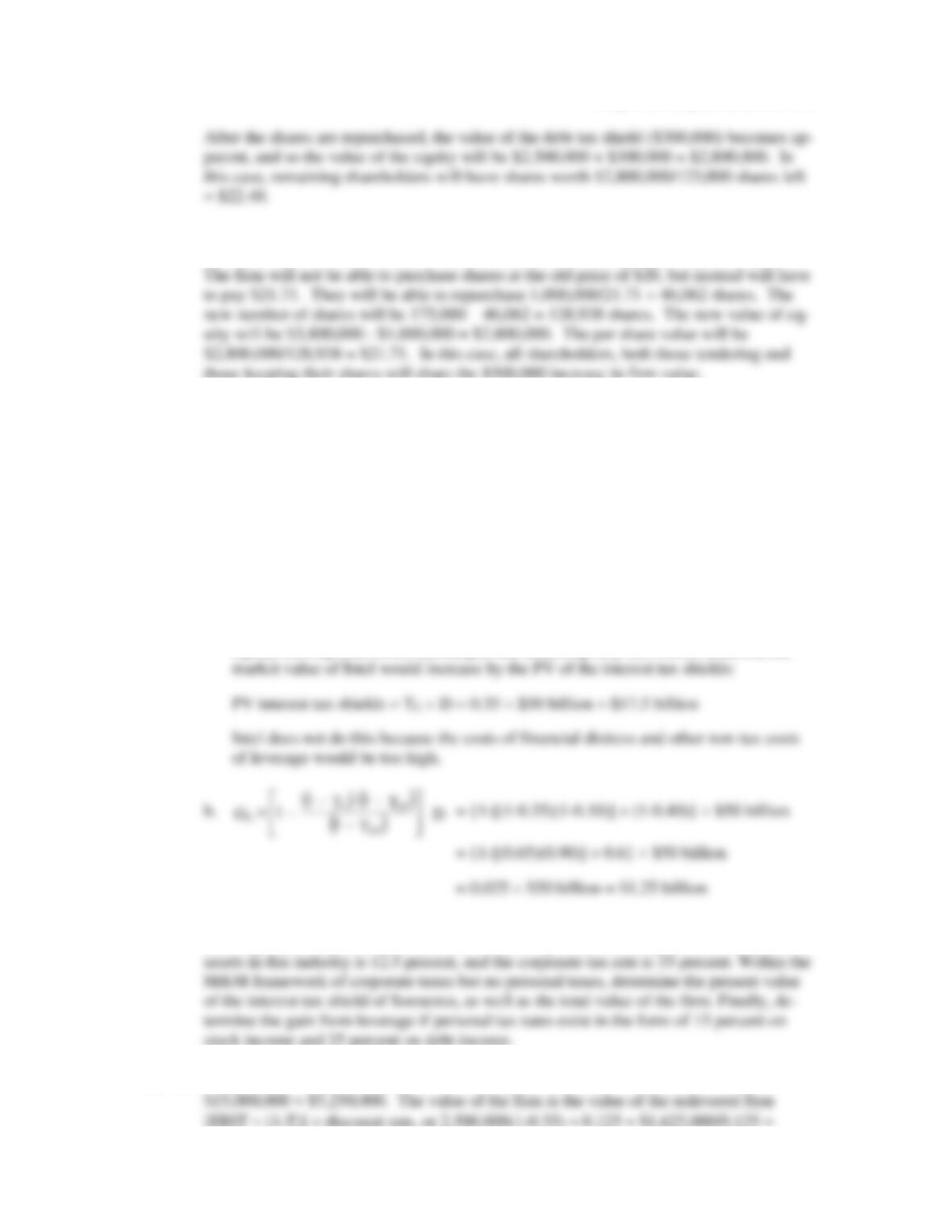
tender their shares. The company’s stock price is 3,500,000/175,000 = $20/share, so the
Chapter 12 Capital Structure 347
Case 2 – Markets are efficient, and as soon as the repurchase announcement is made,
firm value will rise to $3,800,000. Shares will be worth $3,800,000/175,000 = $21.71.
P12-12. Intel Corp. is a firm that uses almost no debt and had a total market capitalization of
about $179 billion in April 2004. Assume that Intel faces a 35 percent tax rate on corpo-
rate earnings. Ignore all elements of the decision except corporate tax savings.
a. By how much could Intel managers increase the value of the firm by issuing $50 bil-
lion in bonds (which would be rolled over in perpetuity) and simultaneously repur-
chasing $50 billion in stock? Why do you think that Intel has not taken advantage of
this opportunity?
b. Suppose that the personal tax rate on equity income faced by Intel shareholders is 10
percent, and the personal tax rate on interest income is 40 percent. Recalculate the
gains to Intel from replacing $50 billion of equity with debt.
A12-12. a. If Intel issued $50 billion in debt, and used the proceeds to repurchase $50 billion of
equity, leaving total assets unchanged and assuming only tax effects mattered, the
P12-13. Soonerco has net operating income of $2.5 million per year, and $15 million of debt out-
standing with a required return (interest rate) of 8 percent. The required rate of return on
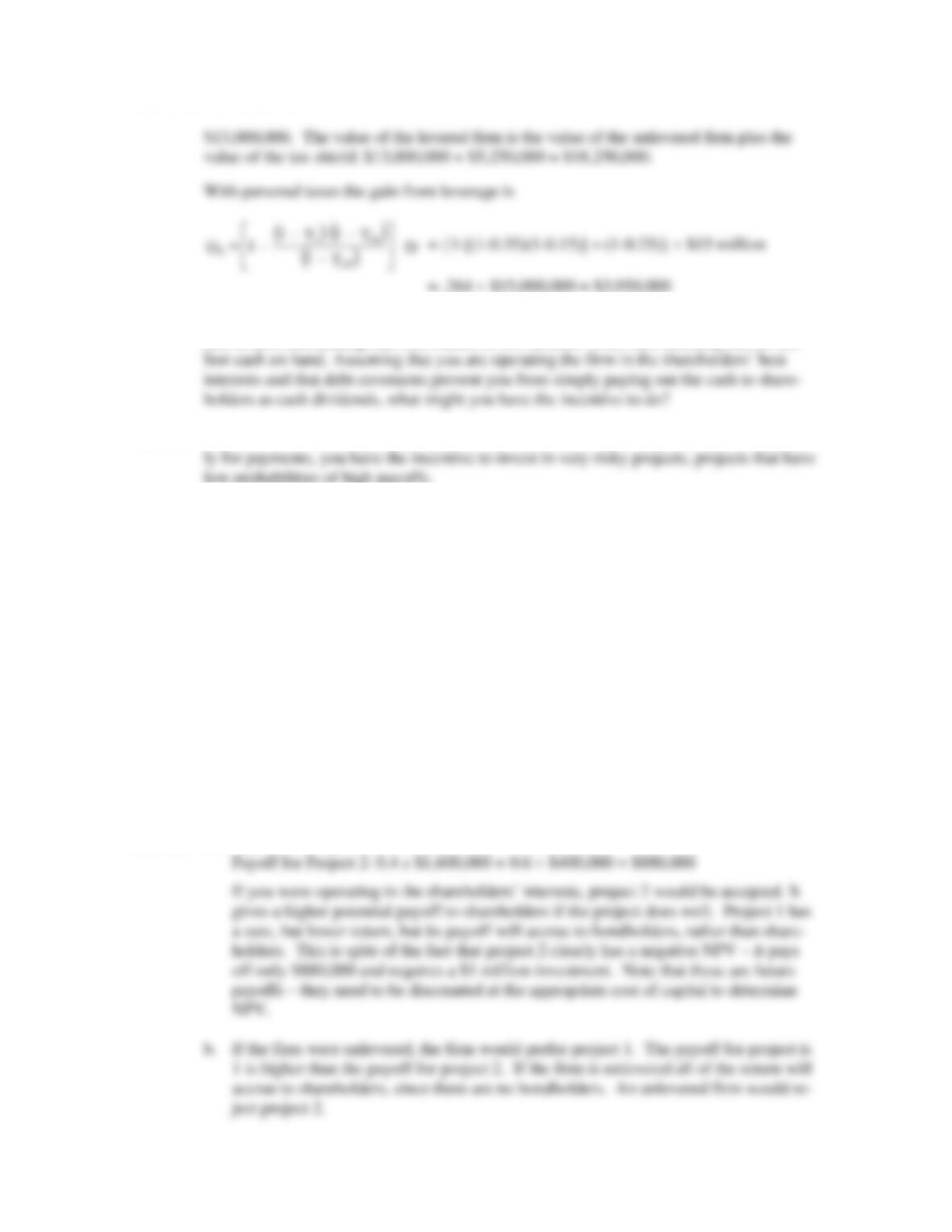
A12-13. The present value of the tax shield is the corporate tax rate x the amount of debt = .35
348 Instructor’s Manual
P12-14. Assume that you are the manager of a financially distressed corporation with $1.5 mil-
lion in debt outstanding that will mature in two months. Your firm currently has $1 mil-
A12-14. If your firm is financially distressed and has excess cash that it does not need immediate-
P12-15. You are the manager of a financially distressed corporation with $1.5 million in debt out-
standing that will mature in three months. Your firm currently has $1 million cash on
hand. Assume that you are offered the opportunity to invest in either of the two projects
described below.
Project 1: the opportunity to invest $1 million in risk-free Treasury bills, with a 4 per-
cent annual interest rate (a quarterly interest rate of 1 percent = 4% per year ÷ 4 quarters
per year)
Project 2: a high-risk gamble, which will pay off $1.6 million in two months if success-
ful (probability = 0.4), but will only pay $400,000 if unsuccessful (probability = 0.6)
a. Compute the expected payoff for each project, and state which one you would adopt
if you were operating the firm in the shareholders’ best interests? Why?
b. Which project would you accept if the firm was unlevered? Why?
c. Which project would you accept if the company was organized as a partnership ra-
ther than a corporation? Why?
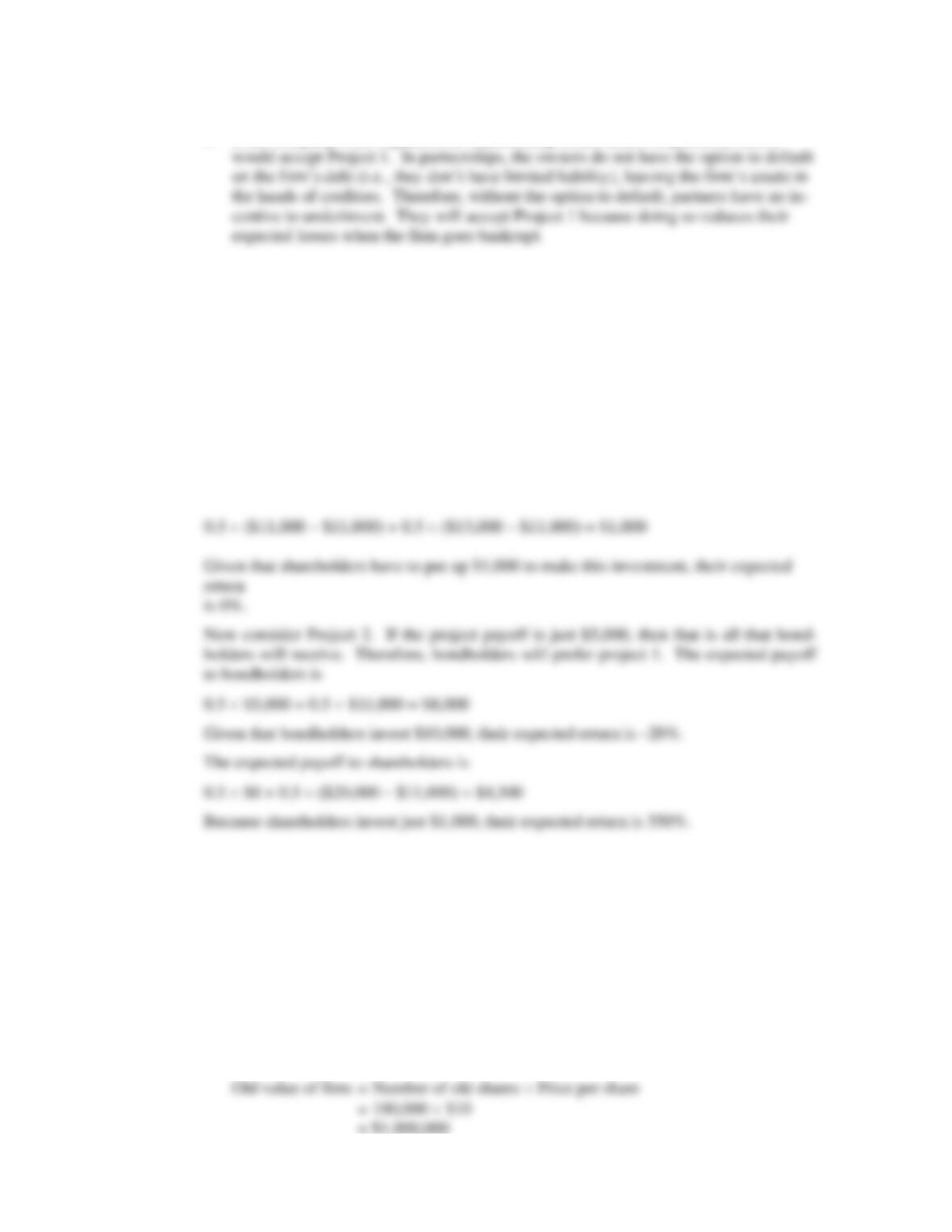
A12-15. a. Payoff for Project 1: $1,000,000 1.01 = $1,010,000
Chapter 12 Capital Structure 349
c. If the company were organized as a partnership rather than a corporation, then it
P12-16. A firm has the choice of investing in one of two projects. Both projects last one year.
Project 1 requires an investment of $11,000 and yields $11,000 with a probability of 0.5
and $13,000 with a probability of 0.5. Project 2 also requires an investment of $11,000
and yields $5,000 with a probability of 0.5 and $20,000 with a probability of 0.5. The
firm is capable of raising $10,000 of the investment required through a bond issue carry-
ing an annual interest rate of 10 percent. Assuming that the investors are concerned only
about expected returns, which project would stockholders prefer? Why? Which project
would bondholders prefer? Why?
A12-16. Consider Project 1 first. In either scenario, the payoff on the project is sufficient to repay
bondholders in full, $11,000. Bondholders earn their 10% return. The expected payoff
to shareholders is
P12-17. An all-equity firm has 100,000 shares outstanding worth $10 each. The firm is consider-
ing a project requiring an investment of $400,000 and has an NPV of $50,000. The com-
pany is also considering financing this project with a new issue of equity.
a. What is the price at which the firm needs to issue the new shares so that the existing
shareholders are indifferent to whether the firm takes on the project with this equity
financing or does not take on the project?
b. What is the price at which the firm needs to issue the new shares so that the existing
shareholders capture the full benefit associated with the new project?
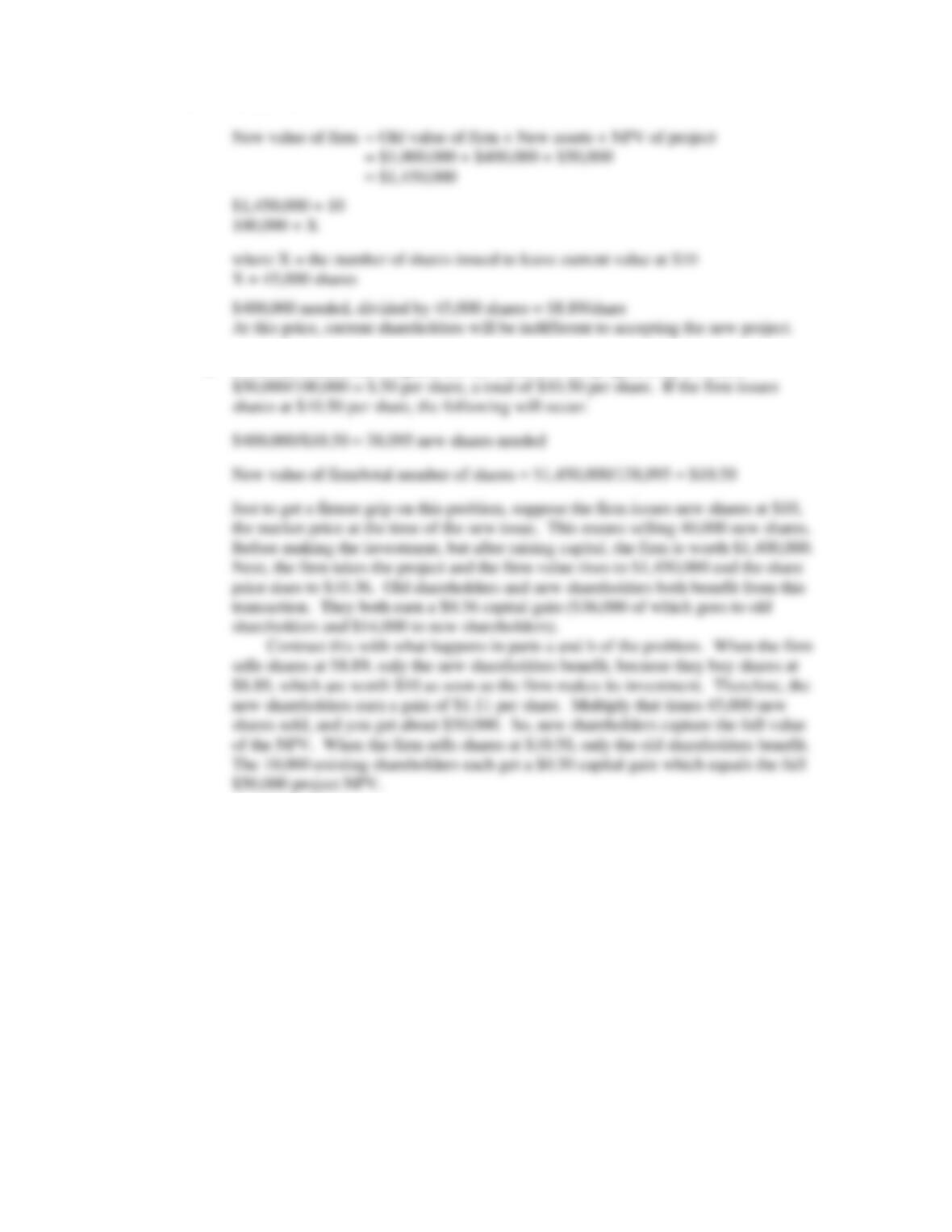
A12-17. a. For existing shareholders to be indifferent, find the number of shares that will leave
share value at its current $10:
350 Instructor’s Manual
b. If the old shareholders capture the full benefit of the project, they will have
P12-18. You are the manager of a financially distressed corporation that has $5 million in loans
coming due in 30 days. Your firm has $4 million cash on hand. Suppose that a long-time
supplier of materials to your firm is planning to exit the business but has offered to sell
your company a large supply of material at a bargain price of $4.5 million—but only if
payment is made immediately in cash. If you choose not to acquire this material, the
supplier will offer it to a competitor, and your firm will have to acquire the materials at
market prices totaling $5 million over the next few months.
a. Assuming that you are operating the firm in shareholders’ best interests, would you
accept the project? Why or why not?
b. Would you accept this project if the firm were unlevered? Why or why not?
c. Would you accept the project if the company were organized as a partnership? Why
or why not?
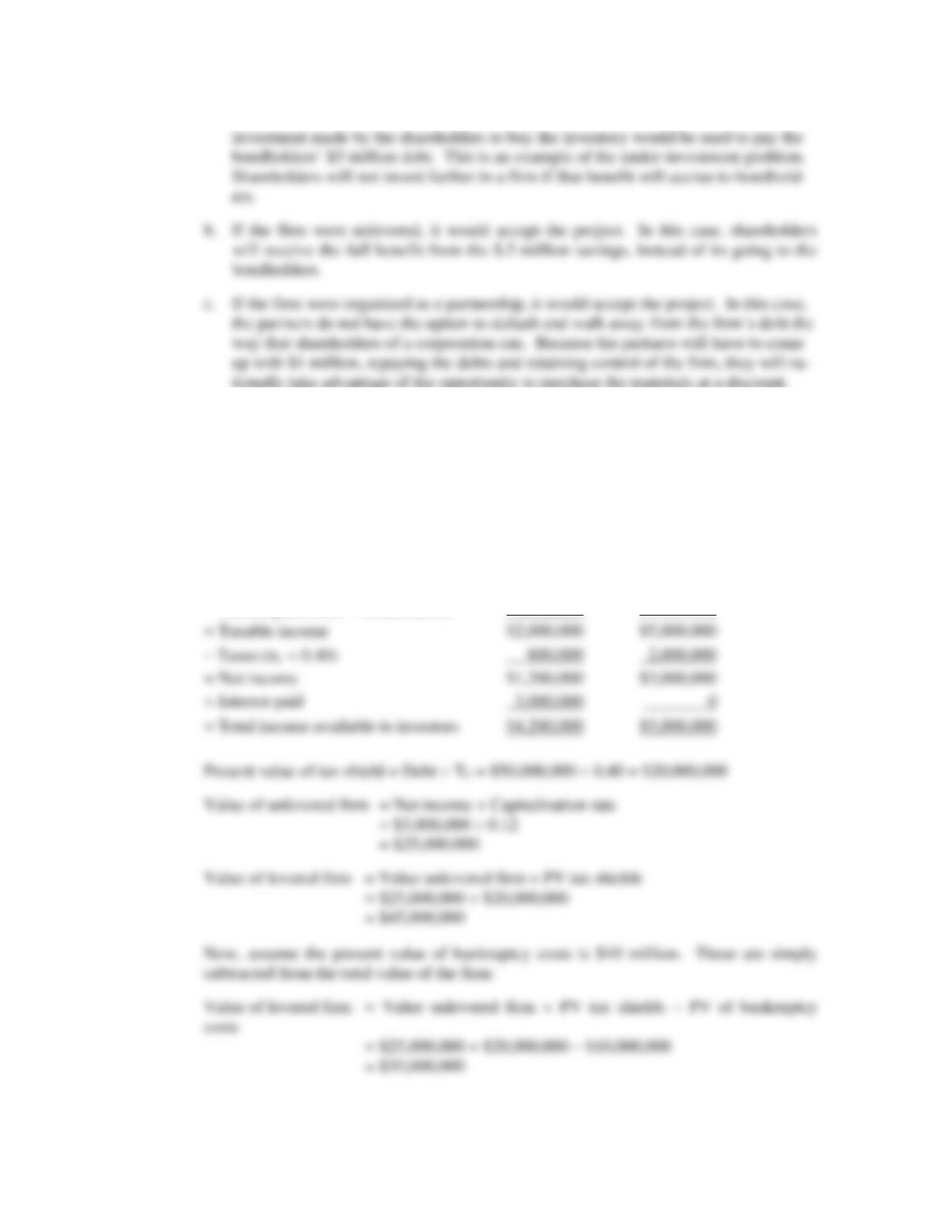
A12-18. a. If you are operating the firm in shareholders’ best interests, you will not accept the
project. It will be better for the shareholders to default and leave the bondholders
with a firm that is worth less than the value of their debt. The additional $.5 million
Chapter 12 Capital Structure 351
P12-19. Magnum Enterprises has net operating income of $5 million; there is $50 million of debt
outstanding with a required rate of return of 6 percent; the required rate of return on the
industry is 12 percent; and the corporate tax rate is 40 percent. There are corporate taxes
but no personal taxes. Compute the value of Magnum, assuming that the present value of
bankruptcy costs are $10 million.
A12-19.
Levered
Unlevered
EBIT
$5,000,000
$5,000,000
– Interest paid (0.06 $50,000,000)
3,000,000
0
– Taxes (C = 0.40)
= Net income
$1,200,000
$3,000,000
P12-20. Slash and Burn Construction Company currently has no debt and expects to earn $10
million in net operating income each year for the foreseeable future. The required return
352 Instructor’s Manual
on assets for construction companies of this type is 12.5 percent, and the corporate tax
rate is 40 percent. There are no taxes on dividends or interest at the personal level. Slash
and Burn calculates that there is a 10 percent chance that the firm will fall into bankrupt-
cy in any given year, and if bankruptcy does occur, it will impose direct and indirect
costs totaling $12 million. If necessary, use the industry required return for discounting
bankruptcy costs.
a. Compute the present value of bankruptcy costs for Slash and Burn.
b. Compute the overall value of the firm.
c. Re-calculate the value of the company, assuming that the firm’s shareholders face a
25 percent personal tax rate on equity income.
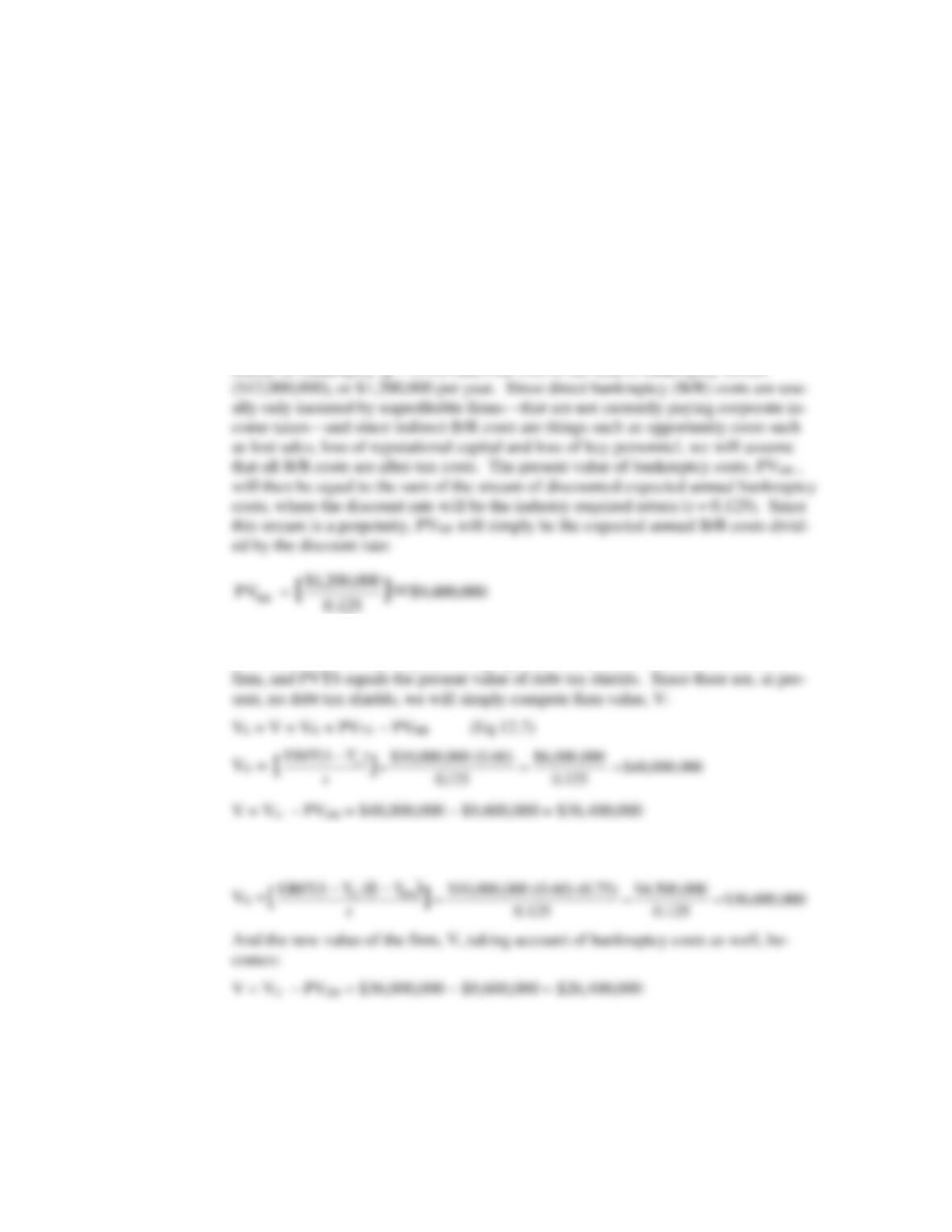
A12-20. a. For any given year, the expected value of bankruptcy costs will be equal to the prob-
ability of bankruptcy (p = 0.10) times the cost to the firm if bankruptcy occurs
b. The overall value of the firm is computed using equation 12.7, where VU is the value
of an unlevered firm (computed using equation 12.3), VL is the value of a levered
c. Incorporating a personal tax rate on equity income into the valuation model of an un-
levered firm presented in equation 12.3 yields:
P12-21. Slash and Burn Construction Company currently has no debt and expects to earn $10
million in net operating income each year, for the foreseeable future. The required return
on assets for construction companies of this type is 12.5 percent, and the corporate tax
rate is 40 percent. There are no taxes on dividends or interest at the personal level. Slash
and Burn calculates that there is a 10 percent chance that the firm will fall into bankrupt-
cy in any given year. If bankruptcy does occur, it will impose direct and indirect costs to-
Chapter 12 Capital Structure 353
taling $12 million. If necessary, use the industry required return for discounting bank-
ruptcy costs. Assume that the managers of this company are weighing two capital struc-
ture alteration proposals.
Proposal 1: involves borrowing $20 million, at an interest rate of 6 percent, and using
the proceeds to repurchase an equal amount of outstanding stock. With this level of debt,
the likelihood that Slash and Burn will fall into bankruptcy in any given year increases to
15 percent. If bankruptcy occurs, it will impose direct and indirect costs, totaling $12
million.
Proposal 2: involves borrowing $30 million, at an interest rate of 8 percent, and also
using the proceeds to repurchase an equal amount of outstanding stock. With this level of
debt, the likelihood of Slash and Burn falling into bankruptcy in any given year rises to
25 percent. The associated direct and indirect costs of bankruptcy, if it occurs, increase to
$20 million. For each proposal, calculate both the present value of the interest tax shields
and the overall value of the firm, assuming that there are no personal taxes on debt or
equity income.
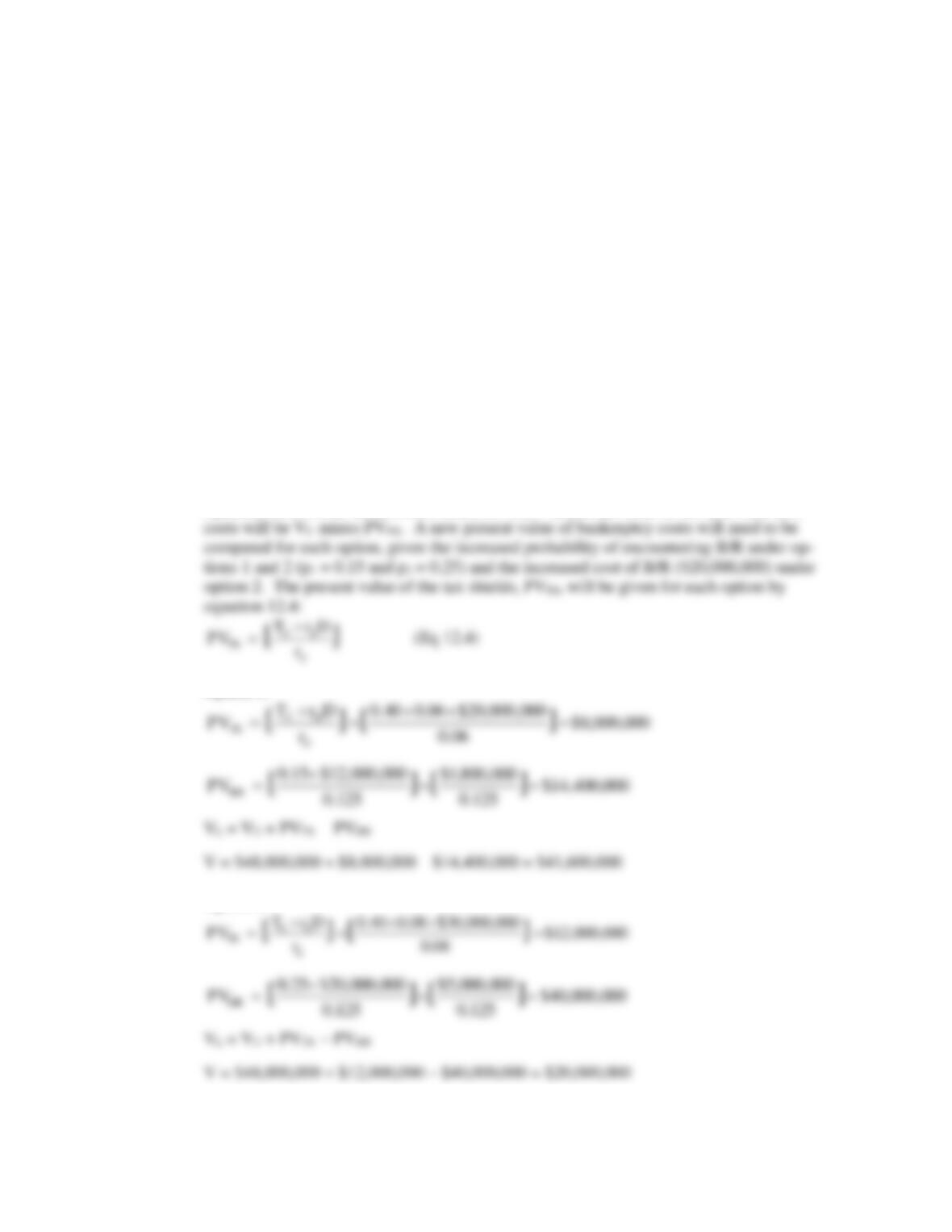
A12-21. If Slash and Burn takes on debt, the firm can be valued as a levered firm using equation
12.7. As in problem 12-22, the value of Erector as an unlevered firm computed using
equation 12.3 will be $48,000,000 [EBIT(1–TC) r] and the value of the firm with B/R
Option 1:
Option 2:
P12-22. Go to Yahoo! and download recent balance sheets for Microsoft, Merck, Archer Daniels
Midland, and General Mills (ticker symbols MSFT, MRK, ADM, and GIS, respectively).
354 Instructor’s Manual
Calculate several debt ratios for each company and comment on the differences that you
observe in the use of leverage. What factors do you think account for these differences?
A12-22. Internet exercise – answers will vary.
THOMSON ONE Business School Edition: Since P12-23 and P12-24 are based on using a live
data base, answers will vary from moment to moment. This is a chance for your students to use a
version of a tool that CFAs use every day. If you would like to use Thomson ONE but are unsure
about how to proceed, contact your rep for copies of A Guide to Using Thomson One BSE by
Rosemary Carlson at Morehead State University. Her guide will lead you through this powerful
tool available to your students with the purchase of any new copy of this text.
Answer to MiniCase
Capital Structure
A few years after being appointed financial manager at Sedona Fabricators, Inc., you are asked by
your boss to prepare for your first presentation to the Board of Directors. This presentation will
pertain to issues associated with capital structure. It is intended to ensure that some of the newly
appointed, independent board members understand certain terminology and issues. As a guideline
for your presentation, you are provided with the following outline of questions.
Assignment
1. What is capital structure?
2. What is financial leverage?
3. How does financial leverage relate to firm risk and expected returns?
4. Modigliani and Miller demonstrated that capital structure policy is irrelevant. What is the basis
for their argument? What are their Propositions I and II?
5. How does the introduction of corporate taxes affect the M&M model?
6. How do the costs of bankruptcy and financial distress affect the M&M model?
7. What are agency costs? How can the use of debt reduce agency costs associated with equity?
Answers
1. Capital structure is the structure of the long-term (capital) sources of financing, or in other
works, the structure of the long-term portion of liabilities and shareholder’s equity on the bal-
ance sheet.
Chapter 12 Capital Structure 355
5. The presence of corporate taxes creates valuable interest tax shield as interest on debt is a tax
6. The costs of bankruptcy and financial distress affect the M&M Model can be demonstrated by
7. Agency costs associated with equity refer to those costs incurred by managers for their person-
al benefit (perquisites) that reduce the value of the firm. Jensen and Meckling show how using