CHAPTER 12: INTERNATIONAL FINANCING AND NATIONAL CAPITAL MARKETS
1
CHAPTER 12
INTERNATIONAL FINANCING AND NATIONAL CAPITAL MARKETS
I begin this session by discussing the evolutionary process under way in world finance, which is
characterized by three simultaneous developments. (1) Financial markets are becoming increasingly
globalized. (2) Old kinds of debt are being made into new kinds of securities. (3) The distinction between
commercial and investment banks is breaking down. Each of these developments will have a profound
influence on everybody involved in the financing business.
The process of globalization has been taking place for some time. U.S. banks developed worldwide
branch networks in the 1960s and 1970s for loans, payments, clearings, and foreign exchange trading.
U.S. securities firms also began to build up their operations abroad, starting in the 1970s at first in
London with the Eurobond market, but then into other markets, including now Tokyo, Hong Kong, and
Singapore. Foreign firms expanded into the U.S., first the commercial banks and later on the securities
houses. Trading in individual markets has globalized. International finance is a Darwinian world – only
the fittest will survive – and most financial firms have concluded that to survive as a force in any one of
the world’s leading financial markets, a firm must have a significant presence in all of them.
The second major development under way in world finance is the process of securitization. Twenty
years ago, banks handled most of the short- and medium-term financing around the world. But corporate
borrowers developed the means to obtain lower-cost funds directly from lenders, such as through
commercial paper marketed by investment banks rather than by commercial banks.
early 1980s until banks were allowed to offer money market deposit accounts to their customers.
I then discuss the differences in national financing patterns and relate these differences to some of the
factors discussed in the chapter. Principal factors are differences in profitability and growth among national
firms and differences in the role of banks and permissible banking activities. I note, however, that the
evolutionary process discussed above is leading to a convergence of financing practices among countries.
INSTRUCTORS MANUAL: FOUNDATIONS OF MULTINATIONAL FINANCIAL MANAGEMENT, 6TH ED.
2
SUGGESTED ANSWERS TO “BEIJING TRIES TO OVERHAUL BANKS THROUGH IPOS”
1. Would you expect loans to SOEs to be safer or riskier than other Chinese bank loans? Explain.
ANSWER. From a strict credit risk standpoint, loans to SOEs are much riskier. These companies are
2. How can IPOs improve the sorry performance of Chinese banks?
3. What difficulties will China face in preparing their state-owned banks for IPOs?
ANSWER. There are several obvious difficulties. First, the state-owned banks have little experience or
4. What other steps can the Chinese government take to improve the performance of their banks?
5. How would a more efficient banking system benefit China?
6. What is the downside of introducing market forces into China’s banking system?

CHAPTER 12: INTERNATIONAL FINANCING AND NATIONAL CAPITAL MARKETS
3
SUGGESTED ANSWERS TO “SIEMENS NEGOTIATES A EUROCURRENCY LOAN”
1. What are the net proceeds to Siemens from each of these syndicated loan proposals?
ANSWER. With an up-front syndication fee of 1.125%, net proceeds to Siemens from the Bank of
America loan proposal are:
2. Assuming that six-month LIBOR is currently at 4.35%, what is the effective annual interest
cost to Siemens for the first six months of each loan?
ANSWER. The interest rate on the Bank of America loan is set at LIBOR + 0.25%, with LIBOR reset
every six months. Given an initial LIBOR6 rate of 4.35%, the first semiannual debt service payment is
3. Which of these two loans would you select on the basis of cost, all else being equal?
4. What other factors might you consider in deciding between these two loan proposals?
ANSWER. You might also want to consider how long it would take to put together the syndicates, the
SUGGESTED ANSWERS TO CHAPTER 12 QUESTIONS
1. What are some basic differences between the financing patterns of U.S. and Japanese firms?
What might account for some of these differences?
ANSWER. The basic differences between the financing patterns of U.S. and Japanese firms are in the
2. What is securitization? What forces underlie it and how has it affected MNC financing policies?
ANSWER. Securitization is the process of matching up borrowers and savers by way of the financial
markets. By contrast, financial intermediation involves the use of financial institutions such as banks and
3. Why is bank lending on the decline worldwide? How have banks responded to their loss of
market share?
ANSWER. Three economic forces underlie the decline of bank lending worldwide. (1) Upward pressure on
4.a. What is meant by the globalization of financial markets?
ANSWER. The globalization of financial markets refers to the increasing integration of national financial
markets. Markets for U.S. government securities and certain stocks, foreign exchange trading, interbank
4.b. How has technology affected the process of globalization?
4.c. How has globalization affected government regulation of national capital markets?
ANSWER. Because the globalization of financial markets and institutions has been brought about by
5. Many financial commentators believe that bond owners and traders today have an enormous
collective influence over a nation‘s economic policies. Explain why this might be correct.
6. Why are large MNCs located in small countries such as Sweden, Holland, and Switzerland
interested in developing a global investor base?
ANSWER. Large MNCs located in these small countries often need to raise substantial capital to continue
growing. Quite often, the domestic market cannot provide this amount of capital on reasonable terms
7. Why are many U.S. MNCs seeking to improve their visibility with foreign investors, even going
so far as to list their shares on foreign stock exchanges?
ANSWER. There are several reasons for companies to list their shares on foreign stock exchanges:
8. List some reasons a U.S.-based corporation might issue debt denominated in a foreign currency.
ANSWER. A U.S. company might issue foreign currency debt because it
9. In an attempt to regain business lost to foreign markets, Swiss authorities abolished stamp
duties on transactions between foreigners as well on as new bond issues by foreign borrowers.
However, transactions involving Swiss citizens will still attract a 0.15% tax, and bond issues by
Swiss borrowers were also made more expensive. What are the likely consequences of these
changes for Swiss financial markets?

CHAPTER 12: INTERNATIONAL FINANCING AND NATIONAL CAPITAL MARKETS
7
10. What is the difference between a Eurocurrency loan and a Eurobond?
ANSWER. The fundamental distinction between a Eurobond and a Eurocurrency loan stems from the
11. What is the difference between a foreign bond and a Eurobond?
12. What is the basic reason for the existence of the Eurodollar market? What factors have
accounted for its growth over time?
ANSWER. The Eurodollar market, exists because it enables borrowers and lenders alike to avoid a variety
13. Why have Eurobonds traditionally yielded less than comparable domestic bonds?
ANSWER. Eurobonds are issued in bearer form, meaning they are unregistered, with no record to identify
ADDITIONAL CHAPTER 12 QUESTIONS AND ANSWERS
1. Suppose the Swiss government imposes an interest rate ceiling on Swiss bank deposits. What is
the likely effect on Eurofranc interest rates of this regulation?
2. What factors account for the rise and recent decline of the Eurobond market as a source of
financing for American companies?
INSTRUCTORS MANUAL: FOUNDATIONS OF MULTINATIONAL FINANCIAL MANAGEMENT, 6TH ED.
8
3. It had been said that if other European interest rates converged toward German rates, ECU
bonds would soar in value. Explain why this would occur.
ANSWER. ECU bonds are priced based on a weighted average of the interest rates of the currencies that
SUGGESTED SOLUTIONS TO CHAPTER 12 PROBLEMS
1. A European company issues common shares that pay taxable dividends and bearer shares that
pay an identical dividend but offer an opportunity to evade taxes: Bearer shares come with a
large supply of coupons that can be redeemed anonymously at banks for the current value of
the dividend.
1.a. Suppose taxable dividends are taxed at the rate of 10%. What is the ratio between market
prices of taxable and bearer shares? If a new issue is planned, should taxable or bearer
shares be sold?
1.b. Suppose, in addition, that it costs 10% of proceeds to issue a taxable dividend, whereas it
costs 20% of the proceeds to issue bearer stocks because of the expense of distribution and
coupon printing. What type of share will the corporation prefer to issue?

1.c. Suppose now that individuals pay 10% taxes on dividends, and corporations pay no taxes,
but bear an administrative cost of 10% of the value of any bearer dividends. Can you
determine the relative market prices for the two types of shares?
2. Suppose that the current 180-day interbank Eurodollar rate is 9% (all rates are stated on an
annualized basis). If next period’s rate is 9.5%, what will a Eurocurrency loan priced at
LIBOR plus 1% cost?
3. Citibank offers to syndicate a Eurodollar credit for the government of Poland with the
following terms:
3.a. What are the net proceeds to Poland from this syndicated loan?
3.b. Assuming that six-month LIBOR is currently at 6.35%, what is the effective annual interest
cost to Poland for the first six months of this loan?
4. IBM needs to raise $1 billion and is trying to decide between a domestic dollar bond issue and
a Eurobond issue. The U.S. bond can be issued at a coupon of 6.75%, paid semiannually, with
underwriting and other expenses totaling 0.95% of the issue size. The Eurobond costs only
0.55% to issue but would bear an annual coupon of 6.88%. Both issues mature in 10 years.
4.a. Assuming all else is equal, which is the least expensive issue for IBM?
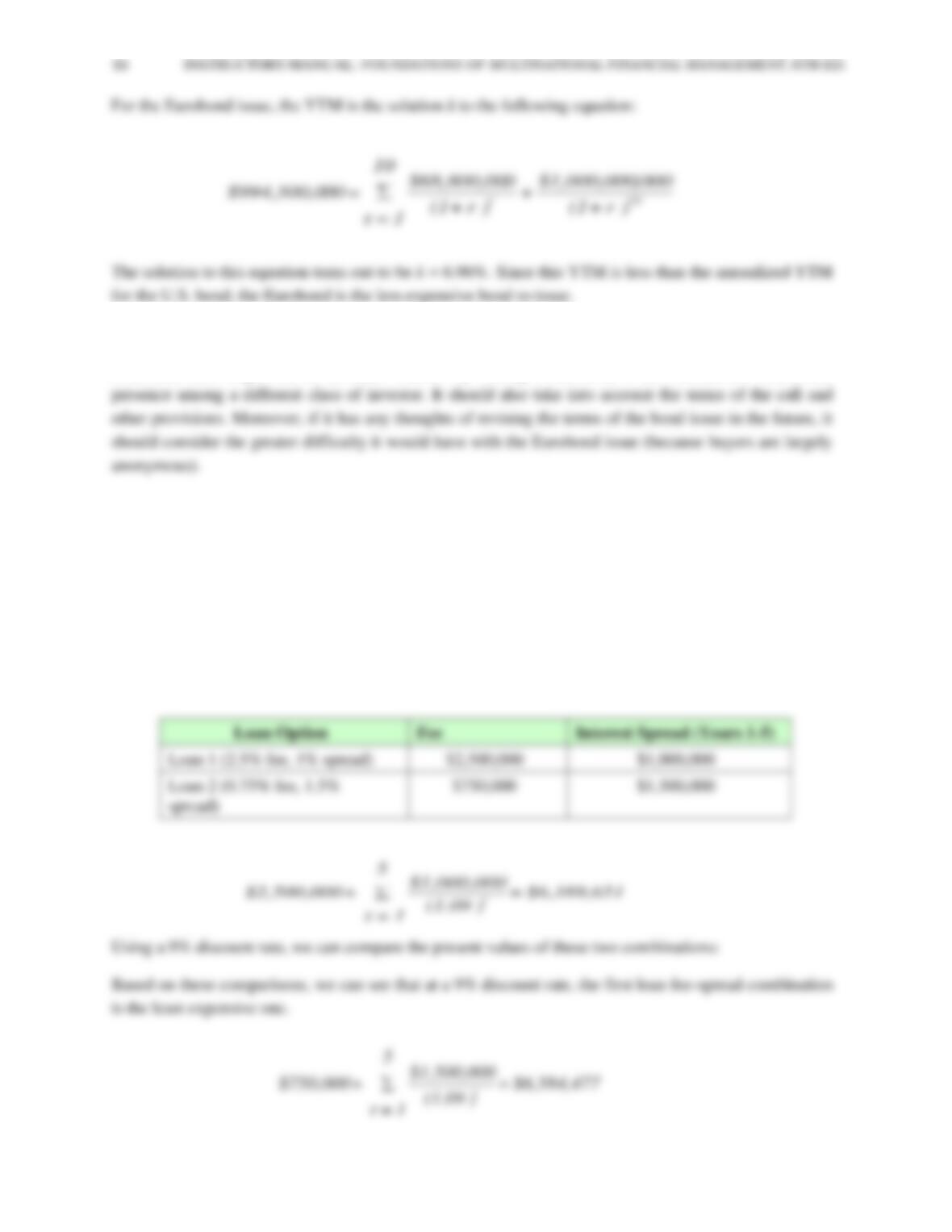
ANSWER. The least expensive issue can be found by comparing the yield to maturity (YTM) for each
bond, computed as the internal rate of return or IRR. For the domestic bond issue, the YTM is the
solution r to the following equation:
4.b. What other factors might IBM want to consider before deciding which bond to issue?
ANSWER. IBM might like to consider whether by issuing a Eurobond it can increase its investment
ADDITIONAL CHAPTER 12 PROBLEMS AND SOLUTIONS
1. Suppose that Zimbabwe has a choice of two possible $100 million, five-year Eurodollar loans. The
first loan is offered at LIBOR + 1% with a 2.5% syndication fee, whereas the second loan is priced
at LIBOR + 1.5% and a 0.75% syndication fee. Assuming that Zimbabwe has a 9% cost of capital,
which loan is preferable? Hint: View this as a capital budgeting problem.
ANSWER. The dollar cash flows associated with these two spread-syndicate fee combinations are as
follows:

2. Refer to the example of Exxon’s zero-coupon Eurobond issue in the section titled The
Euromarkets.
2.a. How much would Exxon have earned if the yield on the stripped Treasurys had been
12.10%? 12.25%?
ANSWER. As we saw in the chapter, Exxon realized proceeds of about $199 million from its $1.8 billion
2.b. Suppose the Japanese government taxed the accretion in the value of zero-coupon bonds at a
rate of 15%. Assuming the same 11.65% after-tax required yield, how would this tax have
affected the price Japanese investors were willing to pay for Exxon’s Eurobond issue? What
is pre-tax yield at this new price? Would any arbitrage incentive still exist for Exxon?
ANSWER. At maturity, investors receive (1 -0.15)(1.8B – P), where P represents the amount paid for the
2.c. Suppose Exxon had sold its zero-coupon Eurobonds to yield 11.5% and bought stripped
Treasury bonds yielding 12.30% to meet the required payment of $1.8 billion. How much
would Exxon have earned through its arbitrage transaction?
3. British Telecom (BT) has issued $1 billion in Euro-CP maturing in 75 days and priced to yield
5.8% annually based on a 360-day year.
3.a. What are BT’s proceeds from the issue?
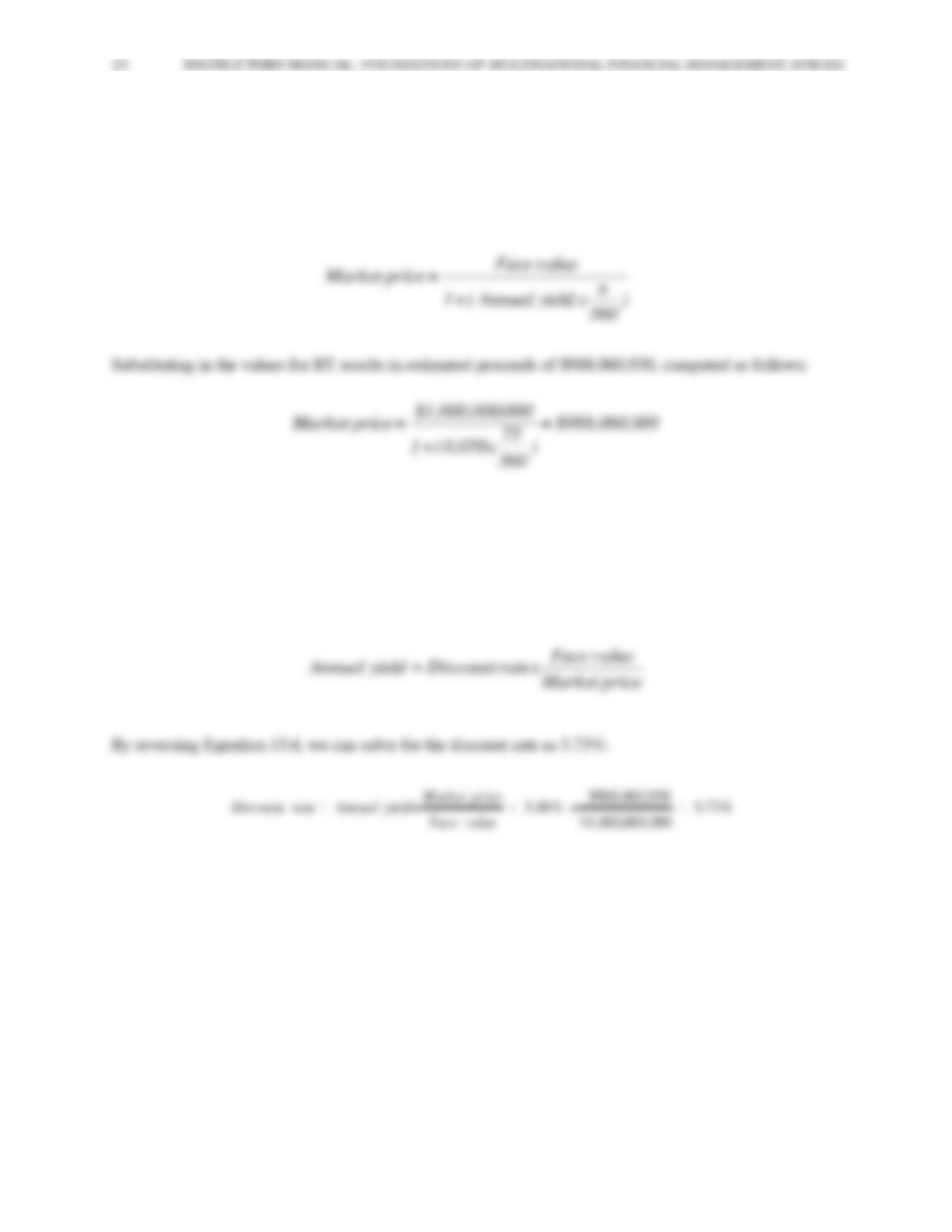
ANSWER. According to Equation 13.7, the market price of a Euro-CP issue can be computed as follows:
3.b. What is the discount rate on BT’s issue?
ANSWER. According to Equation 13.6, the relation between the annual yield and the discount rate can be
expressed as follows: