Mini Case: 12 – 15
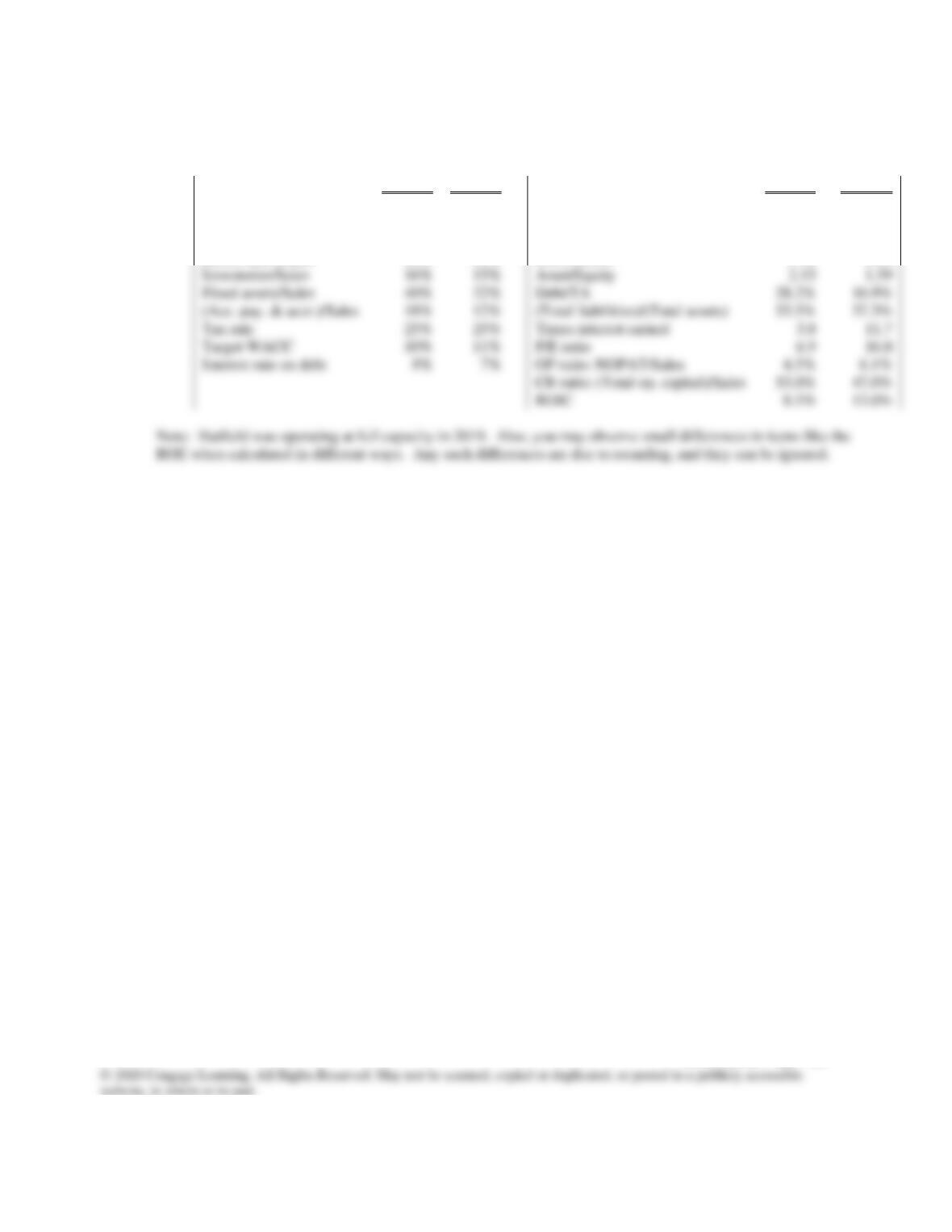
Hatfield Medical Supply: Income Statement and Additional Information (Millions of
Dollars), December 31
Hatfield
Industry
Hatfield
Industry
(Op. costs)/Sales
90%
88%
Profit margin (M)
3.30%
5.60%
Depr./FA
10%
12%
Return on assets (ROA)
4.6%
9.5%
Cash/Sales
1%
1%
Return on equity (ROE)
10.0%
15.1%
Receivables/Sales
14%
11%
Sales/Assets
1.41
1.69
Inventories/Sales
16%
15%
Asset/Equity
2.15
1.59
Fixed assets/Sales
40%
32%
Debt/TA
28.2%
16.9%
(Acc. pay. & accr.)/Sales
18%
12%
(Total liabilities)/(Total assets)
53.5%
37.3%
Tax rate
25%
25%
Times interest earned
11.7
Target WACC
10%
11%
P/E ratio
6.9
16.0
Interest rate on debt
8%
7%
OP ratio: NOPAT/Sales
4.5%
6.1%
ROIC
8.5%
13.0%
Mini Case: 12- 16
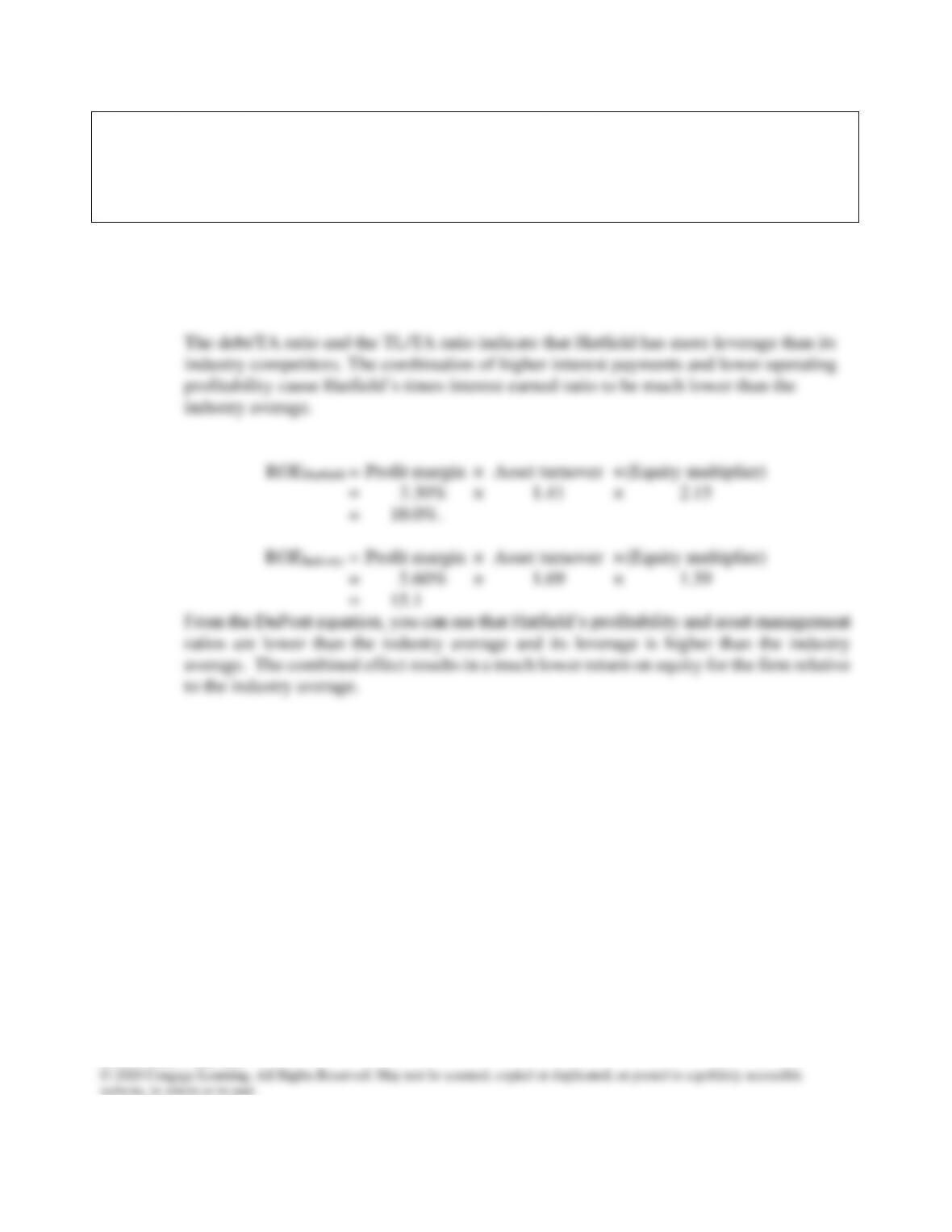
a. a. Using Hatfield’s data and its industry averages, how well run would you say
Hatfield appears to be in comparison with other firms in its industry? What are its
primary strengths and weaknesses? Be specific in your answer, and point to various
ratios that support your position. Also, use the DuPont equation (see Chapter 3) as
one part of your analysis.
Answer: Hatfield has lower operating profitability as shown by operating profitability (OP) ratio:
4.5% vs. 6.1%. Hatfield utilizes operating capital less efficiently, as shown by capital
requirement (CR) ratio: 53% vs. 47%. As a consequence, Hatfield has a lower ROIC:
8.5% vs. 13%. In fact, Hatfield’s ROIC is less than its 10% WACC.
Mini Case: 12 – 17
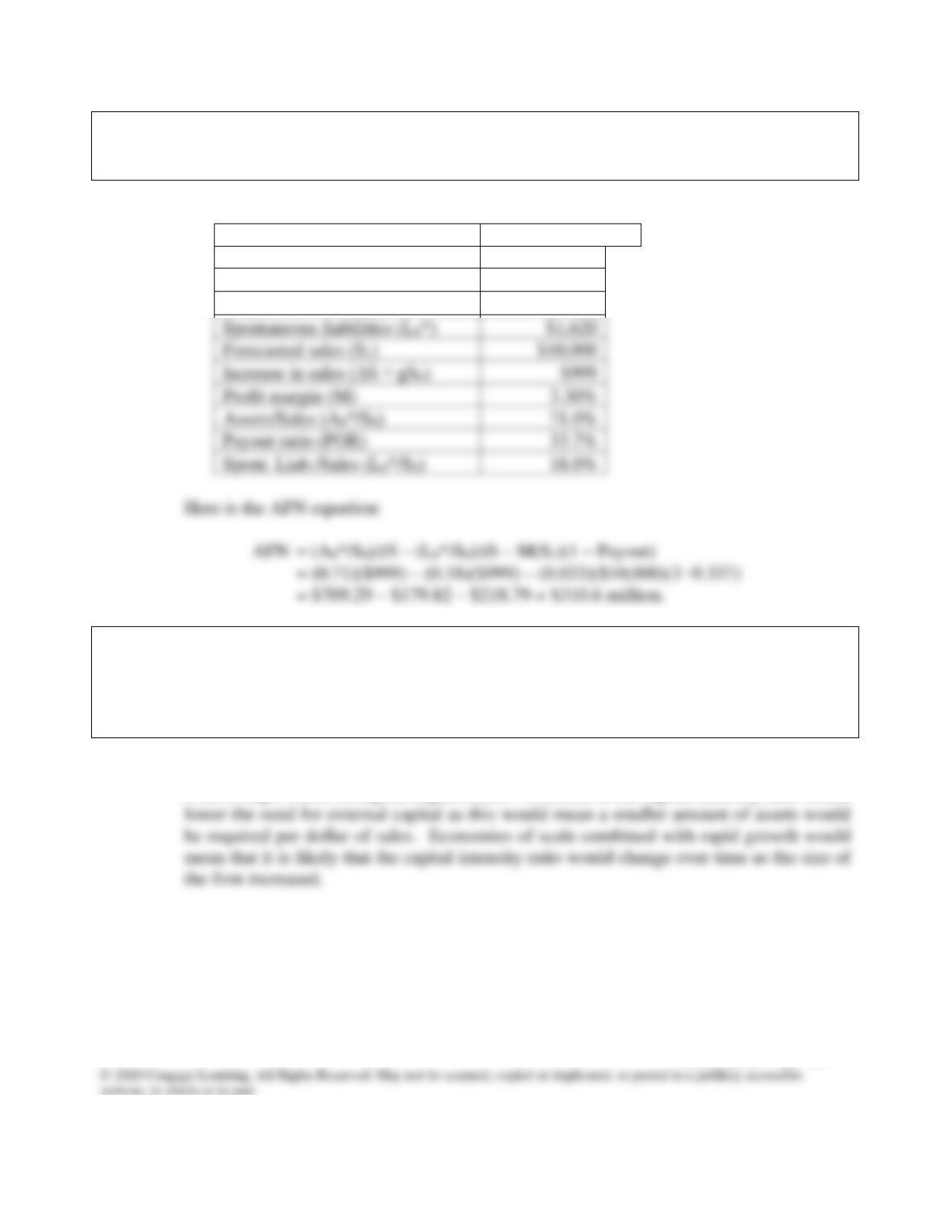
b. Use the AFN equation to estimate Hatfield’s required new external capital for 2020
if the sales growth rate is 11.1%. Assume that the firm’s 2019 ratios will remain the
same in 2020. (Hint: Hatfield was operating at full capacity in 2019.)
Answer:
Data for AFN Equation
Growth rate in sales (g)
11.1%
Sales (S0)
$9,001
Required assets (A0*)
$6,390
Spontaneous liabilities (L0*)
$1,620
Forecasted sales (S1)
Profit margin (M)
3.30%
Assets/Sales (A0*/S0)
71.0%
Payout ratio (POR)
33.7%
Spont. Liab./Sales (L0*/S0)
18.0%
c. Define the term capital intensity. Explain how a decline in capital intensity would
affect the AFN, other things held constant. Would economies of scale combined with
rapid growth affect capital intensity, other things held constant? Also, explain how
changes in each of the following would affect AFN, holding other things constant: the
growth rate, the amount of accounts payable, the profit margin, and the payout ratio.
Answer: The capital intensity ratio is the amount of assets required per dollar of sales, A0*/S0, and
it has a major effect on capital requirements. A decline in the capital intensity ratio would
Mini Case: 12- 18
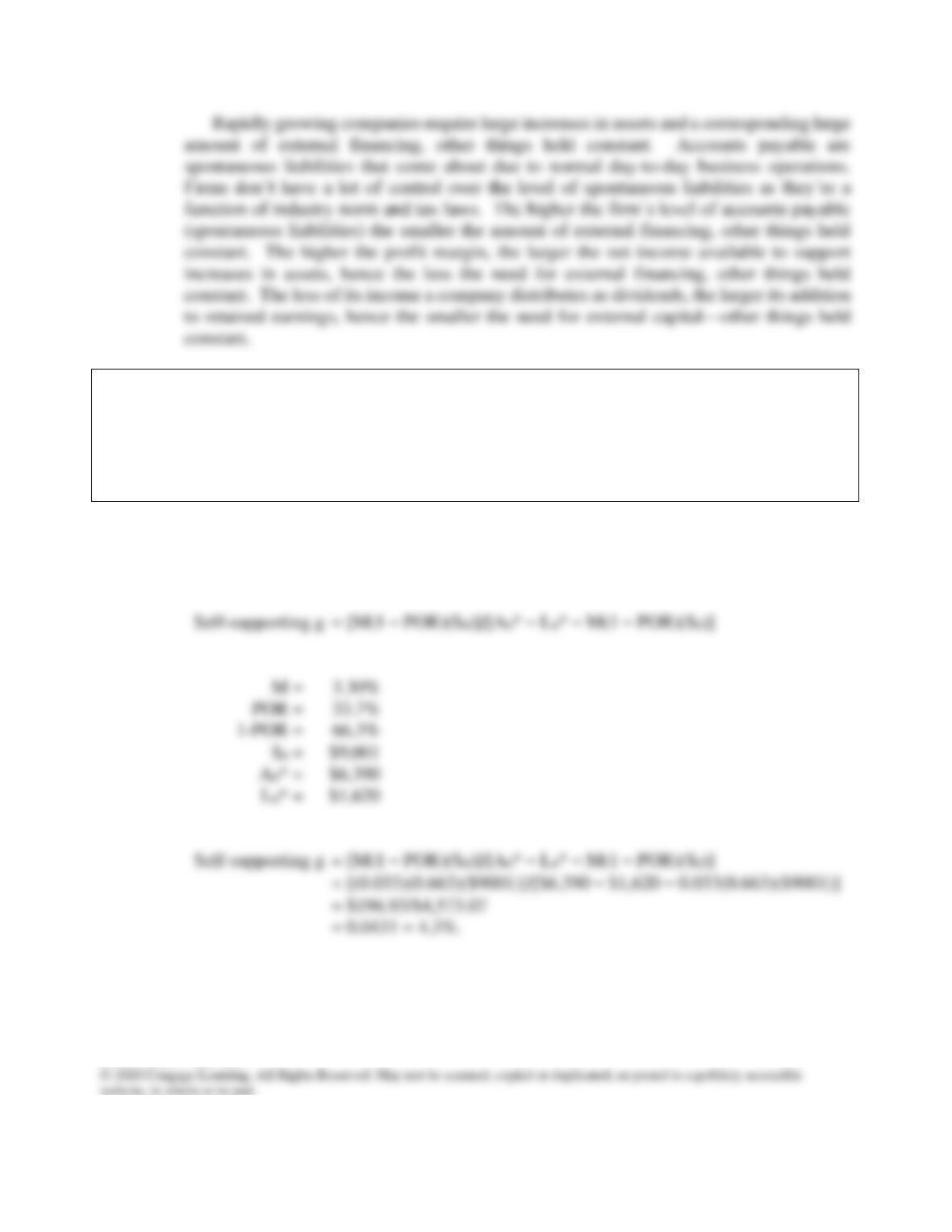
d. Define the term self-supporting growth rate. What is Hatfield’s self-supporting
growth rate? Would the self-supporting growth rate be affected by a change in the
capital intensity ratio or the other factors mentioned in the previous question? Other
things held constant, would the calculated capital intensity ratio change over time if
the company were growing and were also subject to economies of scale and/or lumpy
assets?
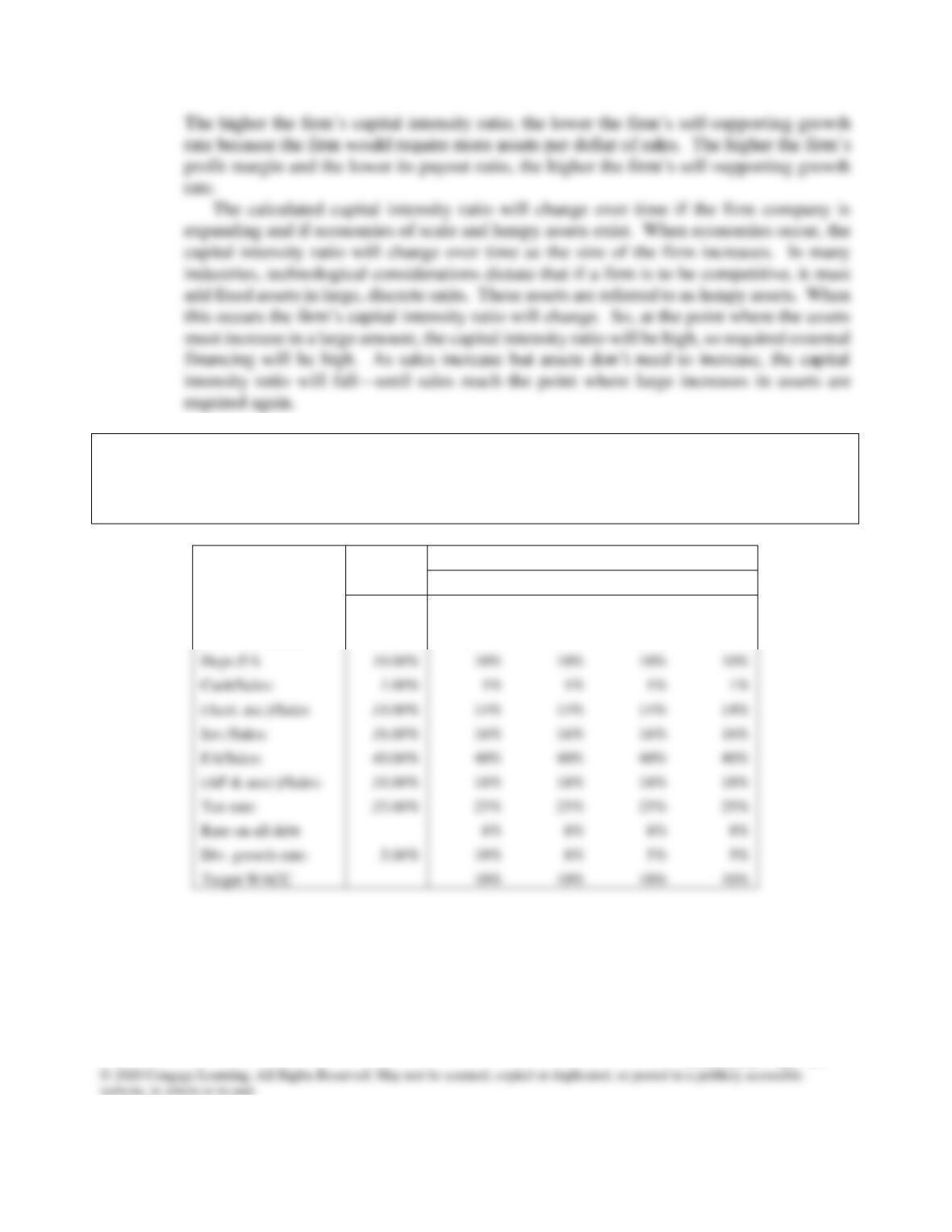
Answer: The self-supporting growth rate is the maximum growth rate the firm could achieve if it
had no access to external capital. From the data given, Hatfield’s self-supporting growth
rate is calculated as:
Mini Case: 12 – 19
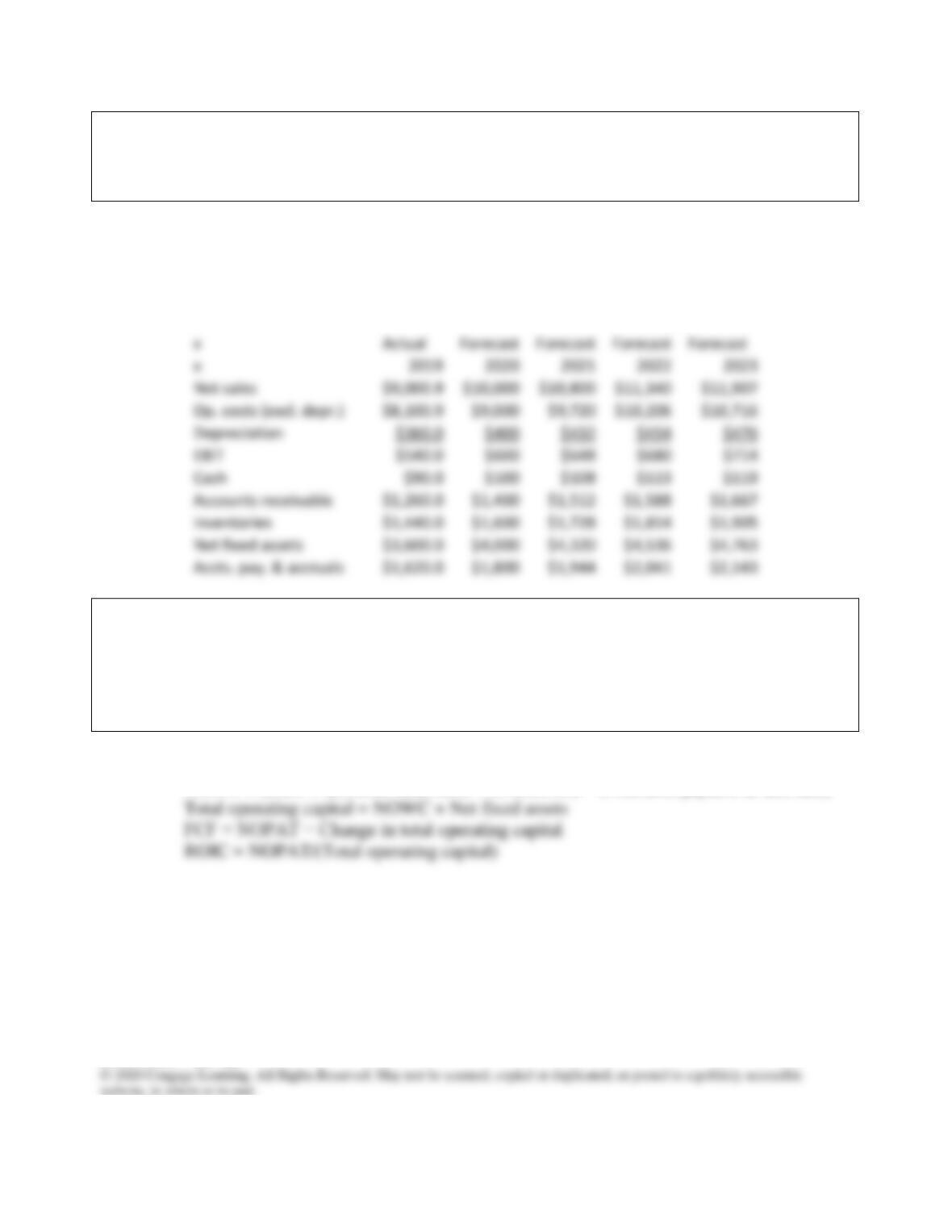
e. Use the following assumptions to answer the questions below: (1) Operating ratios
remain unchanged. (2) Sales will grow by 11.1%, 8%, 5%, and 5% for the next four
years. (3) The target weighted average cost of capital (WACC) is 10%. This is the
No Change scenario because operations remain unchanged.
Actual
Forecast
Inputs
2019
2020
2021
2022
2023
Sales growth rate:
11.1%
8%
5%
5%
(Op. costs)/Sales:
90.00%
90.0%
90%
90%
90%
Depr./FA
10.00%
10%
10%
10%
10%
Cash/Sales:
1%
1%
1%
1%
(Acct. rec.)/Sales
14.00%
14%
14%
14%
14%
Inv./Sales:
16.00%
16%
16%
16%
16%
FA/Sales:
40.00%
40%
40%
40%
40%
(AP & accr.)/Sales:
18.00%
18%
18%
18%
18%
Tax rate:
25.00%
25%
25%
25%
25%
Rate on all debt
8%
8%
8%
8%
Div. growth rate:
10%
8%
5%
5%
Target WACC
10%
10%
10%
10%
Mini Case: 12- 20
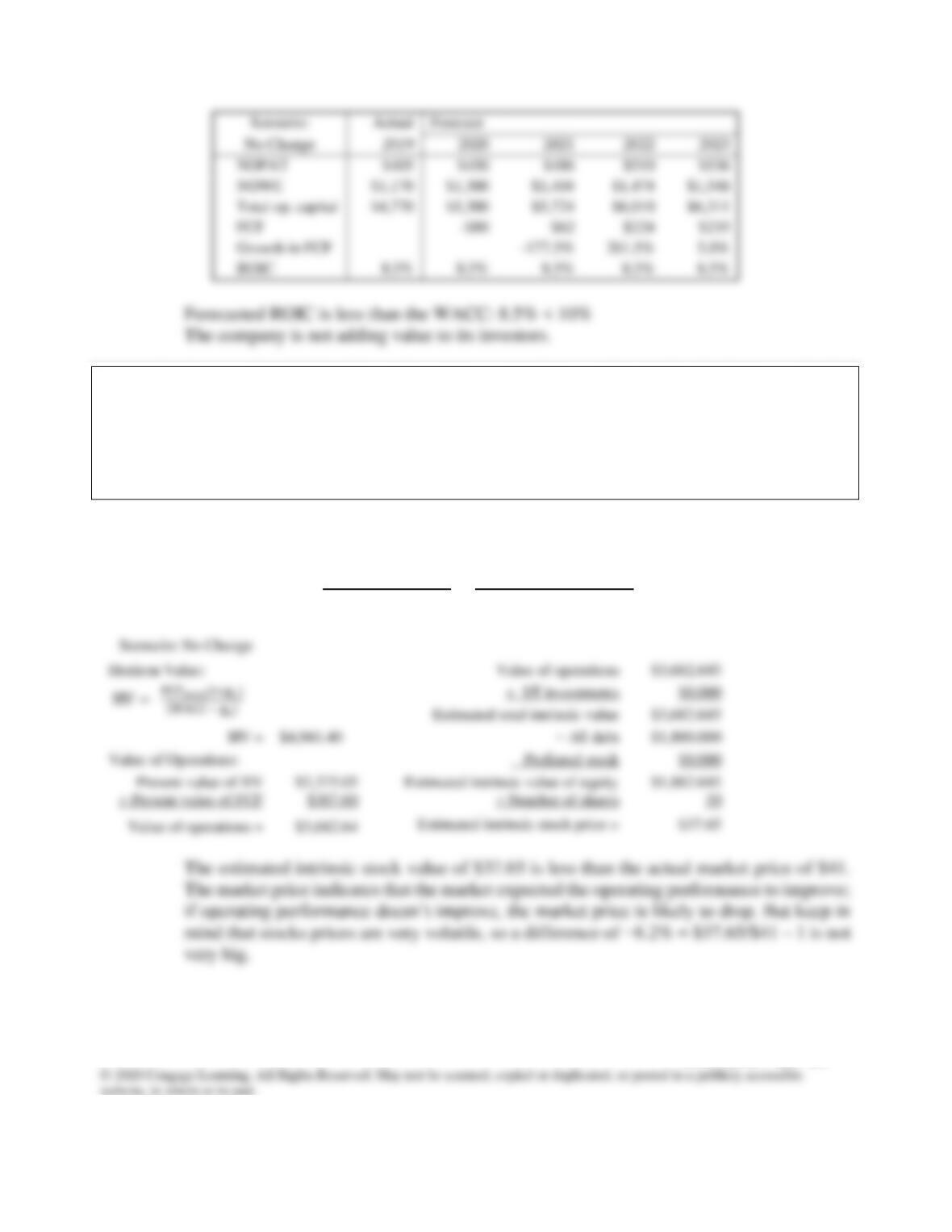
e. 1. For each of the next four years, forecast the following items: sales, cash, accounts
receivable, inventories, net fixed assets, accounts payable & accruals, operating costs
(excluding depreciation), depreciation, and earnings before interest and taxes
(EBIT).
Forecast sales as Salest = Salest-1(1+gt). For example, Sales2020 = $9,00.9(1+0.111) =
$10,000.
Forecast other items as a percent of sales (or as percent of fixed assets for
depreciation). For example, Inventories2020 = $10,000(0.16) = $1,600.
e. 2. Using the previously forecasted items, calculate for each of the next four years the
net operating profit after taxes (NOPAT), net operating working capital, total
operating capital, free cash flow, (FCF), annual growth rate in FCF, and return on
invested capital. What does the forecasted free cash flow in the first year imply about
the need for external financing? Compare the forecasted ROIC compare with the
WACC. What does this imply about how well the company is performing?
NOPAT = EBIT(1-T)
NOWC = (Cash + accounts receivable + inventories) − (Accounts payable & accruals)
Mini Case: 12 – 21
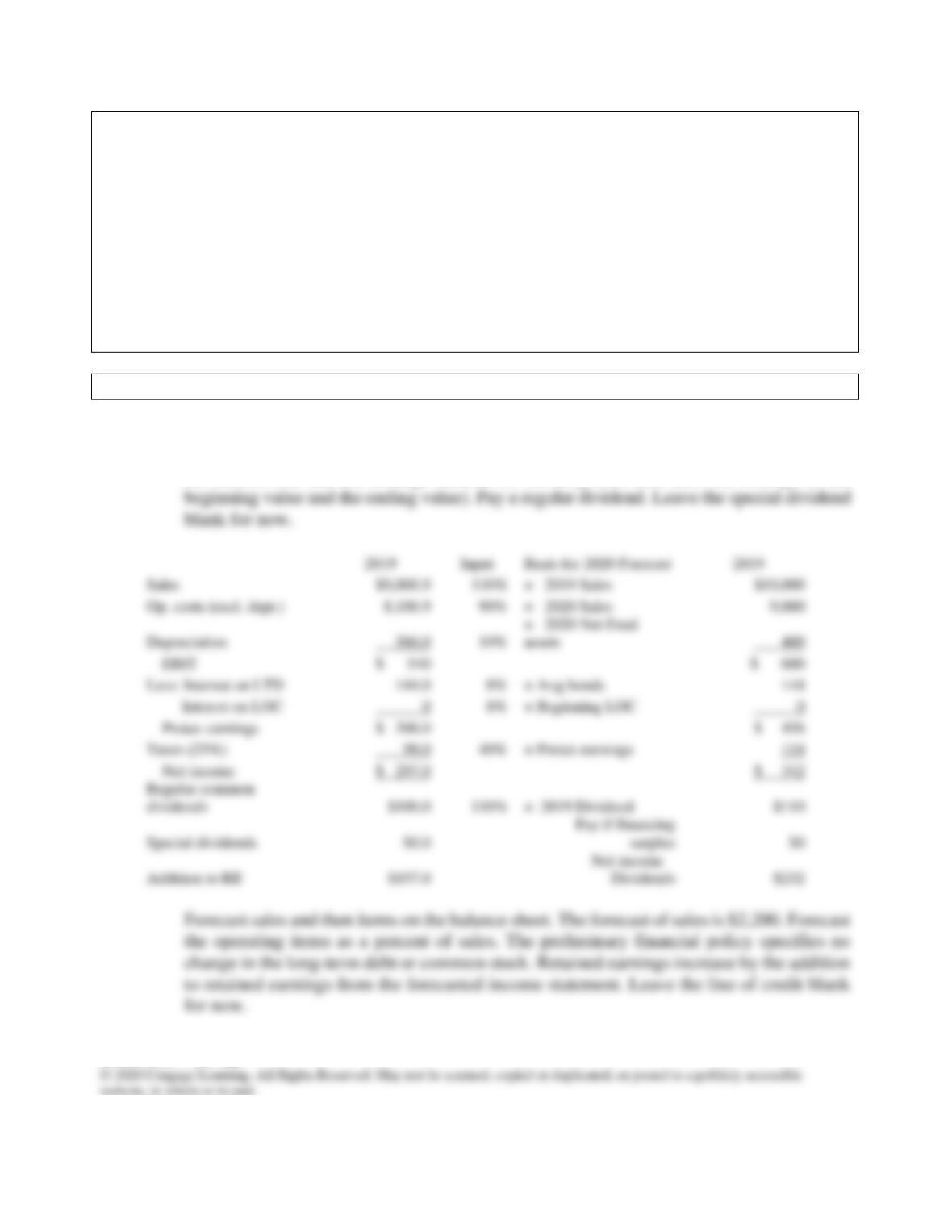
e. 3. Assume that FCF will continue to grow at the growth rate for the last year in the
forecast horizon (Hint: 5%). What is the horizon value at 2023? What is the present
value of the horizon value? What is the present value of the forecasted FCF? (Hint:
use the free cash flows for 2020 through 2023). What is the current value of
operations? Using information from the 2019 financial statements, what is the
current estimated intrinsic stock price?
With no rounding in intermediate steps, FCF2023 = $235.305.
HV2023 = FCF2023(1 + gL)
(WACC − gL)=$235.305(1 + 0.05)
(0.10 − 0.05)=$4,941.40
Mini Case: 12- 22
f. Continue with the same assumptions for the No Change scenario from the previous
question, but now forecast the balance sheet and income statements for 2020 (but not
for the following three years) using the following preliminary financial policy. (1)
Regular dividends will grow by 10%. (2) No additional long-term debt or common
stock will be issued. (3) The interest rate on all debt is 8%. (4) Interest expense for
long-term debt is based on the average balance during the year. (5) If the operating
results and the preliminary financing plan cause a financing deficit, eliminate the
deficit by drawing on a line of credit. The line of credit would be tapped on the last
day of the year, so it would create no additional interest expenses for that year. (6) If
there is a financing surplus, eliminate it by paying a special dividend. After
forecasting the 2020 financial statements, answer the following questions.
f. 1. How much will Hatfield need to draw on the line of credit?
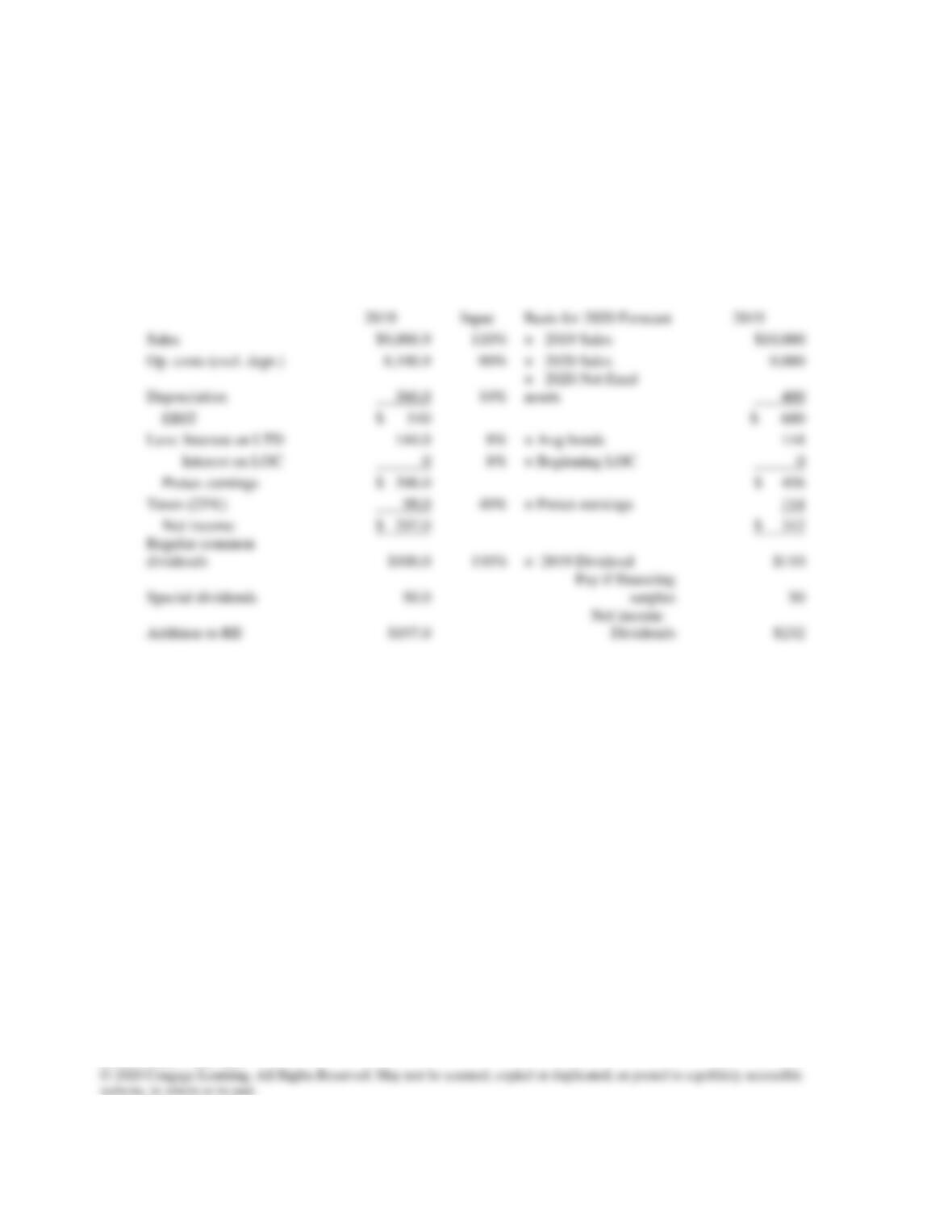
Answer: Forecast the items on the income statement. Costs are a percent of sales, depreciation is a
percent of Net PP&E. Forecast interest expense on the long-term debt as the product of
the interest rate and the average balance on the long-term debt (i.e., the average of the
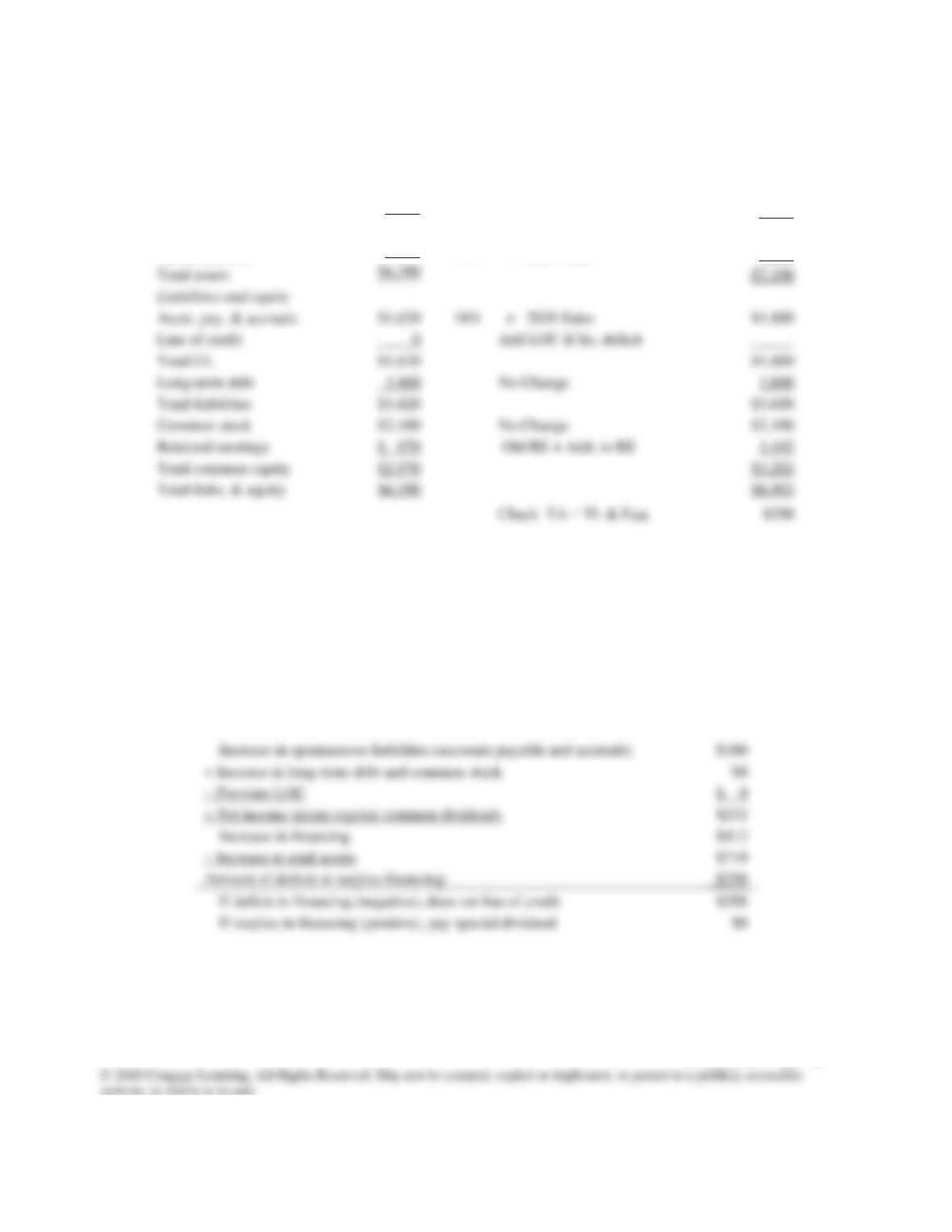
Mini Case: 12 – 23
Assets
2019
Input
Basis for 2020 Forecast
2020
Cash
$ 90
1%
× 2020 Sales
$ 100
Accts. rec.
1,260
14%
× 2020 Sales
1,400
Inventories
1,440
16%
× 2020 Sales
1,600
Total CA
$2,790
$3,100
Net fixed assets
3,600
40%
× 2020 Sales
4,000
Total assets
$6,390
$7,100
Liabilities and equity
Accts. pay. & accruals
18%
× 2020 Sales
$1,800
Line of credit
Add LOC if fin. deficit
Total CL
$1,800
Total liabilities
$3,600
Common stock
No Change
$2,100
Retained earnings
Old RE + Add. to RE
1,102
Total common equity
$3,202
Total liabs. & equity
$6,802
$298
The next step is to identify the financing surplus or deficit. Start with the additions to
operating assets, subtract the increase in spontaneous liabilities (accounts payable and
accruals), subtract any new external financing from long-term debt or common stock,
subtract the previous LOC (because the preliminary financial plan does not call for any
LOC so the outstanding balance must be repaid), and subtract the amount of reinvested
net income (the amount that is not paid out in common dividends). The result is the
financing deficit (if it is negative) or the financing surplus (if it is positive). If there is a
deficit, draw on the LOC. If there is a surplus, pay a special dividend.
+ Increase in long-term debt and common stock
+ Net income minus regular common dividends
Amount of deficit or surplus financing:
Mini Case: 12- 24
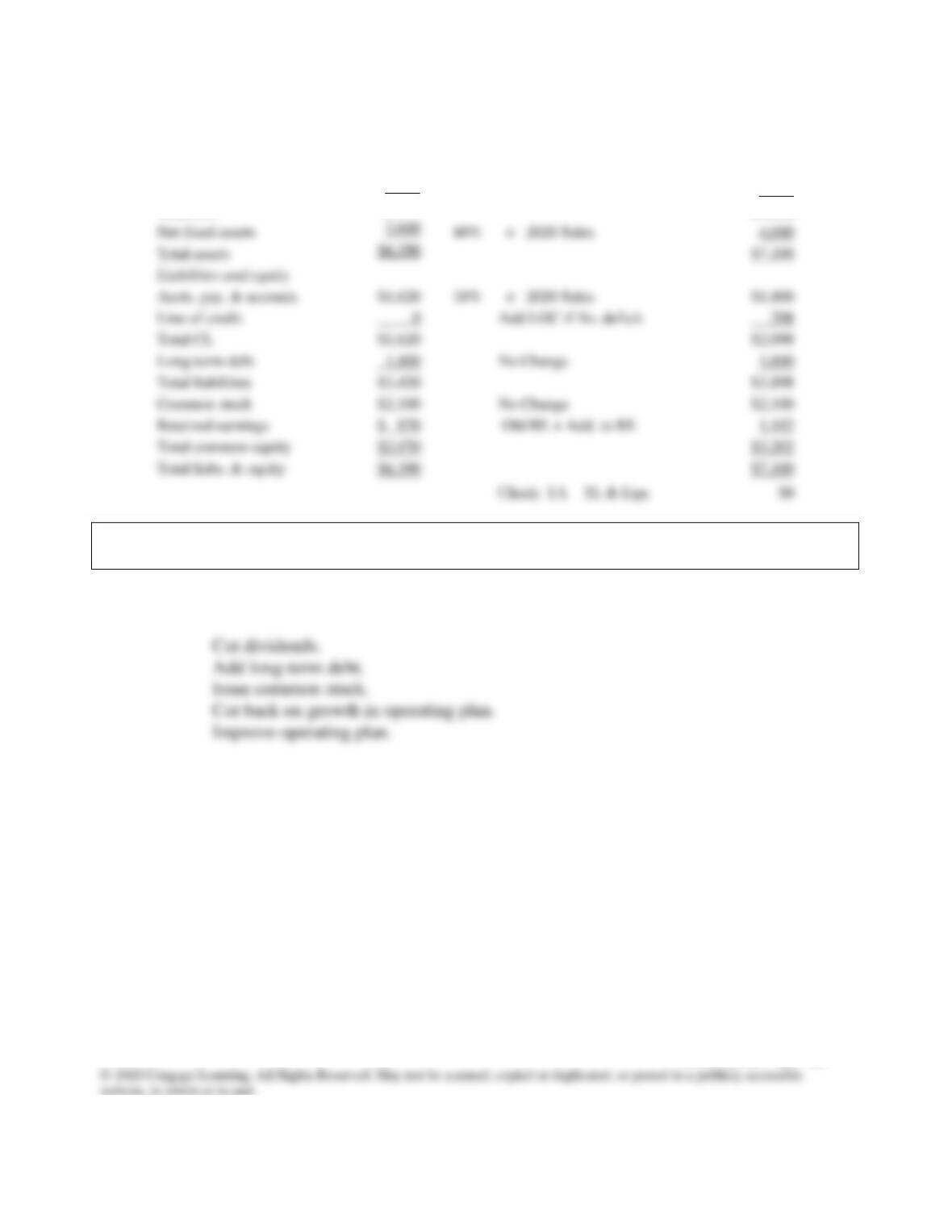
There is a deficit of $298, so update the balance sheets by adding $59 to the line of
credit. Because the LOC is added at the end of the year, there is no additional interest, so
there is no need to update the income statement. If the LOC were instead added earlier in
the year, there would be additional interest, which would cause lower net income, which
would cause a lower addition to retained earnings, which would cause a bigger financial
deficit. This is called financing feedback. See Ch12 Tool Kit.xls and look at the
worksheet CFO Model for a simple way to resolve financing feedback and for an
extension of the 1-year forecasted financial statements to multiple years.
Mini Case: 12 – 25
Assets
2019
Input
Basis for 2020 Forecast
2020
Cash
$ 90
1%
× 2020 Sales
$ 100
Accts. rec.
1,260
14%
× 2020 Sales
1,400
Inventories
1,440
16%
× 2020 Sales
1,600
Total CA
$2,790
Net fixed assets
3,600
40%
× 2020 Sales
4,000
Total assets
$6,390
$7,100
Accts. pay. & accruals
18%
× 2020 Sales
$1,800
Line of credit
Add LOC if fin. deficit
Total CL
$2,098
Long-term debt
No Change
1,800
Common stock
No Change
$2,100
Retained earnings
Old RE + Add. to RE
1,102
Total common equity
$3,202
Total liabs. & equity
$7,100
$3,100
f. 2. What are some alternative ways than those in the preliminary financial policy that
Hatfield might choose to eliminate the financing deficit?
Answer: Here are some alternative ways to eliminate the deficit:
Mini Case: 12- 26
g. Repeat the analysis performed in the previous question, but now assume that
Hatfield is able to improve the following inputs: (1) Reduce operating costs
(excluding depreciation) to sales to 89.4% at a cost of $40 million. (2) Reduce
inventories/sales to 14% at a cost of $10 million. (3) Reduce net fixed assets/sales to
38% at a cost of $20 million. This is the Improve scenario.
Answer: The impact on the operating plan is shown below:
Scenario:
Actual
Forecast
Improve
2019
2020
2021
2022
2023
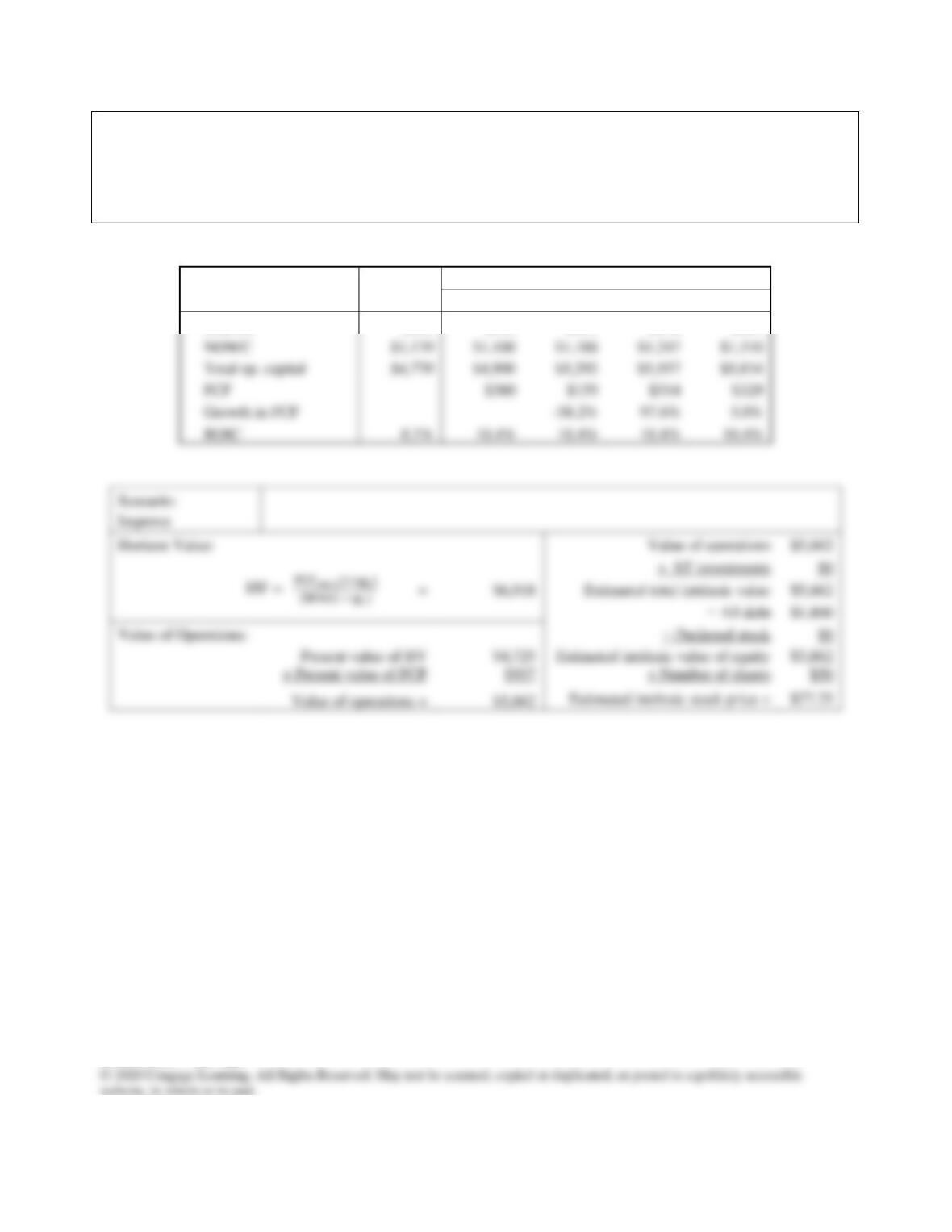
NOPAT
$405
$510
$551
$578
$607
NOWC
Total op. capital
FCF
$380
$159
$314
$329
Growth in FCF
ROIC
Scenario:
Horizon Value:
Value of Operations:
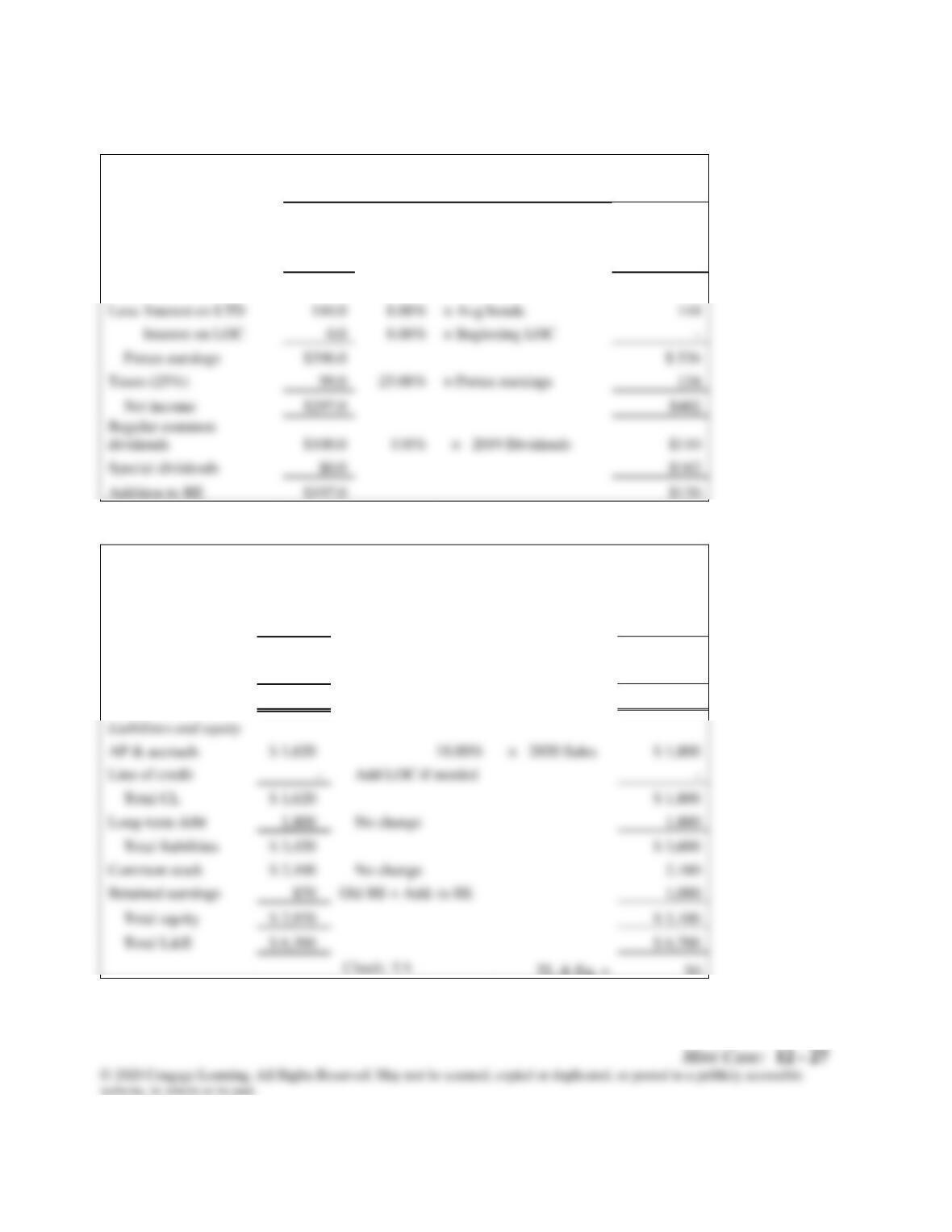
The impact on the financial statements is shown below.
Scenario: Improve
Income Statement
2019
Input
Basis for 2020 Forecast
2020
Sales
$9,000.9
1.111
× 2019 Sales
$10,000
Op. costs (excl. depr.)
8,100.9
89.4%
× 2020 Sales
8,940
Depreciation
360.0
10.00%
× 2020 Net FA
380
EBIT
$540.0
$680
Less: Interest on LTD
144.0
8.00%
× Avg bonds
144
Interest on LOC
8.00%
× Beginning LOC
Pretax earnings
$396.0
Taxes (25%)
99.0
25.00%
× Pretax earnings
134
Net income
$297.0
$402
dividends
$100.0
× 2019 Dividends
Special dividends
$0.0
Addition to RE
$197.0
Assets
2019
Forecast Basis
2020
Cash
$ 90
1.00%
× 2020 Sales
$ 100
Accts. rec.
1,260
14.00%
× 2020 Sales
1,400
Inventories
1,440
14.00%
× 2020 Sales
1,400
Total CA
$ 2,790
$ 2,900
Net fixed assets
3,600
38.00%
× 2020 Sales
3,800
Total assets
$ 6,390
$ 6,700
Liabilities and equity
$ 1,620
18.00%
× 2020 Sales
$ 1,800
Line of credit
–
Add LOC if needed
Total CL
$ 1,620
$ 1,800
Long-term debt
1,800
No change
1,800
Total liabilities
$ 3,420
$ 3,600
Common stock
$ 2,100
No change
2,100
Retained earnings
870
Old RE + Add. to RE
1,000
Total equity
$ 2,970
$ 3,100
Total L&E
$ 6,390
$ 6,700
TL & Eq. =
$0
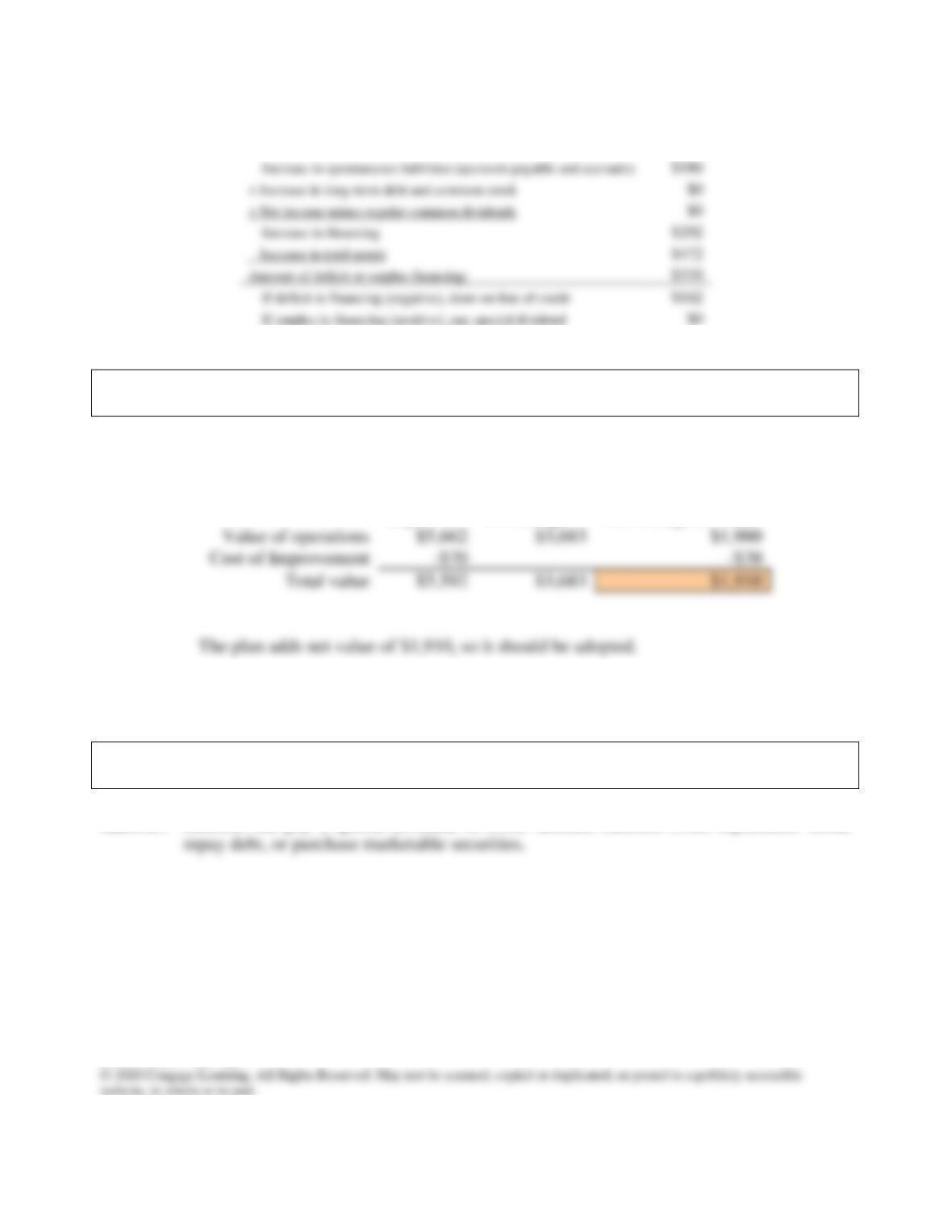
Mini Case: 12- 28
g. 1. Should Hatfield implement the improvement plan? How much value would it add to
the company?
Answer:
Improve
No Change
Net Change in Value
g. 2. How much can Hatfield pay as a special dividend in the Improve Scenario? What else
might Hatfield do with the financing surplus?
Answer: Hatfield can pay a special dividend of $162. Instead, Hatfield could repurchase stock,