Build a Model Problem 11/26/18
Chapter: 12
Problem: 11
2019
Net Sales 800.0$
Costs (except depreciation) 576.0$
Depreciation 60.0$
Assets 2019 Liabilities and Equity 2019
Cash 8.0$ Accounts Payable 16.0$
Short-term investments 20.0 Notes payable 40.0
Accounts receivable 80.0 Accruals 40.0
Total current assets 268.0$ Long-term bonds 300.0$
Inputs Actual Projected Projected Projected Projected
12/31/2019 12/31/20 12/31/21 12/31/22 12/31/23
Sales Growth Rate 15% 10% 6% 6%
Costs/Sales 72% 72% 72% 72% 72%
Depreciation/(Net PPE) 10% 10% 10% 10% 10%
(Acct. Rec.)/Sales 10% 10% 10% 10% 10%
Note to authors. Change income statement and
balance sheets to be values (not formulas) when
doing problem for students.
Start with the partial model in the file Ch12 P11 Build a Model.xlsx on the textbook’s Web site, which contains
Henley Corporation’s most recent financial statements. Use the following ratios and other selected information
for the current and projected years to answer the next questions.
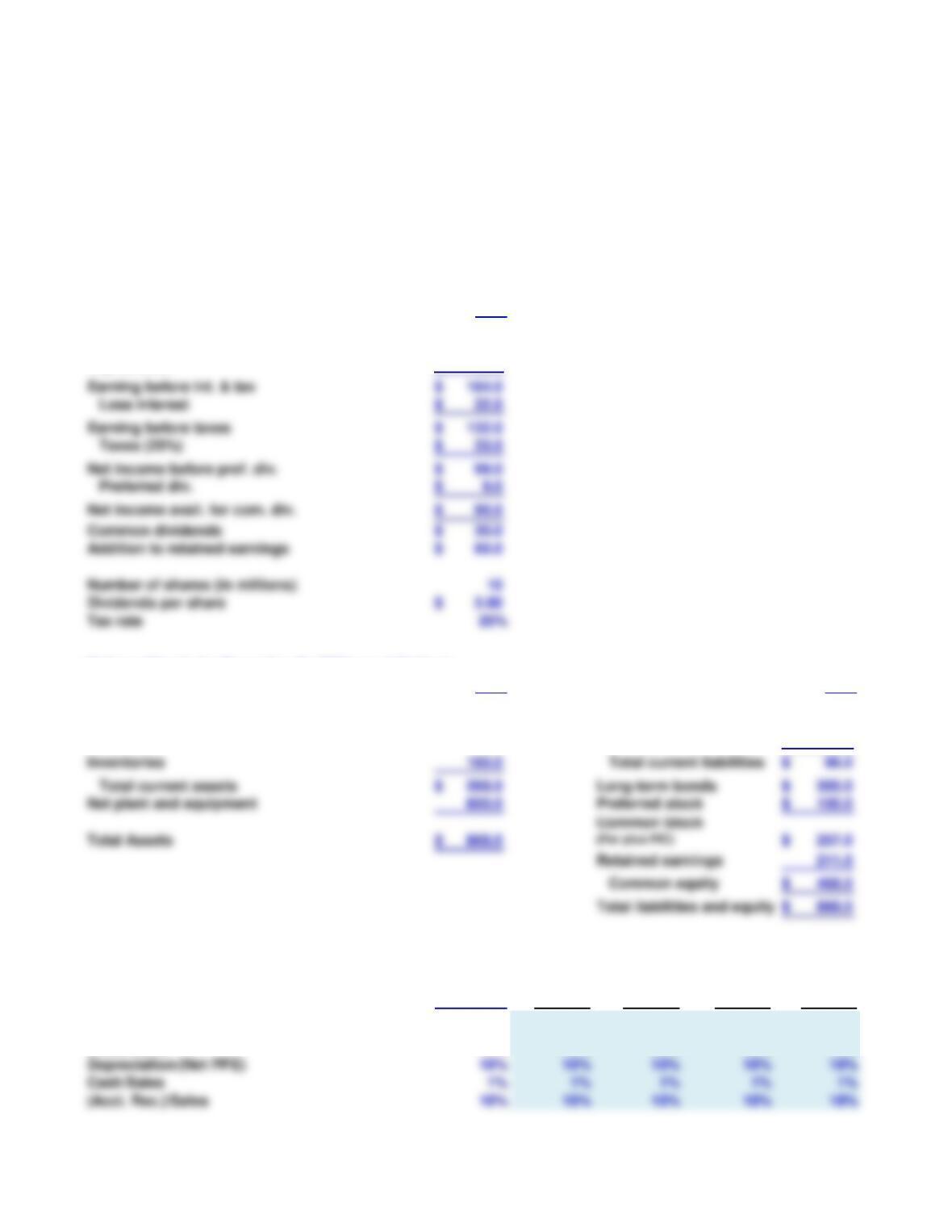
Income Statement for the Year Ending December 31 (Millions of Dollars)
Balance Sheets for December 31 (Millions of Dollars)
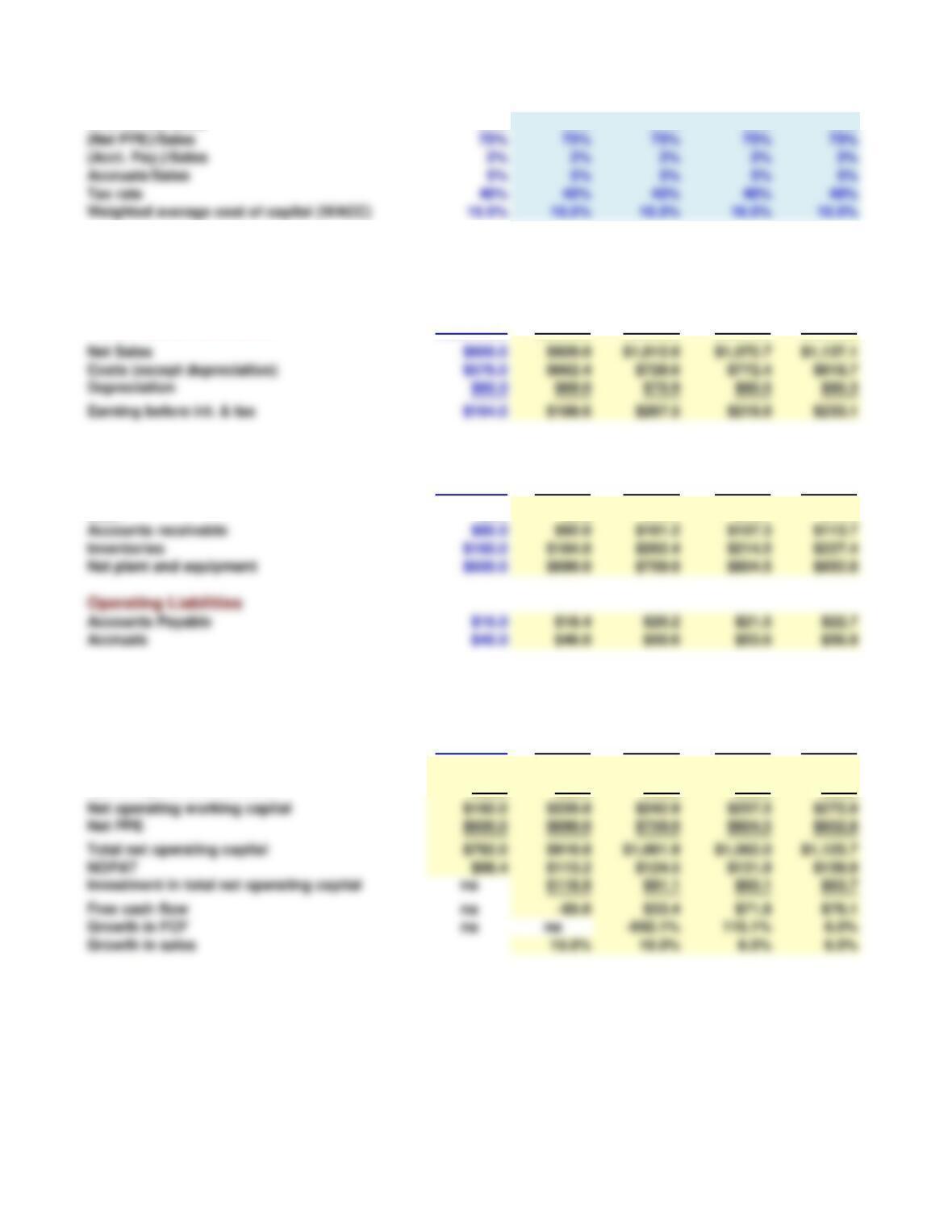
Projected ratios and selected information for the current and projected years are shown below.
Earning before int. & tax 164.0$
Less interest 32.0$
Earning before taxes 132.0$
Taxes (25%) 33.0$
Net income before pref. div. 99.0$
Preferred div. 9.0$
Dividends per share 3.00$
Tax rate 25%
Inventories/Sales 20% 20% 20% 20% 20%
Actual Projected Projected Projected Projected
Income Statement Items 12/31/2019 12/31/20 12/31/21 12/31/22 12/31/23
Actual Projected Projected Projected Projected
Operating Assets 12/31/2019 12/31/20 12/31/21 12/31/22 12/31/23
Cash $8.0 $9.2 $10.1 $10.7 $11.4
Operating Liabilities
Actual Projected Projected Projected Projected
Calculation of FCF 12/31/2019 12/31/20 12/31/21 12/31/22 12/31/23
Operating current assets $248.0 $285.2 $313.7 $332.5 $352.5
Operating current liabilities $56.0 $64.4 $70.8 $75.1 $79.6
Net PPE $600.0 $690.0 $759.0 $804.5 $852.8
Investment in total net operating capital na $118.8 $91.1 $60.1 $63.7
Partial Income Statement for the Year Ending December 31 (Millions of Dollars)
Partial Balance Sheets for December 31 (Millions of Dollars)
a. Forecast the parts of the income statement and balance sheets necessary to calculate free cash flow.
b. Calculate free cash flow for each projected year. Also calculate the growth rates of free cash flow each
year to ensure that there is constant growth (i.e., the same as the constant growth rate in sales) by the end of
the forecast period.
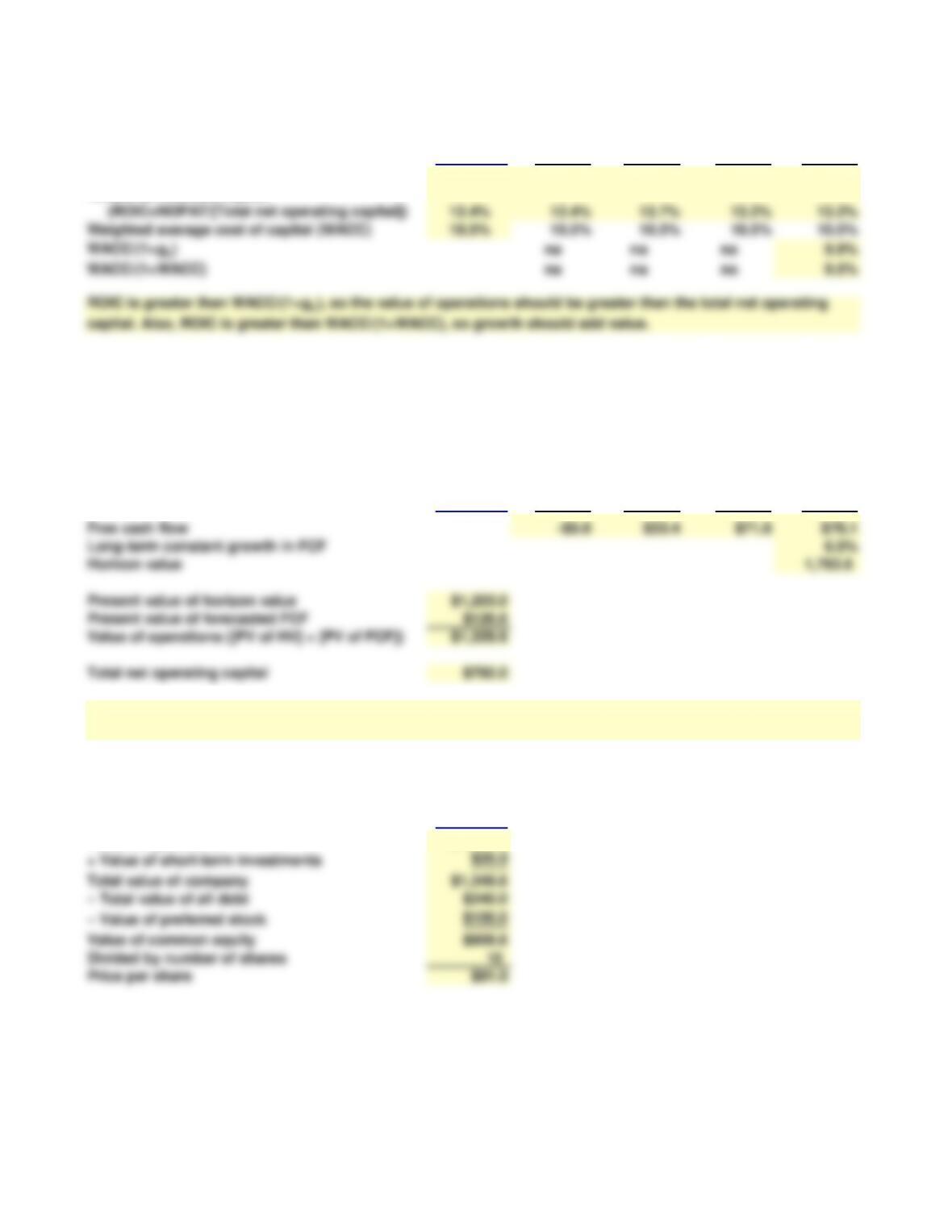
c. Calculate the return on invested capital (ROIC=NOPAT/Total net operating capital) and the growth rate in
free cash flow. What is the ROIC in the last year of the forecast? What is the long-term constant growth rate in
free cash flow (gL is the growth rate in FCF in the last forecast period because all ratios are constant)? Do you
think that Hensley‘s value would increase if it could add growth without reducing its ROIC? (Hint: Growth will
add value if the ROIC > WACC/[1+WACC]). Do you think that the company will have a value of operations
greater than its total net operating capital? (Hint: Is ROIC > WACC/[1+gL]?)
Actual Projected Projected Projected Projected
12/31/2019 12/31/20 12/31/21 12/31/22 12/31/23
Return on invested capital
Weighted average cost of capital (WACC) 10.5%
Actual Projected Projected Projected Projected
12/31/2019 12/31/20 12/31/21 12/31/22 12/31/23
Long-term constant growth in FCF 6.0%
Horizon value 1,793.6
Present value of horizon value $1,203.0
Present value of forecasted FCF $126.6
Value of operations (]PV of HV] + [PV of FCF]) $1,329.6
Total net operating capital $792.0
Millions except price per share Actual
12/31/2019
Value of operations $1,329.6
Total value of company $1,349.6
Value of common equity $909.6
Price per share $91.0
e. Calculate the price per share of common equity as of 12/31/2019
d. Calculate the current value of operations. (Hint: First calculate the horizon value at the end of the forecast
period, which is equal to the value of operations at the end of the forecast period. Assume that the annual
growth rate beyond the horizon is equal to the growth rate at the horizon.) How does the current value of
operations compare with the current amount of total net operating capital?
The value of operations is greater than the total net operating capital because the ROIC is greater than
WACC/(1+gL).
Weighted average cost of capital (WACC) 10.5% 10.5% 10.5% 10.5% 10.5%
WACC/(1+gL)na na na 9.9%