322
Chapter 12 Capital Structure
Chapter Overview
The Opening Focus looks at the two debt issues by two different companies and how the financial
credibility of the firm can affects its capital structure. It tells the story of Target’s, the world’s sec-
Opening Focus Discussion Questions
1. Of the most admired companies, Target has not typically had a high level of debt. How does
this increase in debt change their risk status to investors and creditors?
2. According to Yahoo Finance, Target has a total debt to equity ratio of 116.56 as of October 12,
2011. What does this mean for investors? For creditors?
This chapter discusses:
12-1 What is Financial Leverage?
Technology
2. Smart Concepts animation provides a step-by-step explanation of Miller and Modigliani’s
Proposition I and II.
4. Smart Practices Video features Keith Woodward, vice president of finance for General Mills,
as he discusses his company’s concerns with optimal capital structure.
5. Smart Solutions animation provides a step-by-step solution to Problem P12-7 about applying
the Miller and Modigliani theory.
Lecture Guide
No one has been able to develop a single theory that explains a firm’s optimal capital struc-
ture capital structure is still considered to be a puzzle, with competing theories explaining pieces of
the puzzle. Each theory partially explains capital structure choice, and the theories are not mutual-
ly exclusive.
Chapter 12 Capital Structure 323
Table 12.1: 2011 Long-term Debt to Asset Ratios
12-1 What is Financial Leverage and What Are Its Effects?
Increasing financial leverage can be good for the firm or can force the firm into bankrupt-
cy. The instructor could illustrate this with an example that may be familiar to students, one that at
Table 12.2: Current and Proposed Capital Structures for High-Tech Manufacturing Corpo-
ration
Table 12.3: Expected Cash Flows to Stockholders and Bondholders Under the Current and
Proposed Capital Structures for High-Tech Manufacturing Corporation
Table 12.4: Expected Cash Flows to Stockholders and Bondholders Under the Current and
Proposed Capital Structures for High-Tech Manufacturing Corporation for Three Equally
Likely Outcomes
Section Example: Current and Proposed Capital Structure for HTMC
This section takes a company through a more complex decision than the homeowner had in the
previous example. The firm is considering going from no debt to 50% debt.
• Return on Equity
o As with the homeowner who borrows, the firm expects a considerably higher ROE
• Cash Flows if Economy Experiences Normal Growth
o Note that ROE and EPS are both higher for the firm under the debt scenario. This
324 Instructor’s Manual
• Cash Flows if Economy Experiences Recession or Boom
o This numerically illustrates the upside and downside of financial leverage. If the
12-1a How Leverage Increases the Risk of Expected Earnings per Share
Figure 12.1: The Effect of Debt on the Volatility of Earnings
This EBIT-EPS graph paints a picture of the numbers in the previous example. If the firm
12-1bThe Fundamental Principle of Financial Leverage
Substituting long-term debt for equity in a company’s capital structure increases both the
12-1c Leverage Increases Expected Return but Does It Increase Value?
Note that the market value of the firm has not changed – the stock price is the same under
12-2 The Modigliani and Miller Propositions
The value of the firm is the discounted sum of its future expected cash flows. The cash
flows it can expect from the projects it selects are important, along with the firm’s risk. The higher
the risk, the higher the discount rate applied to those cash flows and the lower the firm value. The
Chapter 12 Capital Structure 325
12-2a M&M Proposition I: Capital Structure Irrelevance
For HTCM, under the all-equity scenario, the cash flow to equity holders is $1,000,000.
(Net income = EBIT – interest of $0 minus taxes of $0). The value of the firm, assuming a perpe-
12-2b M&M Proposition II: How Increasing Leverage Affects the Cost of Equity
Proposition II states that equity holders require a higher return than debtholders. While this is
seen everyday, it is important to remember.
• Student Involvement: Ask students why shareholders demand a higher return for a levered
firm? Most will recognize that debt places equity holders further behind in their claim on
the firm’s assets. Without a tax benefit, WACC remains constant as leverage increases.
The cost of equity increases as firms substitute debt for equity, but WACC stays the same.
Figure 12.2: M&M Proposition II Illustrated—The Cost of Equity, Cost of Debt, and
Weighted Average Cost of Capital for a Firm in a World Without Taxes
This graph illustrates that WACC is independent of capital structure. Since WACC is the
12-c Does Debt Policy Matter?
M&M asserts that capital structure does not matter but is that necessarily true in the mar-
Figure 12.3: Do Firms Have Target Capital Structures?
12.3 M&M Capital Structure Model with Taxes
Most will agree that the M&M assumptions are very unrealistic and can apply only in theo-
ry. However, the benefit of M&M is that if capital structure matters – and it does matter – then
Table 12-5 Cash Flows to Stockholders and Bondholders Under the Current and Proposed
Capital Structure for HTMC—with Corporate Taxation
326 Instructor’s Manual
12-3a Example of Model of Capital Structure, without Corporate Income Taxes
Use circles as an illustration to show students that firm size is fixed. If you show two circles
representing the firm with debt and without debt – both circles would be the same size, regardless
of the capital structure. This is because the size of the firm is fixed. It is fixed because M&M as-
sume that the firm’s investment policy is fixed. Optimal investment policy is to accept all positive
discounted back to the present using the after-tax cost of debt as the discount rate.
• Student Interaction: Ask students whether long term or short term debt is riskier, and to
whom. Most will say that short-term debt is safer for the lender (better able to predict
short term than long term inflation) and riskier to the company (more of a possibility that
their investment projects will not have returned enough money to pay back the debt). Most
companies would prefer to borrow long and lenders to lend short. This leads to the typical
upward sloping yield curve – that long term debt is riskier to the lender who in turn de-
mands an extra premium to compensate for that risk.
There are significant tax benefits to debt. A 2000 Graham study found that the tax benefits of
changes to the tax code, making it difficult for companies to plan for the future.
12-3b Determining the Present Value of Interest Tax Shields
12-3c The M&M Model with Corporate and Personal Taxes
M&M’s tax case yields an equally unrealistic result – that firm’s would want to have 100%
debt in the capital structure. No firm could be all debt, so there must be other reasons to explain
this. The existence of personal tax is one explanation.
Chapter 12 Capital Structure 327
• Example: Miller (1977) and the Gain from Leverage
o Concerning personal taxes, note that it is possible for a situation to develop in
which M&M are correct that capital structure doesn’t matter. However, with cur-
rent U.S. tax laws this is not the case. There still is a benefit to corporate debt fi-
nancing. You can illustrate this with a numerical example. Using equation in the
Figure 12.4: Pie Chart Models of Capital Structure With and Without Corporate Income
Taxes
12-4 The Trade-Off Model of Capital Structure
12-4a Costs of Bankruptcy and Financial Distress
Three executives just finished lunch and were arguing over the bill. “I want it,” said the
first. “I’ll write it off my taxes.” The second exec said, “No. I’ll take it. I’ll charge it to my ex-
pense account. “No. No,” the third exec said. “I’ll pay. I’m filing for bankruptcy tomorrow.”
328 Instructor’s Manual
has an incentive to take on money losing and potentially negative NPV projects during bankruptcy.
A real world example of asset substitution is in the Eastern Airlines bankruptcy. A Weiss and
Wruck study (“Information Problems, Conflicts of Interest and Asset Stripping: Chapter 11’s Fail-
ure in the Case of Eastern Airlines”) said that Eastern lost 50% of its value during its Chapter 11
in DIP financing, enough for it to continue operations for the rest of 2002.
12-4b Agency Costs and Capital Structure
Note that bondholders will control management’s propensity to transfer wealth from bond-
holders to shareholders through restrictive covenants. An example of a real world wealth transfer,
made by a non-distressed firm, is Marriott Corporation. Marriott Corp. spun off its hotel manage-
ment operations into Marriott International, and left the real estate company remainder, Host Mar-
12-4c The Trade-off Model Revisited
The static trade-off model expands the M&M model, noting that while debt increases in-
come per shareholder, it comes with a cost, in particular higher bankruptcy and agency costs.
There is some empirical support for this theory – firms will lever up to a certain amount, and then
when they, or the external markets, consider them to be too risky, they will no longer take on debt.
Figure 12-5: Trade-off Model of Corporate Leverage
12-5 The Pecking Order Theory
There have been several irregularities identified with the trade off model. A number of re-
lationships between firm value, leverage and factors influencing leverage have been documented.
Chapter 12 Capital Structure 329
firm faces. Insider share ownership and managerial entrenchment are indicators of potential agen-
cy costs.
o Student Involvement: Students can look for examples of which industries and firms are
12-5a Assumptions Underlying the Pecking Order Theory
Figure 12-6: What Factors Do U.S. Consider When Choosing Debt Policy?
12-5b Evidence on Pecking-Order and Trade-Off Theories
Capital Structure, Summary
Corporations’ use of bank financing vs. capital markets may also be a factor. If your class
includes international students, this is a good opportunity to bring them into the discussion, asking
what factors might influence capital structures among companies in their countries.
Ch. 12 Resource Articles
“Debt is Good for You,” The Economist, January 27, 2001. This article talks about M&M’s theo-
ry as they apply to corporations. It notes that the current theories don’t do a very good job of ex-
plaining firms’ behavior.
Enrichment Exercises
Break students into groups, each with a question to answer about capital structure theory. Ask each
group to report back to the class. Some suggested questions are:
1. What would happen if Congress increased the tax rate on personal income?
2. What would happen if Congress increased the tax rate on corporate income?
3. What would happen if Congress increased the amount of government debt outstanding?
4. What would happen if a company’s deductions increased for depreciation?
330 Instructor’s Manual
5. What would happen if a company’s deductions increased because of greater tax loss carryfor-
wards?
6. What if the tax structure were simplified to a straight tax system, would this change corporate
behavior toward capital structure?
Answers to Concept Review Questions
1. A recapitalization occurs when a company changes the mix of debt and equity in its capital
structure—leaving total capitalization unchanged. The most common practice is for a company
2. The fundamental principle of financial leverage says that substituting long-term debt for equity
in a company’s capital structure increases both the level of expected returns to shareholders—
3. M&M Propositions I and II both support the conclusion that capital structure doesn’t matter.
Proposition I states that firm value stays the same at every level of capital structure. Proposi-
tion II supports I by allowing a new cost of equity to be calculated as debt is added to the capi-
4. Levered equity means equity in a company that also uses debt financing. Unlevered equity is
5. Accounting for corporate income taxes negates the M&M capital structure irrelevance hypoth-
esis, and instead gives firms an incentive to use “maximum leverage.” Interest payments are a
6. By reducing the effective personal tax rate on equity income (TPS), the Jobs and Growth Tax
7. Direct costs of bankruptcy are out-of-pocket cash expenses directly related to bankruptcy filing
and administration. Document printing and filing expenses, as well as professional fees paid to
lawyers, accountants, investment bankers, and court personnel are all examples of direct bank-
ruptcy costs. These costs can run to several million dollars per month for complex cases. How-
8. The car owner has no incentive to invest in preventive maintenance if he/she expects the bank
9. This problem did occur with savings and loans during the real estate crisis in the late 1980s.
Banks, needing to increase their returns partially because of losses on loans, had the incentive
10. Managers could justify perks on the grounds that the perks make them more productive. For
example, the CEO’s time is very valuable. It might be better spent on a private company jet
11. High tech companies are young, risky and high growth. These are the types of companies that
will finance with more equity and less debt. Lenders are unwilling to risk large amounts of
12. Almost every published empirical study shows that stock prices rise when a company an-
nounces leverage-increasing events, such as debt-for-equity exchange offers, debt-financed
Solutions to Self-Test Problems
ST12-1. As Chief Financial Officer of the Uptown Service Corporation (USC), you are consider-
ing a recapitalization plan that would convert USC from its current all-equity capital
structure to one including substantial financial leverage. USC now has 150,000 shares of
common stock outstanding, which are selling for $80.00 each. The recapitalization pro-
posal is to issue $6,000,000 worth of long-term debt at an interest rate of 7.0 percent and
use the proceeds to repurchase 75,000 shares of common stock worth $6,000,000. USC’s
earnings in the next year will depend on the state of the economy. If there is normal
332 Instructor’s Manual
growth, EBIT will be $1,200,000. EBIT will be $600,000 if there is a recession, and
EBIT will be $1,800,000 if there is an economic boom. You believe that each economic
outcome is equally likely. Assume there are no market frictions such as corporate or per-
sonal income taxes.
a. If the proposed recapitalization is adopted, calculate the number of shares outstand-
ing, the per-share price and the debt-to-equity ratio for USC if the proposed recapi-
talization is adopted.
b. Calculate the earnings per share (EPS) and return on equity for USC shareholders
under all three economic outcomes (recession, normal growth and boom), for both
the current all-equity capitalization and the proposed mixed debt/equity capital struc-
ture.
c. Calculate the break-even level of EBIT, where earnings per share for USC stock-
holders are the same, under the current and proposed capital structures.
d. At what level of EBIT will USC shareholders earn zero EPS, under the current and
the proposed capital structures?
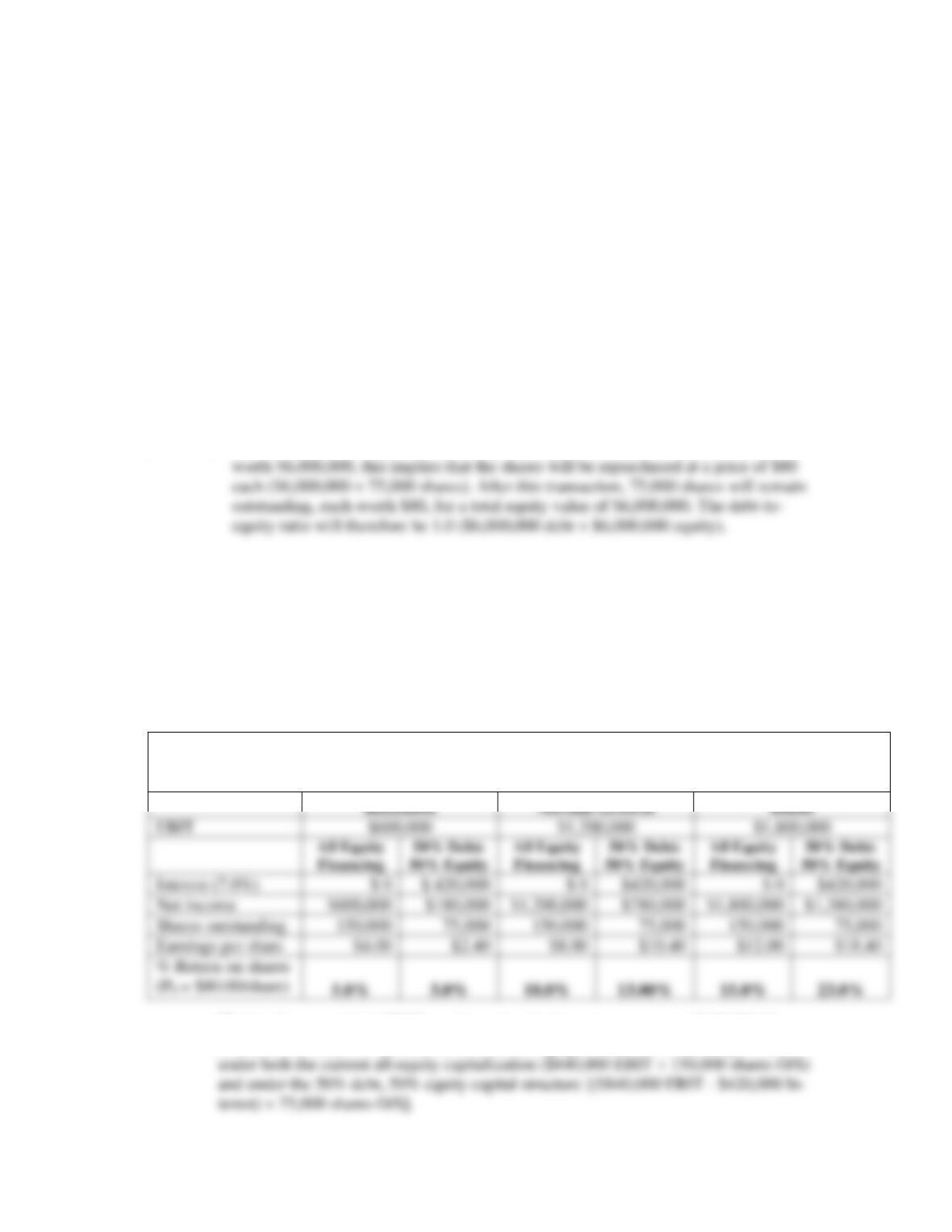
A: a. If USC issues $6,000,000 worth of debt and repurchases 75,000 shares of stock
b.
Expected Operating Profits
Cash Flows to Stockholders and Bondholders Under Current and Proposed Capital Structure
for USC For Three Equally Likely Economic Outcomes
c. The break-even point is EBIT equal to twice the interest payment, or $840,000 (2 x
$420,000 interest). At that level of EBIT, earnings per share will be $5.60 per share
Chapter 12 Capital Structure 333
ST12-2. An unlevered company operates in perfect markets and has net operating income (EBIT)
of $2,000,000. Assume that the required return on assets for firms in this industry is 8
percent. The firm issues $10 million worth of debt with a required return of 6.5 percent,
and uses the proceeds to repurchase outstanding stock. There are no corporate or person-
al taxes.
a. What is the market value and required return of this firm’s stock before the repur-
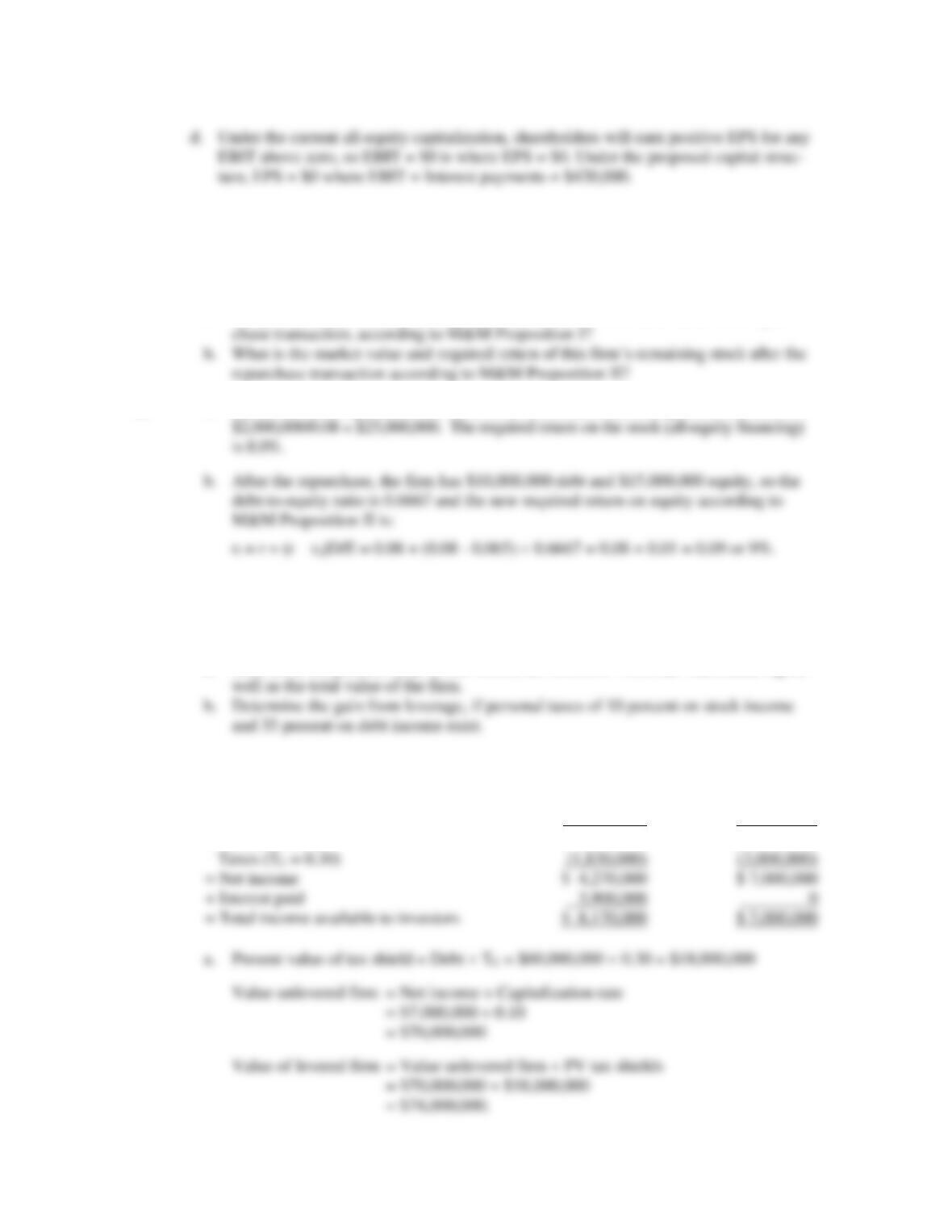
A: a. Before the stock repurchase, the value of the firm under M&M Proposition I is EBIT/r =
ST12-3. Westside Manufacturing has EBIT of $10 million; the firm has $60 million of debt out-
standing, with a required rate of return of 6.5 percent. The required rate of return on the
industry is 10 percent. The corporate tax rate is 30 percent. Assume corporate taxes but
no personal taxes.
a. Determine the present value of the interest tax shield of Westside Manufacturing, as
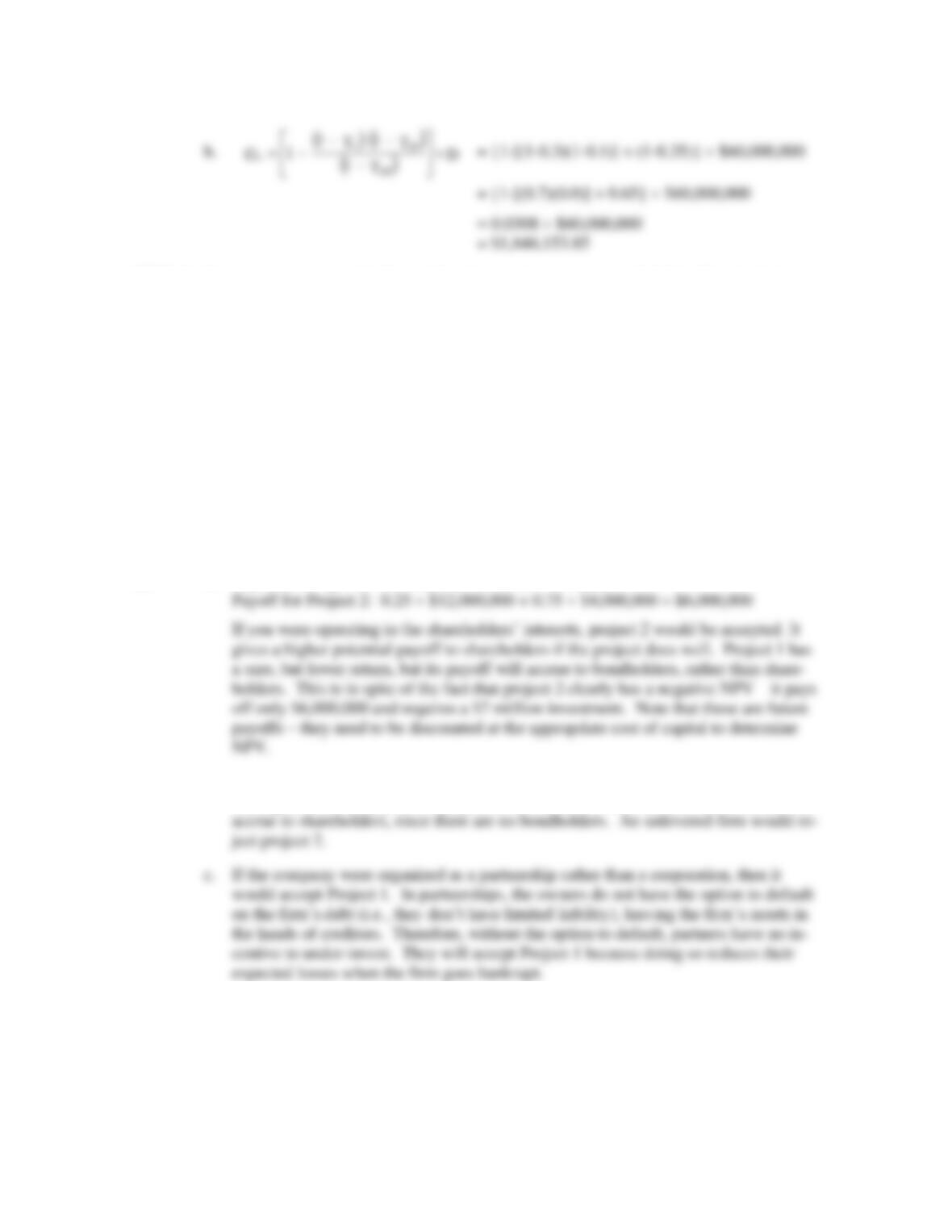
A:
Levered
Unlevered
EBIT
$10,000,000
$10,000,000
– Interest paid (0.065 $60,000,000)
(3,900,000)
0
= Taxable income
$ 6,100,000
$10,000,000
= Net income
$ 4,270,000
$ 7,000,000
+ Interest paid
334 Instructor’s Manual
ST12-4. You are the manager of a financially distressed corporation, with $10 million in debt out-
standing. This debt will mature in one month. Your firm currently has $7 million cash
on hand. Assume that you are offered the opportunity to invest in either of the two pro-
jects described below.
Project 1: The opportunity to invest $7 million in risk-free Treasury bills, with a 4 per-
cent annual interest rate (or a 0.333% per month interest rate)
Project 2: A high-risk gamble, which will pay off $12 million in one month, if success-
ful (probability = 0.25), but will only pay $4,000,000, if unsuccessful (probability =
0.75)
a. Compute the expected payoff for each project, and state which one you would adopt
if you were operating the firm in the shareholders’ best interests? Why?
b. Which project would you accept if the firm was unlevered? Why?
c. Which project would you accept if the company was organized as a partnership ra-
ther than a corporation? Why??
A: a. Payoff for Project 1: $7,000,000 1.00333 = $7,023,333
b. If the firm were unlevered, the firm would prefer project 1. The payoff for project is
1 is higher than the payoff for project 2. If the firm is unlevered, all of the return will
ST12-5. Run-and-Hide Detective Company currently has no debt and expects to earn $5 million
in EBIT each year for the foreseeable future. The required return on assets for detective
companies of this type is 10.0 percent, and the corporate tax rate is 35 percent. No taxes
accrue on dividends or interest at the personal level. Run-and-Hide calculates a 5 percent
chance that the firm will fall into bankruptcy in any given year. If bankruptcy does occur,
it will impose direct and indirect costs totaling $8 million. If necessary, they will use the
industry required return for discounting bankruptcy costs.
Chapter 12 Capital Structure 335
a. Compute the present value of bankruptcy costs for Run-and-Hide.
b. Compute the overall value of the firm.
c. Re-calculate the value of the company, assuming that the firm’s shareholders face a
15 percent personal tax rate on equity income.
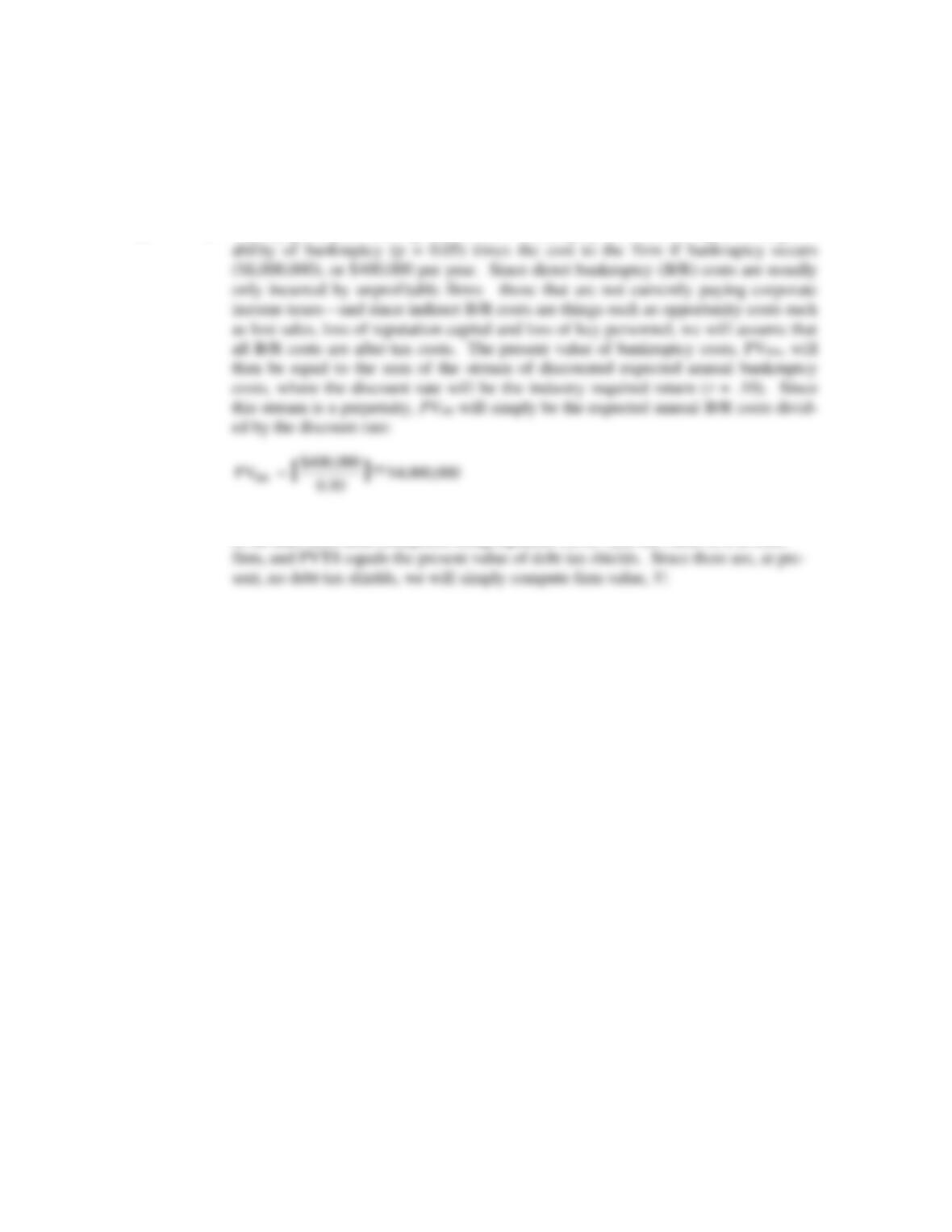
A: a. For any given year, the expected value of bankruptcy costs will be equal to the prob-
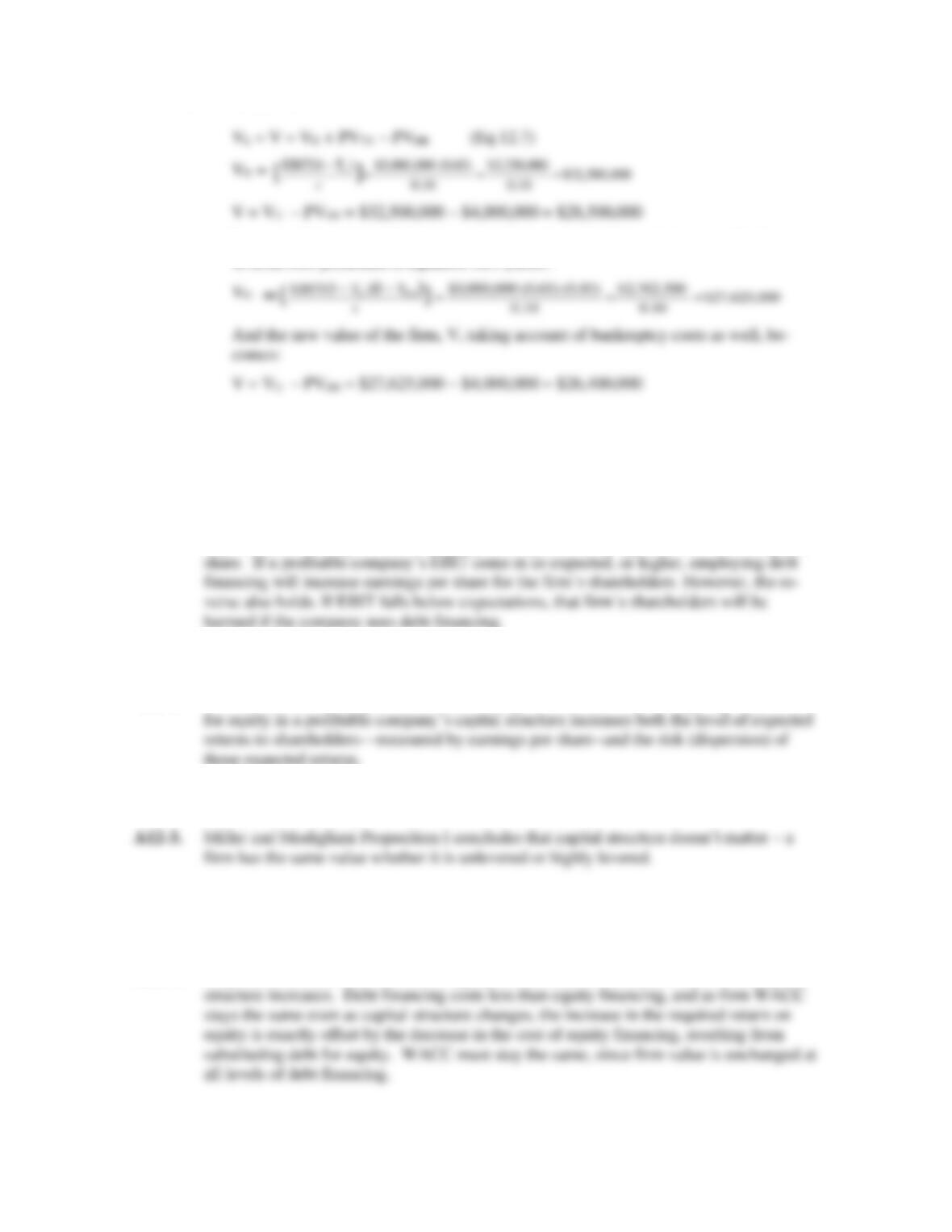
b. The overall value of the firm is computed using equation 12.7, where VU is the value
of an unlevered firm (computed using equation 12.3), VL is the value of a levered
336 Instructor’s Manual
c. Incorporating a personal tax rate on equity income into the valuation model of an un-
levered firm presented in equation 12.3 yields:
Answers to End-of-Chapter Questions
Q12-1. Why is use of long-term debt financing referred to as using financial leverage?
A12-1. Just as a lever is used in the physical world to magnify the effect of a given force on an
object, debt financing is used to magnify the impact of a change in EBIT on earnings per
Q12-2. What is the fundamental principle of financial leverage?
A12-2. The fundamental principle of financial leverage asserts that substituting long-term debt
Q12-3. What is the basic conclusion of the original Modigliani and Miller Proposition I?
Q12-4. Following from the conclusion of Proposition I, what is the crux of M&M Proposition
II? What is the natural relationship between the required returns on debt and equity that
results from Proposition II?
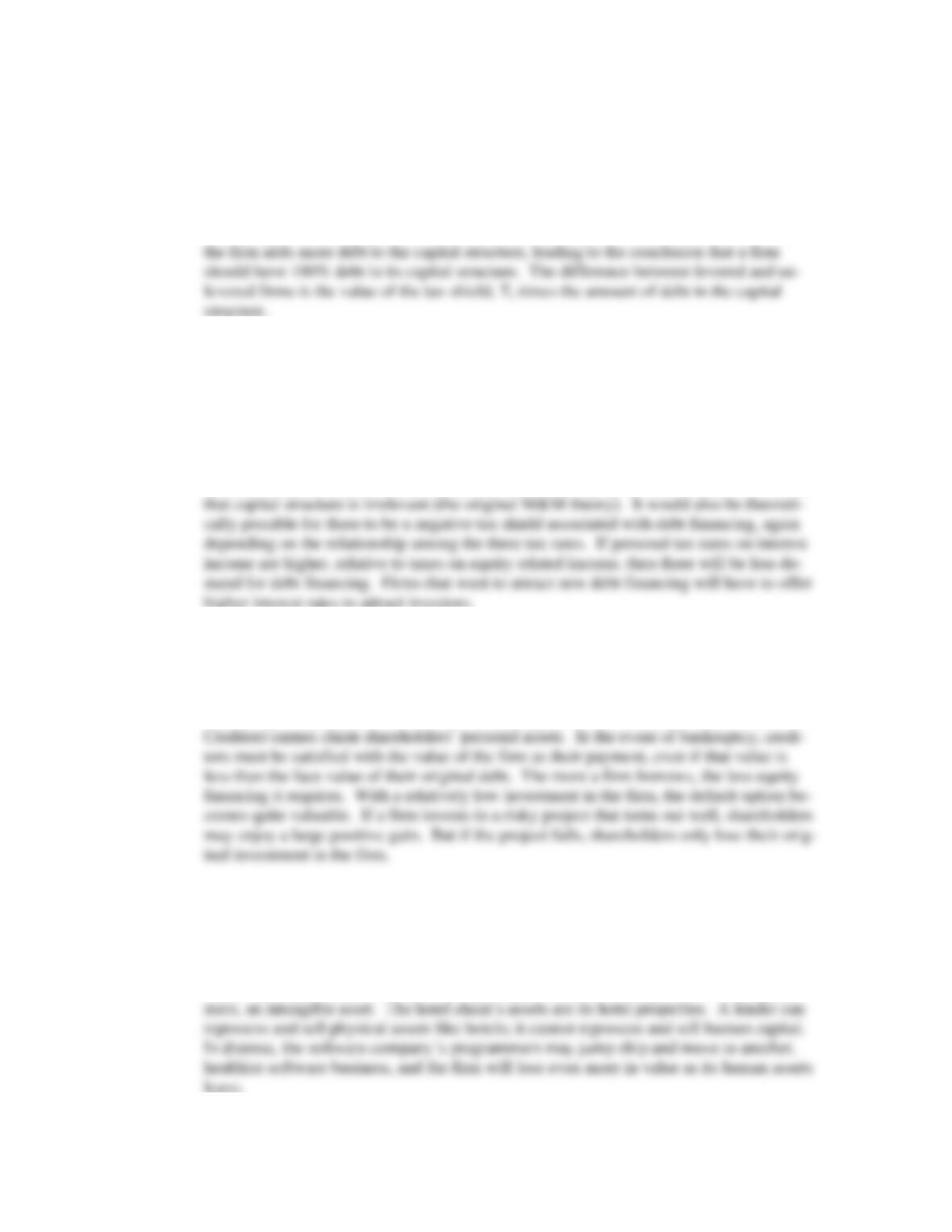
A12-4. Proposition II states that the cost of equity increases as the amount of debt in the capital
Chapter 12 Capital Structure 337
Q12-5. In what way did M&M change their conclusion regarding capital structure choice with
the additional assumption of corporate taxes? In this context, what composes the differ-
ence in value between levered and unlevered firms?
A12-5. Corporate taxes provide an advantage to corporate debt financing because of the tax de-
ductibility of interest payments. Firm value increases by the value of the tax shield as
Q12-6. By introducing personal taxes into the model for capital structure choice, how did Miller
alter the previous M&M conclusion that 100 percent debt is optimal? What happens to
the gains from leverage if personal tax rates on interest income are significantly higher
than those on stock-related income?
A12-6. The existence of personal taxes decreases the value of the corporate tax shield under cur-
rent tax rates. It is theoretically possible for the combination of corporate tax rates, per-
sonal tax rate on debt income and personal tax rate on equity income to lead to the result
Q12-7. Why do a firm’s stockholders hold a valuable “default option”? How could this option
induce stockholders to employ high levels of financial leverage?
A12-7. Limited liability is shareholders’ valuable default option. Shareholders have the right to
walk away from a failed firm. The most that they can lose is their investment in the firm.
Q12-8. All else equal, which firm would face a greater level of financial distress, a software–
development firm or a hotel chain? Why would financial distress costs affect the firms so
differently?
A12-8. A software development firm would face higher costs of financial distress than the hotel
chain. The main asset of the software development firm is the expertise of its program-
338 Instructor’s Manual
Q12-9. Describe how managers whose firms have debt outstanding and face financial distress
A12-9. Managers of financially distressed firms will have incentive to gamble with bondholders’
money. If little value will accrue to shareholders in the event of liquidation, manage-
Q12-10. Differentiate between direct and indirect costs of bankruptcy. Which of the two is gener-
ally more significant?
A12-10. Indirect costs of bankruptcy are considered to be higher than direct costs. Direct costs
include management time, legal fees, and court costs. Indirect costs include loss of firm
Q12-11. How can restrictive covenants in bonds be both an agency cost of debt and a way to pre-
vent agency costs of debt?
A12-11. Restrictive covenants can be an agency cost to the firm if they prevent the firm from tak-
ing on desired positive net present value projects or otherwise sub-optimally constrict the
Q12-12. What are the trade-offs in the agency cost/tax shield trade-off model? How is the firm’s
optimal capital structure determined under the assumptions of this model? Does empiri-
cal evidence support this model?
A12-12. The tradeoffs between agency costs and tax benefits are 1) increasing debt, increasing the
tax shield, but also increasing agency costs or 2) decreasing debt, decreasing agency
costs, but then reducing the tax shield benefit of debt. Optimal capital structure is found