Introduction to Corporate Finance, Fourth Edition Booth, Cleary, Rakita
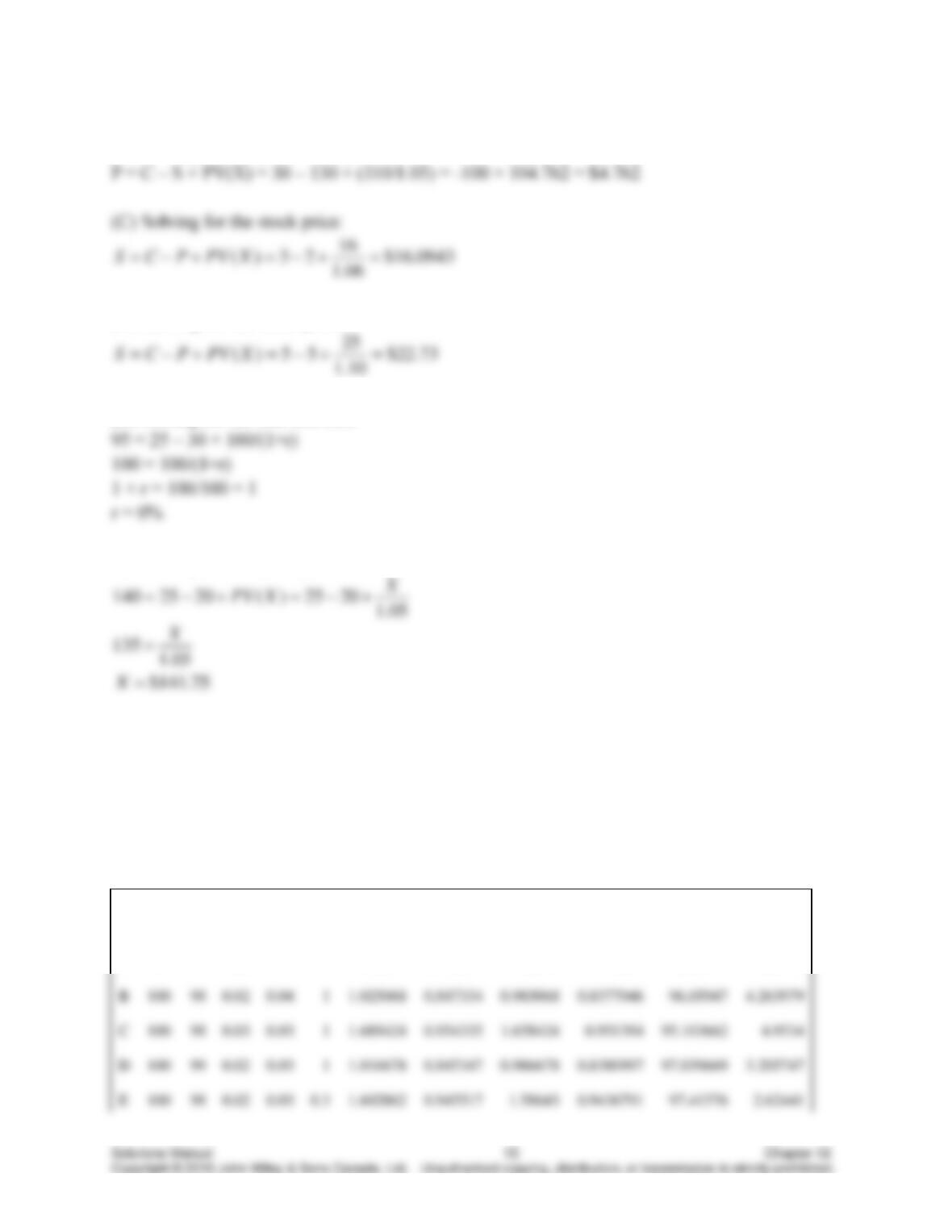
(B) Solving for the price of the put:
(D) Solving for the stock price:
(E) Solving for the risk–free rate:
(F) Solving for the strike price:
25. Section: 12.4 The Black–Scholes Option Pricing Model
Learning Objective: 12.4
Level of Difficulty: Intermediate
Solution:
Using Excel to compute N(d1) and N(d2):
S
X
r
σ
t
d1
N(d1)
d2
N(d2)
Xe–rt
Call
value
A
100
98
0.02
0.03
1
1.35509
0.912306
1.32509
0.9074294
96.05947
4.063373
B
100
98
0.02
0.04
1
1.025068
0.847334
0.985068
0.8377046
96.05947
4.263979
C
100
98
0.03
0.03
1
1.688424
0.954335
1.658424
95.103662
E
100
98
0.02
0.03
0.3
1.602862
0.945517
1.58643
0.9436791
97.41376
2.62441
Introduction to Corporate Finance, Fourth Edition Booth, Cleary, Rakita
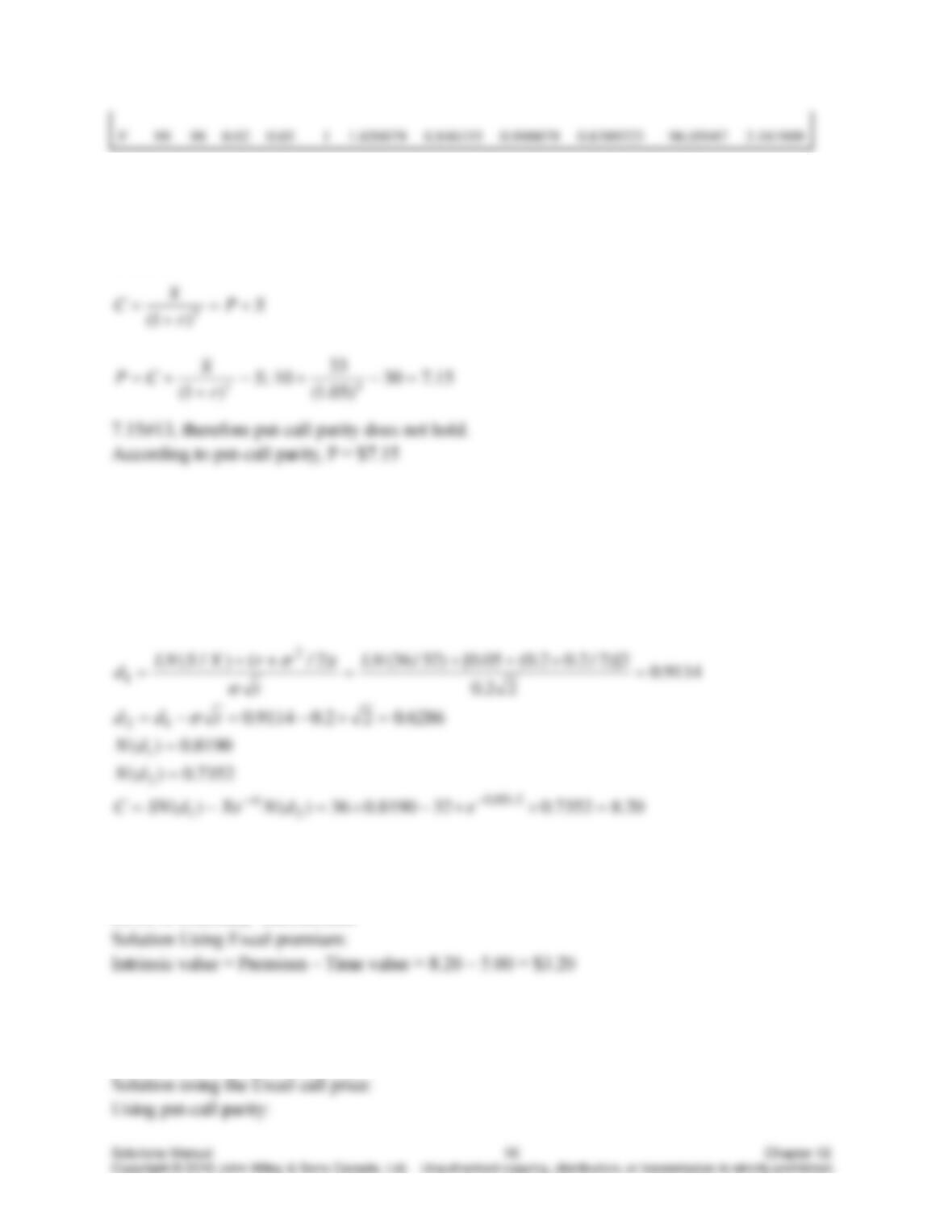
26. Section: 12.3 Put–Call Parity
Learning Objective: 12.3
Level of Difficulty: Intermediate
Solution:
27. Section: 12.4 The Black–Scholes Option Pricing Model
Learning Objective: 12.4
Level of Difficulty: Intermediate
Solution:
Using Excel to compute N(d1) and N(d2):
28. Section: 12.1 Call Options
Learning Objective: 12.1
Level of Difficulty: Intermediate
29. Section: 12.3 Put–Call Parity
Learning Objective: 12.3
Level of Difficulty: Intermediate
Introduction to Corporate Finance, Fourth Edition Booth, Cleary, Rakita
30. Section: 12.3 Put–Call Parity and 12.4 The Black–Scholes Option Pricing Model
Learning Objective: 12.3 and 12.4
Level of Difficulty: Intermediate
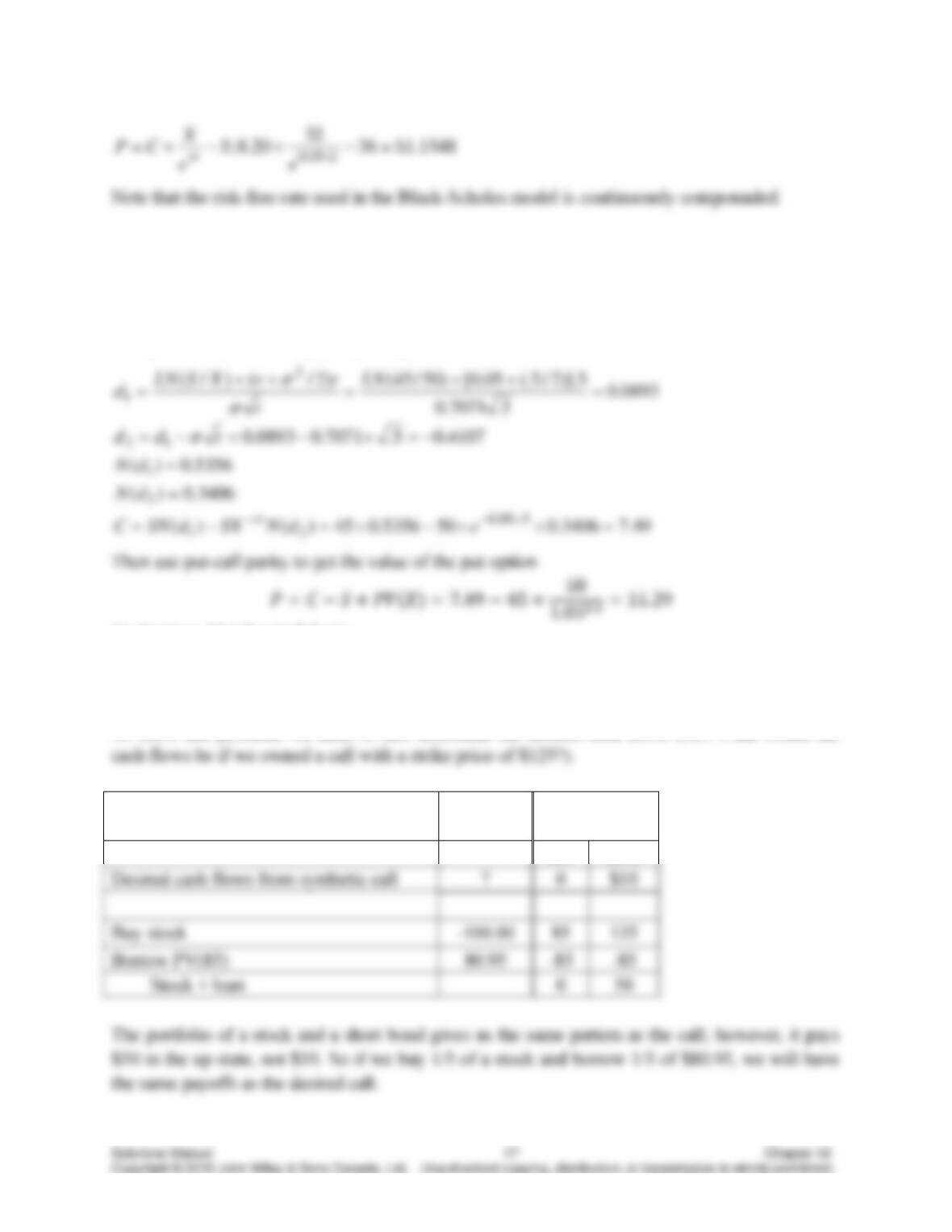
Solution:
Using the Black–Scholes option pricing model:
31. Section: 12.3 Put–Call Parity
Learning Objective: 12.3
Level of Difficulty: Intermediate
Solution:
To solve this problem, we need to first determine the desired cash flows (i.e., What would the
Action
Cash flow
today
Future value
of stock
$85
$135
80.95
Introduction to Corporate Finance, Fourth Edition Booth, Cleary, Rakita
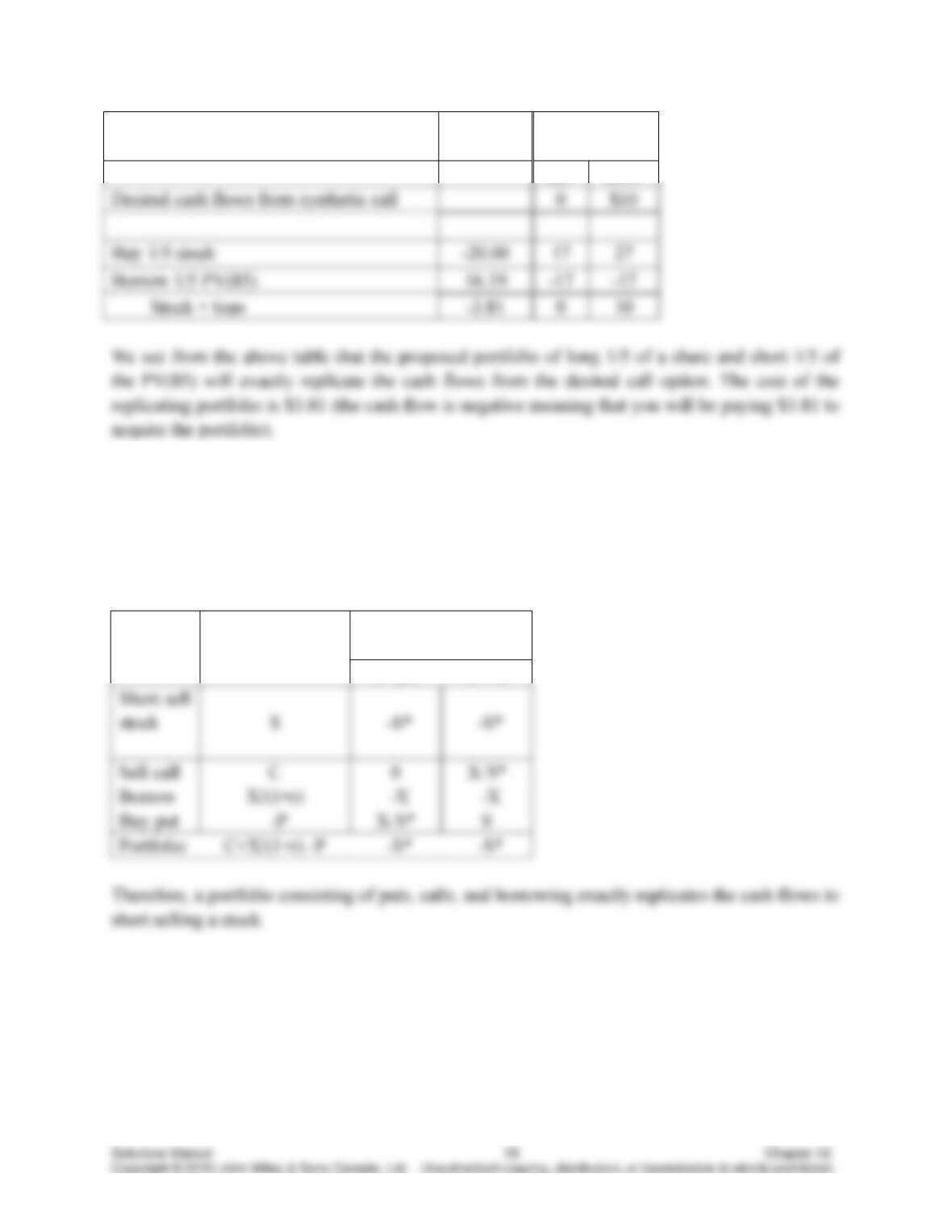
Action
Cash flow
today
Future value
of stock
$85
$135
16.19
32. Section: 12.3 Put–Call Parity
Learning Objective: 12.3
Level of Difficulty: Intermediate
Solution:
Let X be the strike price, then
Strategy
Cash flow today
Cash flow at
expiration
S*≤X
S*>X
33. Section: Appendix 12.A Binomial Option Pricing and Risk–Neutral Probabilities
Learning Objective: 12.3 and 12.6
Level of Difficulty: Intermediate
Solution:
a. First we need to determine the hedge ratio:
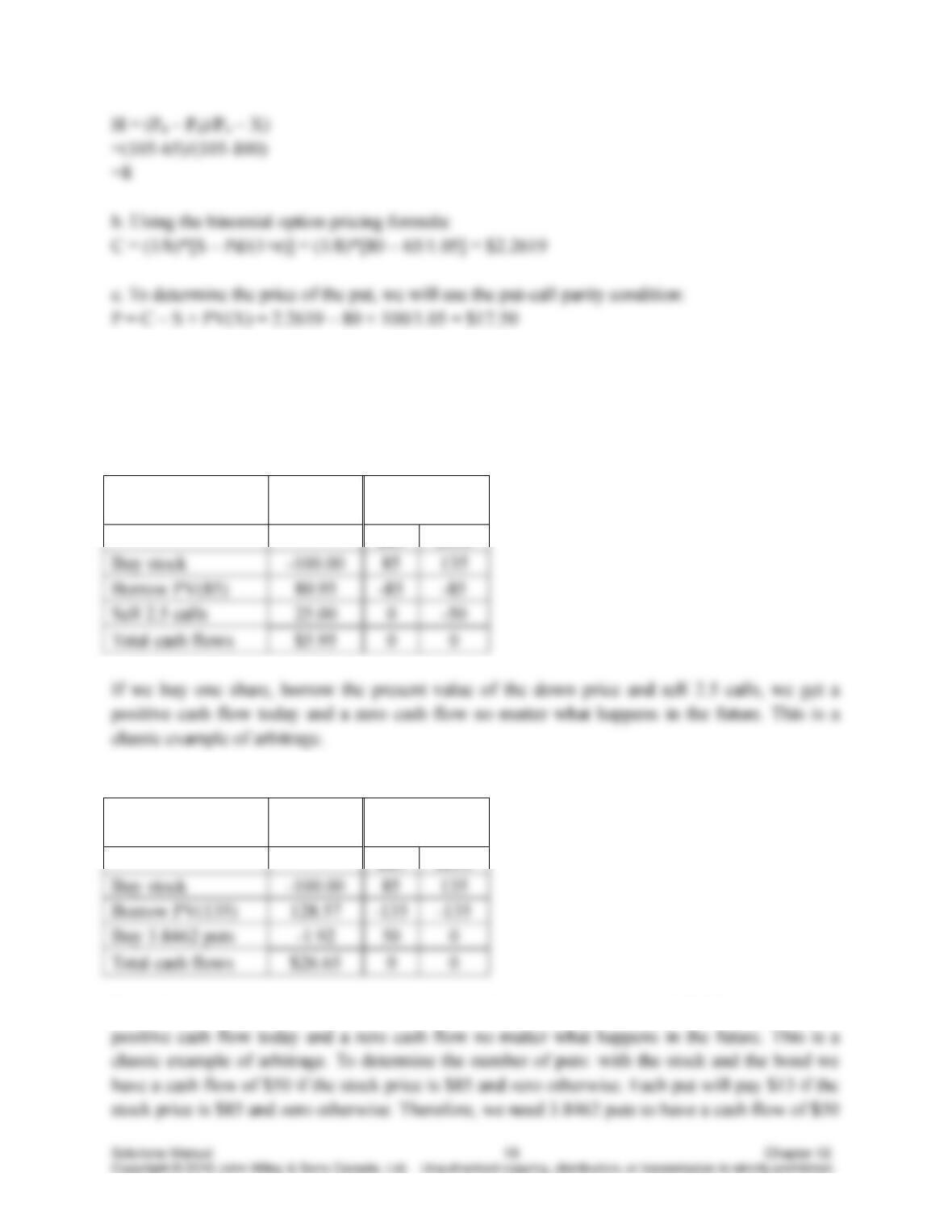
Introduction to Corporate Finance, Fourth Edition Booth, Cleary, Rakita
34. Section: Appendix 12A Binomial Option Pricing and Risk–Neutral Probabilities
Learning Objective: 12.6
Level of Difficulty: Intermediate
Solution:
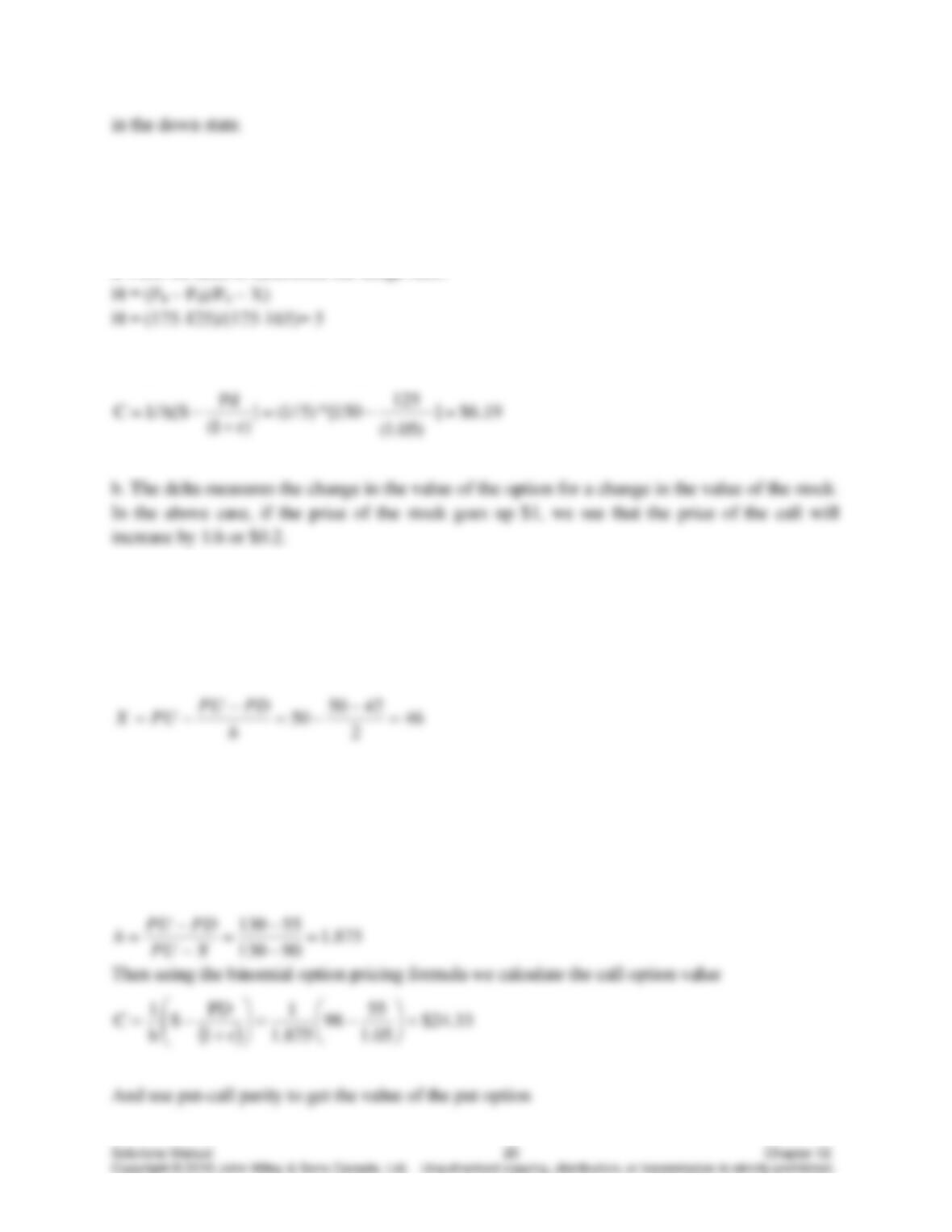
a.
Action
Cash flow
today
Future value
of stock
$85
$135
80.95
25.00
$5.95
b.
Action
Cash flow
today
Future value
of stock
$85
$135
If we buy one share, borrow the present value of the up price and buy 3.8462 puts, we get a
Introduction to Corporate Finance, Fourth Edition Booth, Cleary, Rakita
35. Section: Appendix 12A Binomial Option Pricing and Risk–Neutral Probabilities
Learning Objective: 12.6
Level of Difficulty: Intermediate
Solution:
a. First we need to determine the hedge ratio:
Using the binomial option pricing formula:
36. Section: Appendix 12A Binomial Option Pricing and Risk–Neutral Probabilities
Learning Objective: 12.6
Level of Difficulty: Intermediate
Solution:
37. Section: Appendix 12A Binomial Option Pricing and Risk–Neutral Probabilities
Learning Objective: 12.3 and 12.6
Level of Difficulty: Intermediate
Solution
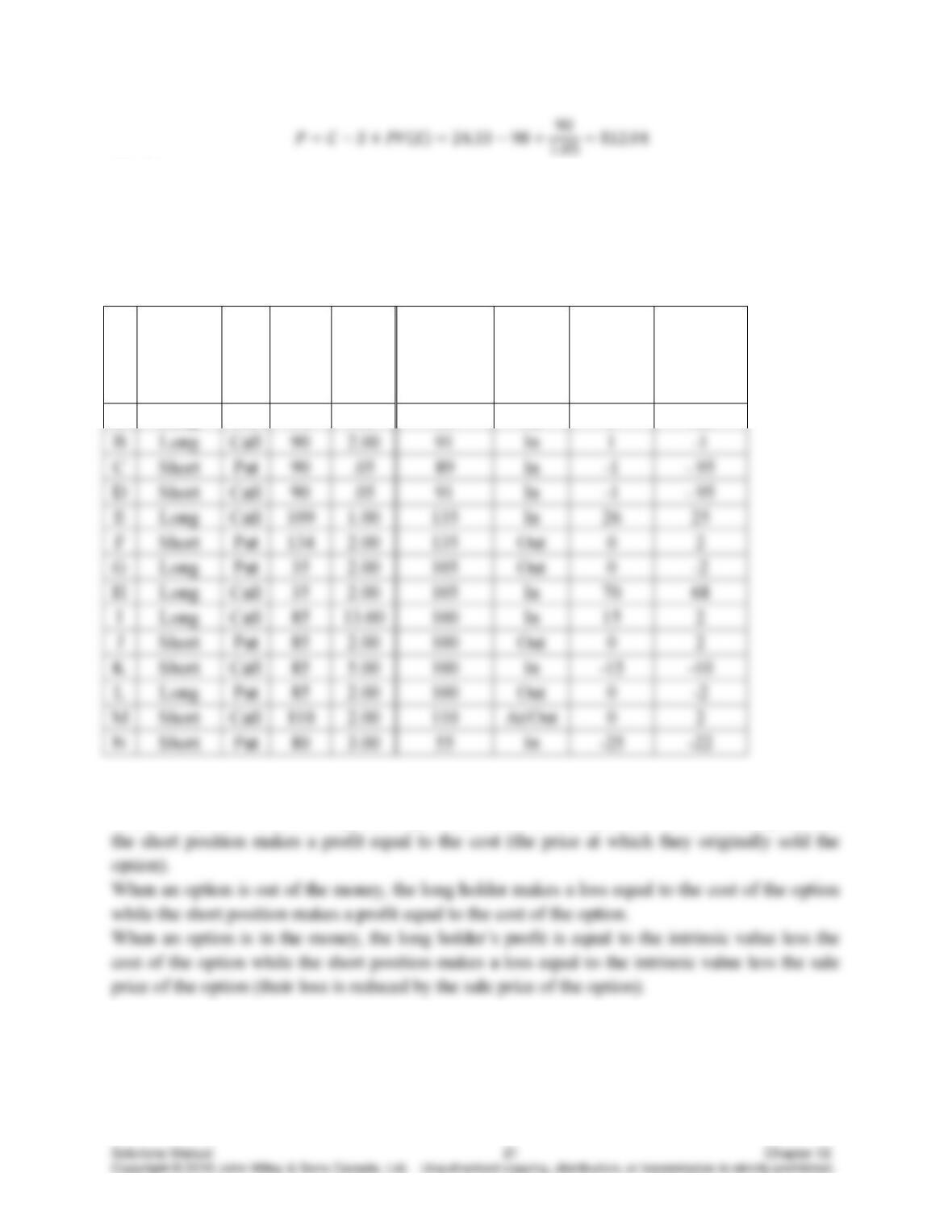
First we calculate the hedge ratio
Introduction to Corporate Finance, Fourth Edition Booth, Cleary, Rakita
Challenging
38. Sections: 12.1 Call Options and 12.2 Put Options
Learning Objective: 12.1 and 12.2
Level of Difficulty: Challenging
Solution:
Long or
Short
Call
or
Put
Strike
price
Value
of
option
today
Value of
underlying
asset
In/Out
of the
money
Payoff
(intrinsic
value of
option)
Profit
(loss)
A
Long
Put
90
.05
90
At
0
–.05
Long
90
91
1
Short
Put
90
.05
89
–.95
D
Short
90
.05
91
–.95
E
Long
25
Short
Put
0
G
Put
35
0
H
Long
35
68
Long
85
13.00
Short
Put
85
0
K
Short
85
L
Long
Put
85
0
Short
0
N
Short
Put
80
55
Notes for solutions:
When an option is at the money, the long holder makes a loss equal to the cost of the option and
39. Sections: 12.1 Call Options and 12.2 Put Options
Learning Objective: 12.1 and 12.2
Level of Difficulty: Challenging
Solution:
Introduction to Corporate Finance, Fourth Edition Booth, Cleary, Rakita
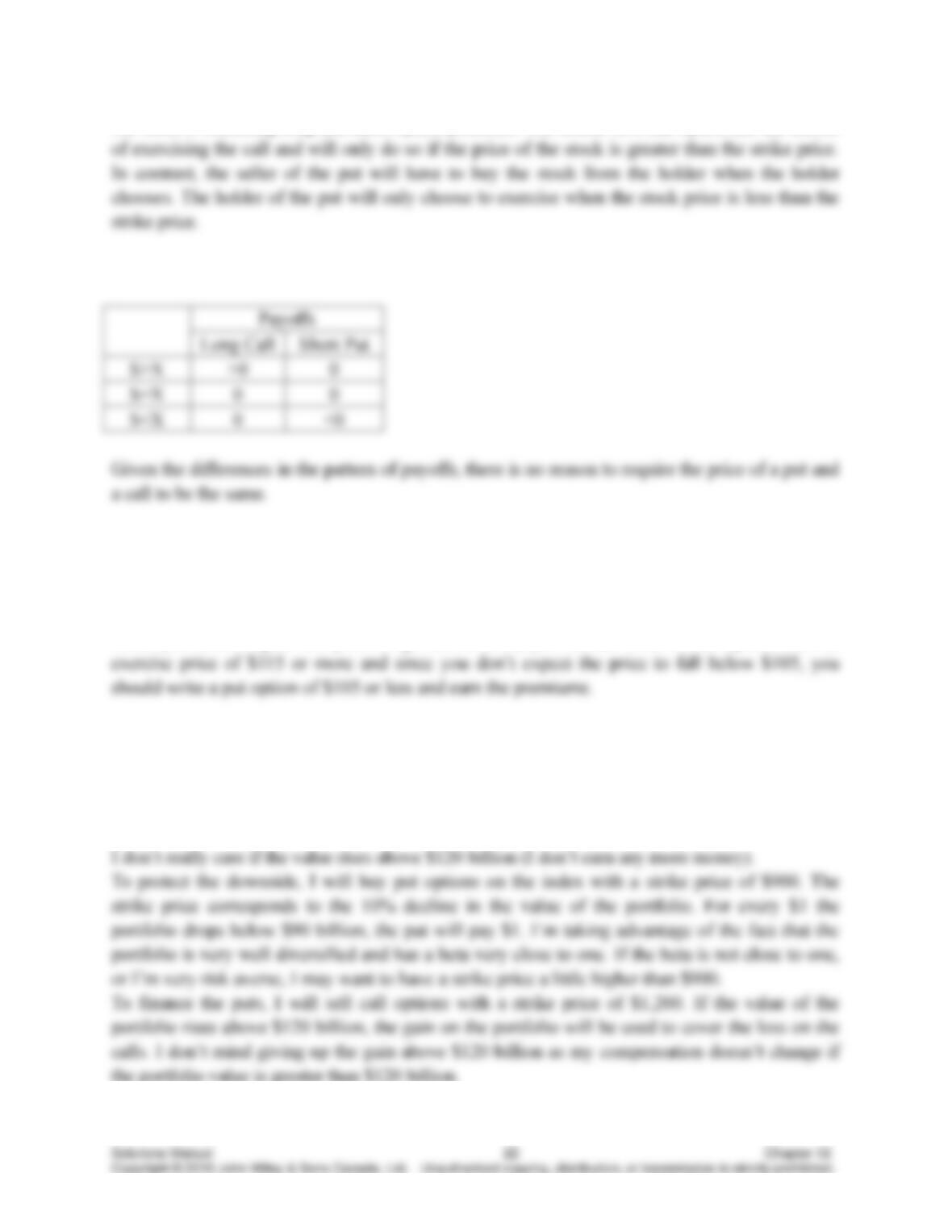
Mr. Kent is confusing long and short option positions. The holder of a call option has the choice
The payoffs to the two positions are summarized below:
40. Sections: 12.1 Call Options and 12.2 Put Options
Learning Objective: 12.1 and 12.2
Level of Difficulty: Challenging
Solution:
Since you don’t expect the price to go above $115, you should write a call option with an
41. Section: 12.3 Put–Call Parity and 12.4 The Black–Scholes Option Pricing Model
Learning Objective: 12.3 and 12.4
Level of Difficulty: Challenging
Solution:
a. Given my compensation, I definitely do not want the portfolio value to drop below $90 billion.
Introduction to Corporate Finance, Fourth Edition Booth, Cleary, Rakita
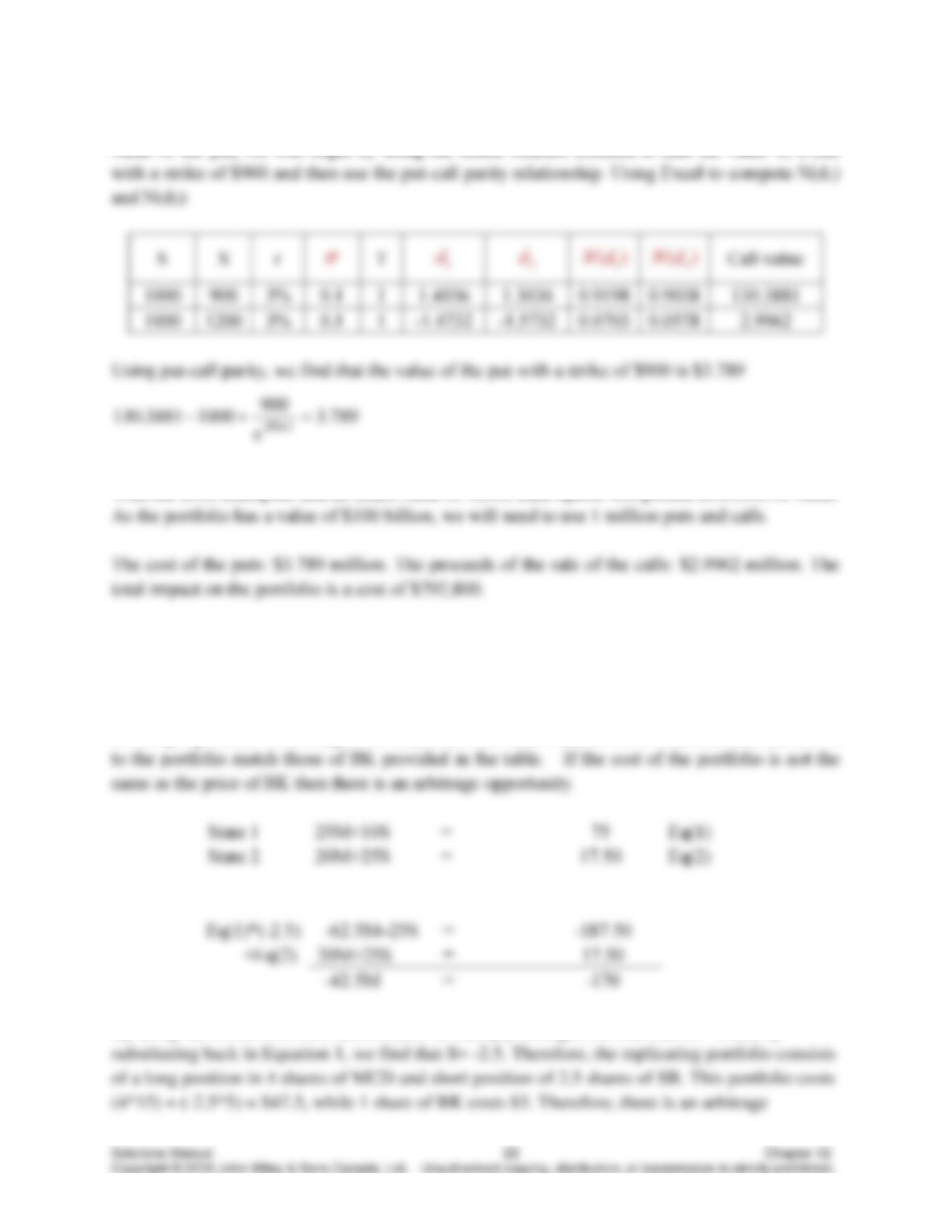
b. To determine the value of the call (strike=1,200) we will use Black–Scholes. To determine the
value of the put, we will begin by using the Black–Scholes formula to find the value of a call
With the $100 multiplier and an index value of 1,000, each option will protect $100,000 of value.
42. Section: 12.3 Put–Call Parity
Learning Objective: 12.3
Level of Difficulty: Challenging
Solution:
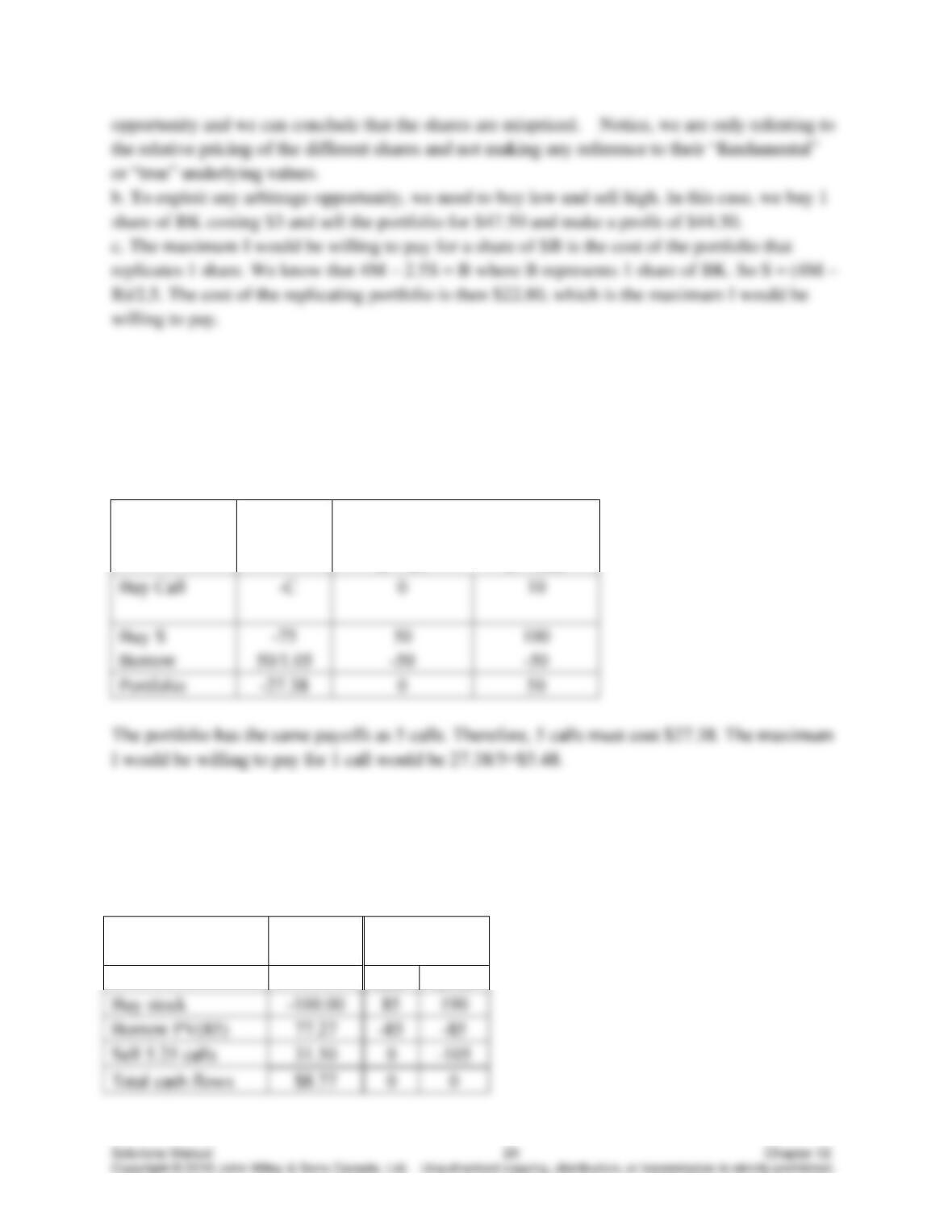
a. Set up a portfolio consisting of M shares of MCD and S shares of SB such that the cash flows
By using the lowest common denominator to multiply through, we find that M= 4, and by
Introduction to Corporate Finance, Fourth Edition Booth, Cleary, Rakita
43. Section: 12.3 Put–Call Parity
Learning Objective: 12.3
Level of Difficulty: Challenging
Solution:
The necessary information about the cash flows to the different strategies is summarized below:
Strategy
Cash flow
today
Cash flow at expiration
S*=50
S*=100
Borrow
Portfolio
44. Section: Appendix 12A Binomial Option Pricing and Risk–Neutral Probabilities
Learning Objective: 12.6
Level of Difficulty: Challenging
Solution:
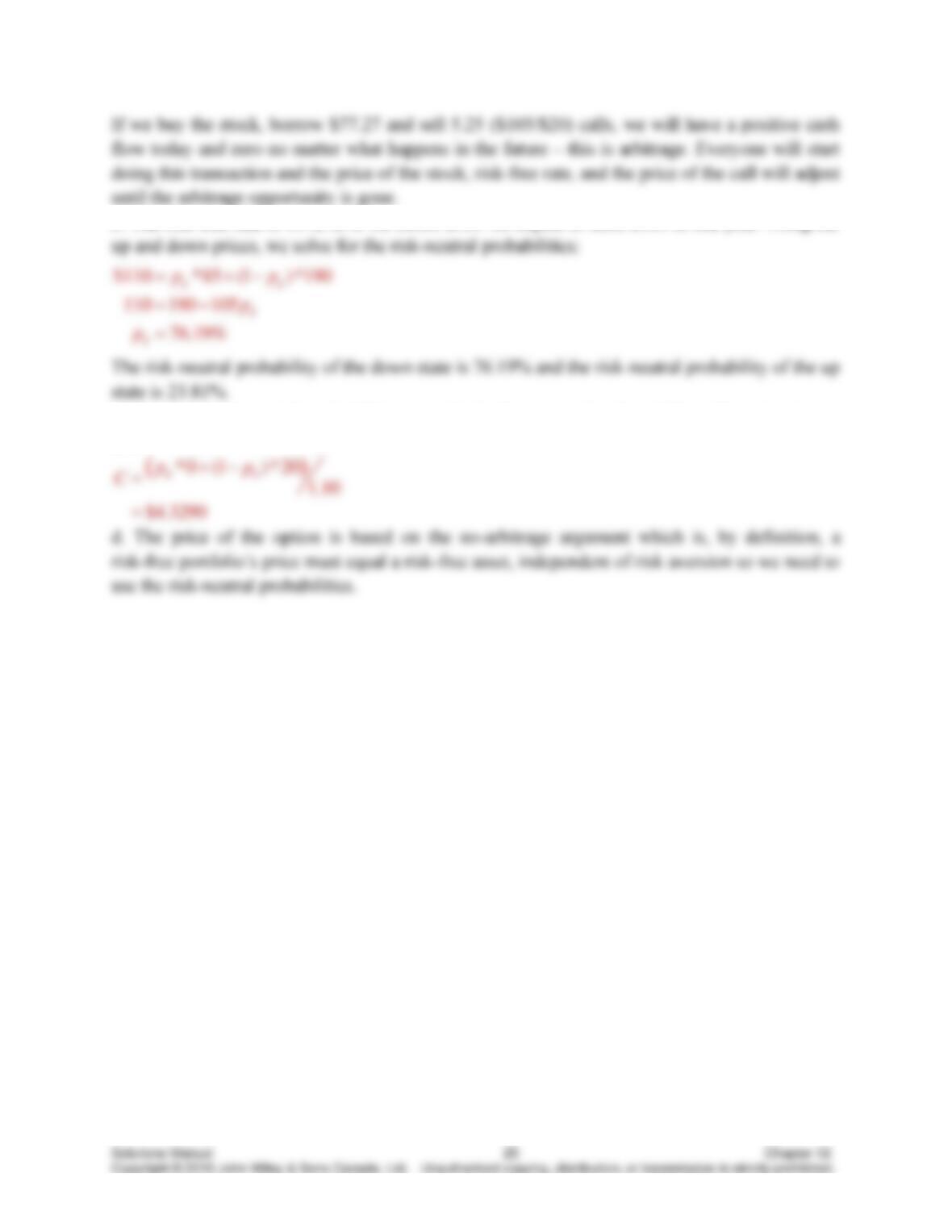
a.
Action
Cash flow
today
Future value
of stock
$85
$190
77.27
31.50
Introduction to Corporate Finance, Fourth Edition Booth, Cleary, Rakita
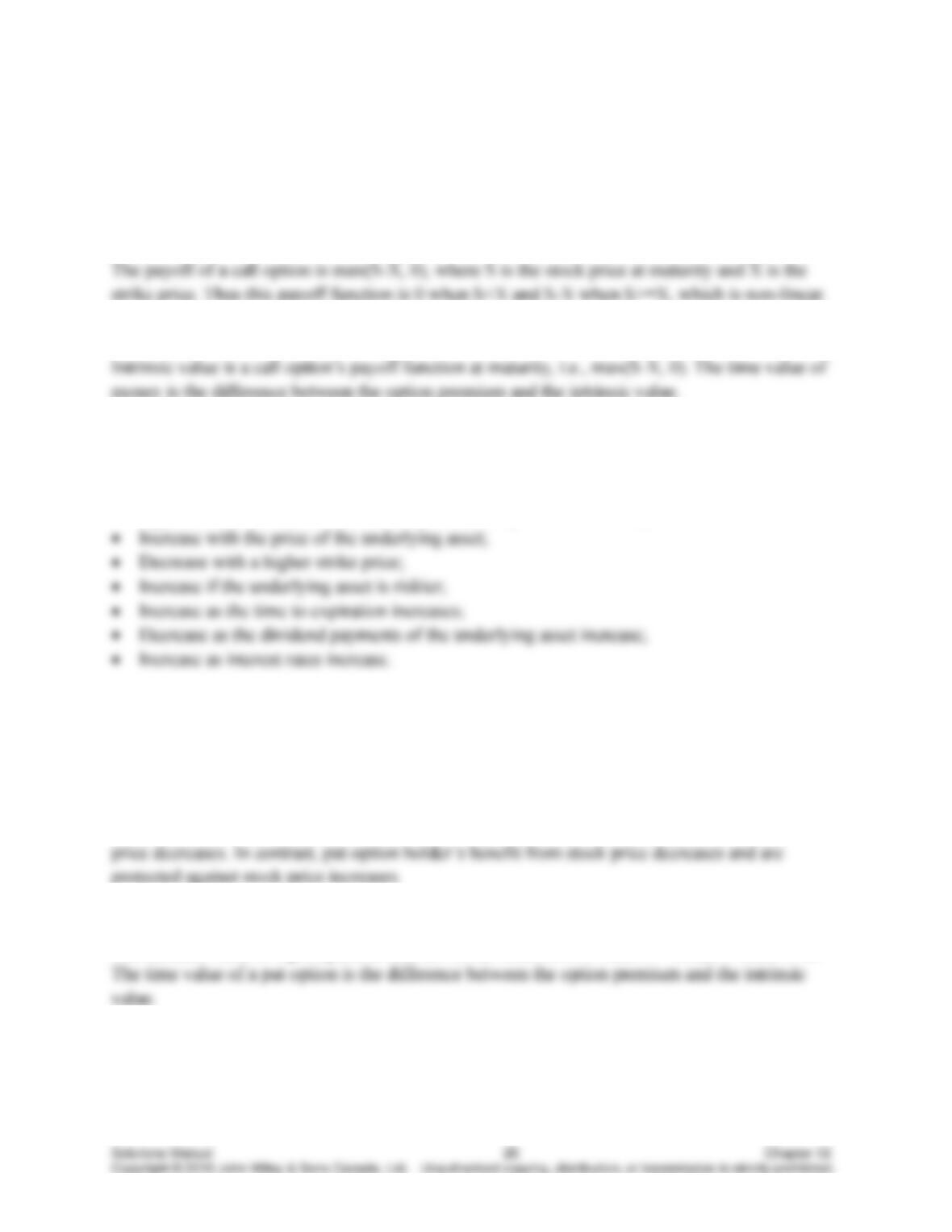
b. The risk–free rate is 10%, so if we invest $100 we expect to have $110 in one year. Using the
c. Using the risk–neutral probabilities, we obtain the expected value of the call option in one
year:
Introduction to Corporate Finance, Fourth Edition Booth, Cleary, Rakita
Answers to Concept Review Questions
12.1 Call Options
Concept Review Questions
1. Explain why the payoff from a call option is non–linear.
2. Explain how to estimate the intrinsic value and time value for a call option.
3. Briefly describe the main factors that affect a call option’s value, and how they affect the
value.
Option prices
• Approach their intrinsic value for deep in and deep out of the money calls;
12.2 Put Options
Concept Review Questions
1. Contrast the payoff from a put option with that from a call option.
A call option’s payoff function is max(S–X, 0) while a put option’s payoff function is max (X–S,
0). Thus call option holders benefit from stock price increases and are protected against stock
2. Explain how to estimate the intrinsic value and time value for a put option.
The intrinsic value of a put option is max (X–S, 0), which is X–S when S<=X and 0 when S>X.
3. Briefly describe the main factors that affect a put or a call option’s value, and explain how
they affect the value of each.
Asset price, strike price, term to maturity, volatility, interest rates, and dividends affect both call
12.3 Put–Call Parity
Concept Review Questions
1. Illustrate how to combine the four basic option positions to create a variety of net payoff
positions.
For one example, a long underlying asset, a long call position, and a short put position have the
2. Explain why the put–call parity relationship should hold if markets are efficient.
The put–call parity holds only when the security prices are known to all investors, and they can
3. Explain how to synthetically create long and short positions in calls, puts, and the underlying
assets using put–call parity.
12.4 The Black Scholes Option Pricing Model
Concept Review Questions
1. How can the Black–Scholes equation be used to price options?
2. What is measured by each of the five Greeks discussed in this section?
Delta is the change in the price of the option for a given change in the price of the underlying
12.5 Options Markets
Introduction to Corporate Finance, Fourth Edition Booth, Cleary, Rakita
Concept Review Questions
1. Where are options traded?
2. How are implied volatilities calculated? What information do they provide?
3. What real options have you been given over the past year and how valuable were they? What
factors do you think influenced your valuation of them?
Appendix 12A Binomial Option Pricing and Risk–Neutral Probabilities
Concept Review Questions
1. Explain how to create a risk–free portfolio from the stock and the option’s payoff.
With the binomial model for a call option you determine the payoff from the long position when
2. What is a hedge ratio?
3. Why don’t the probabilities of going up and down affect the options value?
4. What are risk–neutral probabilities?
Since we don’t need the probability of the stock going up or down to value it, we can use any