Chapter 12 – Application of Real- Option Techniques to Capital Budgeting and Capital Structure
CHAPTER 12
Application of Real-Option Techniques
to Capital Budgeting and Capital Structure
1. This is a fundamental issue. Real options theory is an extension of DCF and implicitly
assumes that maximizing the fundamental value of the firm (or its equity) is the same as
maximizing market value. In practice, the two may diverge. Moreover, if enough managers
and analysts rely on EPS-based heuristics rather than fundamental value, market prices may
be better captured by those heuristics than fundamental values, at least in the short-term.
2. To begin the analysis, consider the cash flows that underlie the real option in this question.
The original investment decision was made a year ago, and the future cash flows will not be

2
The next step in the analysis is to arrive at the valuation tree. The valuations for t3 are
obtained from the constant growth rate perpetuity formula. For example, after up-moves at t1
and t2, the value of the future cash flows, if they continued, would be $156 million. This is
obtained by calculating the expected cash flows at t4 and dividing by r-g. Given the
The value of the future cash flows after two such up-moves is
By the same procedure, after an up-move and down move, the value at t3 of the future cash
flows would be 100.
39.1
0
025.0
0 0
016.0
0
10.2
Table 1
Incremental Cash Flows
Underlying Option

Chapter 12 – Application of Real- Option Techniques to Capital Budgeting and Capital Structure
3
Moving back one period, what is the value of a claim that will be worth either $156 million
or $100 million a year hence? Given the probabilities above, and a discount rate of 20
The resulting valuation tree is:

Chapter 12 – Application of Real- Option Techniques to Capital Budgeting and Capital Structure
The next tree in the analysis the return tree. Consider an investor who holds a claim to the
If the asset is worth $100 million at t3, the return is
The resulting return tree is:

Chapter 12 – Application of Real- Option Techniques to Capital Budgeting and Capital Structure
5
The return tree gives rise to the risk-neutral probabilities. Here u is the up-return (50%) and d
is the down return (-4%). The risk-free rate is 5%. Therefore, the up risk-neutral probability
is
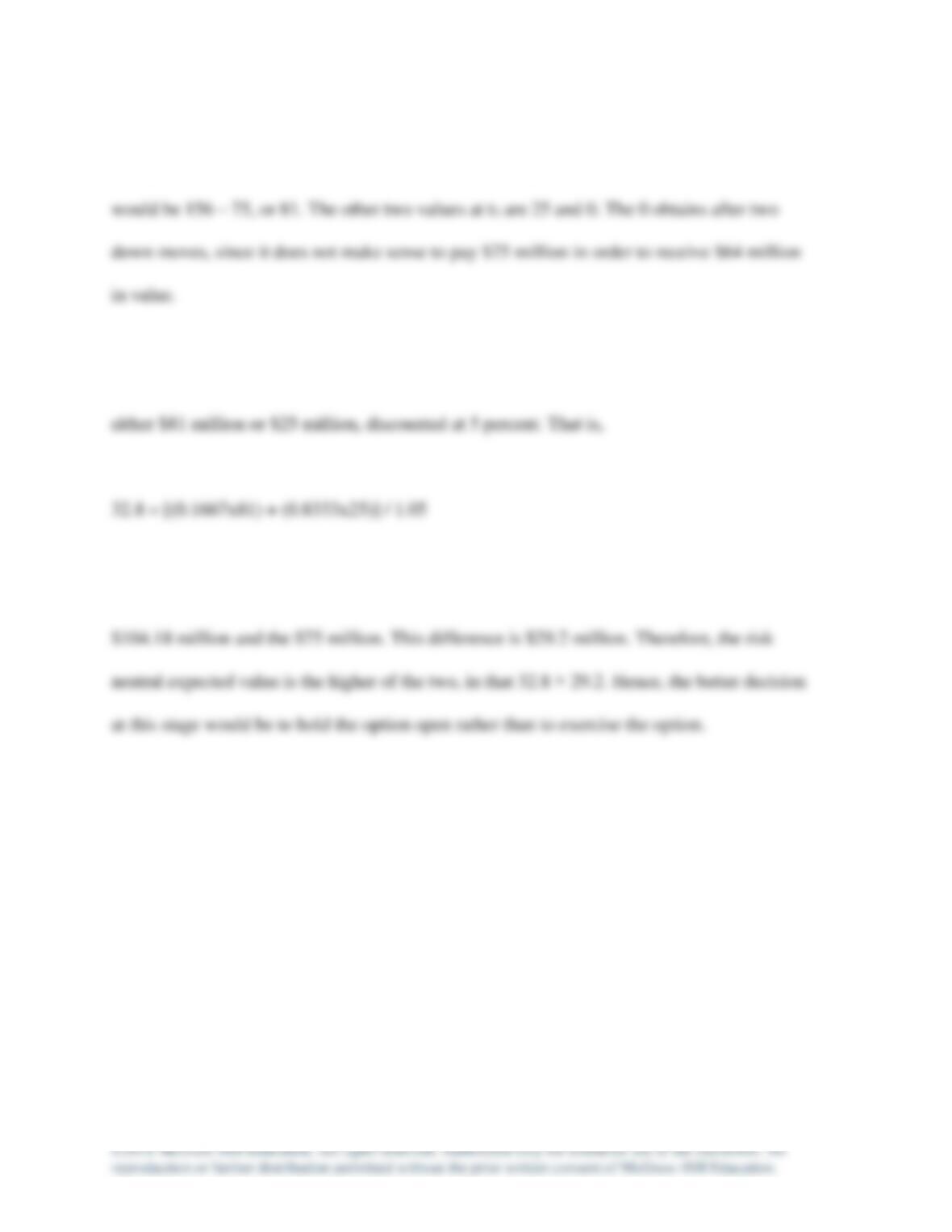
option trees, (1) the risk-neutral expected values, and (2) the value of immediate exercise.
Chapter 12 – Application of Real- Option Techniques to Capital Budgeting and Capital Structure
6
At t3, the option is worth exercising if the value of the cash flows is at least $75 million, and
the option is worth the difference. Therefore, after two up-moves, the value of exercise
The risk-neutral expected value at t2, after an up-move is the expected value associated with
The value of immediate exercise is the difference between the asset value at that time,
The option valuation trees are as follows:
Chapter 12 – Application of Real- Option Techniques to Capital Budgeting and Capital Structure
7
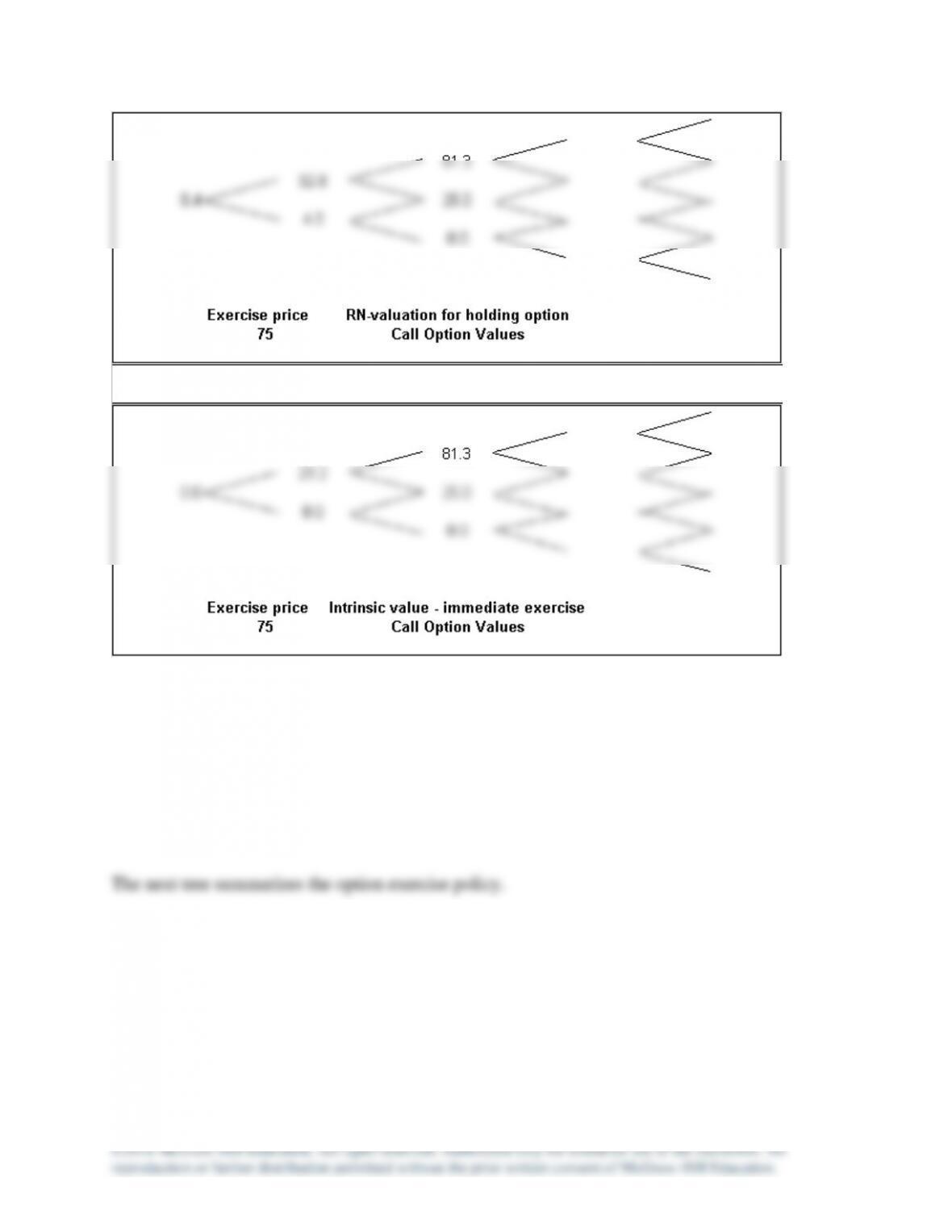
The associated exercise policy is to exercise only at t3, and then only if at least one of the two
prior moves has been an up-move.
Chapter 12 – Application of Real- Option Techniques to Capital Budgeting and Capital Structure
8
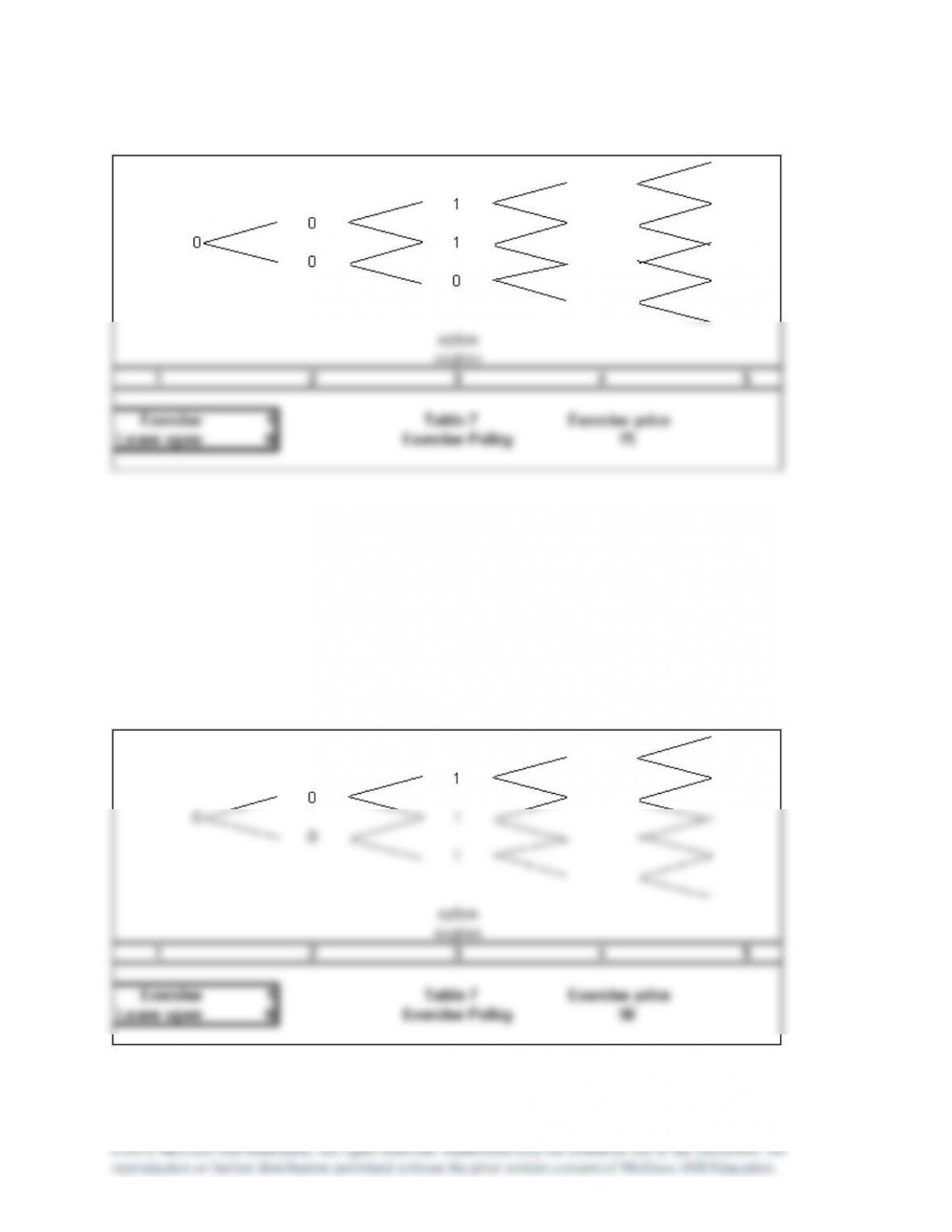
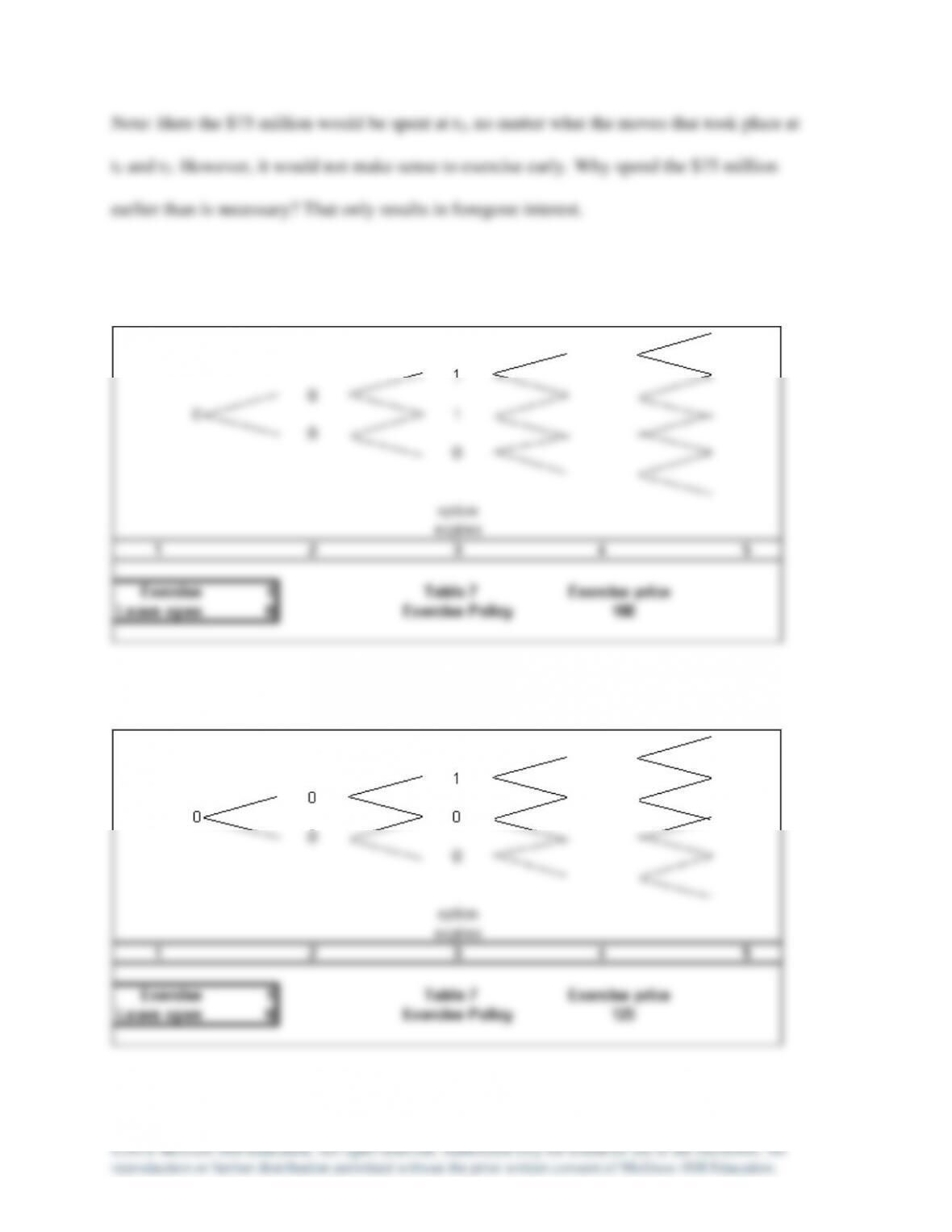
The following trees illustrate the option exercise policies as the amount to be invested
increases in $25 million increments from $50 million to $200 million.
Chapter 12 – Application of Real- Option Techniques to Capital Budgeting and Capital Structure
9
©2018 McGraw-Hill Education. All rights reserved. Authorized only for instructor use in the classroom. No
reproduction or further distribution permitted without the prior written consent of McGraw–Hill Education.
Note: Here the $75 million would be spent at t3, no matter what the moves that took place at
t1 and t2. However, it would not make sense to exercise early. Why spend the $75 million
earlier than is necessary? That only results in foregone interest.
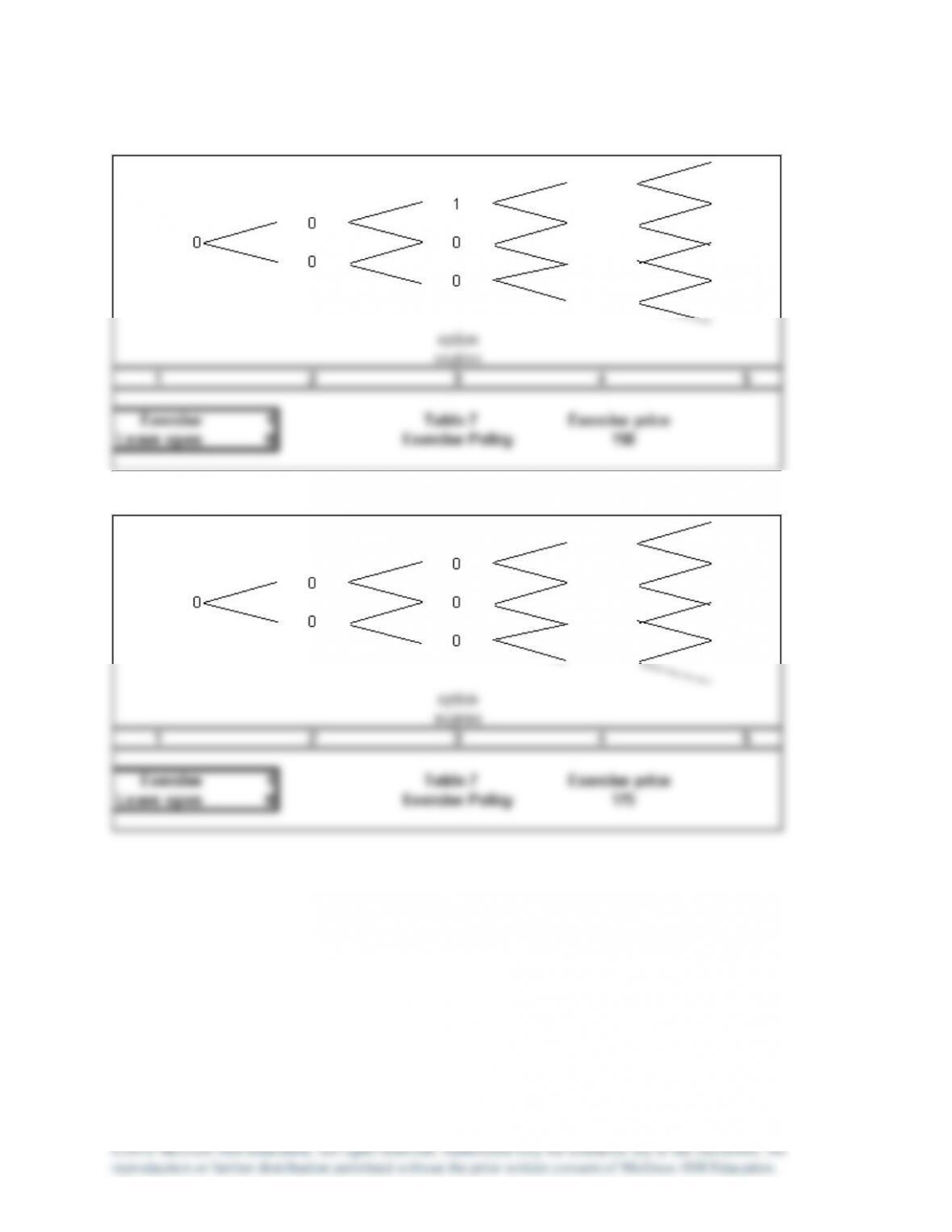
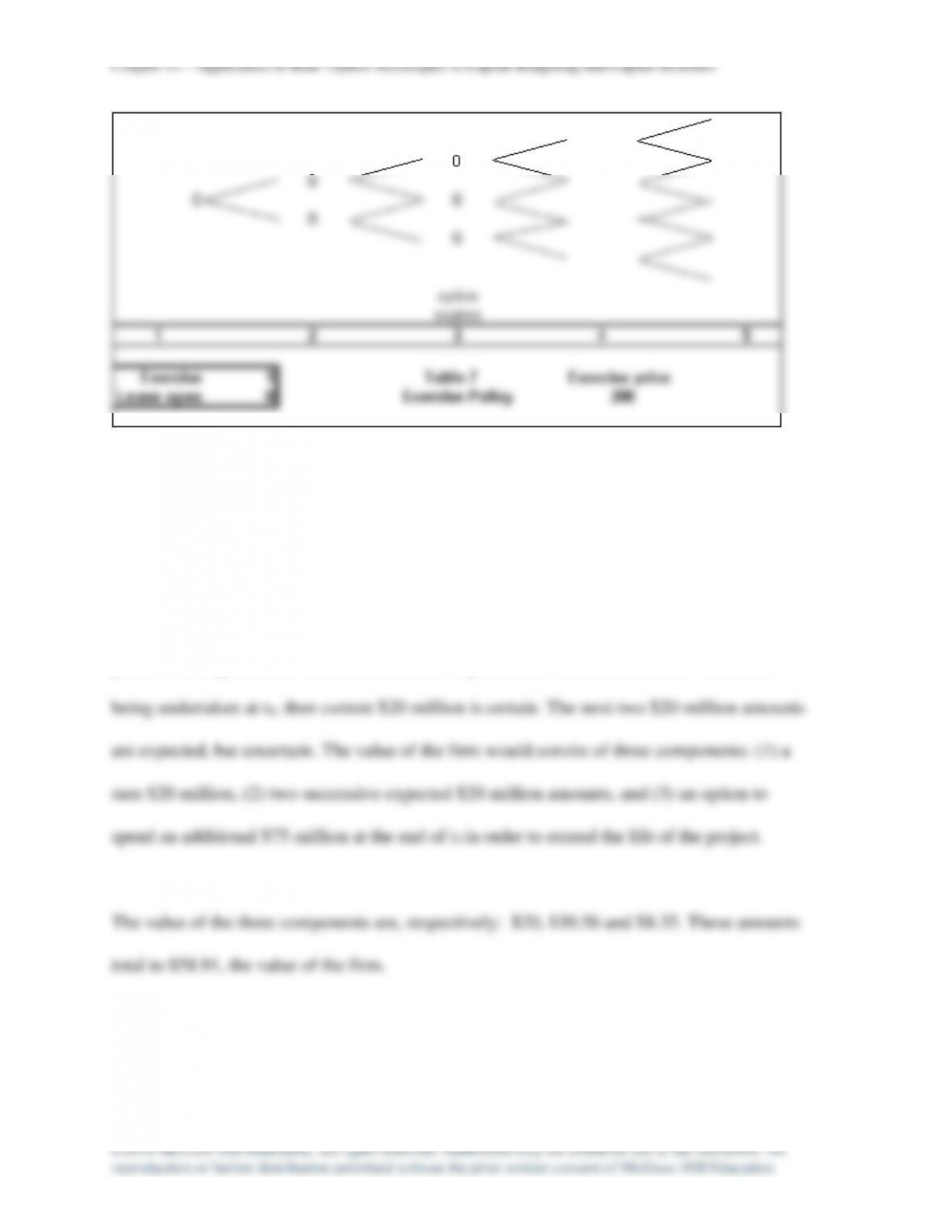
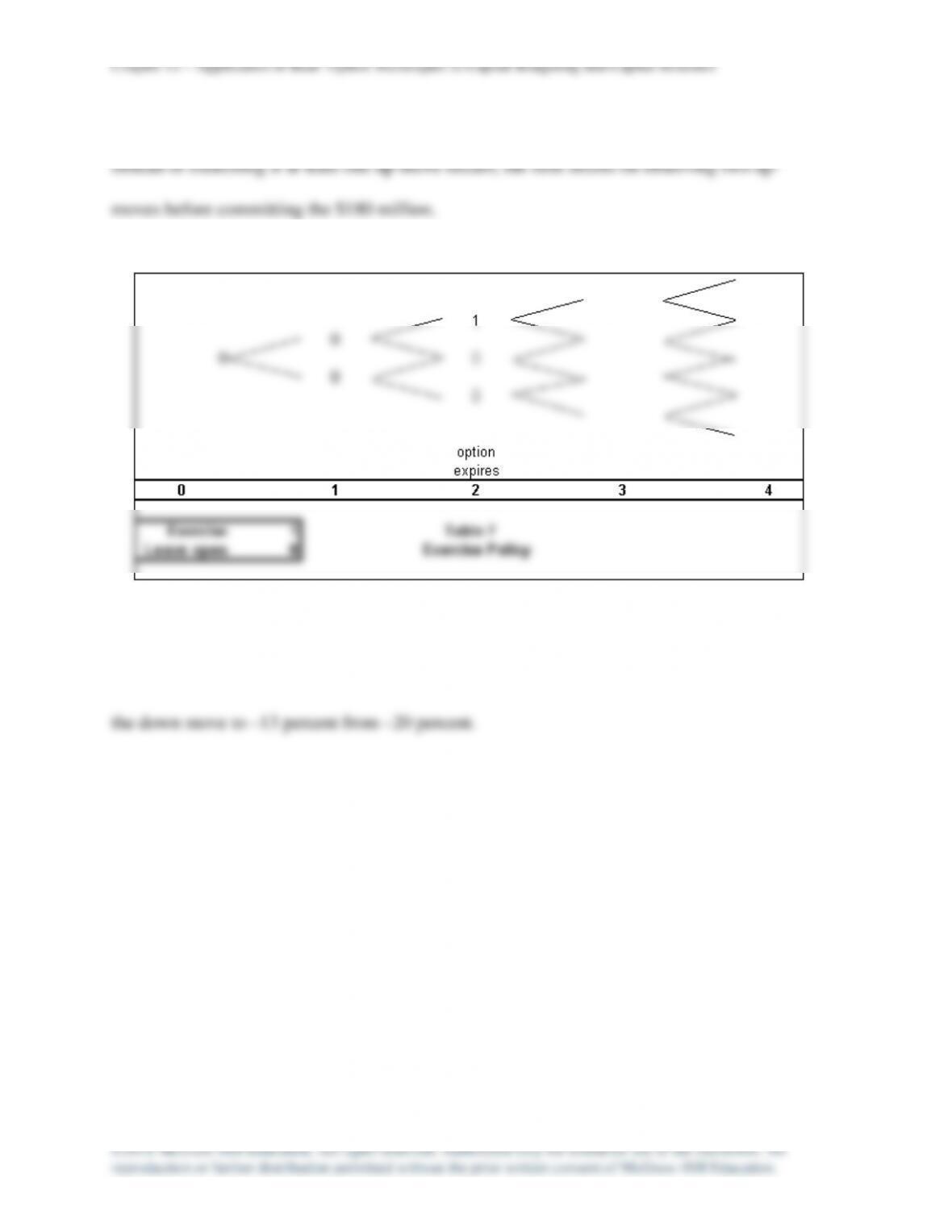
Below, notice how the exercise policy changes as the amount to be reinvested increases.
Chapter 12 – Application of Real- Option Techniques to Capital Budgeting and Capital Structure
10
11
3. An acquirer who purchased at t1 and received the $20 million cash flow in t1 would
perceive an expected $20 million at t2 and an expected $20 million at t3. If the valuation is
12
4. Increasing the discount rate reduces the present value of the future cash flows. Now
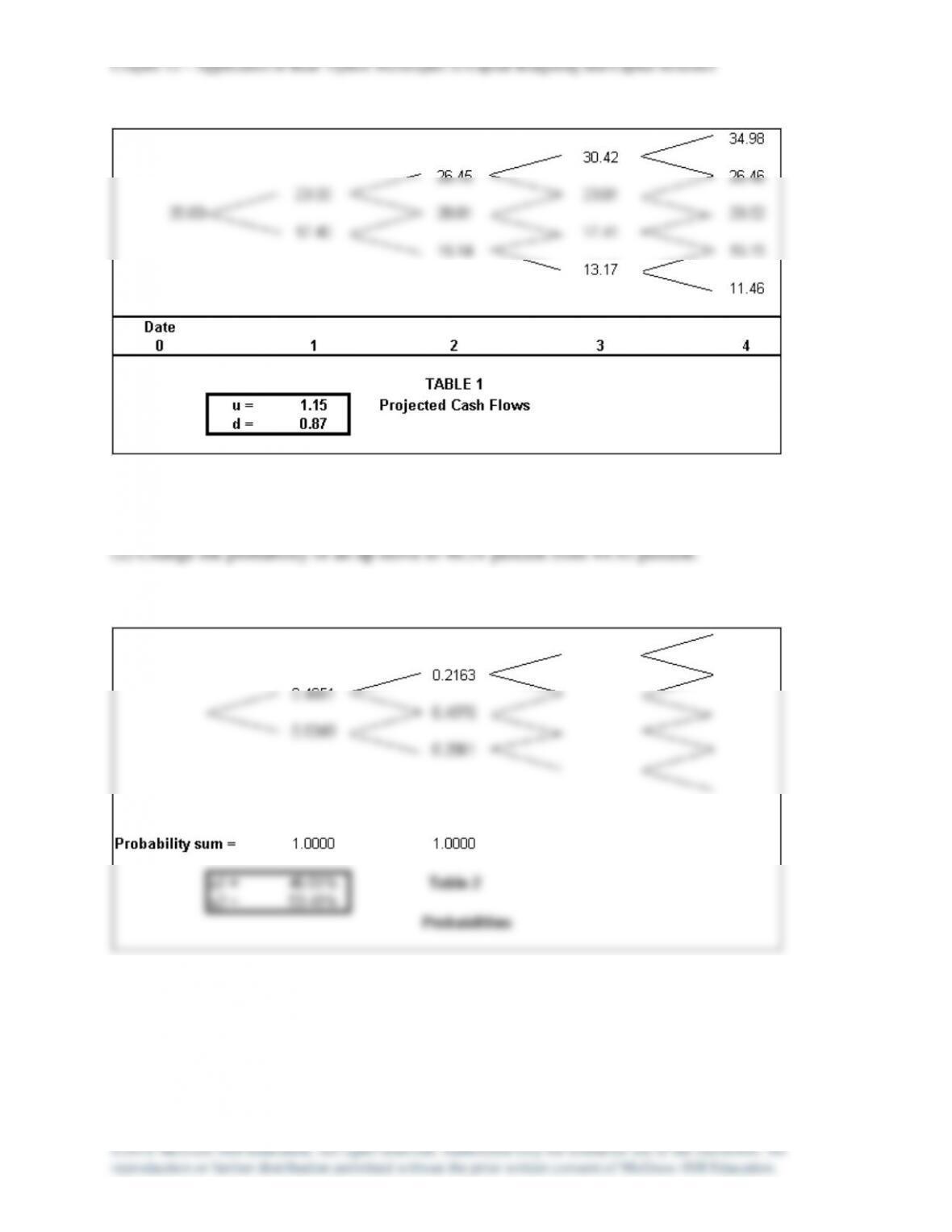
5. The changes occur as follows. (1) Change the up move to 15 percent from 25 percent, and
13
(3) Change the required rate of return to 10 percent from 15 percent.

Chapter 12 – Application of Real- Option Techniques to Capital Budgeting and Capital Structure
14
With these changes, expected growth becomes positive. The present value table becomes
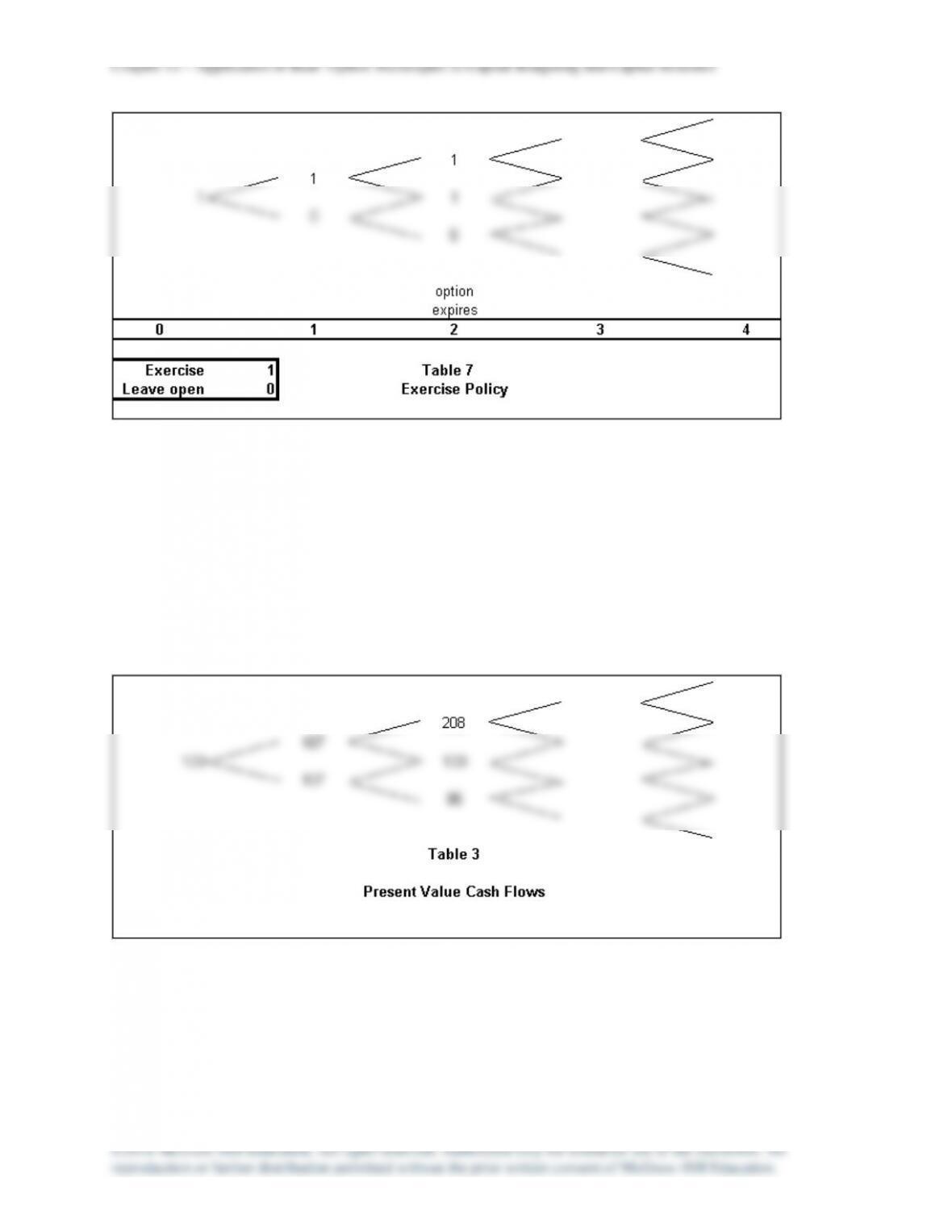
The expected return becomes 26.5 percent for an up-move and –4.3 percent for a down
move. The associated risk neutral probabilities become 30.27 percent and 69.73 percent.
The optimal exercise policy is:
15
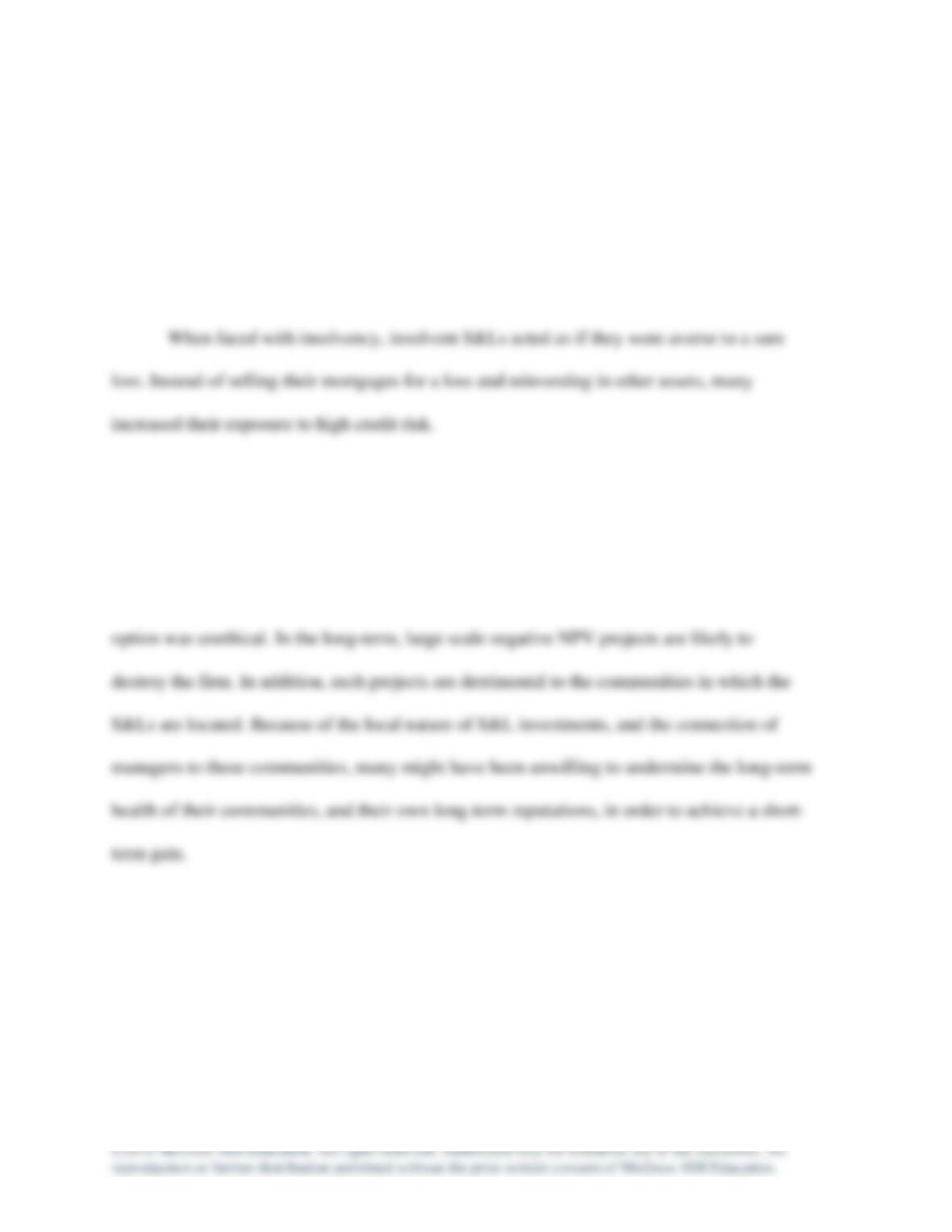
6. Overconfidence leads the firm’s managers to invest too early, after having observed just
one up-move. This leads managers to invest $180 million at a time when the project NPV is
negative, even though the managers believe the NPV to be positive. The actual PV-tree is as
follows:
In contrast, managers believe the PV-tree to be:

Chapter 12 – Application of Real- Option Techniques to Capital Budgeting and Capital Structure
16
Chapter 12 – Application of Real- Option Techniques to Capital Budgeting and Capital Structure
17
Minicase
Case Analysis Questions
1. In 1982, the U.S. government, by not recognizing the value of its huge insurance liability
in respect to the S&L industry, engaged in opaque framing.
Only a relatively few firms appeared to act in ways that maximized the value of the
implicit put option associated with deposit insurance. Why might this have been the case?
Consider two possibilities. The first possibility is that the managers of these firms
decided that investing in negative NPV projects in order to increase the value of the implicit
The second possibility is that managers did not understand how their actions would
affect the value of the implicit options held by equity holders. Option valuation is not
intuitive. The valuation problems might have been opaque to most managers of S&Ls.