
(WACC)? Answer: See Chapter 11 PowerPoint file.
(2.) Should the component costs be figured on a before-tax or an after-tax basis? Answer: See Chapter 11
1
2
3
4
5
6
7
8
9
10
11
12
20
21
22
23
24
30
31
32
33
34
35
41
42
43
44
A B C D E F G H I
1/6/2015
Situation
COST OF DEBT, rd
N30
B-T rd10%
Chapter 11. Mini Case
(1) The firm’s tax rate is 40%.
The relevant cost of debt is the after-tax cost of new debt, taking account of the tax deductibility of interest. The after-
tax rate is calculated by multiplying the interest rate (or the before-tax cost of debt) times one minus the tax rate.
To help you structure the task, Leigh Jones has asked you to answer the following questions.
(5) Harry Davis’s target capital structure is 30% long-term debt, 10% preferred stock, and 60% common equity.
b. What is the market interest rate on Harry Davis’s debt and what is the component cost of this debt for WACC
purposes?
During the last few years, Harry Davis Industries has been too constrained by the high cost of capital to make many
capital investments. Recently, though, capital costs have been declining, and the company has decided to look
seriously at a major expansion program that has been proposed by the marketing department. Assume that you are
an assistant to Leigh Jones, the financial vice president. Your first task is to estimate Harry Davis’s cost of capital.
Jones has provided you with the following data, which she believes may be relevant to your task:
a. (1.) What sources of capital should be included when you estimate Harry Davis’s weighted average cost of capital
(2) The current price of Harry Davis’s 12% coupon, semiannual payment, noncallable bonds with 15 years remaining
to maturity is $1,153.72. Harry Davis does not use short-term interest-bearing debt on a permanent basis. New bonds
would be privately placed with no flotation cost.
Davis would incur flotation costs equal to 5% of the proceeds on a new issue.
(4) Harry Davis’s common stock is currently selling at $50 per share. Its last dividend (D0) was $3.12, and dividends
are expected to grow at a constant rate of 5.8% in the foreseeable future. Harry Davis’s beta is 1.2, the yield on T-
bonds is 5.6%, and the market risk premium is estimated to be 6%. For the own-bond-yield-plus-judgmental-risk-
premium approach, the firm uses a 3.2% judgmental risk premium.
52
53
54
55
56
57
Preferred stock carries a higher risk to investors than debt. Companies are not required to pay preferred dividends
although, firms typically want to pay preferred dividends. Otherwise, they cannot pay common dividends, so there
will be difficulty raising additional funds, and preferred stockholders may gain control of the firm.
67
68
69
70
74
75
76
77
78
79
80
81
82
83
84
d. (1.) What are the two primary ways companies raise common equity? Answer: See Chapter 11 PowerPoint file.
(2.) Why is there a cost associated with reinvested earnings? Answer: See Chapter 11 PowerPoint file.
96
97
99
101
102
103
104
105
106
107
108
A B C D E F G H I
COST OF PREFERRED STOCK, rps
Example:
rps 9%
rd10%
T40%
COST OF EQUITY (INTERNAL), rs
The CAPM Approach
rs = Risk-free rate + (Market risk premium) (Beta)
rs = rRF + (RPM) bi (Note: RPM is the expected return on the market minus the risk-free rate.)
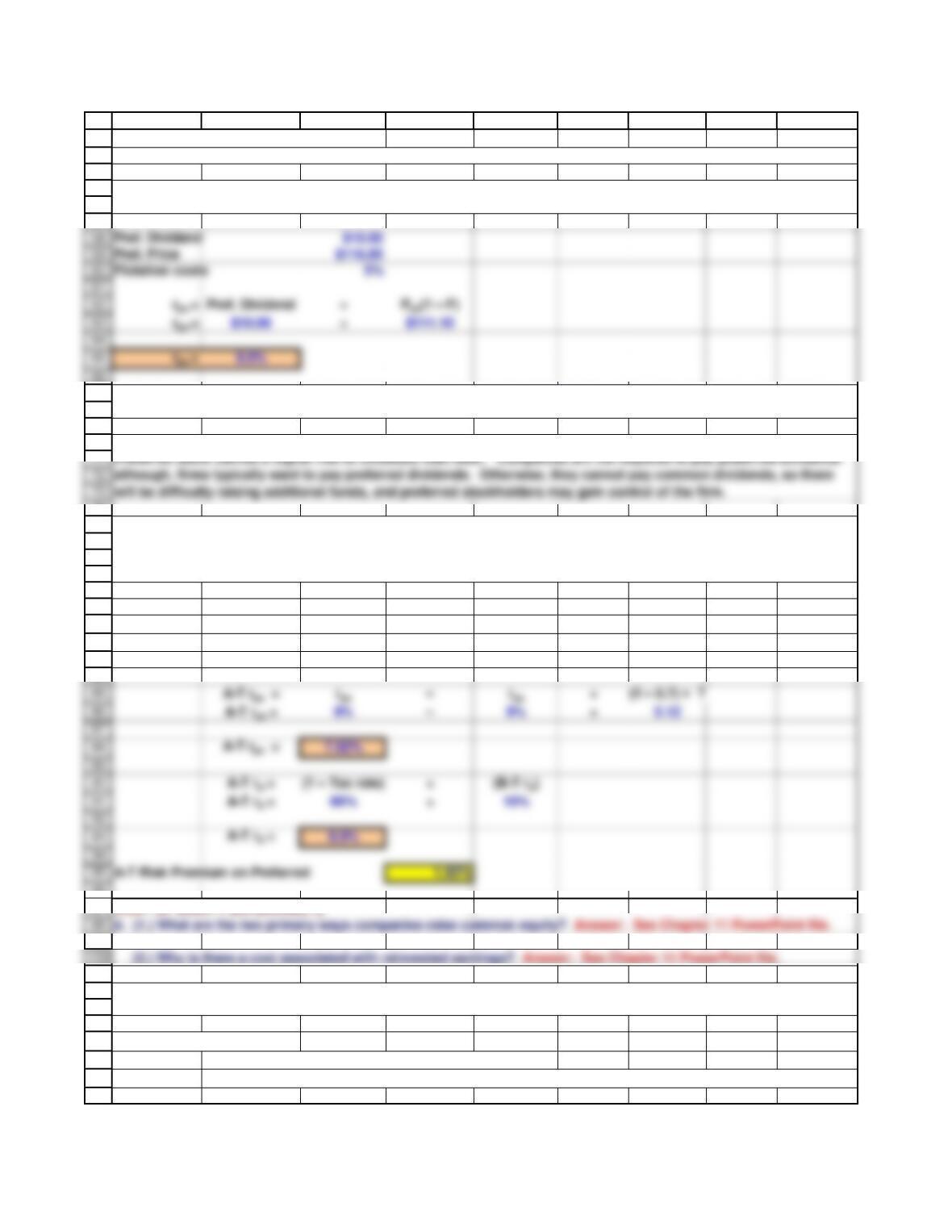
The cost of preferred stock is simply the preferred dividend divided by the price the company will receive if it issues
new preferred stock. No tax adjustment is necessary, as preferred dividends are not tax deductible.
Corporations own most preferred stock, because 70% of preferred dividends are non-taxable to corporations.
Therefore, preferred stock often has a lower before-tax yield than the before-tax yield on debt. But, the after-tax costs
to the issuer are higher on preferred stock than debt. This is consistent with the higher risks of preferred stock.
(2.) Harry Davis’s preferred stock is riskier to investors than its debt, yet the preferred’s yield to investors is lower
than the
(3.) Harry Davis doesn’t plan to issue new shares of common stock. Using the CAPM approach, what is Harry
Davis’s estimated cost of equity?
c. (1.) What is the firm’s cost of preferred stock?
to determine the marginal investor’s expected future growth rate. Three approaches are commonly used: (1)
historical growth rates, (2) retention growth model, and (3) analysts’ forecasts.
D0 =$3.12
D1 =$3.30
156
109
110
111
112
113
121
122
123
124
125
130
131
132
133
134
143
144
145
146
147
148
149
150
151
152
158
159
160
161
162
163
164
165
166
A B C D E F G H I
PROBLEM
Risk-free rate 5.6%
THE DISCOUNTED CASH FLOW APPROACH
e. (1.) What is the estimated cost of equity using the discounted cash flow (DCF) approach?
P0 =$50.00
2. Retention Growth Model
Find g:
Payout rate = 62%
BONUS: APPLICATION OF THE DISCOUNTED CASH FLOW APPROACH WHEN GROWTH IS NOT CONSTANT
(3.) Could the DCF method be applied if the growth rate was not constant? How?
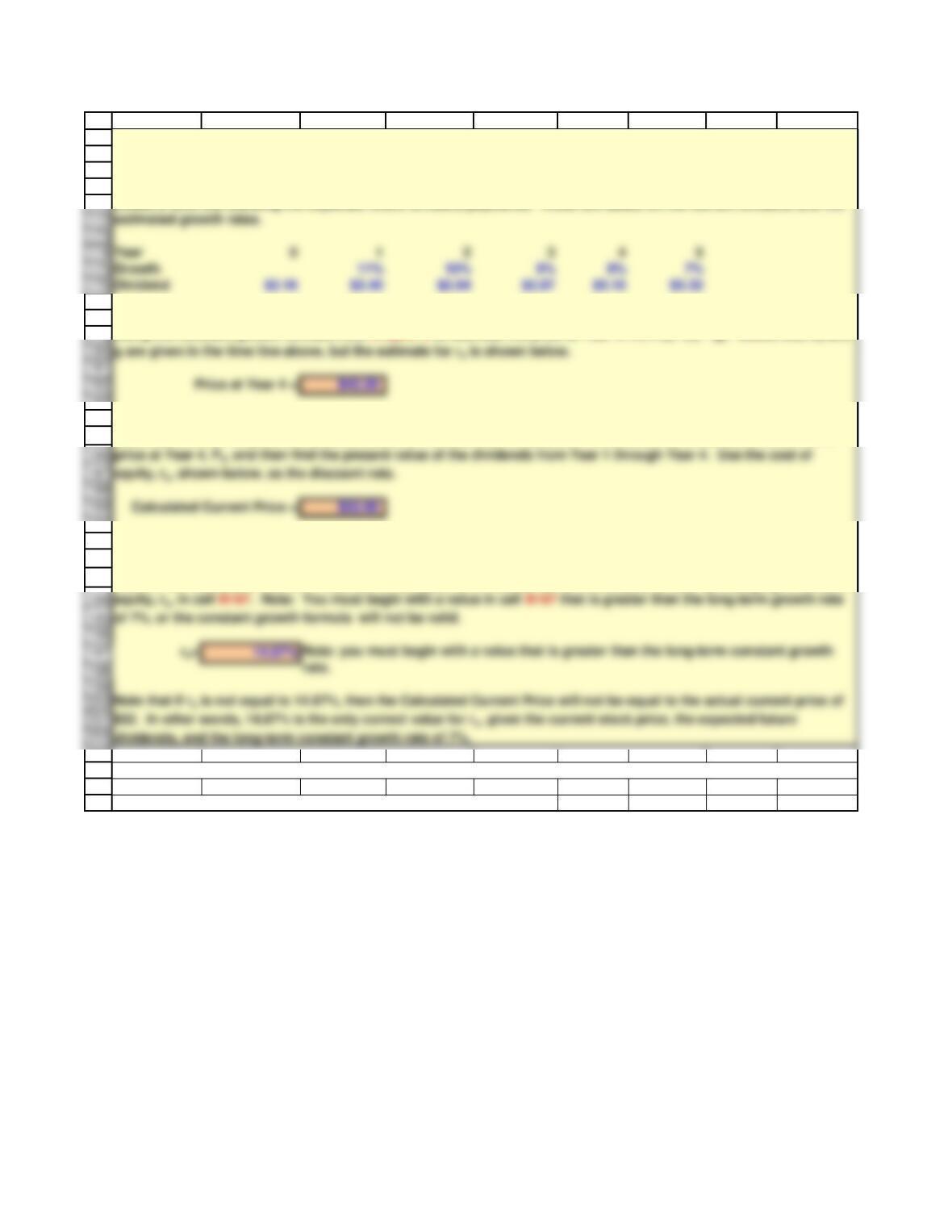
Suppose the current dividend is $2.16 per share and the current actual price that we observe is $32.00 per share.
Analysts forecast growth of 11% the first year, 10% the second year, 9% the third year, 8% the fourth year, and 7%
thereafter. Estimate the cost of equity.
As we noted earlier, analysts often provide non-constant estimates of future growth. We can use a modification of
the discounted cash flow valuation procedure for non-constant growth from Chapter 8 to estimate the cost of equity.
e. (2.) Suppose the firm has historically earned 15% on equity (ROE) and retained 35% of earnings, and investors
expect this situation to continue in the future. How could you use this information to estimate the future dividend
growth rate, and what growth rate would you get? Is this consistent with the 5% growth rate given earlier?
Suppose a firm’s stock trades at $50 and its most recent dividend was $3.12. If the expected constant growth rate is
5.8%, what is the firm’s cost of equity?
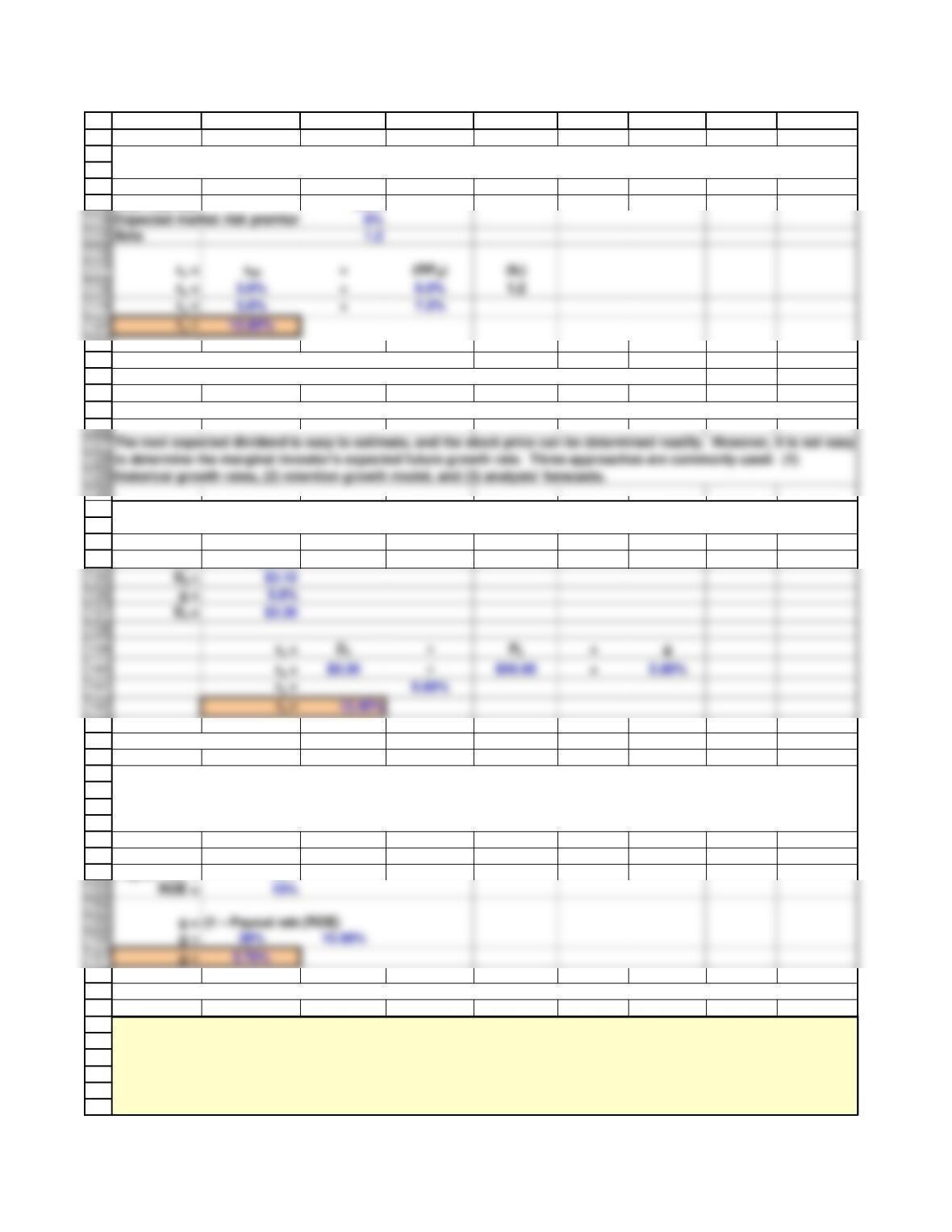
Assuming the risk-free rate (i.e., the current yield on a long-term Treasury bond) equals 5.6%, the expected market
risk premium is 6%, and the firm’s beta is 1.2, what is the company‘s cost of equity from internal funds?
The simplest DCF model assumes that growth is expected to remain constant, and in this case: rs = D1/P0 + g.
Expected market risk premium
g are given in the time line above, but the estimate for rs is shown below.
167
168
169
170
171
177
178
179
price at Year 4, P4, and then find the present value of the dividends from Year 1 through Year 4. Use the cost of
equity, rs, shown below, as the discount rate.
183
184
185
equity, rs, in cell B197. Note: You must begin with a value in cell B197 that is greater than the long-term growth rate
of 7%, or the constant growth formula will not be valid.
Note that if rs is not equal to 14.87%, then the Calculated Current Price will not be equal to the actual current price of
$32. In other words, 14.87% is the only correct value for rs, given the current stock price, the expected future
dividends, and the long-term constant growth rate of 7%.
190
191
192
193
203
204
205
206
A B C D E F G H I
Step 1:
Step 2:
Step 3:
Step 4:
THE BOND-YIELD-PLUS-JUDGMENTAL-RISK-PREMIUM APPROACH
Create a time line showing the expected future dividend payments. These are based on the current dividend and the
Using the constant growth formula from Chapter 8 to estimate the price at Year 4: P4 = D5 / (rs – g). Notice that D5 and
Calculate the current price of the stock, based on the estimate of rs below. To do this, find the present value of the
Suppose the current dividend is $2.16 per share and the current actual price that we observe is $32.00 per share.
Analysts forecast growth of 11% the first year, 10% the second year, 9% the third year, 8% the fourth year, and 7%
thereafter. Estimate the cost of equity.
Use Goal Seek to determine the cost of equity, rs, shown below. Click Tools (What-If Analysis), Goal Seek and set the
value of the Calculated Current Price, cell C189, equal to the actual current stock price of $32 by changing the cost of
f. What is the cost of equity based on the over-own-bond-yield-plus-judgmental-risk-premium method?
estimated growth rates.
207
208
209
210
211
212
213
214
215
220
221
222
223
224
225
226
227
232
233
234
235
236
237
238
239
243
245
248
249
251
252
253
254
255
256
257
258
A B C D E F G H I
Over-own-bond-judgmental risk premium = 3.2%
Bond yield = 10.0%
THE COST OF EQUITY ESTIMATE
Method
Cost of Equity
CAPM rs = 12.8%
THE WEIGHTED AVERAGE COST OF CAPITAL
T = 40%
-Their capital structure is 10% debt and 90% common equity.
-Their cost of debt is typically 12%.
-The beta is 1.7.
The weighted average cost of capital (WACC) is calculated using the firm’s target capital structure together with its
after-tax cost of debt, cost of preferred stock, and cost of common equity.
It is common to use several methods to estimate the cost of equity, and then find the average of these methods.
h. What is Harry Davis’s weighted average cost of capital (WACC)?
Given this information, what would your estimate be for the new division’s cost of capital?
k. What procedures are used to determine the risk-adjusted cost of capital for a particular division? What
l. Harry Davis is interested in establishing a new division that will focus primarily on developing new Internet-based
projects. In trying to determine the cost of capital for this new division, you discover that specialized firms involved
in similar projects have on average the following characteristics:
g. What is your final estimate for the cost of equity, rs?
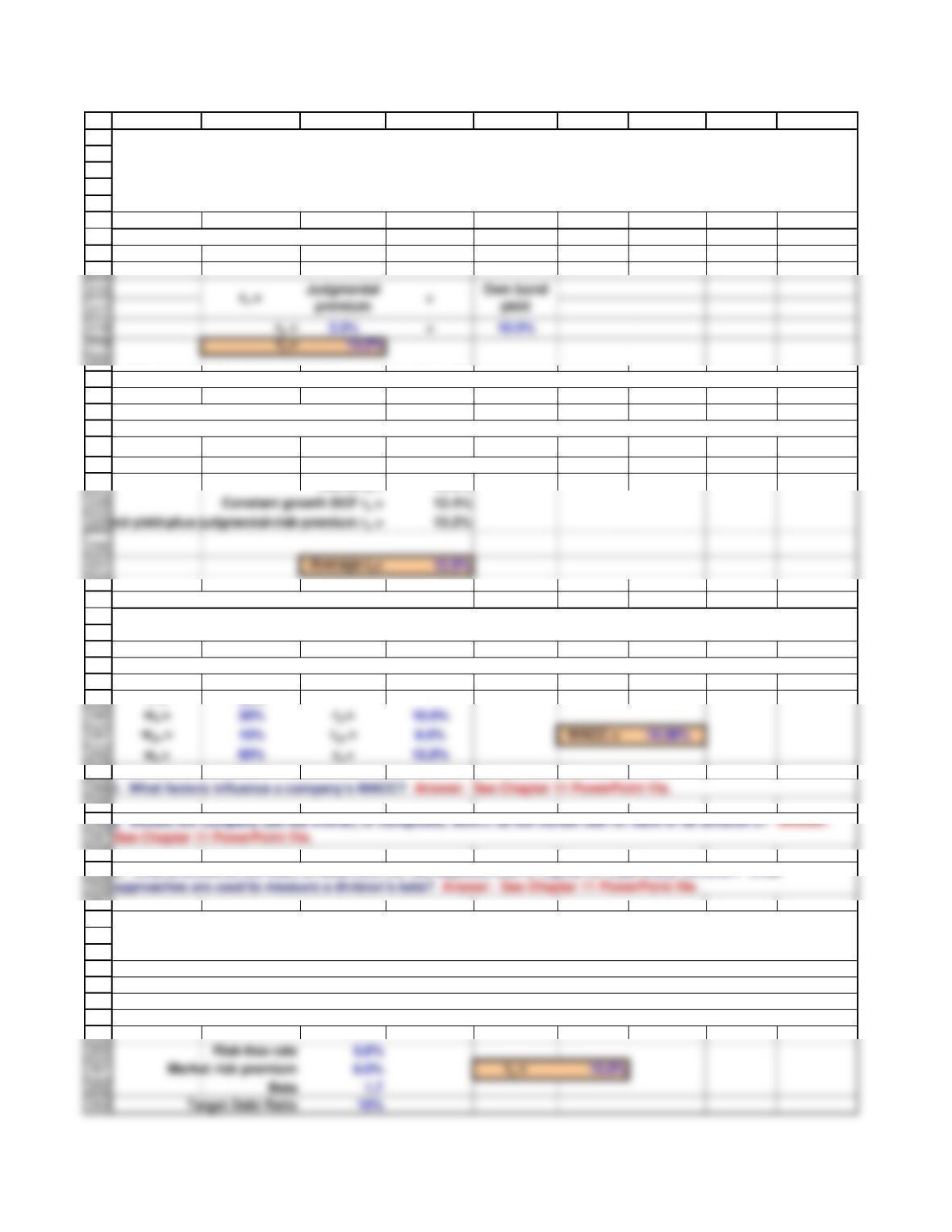
This approach consists of adding a judgmental risk premium to the yield on the firm’s own long-term debt. It is
logical that a firm with risky, low-rated debt would also have risky, high-cost equity. Historically, we have observed
that the risk premium for equity is in the range of 3 to 5 percentage points. This method provides a ballpark estimate,
and it is generally used as a check on the CAPM and DCF estimates. This method is used primarily in utility rate case
hearings.
264
265
266
m. What are three types of project risk? How is each type of risk used? Answer: See Chapter 11 PowerPoint file.
raised internally as retained earnings. Answer: See Chapter 11 PowerPoint file.
D0 =$3.12
273
274
275
276
278
279
281
282
283
284
285
286
287
288
289
290
291
302
303
304
305
306
307
314
315
316
317
318
319
A B C D E F G H I
rd12%
Tax Rate 40%
ADJUSTING THE COST OF CAPITAL FOR FLOTATION COSTS
P0 =$50.00
Net proceeds after flotation costs =
(Stock Price) (1 – F)
Net proceeds after flotation costs =
$50.00 85%
Net proceeds after flotation costs = $42.50
Net proceeds after flotation costs = $42.50
This indicates that the division’s market risk is greater than the firm’s average division. Typical projects within this
new division would be accepted if their returns are above the divisional WACC.
n. Explain in words why new common stock that is raised externally has a higher percentage cost than equity that is
Notice that this cost of stock is quite different than the cost of stock without flotation costs. To find the cost of
perpetual preferred stock, simply use the procedure above with g = 0. If the preferred stock has a fixed maturity, then
use the same procedure as for debt, except that the preferred dividend is not tax deductible.
o. (2.) Suppose Harry Davis issues 30-year debt with a par value of $1,000 and a coupon rate of 10%, paid annually. If
flotation costs are 2%, what is the after-tax cost of debt for the new bond issue?
o. (1.) Harry Davis estimates that if it issues new common stock, the flotation cost will be 15%. Harry Davis
incorporates the flotation costs into the DCF approach. What is the estimated cost of newly issued stock, taking into
account the flotation cost?
Flotation costs are the fees charged by investment bankers plus the accounting and legal expenses associated with
the issuance of new securities. A company cannot use the entire proceeds of a new security issuance, because it
must use some of the proceeds to pay the flotation costs.
268
269

320
321
322
328
329
330
331
338
339
340
341
342
348
349
350
351
A B C D E F G H I
PROBLEM: Flotation Costs and the Cost of Debt
After-tax coupon payment =
(Coupon
pmt.)
(1 – Tax
rate)
Number of coupon payments = N = 30
Now find the rate that the company pays, based on its net proceeds after flotation costs and its after-tax payments.
First, calculate the after-tax coupon payments and the net proceeds after the flotation costs.
Notice that this after-tax cost of debt is only slightly higher than the after-tax cost of debt for which flotation costs are
ignored. Therefore, analysts often ignore the flotation costs of debt.
o. (2.) Suppose Harry Davis issues 30-year debt with a par value of $1,000 and a coupon rate of 10%, paid annually. If
flotation costs are 2%, what is the after-tax cost of debt for the new bond issue?