ANSWERS TO CHAPTER QUESTIONS
Chapter 11 Risk Management
1) Risk management is the process of establishing and controlling risk so as to achieve
the goals set out.
2) Portfolio management is often expressed in risk – return terms. Diversification
techniques in portfolio management help to control household risk. Besides the
3) Diversification, not “putting all your eggs in one basket” can assist in reducing risk.
4) A risk manager is in charge of the process of identifying objectives, establishing
exposures, matching appropriate risk management tools to exposure, actually
5) Business risk is taking a risk to receive a financial reward. An example is starting a
6) Term insurance. For a given outcome (financial inflow) such as faking injury term
insurance requires less of an outlay than whole life.
7) Reduce risk. The chance of an accident is lessened.
9) Term insurance. The need is only temporary.
10) The portfolio we are speaking about is the total portfolio consisting of all household
assets. By purchasing insurance on human or real assets you reduce the risk of a
11) Significant factors in selecting an insurance company include:
a) Financial strength
b) Service
12) The types of risk to human assets, and ways to reduce them include:
a) Health
i) Reduce stress
b) Illness or disability
i) Have appropriate insurance such as medical and disability.
c) Longevity – early death
i) Same as health.
d) Longevity – extra long life
i) Extra savings
13) Outlays by holders in early years in excess of mortality cost along with investment
returns that build up cash create a fund that is used in later years. At that time the
14) Insurance needs is a function of the goal set out. The goal may be to replace current
income, to fund a defined lifestyle, or just to handle a particular fixed-period expense
such as children’s educational cost. In each case insurance is to provide the resources
15) Not always. At some point the cash value can decline due to the sharp increase in the
mortality cost.
16) Term is pure mortality cost along with insurance company overhead costs including
profit. By deducting its cost from the life insurance policy you can compare extra
17) Variable life insurance provides alternative stock and bond investment vehicles for
cash value. Universal life provides more flexibility in payment terms and coverage.
18) Term could be more attractive even over twenty years if there is a realistic possibility
19) The strengths and weaknesses of term and whole life insurance are as follows:
a) Strengths of Term Life Insurance
i) Much cheaper to begin with
b) Weaknesses of Term Life Insurance
i) Price climbs markedly in later years
c) Strengths of Whole Life Insurance
i) Doesn’t rise in cost
d) Weaknesses of Whole Life Insurance
i) Hard to compare
20) Indexed universal life offers a cash value account tied to one or more market
benchmarks, such as the Standard & Poor’s 500 Index. This means your cash value
21) The three parts of an insurance policy are:
a) Mortality Charge: Insurance companies calculate the probability of death for any
group of insurance holders and places the expected value plus a premium as one
22) Longevity risk is the risk of living beyond normal expectations or dying prematurely.
A premature death situation would cause the other members of the household to

ANSWERS TO CHAPTER PROBLEMS
Chapter 11 Risk Management
1) Randy had two term policies to compare with costs as shown below. Calculate the
NPV at a 6 percent after-tax discount rate and the IRR. Which one should she
select and why?
Year
A
B
1
$225
$300
2
$275
$310
3
$350
$320
4
$400
$330
5
$500
$340
Excel Solution:
3 ($350) ($320)
4 ($400) ($330)
5 ($500) ($340)
2
3
4
9
10
11
12
A B C D
Year
Policy A
Premium
Policy B
Premium
1 ($225) ($300)
Discount Rate
6%
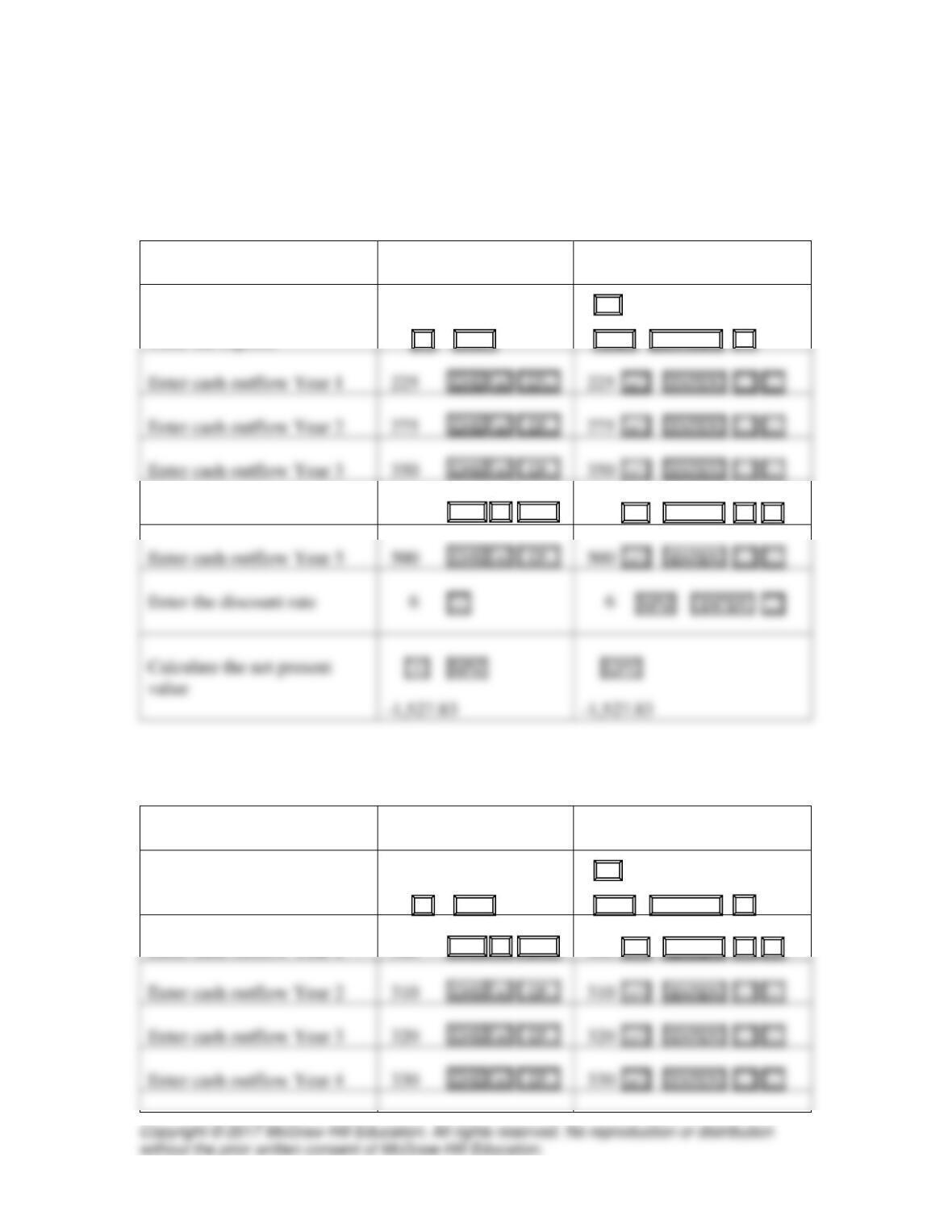
Calculator Solution
Policy A:
General Calculator Approach
Specific HP12C
Specific TI BA II Plus
Clear the register
Enter cash outflow Year 1
225
225
Enter cash outflow Year 2
275
275
Enter cash outflow Year 3
350
350
ENTER
↓
g
CHS
+/–
CFj
g
CHS
ENTER
↓
↓
+/–
g
CHS
ENTER
↓
↓
+/–
↓
Enter cash outflow Year 4
400
400
Enter cash outflow Year 5
500
500
Enter the discount rate
6
6
Calculate the net present
value
-1,527.83
-1,527.83
CFj
g
CHS
ENTER
NPV
i
ENTER
↓
Policy B:
General Calculator Approach
Specific HP12C
Specific TI BA II Plus
Clear the register
Enter cash outflow Year 1
300
300
Enter cash outflow Year 2
310
310
Enter cash outflow Year 3
320
320
Enter cash outflow Year 4
330
330
g
CHS
ENTER
↓
↓
+/–
CFj
g
CHS
ENTER
↓
↓
+/–
CFj
g
CHS
ENTER
f
FIN
CF
2nd
CLR Work
CFj
g
CHS
ENTER
↓
↓
+/–
↓
CF0
ENTER
↓
f
FIN
CF
2nd
CLR Work
g
CHS
+/–
↓
↓
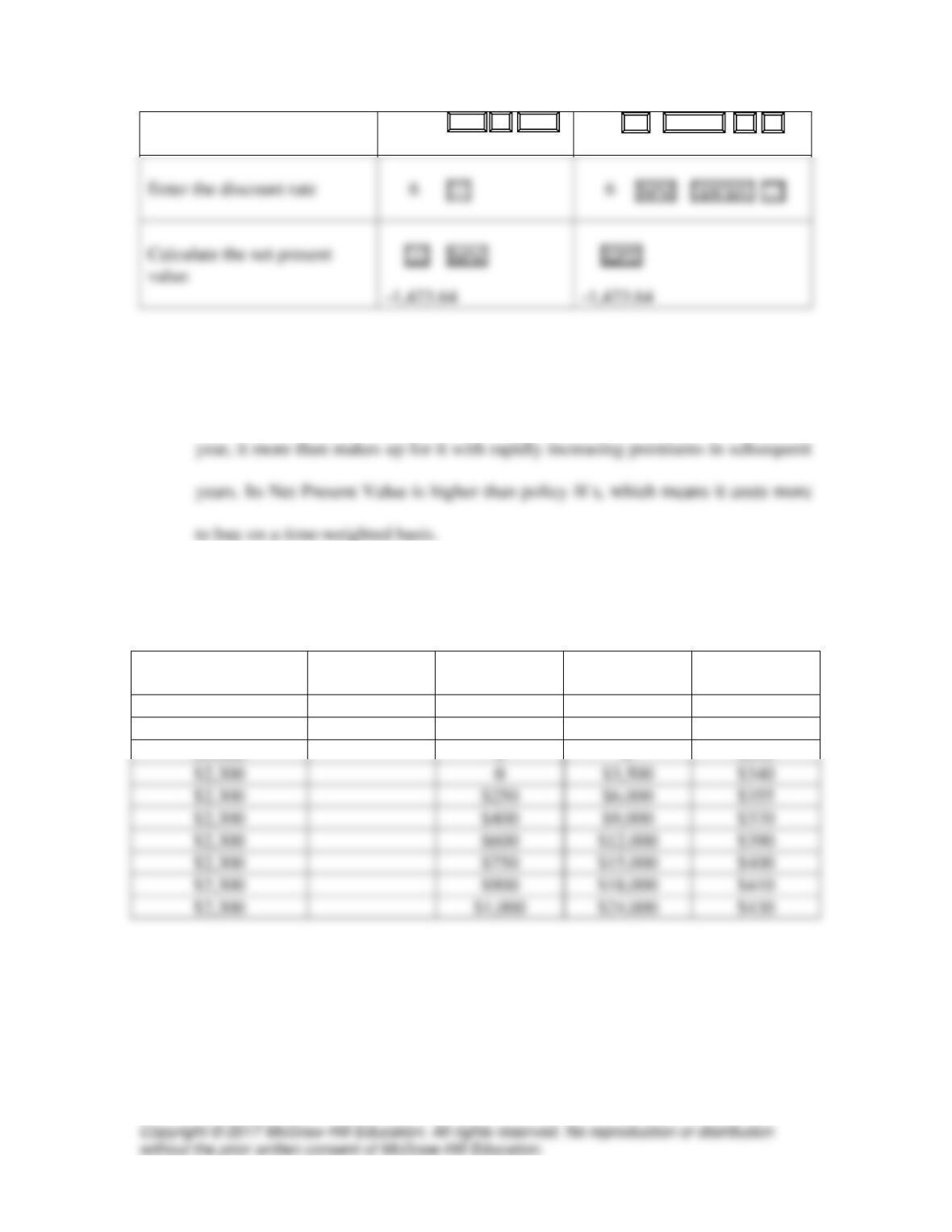
Enter cash outflow Year 5
340
340
Enter the discount rate
6
6
value
-1,423.64
-1,423.64
↓
Randy should select policy B. Although policy A is much cheaper in the first
2) Given the following information:
Guaranteed
Contract Premium
Guaranteed
Death Benefit
Projected
Dividend
Projected
Cash Value
Term
Premium
$2,300
$200,000
0
0
$325
$2,300
0
0
$330
$2,300
0
0
$335
$2,300
0
$340
$2,300
$250
$355
$2,300
$400
$370
$2,300
$600
$390
$2,300
$750
$400
$2,300
$900
$410
$2,300
$430
Find the return on the whole life insurance policy when the cost of term is
included. Which would you select if you can invest the difference between the
term and whole life policies’ premium at a 9 percent? Explain your reasoning.
Excel Solution
CFj
g
CHS
ENTER
↓
↓
+/–
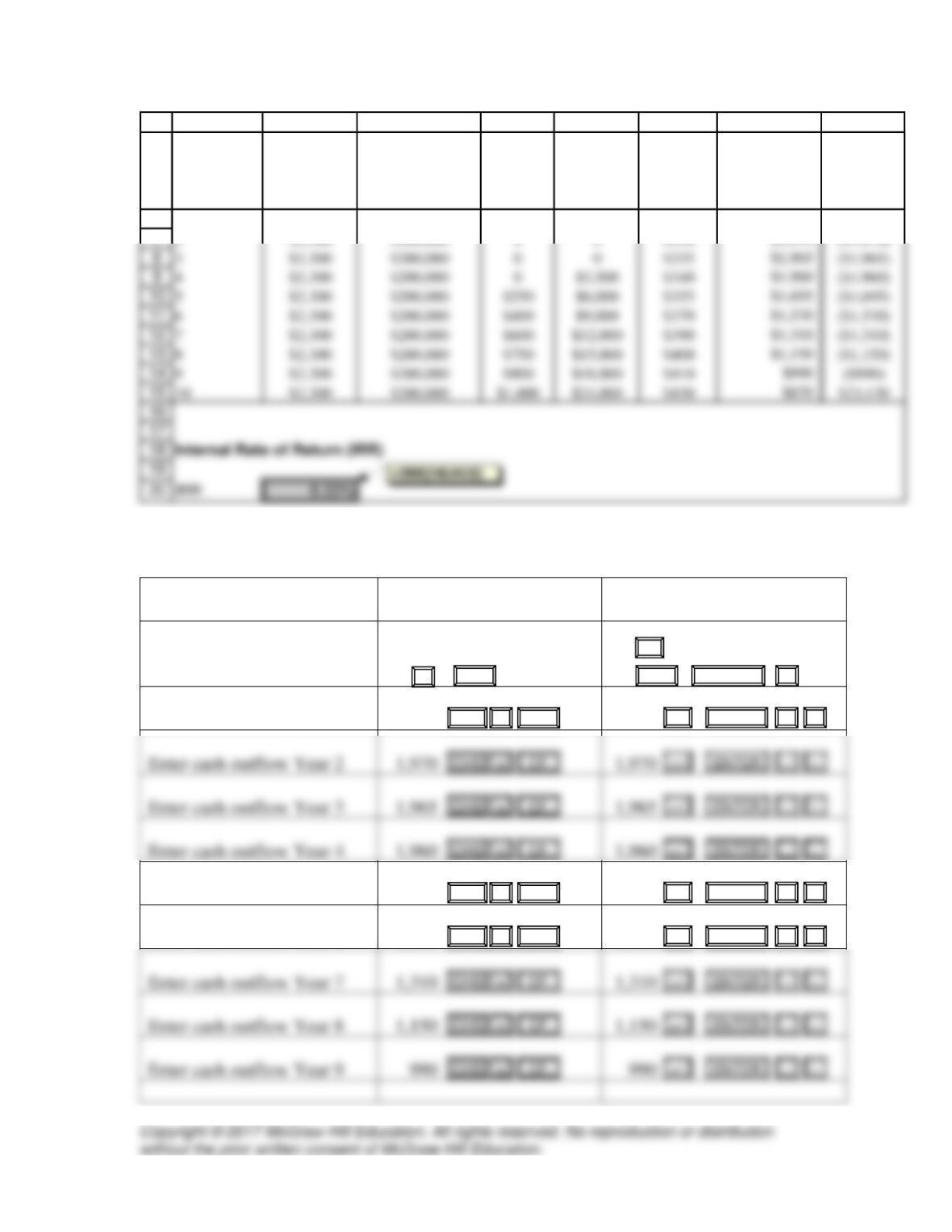
2 $2,300 $200,000 0 0 $330 $1,970 ($1,970)
3 $2,300 $200,000 0 0 $335 $1,965 ($1,965)
4 $2,300 $200,000 0 $3,500 $340 $1,960 ($1,960)
5 $2,300 $200,000 $250 $6,000 $355 $1,695 ($1,695)
6 $2,300 $200,000 $400 $9,000 $370 $1,530 ($1,530)
7 $2,300 $200,000 $600 $12,000 $390 $1,310 ($1,310)
8 $2,300 $200,000 $750 $15,000 $400 $1,150 ($1,150)
9 $2,300 $200,000 $900 $18,000 $410 $990 ($990)
5
6
A B C D E F G H
Year
Guaranteed
Contract
Premium
Guaranteed
Death Benefit
Projected
Dividend
Projected
Cash Value
Term
Premium
Life Premium
Minus Term
Premium and
Dividend
Cash Flows
1 $2,300 $200,000 0 0 $325 $1,975 ($1,975)
Calculator Solution:
General Calculator Approach
Specific HP12C
Specific TI BA II Plus
Clear the register
Enter cash outflow Year 1
1,975
1,975
Enter cash outflow Year 2
1,970
1,970
Enter cash outflow Year 3
1,965
1,965
Enter cash outflow Year 4
1,960
1,960
CFj
g
CHS
ENTER
↓
+/–
↓
CFj
g
CHS
ENTER
↓
+/–
↓
CFj
g
CHS
ENTER
↓
+/–
↓
Enter cash outflow Year 5
1,695
1,695
Enter cash outflow Year 6
1,530
1,530
Enter cash outflow Year 7
1,310
1,310
Enter cash outflow Year 8
1,150
1,150
CFj
g
CHS
ENTER
↓
+/–
↓
CFj
g
CHS
ENTER
↓
+/–
↓
CFj
g
CHS
ENTER
↓
+/–
↓
CFj
g
CHS
ENTER
↓
+/–
↓
CFj
g
CHS
ENTER
↓
+/–
↓
f
FIN
CF
2nd
CLR Work
↓
CF0
g
CHS
ENTER
↓
+/–
↓
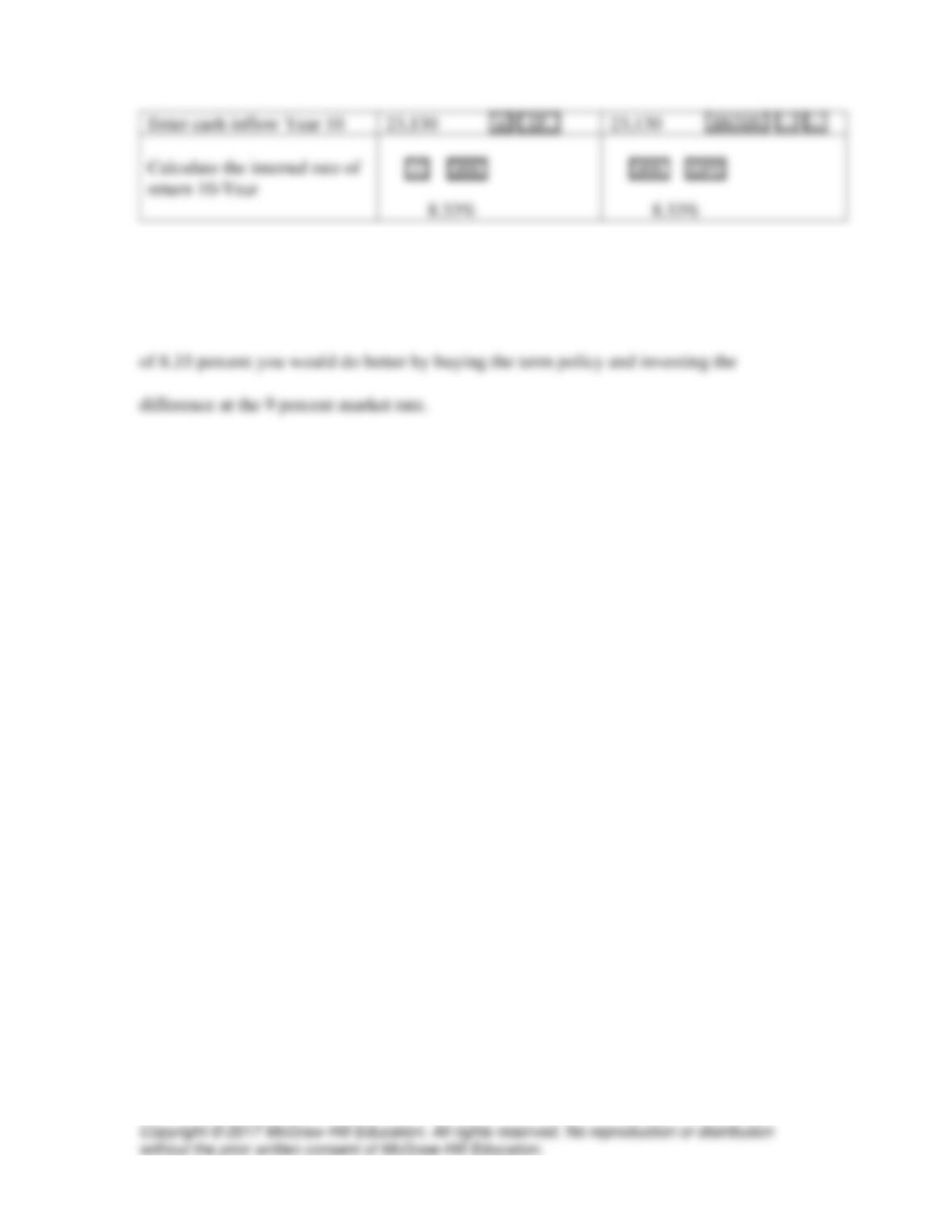
You should select the term policy. Since the whole life insurance policy provides a return
ANSWERS TO CASE APPLICATION QUESTIONS
Chapter 11 Risk Management
1) Their risk profile is fairly high. Richard’s human assets appear somewhat
vulnerable given his poor health habits, his inability to get along with co-workers
2) The focus needs to be placed on getting Richard to improve his health habits and
finding some way to focus on improvement in his present job. He has a strong
plus in being described as brilliant.
3) One cannot be too optimistic given Richard’s prior statements. However
Richard’s indication of turning over a new leaf sounds promising. An insurance
policy with Monica as beneficiary and her taking a job could help regardless of
what Richard does in active implementation.
4) Aside from the insurance and the job, Monica should consider their splitting their

5) As mentioned, yes. She is the most vulnerable in the event of setbacks. In the
6) Whole life would be very expensive but could continue for their full lives. The
cost of term would become unsustainable at some point. Whole life to the extent
affordable might be best.
Answers to CFP® Questions
Question
Answer
Author’s Explanation
Question 11.1
Question 11.2
Question 11.3
Question 11.4
ERRATA TO CFP® CERTIFICATION EXAMINATION QUESTIONS AND
PROBLEMS
11.1
The alternative c. is incorrectly stated in the book. Correct alternative should be: