Introduction to Corporate Finance, Fourth Edition Booth, Cleary, Rakita
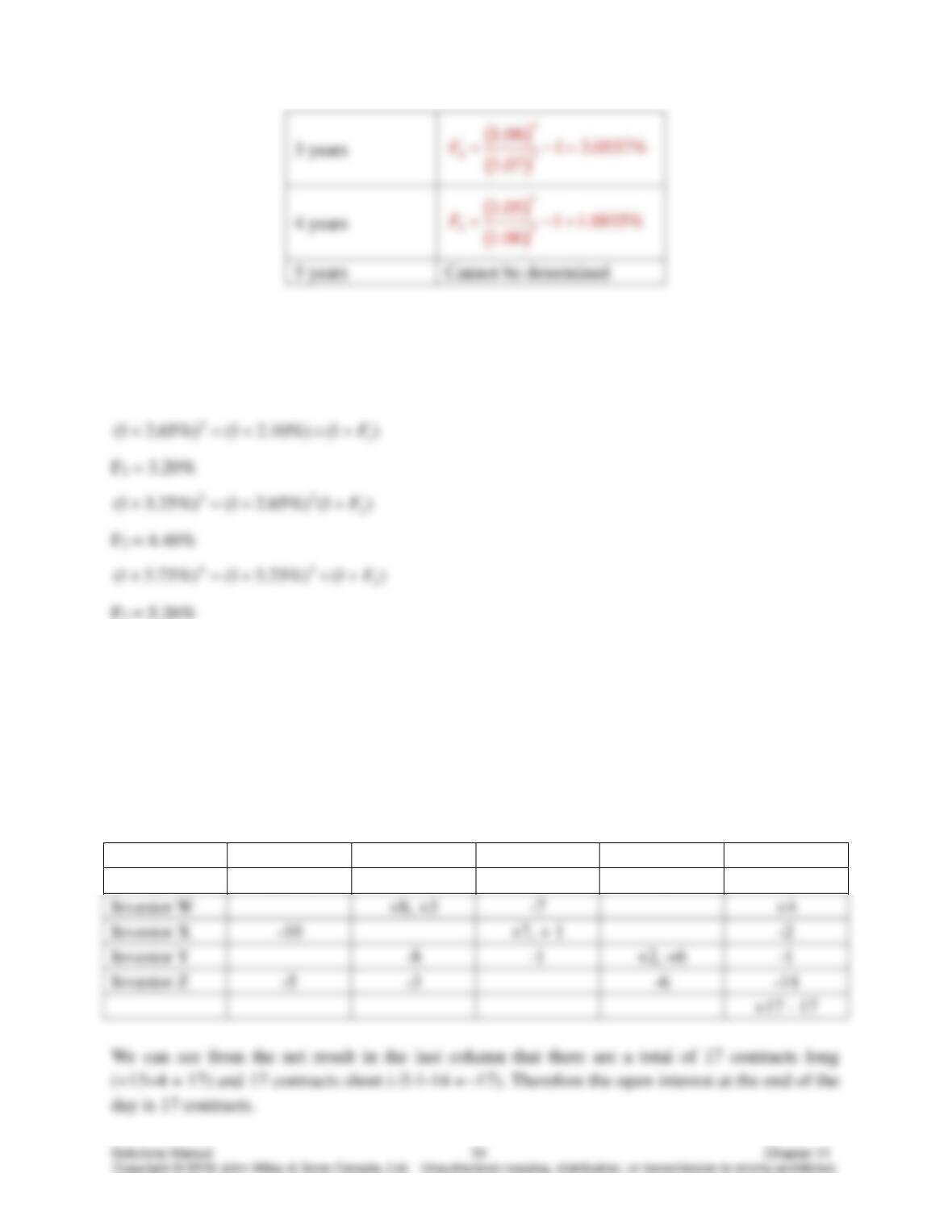
5 years
Cannot be determined
47. Appendix 11A
Learning Objective 11.5
Level of difficulty: Intermediate
Solution:
48. Section 11.2 Future Contracts
Learning Objective: 11.2
Level of difficulty: Intermediate
Solution:
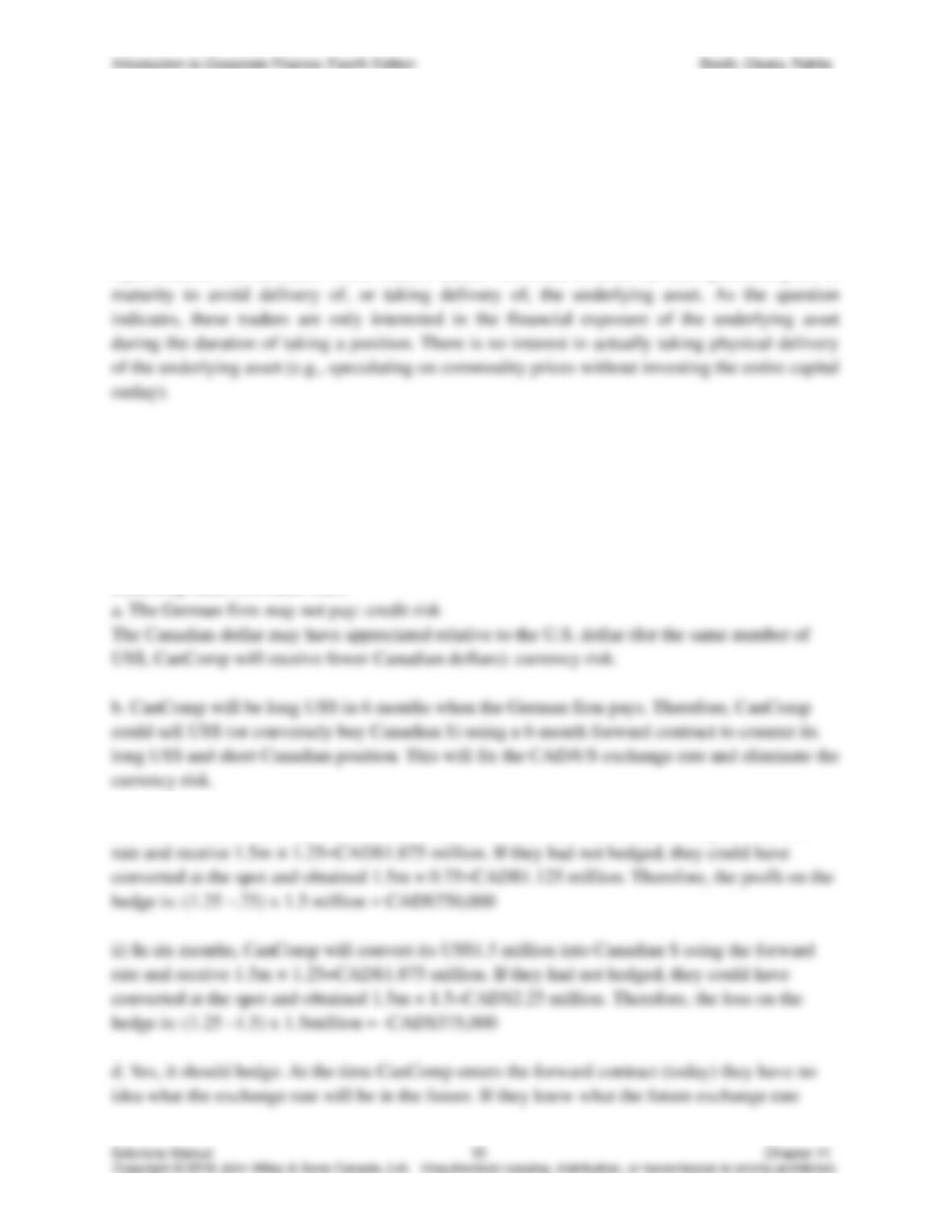
In the table below, a buy is recorded as a positive number and a sell is recorded as a negative
number.
Set 1
Set 2
Set 3
Set 4
Net
Investor V
+10, + 5
-2
+13
Investor W
-7
Investor X
-2
Investor Y
-8
-1
-1
Investor Z
-5
-3
-6
+17 – 17
49. Section 11.2 Future Contracts
Learning Objective: 11.2
Level of difficulty: Intermediate
Solution:
Open interest will decrease. These futures traders will want to close out their positions prior to
Challenging
50. Section 11.1 Forward Contracts
Learning Objective: 11.1
Level of difficulty: Challenging
Solution:
CanComp faces two main risks:
c.
i) In six months, CanComp will convert its US$1.5 million into Canadian $ using the forward
Introduction to Corporate Finance, Fourth Edition Booth, Cleary, Rakita
51. Section 11.1 Forward Contracts
Learning Objective: 11.1
Level of difficulty: Challenging
Solution:
a. Bert has not taken into account the link between the spot and the forward price. If the forward
b. In this question, the impact is on the cost of carry and the spot price. Once again, we will have
52. Section 11.3 Swaps
Learning Objective: 11.3
Level of difficulty: Challenging
Solution:
a. As Anthony’s income is very closely tied to market interest rates, he would prefer the floating
Introduction to Corporate Finance, Fourth Edition Booth, Cleary, Rakita
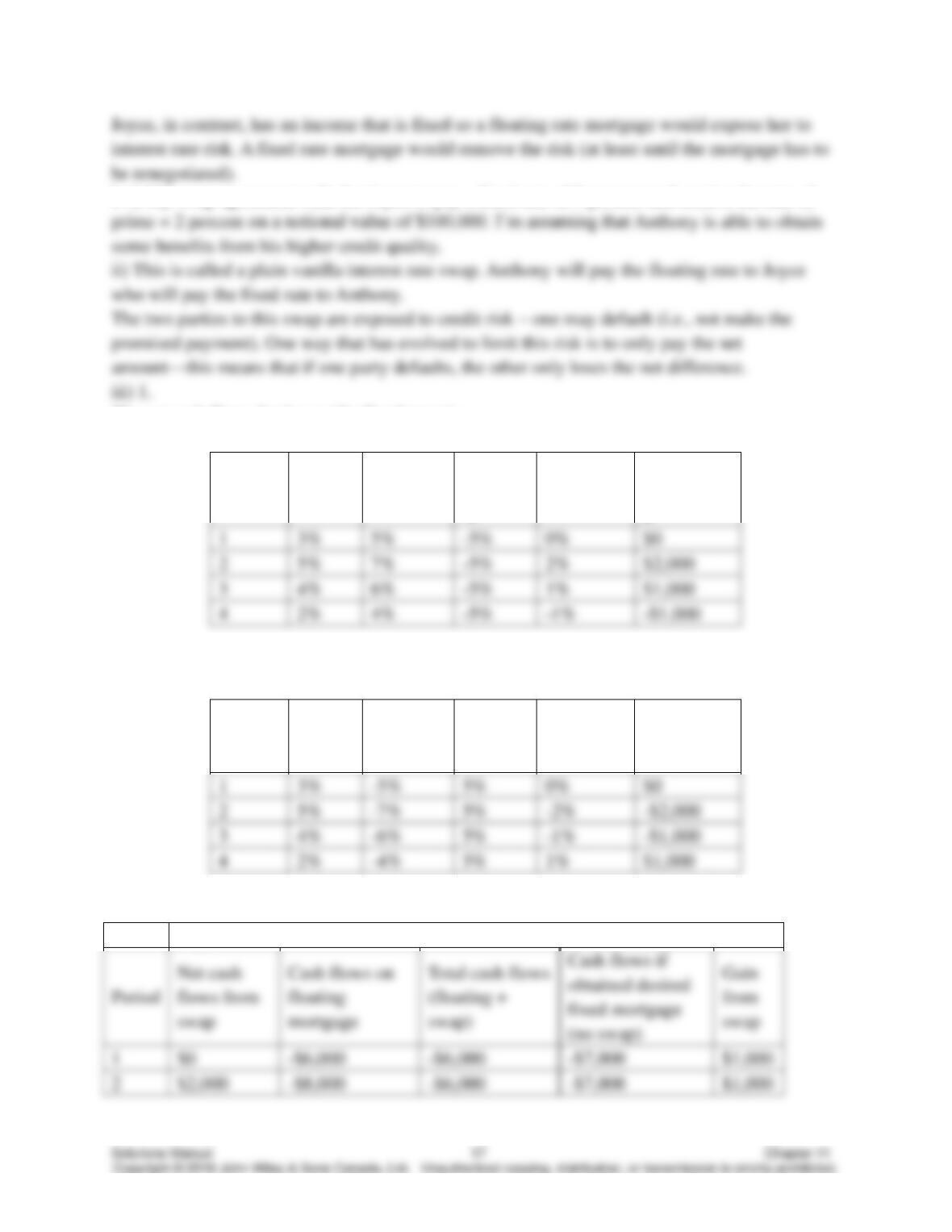
b. i) My swap agreement calls for Joyce to pay a fixed rate of 5 percent and receive the rate of
The net cash flows for Joyce (the fixed payer):
Start of
Period
PRIME
%
Floating
pay %
Fixed
pay
%
Net pay
%
Net pay on
swap
$
1
3%
5%
-5%
0%
$0
2
5%
7%
-5%
2%
$2,000
3
4%
6%
-5%
1%
$1,000
4
2%
4%
-5%
-1%
-$1,000
The net cash flows for Anthony (the fixed receiver):
Start of
Period
PRIME
%
Floating
pay %
Fixed
pay
%
Net pay
%
Net pay on
swap
$
1
3%
-5%
5%
0%
$0
2
5%
-7%
5%
-2%
-$2,000
3
4%
-6%
5%
-1%
-$1,000
4
2%
-4%
5%
1%
$1,000
iii) 2.
Joyce
Period
flows from
swap
floating
mortgage
(floating +
swap)
obtained desired
fixed mortgage
(no swap)
from
swap
1
$0
-$6,000
-$6,000
-$7,000
$1,000
2
$2,000
-$8,000
-$6,000
-$7,000
$1,000
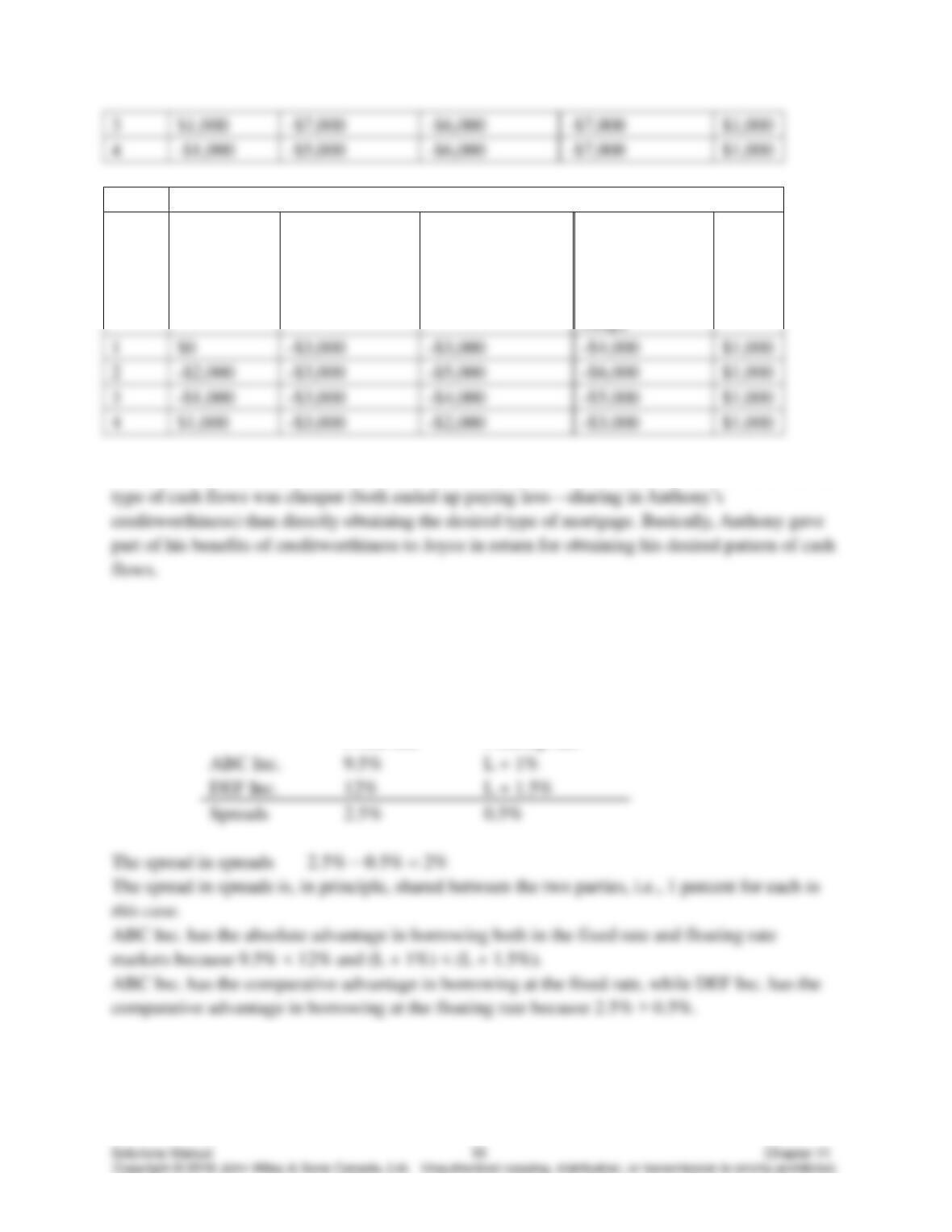
Introduction to Corporate Finance, Fourth Edition Booth, Cleary, Rakita
3
$1,000
-$7,000
-$6,000
-$7,000
$1,000
4
-$1,000
-$5,000
-$6,000
-$7,000
$1,000
Anthony
Period
Net cash
flows from
swap
Cash flows on
mortgage
Total cash flows
by individual
under swap
Cash flows if
obtained desired
floating
mortgage (no
swap)
Gain
from
swap
1
$0
-$3,000
-$3,000
-$4,000
$1,000
3
-$1,000
-$3,000
-$4,000
-$5,000
$1,000
4
$1,000
-$3,000
-$2,000
-$3,000
$1,000
We can see in the above tables that obtaining a mortgage and then swapping to obtain the desired
53. Section 11.3 Swaps
Learning Objective: 11.3
Level of difficulty: Challenging
Solution:
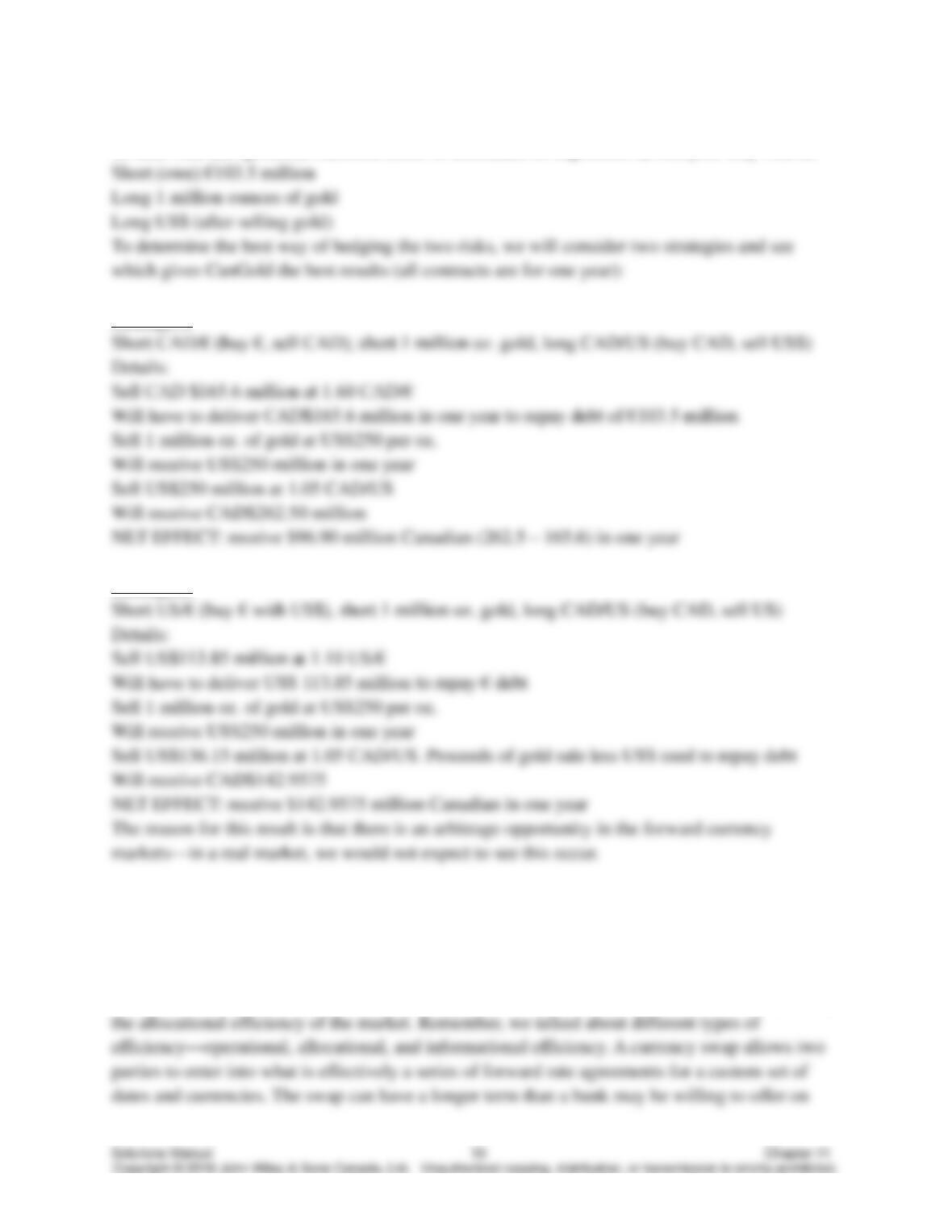
Fixed rate
Floating rate
ABC Inc.
9.5%
L + 1%
DEF Inc.
12%
L + 1.5%
Spreads
2.5%
0.5%
54. Section 11.3 Swaps
Learning Objective: 11.3
Level of difficulty: Challenging
Introduction to Corporate Finance, Fourth Edition Booth, Cleary, Rakita
Solution:
To deal with this question, CanGold needs to determine its exposures. In one year they will be:
Strategy 1:
Strategy 2:
55. Section 11.3 Swaps
Learning Objective: 11.3
Level of difficulty: Challenging
Solution:
One way that swaps, especially currency swaps, can make both parties better off is by improving
Introduction to Corporate Finance, Fourth Edition Booth, Cleary, Rakita
56. Appendix 11A
Learning Objective 11.5
Level of difficulty: Challenging
Solution:
a. At the end of year 2, bond C will have one year to maturity. To obtain the price of bond C at
b. This bond will have coupons at the end of years 1, 2, and 3. The cash flows in years 1 and 2
are $70 and the cash flow at the end of year 3 is $1,070. We need to discount each cash flow
57. Section 11.2 Future Contracts
Learning Objective: 11.2
Level of difficulty: Challenging
Solution:
Introduction to Corporate Finance, Fourth Edition Booth, Cleary, Rakita
Introduction to Corporate Finance, Fourth Edition Booth, Cleary, Rakita
Answers to Concept Review Questions
11.1 Forward Contracts
Concept review questions
1. Why do forward contracts involve credit risk for banks?
The party in a forward contract whose position incurs a loss from a changing spot price may decide
2. When would a speculator assume a long position in a forward contract on an underlying asset?
When would a speculator assume a short position?
In a currency forward contract, if for example, the Canadian dollar is expected to depreciate; a
3. When would a hedger assume a long position in a forward contract on an underlying asset?
When would a hedger assume a short position?
A Canadian importer of U.S. goods who needs to pay the seller in U.S. dollars has an exposure on
4. What is the relationship among spot rates, forward rates, and the cost of carry?
The spot rate is the current price for immediate delivery while the forward rate is the price set
11.2 Futures Contracts
Concept review questions
1. Define initial margin, maintenance margin, margin call, open interest, and notional amount.
Initial margin is a small deposit in a futures contract made by the long and the short positions with
the clearinghouse. It is between 2 and 10 percent of the value of the contract.
Introduction to Corporate Finance, Fourth Edition Booth, Cleary, Rakita
2. Explain what is meant by “marked to market”.
All futures contracts are marked to market at the end of each trading day and this means all profits
3. What is basis risk? Why is it important for hedgers?
Basis risk is the risk associated with a hedged position that is attributable to the fact that the asset to
4. Compare and contrast forwards and futures.
Though they are conceptually similar, forwards are customized and therefore offer more flexibility
than futures contracts which are standardized. Forwards trade over-the- counter while futures trade
11.3 Swaps
Concept Review Questions
1. Explain how plain vanilla interest rate swaps are structured and what purpose they serve.
Plain vanilla interest rate swaps serve to convert fixed rate debt into floating rate debt and
2. Explain how currency swaps are structured and how they can be used for hedging purposes.
Currency swaps are used to hedge foreign currency risk. A Canadian company owing US $1
Introduction to Corporate Finance, Fourth Edition Booth, Cleary, Rakita
3. Why does it make sense that interest rate swaps involve an exchange of net payments, while
currency swaps exchange all cash flows?
11.4 The Financial Crisis and the Credit Default Swap Market
Concept Review Questions
1. Explain the difference between an insurance contract and a credit default swap.
First, the risk attached to regular insurance is essentially random risk depends on factors unique
to an individual. In contrast, for a CDS the underlying risk depends on the economy and as a
2. How and why did AIG fail?
Many CDSs were sold as insurance to cover those exotic financial instruments that created and
spread the sub-prime housing crisis. As those mortgage- backed securities and collateralized debt
3. Why would making CDSs an exchange-listed product have avoided the collapse of AIG and
averted the 2008–9 financial crisis?
To normalize the risk, there is a push to convert the CDS OTC market into an exchange-listed
Introduction to Corporate Finance, Fourth Edition Booth, Cleary, Rakita
11A Appendix Forward Interest Rates and Forward Rate Agreements (FRAs)
Concept Review Questions
1. Discuss three different strategies you can follow to invest in Canadian securities to obtain a
return over a three-year period.
There are many different ways of investing in fixed income securities for a three-year time
2. If the yield curve is upward (downward/inverted) where is the market expecting short-term
interest rates to go?
Assuming that the unbiased expectations theorem holds such that the forward rate is equal to the