
Chapter 11
Feasibility Studies
Go to the Chapter 11 folder in the Additional Instructor Resources & Solutions folder to find
the Excel spread sheets that accompany this chapter’s material.
Chapter Overview
I. Introduction
II. Feasibility studies defined
a. Phases of a feasibility study
b. Parts of a feasibility study
III. Market demand
d. Corporate demand
i. Corporate depth analysis
ii. Suite and seat revenue potential
iii. Naming rights and other sponsorship revenue
e. Event activity
i. Arena size and ticket return
ii. Other facility revenues
g. Results of market demand analysis
IV. Financing
Key Concepts
When reading this chapter, students should focus on the following key concepts:
1. Feasibility studies are extremely important components of facility construction projects,
as they specify the size and cost of the facility, expected revenues, the types and
sources of financing, and likely economic impact.
Quiz Questions
Multiple Choice
1. Without the benefit of having a feasibility study, the public in which city was asked to
vote to spend $143 million of public money to build the Sprint Center without a major
tenant?
a. St. Louis
b. Milwaukee
2. Of the following, which is a main part of a feasibility study?
d. Location, construction costs, and engineering
e. All of the above
3. As part of a feasibility study, a __________ directly investigates actual facilities that
might compete with a subject facility in order to host events.
a. A financing analysis
b. A comparables analysis
4. When determining market demand for a facility, one must examine which of the
following?
d. Facility specifications and operating estimated
e. All of the above
5. Which section of the feasibility study drives much of the rest of the study?
a. Market demand
b. Economic and fiscal impact
6. Which section of the feasibility study determines the luxury seating capacity of a
market?
d. Facility specifications
e. All of the above
7. Factors examined in which part of the feasibility study include population, age, income,
and competing sports franchises?
a. Individual ticket demand
b. Corporate demand
8. In which section of the feasibility study are the needs of attendees and event property
owners calculated?
d. Facility specifications and operating estimates
e. All of the above
9. In which section of the feasibility study does one determine if there is sufficient revenue
to pay for facility financing costs?
a. Individual ticket demand
b. Corporate demand
10. If facilities are successful in various similar cities, then a facility will be successful in the
subject city. Where does this notion comes from?
d. Primary research
e. None of the above
11. For a recreation facility such as a water park, which of the following factors is not likely
to be part of the feasibility analysis?
a. Age of local population
b. Income of local population
True/False
1. T or F Feasibility studies in sport can be used to determine whether a city
should bid to host a major sporting event.
4. T or F Primary research typically involves the analysis of data that have already
been generated for other purposes but might provide information for the
question at hand.
5. T or F Comparables analysis is a type of primary research.
8. T or F Naming rights are the largest single sponsorship revenue source for a
sport facility.
9. T or F Facility revenues are typically kept by the facility owner.
Answers to Quiz Questions
Numbers in parentheses represent where, in the text, you’ll find this discussed.
Multiple Choice
1. d (p. 303; Sidebar 11.B)
2. e (p. 289)
True/False
1. T (p. 288)
2. F (p. 288)

Responses
1. What factor or variable is the most important in forecasting market demand for a new
MLB stadium? Provide evidence for your answer.
See pages 290–292. The point of this question is to get students thinking about all of the
fundamental factors that make a good market for Major League Baseball. These include
population, corporate depth, and spending power (income or a better measure of that).
The fundamental factors are those that are inherent in the community. The team factors
Two studies have examined this. Clapp and Hakes (2005) created a demand model for
MLB using attendance as the proxy for demand. Other than some stadium- and team-
specific factors such as winning percentage and stadium capacity, population seems to
have the most impact on demand as far as the fundamental factors are concerned. It
appears, however, that the authors chose to use only population (based on findings in
2. What factor or variable is the most important in forecasting market demand for a new
minor league baseball stadium? Provide evidence for your answer.
See pages 290–292. This is similar to the previous question. From Siegfried and
Eisenberg (1980):
Our empirical estimation of the demand for minor league baseball
attendance supports the general hypotheses one derives from the theory of
consumer demand. As expected, the quantity demanded is negatively related
Davis (2006) finds that income and population are so correlated that having them both
in the same model is problematic. (Davis, M.C. [2006]. Called up to the Big Leagues: An
examination of the factors affecting the location of minor league baseball teams,”
International Journal of Sport Finance, 1(4), 253–264.)
3. Is a comparables analysis a type of secondary research or primary research? Explain your
answer.
See page 291. Comparing similar situations in other markets (whether it be attendance
in other markets, corporate depth, or population) is a form of secondary research
4. Suppose a community is considering constructing a large pool facility for use by
community residents. How might it go about conducting a feasibility study for the pool?
a. Describe possible methods for determining annual usage at the pool.
In general, both primary and secondary research should be conducted. Finding
comparable community pools in similar nearby towns is an important first step.
Comparability can include looking at population, income, demographics, and pool size

the comparable ones. This primary research should focus on usage, pricing, features of
the pool, and costs to the public (via local bonds or other forms of financing).
5. Why do analysts sometimes use retail spending as a factor in measuring market demand
for a sport facility? What are the pros and cons of using it?
See pages 292 and 295. Answers will vary; students may not find the answer in the text
directly but will need to think about this on their own.
Response Questions
See the Chapter 11 Excel Spread Sheets found in the Additional Instructor Resources &
Solutions folder.
This case involves a new minor league baseball stadium near the central business district of
Background:
The City of Ventura (officially San Buenaventura) sits on 21 square miles just northwest of
Los Angeles, California, and has just over one hundred thousand people (although estimates
for 2010 peg it at 115,000), with median household income just over $52,000 (from the
2000 Census). Retail sales per capita is more than 60% higher than the California average.
The town is set up against the Santa Ynez mountains, so there very little flat land north or
east of the downtown area.
1. Assuming a club that is average in terms of performance on the field, what would be the
expected attendance per season during a typical year (once the “honeymoon effect” has
worn away)?
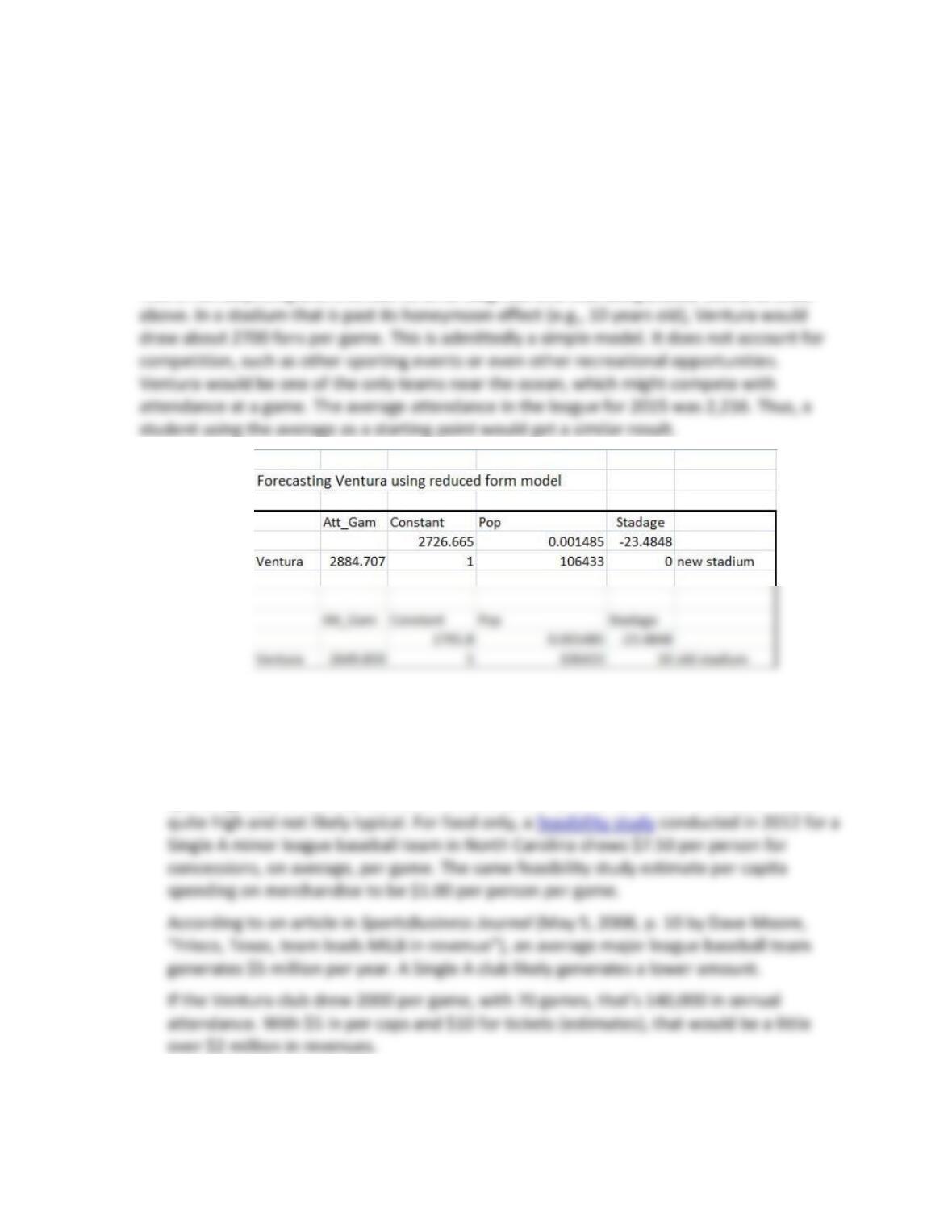
Using the data provided in the Chapter 11 Excel Spread Sheet (found in the Additional
Instructor Resources & Solutions folder), a simple model of attendance per game (or
attendance) can be created for the California League. A more involved model is also shown
in the Excel file; as can be seen, winning is not an important determinant of attendance.
This is not surprising and is similar to what Siegfried and Eisenberg (1980) found, as cited
2. What revenue would you expect to be generated from tickets, concessions, parking, and
merchandise?
Some comparable information had been provided by a minor league baseball
concessions company (Pro Sports Catering). It showed that per caps (per capita
spending beyond tickets) have been around $11 or $12 for a number of teams. That is
3. What revenues would you expect from naming rights and sponsorship?

As shown in this article, the Lansing Lugnuts (Single A) received $1.5 million per year in
naming rights revenue. That appears quite generous for a Single A club. Perhaps total
naming rights and sponsorship revenue of $1.5 million would be successful in the
California League.