Answers and Solutions: 11 – 1
Chapter 11
Cash Flow Estimation and
Risk Analysis
ANSWERS TO END-OF-CHAPTER QUESTIONS
11-1 a. Project cash flow, which is the relevant cash flow for project analysis, represents the
actual flow of cash, which includes investments in capital and working capital, but does
not include interest expenses or noncash charges like depreciation (except to the extent
that depreciation affects taxes). In other words, project cash flow is the free cash flow
generated by the project. Accounting income, on the other hand, reports accounting data
as defined by Generally Accepted Accounting Principles (GAAP).
c. Net operating working capital changes are the increases in current operating assets
resulting from accepting a project less the resulting increases in current operating
liabilities, or accruals and accounts payable. A net operating working capital change
must be financed just as a firm must finance its increases in fixed assets. Salvage value
is the market value of an asset after its useful life. Salvage values and their tax effects
must be included in project cash flow estimation.
Answers and Solutions: 11 – 2
d. Stand-alone risk is the risk a project would have if it was held in isolation. Corporate
(within-firm) risk is the risk that a project contributes to a company after taking into
consideration the cash flows of the company’s other projects; because projects are not
perfectly correlated, corporate risk usually will be less than stand-alone risk. Market
(beta) risk is the risk that a company contributes to a well diversified portfolio.
f. A risk-adjusted discount rate incorporates the risk of the project’s cash flows. The cost
of capital to the firm reflects the average risk of the firm’s existing projects. Thus, new
projects that are riskier than existing projects should have a higher risk-adjusted discount
rate. Conversely, projects with less risk should have a lower risk-adjusted discount rate.
This adjustment process also applies to a firm’s divisions. Risk differences are difficult
to quantify, thus risk adjustments are often subjective in nature. A project’s cost of
capital is its risk-adjusted discount rate for that project.
Answers and Solutions: 11 – 3
11-2 Only cash can be spent or reinvested, and since accounting profits do not represent cash, they
are of less fundamental importance than cash flows for investment analysis. Recall that in
the stock valuation chapters we focused on dividends and free cash flows, which represent
cash flows, rather than on earnings per share, which represent accounting profits.
11-3 Since the cost of capital includes a premium for expected inflation, failure to adjust cash
11-4 Capital budgeting analysis should only include those cash flows which will be affected by
the decision. Sunk costs are unrecoverable and cannot be changed, so they have no bearing
11-5 When a firm takes on a new capital budgeting project, it typically must increase its
investment in receivables and inventories, over and above the increase in payables and
accruals, thus increasing its net operating working capital. Since this increase must be
financed, it is included as an outflow in Year 0 of the analysis. At the end of the project’s
life, inventories are depleted and receivables are collected. Thus, there is a decrease in
NOWC, which is treated as an inflow.
Answers and Solutions: 11 – 4
11-6 Scenario analysis analyzes a limited number of outcomes. Although the base case scenario
may be the most likely, or expected outcome, the bad and good scenarios are frequently worst
case and best case scenarios, that is, when everything goes bad together, or everything goes
11-7 The costs associated with financing are reflected in the weighted average cost of capital.
To include interest expense in the capital budgeting analysis would “double count” the cost
of debt financing.
11-8 Daily cash flows would be theoretically best, but they would be costly to estimate and
probably no more accurate than annual estimates because we simply cannot forecast
11-9 In replacement projects, the benefits are generally cost savings, although the new
machinery may also permit additional output. The data for replacement analysis are
generally easier to obtain than for new products, but the analysis itself is somewhat more
Answers and Solutions: 11 – 5
11-10 Stand-alone risk is the project’s risk if it is held as a lone asset. It disregards the fact that
it is but one asset within the firm’s portfolio of assets and that the firm is but one stock in
a typical investor’s portfolio of stocks. Stand-alone risk is measured by the variability of
11-11 It is often difficult to quantify market risk. On the other hand, we can usually get a good
idea of a project’s stand–alone risk, and that risk is normally correlated with market risk:
The higher the stand-alone risk, the higher the market risk is likely to be. Therefore, firms
tend to focus on stand-alone risk, then deal with corporate and market risk by making
subjective, judgmental modifications to the calculated stand-alone risk.
Answers and Solutions: 11 – 6
SOLUTIONS TO END-OF-CHAPTER PROBLEMS
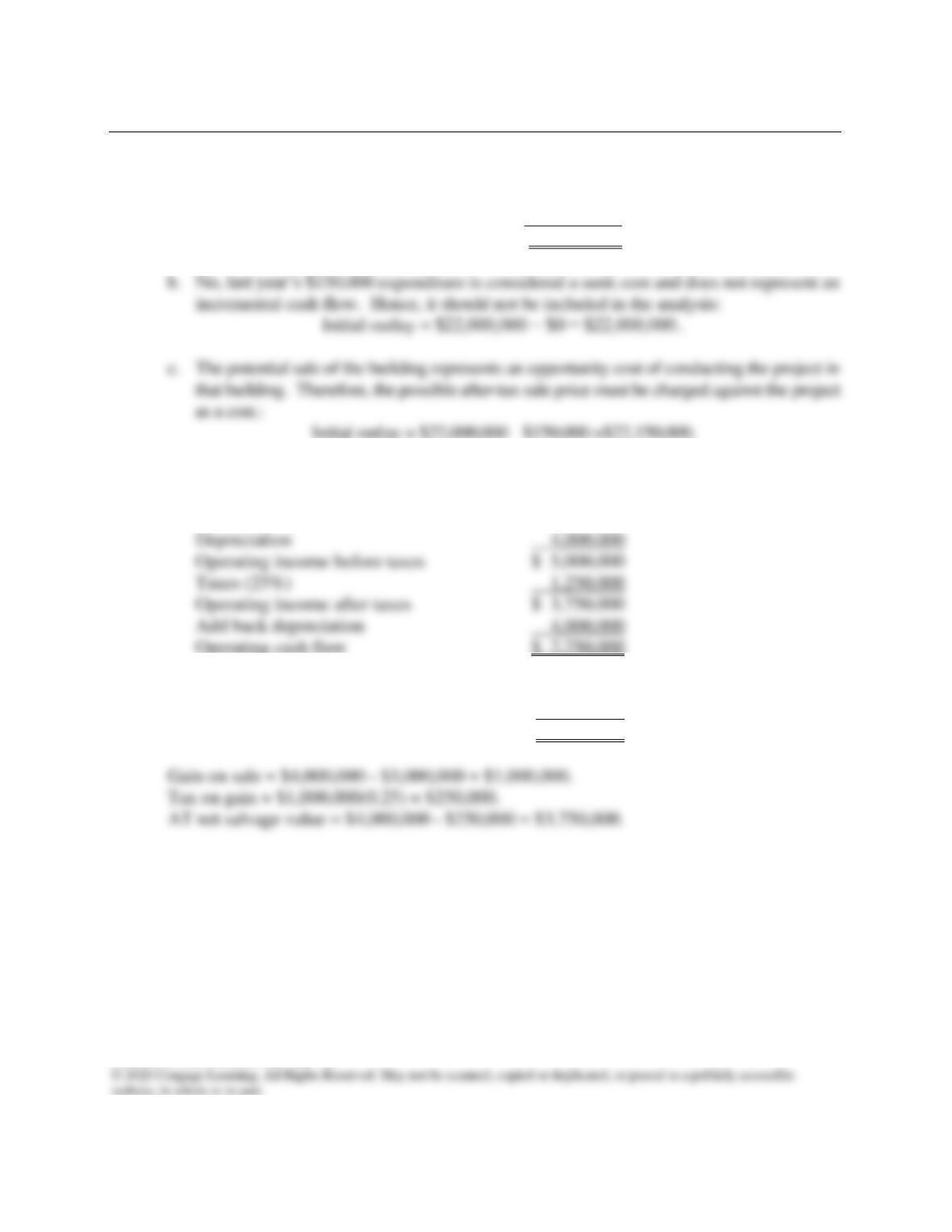
11-1 a. Equipment $ 17,000,000
NWC Investment 5,000,000
Initial investment outlay $22,000,000
11-2 Operating Cash Flows: t = 1
Sales revenues $18,000,000
Operating costs 9,000,000
11-3 Equipment’s original cost $12,000,000
Depreciation (80%) 9,000,000
Book value $ 3,000,000
Answers and Solutions: 11 – 7
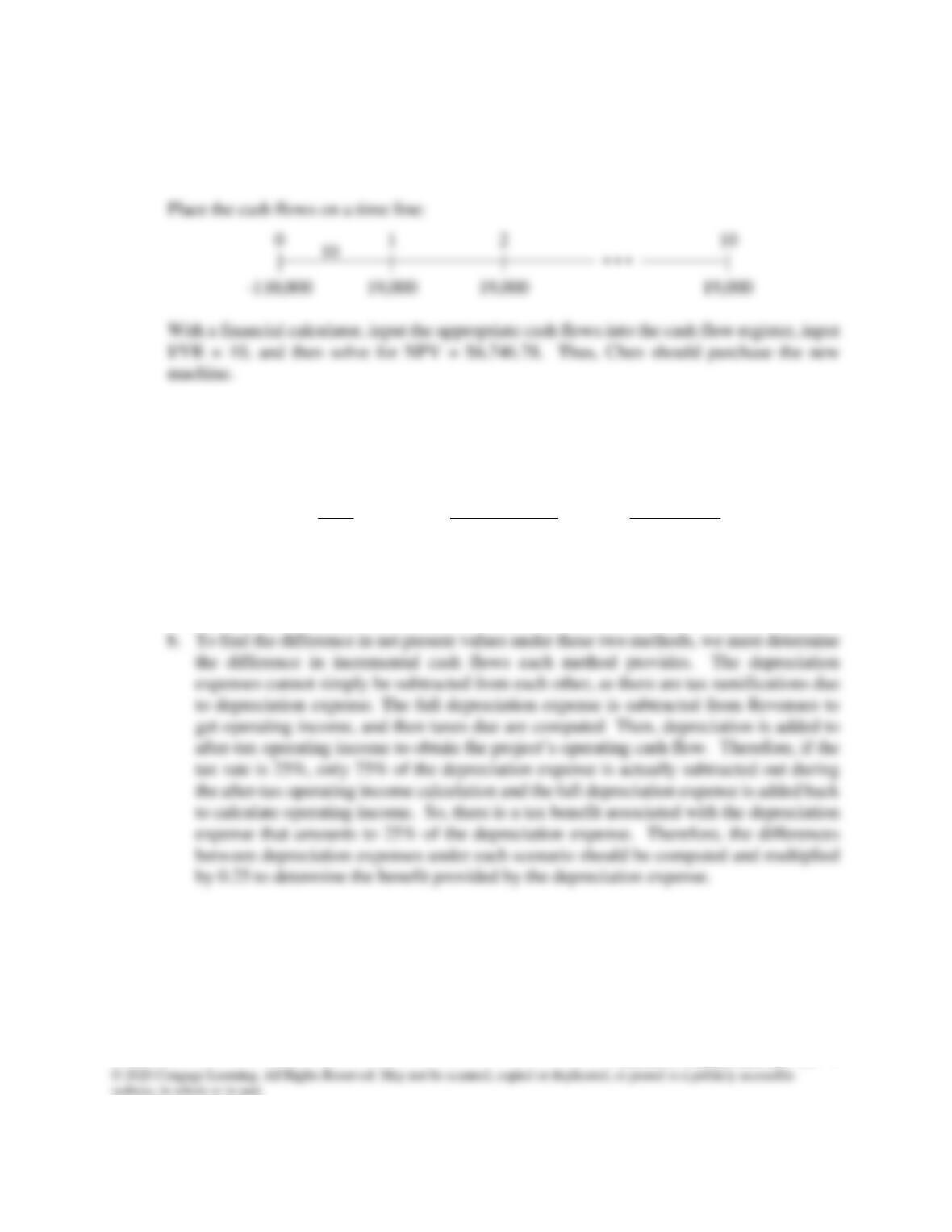
11-4 Cash outflow = $110,000.
Increase in annual after-tax cash flows: CF = $19,000.
11-5 a. The MACRS rates are 33.33%, 44.45%, 14.81%, and 7.41%. The first MACRS
depreciation expense is 33.33%($1,700,000) = $566,610. The others are calculated
similarly. The applicable depreciation values are as follows for the two scenarios:
Scenario 1 Scenario 2
Year (Straight Line) (MACRS)
1 $425,000 $566,610
2 425,000 755,650
3 425,000 251,770
4 425,000 125,970
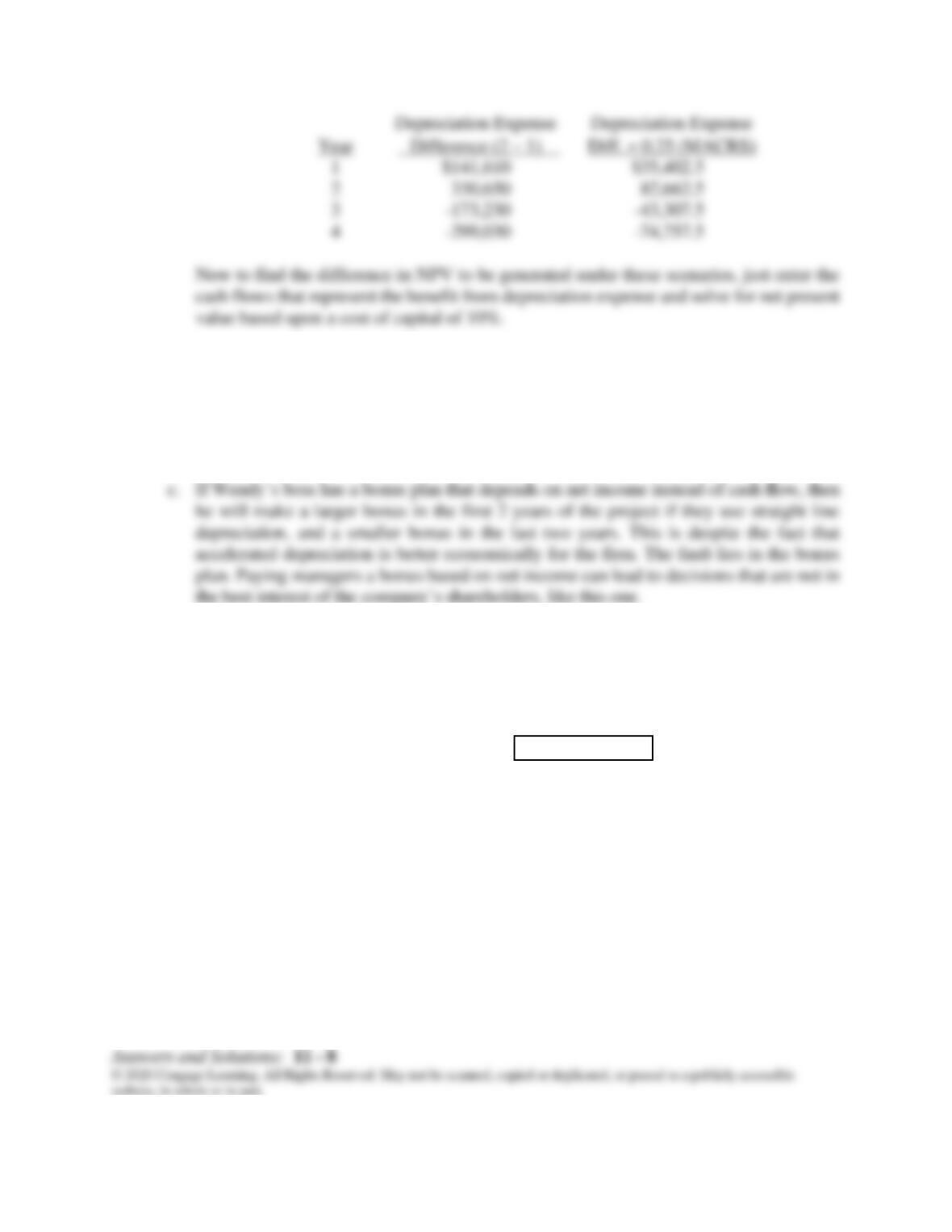
CF0 = 0; CF1 = 35402.5; CF2 = 82662.5; CF3 = -43307.5; CF4 = -74757.5; and I/YR =
10. Solve for NPV = $16,902.26
So, all else equal the use of the accelerated depreciation method will result in a higher
NPV (by $16,902.26) than would the use of a straight-line depreciation method.
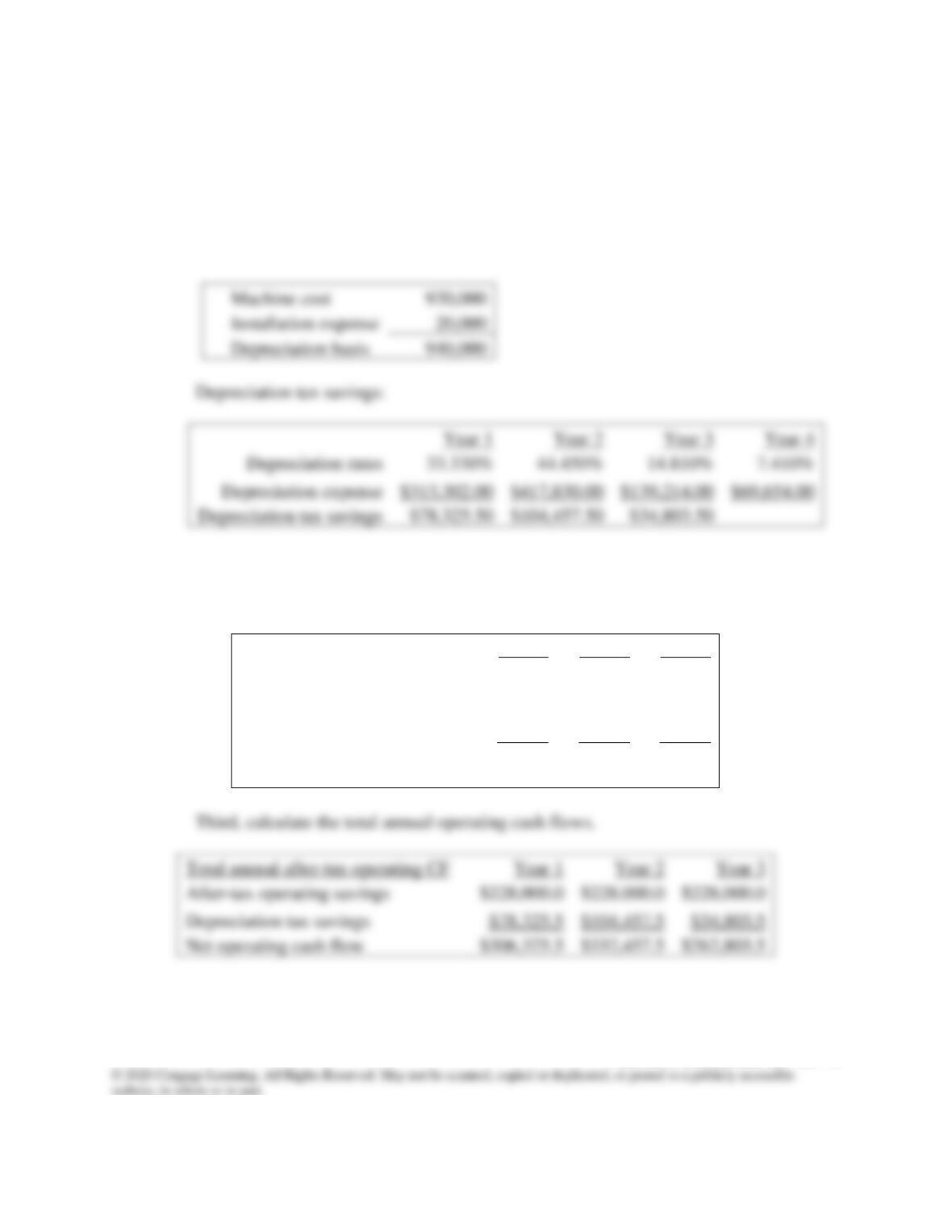
11-6 a. The net initial cash flow is:
Machine price
−$920,000
Installation cost
−$20,000
NWC required
−$15,500
Year 0 CF
−$955,500
Answers and Solutions: 11 – 9
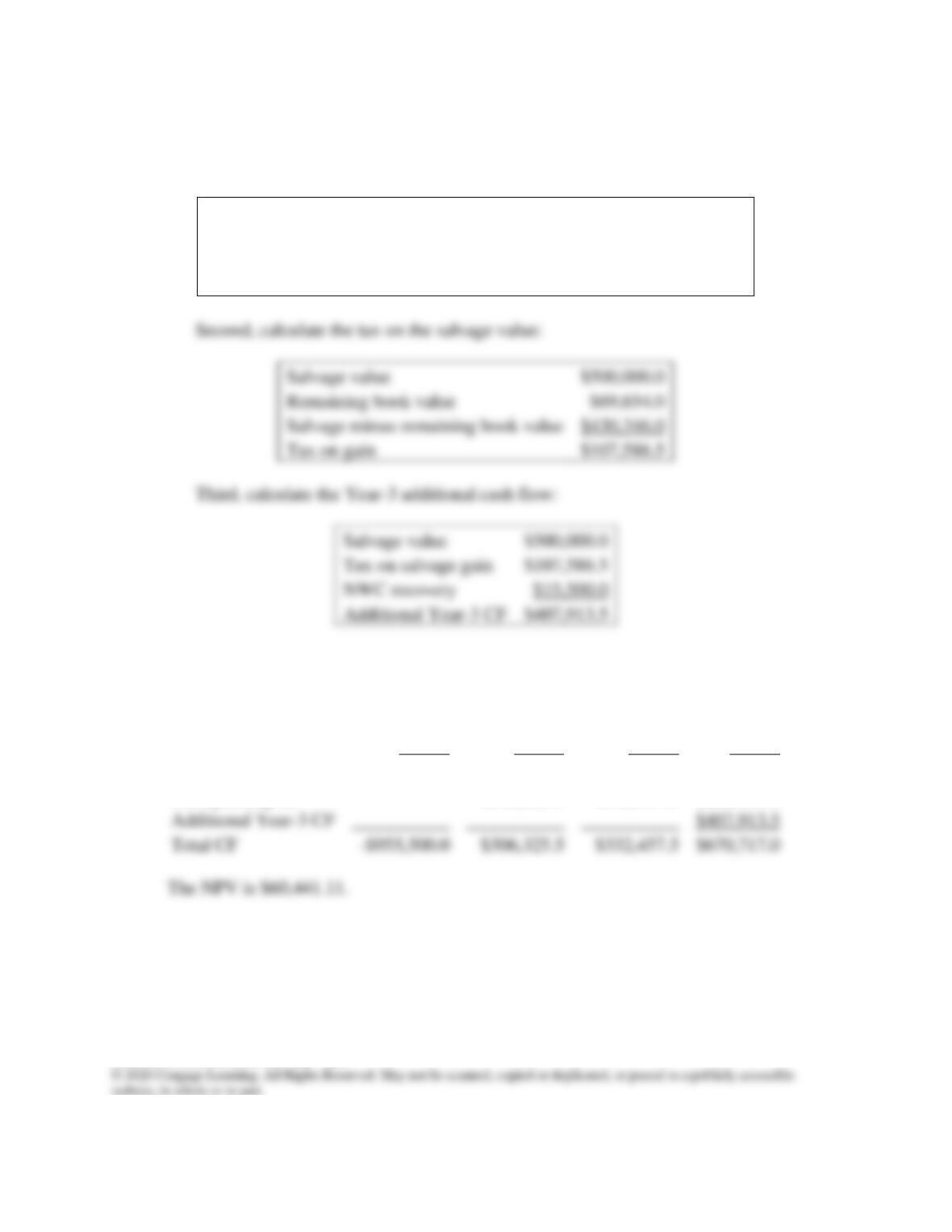
b. The operating cash flows are:
First, calculate deprecation basis, annual depreciation expenses, and the annual tax
savings due to depreciation. The tax rate is 25%.
Basis:
$313,302.00
$417,830.00
$139,214.00
$69,654.00
$104,457.50
Second, calculate the after-tax operating savings.
Year 1
Year 2
Year 3
Before-tax operating savings
304,000
304,000
304,000
Tax on operating savings
76,000
76,000
76,000
After-tax operating savings
228,000
228,000
228,000
Total annual after-tax operating CF
After-tax operating savings
$228,000.0
$228,000.0
$228,000.0
Depreciation tax savings
$104,457.5
Net operating cash flow
$306,325.5
$332,457.5
$262,803.5
Answers and Solutions: 11 – 10
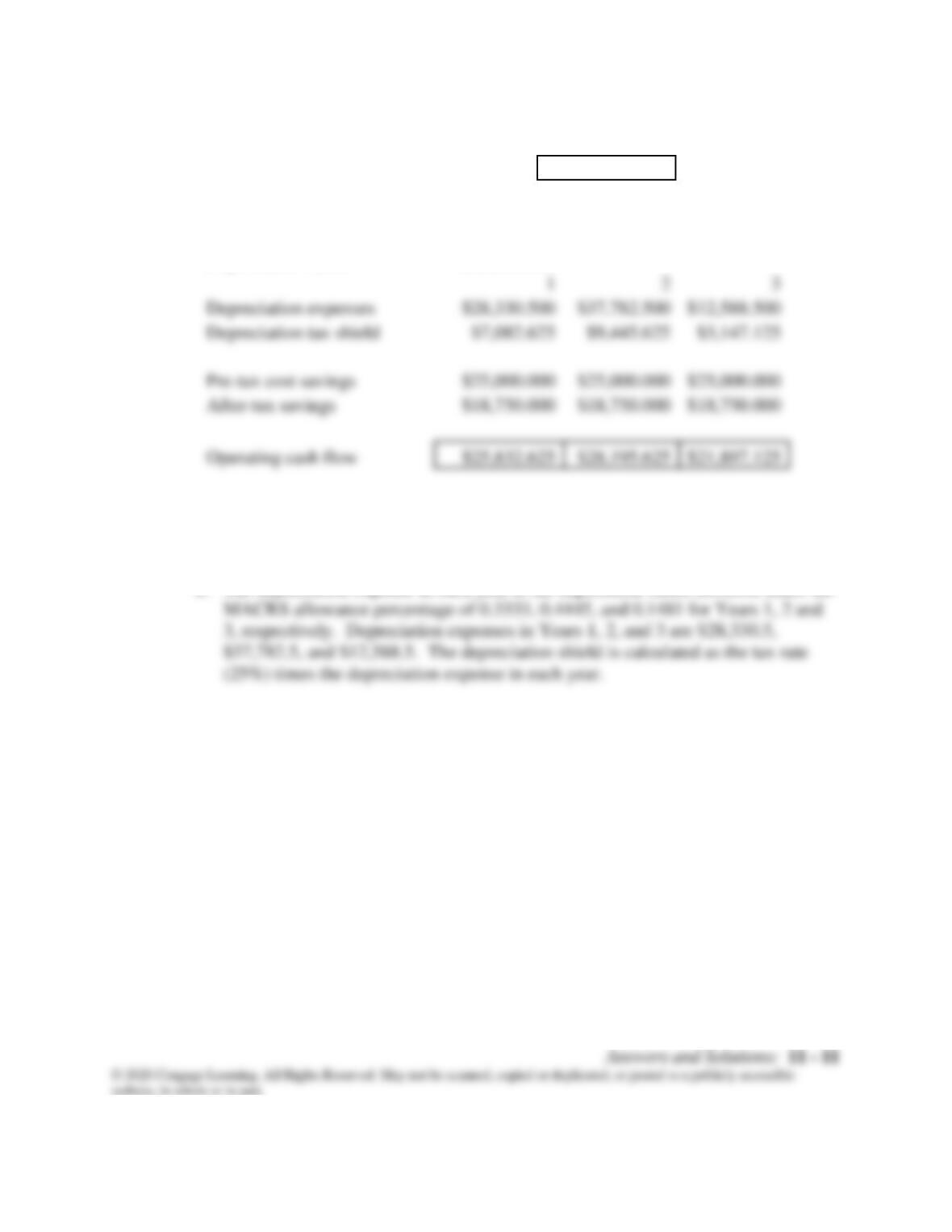
c. The additional Year-3 cash flows are:
First, find the remaining book value:
Salvage value calculation
Additional Year-3 CF
Depreciation basis
$940,000.0
Total depreciation expense in Years 1 through 3
$870,346.0
Remaining book value
$69,654.0
Salvage value
$500,000.0
Remaining book value
Salvage minus remaining book value
$430,346.0
Tax on gain
$107,586.5
Salvage value
$500,000.0
Tax on salvage gain
$107,586.5
NWC recovery
Additional Year-3 CF
$407,913.5
d. The cost of capital is 12%.
The total annual cash flows are:
Year 0
Year 1
Year 2
Year 3
Year 0 CF
-$955,500.0
Net operating CF
$306,325.5
$332,457.5
$262,803.5
Additional Year-3 CF
$407,913.5
Total CF
-$955,500.0
$306,325.5
$332,457.5
$670,717.0
11-7 The net cost is $89,000:
Basic price
$70,000.00
Modifications
$15,000.00
NWC increase
$4,000.00
Time 0 CF
$89,000.00
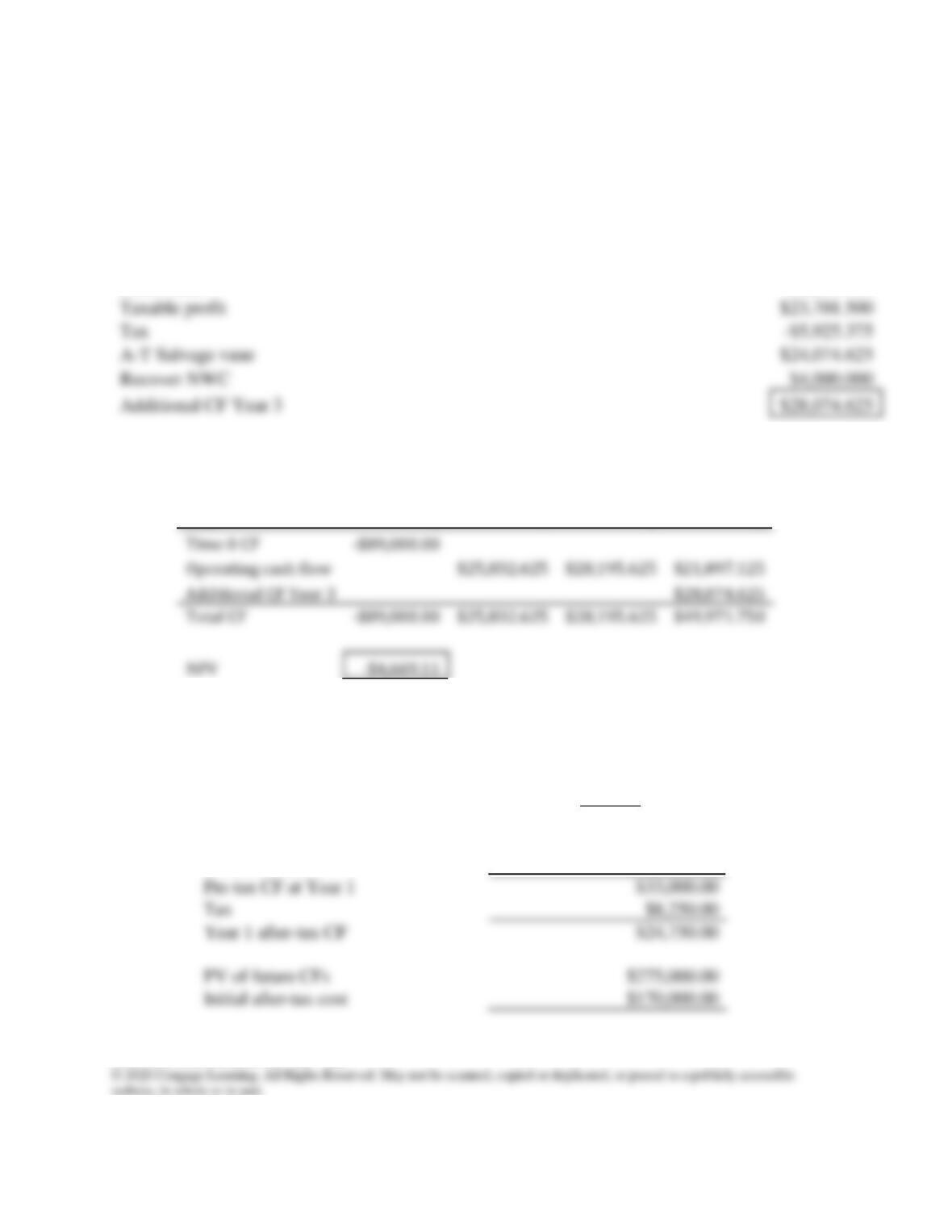
b. The operating cash flows follow:
Depreciation basis
$85,000.000
Depreciation expenses
$28,330.500
$12,588.500
Depreciation tax shield
After-tax savings
$18,750.000
$18,750.000
Operating cash flow
$21,897.125
Notes:
1. The after-tax cost savings is $25,000(1 – T) = $25,000(0.75) = $18,750.
2. The depreciation expense in each year is the depreciable basis, $85,000, times the
Answers and Solutions: 11 – 12
c. The additional end-of-project cash flow is $24,519:
Beginning Book Value
$85,000.00
$56,669.50
$18,887.00
Depreciation
$28,330.50
$37,782.50
$12,588.50
Ending Book Value
$56,669.50
$18,887.00
$6,298.50
Salvage value
$30,000.000
Book value
$6,298.500
Taxable profit
$23,701.500
Tax
A-T Salvage vaue
$24,074.625
Recover NWC
$4,000.000
Additional CF Year 3
$28,074.625
d. The project has an NPV of −$4,669.11. Thus, it should not be accepted.
Year
0
1
2
3
Time 0 CF
-$89,000.00
Operating cash flow
Additional CF Year 3
NPV
11-8 a.
Year1 sales = 1,000($138)$138,000
Year-1 costs = 1,000($105)105,000
Sales revenues at Year 1
$138,000.00
Costs at Year 1
$105,000.00
Pre-tax CF at Year 1
Tax
Year 1 after-tax CF
PV of future CFs
$275,000.00
Initial after-tax cost
$170,000.00
Answers and Solutions: 11 – 13
NPV
$105,000.00
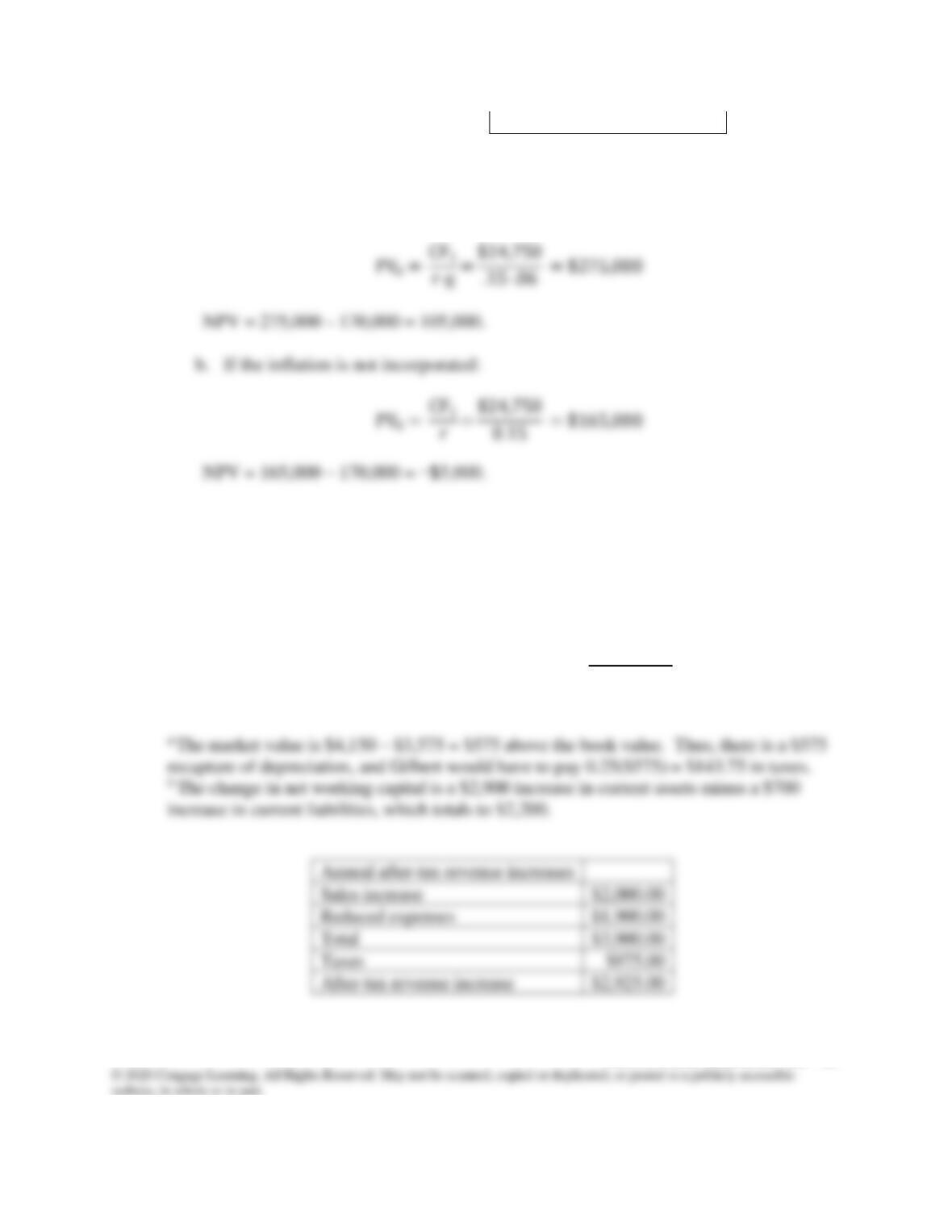
Using the Year-1 price and theconstant growth formula , the present value of all of
the future cash flows is:
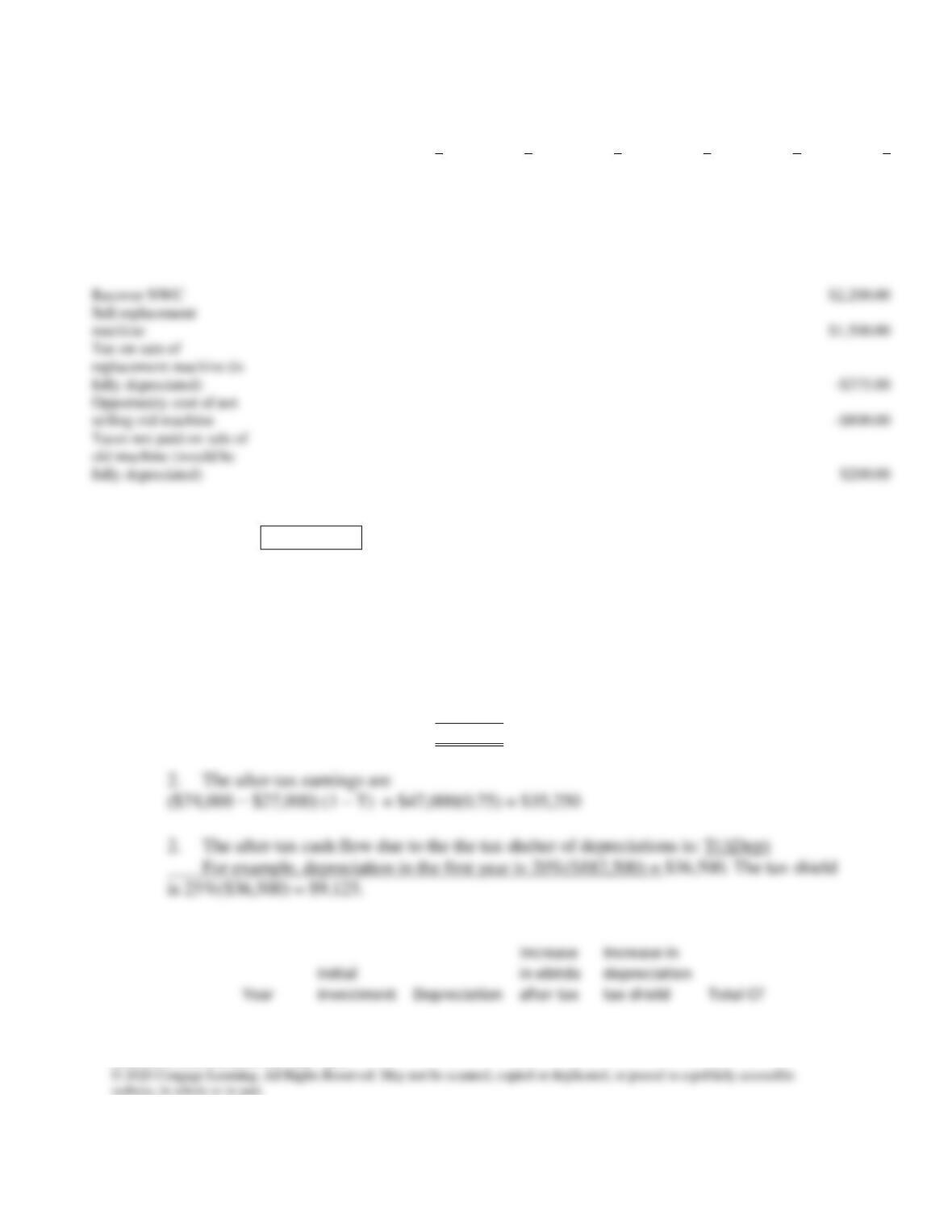
11-9 First determine the net cash flow at t = 0:
CF0 Calculation
Purchase Price
-$12,000.00
Sale of old machine
$4,150.00
Tax on sale
-$143.75
Net working capital
-$2,200.00
Total investment
-$10,193.75
Answers and Solutions: 11 – 14
Year
1
2
3
4
5
6
New depreciation
$2,400.00
$3,840.00
$2,304.00
$1,382.40
$1,382.40
$691.20
Old depreciation
$650.00
$650.00
$650.00
$650.00
$650.00
$325.00
Change in depreciation
$1,750.00
$3,190.00
$1,654.00
$732.40
$732.40
$366.20
Incremental Depr. Tax
savings
$437.50
$797.50
$413.50
$183.10
$183.10
$91.55
Recover NWC
$2,200.00
Sell replacement
machine
$1,500.00
selling old machine
$200.00
Total CFs
-$10,193.75
$3,362.50
$3,722.50
$3,338.50
$3,108.10
$3,108.10
$5,741.55
NPV
$3,544.60
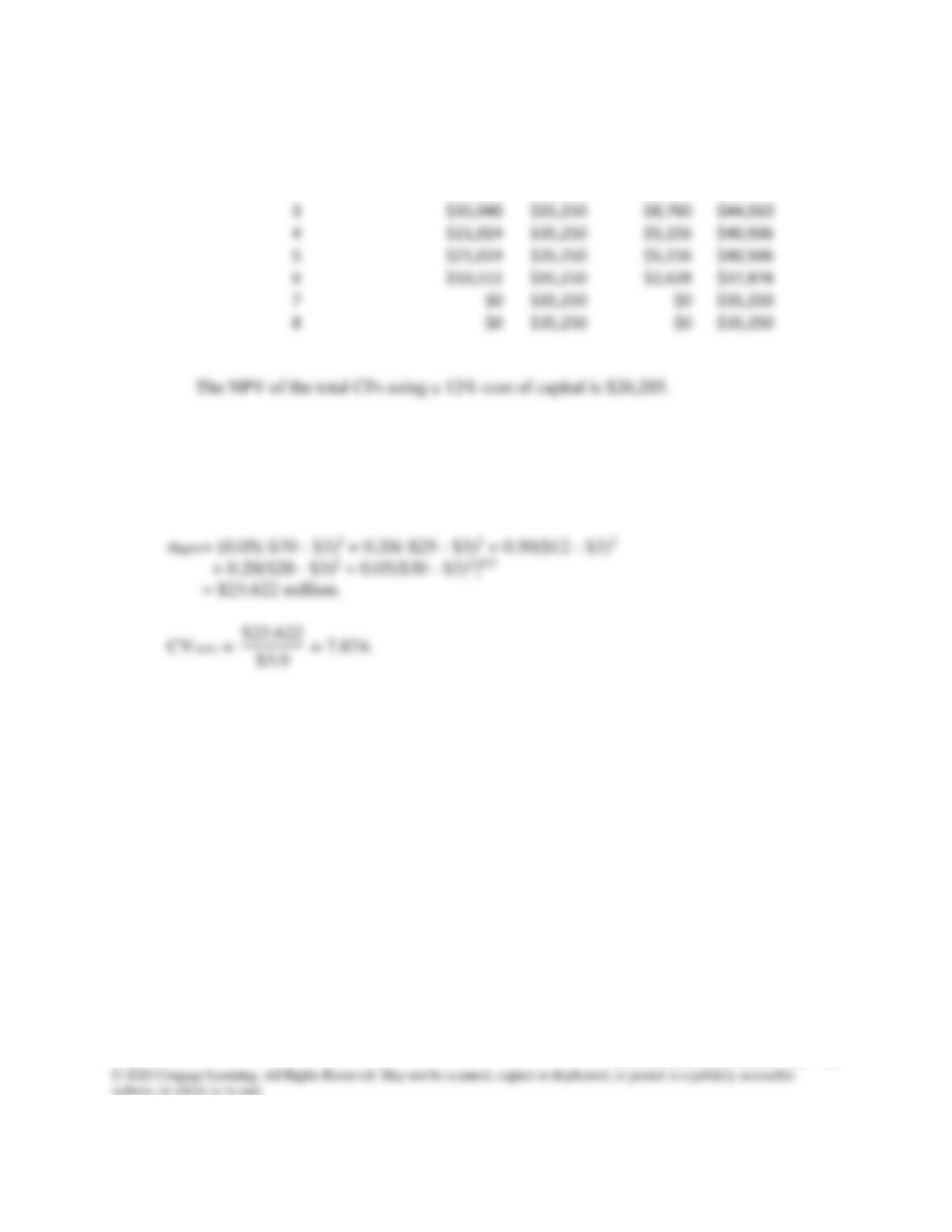
11–10 1. Net investment at t = 0:
Cost of new machine $182,500
Net investment outlay (CF0) $182,500
Answers and Solutions: 11 – 15
0
$182,500
–
$182,500
1
$36,500
$35,250
$9,125
$44,375
2
$58,400
$35,250
$14,600
$49,850
3
$35,040
$35,250
$8,760
$44,010
4
$21,024
$35,250
$5,256
$40,506
5
$21,024
$35,250
$5,256
$40,506
6
$10,512
$35,250
$2,628
$37,878
7
$35,250
$35,250
8
$35,250
$35,250
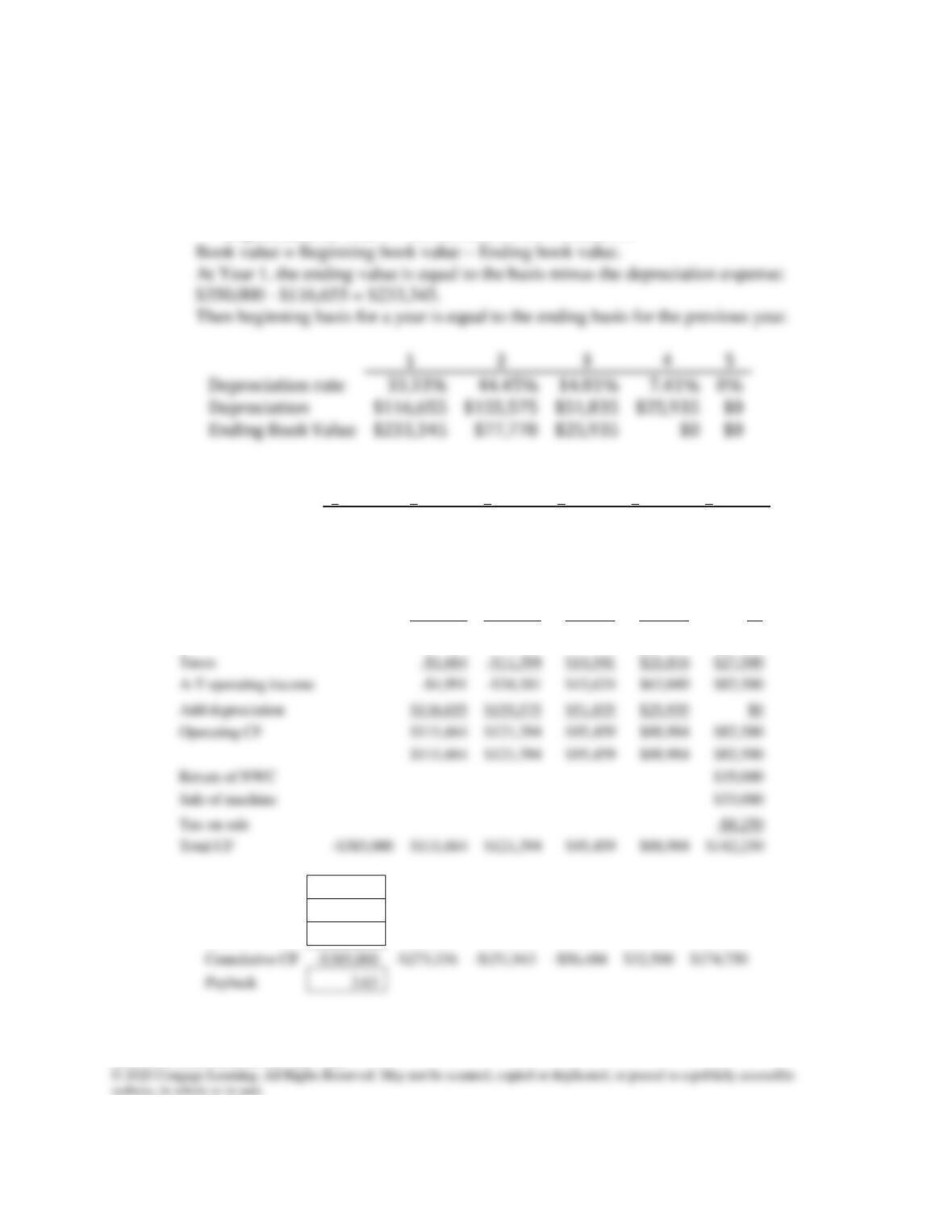
11-11 E(NPV) = 0.05(-$70) + 0.20(-$25) + 0.50($12) + 0.20($20) + 0.05($30)
= -$3.5 + -$5.0 + $6.0 + $4.0 + $1.5
= $3.0 million.
Answers and Solutions: 11 – 16
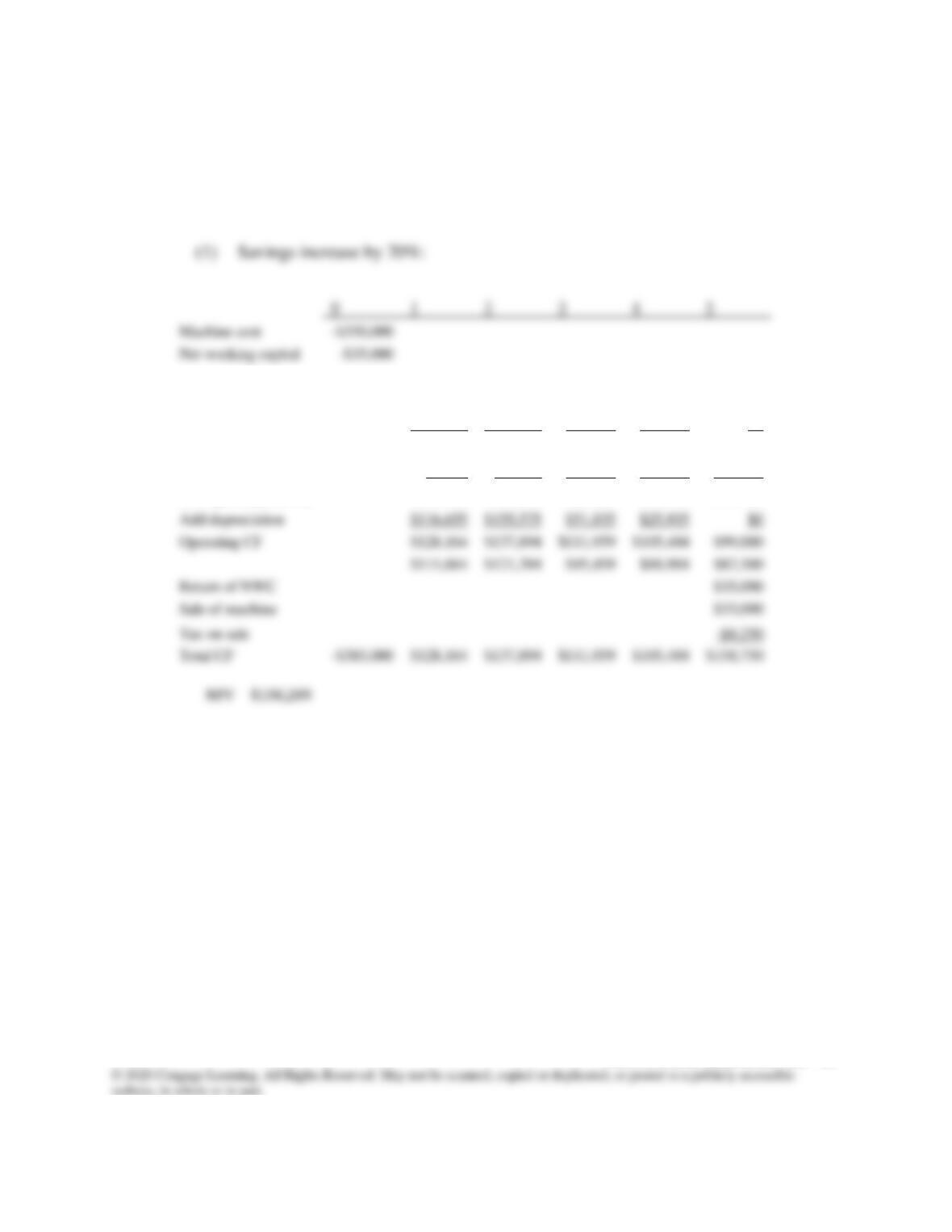
11-12 a. First, set up a depreciation schedule.
Depreciation basis = $350,000.
Depreciation = Basis(Depreciation rate)
For example, the depreciation in Year 1 is:
Depreciation in Year 1 = $350,000(0.3333) = $116,655.
0
1
2
3
4
5
Machine cost
-$350,000
Net working capital
-$35,000
Cost savings
$110,000
$110,000
$110,000
$110,000
$110,000
Depreciation
$116,655
$155,575
$51,835
$25,935
$0
Op. Inc. before taxes
-$6,655
-$45,575
$58,165
$84,065
$110,000
Taxes
-$1,664
-$11,394
$14,541
$21,016
$27,500
A-T operating income
-$4,991
-$34,181
$43,624
$63,049
$82,500
Add depreciation
$116,655
$155,575
$51,835
$25,935
$0
Operating CF
$111,664
$121,394
$95,459
$88,984
$82,500
$111,664
$121,394
$95,459
$88,984
$82,500
Return of NWC
$35,000
Sale of machine
$33,000
Tax on sale
-$8,250
Total CF
-$385,000
$111,664
$121,394
$95,459
$88,984
$142,250
NPV
$37,661
IRR
13.72%
MIRR
12.07%
Cumulative CF
-$385,000
-$273,336
-$151,943
-$56,484
$32,500
$174,750
Payback
Answers and Solutions: 11 – 17
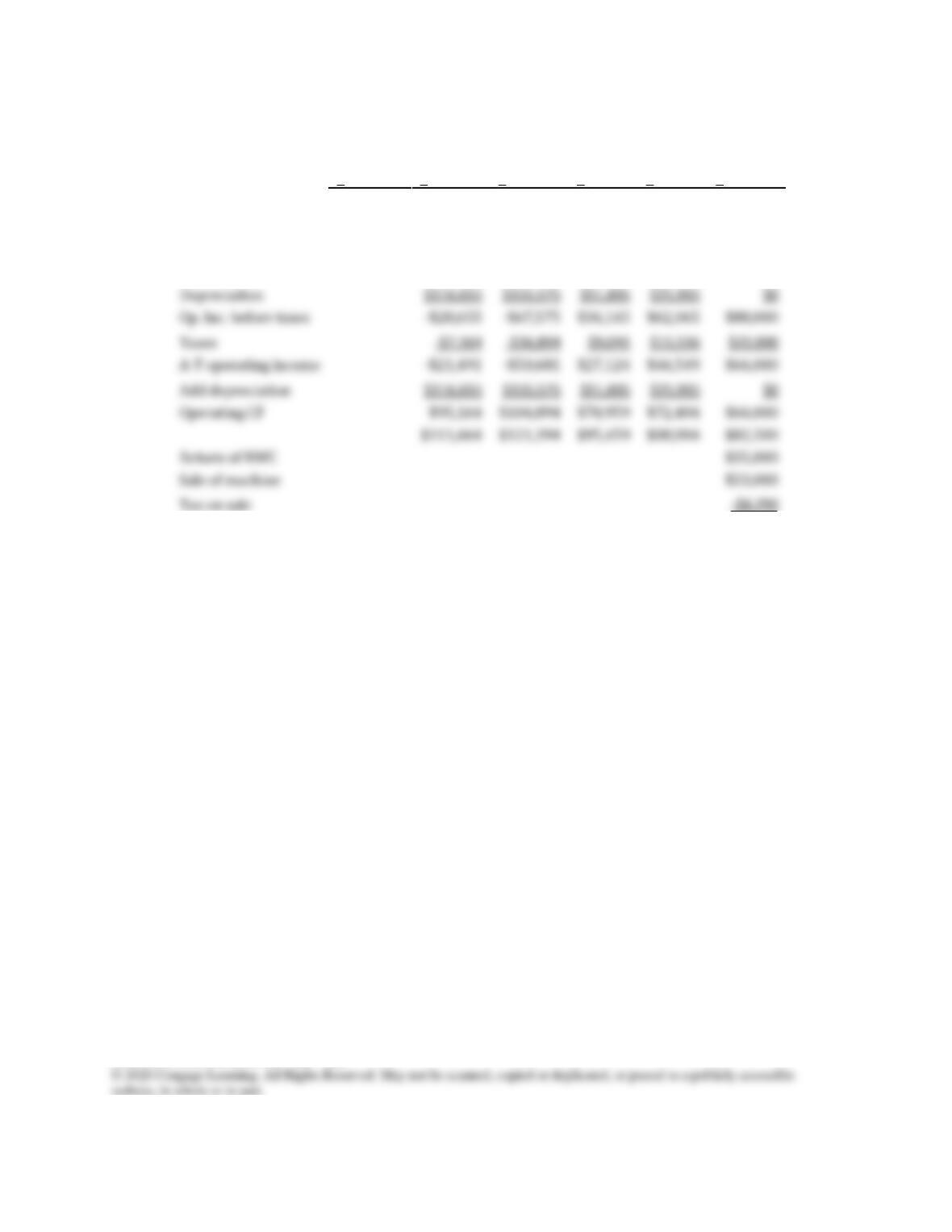
b. If savings increase by 20%, then savings will be (1.2)($110,000) = $132,000.
If savings decrease by 20%, then savings will be (0.8)($110,000) = $88,000.
0
1
2
3
4
5
Machine cost
-$350,000
Net working capital
-$35,000
Cost savings
$132,000
$132,000
$132,000
$132,000
$132,000
Depreciation
$116,655
$155,575
$51,835
$25,935
$0
Op. Inc. before taxes
$15,345
-$23,575
$80,165
$106,065
$132,000
Taxes
$3,836
-$5,894
$20,041
$26,516
$33,000
A-T operating income
$11,509
-$17,681
$60,124
$79,549
$99,000
Add depreciation
$116,655
$155,575
$51,835
$25,935
$0
Operating CF
$128,164
$137,894
$111,959
$105,484
$99,000
$111,664
$121,394
$95,459
$88,984
$82,500
Return of NWC
$35,000
Sale of machine
$33,000
Tax on sale
-$8,250
Total CF
-$385,000
$128,164
$137,894
$111,959
$105,484
$158,750
Answers and Solutions: 11 – 18
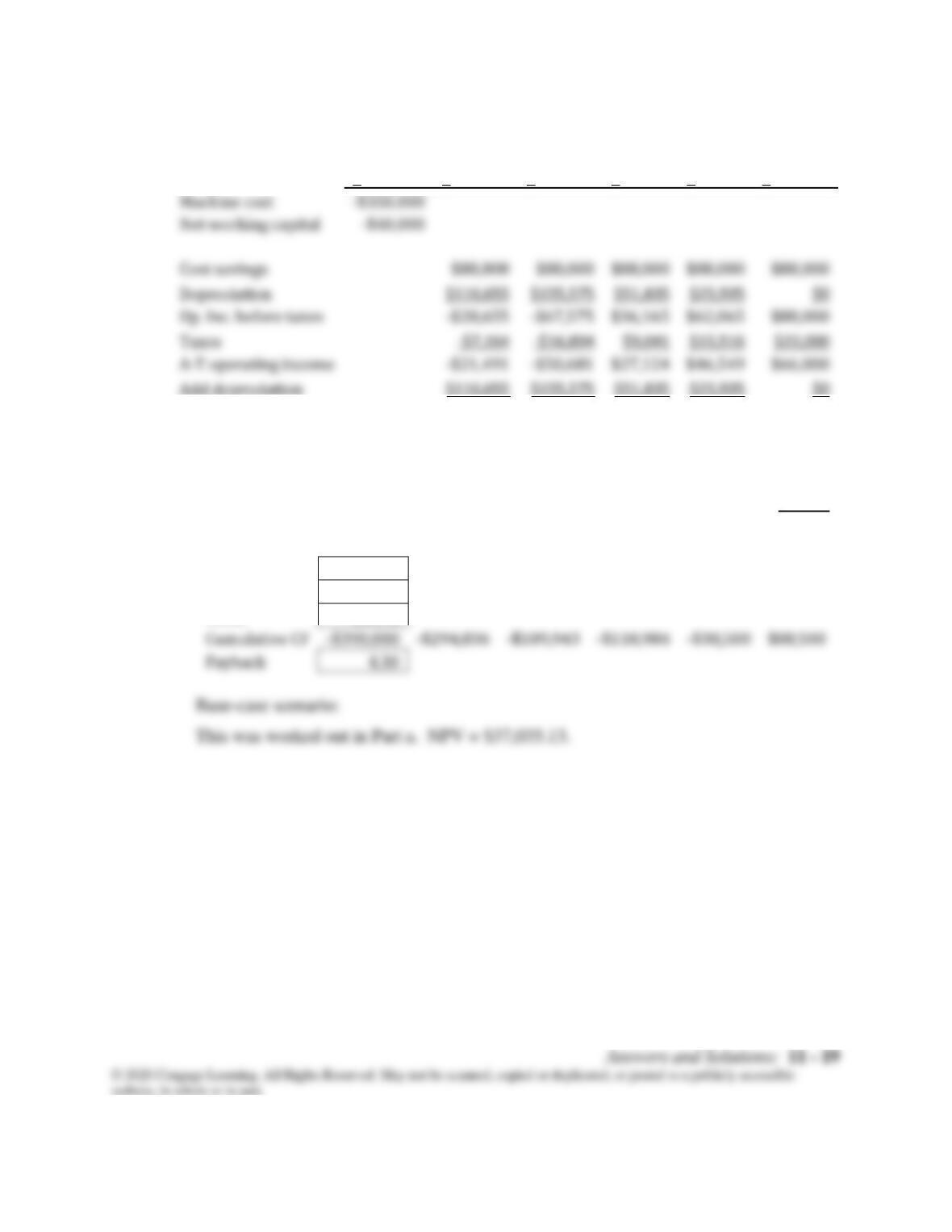
(2) Savings decrease by 20%:
0
1
2
3
4
5
Machine cost
-$350,000
Net working capital
-$35,000
Cost savings
$88,000
$88,000
$88,000
$88,000
$88,000
Depreciation
Op. Inc. before taxes
$36,165
$62,065
$88,000
Taxes
A-T operating income
$27,124
$46,549
$66,000
Add depreciation
Operating CF
$95,164
$104,894
$78,959
$72,484
$66,000
$111,664
$121,394
$95,459
$88,984
$82,500
Return of NWC
$35,000
Sale of machine
$33,000
Tax on sale
Total CF
-$385,000
$95,164
$104,894
$78,959
$72,484
$125,750
NPV –$24,887
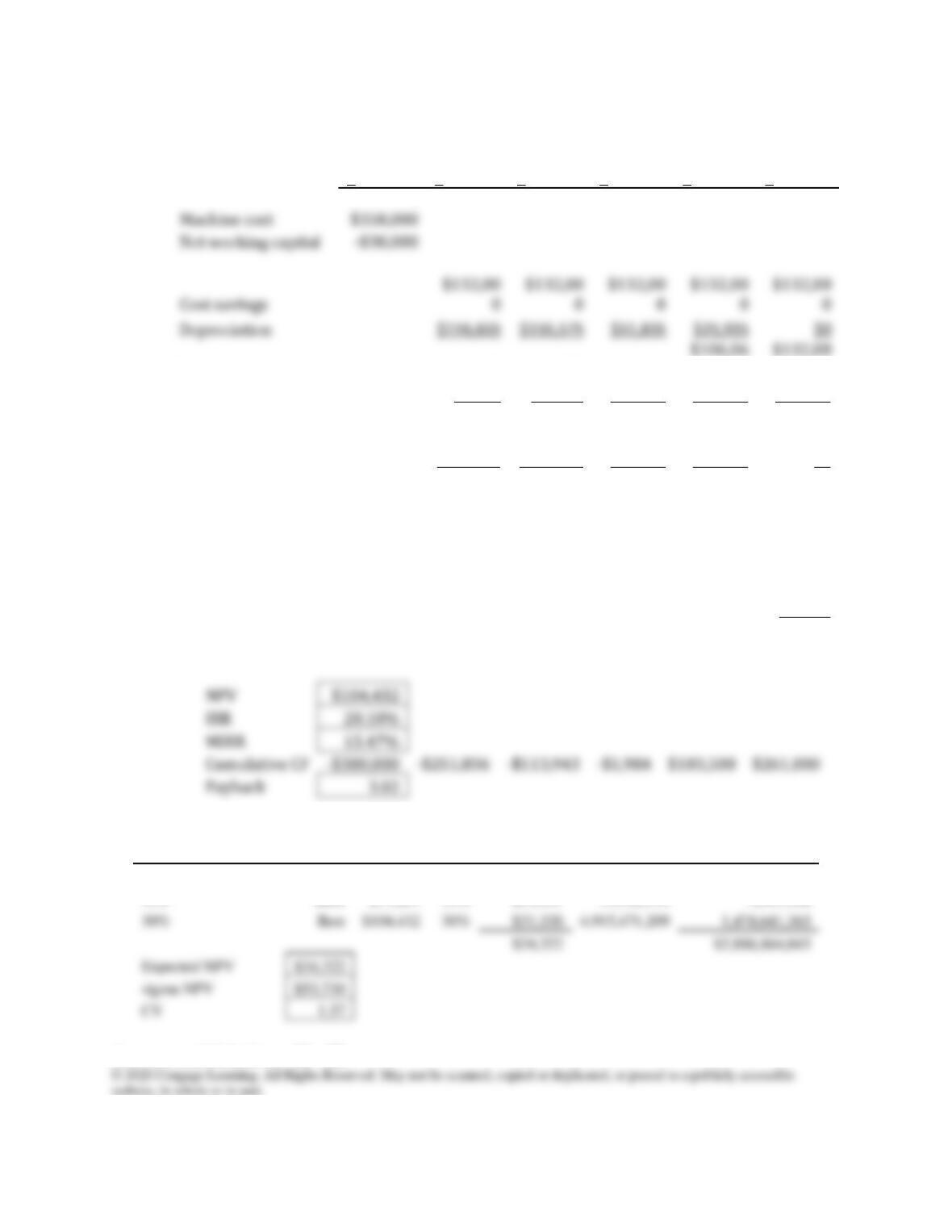
c. Worst-case scenario:
0
1
2
3
4
5
Machine cost
-$350,000
Net working capital
-$40,000
Cost savings
$88,000
$88,000
$88,000
$88,000
$88,000
Depreciation
Op. Inc. before taxes
$36,165
$62,065
$88,000
Taxes
-$7,164
A-T operating income
$27,124
$46,549
$66,000
Add depreciation
Operating CF
$95,164
$104,894
$78,959
$72,484
$66,000
$111,664
$121,394
$95,459
$88,984
$82,500
Return of NWC
$40,000
Sale of machine
$28,000
Tax on sale
-$7,000
Total CF
-$390,000
$95,164
$104,894
$78,959
$72,484
$127,000
NPV
-$29,111
IRR
7.08%
MIRR
8.31%
-$390,000
-$294,836
-$189,943
-$110,984
-$38,500
$88,500
Payback
Answers and Solutions: 11 – 20
Best-case scenario:
0
1
2
3
4
5
Machine cost
Net working capital
-$30,000
Cost savings
$132,00
0
$132,00
0
$132,00
0
$132,00
0
$132,00
0
Depreciation
$51,835
$25,935
$0
$106,06
$132,00
Op. Inc. before taxes
$15,345
-$23,575
$80,165
5
0
Taxes
$3,836
-$5,894
$20,041
$26,516
$33,000
A-T operating
income
$11,509
-$17,681
$60,124
$79,549
$99,000
Add depreciation
$116,655
$155,575
$51,835
$25,935
$0
Operating CF
$128,16
4
$137,89
4
$111,95
9
$105,48
4
$99,000
$111,66
4
$121,39
4
$95,459
$88,984
$82,500
Return of NWC
$30,000
Sale of machine
$38,000
Tax on sale
-$9,500
Total CF
–
$380,000
$128,16
4
$137,89
4
$111,95
9
$105,48
4
$157,50
0
NPV
IRR
MIRR
Cumulative CF
-$380,000
-$251,836
-$113,943
-$1,984
$103,500
$261,000
Scenario probabilities
NPV
Prob.
Prob x NPV
Dev. Squared
Prob(Dev. Squared)
35%
Worst
-$29,111
35%
-$10,189
4,023,775,752
1,408,321,513
35%
Base
$37,661
35%
$13,181
11,146,193
3,901,168
30%
30%
$31,330
4,915,471,209
1,474,641,363
$34,322
$2,886,864,043
Expected NPV
$34,322
sigma NPV
$53,730