11/21/2018
Chapter 11 Mini Case
Situation
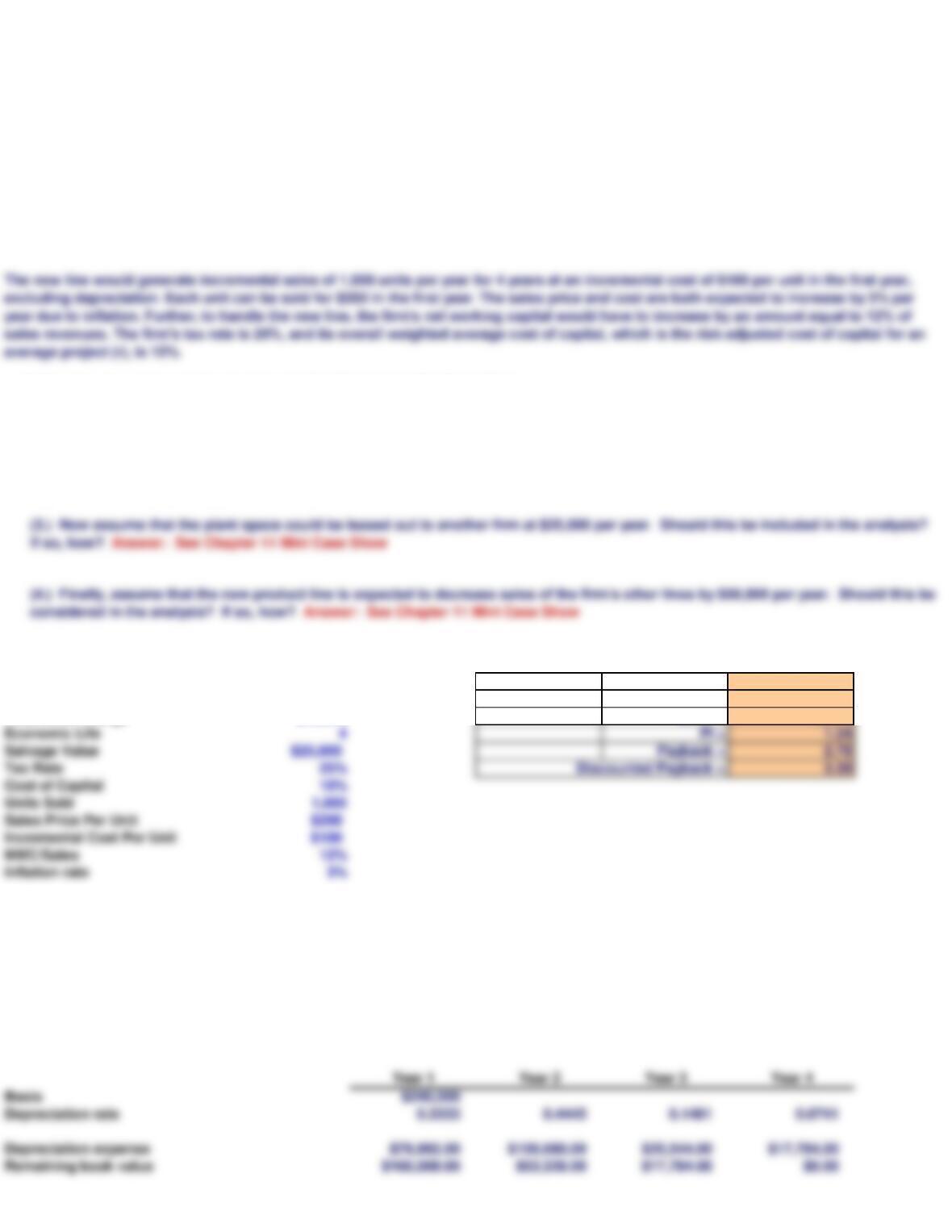
Part I: Input Data
Scenario: Base Case
Equipment cost $200,000 Key Outputs: NPV = $62,593
Shipping charge $10,000 IRR = 20.1%
Installation charge $30,000 MIRR = 16.0%
Annual Depreciation Expense
Depreciable Basis = Equipment + Freight + Installation
Depreciable Basis = $240,000
Depreciation rate 0.3333 0.4445 0.1481 0.0741
Depreciation expense $79,992.00 $106,680.00 $35,544.00 $17,784.00
Shrieves Casting Company is considering adding a new line to its product mix, and the capital budgeting analysis is being conducted by
Sidney Johnson, a recently graduated MBA. The production line would be set up in unused space in Shrieves’ main plant. The machinery’s
invoice price would be approximately $200,000, another $10,000 in shipping charges would be required, and it would cost an additional
$30,000 to install the equipment. The machinery has an economic life of 4 years, and Shrieves has obtained a special tax ruling that places
the equipment in the MACRS 3-year class. The machinery is expected to have a salvage value of $25,000 after 4 years of use.
average project (r), is 10%.
a. Define “incremental cash flow.” Answer: See Chapter 11 Mini Case Show
(2.) Suppose the firm had spent $100,000 last year to rehabilitate the production line site. Should this be included in the analysis?
Explain. Answer: See Chapter 11 Mini Case Show
(1.) Should you subtract interest expense or dividends when calculating project cash flow? Answer: See Chapter 11 Mini Case Show
(3.) Now assume that the plant space could be leased out to another firm at $25,000 per year. Should this be included in the analysis?
If so, how? Answer: See Chapter 11 Mini Case Show
considered in the analysis? If so, how? Answer: See Chapter 11 Mini Case Show
b. Disregard the assumptions in Part a. What is Shrieves’ depreciable basis? What are the annual
depreciation expenses?
c. Calculate the annual sales revenues and costs (other than depreciation). Why is it important to include inflation when estimating cash
flows? See answer to part d.
Economic Life 4PI = 1.24
Salvage Value $25,000 Payback = 2.76
Tax Rate 25% Discounted Payback = 3.30
Cost of Capital 10%
Units Sold 1,000
Sales Price Per Unit $200
Incremental Cost Per Unit $100
Inflation rate 3%
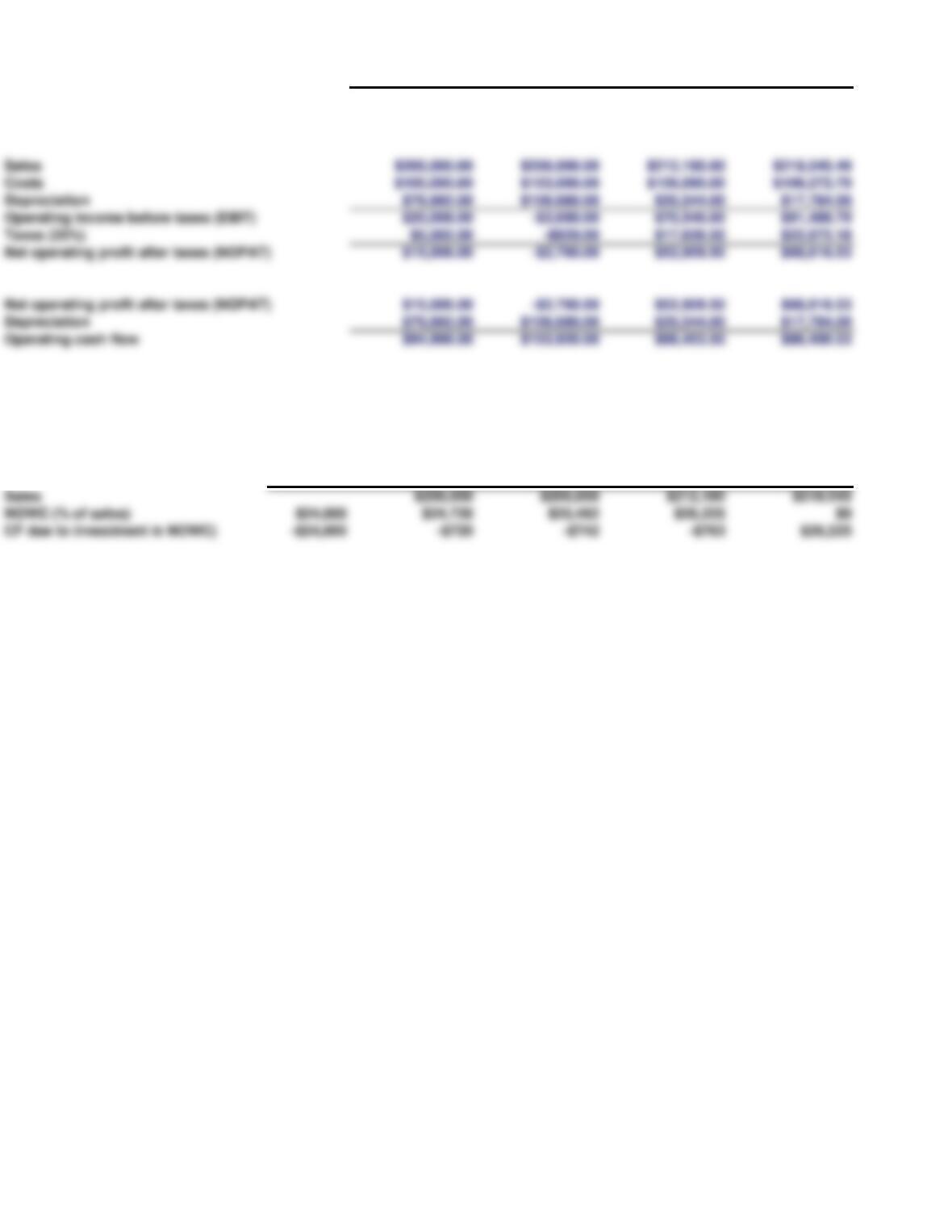
Annual Operating Cash Flows
Year 1 Year 2 Year 3 Year 4
Units 1,000 1,000 1,000 1,000
Unit price $200.00 $206.00 $212.18 $218.55
Unit cost $100.00 $103.00 $106.09 $109.27
Annual Cash Flows due to Investments in Net Working Capital
Year 0 Year 1 Year 2 Year 3 Year 4
NOWC (% of sales) $24,000 $24,720 $25,462 $26,225 $0
CF due to investment in NOWC) -$24,000 -$720 -$742 -$763 $26,225
d. Calculate annual net operating profit after sales (NOPAT).
e. Estimate the required net operating working capital (NOWC) for each year, and the cash flow due to investments in net working capital.
Depreciation $79,992.00 $106,680.00 $35,544.00 $17,784.00
Operating income before taxes (EBIT) $20,008.00 -$3,680.00 $70,546.00 $91,488.70
Taxes (25%) $5,002.00 -$920.00 $17,636.50 $22,872.18
Net operating profit after taxes (NOPAT) $15,006.00 -$2,760.00 $52,909.50 $68,616.53
Net operating profit after taxes (NOPAT) $15,006.00 -$2,760.00 $52,909.50 $68,616.53
Operating cash flow $94,998.00 $103,920.00 $88,453.50 $86,400.53
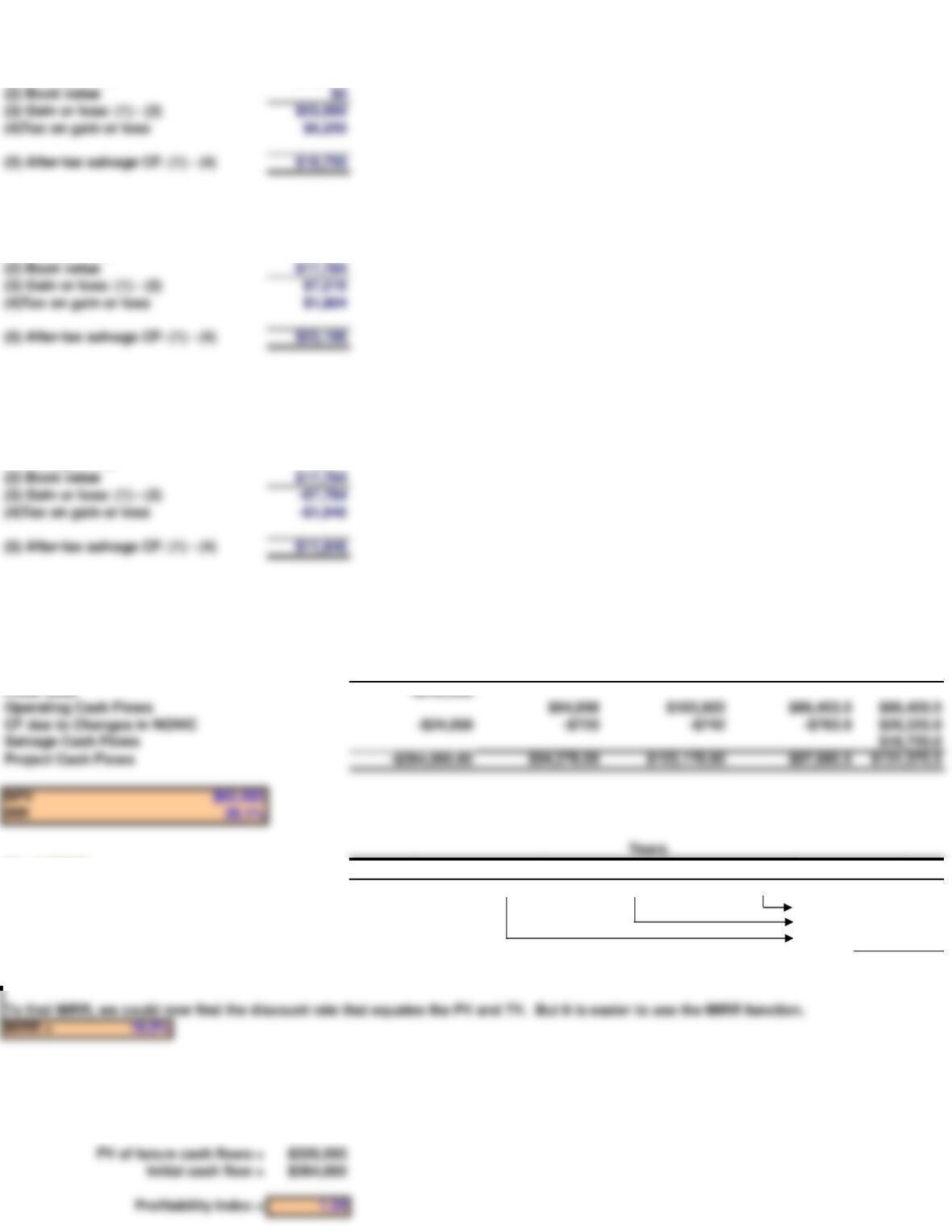
f. Calculate the after-tax salvage cash flow.
After-tax Salvage Value
(1) Salvage value $25,000
If the project lasts only 3 years and the salvage value is $25,000, what is the after-tax salvage cash flow?
(1) Salvage value $25,000
(2) Book value $17,784
(3) Gain or loss: (1) – (2) $7,216
(4)Tax on gain or loss $1,804
If the project lasts 3 year and the salvage value is $10,000, what is the after-tax salvage cash flow?
(1) Salvage value $10,000
(2) Book value $17,784
(3) Gain or loss: (1) – (2) -$7,784
(4)Tax on gain or loss -$1,946
Operating Cash Flows
Year 0 Year 1 Year 2 Year 3 Year 4
Initial Cost -$240,000
Operating Cash Flows $94,998 $103,920 $88,453.5 $86,400.5
CF due to Changes in NOWC -$24,000 -$720 -$742 -$763.0 $26,225.0
Find MIRR 0 1 2 3 4
Net Cash Flows -264,000 94,278 103,178 87,690.5 131,375.5
96,459.6
124,845.4
125,484.0
PV= -264,000 TV = 478,164.5
Find the Profitability Index (PI)
The profitability index is the present value of future cash flows divided by initial cost.
g. Calculate the net cash flows for each year. Based on these cash flows and the average project cost of capital, what are the project’s NPV,
IRR, MIRR, PI, payback, and discounted payback? Do these indicators suggest that the project should be undertaken?
(2) Book value $0
(3) Gain or loss: (1) – (2) $25,000
(4)Tax on gain or loss $6,250
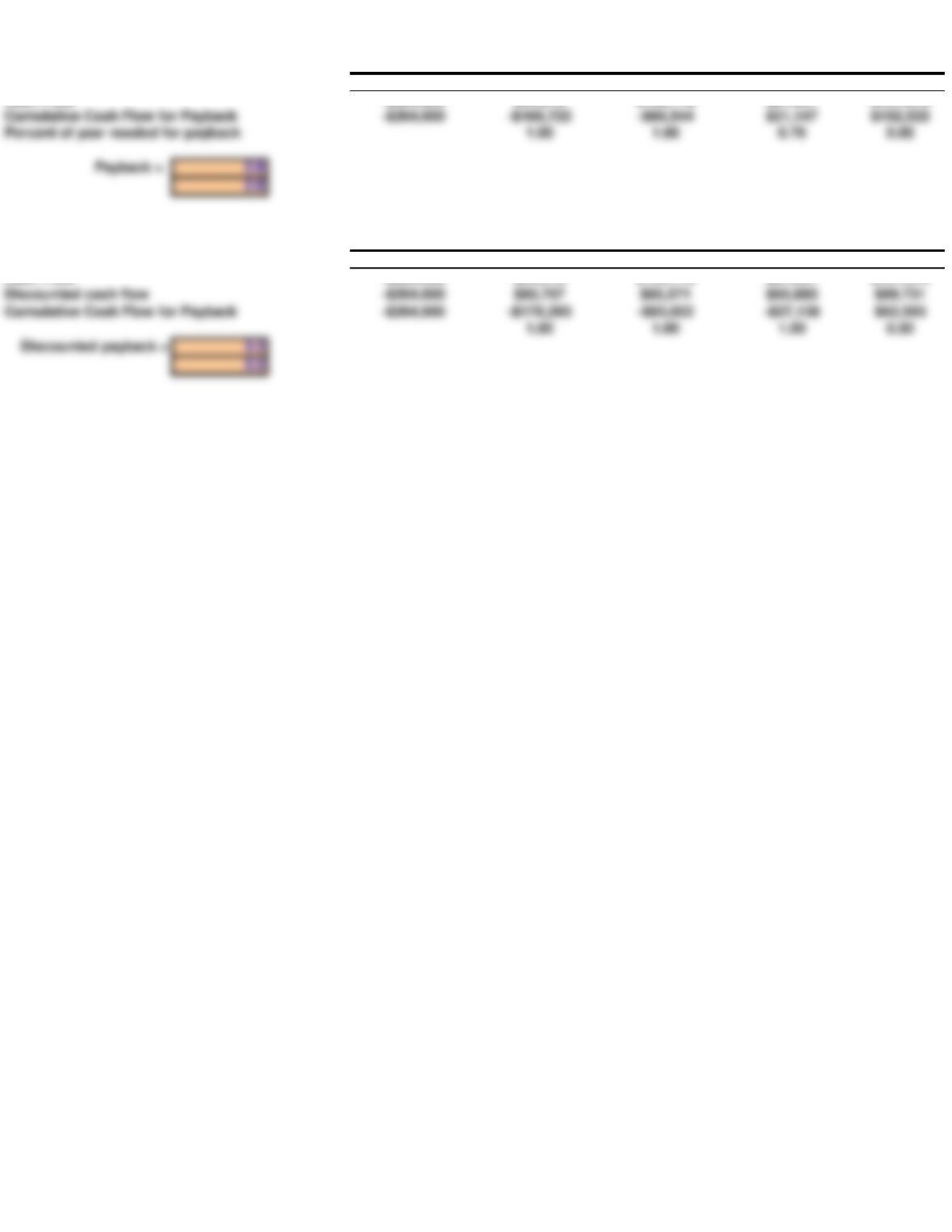
Find Payback
0 1 2 3 4
Cash Flow -$264,000 $94,278 $103,178 $87,691 $131,376
Find Discounted Payback
0 1 2 3 4
Cash Flow -$264,000 $94,278 $103,178 $87,691 $131,376
Years
Years
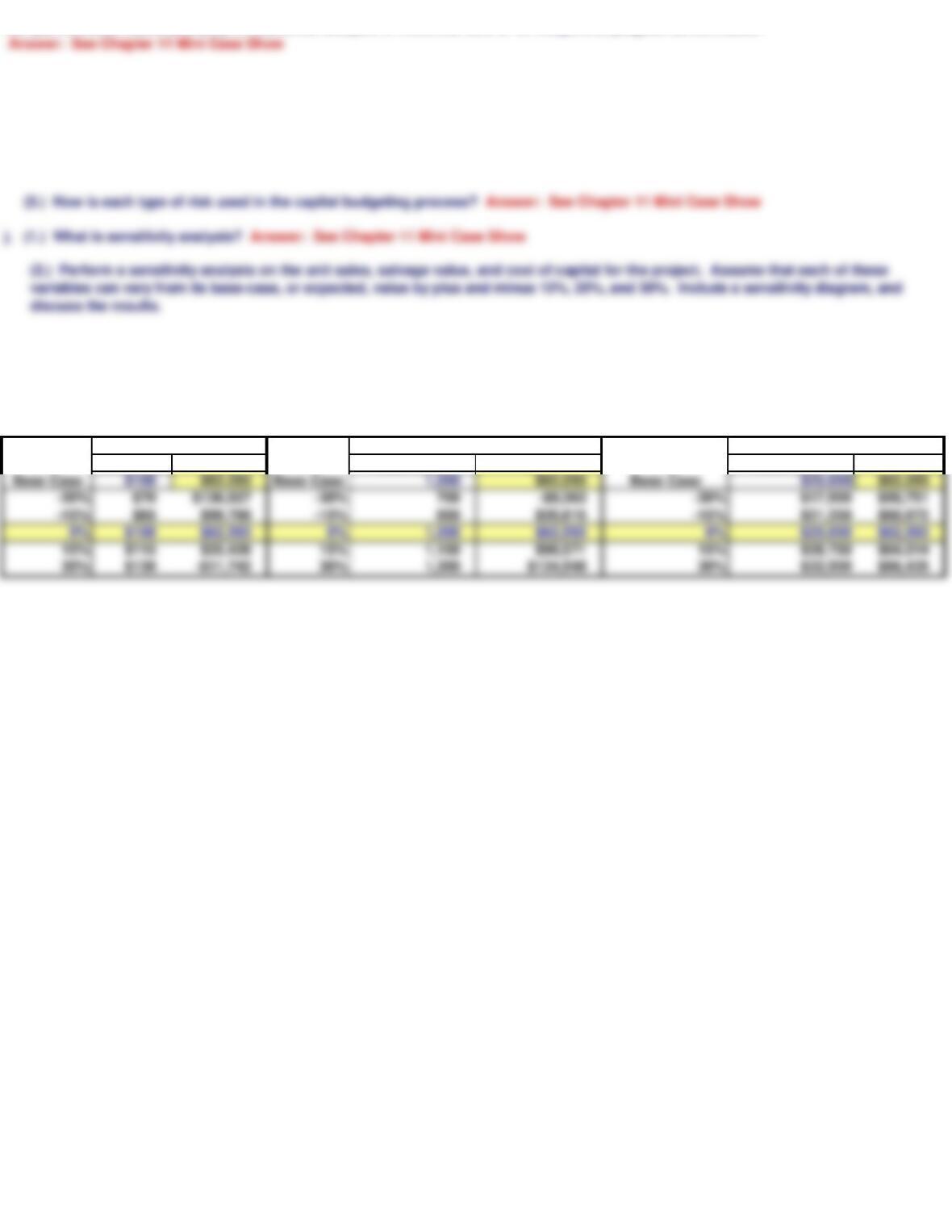
% Deviation % Deviation % Deviation
from Base cost NPV from Base units NPV from Base Salv. NPV
We summarize the data tables and show the sensitivity analysis graph below:
1st YEAR UNIT SALES
SALVAGE
j. (1.) What is sensitivity analysis? Answer: See Chapter 11 Mini Case Show
discuss the results.
(3.) How is each type of risk used in the capital budgeting process? Answer: See Chapter 11 Mini Case Show
Incremental Costs
Here we use an Excel “Data Table” to find the NPVs for changes in unit sales, salvage value, and WACC holding other things constant–
changing one variable at a time. This produces the sensitivity analys as shown below.
(2.) How is each of these risk types measured, and how do they relate to one another? Answer: See Chapter 11 Mini Case Show
h. What does the term ”risk” mean in the context of capital budgeting; to what extent can risk be quantified; and when risk is quantified, is
the quantification based primarily on statistical analysis of historical data or on subjective, judgmental estimates?
i. (1.) What are the three types of risk that are relevant in capital budgeting? Answer: See Chapter 11 Mini Case Show
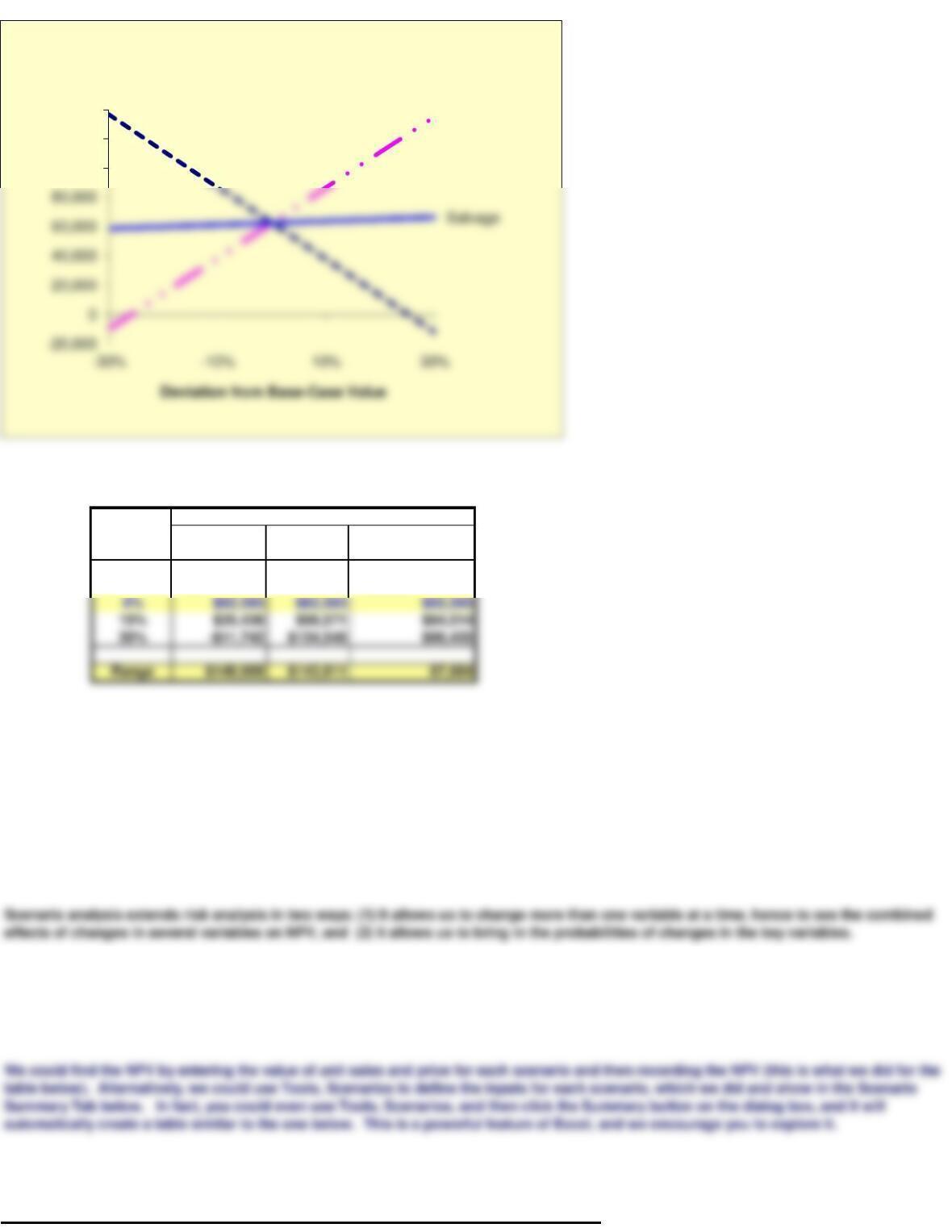
Deviation NPV Deviation from Base Case
from
Base Case Cost per unit Units Sold Salvage
-30% $136,927 -$9,363 $58,751
-15% $99,760 $26,615 $60,672
Scenario Analysis
Probability Unit Sales Unit Price NPV
Scenario
(2.) What is the worst-case NPV? The best-case NPV?
(3.) Use the worst-, most likely, and best-case NPVs and probabilities of occurrence to find the project’s expected NPV, standard
deviation, and coefficient of variation.
Squared Deviation
times Probability
(3.) What is the primary weakness of sensitivity analysis? What is its primary usefulness? Answer: See Chapter 11 Mini Case Show
k. Assume that Sidney Johnson is confident of her estimates of all the variables that affect the project’s cash flows except unit sales and
sales price: If product acceptance is poor, unit sales would be only 800 units a year and the unit price would only be $160; a strong
consumer response would produce sales of 1,200 units and a unit price of $240. Sidney believes that there is a 25% chance of poor
acceptance, a 25% chance of excellent acceptance, and a 50% chance of average acceptance (the base case).
(1.) What is scenario analysis?
Cost per unit Units Sold
100,000
120,000
140,000
NPV ($)
Sensitivity Analysis
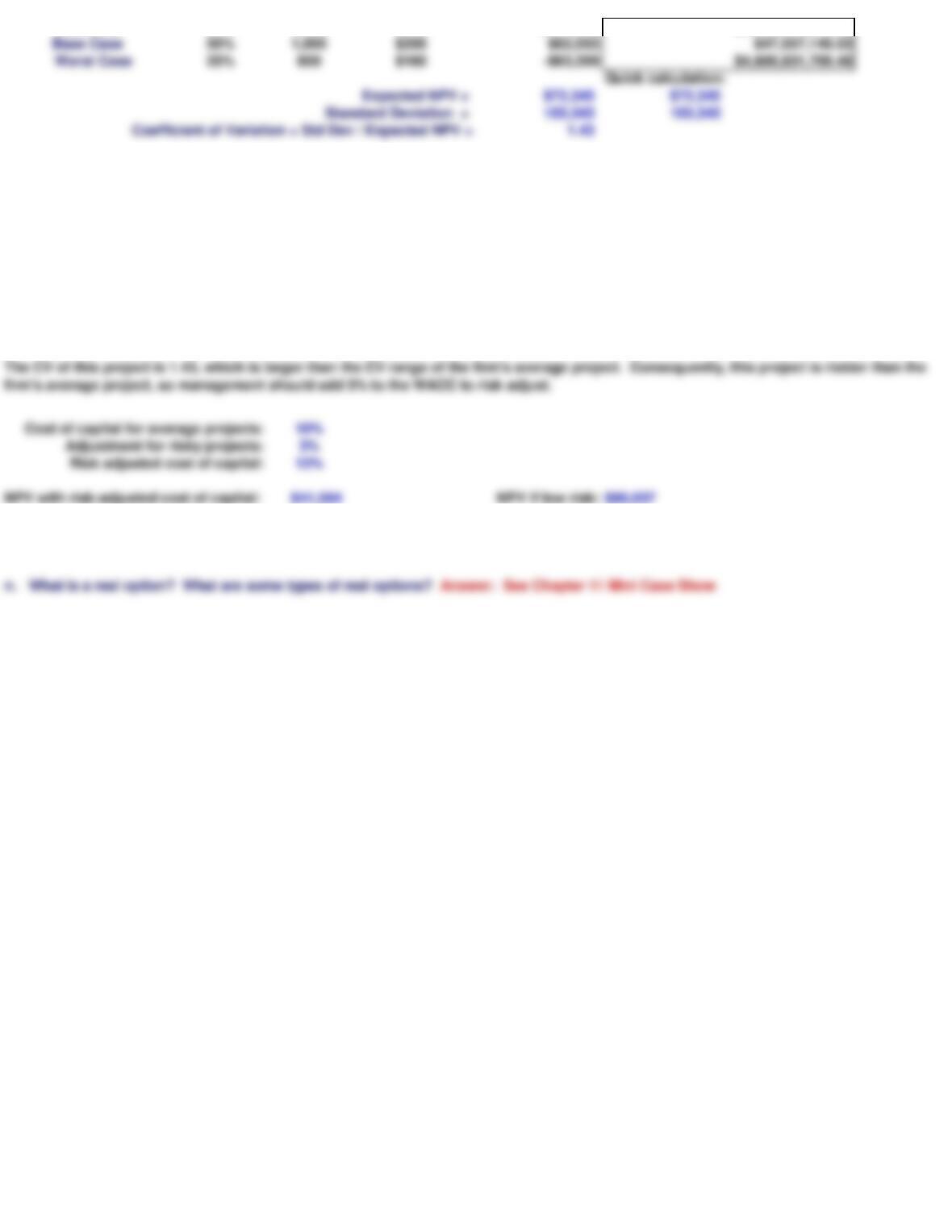
25% 1,200 $240 $227,595
(2.) Shrieves typically adds or subtracts 3 percentage points to the overall cost of capital to adjust for risk. Should the new line be
accepted?
(3.) Are there any subjective risk factors that should be considered before the final decision is made? Answer: See Chapter 11 Mini Case
Show
m. (1.) Assume that Shrieves’ average project has a coefficient of variation in the range of 0.2 to 0.4. Would the new line be classified as
high risk, average risk, or low risk? What type of risk is being measured here? Answer: See Chapter 11 Mini Case Show
Best Case
l. Are there problems with scenario analysis? Define simulation analysis, and discuss its principal advantages and disadvantages.
Answer: See Chapter 11 Mini Case Show. Also, see the worksheet this file for an application of simulation analysis to this project analysis.
$6,025,613,876.98
50% 1,000 $200 $62,593
$4,606,631,706.48