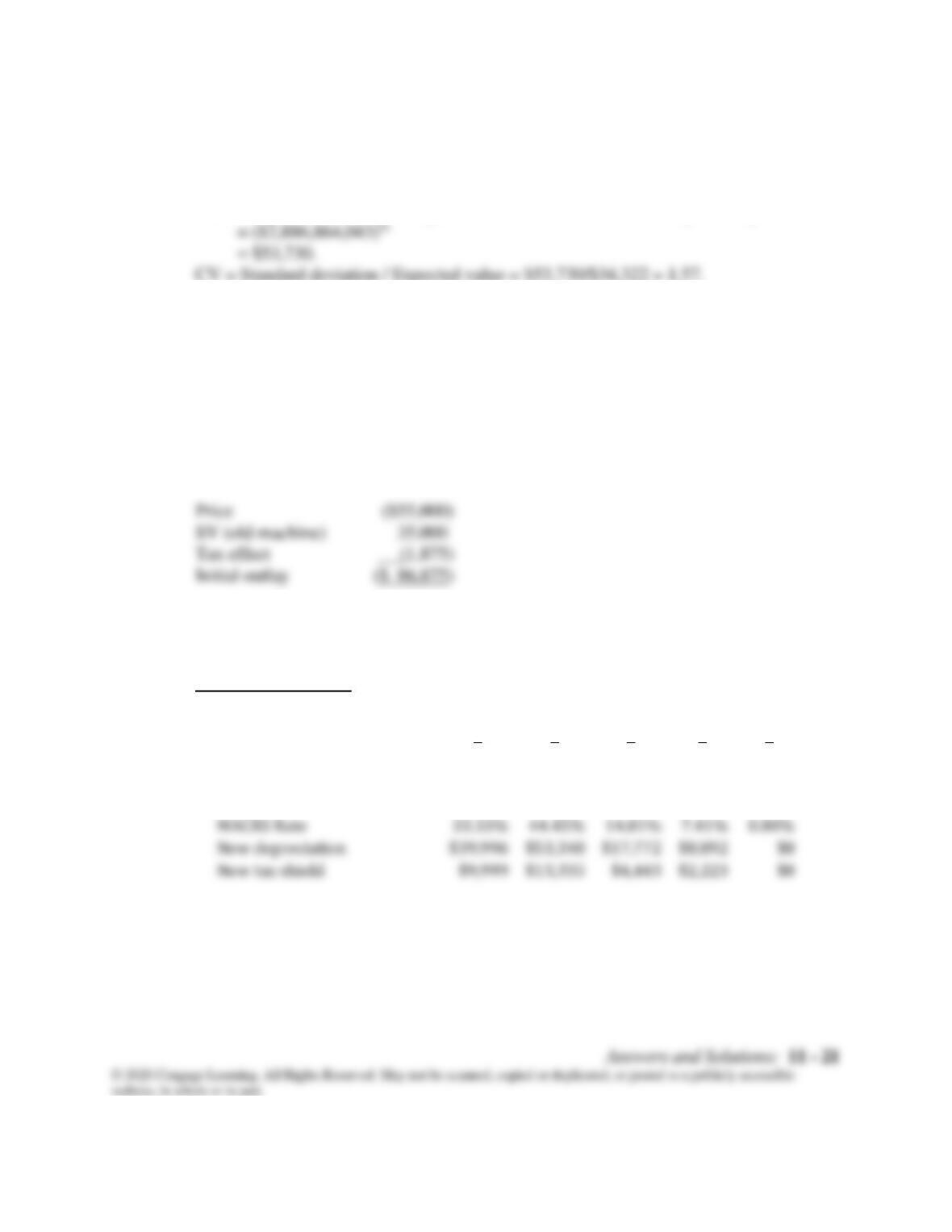
E[NPV] = Sum of NPV x Prob. = sum in 5th column of preceding table = $34,322.
NPV = Square root of sum of squared deviations in last column of preceding table.
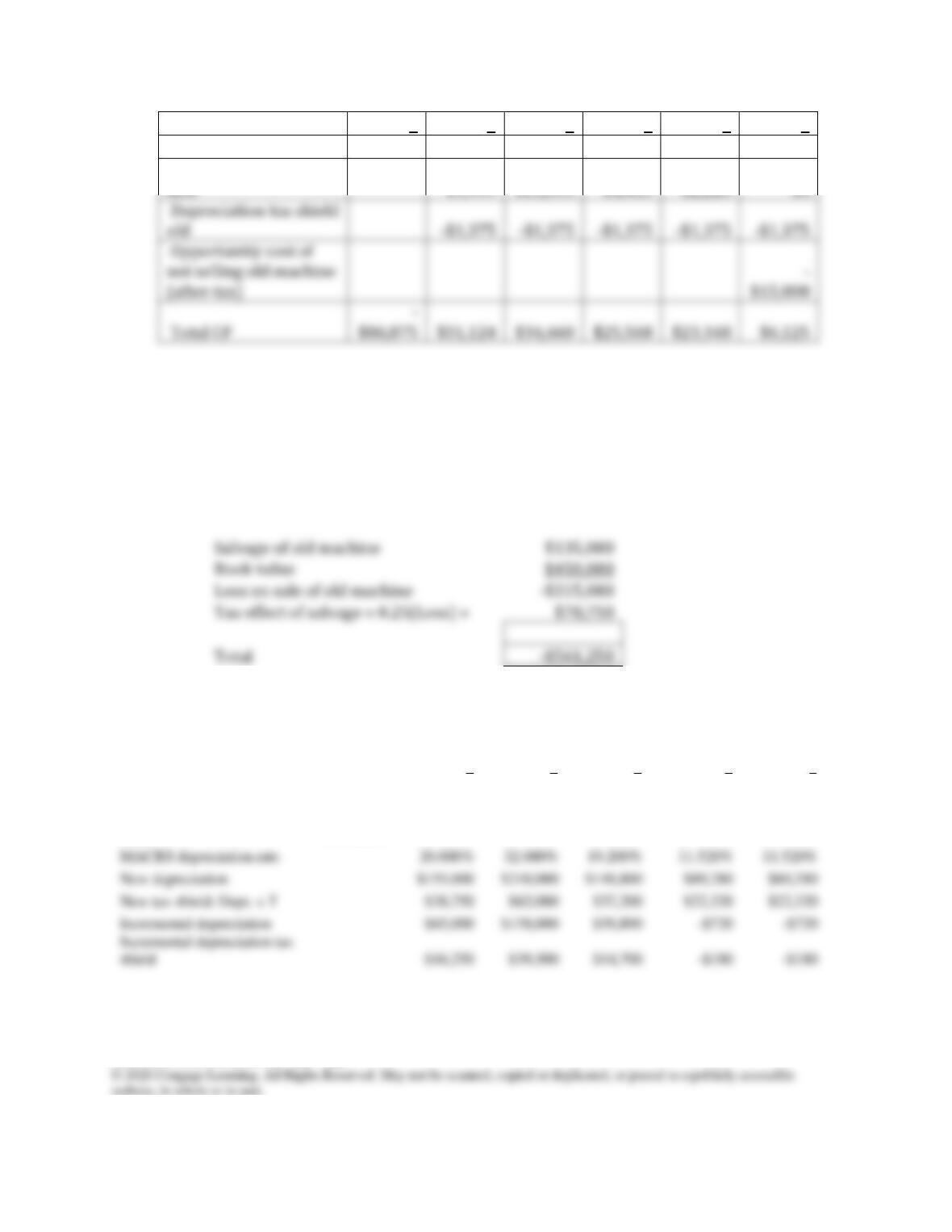
11–13 a. Old depreciation = $5,500 per year.
Book value = $55,000 – 5($5,500) = $27,500.
Gain = $35,000 – $27,500 = $7,500.
Tax on book gain = $7,500(0.25) = $1,875
.
b.
MACRS Rate
33.33%
44.45%
14.81%
7.41%
0.00%
1
2
3
4
5
Old depreciation
$5,500
$5,500
$5,500
$5,500
$5,500
Old tax shield
$1,375
$1,375
$1,375
$1,375
$1,375
Basis
$120,000
MACRS Rate
New depreciation
$39,996
$53,340
$17,772
$8,892
New tax shield
$9,999
$13,335
$4,443
$2,223
Answers and Solutions: 11 – 22
0
1
2
3
4
5
After tax savings
$22,500
$22,500
$22,500
$22,500
$22,500
$13,335
Depreciation tax shield
(after-tax)
Total CF
$31,124
$34,460
$25,568
$23,348
Depreciation tax shield
c. NPV -$2,243.15
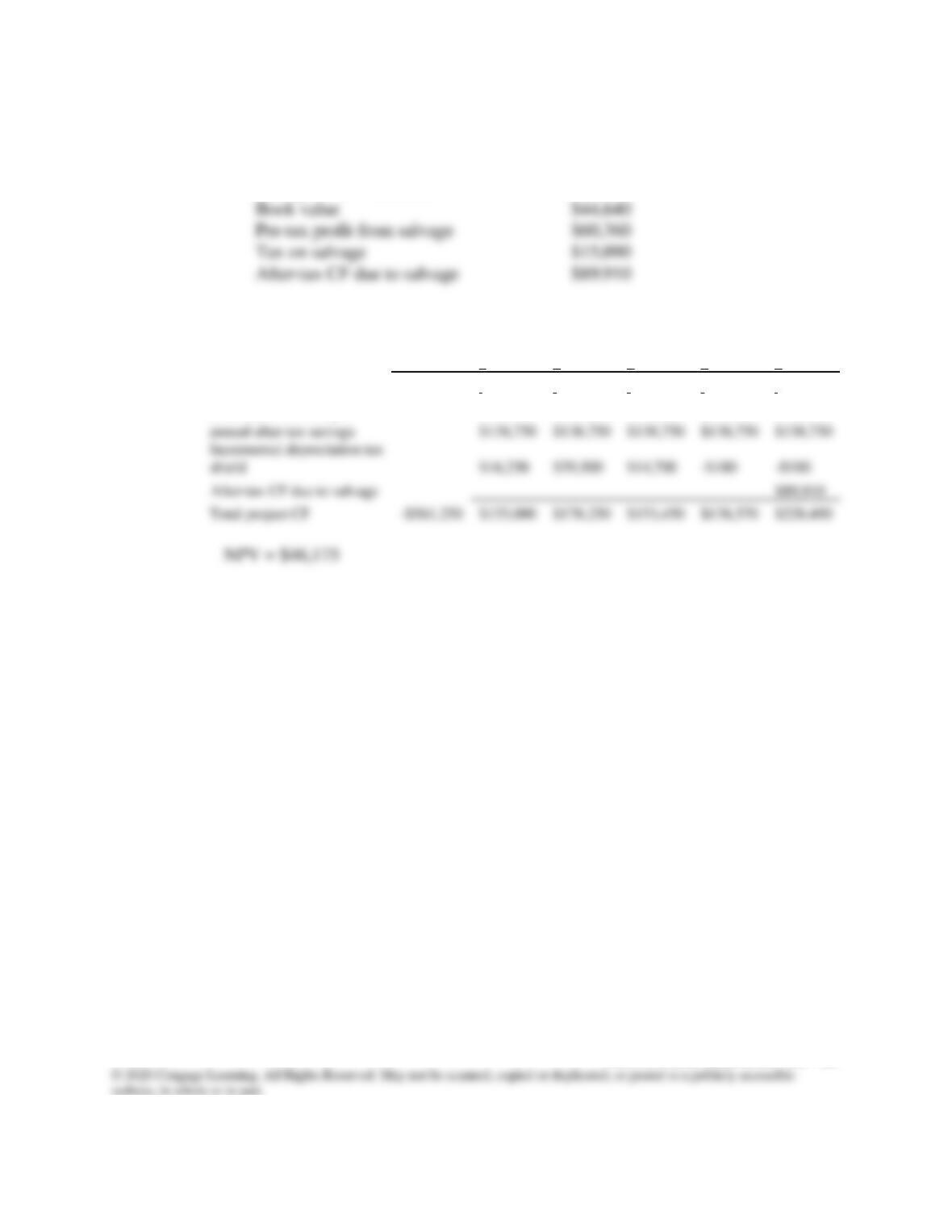
11–14 a.
New machine cost
-$775,000
Salvage of old machine
Book value
Loss on sale of old machine
-$315,000
Tax effect of salvage = 0.25(Loss) =
b.
1
2
3
4
5
Old depreciation
$90,000
$90,000
$90,000
$90,000
$90,000
Old tax shield: Depr. x T
$22,500
$22,500
$22,500
$22,500
$22,500
Basis
$775,000
MACRS depreciation rate
New depreciation
$155,000
$89,280
$89,280
New tax shield: Depr. x T
$38,750
$62,000
$37,200
$22,320
$22,320
Incremental depreciation
$65,000
$58,800
shield
$16,250
$39,500
$14,700
Answers and Solutions: 11 – 23
c.
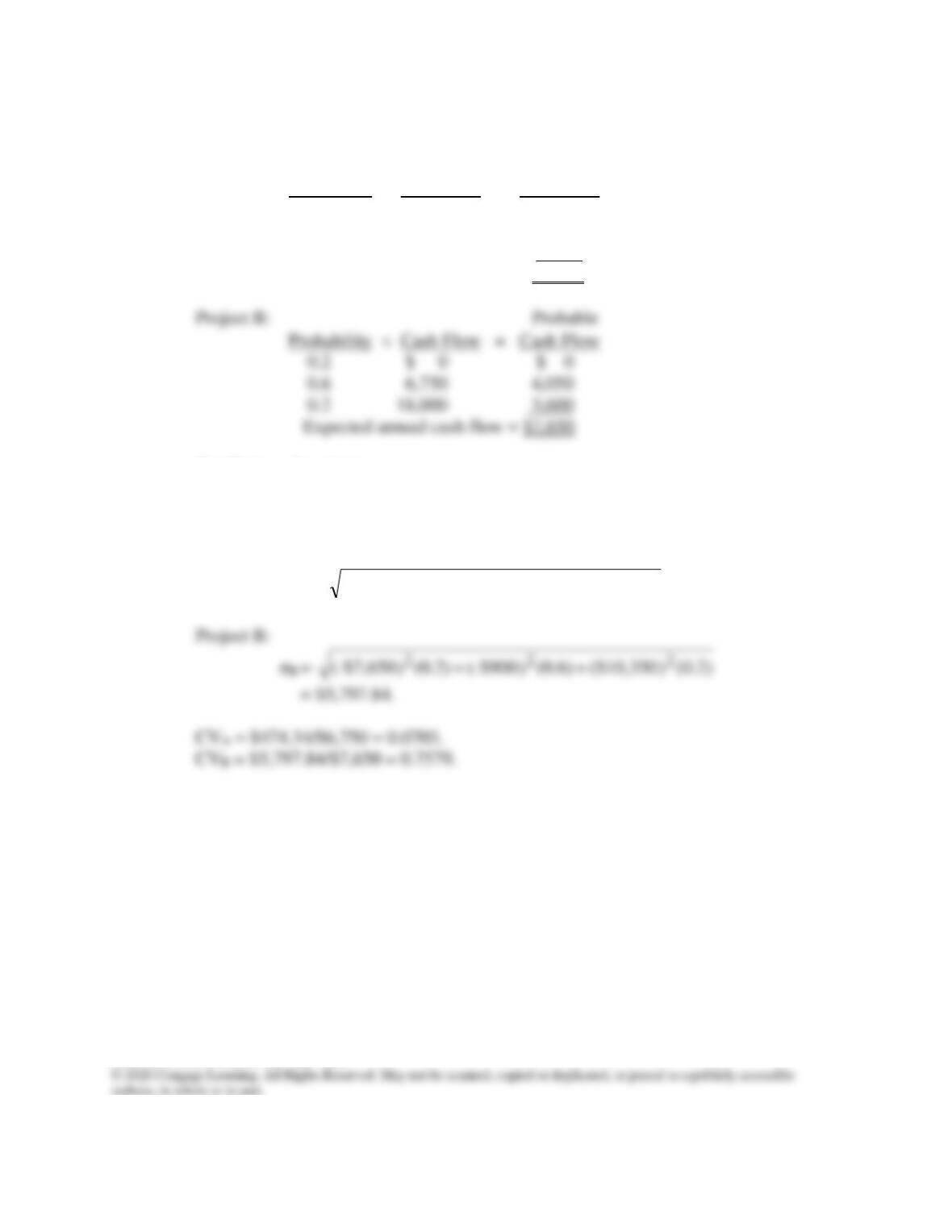
Year 5
Salvage of new machine
$105,000
Book value
Pre–tax profit from salvage
Tax on salvage
After–tax CF due to salvage
d.
0
1
2
3
4
5
Initial cash flow
-$561,250
annual pre-tax savings
$185,000
$185,000
$185,000
$185,000
$185,000
annual after-tax savings
$138,750
$138,750
$138,750
$138,750
$138,750
$16,250
$39,500
$14,700
After-tax CF due to salvage
$89,910
Total project CF
-$561,250
$155,000
$178,250
$153,450
$138,570
$228,480
Answers and Solutions: 11 – 24
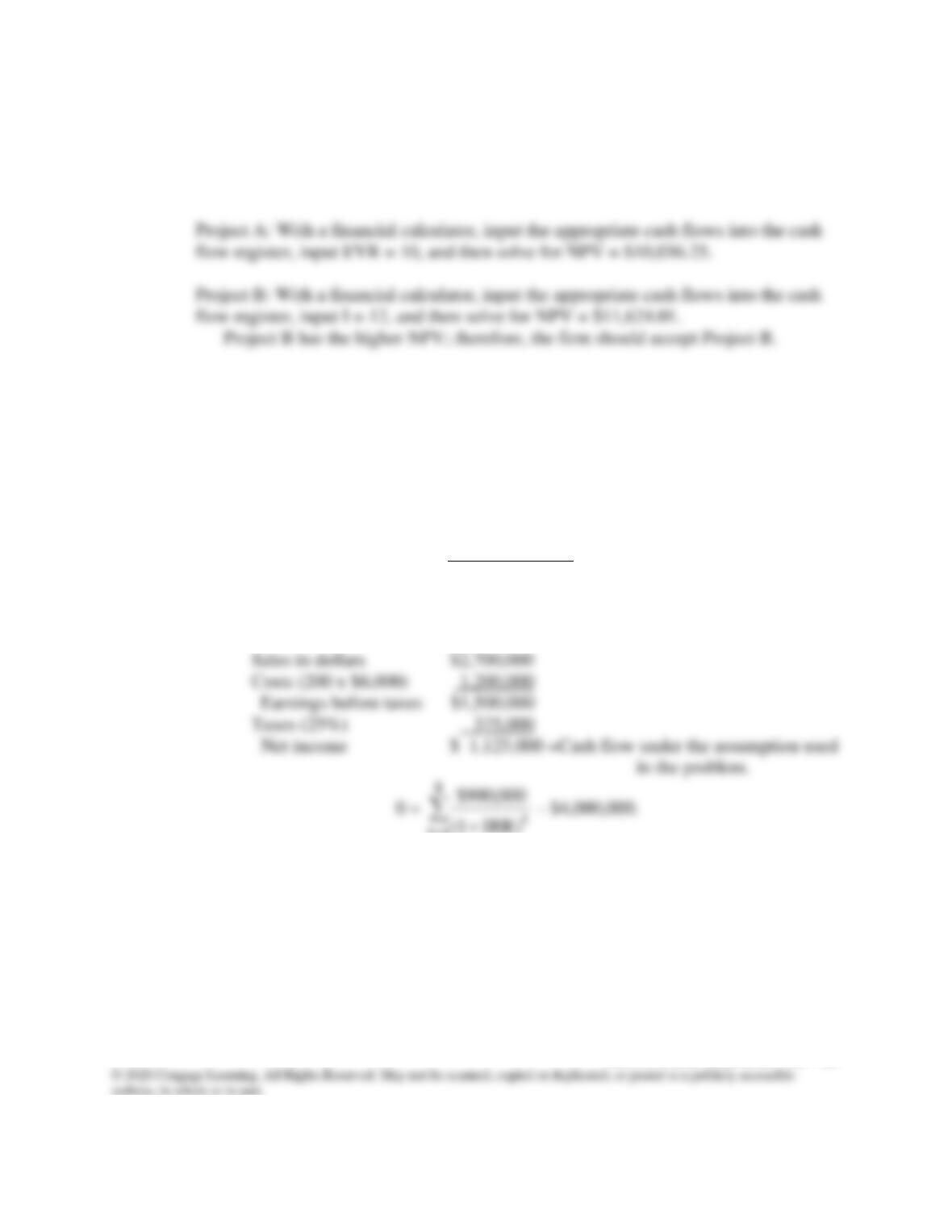
11-15 a. Expected annual cash flows:
Project A: Probable
Probability Cash Flow = Cash Flow
0.2 $6,000 $1,200
0.6 6,750 4,050
0.2 7,500 1,500
Expected annual cash flow = $6,750
Coefficient of variation:
CV = Standard deviation / Expected value = σCF/Expected CF
Project A:
σA =
$474.34. = (0.2)
)
($750 + (0.6)
)
($0 + (0.2)
)
(-$750 222
Answers and Solutions: 11 – 25
b. Project B is the riskier project because it has the greater variability in its probable
cash flows, whether measured by the standard deviation or the coefficient of
variation. Hence, Project B is evaluated at the 12 percent cost of capital, while
Project A requires only a 10 percent cost of capital.
c. The portfolio effects from Project B would tend to make it less risky than otherwise.
This would tend to reinforce the decision to accept Project B. Again, if Project B
were negatively correlated with the GDP (Project B is profitable when the economy is
down), then it is less risky and Project B’s acceptance is reinforced.
11-16 a. First, note that with symmetric probability distributions, the middle value of each
distribution is the expected value. Therefore,
Expected Values
Sales (units) 200
Sales price $13,500
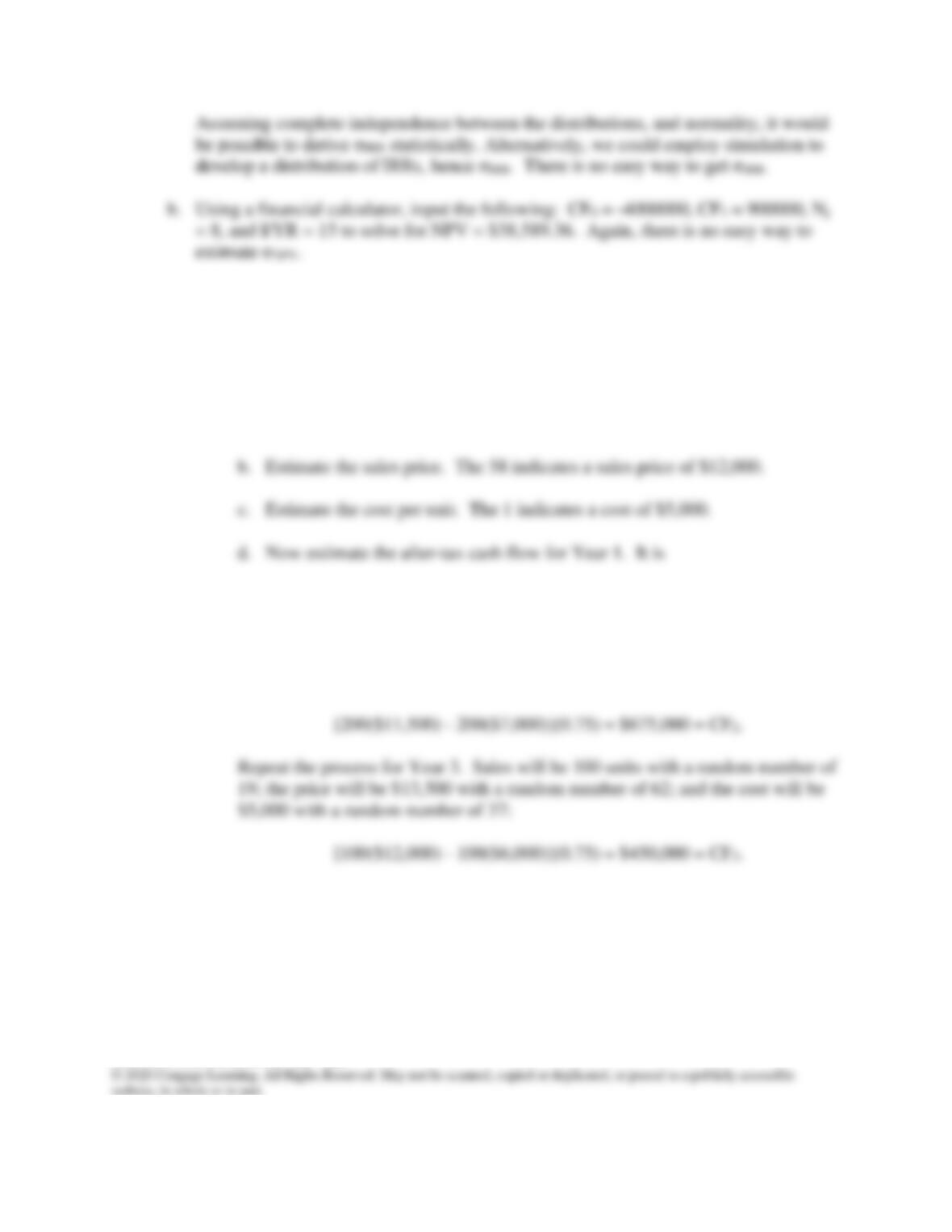
Using a financial calculator, input the following: CF0 = -4000000, CF1 = 900000, and
Nj = 8, to solve for IRR = 15.29%.
Expected IRR = 15.29% ≈ 15.3%.
=+
1t t
Answers and Solutions: 11 – 26
c. (1) a. Calculate the project life. The 17, being less than 20, indicates that a 3-year
life should be used.
b. Calculate developmental costs. The 44 random number value, coming
between 30 and 70, indicates that the costs for this run are $4 million.
(2) a. Estimate unit sales. The 16 indicates sales of 100 units.
[100($12,000) – 100($5,000)](1 – 0.25) = $525,000 = CF1.
Repeat the process for Year 2. Sales will be 200 with a random number of 79;
the price will be $11,500 with a random number of 83; and the cost will be
$7,000 with a random number of 86:
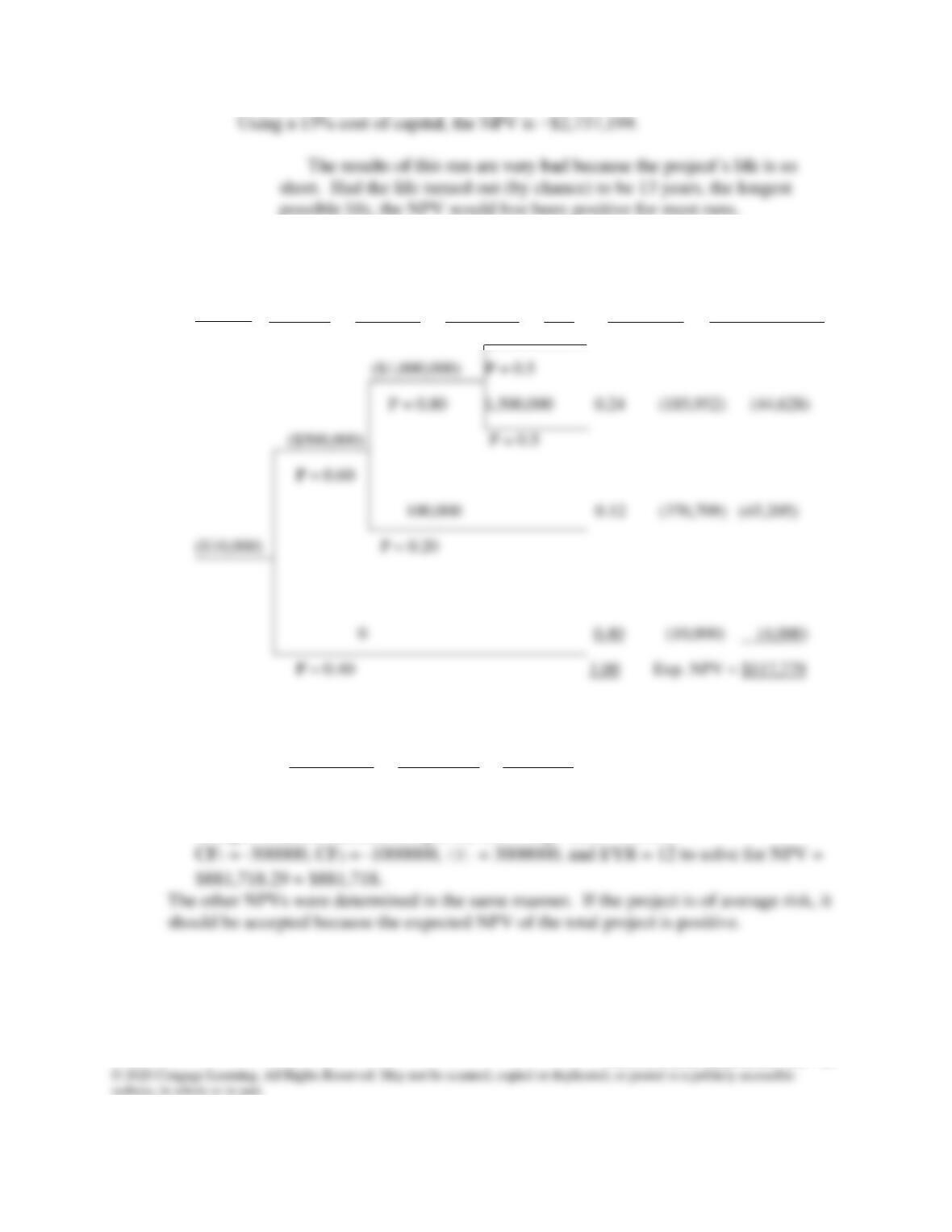
(2) The time line is :
Year 0
Year 1
Year 2
Year 3
-$4,000,000
$525,000
$675,000
$450,000
Answers and Solutions: 11 – 27
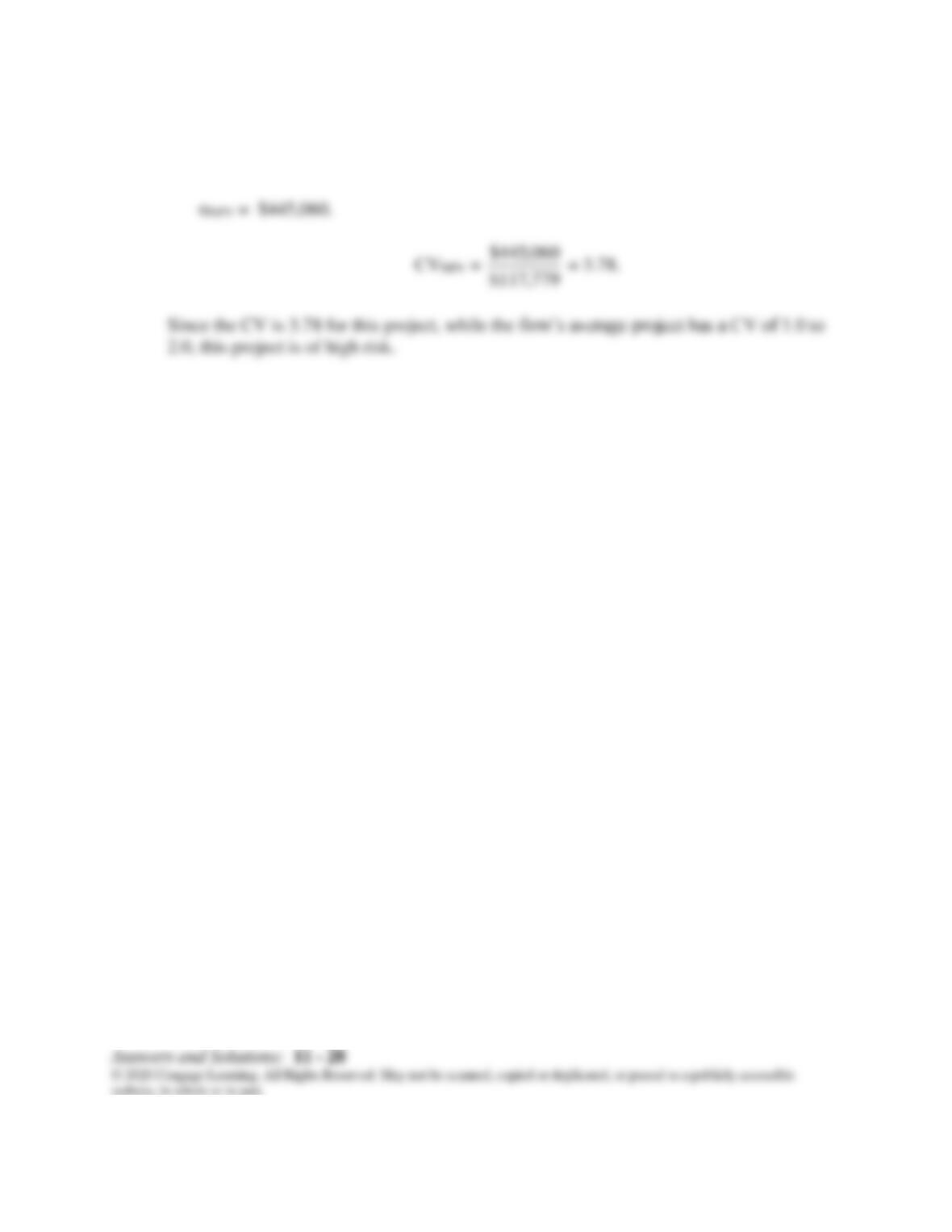
11-17 a. The resulting decision tree is:
NPV
t = 0 t = 1 t = 2 t = 3 P NPV Product
$3,000,000 0.24 $881,718 $211,612
The NPV of the top path is:
– – – $10,000 = $881,718.
Using a financial calculator, input the following: CF0 = -10000,
3
)12.1(
000,000,3$
2
)12.1(
000,000,1$
1
)12.1(
000,500$
b. σ2NPV = 0.24($881,718 – $117,779)2 + 0.24(-$185,952 – $117,779)2
+ 0.12(-$376,709 – $117,779)2 + 0.4(-$10,000 – $117,779)2
= 198,078,470,853.

Answers and Solutions: 11 – 29
SOLUTION TO SPREADSHEET PROBLEM
11-18 The detailed solution for the problem is available in the file Ch 11 P18 Build a Model
Solution.xlsx at the textbook’s Web site.
Mini Case: 11 – 30
MINI CASE
Shrieves Casting Company is considering adding a new line to its product mix, and the capital
budgeting analysis is being conducted by Sidney Johnson, a recently graduated MBA. The
production line would be set up in unused space in Shrieves’ main plant. The machinery’s
invoice price would be approximately $200,000, another $10,000 in shipping charges would be
required, and it would cost an additional $30,000 to install the equipment. The machinery has
an economic life of 4 years, and Shrieves has obtained a special tax ruling that places the
equipment in the MACRS 3-year class. The machinery is expected to have a salvage value of
$25,000 after 4 years of use.
The new line would generate incremental sales of 1,000 units per year for 4 years at an
incremental cost of $100 per unit in the first year, excluding depreciation. Each unit can be
sold for $200 in the first year. The sales price and cost are both expected to increase by 3% per
year due to inflation. Further, to handle the new line, the firm’s net working capital would
have to increase by an amount equal to 12% of sales revenues. The firm’s tax rate is 25%, and
its overall weighted average cost of capital, which is the risk-adjusted cost of capital for an
average project (r), is 10%.
a. Define “incremental cash flow.”
a. 1. Should you subtract interest expense or dividends when calculating project cash
flow?
Answer: The cash flow statement should not include interest expense or dividends. The return
a. 2. Suppose the firm had spent $100,000 last year to rehabilitate the production line
site. Should this cost be included in the analysis? Explain.
Answer: The $100,000 cost to rehabilitate the production line site was incurred last year, and
Mini Case: 11 – 31
a. 3. Now assume that the plant space could be leased out to another firm at $25,000 per
year. Should this be included in the analysis? If so, how?
Answer: If the plant space could be leased out to another firm, then if Shrieves accepts this project,
a. 4. Finally, assume that the new product line is expected to decrease sales of the firm’s
other lines by $50,000 per year. Should this be considered in the analysis? If so,
how?
Answer: If a project affects the cash flows of another project, this is an “externality” that must be
b. Disregard the assumptions in part a. What is Shrieves’ depreciable basis? What
are the annual depreciation expenses?
Answer: The asset’s depreciable basis includes shipping and installation costs. Thus, the asset’s
depreciable basis = $200,000 + $10,000 + $30,000 = $240,000. Get the depreciation