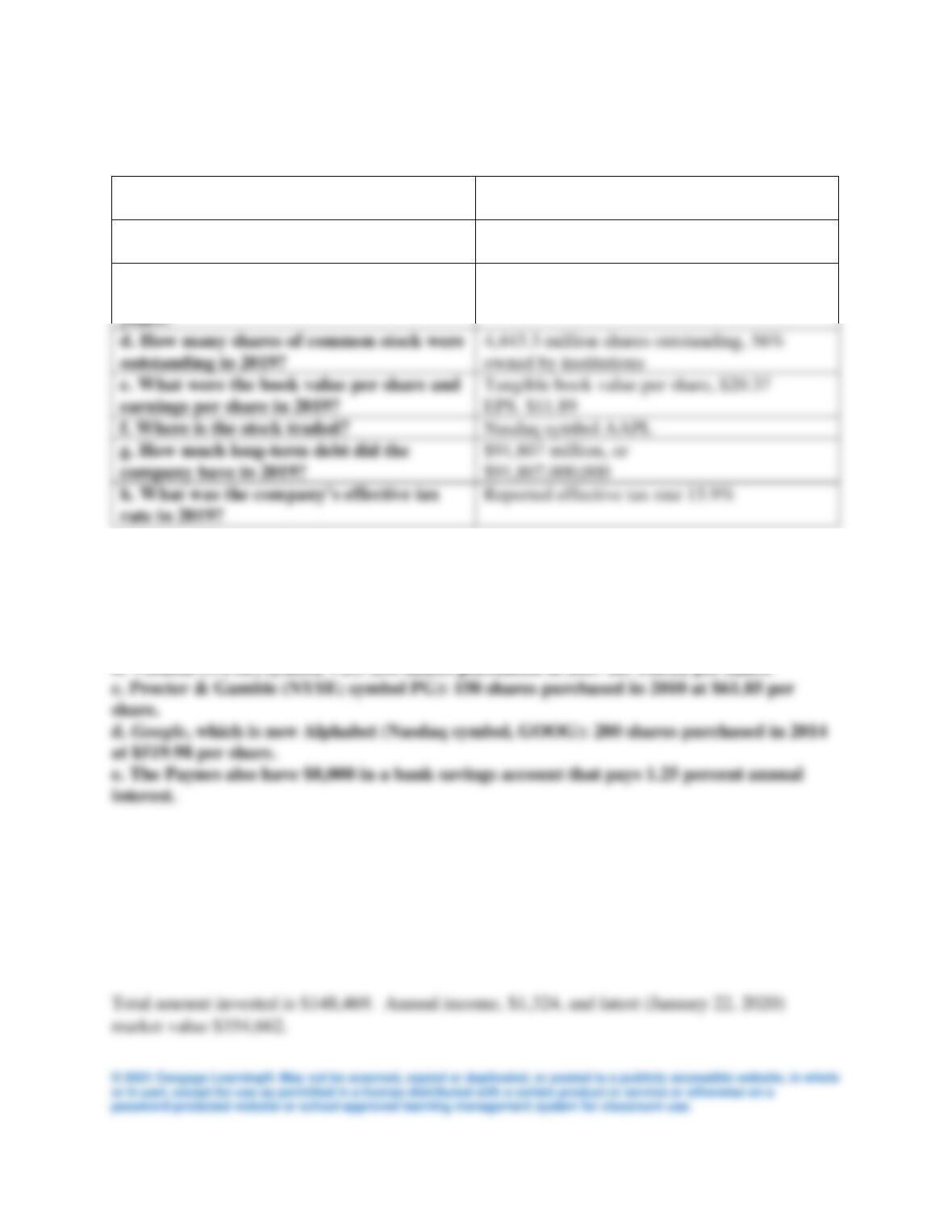
13. Interpreting stock report information. Using the stock report in Exhibit 11.6, find the
following information for Apple.
a. What was the amount of revenues (i.e.,
sales) generated by the company in 2018?
$265,595
b. What were the latest annual dividends
per share and dividend yield?
Dividends per share, $3.08
Dividend yield, 1.20%
c. What was the earnings (per share)
growth rate projection for the next three
years?
d. How many shares of common stock were
outstanding in 2019?
4,443.3 million shares outstanding, 56%
owned by institutions
e. What were the book value per share and
earnings per share in 2019?
Tangible book value per share, $20.37
EPS. $11.89
f. Where is the stock traded?
Nasdaq symbol AAPL
g. How much long-term debt did the
company have in 2019?
$91,807 million, or
$91,807,000,000
rate in 2019?
Reported effective tax rate 15.9%
10%
14. Tracking portfolio performance. Use Worksheet 11.2 to help Destiny and Robert Payne,
a married couple in their late 40s, evaluate their securities portfolio, which includes these
holdings.
a. IBM. (NYSE; symbol IBM): 100 shares bought in 2011 for $170.40 per share.
1. Based on the latest quotes and portfolio tracking tools obtained from the Internet,
complete Worksheet 11.2.
Buy, sell or hold will vary with students. Not certain that is one correct answer.
2. What’s the total amount the Paynes have invested in these securities, the annual income
they now receive, and the latest market value of their investments?
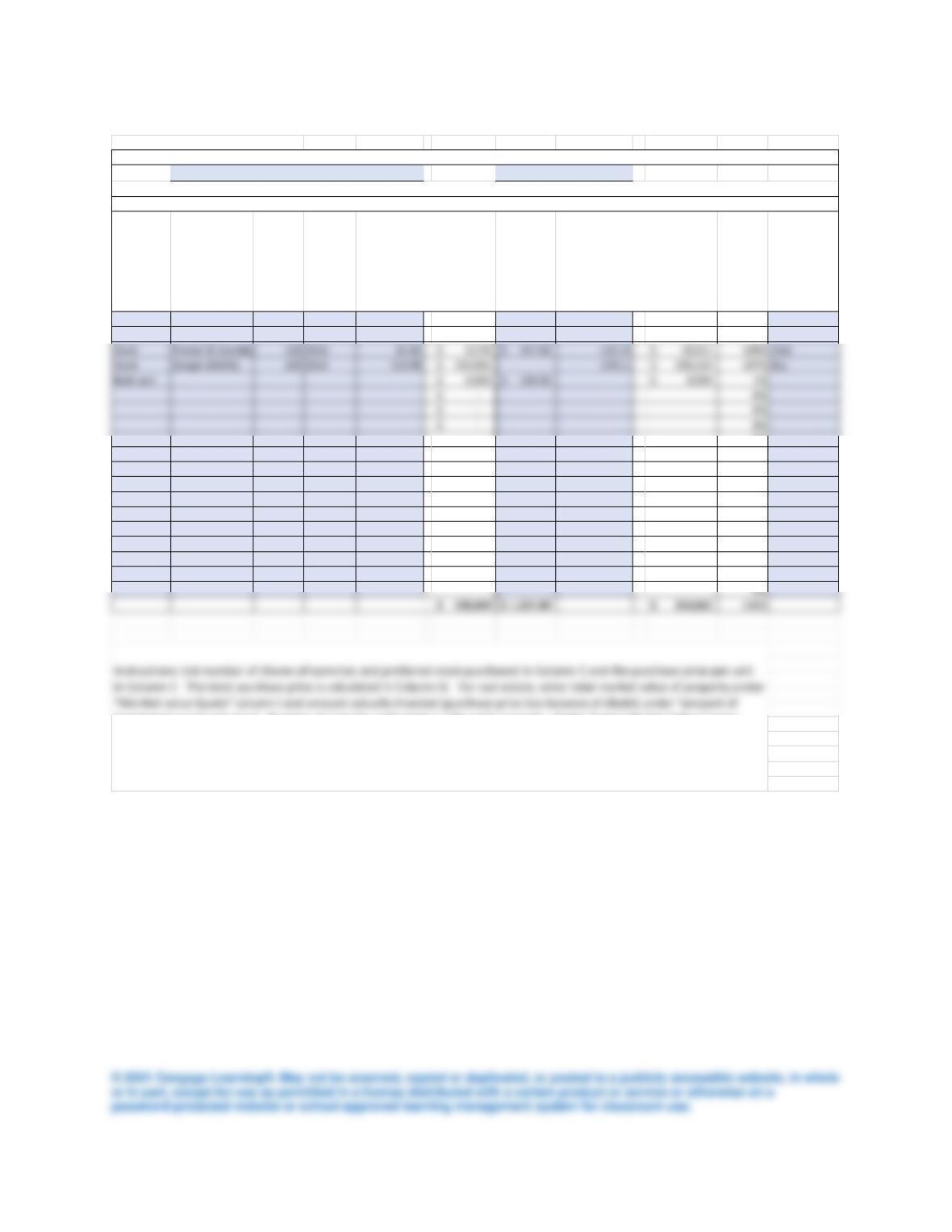
Worksheet 11.2, Chapter 11 Exercixe 14
Name(s): Destiny and Robert Payne Date:
Type of
Investment
Name of
investment
[stock symbol]
Number
of units
[shares or
other]
Date
Purchased
Cumulative
Amount of
Annual
Income
from
Dividends,
Interest, etc.
Return
Comments/
Planned
Actions: Buy,
Sell, Hold
Stock IBM [IBM] 100 2011 170.40$ 17,040$ 162.00$ 143$ 14,321$ -15% Sell
Stock Verizon [VZ] 250 2007 40.62 10,155$ 615.00$ 60.8 15,200$ 56% Hold
0%
0%
0%
0%
0%
0%
0%
0%
0%
0%
investment quote column E. Number of units for real estate is 1 for each property. Under “Latest Market Value,” enter
market price as of the date of this report (for instance, in December 2020, Pall Corp. was trading at 18.50). The latest market
value for real estate is entered as an estimate of what the property would likely sell for (under “market value Quote”). To
print with Column M, select “Fit to Page”as the scaling option. The return is computed as the (gain + annual income)
divided by purchase price.
AN INVENTORY OF INVESTMENT HOLDINGS
1/22/2020
Amount of
Investment
(Quote—$ Amount)
Latest
Market Value
(Quote—$ Amount)
Critical Thinking Cases
11.1 The Jessen’s Struggle with Two Investment Goals
Like many married couples, Morgan and Thomas Jensen are trying their best to save for
two important investment objectives: (1) an education fund to put their two children
through college; and (2) a retirement nest egg for themselves. They want to set aside
$100,000 per child by the time each one starts college. Given that their children are now 10
and 12 years old, Morgan and Thomas have 6 years remaining for one child and 8 for the
other. As far as their retirement plans are concerned, the Jensens both hope to retire in 20
years, when they reach age 65. Both Morgan and Thomas work, and together, they
currently earn about $90,000 a year.
Critical Thinking Questions
1. Use Worksheet 11.1 to determine whether the Jensens have enough money right now to
meet their children’s educational needs. That is, will the $65,000 they’ve accumulated so
far be enough to put their children through school, given they can invest their money at 6
percent? Remember, they want to have $100,000 set aside for each child by the time each
one starts college.
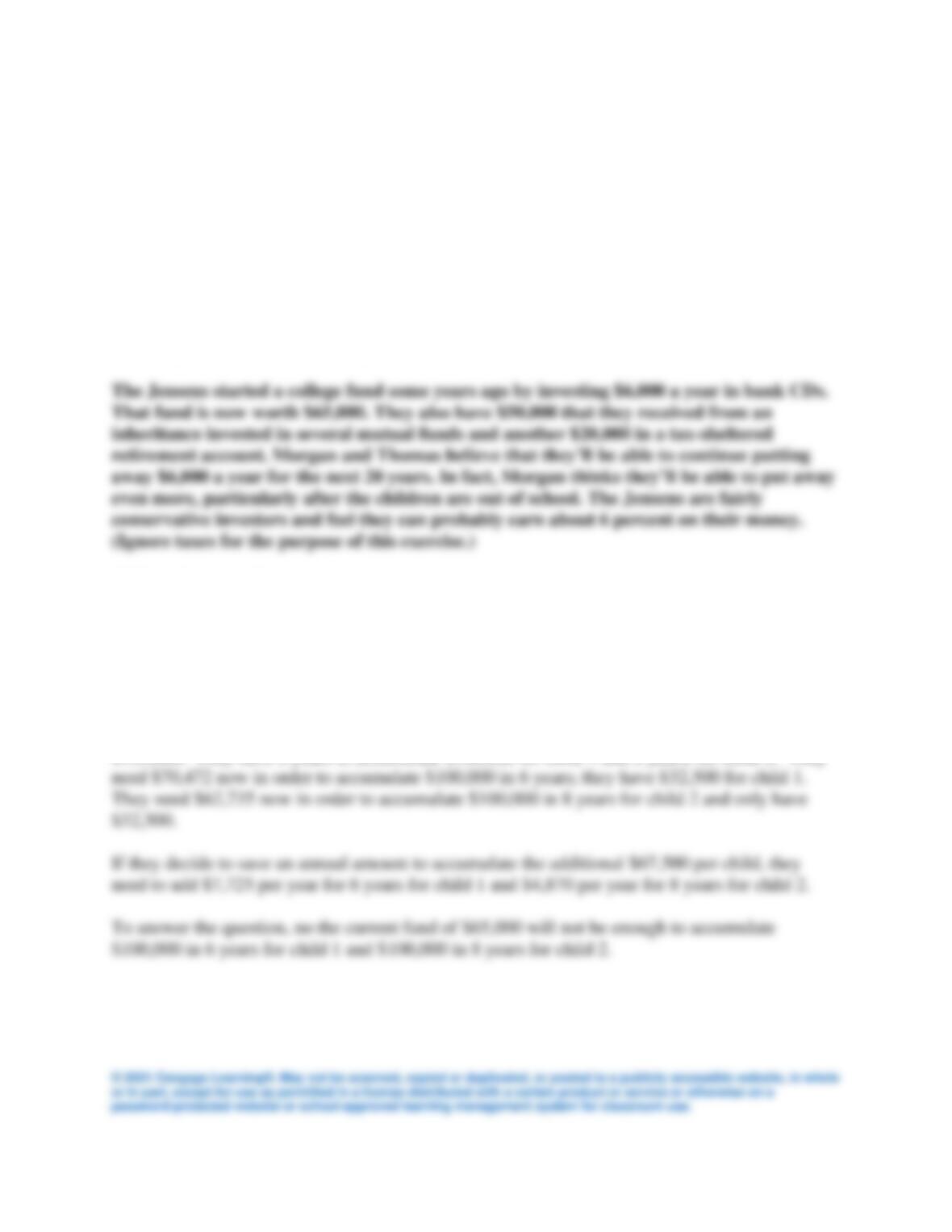
The Jensens have a balance of $65,000 saved for the education fund. They need an additional
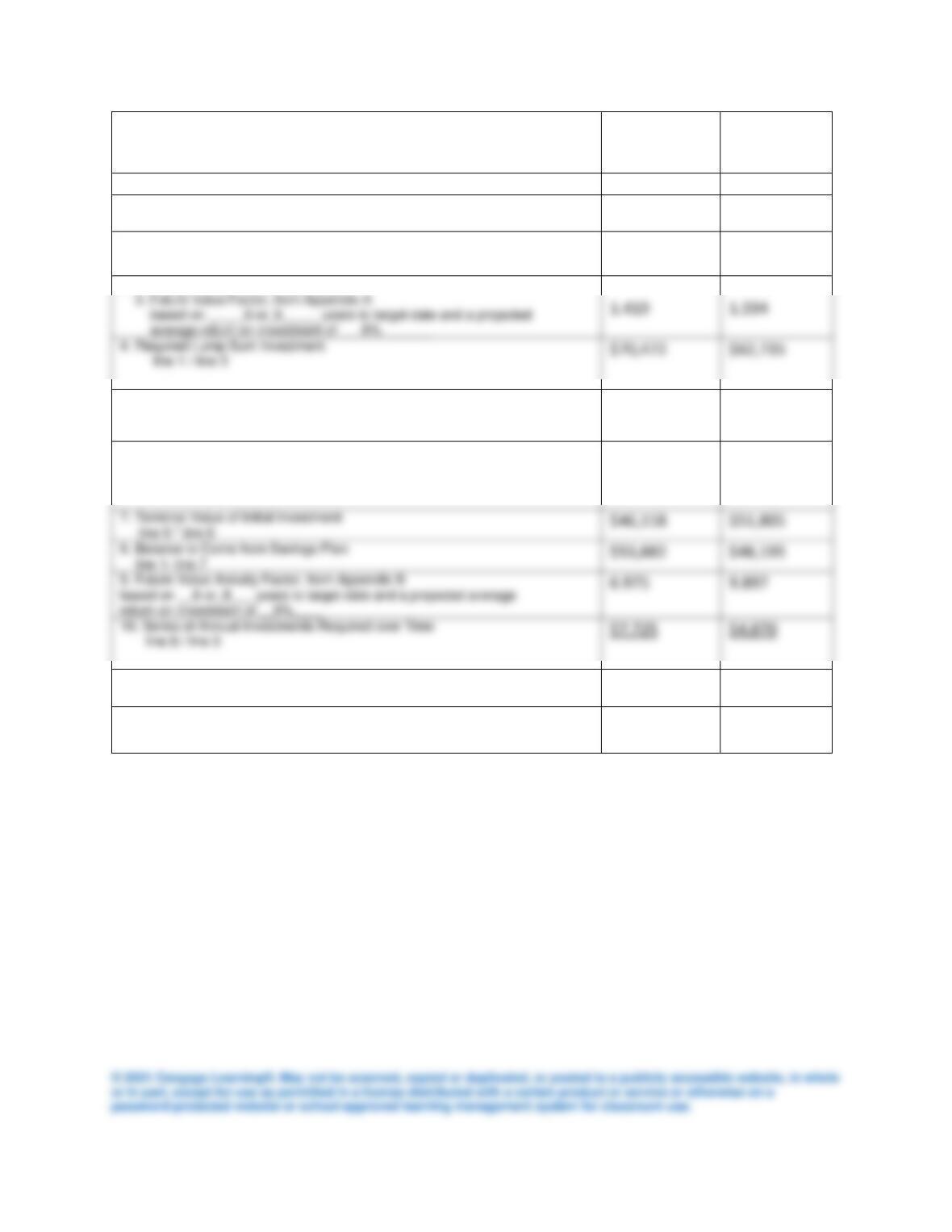
Determining the Amount of Investment
Capital
Financial Goal: To accumulate an additional $200,000 in 8 years
Child 1
Child 2
1. Targeted Financial Goal (see Note 1)
$100,000
$100,000
2. Projected Average Return on Investments
6%
6%
A. Finding a Lump Sum Investment:
line 1 / line 3
$70,472
$62,735
B. Making a Series of Investments over Time:
5. Amount of Initial Investment, if any (see Note 2)
32,500
32,500
6. Future Value Factor, from Appendix A
based on __6 or_8___ years of target date and a projected average
return on investment of ___6%___
6.975
9.897
1.419
1.594
Note 1: The “targeted financial goal” is the amount of money you want to
accumulate by some target date in the future.
Note 2: If you’re starting from scratch—i.e., there is no initial investment—enter
zero on line 5, skip lines 6 and 7, and then use the total targeted financial goal
(from line 1) as the amount to be funded
2. Regarding their retirement nest egg, assume that no additions are made to either the
$50,000 they now have in mutual funds or to the $20,000 in the retirement account. How
much would these investments be worth in 20 years, given that they can earn 6 percent?
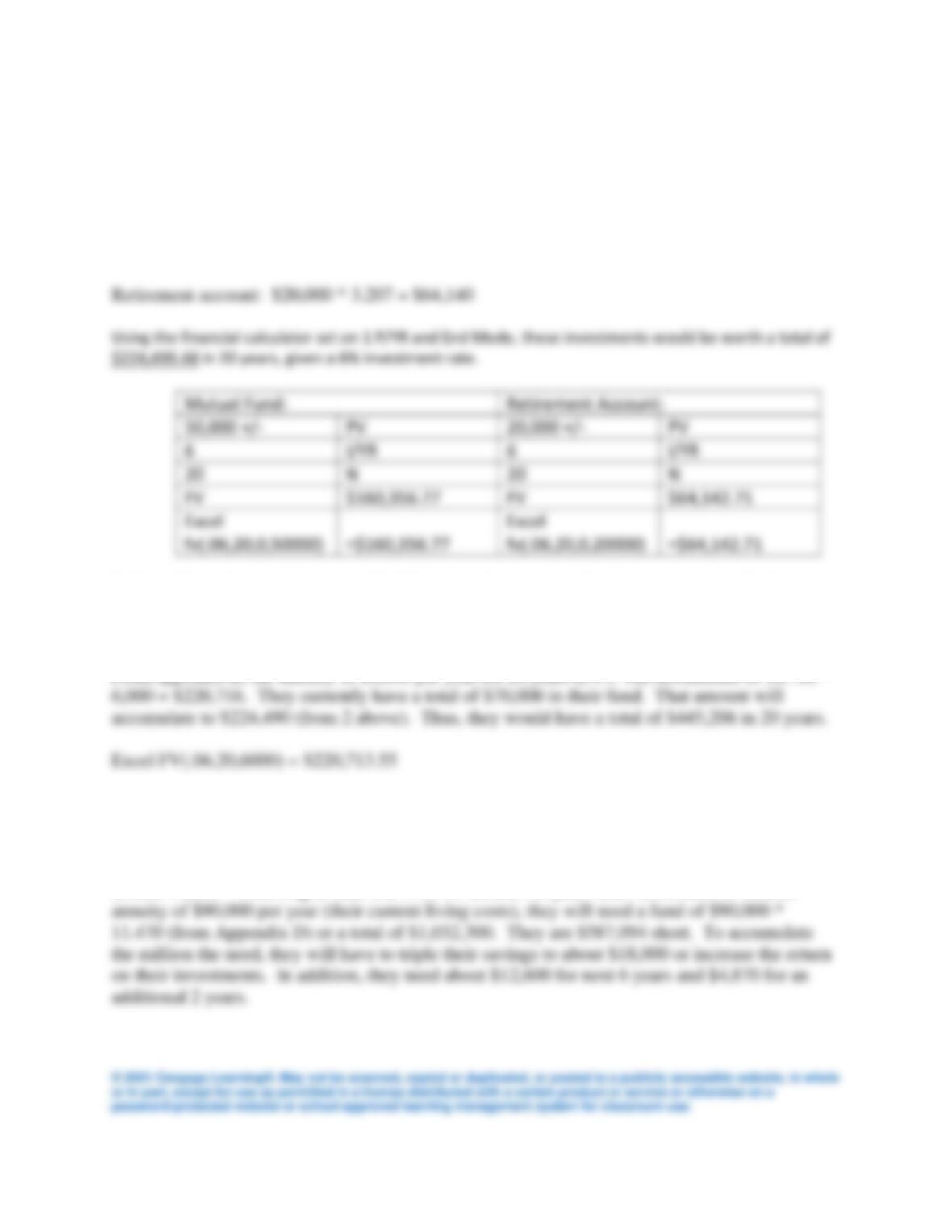
Using Appendix A, the future value of the two amounts will be:
Mutual Funds: $50,000 * 3.207 = $160,350
3. Now, if the Jensens can invest $6,000 a year for the next 20 years and apply all of that to
their retirement nest egg, how much would they be able to accumulate given their 6 percent
rate of return?
4. How do you think the Jensens are doing with regard to meeting their twin investment
objectives? Explain.
They are not on target to meet their goal for the educational fund. Their retirement fund is
11.2 Martin Moreno Takes Stock of His Securities
Martin Moreno is 42 years old, single, and works as a designer for a major architectural
firm. He is well paid and over time has built up a sizable portfolio of investments. He
considers himself an aggressive investor and, because he has no dependents to worry about,
likes to invest in high-risk/high-return securities. His records show the following
information.
1. In 2006, Martin bought 200 shares of eBay (Nasdaq; symbol EBAY) at $29.77 a share.
Every 3 months or so Martin prepares a complete, up-to-date inventory of his investment
holdings.
Critical Thinking Questions
1. Use a form like Worksheet 11.2 to prepare a complete inventory of Martin’s investment
holdings.
(Note: Look in the latest issue of The Wall Street Journal, or pull up an online source such
as http://finance.yahoo.com, to find the most recent closing price of the five stocks in
Martin’s portfolio.)
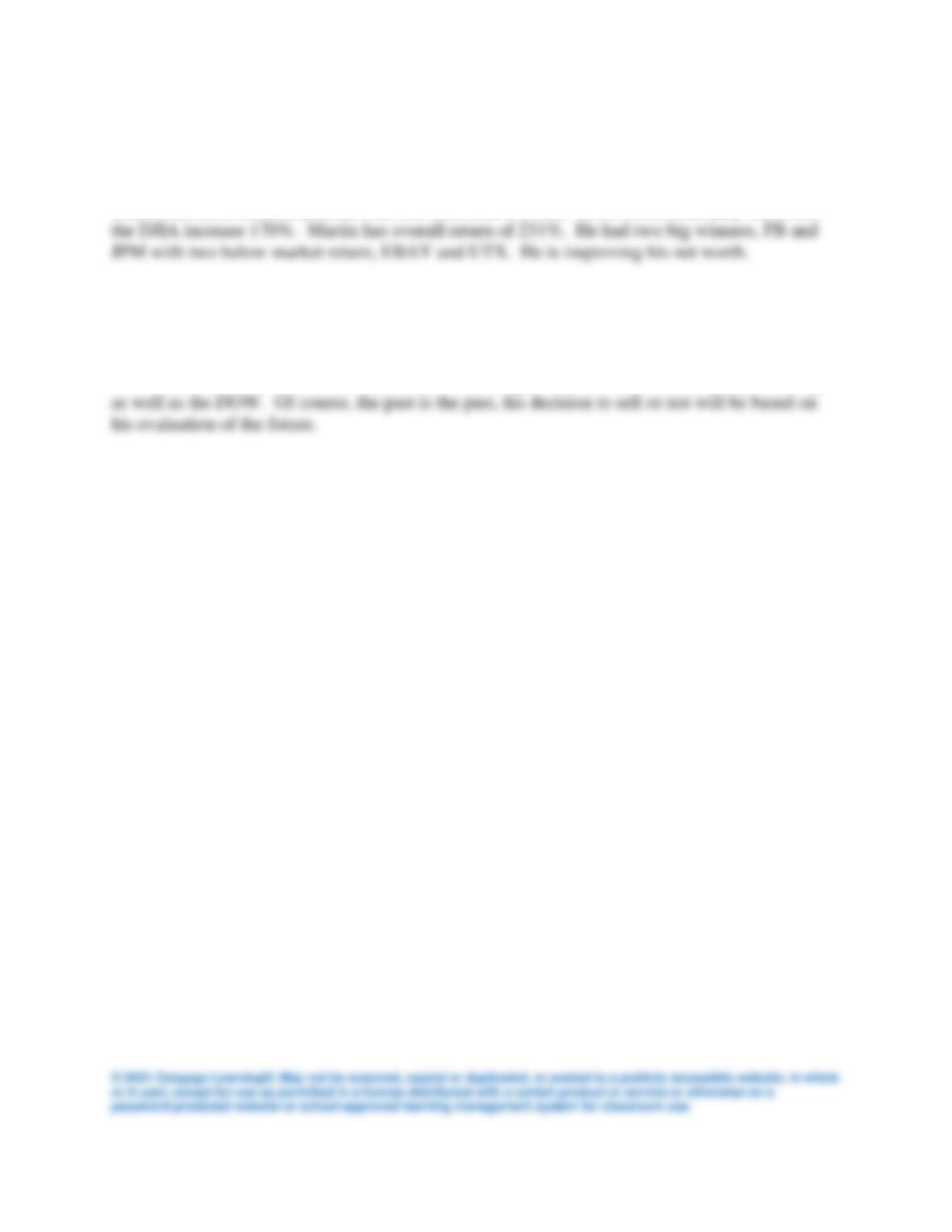
An Inventory of Investment Holdings
Marin Moreno Date January 22, 2020
Type of
Investment
Description of
Investment
Date
Purchased
Amount of
Investment
Overall
Return
Latest Market
Value
Current
price
Common Stock
200 sh, EBAY
2006
$5,954
20%
$7,178
35.89
Common Stock
250 sh, FB
2013
$6,722
724%
$55,330
221.32
Common Stock
200 sh, UTX
2008
$14,984
105%
$30,748
153.74
Common Stock
450 sh, JPM
2009
$7,200
755%
$61,497
136.66
Common Stock
400 sh, PEP
2009
$21,000
173%
$57,376
143.44
Totals
$67,860
231%
2. What is your overall assessment of Martin’s investment portfolio? Does it appear that
his personal net worth is improving because of his investments?
3. Based on the worksheet you prepared in Question 1, do you see any securities that you
think Martin should consider selling? What other investment advice might you give
Martin?
He should review EBAY and UTX (United Technology). These two stocks are not performing
Test Yourself
11-1 Briefly discuss the relationship between investing and personal financial planning.
Investing is generally considered to take a long-term perspective and is viewed as a process of
purchasing securities wherein stability of value and level of return are somewhat predictable.
11-2 What’s the difference between an investment plan and a capital accumulation plan?
Capital accumulation, which is saving, is necessary in order to have funds to invest. Investing is
11-3 Why is it important to have investment objectives when embarking on an investment
program?
There are a wide variety of securities available for investing. Some provide annual income in the
11-4 How does a primary market differ from a secondary market? Where are most
securities traded: in the primary or the secondary market?
In the primary market, new securities are sold to the public, and one party to the transaction is
always the issuer. In contrast, old (outstanding) securities are bought and sold in the secondary
11-5 What is the difference between the broker and dealer markets?
Broker markets are the national and regional stock exchanges. At the stock exchange the buyer
and seller meet and exchange the stock. The Dealer market does not have a central point where
11-6 What are regional exchanges, and what role do they play?
The regional exchanges operate much like the New York Stock Exchange. They have brokers
11-7 Describe the operations of the Nasdaq market. Compare it with an exchange, such as
the NYSE.
To be traded on Nasdaq, all stocks must have at least two market makers—although the bigger,
11-8 Contrast the Nasdaq and National Market System with the OTCBB.
NASDAQ sets various listing standards, the most comprehensive of which are for the 2,000 or so
stocks traded on the NASDAQ National Market (NNM).
The other part of the dealer market is made up of securities that trade in the over-the-counter
11-9 Explain the difference between a bull market and a bear market. Discuss the
frequency with which returns as bad as those during 2007–2009 occur. How would you
characterize the current state of the stock market?
11-10 Describe the role that discount brokers play in carrying out security transactions. To
whom are their services especially appealing?
In contrast, investors who simply want to execute trades and aren’t interested in obtaining all
11-11 What are online brokers, and what kinds of investors are most likely to use them?
Again, most brokers have an online presence and low transaction fees. Investors who manage
11-12 What is the SIPC, and how does it protect investors?
As a client, you’re protected against the loss of securities or cash held by your broker by the
Securities Investor Protection Corporation (SIPC), a nonprofit corporation authorized by the
11-13 What is arbitration? Does SIPC require the use of arbitration in investor disputes?
Arbitration is a process whereby you and your broker present the two sides of the argument
11-14 Name and describe three basic types of orders.
An order to buy or sell a security at the best price available at the time it’s placed is a market
order.
11-15 Why might an investor buy securities on margin?
Buying on margin, as it’s called, is a practice that allows investors to use borrowed shares if
11-16 Describe how the return on an investment is calculated.
Rate of return is the increase or decrease in the price of an investment as well as any income
11-17 What is a short sale? Explain the logic behind it. How much could be gained or lost
on a short sale investment?
11-18 Briefly discuss the four basic types of information that you, as an investor, should
follow.
Here are the four types of investment information that you should follow on a regular basis:
• Economic developments and current events: To help you evaluate the underlying investment
environment
11-19 What role do market averages and indexes play in the investment process?
Usually presented in the form of averages, or indexes, market data describe the general behavior
11-20 Briefly describe the DJIA, S&P 400, S&P 500, NASDAQ Composite, Russell 2000, and
Dow Jones Wilshire 5000 indexes. Which segments of the market does each measure track?
Dow Jones Industrial Average (DJIA). The Dow Jones averages, which began in 1896, are
made up of four parts: (1) an industrial average, the DJIA, which is based on 30 stocks; (2) a
transportation average based on 20 stocks; (3) a utility average based on 15 stocks; and (4) a
11-21 Describe the Internet’s impact on the world of investing.
The Internet is a major force in the investing environment. It has opened the world of investing
to individual investors, leveling the playing field and providing access to tools and market
11-22 What are some products and services that you, as an individual investor, can now
obtain online?
11-23 Briefly describe several types of online investment tools and note how they can help
you become a better investor.
The Internet offers a wide array of tutorials, online classes, and articles to educate the novice
investor. Even experienced investors will find sites that expand their investing knowledge.
Although most good investment-oriented Web sites include many educational resources, here are
a few good sites featuring investment fundamentals.
11-24 What is day trading, and how is it different from the more traditional approach to
investing?
The attraction of trading stocks online is so compelling that some investors have become day
11-25 Explain why it might be preferable for a person to invest in a portfolio of securities
rather than in a single security.
Don’t put all your eggs in one basket. In essence, a portfolio is a collection of investment
11-26 Briefly describe the concept of asset allocation and note how it works.
The investor’s needs shape one’s financial goals. But to create a portfolio geared to those goals,
you need to develop an asset allocation strategy. Asset allocation involves a decision on how to
11-27 Discuss the role of asset allocation in portfolio management.
There’s overwhelming evidence that, over the long run, the total return on a portfolio is
11-28 What, if anything, can be gained from keeping track of your investment holdings?
Key Terms
annual
stockholders’
report
A report made available to stockholders and other interested parties
that includes a variety of financial and descriptive information about a
firm’s operations in the recent past.
arbitration
A procedure used to settle disputes between a brokerage firm and its
clients; both sides present their positions to a board of arbitration,
which makes a final and often binding decision on the matter.
ask price
The price at which one can purchase a security.
bid price
The price at which one can sell a security.
bear market
A condition of the market typically associated with investor pessimism
prices.
bull market
A market condition normally associated with investor optimism,
economic recovery, and expansion; characterized by generally rising
securities prices.
day trader
An investor who buys and sells stocks (and other securities) rapidly
throughout the day in hopes of making quick profits.
discount broker
A broker with low overhead who charges low commissions and offers
little or no services to investors.
diversification
The process of choosing securities with dissimilar risk–return
characteristics in order to create a portfolio that provides an acceptable
level of return and an acceptable exposure to risk.
Dow Jones
Industrial Average
(DJIA)
The most widely followed measure of stock market performance;
consists of 30 blue-chip stocks listed mostly on NYSE.
Wilshire
5000 index
An index of the total market value of the approximately 6,000–7,000
most actively traded stocks in the United States.
investing
The process of placing money in some medium such as stocks or bonds
in the expectation of receiving some future benefit
investment plan
A statement—preferably written—that specifies how investment
capital will be invested to achieve a specified goal.
limit order
An order to either buy a security at a specified or lower price or to sell
a security at or above a specified price.
market order
An order to buy or sell a security at the best price available at the time
it is placed.
National
Association
of Securities
Dealers
(NASD)
NYSE index
An index of the performance of all stocks listed on the New York
Stock Exchange.
odd lot
A quantity of fewer than 100 shares of a stock.
online broker
Typically a discount broker through which investors can execute trades
electronically/ online through a commercial service or on the Internet;
also called Internet broker or electronic broker.
portfolio
A collection of securities assembled for the purpose of meeting
An agency made up of brokers and dealers in over-the-counter
securities that regulates OTC market operations.
common investment goals.
prospectus
A document made available to prospective security buyers that
describes the firm and a new security issue.
risk averse
The average investor’s attitude toward risk is such that, when presented
with two investments having the same expected return, the one with the
lowest risk will be chosen.
rate of return
The increase or decrease in the price of an investment as well as any
income received over the investment period, both stated as a
percentage of the initial investment.
round lot
A quantity of 100 shares of stock, or multiples thereof.
Securities and
Exchange
Commission (SEC)
An agency of the federal government that regulates the disclosure of
information about securities and generally oversees the operation of
securities exchanges and markets.
Securities Investor
Protection
Corporation
(SIPC)
A nonprofit corporation, created by Congress and subject to SEC and
congressional oversight that insures customer accounts against the
financial failure of a brokerage firm.
securities markets
The marketplace in which stocks, bonds, and other financial
instruments are traded.
short sale
A transaction that involves selling borrowed securities with the
expectation that they can be replaced at a lower price at some future
date; made in anticipation of a decline in the security’s price.
speculating
A form of investing in which future value and expected returns are
highly uncertain.
Standard & Poor’s
(S&P) indexes
Indexes compiled by Standard & Poor’s that are similar to the DJIA
but employ different computational methods and consist of far more
Investment Planning
Chapter Outline
Learning Objectives
I. The Objectives and Rewards of Investing
A. How Do I Get Started?
B. The Role of Investing in Personal Financial Planning
1. Coming Up With the Capital
2. An Investment Plan Provides Direction
C. What Are Your Investment Objectives?
D. Different Ways to Invest
1. Common Stock
2. Bonds
II. Securities Markets
A. Primary and Secondary Markets
1. Primary Markets
2. Secondary Markets
III. Making Transactions in the Securities Markets
A. Stockbrokers
1. Selecting a Broker
2. Full-Service, Discount, and Online Brokers
1. Market Order
2. Limit Order
IV. Becoming an Informed Investor
A. Annual Stockholders’ Reports
B. The Financial Press
1. Market Data
3. Company Data
4. Stock Quotes
C. Brokerage Reports
D. Advisory Services
V. Online Investing
A. Online Investor Services
1. Investor Education
2. Investment Tools
VI. Managing Your Investment Holdings
A. Building a Portfolio of Securities