Chapter 11
Stock Valuation and Risk
Outline
Stock Valuation Methods
Price-Earnings (PE) Method
Required Rate of Return on Stocks
Capital Asset Pricing Model
Factors That Affect Stock Prices
Economic Factors
Stock Risk
Volatility of a Stock
Measuring Risk-Adjusted Stock Performance
Sharpe Index
Treynor Index
Stock Market Efficiency
Foreign Stock Valuation and Performance
Valuation of Foreign Stocks
Chapter 11: Stock Valuation and Risk ❖ 2
Key Concepts
1. Explain stock valuation models.
POINT/COUNTER-POINT:
Is The Stock Market Efficient?
POINT: Yes. Investors fully incorporate all available information when trading stocks. Thus, the prices of
stocks fully reflect all information.
COUNTER-POINT: No. The high degree of stock price volatility offers evidence of how much
WHO IS CORRECT? Use the Internet to learn more about this issue and then formulate your own
opinion.
ANSWER: There is no perfect answer, and there are valid arguments for and against whether markets are
Questions
1. Price-Earnings Model. Explain the use of the price-earnings (PE) ratio for valuing a stock. Why
might investors derive different valuations for a stock when using the price-earnings method? Why
might investors derive an inaccurate valuation of a firm when using the price-earnings method?
ANSWER: Investors can value a stock by applying the industry PE ratio to the firm’s expected
earnings for the next year. This method implicitly assumes that the growth in earnings in future years
Chapter 11: Stock Valuation and Risk ❖ 3
2. Dividend Discount Model. Describe the dividend discount valuation model. What are some
limitations when using this model?
ANSWER: The dividend discount valuation model measures the value of a firm as the present value
of future expected dividends to be received by the investor. The model can account for uncertainty by
3. Impact of Economic Growth. Explain how economic growth affects the valuation of a stock.
ANSWER: The firm’s value should reflect the present value of its future cash flows. Because
4. Impact of Interest Rates. How are the interest rate, the required rate of return on a stock, and the
valuation of a stock related?
ANSWER: Given a choice of risk-free Treasury securities or stocks, stocks should be purchased only
if they are appropriately priced to reflect a sufficiently high expected return above the risk-free rate.
5. Impact of Inflation. Assume that the expected inflation rate has just been revised upward by the
market. Would that change affect the required return by investors who invest in the stocks? Explain.
ANSWER: An increase in expected inflation can increase the risk-free interest rate, which is a key
required rate of return on stocks.
6. Impact of Exchange Rates. Explain how the value of the dollar affects stock valuations.
ANSWER: The value of the dollar can affect U.S. stock prices for a variety of reasons. First, foreign
Chapter 11: Stock Valuation and Risk ❖ 4
7. Investor Sentiment. Explain why investor sentiment can affect stock prices.
ANSWER: Investor sentiment represents the general mood of investors in the stock market. Since the
8. January Effect. Describe the January effect.
ANSWER: Because many portfolio managers are evaluated over the calendar year, they tend to invest
9. Earnings Surprises. How do earnings surprises affect valuations of stocks?
10. Impact of Takeover Rumors. Why can expectations of an acquisition affect the value of the target’s
stock?
11. Emerging Markets. hat are the risks of investing in stocks in emerging markets?
ANSWER: Stocks in emerging markets are more exposed to major government turnover and other
12. Stock Volatility During the Credit Crisis. Explain how stock volatility changed during the
credit crisis of 2008-2009.
ANSWER: Stock prices became much more volatile due to uncertainty about economic conditions.
Chapter 11: Stock Valuation and Risk ❖ 5
13. Stock Portfolio Volatility. Identify the factors that affect a stock portfolio’s volatility and explain
their effects.
ANSWER: A stock portfolio has more volatility when its individual stock volatilities are high, other
14. Beta. Explain how to estimate the beta of a stock. Explain why beta serves as a measure of the stock’s
risk.
ANSWER: The beta of a stock can be estimated by obtaining returns of the firm and the stock market
over the last 12 quarters and applying regression analysis to derive the slope coefficient as in this
model:
Rjt = B0 + B1Rmt + ut
Some investors or analysts prefer to use monthly returns rather than quarterly returns to estimate the
beta. The choice is dependent on the holding period for which one wants to assess sensitivity. If the
goal is to assess sensitivity to monthly returns, then monthly data would be more appropriate.
15. Wall Street. In the movie Wall Street, Bud Fox is a broker who conducts trades for Gordon Gekko’s
firm. Gekko purchases shares of firms that he believes are undervalued. Various scenes in the movie
offer excellent examples of concepts discussed in this chapter.
a. Bud Fox makes the comment to Gordon Gekko that a firm’s breakup value is twice its market
price. What is Bud suggesting in this statement? How would employees of the firm respond to
Bud’s statement?
Chapter 11: Stock Valuation and Risk ❖ 6
b. When Bud informs Gekko that another investor, Mr. Wildman, is secretly planning to acquire a
target firm in Pennsylvania, Gekko tells Bud to buy a large amount of this stock. Why?
ANSWER: Gekko wants to accumulate much of the stock before Mr. Wildman attempts to acquire
c. Gekko says “Wonder why fund managers can’t beat the S&P 500? Because they are sheep.”
What is Gekko’s point? How does it relate to market efficiency?
ANSWER: Gekko is implying that all fund managers use the same type of information, which is
16. Market Efficiency. Explain the difference between weak-form, semistrong-form, and strong-form
efficiency. Which of these forms of efficiency is most difficult to test? Which is most likely to be
refuted? Explain how to test weak-form efficiency in the stock market.
ANSWER: The weak form suggests that security prices reflect recent price movements and trading
17. Market Efficiency. A consulting firm was hired to determine whether a particular trading strategy
could generate abnormal returns. The strategy involved taking positions based on recent historical
movements in stock prices. The strategy did not achieve abnormal returns. Consequently, the
consulting firm concluded that the stock market is weak-form efficient. Do you agree? Explain.
Advanced Questions
18. Value at Risk. Describe the value-at-risk method for measuring risk.
ANSWER: Value at risk is a risk measurement that estimates the largest expected loss to a particular
Chapter 11: Stock Valuation and Risk ❖ 7
19. Implied Volatility. Explain the meaning and use of implied volatility.
ANSWER: Investors can derive the stock’s implied standard deviation (ISD) from the stock option
pricing model. The premium on a call option for a stock is dependent on factors such as the
20. Leveraged Buyout. At the time that a management group of RJR Nabisco initially considered
engaging in a leveraged buyout, RJR’s stock price was less than $70 per share. Ultimately, RJR was
acquired by the firm Kohlberg, Kravis, and Roberts (KKR) for about $108 per share. Does the large
discrepancy between the stock price before an acquisition was considered versus after the acquisition
mean that RJR’s price was initially undervalued? If so, does this imply that the market was
inefficient?
ANSWER: The stock price may have been appropriate under the conditions of unchanged
21. How Stock Prices May Respond to Prevailing Conditions. Consider the prevailing conditions that
could affect the demand for stocks, including inflation, the economy, the budget deficit, and the Fed’s
monetary policy, political conditions, and the general mood of investors. Based on prevailing
conditions, do you think stock prices will increase or decrease during this semester? Offer some logic
to support your answer. Which factor do you think will have the biggest impact on stock prices?
ANSWER: This question is open-ended. It requires students to apply the concepts that were presented
22. Application of the CAPM to Stock Pricing. Explain (using intuition instead of math) why stock
prices may decrease in response to a higher risk-free rate according to the CAPM. In some periods,
the risk-free rate rises in response to higher economic growth. Explain (using intuition instead of
math) why stock prices may increase in this situation even though the risk-free rate increases.
ANSWER: When the risk-free rate rises, the required rate of return rises, and therefore expected cash
23. Impact of SOX on Stock Valuations. Use a stock valuation framework to explain why the Sarbanes-
Oxley Act (SOX) could improve the valuation of a stock. Why might SOX cause a reduction in the
valuation of a stock? (See the chapter appendix).
ANSWER: The Sarbanes-Oxley Act of 2002 was intended to improve the reporting of financial
24. Interpretation of VIX. Explain why participants in the stock market monitor the
VIX index. What does a decline in VIX imply about a change in expected volatility by market
participants?
CRITICAL THINKING QUESTION
Credit Crisis versus Equity Crisis The credit crisis that occurred in 2008-2009 could also be called an
equity crisis due to systemic risk. Write a short essay to explain the impact of the credit markets on the
equity markets during the crisis.
ANSWER
The credit crisis was triggered by large defaults of debt securities (especially mortgages), which caused
Interpreting Financial News
Interpret the following comments made by Wall Street analysts and portfolio managers.
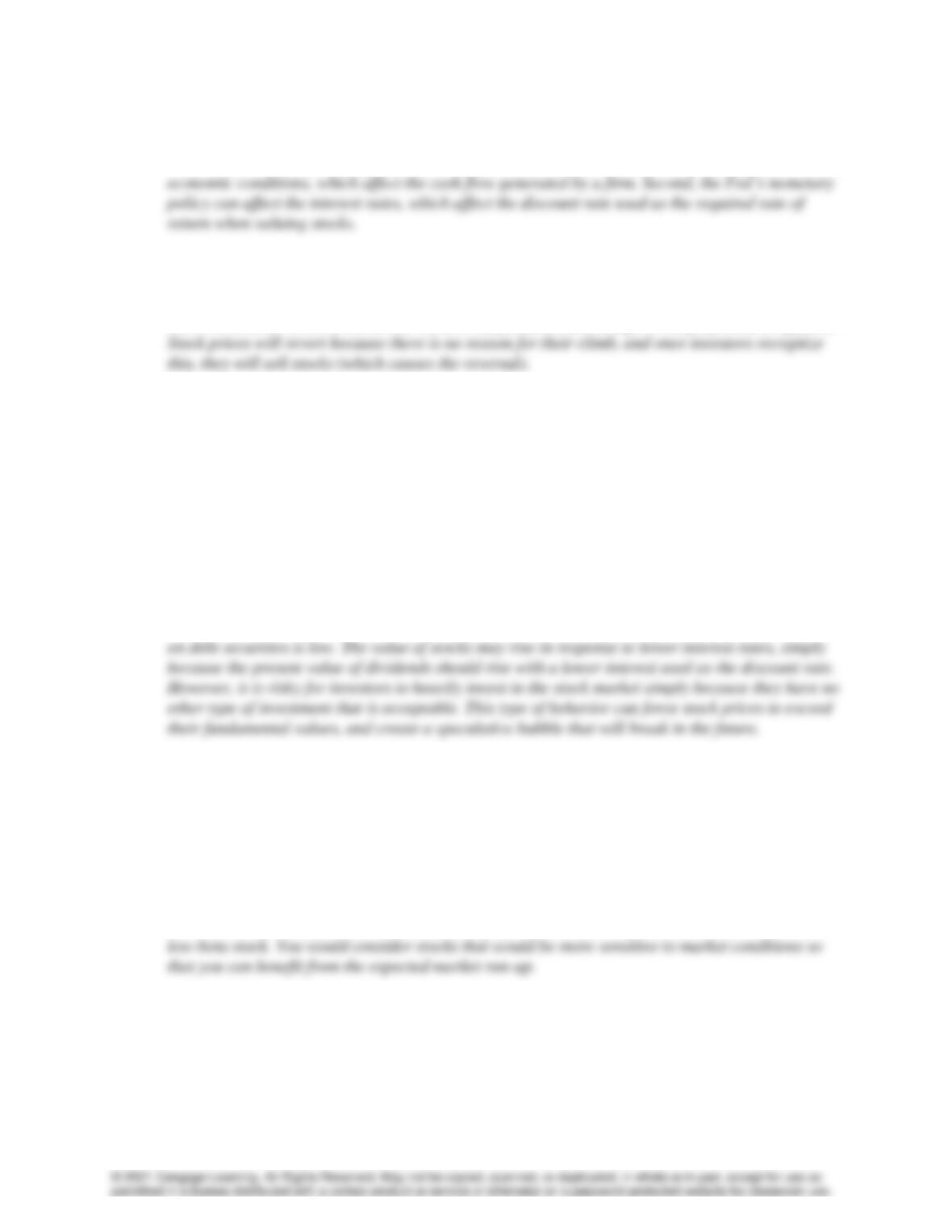
a. “The stock market’s recent climb has been driven by falling interest rates.”
The value of a stock may be measured as the present value of future cash flows provided to
Chapter 11: Stock Valuation and Risk ❖ 9
b. “Future stock prices are dependent on the Fed’s policy meeting next week.”
The Fed’s monetary policy affects the values of stocks in various ways. First, it can affect
c. “Given a recent climb in stocks that cannot be explained by fundamentals, a correction is
inevitable.”
The recent climb in stocks occurred without any fundamental change in the performance of firms.
Managing in Financial Markets
As an investment manager, you frequently make decisions about investing in stocks versus other types of
investments, and about types of stocks to purchase.
a. You have noticed that investors tend to invest more heavily in stocks after interest rates have
declined. You are considering this strategy as well. Is it rational to invest more heavily in stocks
once interest rates have declined?
One argument is that investors are unwilling to accept a very low interest rate on debt securities,
and are more willing to invest in stocks simply because their opportunity cost (what they forgo)
b. Assume that you are about to select a specific stock that will perform well in response to an
expected runup in the stock market. You are very confident that the stock market will perform
well in the near future. Recently, a friend recommended that you consider purchasing stock of a
specific firm because it had decent earnings over the last few years, it has a low beta (reflecting a
low degree of systematic risk), and its beta is expected to remain low. You usually rely on beta as
a measurement of a firm’s systematic risk. Should you seriously consider buying that stock?
Explain.
No. Given that you expect the stock market to perform well, you would not be so interested in a
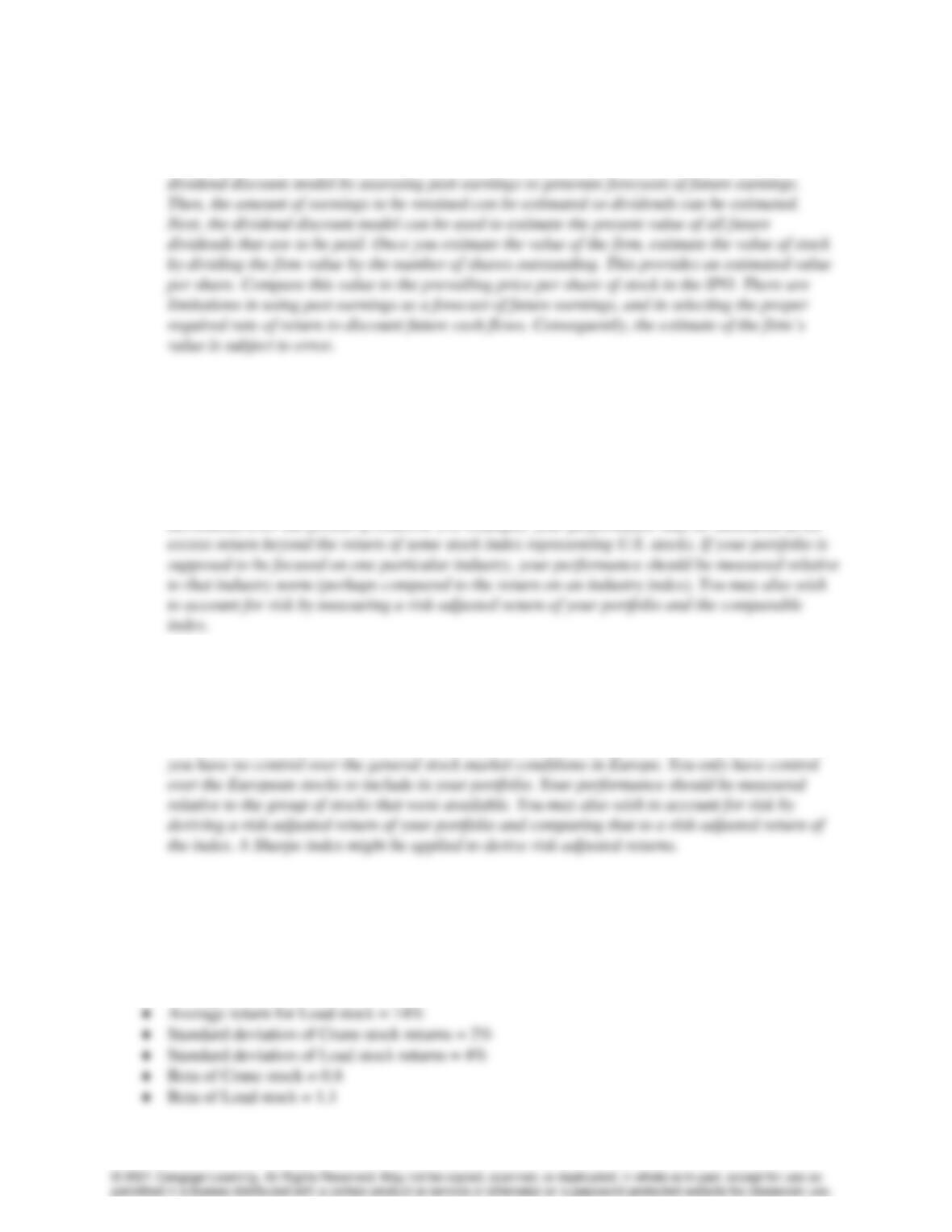
c. You are considering an investment in an initial public offering by Marx Co., which has performed
very well recently, according to its financial statements. The firm will use some of the proceeds
from selling stock to pay off some of its bank loans. How can you apply stock valuation models
to estimate this firm’s value, when its stock is not yet publicly traded? Once you estimate the
value of the firm, how can you use this information to determine whether to invest in it? What are
some limitations involved in estimating the value of this firm?
Chapter 11: Stock Valuation and Risk ❖ 10
There are numerous possible solutions, but most solutions would involve the estimation of the
firm’s future cash flows and deriving a present value of those cash flows. You can apply the
d. In the past, your boss assessed your performance based on the actual return on the portfolio of
U.S. stocks that you manage. For each quarter in which your portfolio generated an annualized
return of at least 20 percent, you received a bonus. Now your boss wants you to develop a method
for measuring your performance in managing the portfolio. Offer a method that accurately
measures your performance.
There are many possible solutions. The method should include some control for the stock market
e. Assume that you were also asked to manage a portfolio of European stocks. How would your
method for measuring your performance in managing this portfolio differ from the U.S. stock
portfolio in the previous question?
The European portfolio return should be compared to a European stock index. The reason is that
Problems
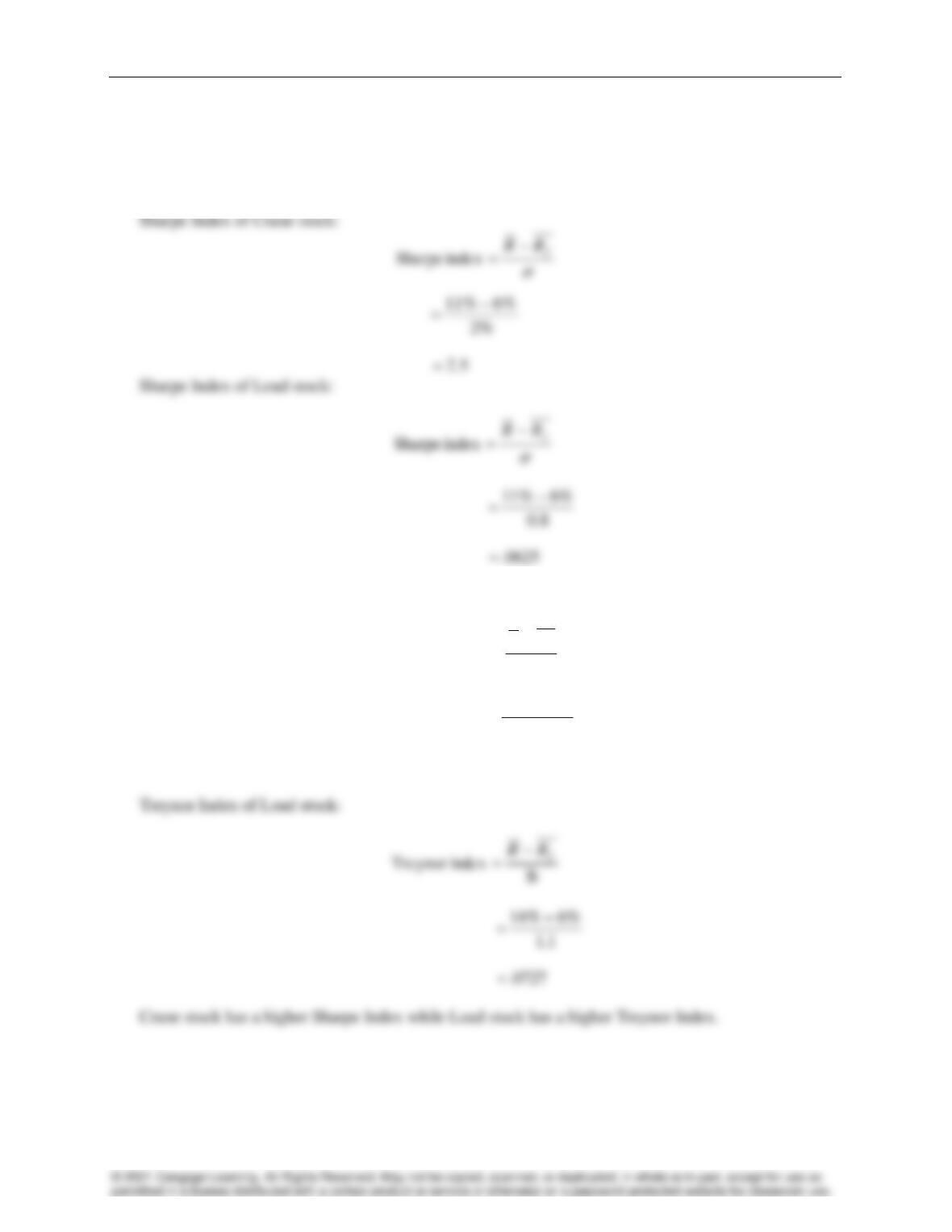
1. Risk-Adjusted Return Measurements. Assume the following information over a five-year period.
Average risk-free rate = 6%
Average return for Crane stock = 11%
Chapter 11: Stock Valuation and Risk ❖ 11
Determine which stock has higher risk-adjusted returns according to the Sharpe Index. Which stock
has higher risk-adjusted returns according to the Treynor Index? Show your work.
ANSWER:
0625.=
Treynor Index of Crane stock:
B
indexTreynor f
RR −
=
0.8
%6%11 −
=
0625.=
B
indexTreynor f
RR −
=
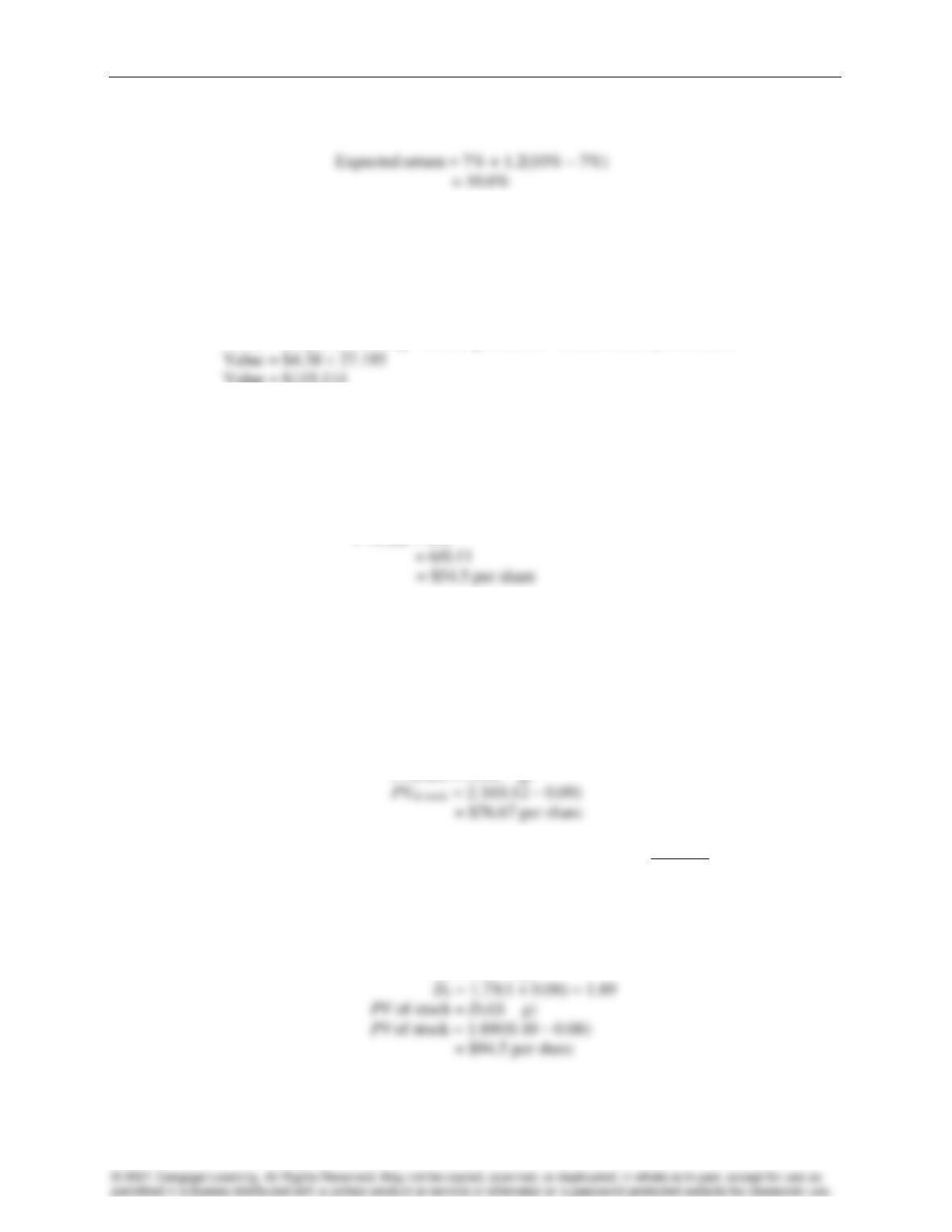
2. Measuring Expected Return. Assume Mess stock has a beta of 1.2. If the risk-free rate is 7 percent,
and the market return is 10 percent, what is the expected return on Mess stock?
Chapter 11: Stock Valuation and Risk ❖ 12
ANSWER:
3. Using the PE Method. You discovered that Olmsted Stock is expected to generate earnings of $4.38
per share this year, and that the mean PE ratio for its industry is 27.195. Use the PE valuation method
to determine the value of Olmsted shares.
ANSWER:
Value = (Expected earnings of IBM per share) × (Mean industry P/E ratio)
Value = $119.114
4. Using the Dividend Discount Model. Suppose that you are interested in buying the stock of a
company that has a policy of paying a $6 per share dividend every year. Assuming no changes in the
firm’s policies, what is the value of a share of stock if the required rate of return is 11 percent?
ANSWER:
5. Using the Dividend Discount Model. Micro, Inc. will pay a dividend of $2.30 per share next year. If
the company plans to increase its dividend by 9 percent per year indefinitely, and you require a 12
percent return on your investment, what should you pay for the company’s stock?
ANSWER:
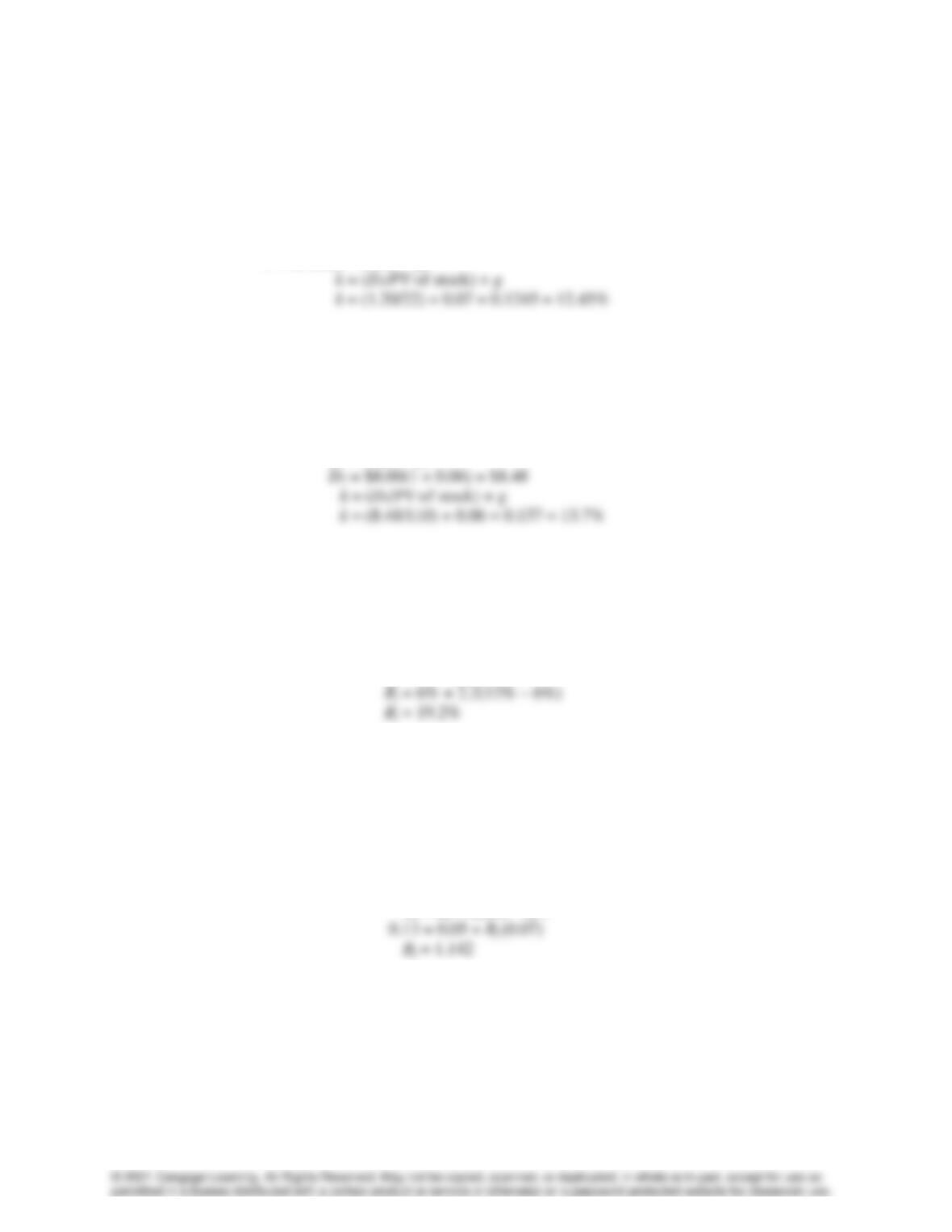
6. Using the Dividend Discount Model. Suppose you know that a company just paid a dividend of
$1.75 per share on its stock and that the dividend will continue to grow at a rate of 8 percent per year.
If the required return on this stock is 10 percent, what is the current share price?
ANSWER:
D1 = D0(1 + g)
Chapter 11: Stock Valuation and Risk ❖ 13
7. Deriving the Required Rate of Return. The next expected dividend for Sun, Inc., will be $1.20 per
share and analysts expect the dividend to grow at a rate of 7 percent indefinitely. If Sun stock
currently sells for $22 per share, what is the required rate of return?
ANSWER:
PV of stock = D1/(k – g)
8. Deriving the Required Rate of Return. A share of common stock currently sells for $110. Current
dividends are $8 per share and are expected to grow at 6 percent per year indefinitely. What is the rate
of return required by investors in the stock?
ANSWER:
D1 = D0(1 + g)
9. Deriving the Required Rate of Return. A stock has a beta of 2.2, the risk-free rate is 6 percent, and
the expected return on the market is 12 percent. Using the CAPM, what would you expect the
required rate of return on this stock to be? What is the market risk premium?
ANSWER:
Rj = Rf + Bj(Rm – Rf )
The market risk premium is 6 percent.
10. Deriving the Stock’s Beta. You are considering investing in a stock that has an expected return of 13
percent. If the risk-free rate is 5 percent and the market risk premium is 7 percent, what is the beta of
this stock?
ANSWER:
11. Measuring Stock Returns. Suppose you bought a stock at the beginning of the year for $76.50.
During the year, the stock paid a dividend of $0.70 per share and had an ending share price of $99.25.
What is the total percentage return from investing in that stock over the year?
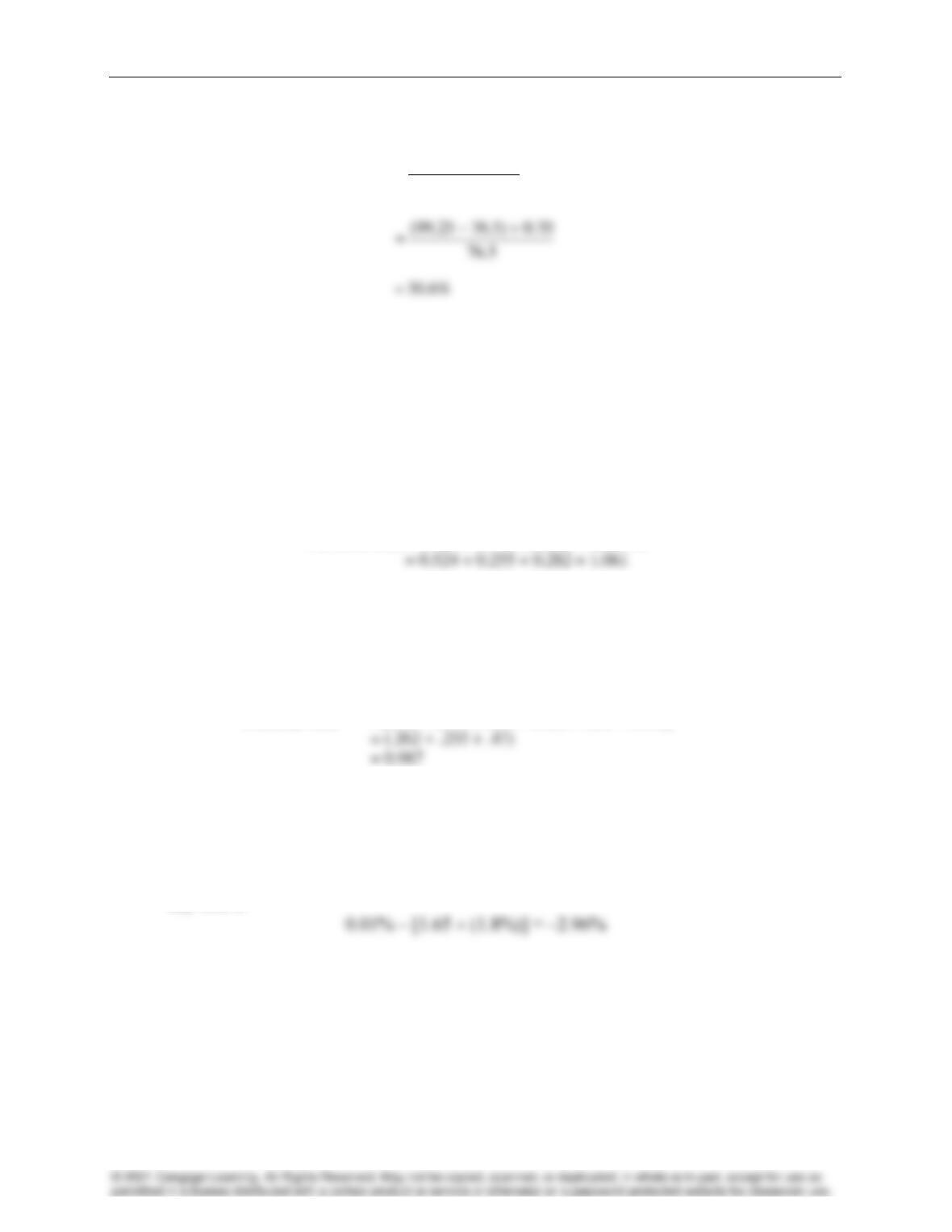
Chapter 11: Stock Valuation and Risk ❖ 14
ANSWER:
INV
)INV( DSP
R+−
=
12. Measuring the Portfolio Beta. Assume the following information:
Beta of Stock D = 1.31
Beta of Stock E = 0.85
Beta of Stock F = 0.94
If you invest 40 percent of your money in Stock D, 30 percent in Stock E and 30 percent in Stock F,
what is your portfolio’s beta?
ANSWER:
Portfolio beta = 0.4(1.31) + 0.3(0.85) + 0.3(0.94)
13. Measuring the Portfolio Beta. Using the information from Problem 12, suppose that you instead
decide to invest $20,000 in Stock D, $30,000 in Stock E and $50,000 in Stock F. What is the beta of
your portfolio now?
ANSWER:
Portfolio beta = [(0.2 1.31) + (0.3 0.85) + (0.5 0.94)]
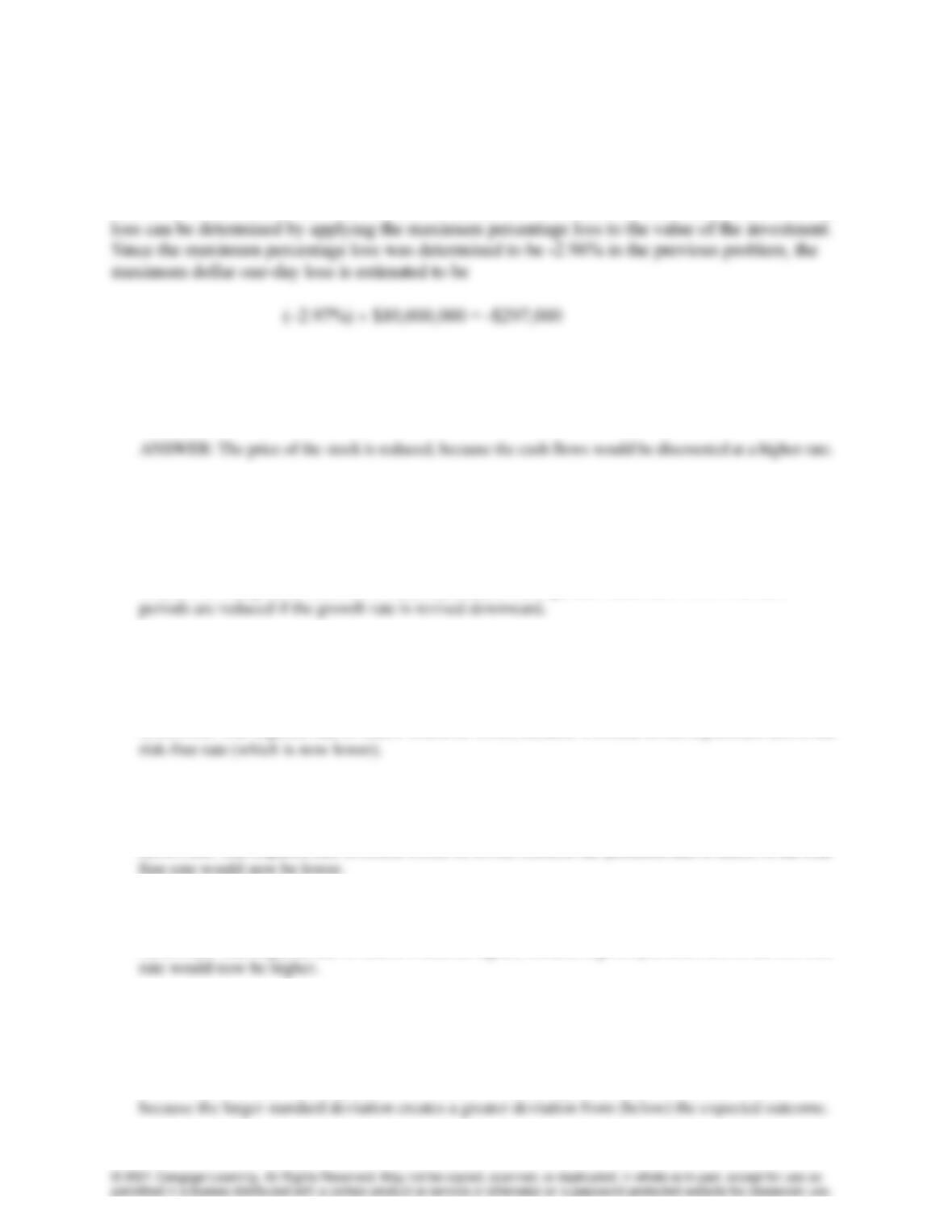
14. Value at Risk. Assume that the standard deviation of daily returns for a particular stock in
a recent historical period is 1.8 percent. Assume that the expected daily return of the stock is 0.01
percent. Estimate the maximum percentage one-day loss based on a 95 percent confidence level.
ANSWER: Based on an expected daily return of 0.01 percent, the maximum percentage one-
day loss is
Chapter 11: Stock Valuation and Risk ❖ 15
15. Value at Risk. Assume that in the previous problem, an investor has invested $10 million in
the stock of concern. Estimate the maximum dollar one-day loss based on a 95 percent
confidence level.
ANSWER: If an investor has a $10 million investment in that stock, the maximum dollar one-day
16. Dividend Model Relationships.
a. When computing the price of the stock with the dividend discount model, how would the price of
a stock be affected if the required rate of return is increased. Explain the logic of this relationship.
b. When computing the price of a stock using the constant-growth dividend discount model,
determine how the price of a stock would be affected if the growth rate is reduced. Explain the
logic of this relationship.
ANSWER: The price of the stock is reduced, because the expected future cash flows in distant
17. CAPM Relationships.
a. When using the CAPM, how would the required rate of return on a stock be affected if the risk-
free rate were lower.
b. When using the CAPM, how would the required rate of return on a stock be affected if the market
return were lower.
free rate would now be lower.
c. When using the CAPM, how would the required rate of return on a stock be affected if the beta
were higher.
ANSWER: The required rate of return would be higher, because a given premium above the risk-free
18. Value at Risk.
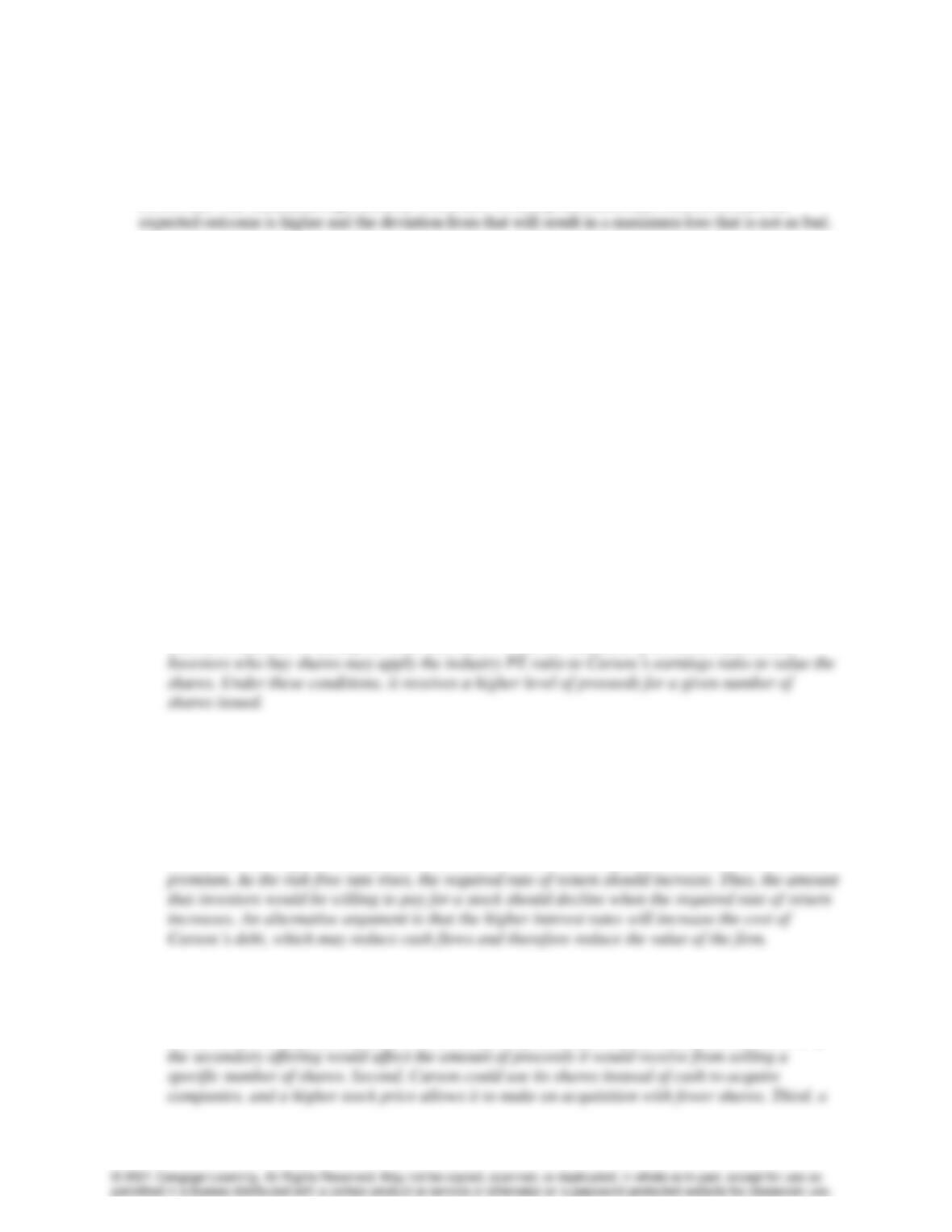
a. How is the maximum expected loss on a stock affected by an increase in the volatility (standard
deviation), based on a 95 percent confidence interval?
ANSWER: The maximum expected loss would now be more pronounced (worse) than before,
Chapter 11: Stock Valuation and Risk ❖ 16
b. Determine how the maximum expected loss on a stock would be affected by an increase in the
expected return of the stock, based on a 95 percent confidence interval.
Flow of Funds Exercise
Valuing Stocks
Recall that if the economy continues to be strong, Carson Company may need to increase its production
capacity by approximately 50 percent over the next few years to satisfy demand for its products. It would
need financing to expand and accommodate this increase in production. The yield curve is currently
upward sloping and Carson is concerned about a possible slowing of the economy because of potential
Fed actions to reduce inflation. The company is also considering issuing stock or bonds to raise funds in
the next year. If Carson goes public, it might even consider using its stock as a means of acquiring some
target firms. It would also consider engaging in a secondary offering at a future point in time if the IPO is
successful and if its growth continues over time. It would also change its compensation system to
compensate most of its managers with shares of its stock that would represent about 30 percent of their
compensation and would pay the remainder of the compensation as salary.
a. At the present time, the price-earnings (PE) ratio (stock price per share divided by earnings per
share) of other firms in Carson’s industry is relatively low but should rise in the future. Why
might this information affect the time at which Carson issues its stock?
Carson would like to attempt to issue the shares when the valuation of its stock is favorable.
b. Assume that Carson Company believes that issuing of stock is an efficient means of
circumventing the potential for high interest rates. Even if long-term interest rates have increased
by the time it issues stock, Carson thinks that it would be insulated from the effects of this
increase by issuing stock instead of bonds. Is this view correct?
No. If interest rates increase, the risk–free interest rate that can be earned by investors has
increased. The required rate of return by investors when investing in a new stock contains a risk
c. Carson Company recognizes the importance of a high stock price at the time it engages in an IPO
(if it goes public). But why would its stock price be important to Carson Company even after the
IPO?
First, Carson Company may do a secondary offering someday, and the stock price at the time of
Chapter 11: Stock Valuation and Risk ❖ 17
d. If Carson Company goes public, it may be able to motivate its managers by granting them stock
as part of their compensation. Explain why the stock may motivate managers to perform well.
Then explain why the use of stock as compensation may motivate them to use a very focus on
short-term goals, even though they are supposed to focus on maximizing shareholder wealth over
the long run. How can a firm provide stock as a motivational tool, yet prevent its managers from
adopting a very short-term focus?
Stock compensation can motivate managers to make decisions that maximize the stock price,
Answers to Appendix Discussion Questions
1. Should an accounting firm be prohibited from offering both auditing services and consulting services
to the same client? Explain your answer. If an accounting firm offered only one service, could there
still be conflicts of interest due to referrals (and finder’s fees)?
ANSWER: The goal is to allow students to present advantages and disadvantages of the SEC’s
2. Should members of Congress be allowed to enact laws on accounting and financial matters while
receiving donations from related lobbying groups?
ANSWER: This answer has no clear solution and will likely result in some animated discussion.
3. What alternative sources of information about a firm should investors rely on if they cannot rely on
financial statements?
4. Should investors have confidence in ratings by analysts who are affiliated with securities firms that
provide consulting services to firms? Explain.
ANSWER: If analysts are unwilling to assign a true rating to a firm, then investors cannot rely on
Chapter 11: Stock Valuation and Risk ❖ 18
5. Does an analyst employed by a securities firm to rate firms face a conflict of interest? If so, can the
conflict be resolved?
ANSWER: There is a conflict of interests if analysts must appease firms that they rate so that their
6. How might a firm’s board of directors discourage its managers from attempting to manipulate
financial statements to create a temporarily high stock price?
ANSWER: The firm could implement a compensation system that prevents managers from selling
7. How can the compensation of a firm’s board of directors be structured so that the board will not be
tempted to allow accounting or other managerial decisions that could cause a superficially high price
over a short period?
ANSWER: The firm could implement a compensation system that prevents board members from