161
Chapter 11
Optimal Portfolio Choice and the Capital
Asset Pricing Model
11–1. You are considering how to invest part of your retirement savings. You have decided to put
$200,000 into three stocks: 50% of the money in GoldFinger (currently $25/share), 25% of the
money in Moosehead (currently $80/share), and the remainder in Venture Associates (currently
$2/share). If GoldFinger stock goes up to $30/share, Moosehead stock drops to $60/share, and
Venture Associates stock rises to $3 per share,
a. What is the new value of the portfolio?
b. What return did the portfolio earn?
c. If you don’t buy or sell shares after the price change, what are your new portfolio weights?
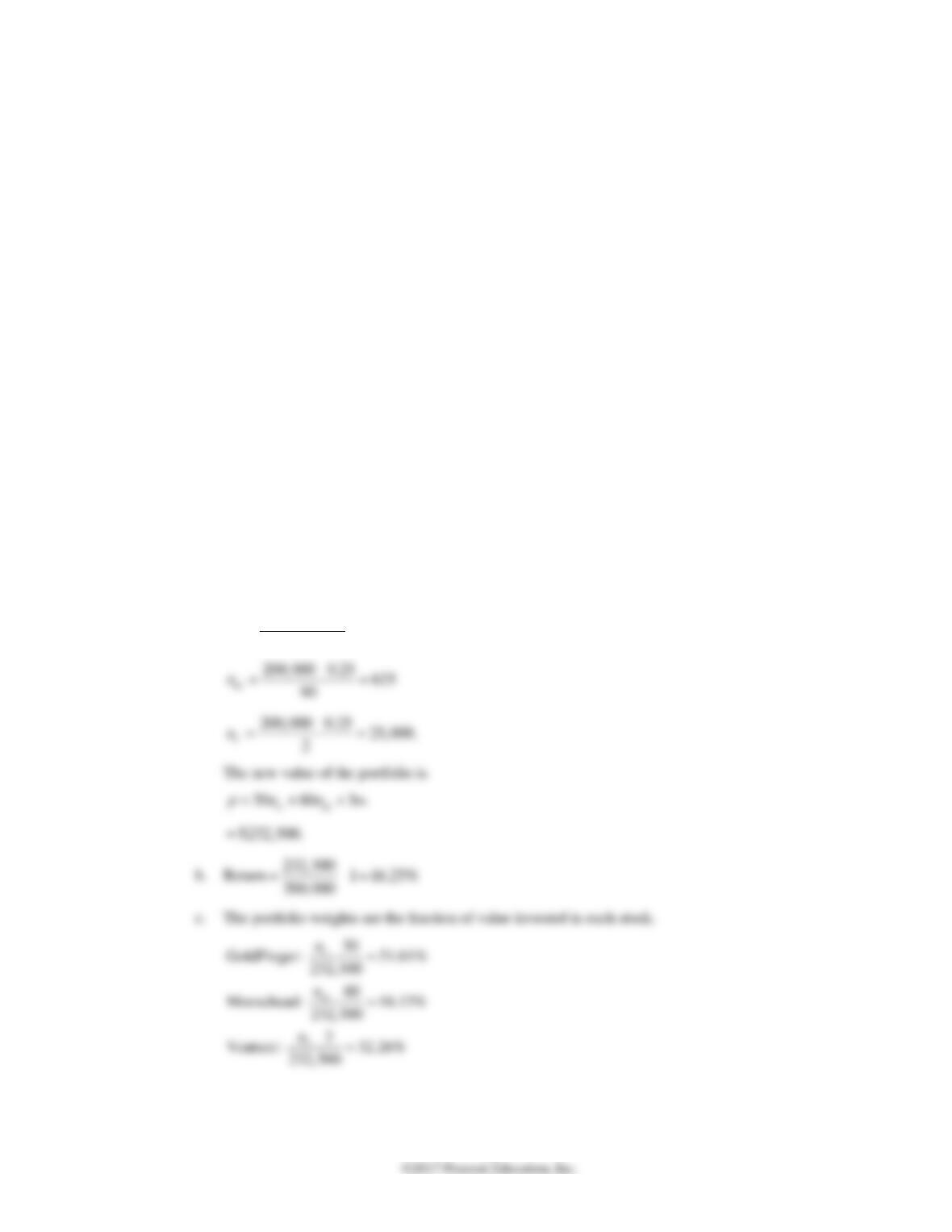
a. Let
i
n
be the number of share in stock I, then
200,000 0.5 4,000
25
G
n´
= =
11–2. You own three stocks: 600 shares of Apple Computer, 10,000 shares of Cisco Systems, and 5000
shares of Colgate-Palmolive. The current share prices and expected returns of Apple, Cisco, and
Colgate-Palmolive are, respectively, $500, $20, $100 and 12%, 10%, 8%.
a. What are the portfolio weights of the three stocks in your portfolio?
b. What is the expected return of your portfolio?
c. Suppose the price of Apple stock goes up by $25, Cisco rises by $5, and Colgate-Palmolive
falls by $13. What are the new portfolio weights?
d. Assuming the stocks’ expected returns remain the same, what is the expected return of the
portfolio at the new prices?
New
New
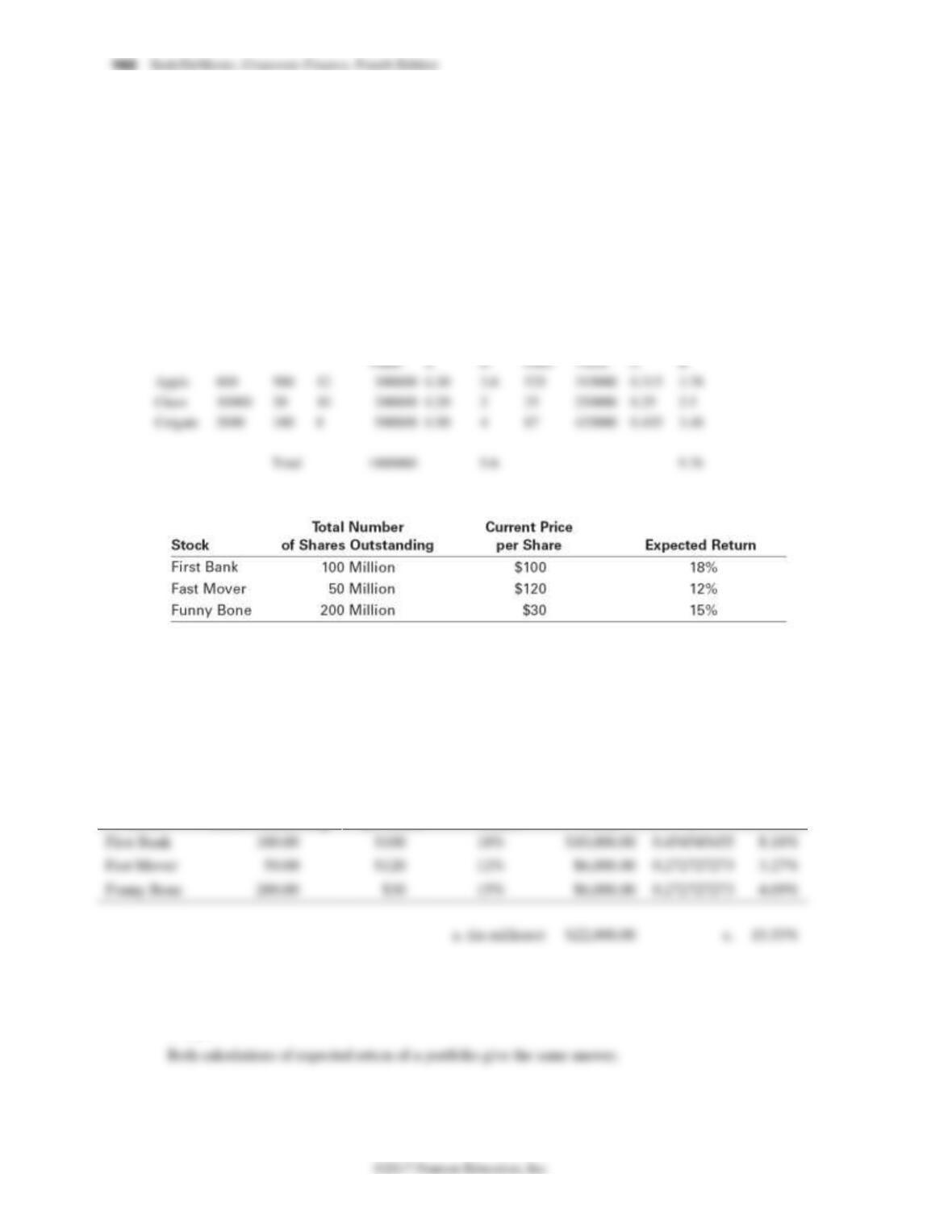
11–3. Consider a world that only consists of the three stocks shown in the following table:
a. Calculate the total value of all shares outstanding currently.
b. What fraction of the total value outstanding does each stock make up?
c. You hold the market portfolio, that is, you have picked portfolio weights equal to the answer
to part b (that is, each stock’s weight is equal to its contribution to the fraction of the total
value of all stocks). What is the expected return of your portfolio?
Stock
Total Number of
Shares Outstanding
Current Price
per Share
Expected
Return
Value
b.
11–4. There are two ways to calculate the expected return of a portfolio: either calculate the expected
return using the value and dividend stream of the portfolio as a whole, or calculate the weighted
average of the expected returns of the individual stocks that make up the portfolio. Which return
is higher?
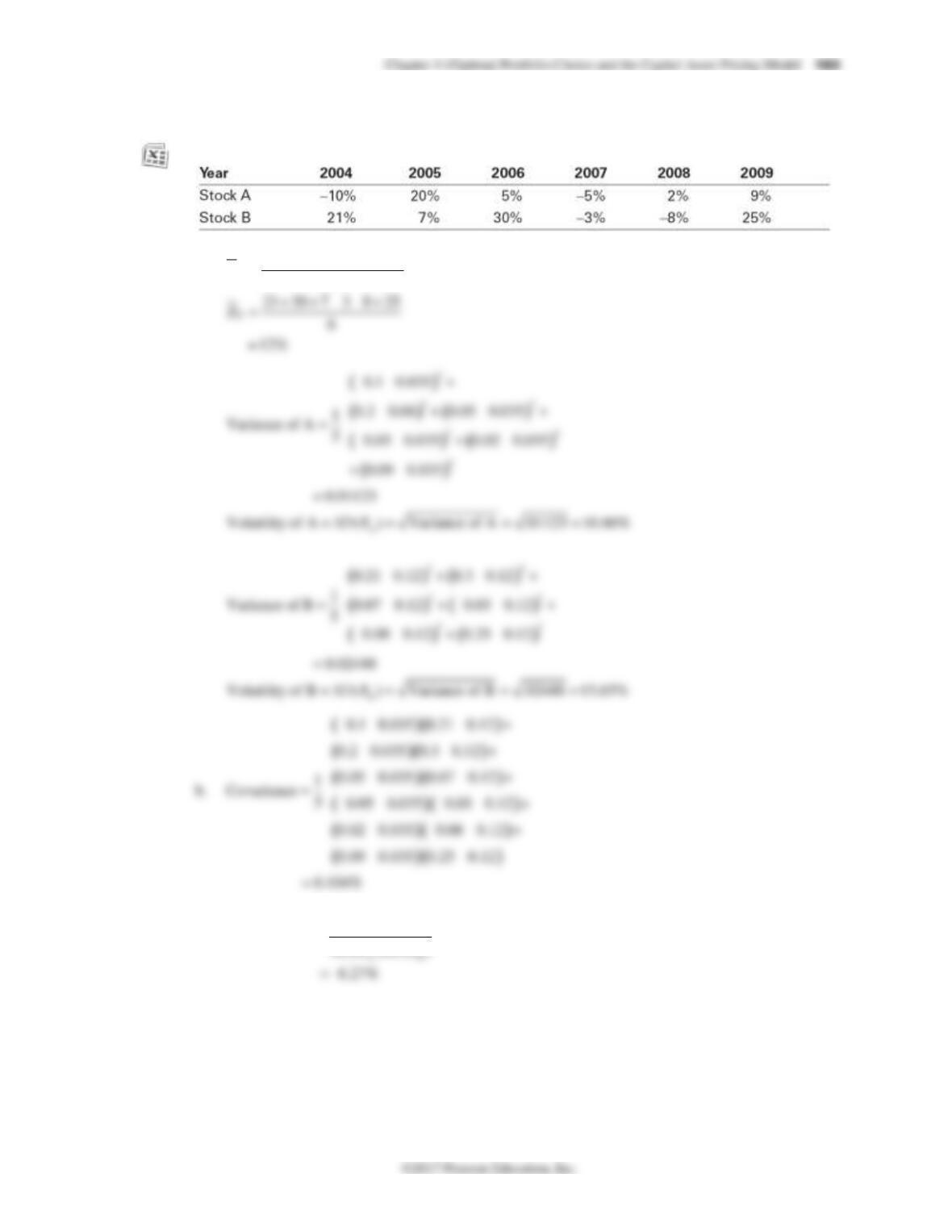
11–5. Using the data in the following table, estimate (a) the average return and volatility for each stock,
(b) the covariance between the stocks, and (c) the correlation between these two stocks.
a.
10 20 5 5 2 9 3.5%
6
A
R
– + + – + +
= =
c.
Covariance
Correlation SD(R )SD(R )
=
164 Berk/DeMarzo, Corporate Finance, Fourth Edition
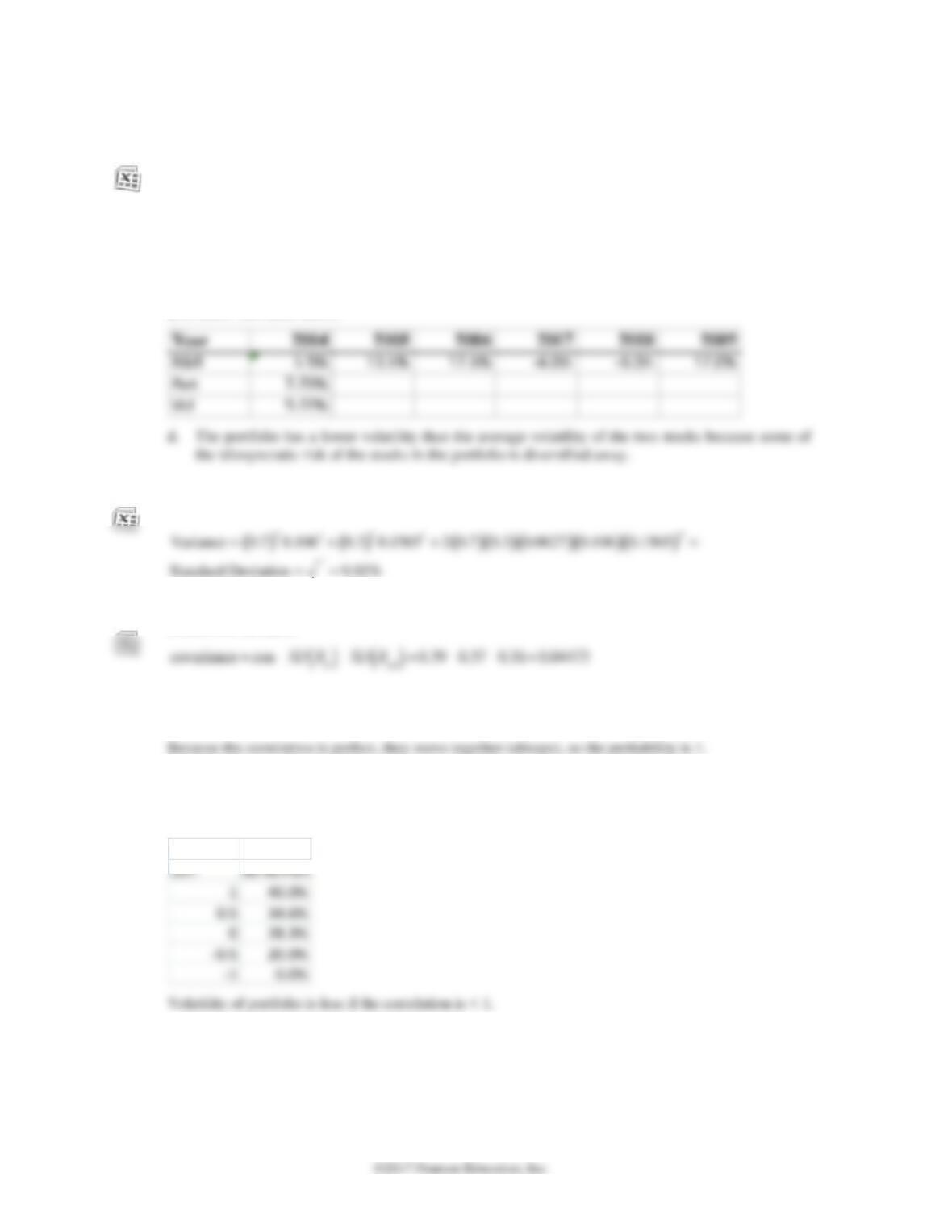
11–6. Use the data in Problem 5, consider a portfolio that maintains a 50% weight on stock A and a
50% weight on stock B.
a. What is the return each year of this portfolio?
b. Based on your results from part a, compute the average return and volatility of the portfolio.
c. Show that (i) the average return of the portfolio is equal to the average of the average
returns of the two stocks, and (ii) the volatility of the portfolio equals the same result as from
the calculation in Eq. 11.9.
d. Explain why the portfolio has a lower volatility than the average volatility of the two stocks.
a, b, and c. See table below.
11–7. Using your estimates from Problem 5, calculate the volatility (standard deviation) of a portfolio
that is 70% invested in stock A and 30% invested in stock B.
11–8. Using the data from Table 11.3, what is the covariance between the stocks of Alaska Air and
Southwest Airlines?
11–9. Suppose two stocks have a correlation of 1. If the first stock has an above average return this
year, what is the probability that the second stock will have an above average return?
11-10. Arbor Systems and Gencore stocks both have a volatility of 40%. Compute the volatility of a
portfolio with 50% invested in each stock if the correlation between the stocks is (a) + 1, (b) 0.50,
(c) 0, (d) −0.50, and (e) −1.0. In which cases is the volatility lower than that of the original stocks?
stock vol 40%
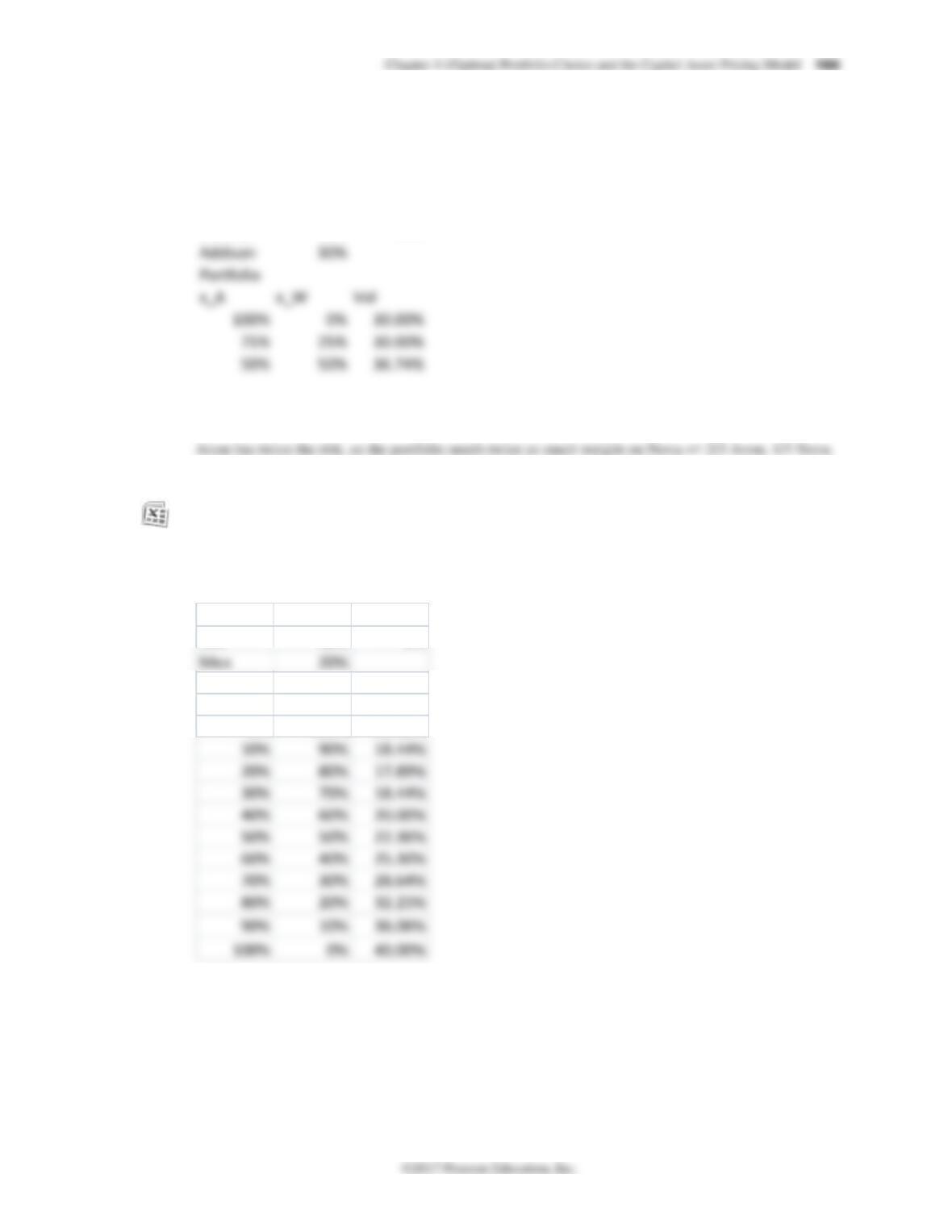
11-11. Suppose Wesley Publishing’s stock has a volatility of 60%, while Addison Printing’s stock has a
volatility of 30%. If the correlation between these stocks is 25%, what is the volatility of the
following portfolios of Addison and Wesley: (a) 100% Addison, (b) 75% Addison and 25%
Wesley, and (c) 50% Addison and 50% Wesley.
Vol Corr
Wesley 60% 25%
11-12. Suppose Avon and Nova stocks have volatilities of 50% and 25%, respectively, and they are
perfectly negatively correlated. What portfolio of these two stocks has zero risk?
11-13. Suppose Tex stock has a volatility of 40%, and Mex stock has a volatility of 20%. If Tex and Mex
are uncorrelated,
a. What portfolio of the two stocks has the same volatility as Mex alone?
b. What portfolio of the two stocks has the smallest possible volatility?
Vol Corr
Tex 40% 0%
Portfolio
x_tex x_mex Vol
0% 100% 20.00%
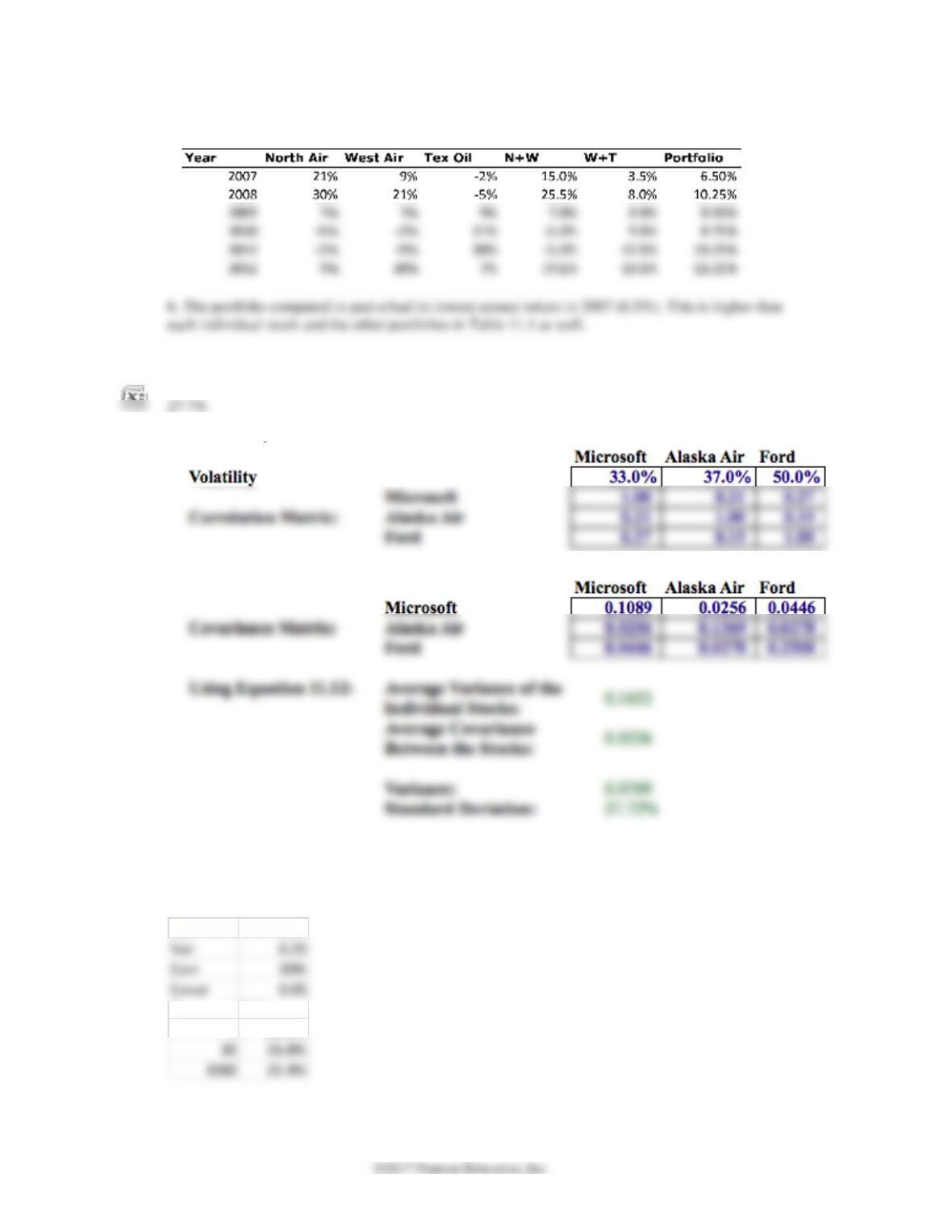
11–14. Using the data in Table 11.1,
a. Compute the annual returns for a portfolio with 25% invested in North Air, 25% invested in
West Air, and 50% invested in Tex Oil.
b. What is the lowest annual return for your portfolio in part a? How does it compare with the
lowest annual return of the individual stocks or portfolios in Table 11.1
166 Berk/DeMarzo, Corporate Finance, Fourth Edition
a.
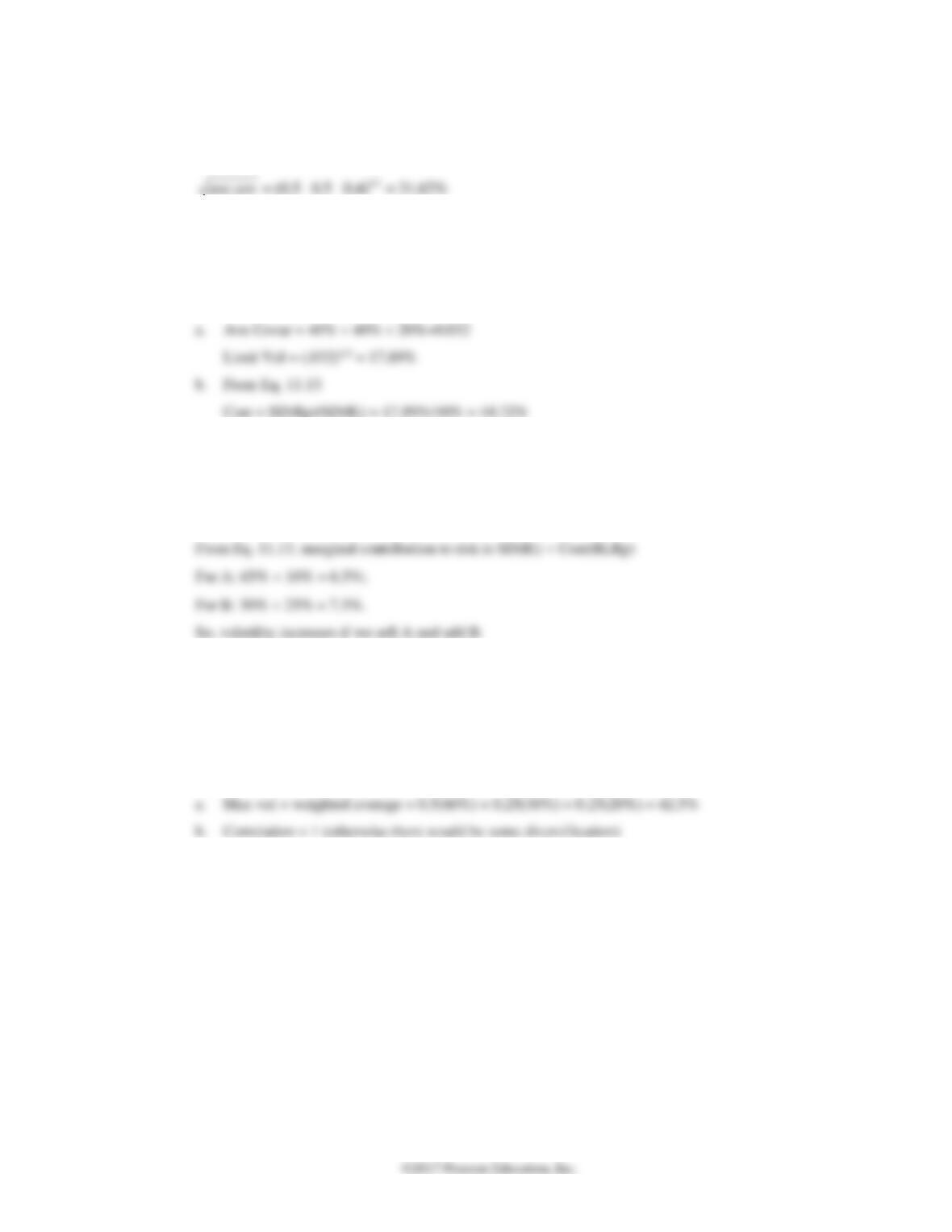
11–15. Using the data from Table 11.3, what is volatility of an equally weighted portfolio of Microsoft,
Alaska Air, and Ford Motor stock?
11–16. Suppose that the average stock has a volatility of 50%, and that the correlation between pairs of
stocks is 20%. Estimate the volatility of an equally weighted portfolio with (a) 1 stock, (b) 30
stocks, (c) 1000 stocks.
Vol 50%
N Vol
1 50.0%
Chapter 11/Optimal Portfolio Choice and the Capital Asset Pricing Model 167
11–17. What is the volatility (standard deviation) of an equally weighted portfolio of stocks within an
industry in which the stocks have a volatility of 50% and a correlation of 40% as the portfolio
becomes arbitrarily large?
11–18. Consider an equally weighted portfolio of stocks in which each stock has a volatility of 40%, and
the correlation between each pair of stocks is 20%.
a. What is the volatility of the portfolio as the number of stocks becomes arbitrarily large?
b. What is the average correlation of each stock with this large portfolio?
11–19. Stock A has a volatility of 65% and a correlation of 10% with your current portfolio. Stock B
has a volatility of 30% and a correlation of 25% with your current portfolio. You currently hold
both stocks. Which will increase the volatility of your portfolio: (i) selling a small amount of
stock B and investing the proceeds in stock A, or (ii) selling a small amount of stock A and
investing the proceeds in stock B?
11–20. You currently hold a portfolio of three stocks, Delta, Gamma, and Omega. Delta has a volatility
of 60%, Gamma has a volatility of 30%, and Omega has a volatility of 20%. Suppose you invest
50% of your money in Delta, and 25% each in Gamma and Omega.
a. What is the highest possible volatility of your portfolio?
b. If your portfolio has the volatility in (a), what can you conclude about the correlation
between Delta and Omega?
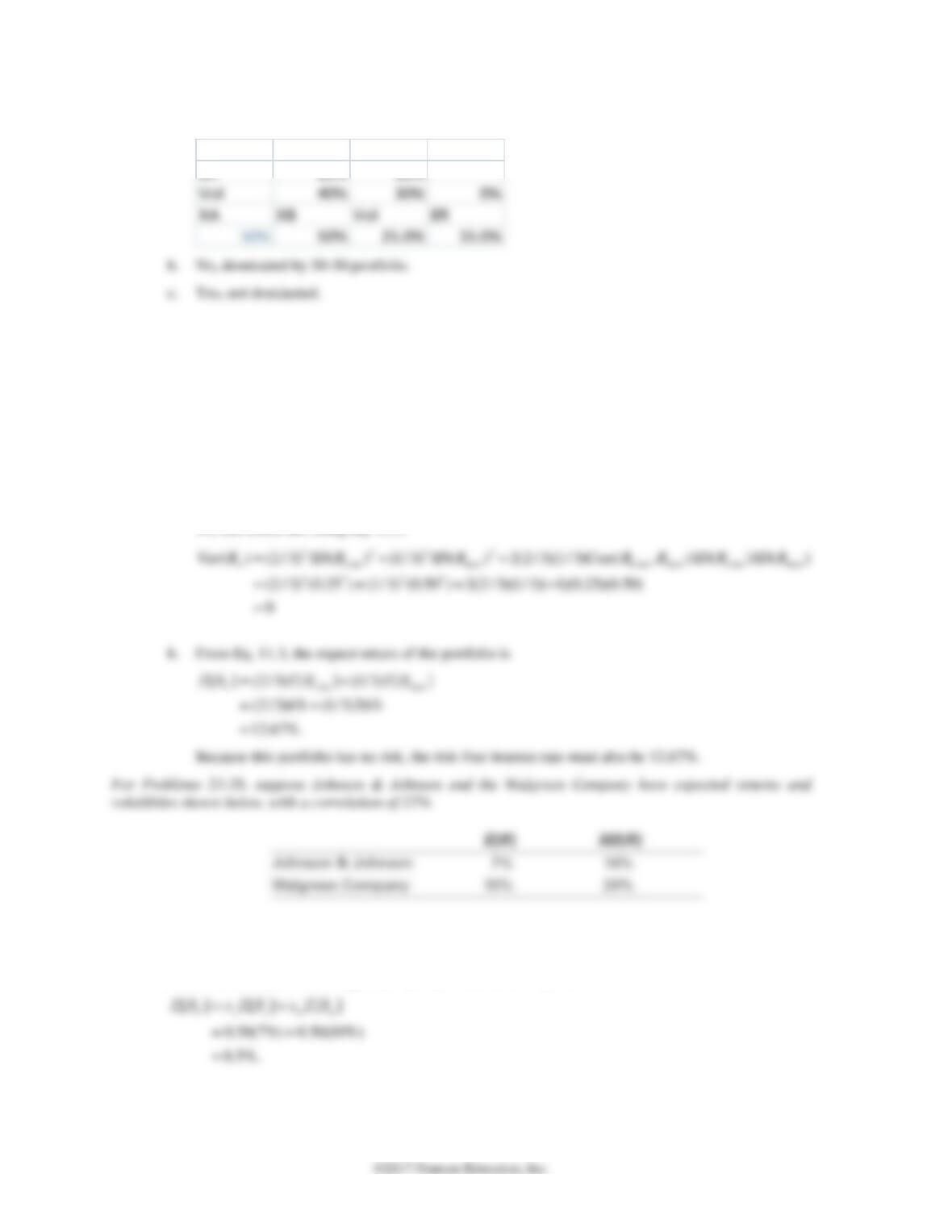
11–21. Suppose Ford Motor stock has an expected return of 20% and a volatility of 40%, and Molson
Coors Brewing has an expected return of 10% and a volatility of 30%. If the two stocks are
uncorrelated,
a. What is the expected return and volatility of an equally weighted portfolio of the two stocks?
b. Given your answer to (a), is investing all of your money in Molson Coors stock an efficient
portfolio of these two stocks?
c. Is investing all of your money in Ford Motor an efficient portfolio of these two stocks?
168 Berk/DeMarzo, Corporate Finance, Fourth Edition
a.
A B Corr
ER 20% 10%
11–22. Suppose Intel’s stock has an expected return of 26% and a volatility of 50%, while Coca-Cola’s
has an expected return of 6% and volatility of 25%. If these two stocks were perfectly negatively
correlated (i.e., their correlation coefficient is −1),
a. Calculate the portfolio weights that remove all risk.
b. If there are no arbitrage opportunities, what is the risk-free rate of interest in this economy?
a. If the two stocks are perfectly correlated negatively, they fluctuate due to the same risks, but in
opposite directions. Because Intel is twice as volatile as Coke, we will need to hold twice as much
Coke stock as Intel in order to offset Intel’s risk. That is, our portfolio should be 2/3 Coke and 1/3
Intel.
We can check this using Eq. 11.9.
11–23. Calculate (a) the expected return and (b) the volatility (standard deviation) of a portfolio that is
equally invested in Johnson & Johnson’s and Walgreen’s stock.
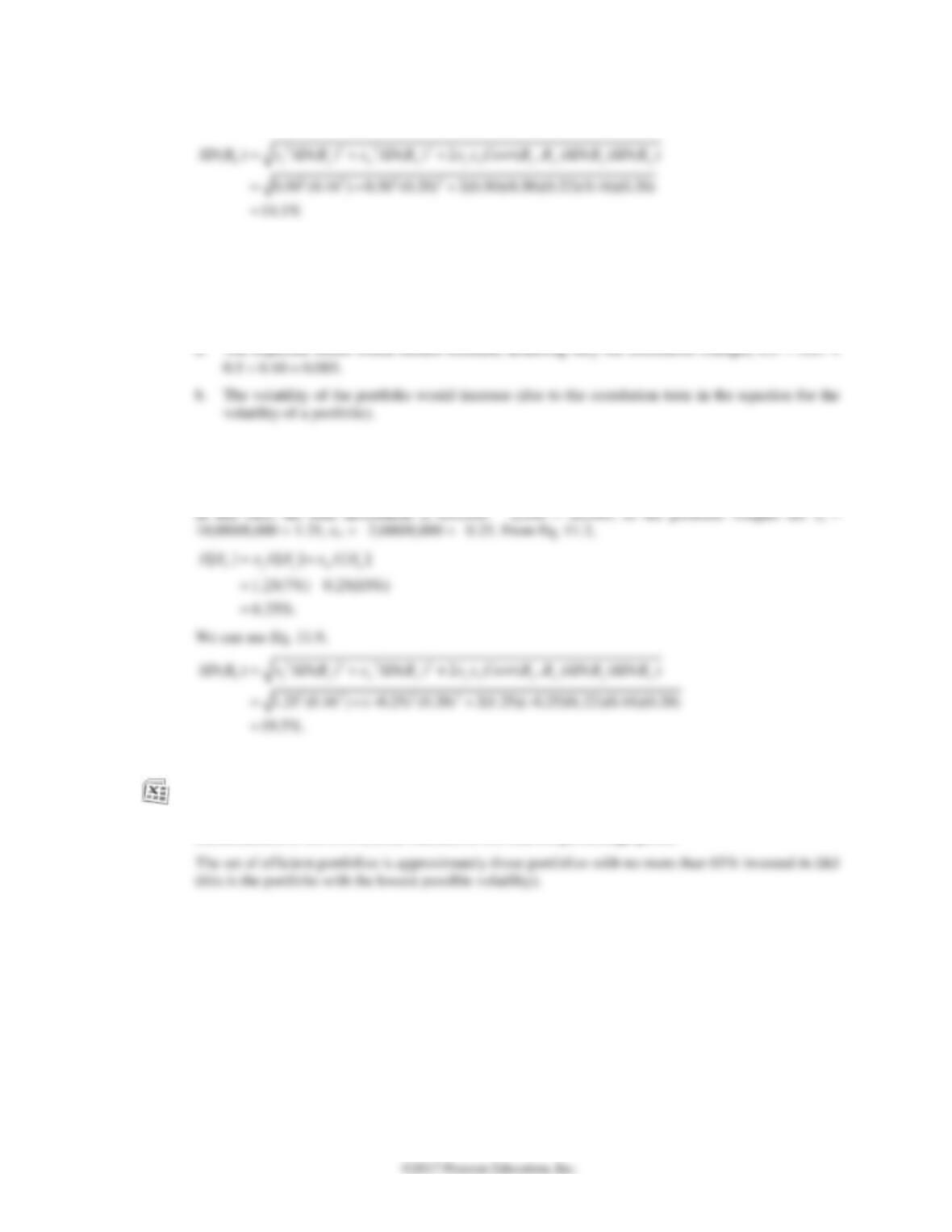
In this case, the portfolio weights are xj = xw = 0.50. From Eq. 11.3,
Chapter 11/Optimal Portfolio Choice and the Capital Asset Pricing Model 169
We can use Eq. 11.9.
11–24. For the portfolio in Problem 23, if the correlation between Johnson & Johnson’s and Walgreen’s
stock were to increase,
a. Would the expected return of the portfolio rise or fall?
b. Would the volatility of the portfolio rise or fall?
11–25. Calculate (a) the expected return and (b) the volatility (standard deviation) of a portfolio that
consists of a long position of $10,000 in Johnson & Johnson and a short position of $2000 in
Walgreen’s.
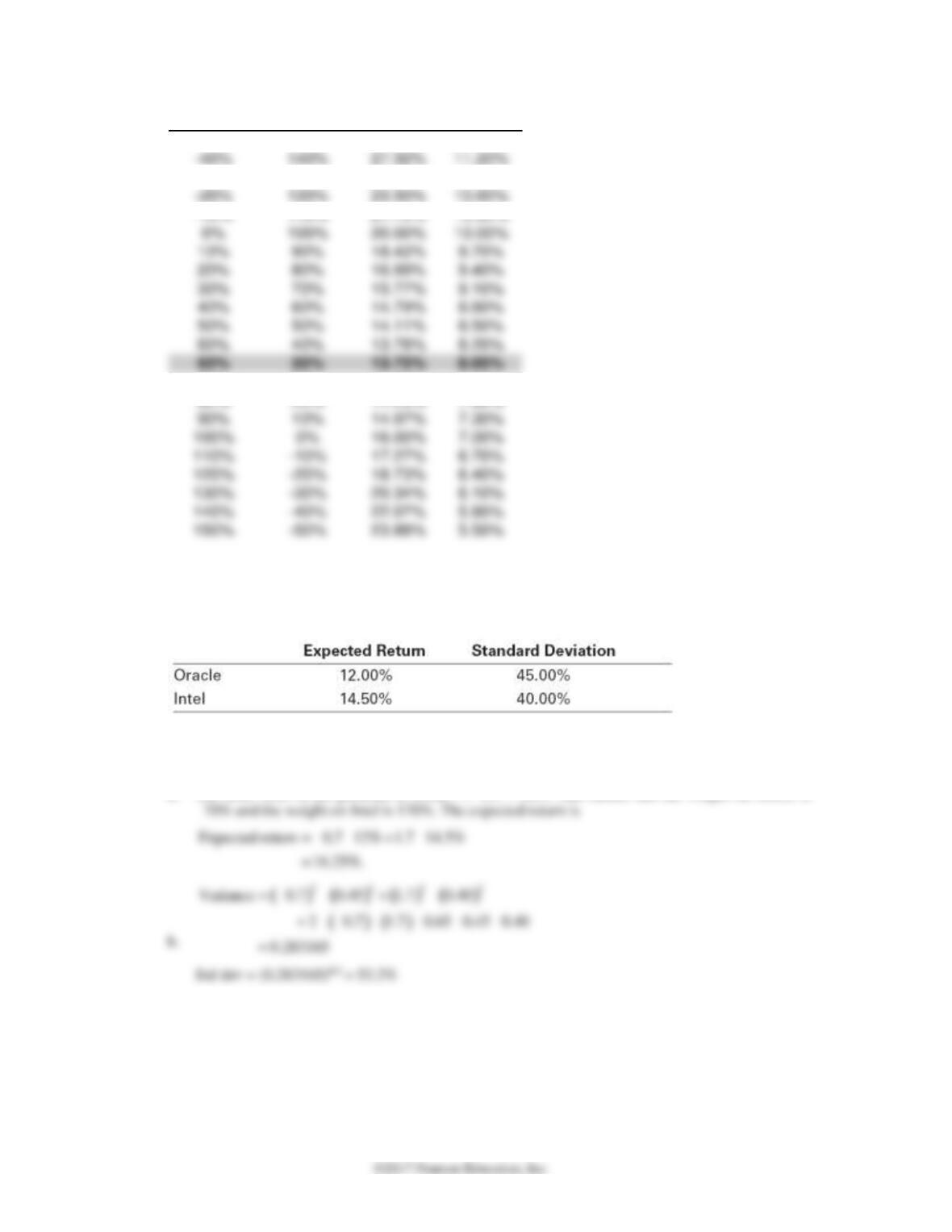
11-26. Using the same data as for Problem 23, calculate the expected return and the volatility (standard
deviation) of a portfolio consisting of Johnson & Johnson’s and Walgreen’s stocks using a wide
range of portfolio weights. Plot the expected return as a function of the portfolio volatility. Using
your graph, identify the range of Johnson & Johnson’s portfolio weights that yield efficient
combinations of the two stocks, rounded to the nearest percentage point.
170 Berk/DeMarzo, Corporate Finance, Fourth Edition
x(J&J) x(Walgreen) SD ER
-50% 150% 29.30% 11.50%
-30% 130% 25.38% 10.90%
70% 30% 13.82% 7.90%
11–27. A hedge fund has created a portfolio using just two stocks. It has shorted $35,000,000 worth of
Oracle stock and has purchased $85,000,000 of Intel stock. The correlation between Oracle’s and
Intel’s returns is 0.65. The expected returns and standard deviations of the two stocks are given
in the table below:
a. What is the expected return of the hedge fund’s portfolio?
b. What is the standard deviation of the hedge fund’s portfolio?
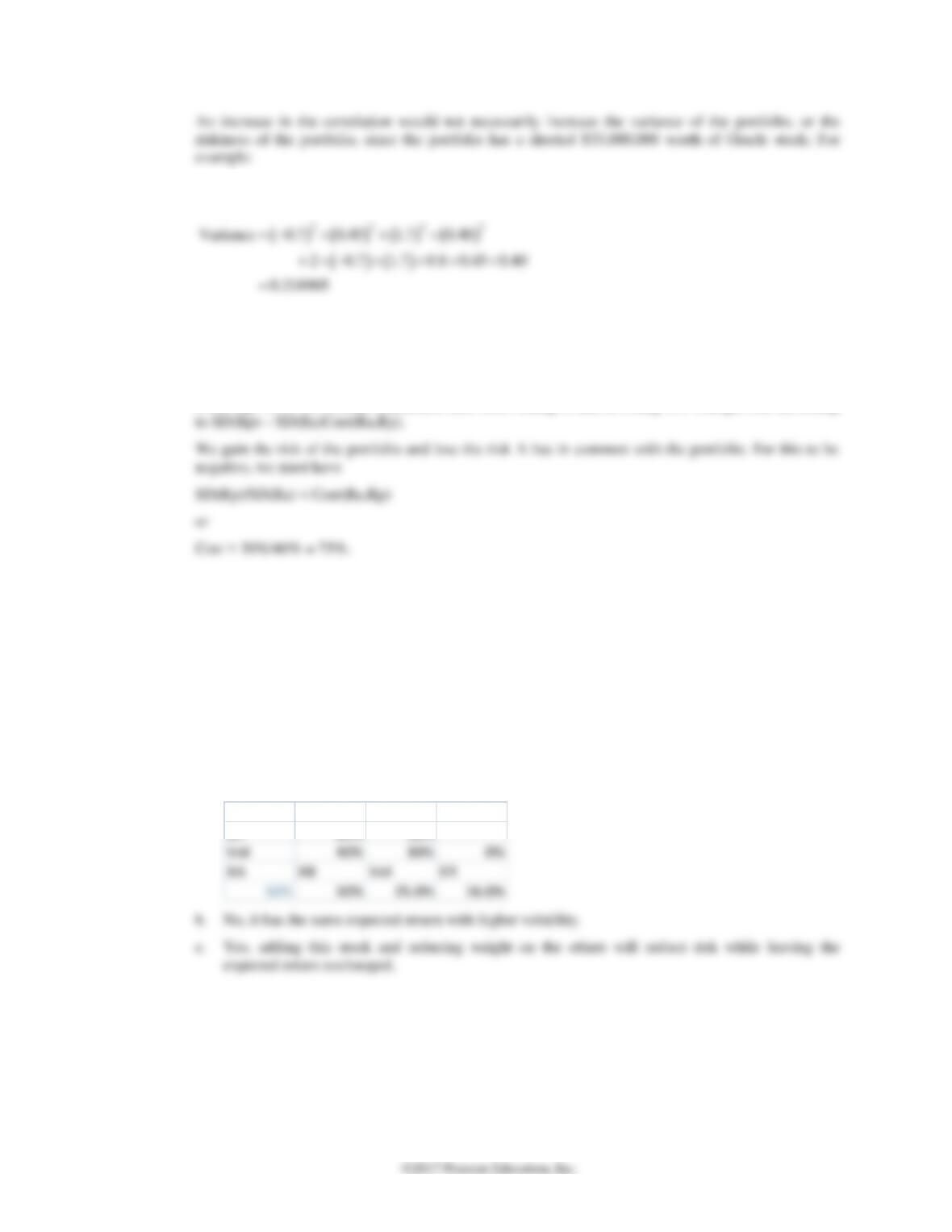
a. The total value of the portfolio is $50m = (–$35 + $85). This means that the weight on Oracle is
11–28. Consider the portfolio in Problem 27. Suppose the correlation between Intel and Oracle’s stock
increases, but nothing else changes. Would the portfolio be more or less risky with this change?
Chapter 11/Optimal Portfolio Choice and the Capital Asset Pricing Model 171
If the correlation increased to 0.8, for example, the variance is
11–29. Fred holds a portfolio with a 30% volatility. He decides to short sell a small amount of stock with
a 40% volatility and use the proceeds to invest more in his portfolio. If this transaction reduces
the risk of his portfolio, what is the minimum possible correlation between the stock he shorted
and his original portfolio?
From Eq. 11.13, for a small transaction size, short selling A and investing in P changes risk according
11–30. Suppose Target’s stock has an expected return of 20% and a volatility of 40%, Hershey’s stock
has an expected return of 12% and a volatility of 30%, and these two stocks are uncorrelated.
a. What is the expected return and volatility of an equally weighted portfolio of the two stocks?
Consider a new stock with an expected return of 16% and a volatility of 30%. Suppose this new
stock is uncorrelated with Target’s and Hershey’s stock.
b. Is holding this stock alone attractive compared to holding the portfolio in (a)?
c. Can you improve upon your portfolio in (a) by adding this new stock to your portfolio?
Explain.
a.
A B Corr
ER 20% 12%
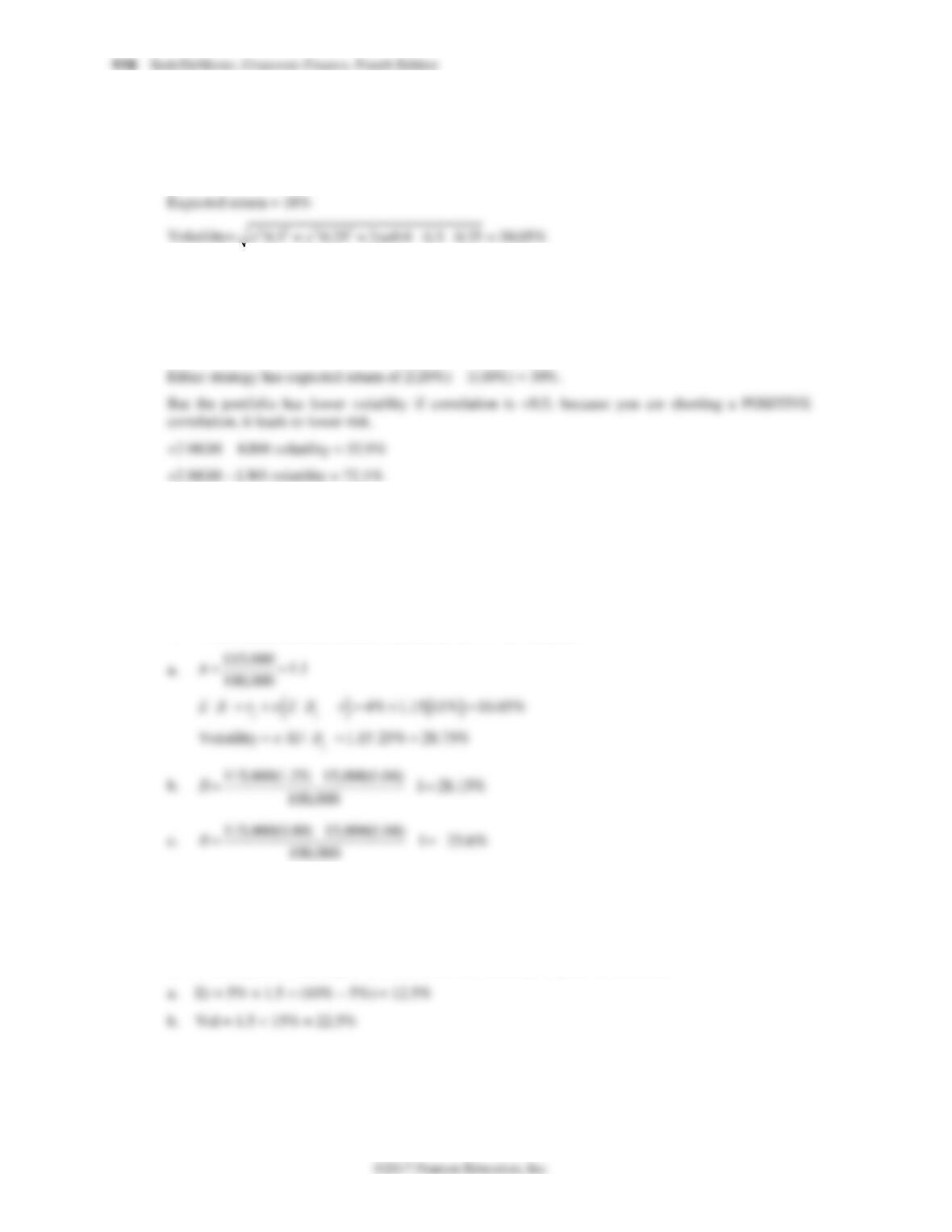
11–31. You have $10,000 to invest. You decide to invest $20,000 in Google and short sell $10,000 worth
of Yahoo! Google’s expected return is 15% with a volatility of 30% and Yahoo!’s expected
return is 12% with a volatility of 25%. The stocks have a correlation of 0.9. What is the expected
return and volatility of the portfolio?
11–32. You expect HGH stock to have a 20% return next year and a 30% volatility. You have $25,000 to
invest, but plan to invest a total of $50,000 in HGH, raising the additional $25,000 by shorting
either KBH or LWI stock. Both KBH and LWI have an expected return of 10% and a volatility
of 20%. If KBH has a correlation of +0.5 with HGH, and LWI has a correlation of −0.50 with
HGH, which stock should you short?
11–33. Suppose you have $100,000 in cash, and you decide to borrow another $15,000 at a 4% interest
rate to invest in the stock market. You invest the entire $115,000 in a portfolio J with a 15%
expected return and a 25% volatility.
a. What is the expected return and volatility (standard deviation) of your investment?
b. What is your realized return if J goes up 25% over the year?
c. What return do you realize if J falls by 20% over the year?
11–34. You have $100,000 to invest. You choose to put $150,000 into the market by borrowing $50,000.
a. If the risk-free interest rate is 5% and the market expected return is 10%, what is the
expected return of your investment?
b. If the market volatility is 15%, what is the volatility of your investment?
11–35. You currently have $100,000 invested in a portfolio that has an expected return of 12% and a
volatility of 8%. Suppose the risk-free rate is 5%, and there is another portfolio that has an
expected return of 20% and a volatility of 12%.
a. What portfolio has a higher expected return than your portfolio but with the same
volatility?
b. What portfolio has a lower volatility than your portfolio but with the same expected return?
Invest an amount x in the other portfolio and the expected return and volatility are
E[Rx]=rf+x(E[RO]–rf)=5% +x(20% –5%)
SD(Rx)=x SD(RO)=x(12%).
11–36. Assume the risk-free rate is 4%. You are a financial advisor, and must choose one of the funds
below to recommend to each of your clients. Whichever fund you recommend, your clients will
then combine it with risk-free borrowing and lending depending on their desired level of risk.
Which fund would you recommend without knowing your client’s risk preference?
11–37. Assume all investors want to hold a portfolio that, for a given level of volatility, has the
maximum possible expected return. Explain why, when a risk-free asset exists, all investors will
choose to hold the same portfolio of risky stocks.
11–38. In addition to risk-free securities, you are currently invested in the Tanglewood Fund, a broad–
based fund of stocks and other securities with an expected return of 12% and a volatility of 25%.
Currently, the risk-free rate of interest is 4%. Your broker suggests that you add a venture
capital fund to your current portfolio. The venture capital fund has an expected return of 20%, a
volatility of 80%, and a correlation of 0.2 with the Tanglewood Fund. Calculate the required
return and use it to decide whether you should add the venture capital fund to your portfolio.
11–39. You have noticed a market investment opportunity that, given your current portfolio, has an
expected return that exceeds your required return. What can you conclude about your current
portfolio?
11–40. The Optima Mutual Fund has an expected return of 20% and a volatility of 20%. Optima claims
that no other portfolio offers a higher Sharpe ratio. Suppose this claim is true, and the risk-free
interest rate is 5%.
a. What is Optima’s Sharpe Ratio?
b. If eBay’s stock has a volatility of 40% and an expected return of 11%, what must be its
correlation with the Optima Fund?
c. If the SubOptima Fund has a correlation of 80% with the Optima Fund what is the Sharpe
ratio of the SubOptima Fund?
11–41. You are currently only invested in the Natasha Fund (aside from risk-free securities). It has an
expected return of 14% with a volatility of 20%. Currently, the risk-free rate of interest is 3.8%.
Your broker suggests that you add Hannah Corporation to your portfolio. Hannah Corporation
has an expected return of 20%, a volatility of 60%, and a correlation of 0 with the Natasha Fund.
a. Is your broker right?
b. You follow your broker’s advice and make a substantial investment in Hannah stock so that,
considering only your risky investments, 60% is in the Natasha Fund and 40% is in Hannah
stock. When you tell your finance professor about your investment, he says that you made a
mistake and should reduce your investment in Hannah. Is your finance professor right?
c. You decide to follow your finance professor’s advice and reduce your exposure to Hannah.
Now Hannah represents 15% of your risky portfolio, with the rest in the Natasha fund. Is
this the correct amount of Hannah stock to hold?
Initial Portfolio
60-40 Portfolio
85-15 Portfolio
Natasha Fund
Expected Return
0.14
0.14
0.14
Expected Return
0.2
0.2
0.2
Volatility
0.6
0.6
0.6
Risk-Free Rate
0.038
0.038
0.038
Portfolio weight in Hannah
0
0.4
0.15
Expected Return of Portfolio
0.14
0.164
0.149
Volatility of Portfolio
0.2
11–42. Calculate the Sharpe ratio of each of the three portfolios in Problem 39. What portfolio weight in
Hannah stock maximizes the Sharpe ratio?
Initial Portfolio
60-40 Portfolio
85-15 Portfolio
Natasha Fund
Expected Return
0.14
0.14
0.14
Hannah Stock
Expected Return
0.2
0.2
0.2
0.6
0.6
0.6
Risk-Free Rate
0.038
0.038
0.038
Portfolio weight in Hannah
0
0.4
0.15
Expected Return of Portfolio
0.14
0.164
0.149
Volatility of Portfolio
0.2
Sharpe Ratio
0.51
0.09002
The Sharpe Ratio is maximized at 15% in Hannah Stock.
11–43. Returning to Problem 38, assume you follow your broker’s advice and put 50% of your money in
the venture fund.
a. What is the Sharpe ratio of the Tanglewood Fund?
b. What is the Sharpe ratio of your new portfolio?
c. What is the optimal fraction of your wealth to invest in the venture fund? (Hint:Use Excel
Initial Portfolio
50-50 Split
Tanglewood Fund
Expected Return
0.12
0.12
Volatility
0.25
0.25
0.25
Venture Fund
Expected Return
0.2
0.2
0.8
0.8
Risk-Free Rate
0.04
0.04
Portfolio weight in Hannah
0
0.5
Expected Return of Portfolio
0.12
0.16
Volatility of Portfolio
0.25
0.25
Sharpe Ratio
0.32
0.0656
176 Berk/DeMarzo, Corporate Finance, Fourth Edition
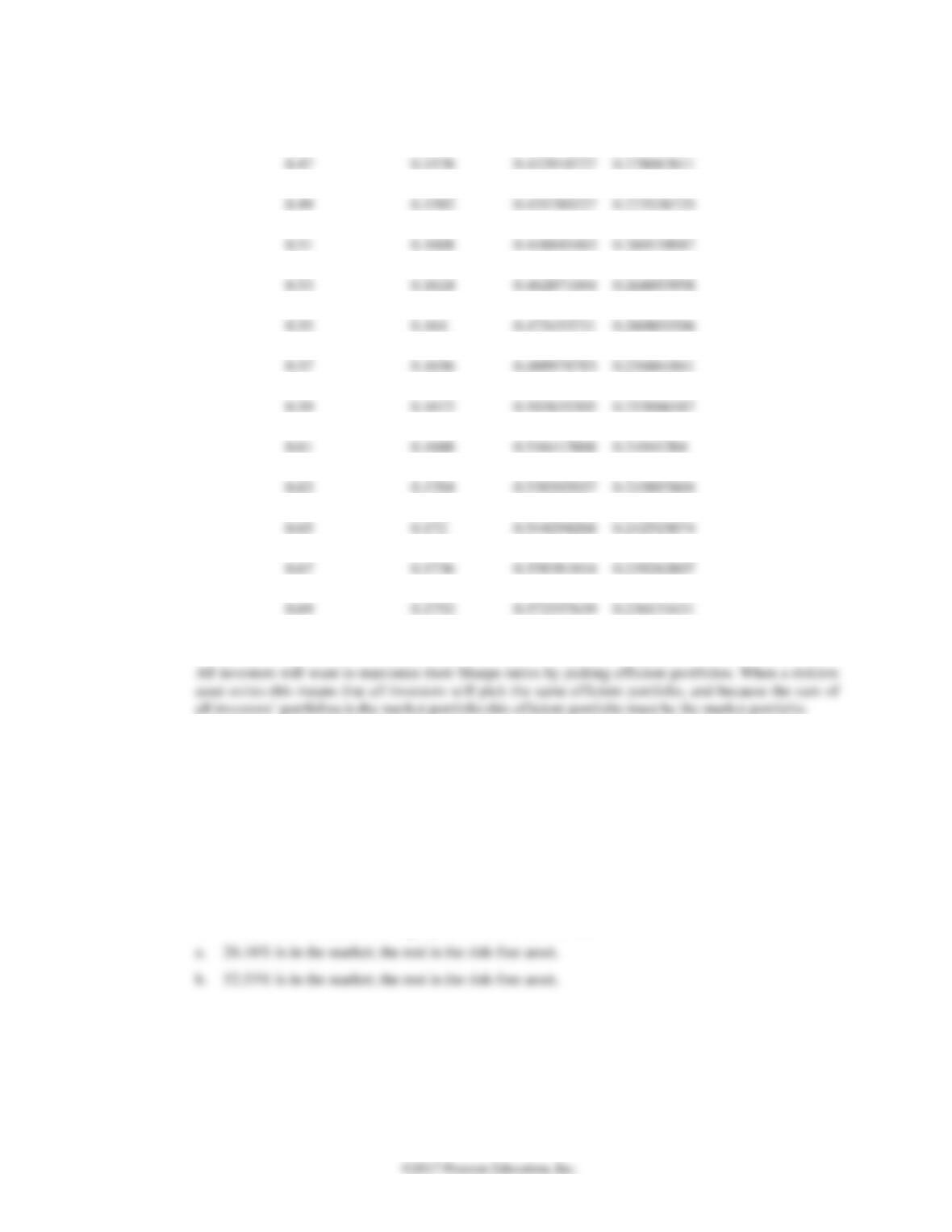
The Sharpe Ratio is maximized at 12% in the venture fund.
Weight in venture fund
Expected Return
Volatility
Sharpe Ratio
0
0.12
0.25
0.32
Part a
0.01
0.1208
0.249223293
0.324207256
0.02
0.1216
0.248694592
0.328113287
0.03
0.1224
0.248415479
0.331702358
0.04
0.1232
0.248386795
0.334961446
0.05
0.124
0.248608628
0.337880469
0.06
0.1248
0.249080308
0.340452445
0.07
0.1256
0.24980042
0.342673563
0.08
0.1264
0.250766824
0.344543184
0.09
0.1272
0.251976685
0.346063763
0.11
0.1288
0.25511223
0.348082097
0.12
0.1296
0.257029181
0.34859855
0.13
0.1304
0.25917224
0.348802788
Part c
0.14
0.1312
0.261535848
0.348709366
0.15
0.132
0.264114085
0.348334319
0.16
0.1328
0.266900731
0.347694814
0.17
0.1336
0.269889329
0.346808821
0.18
0.1344
0.27307325
0.34569479
0.19
0.1352
0.276445745
0.34437137
0.2
0.136
0.28
0.342857143
0.21
0.1368
0.283729184
0.341170403
0.22
0.1376
0.287626494
0.339328963
0.23
0.1384
0.29168519
0.337350004
0.24
0.1392
0.295898631
0.335249945
0.25
0.14
0.300260304
0.333044358
0.26
0.1408
0.304763843
0.330747896
0.27
0.1416
0.309403054
0.328374263
0.28
0.1424
0.314171927
0.325936187
0.29
0.1432
0.319064649
0.323445422
0.3
0.144
0.324075608
0.31
0.1448
0.329199408
0.318348082
0.32
0.1456
0.33443086
0.315760334
0.33
0.1464
0.339764992
0.313157631
0.34
0.1472
0.345197045
0.31054727
0.35
0.148
0.350722469
0.307935789
0.36
0.1488
0.356336919
0.305329013
0.37
0.1496
0.362036255
0.302732112
0.38
0.1504
0.36781653
0.300149642
0.39
0.1512
0.373673989
0.297585605
0.4
0.152
0.379605058
0.295043487
0.41
0.1528
0.385606341
0.29252631
0.42
0.1536
0.39167461
0.290036671
0.43
0.1544
0.3978068
0.287576784
0.44
0.1552
0.404
0.285148515
0.45
0.156
0.410251447
0.282753421
Chapter 11/Optimal Portfolio Choice and the Capital Asset Pricing Model 177
Weight in venture fund
Expected Return
Volatility
Sharpe Ratio
0.46
0.1568
0.416558519
0.280392777
0.47
0.1576
0.422918727
0.278067611
0.48
0.1584
0.42932971
0.275778725
0.49
0.1592
0.435789227
0.273526725
0.5
0.16
0.44229515
0.271312041
Part b
0.51
0.1608
0.448845463
0.269134947
0.52
0.1616
0.45543825
0.26699558
0.53
0.1624
0.462071694
0.264893958
0.54
0.1632
0.468744067
0.262829994
0.55
0.164
0.475453731
0.260803506
0.56
0.1648
0.482199129
0.258814238
0.57
0.1656
0.488978783
0.256861861
0.58
0.1664
0.495791287
0.254945989
0.59
0.1672
0.502635305
0.253066187
0.6
0.168
0.509509568
0.251221975
0.61
0.1688
0.516412868
0.24941284
0.62
0.1696
0.523344055
0.247638239
0.63
0.1704
0.530302037
0.245897604
0.64
0.1712
0.537285771
0.244190349
0.65
0.172
0.544294268
0.242515874
0.66
0.1728
0.551326582
0.240873566
0.67
0.1736
0.558381814
0.239262807
0.68
0.1744
0.565459106
0.237682971
0.69
0.1752
0.572557639
0.236133431
11–44. When the CAPM correctly prices risk, the market portfolio is an efficient portfolio. Explain why.
11–45. A big pharmaceutical company, DRIg, has just announced a potential cure for cancer. The stock
price increased from $5 to $100 in one day. A friend calls to tell you that he owns DRIg. You
proudly reply that you do too. Since you have been friends for some time, you know that he holds
the market, as do you, and so you both are invested in this stock. Both of you care only about
expected return and volatility. The risk-free rate is 3%, quoted as an APR based on a 365-day
year. DRIg made up 0.2% of the market portfolio before the news announcement.
a. On the announcement, your overall wealth went up by 1% (assume all other price changes
canceled out so that without DRIg, the market return would have been zero). How is your
wealth invested?
b. Your friend’s wealth went up by 2%. How is he invested?
11–46. Your investment portfolio consists of $15,000 invested in only one stock—Microsoft. Suppose the
risk-free rate is 5%, Microsoft stock has an expected return of 12% and a volatility of 40%, and
the market portfolio has an expected return of 10% and a volatility of 18%. Under the CAPM
assumptions,
a. What alternative investment has the lowest possible volatility while having the same
expected return as Microsoft? What is the volatility of this investment?
b. What investment has the highest possible expected return while having the same volatility as
Microsoft? What is the expected return of this investment?
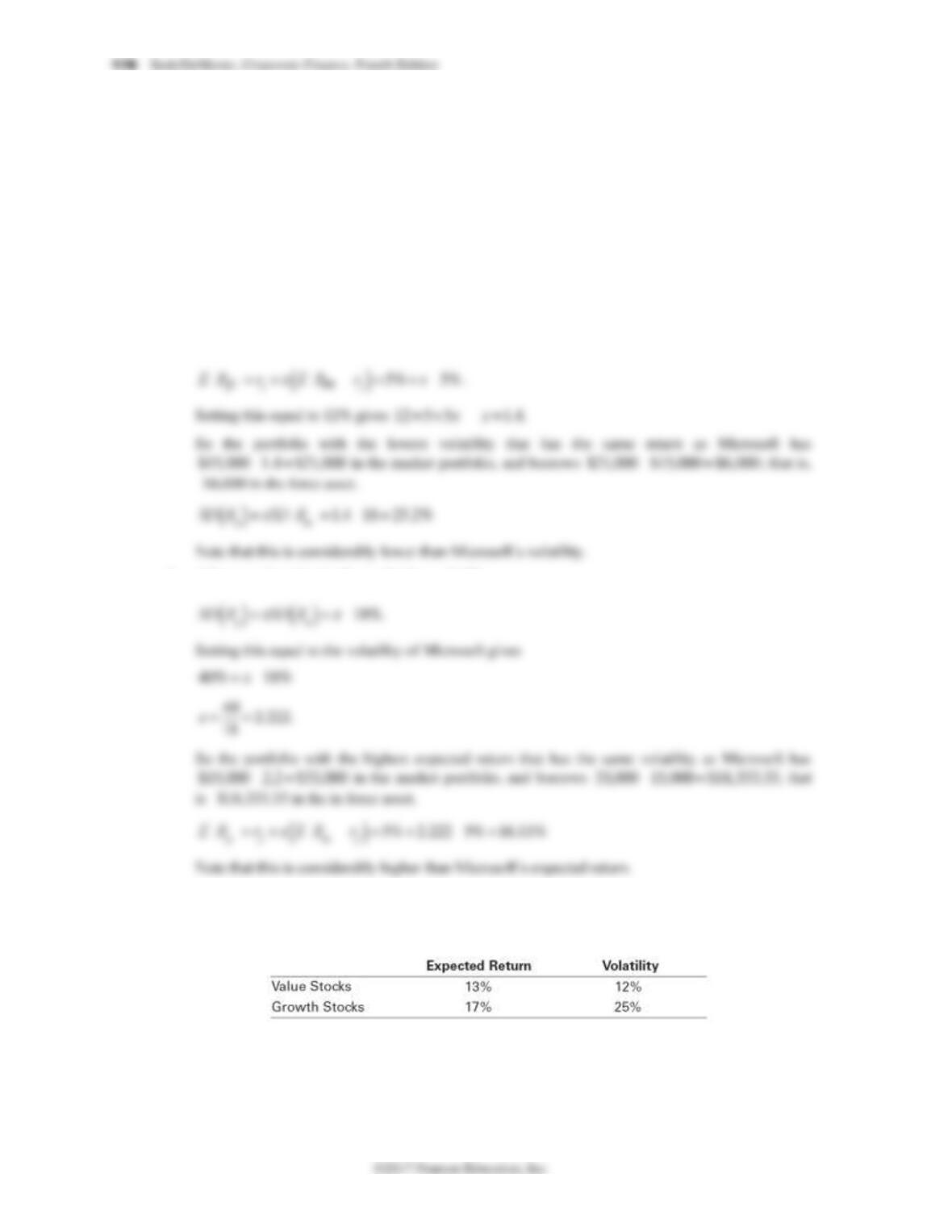
a. Under the CAPM assumptions, the market is efficient; that is, a leveraged position in the market
has the highest expected return of any portfolio for a given volatility and the lowest volatility for a
given expected return. By holding a leveraged position in the market portfolio, you can achieve an
expected return of
b. A leveraged portion in the market has volatility
h
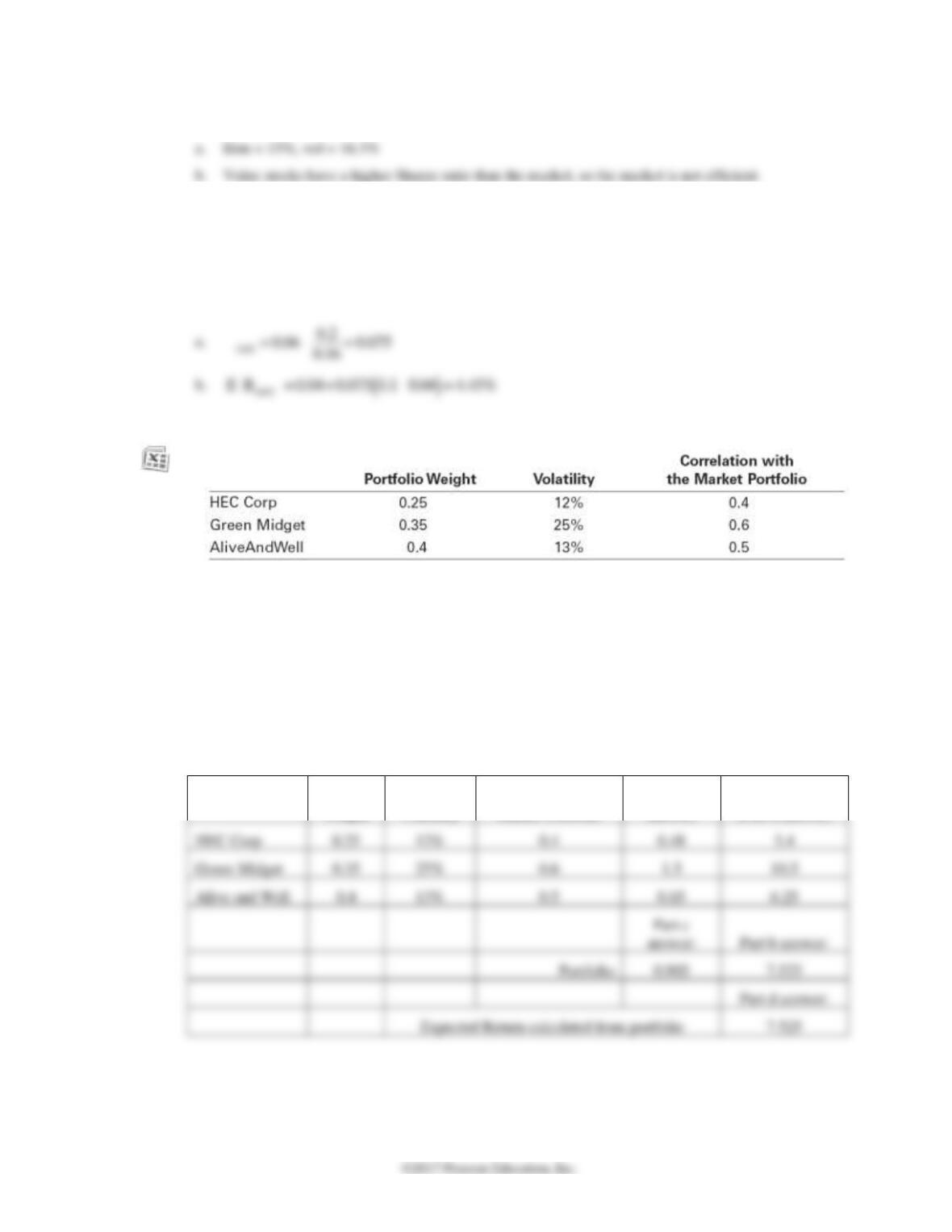
11–47. Suppose you group all the stocks in the world into two mutually exclusive portfolios (each stock
is in only one portfolio): growth stocks and value stocks. Suppose the two portfolios have equal
size (in terms of total value), a correlation of 0.5, and the following characteristics:
The risk-free rate is 2%.
a. What is the expected return and volatility of the market portfolio (which is a 50–50
combination of the two portfolios)?
Chapter 11/Optimal Portfolio Choice and the Capital Asset Pricing Model 179
b. Does the CAPM hold in this economy? (Hint: Is the market portfolio efficient?)
11–48. Suppose the risk-free return is 4% and the market portfolio has an expected return of 10% and
a volatility of 16%. Merck & Co. (Ticker: MRK) stock has a 20% volatility and a correlation
with the market of 0.06.
a. What is Merck’s beta with respect to the market?
b. Under the CAPM assumptions, what is its expected return?
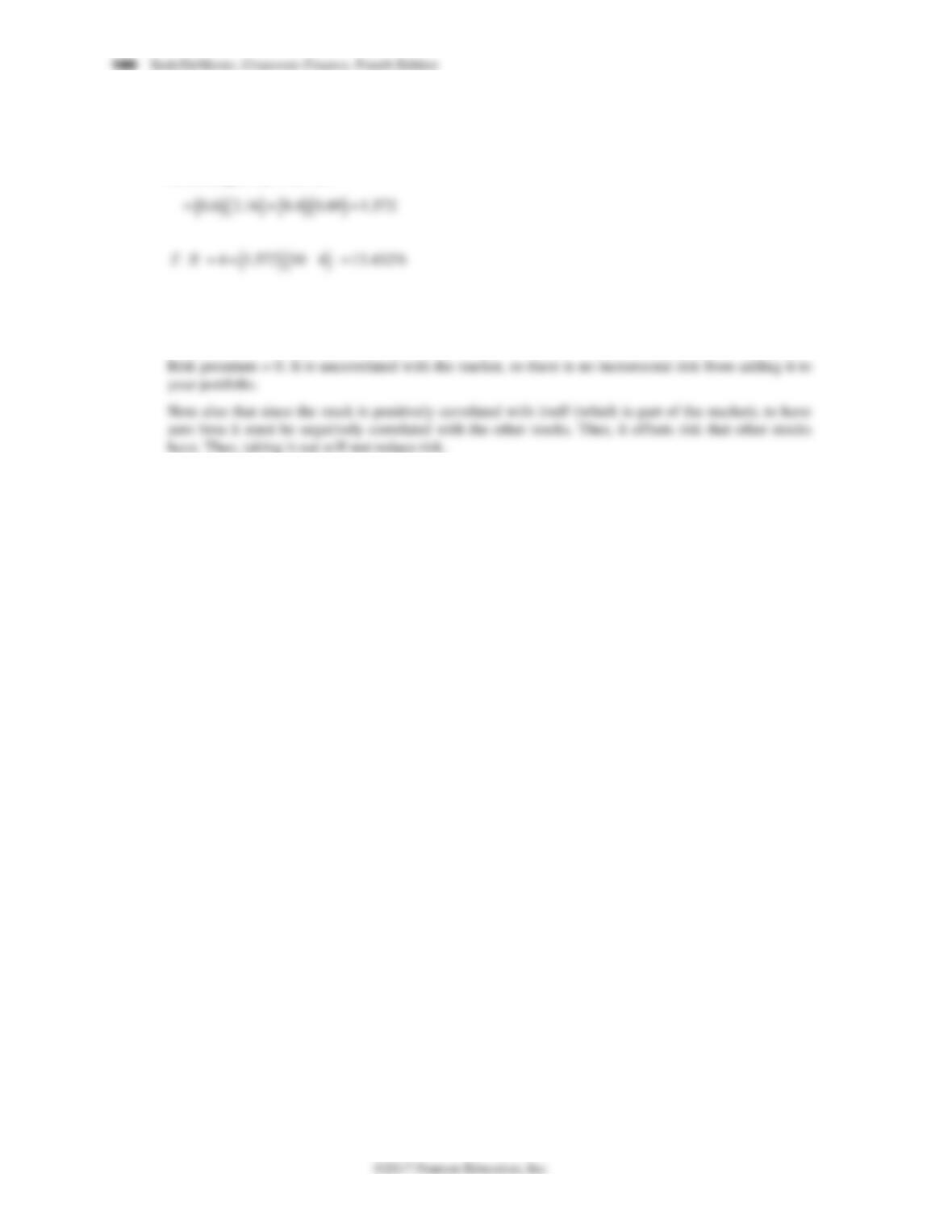
11–49. Consider a portfolio consisting of the following three stocks:
The volatility of the market portfolio is 10% and it has an expected return of 8%. The risk-free
rate is 3%.
a. Compute the beta and expected return of each stock.
b. Using your answer from part a, calculate the expected return of the portfolio.
c. What is the beta of the portfolio?
d. Using your answer from part c, calculate the expected return of the portfolio and verify that
it matches your answer to part b.
Portfolio
Weight
Volatility
Correlation with the
Market Portfolio
Beta (Part a
answer)
Expected Return
(Part a answer)
11–50. Suppose Autodesk stock has a beta of 2.16, whereas Costco stock has a beta of 0.69. If the risk–
free interest rate is 4% and the expected return of the market portfolio is 10%, what is the
expected return of a portfolio that consists of 60% Autodesk stock and 40% Costco stock,
according to the CAPM?
11–51. What is the risk premium of a zero-beta stock? Does this mean you can lower the volatility of a
portfolio without changing the expected return by substituting out any zero-beta stock in a
portfolio and replacing it with the risk-free asset?